REVIEW 4 major objections 4 minor 3 references
Auditing the Ethical Logic of Generative AI Models
T0 review · 4 major / 4 minor · reviewed 2026-08-16 · deepseek-v4-flash
Pith's one-line read A five-dimension audit measures LLM ethical logic, and chain-of-thought prompting raises the scores.
desk verdict Fresh dilemmas and a clear audit rubric, but the headline CoT improvement is an artifact of verbosity and self-rating. read the letter →
The pith
A machine-rendered reading of the paper's core claim, the machinery that carries it, and where it could break.
The reading
What carries the argument
The central object is the five-dimension Audit Model, a rubric that operationalizes 'quality of ethical logic' as Analytic Quality, Breadth of Ethical Considerations, Depth of Explanation, Consistency, and Decisiveness. The mechanism is self-audit: an LLM (here GPT-4o) is given the rubric and asked to score its own and other models' responses on 0-100 scales; the paper treats these scores as the measurement device. The design also uses Battery III, six freshly written dilemmas, to force de novo analysis rather than recall of widely discussed scenarios, and chain-of-thought prompts are the intervention that raises measured scores.
What would settle it
Run the audit a second time with every model response abbreviated into a concise, same-content summary; if the concise versions score near the originals, the audit survives, but if scores collapse with length, the measured 'ethical logic quality' is in large part verbosity.
Extended reading notes
Core claim
The central claim is that ethical logic in LLMs is measurable on five independent dimensions, and that this measurement supports comparative, time-bound benchmarking even when no ethical ground truth exists. The paper demonstrates the method by having GPT-4o audit its own and six other models' responses across three prompt batteries, including six newly written dilemmas intended to be absent from training data. It finds a stable ranking—GPT-4o and Claude 3.5 at the top, DeepSeek R1 at the bottom—and reports that reasoning-tuned versions of the same foundation models (GPT-4o vs GPT-4, o1/DeepResearch vs GPT-4) receive substantially higher audit scores, while a DeepSeek V3-to-R1 comparison shows no significant difference. The authors also report convergence: models choose similar options in the dilemmas, and all emphasize the moral foundations of care and fairness over loyalty, authority, and purity.
Load-bearing premise
The rankings depend on GPT-4o's 0-100 scores reflecting the quality of ethical reasoning itself, rather than rewarding answers that are longer and more elaborately worded.
Editorial extensions
If this is right
- If the audit is valid, benchmarkers can compare the ethical reasoning quality of LLMs without needing a moral ground truth, using only a rubric and an LLM judge.
- Chain-of-thought prompting and reasoning-optimized fine-tuning become a practical, low-cost lever for improving measured ethical logic, since they raise audit scores in the GPT family.
- The finding that models converge on choices but diverge in explanatory rigor means ethical benchmarking should separate the decision from the justification, not just score the outcome.
- The correlation between process-oriented dimensions (analytic quality, breadth, depth) and outcome-oriented dimensions (consistency, decisiveness) suggests these two facets of ethical logic move together.
- Because audit ratings track output length, future benchmarks must control for verbosity or explicitly reward concise reasoning.
Reading between the lines
- Inference: The reported chain-of-thought gains may partly be verbosity effects; the paper itself concedes that ratings are tied to the level of detail models choose to provide, so a testable extension is to re-score equal-length, same-content compressed responses.
- Inference: The same five-dimension rubric could generalize beyond ethics to audit the epistemic quality of expert explanations in law, medicine, or policy, where ground truth is also contested.
- Inference: If reasoning models' high scores depend on long outputs, the commercial push toward reasoning models may incentivize verbosity rather than moral insight, a dynamic the paper leaves unexamined.
- Inference: The absence of human expert ratings leaves open whether the five dimensions track what human ethicists value; adding a human-rated validation set would settle this.
Signed reviews
Editorial analysis
A structured set of objections, weighed in public.
Referee Report
Summary. The paper proposes a five-dimensional audit model (Analytic Quality, Breadth of Ethical Considerations, Depth of Explanation, Consistency, Decisiveness) for evaluating the ethical logic of LLM responses to ethical dilemmas. It benchmarks seven contemporary LLMs using three prompt batteries, including six newly written dilemmas intended to avoid training-data contamination. The main quantitative evidence is a table of 0-100 audit ratings produced by GPT-4o rating all seven models, including itself. The paper also compares traditional versus chain-of-thought/reasoning models (GPT-4 vs GPT-4.5 vs o1/DeepResearch, and DeepSeek V3 vs R1) and reports that CoT/reasoning models 'significantly enhance performance' on the audit metrics. The Discussion concedes that the ratings are closely tied to response length and that an LLM judge may reward elaborate articulation.
Significance. If the audit measured what it claims to measure, the paper would offer a scalable method for benchmarking ethical reasoning in LLMs, and the comparison of reasoning vs traditional models would speak directly to current debates about chain-of-thought prompting and value alignment. The paper has several strengths: it uses multiple prompt batteries, includes six genuinely novel dilemma scenarios, spans seven current models, and shows some critical self-awareness about scoring limitations. However, the current evidence does not establish the central claim. The audit scores rest on a single unvalidated LLM judge with no human baseline, no inter-rater reliability, and no statistical comparison, and the paper's own data and discussion indicate that the scores largely track output length. If the verbosity confound is real, the cross-model rankings and the abstract's 'significantly enhance' claim collapse. The work is best read as a proposal for an auditing framework that needs substantial validation before it can support comparative conclusions.
major comments (4)
- [Table 2 and 'Audit Ratings of Seven LLMs'] The central quantitative evidence for the cross-model rankings is a single audit by GPT-4o, which rates all models including itself on a 0-100 scale. No human expert ratings, no inter-rater reliability, no blinding to model identity, and no repeated sampling are reported. The paper's statement that GPT-4o previously rated itself in the middle or lowest is not documented, so a self-preference effect cannot be ruled out. Because this table is the only quantitative support for the claim that the audit 'measures the quality of ethical logic,' the validity of the entire comparison is unsupported.
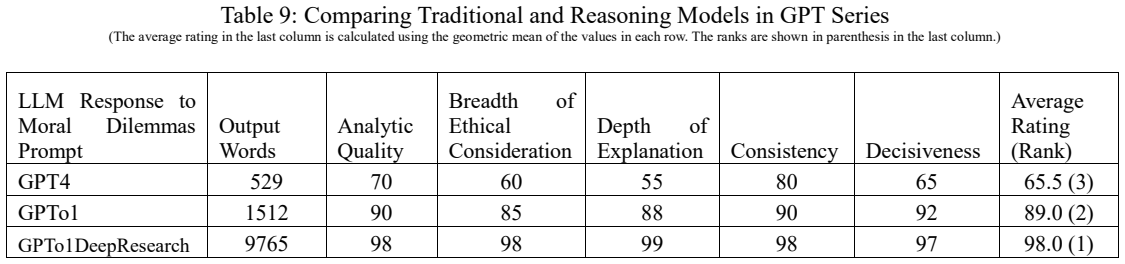
- [Tables 8-10 and Discussion] The abstract's claim that chain-of-thought prompting and reasoning-optimized models 'significantly enhance performance' is directly undermined by the paper's own data. In Table 9, average audit scores rise from 65.5 (GPT4, 529 words) to 89.0 (GPTo1, 1512 words) to 98.0 (GPTo1DeepResearch, 9765 words), while the Discussion concedes that 'quality ratings are clearly tied to the level of detail models choose to provide.' In Table 10, where output length is nearly equal (DeepSeek V3 1139 words vs R1 1163 words), the reasoning model R1 actually scores slightly lower (94.8 vs 93.2), which contradicts the claimed enhancement. No significance tests are reported anywhere, so 'significantly' is not supported.
- [The Audit Model] The five dimensions are presented as if they are established measures, but the text says they were derived through an iterative process involving human judges and LLM self-evaluation, with no evidence of construct validity, inter-rater reliability, or discriminant validity. The statement that the first dimension is 'roughly summative of the others' further undermines the claim that the dimensions are independent. Without validation that scores reflect ethical logic rather than prose elaboration, the rankings in Table 2 cannot be interpreted as measuring ethical reasoning quality.
- [Figure 3 and dimension grouping] The two-dimensional mapping in Figure 3 depends on an unweighted geometric mean and an ad-hoc grouping of the five dimensions into 'process' and 'outcome' orientations, and the paper correctly notes that 'how dimensions are grouped matters.' No sensitivity analysis is provided, so the visual separation in Figure 3 may be an artifact of the grouping choice rather than a substantive finding. This is a secondary issue, but it affects the presentation of results.
minor comments (4)
- [Table 1] There is a typo in the column header: 'Mikstral 7B' should be 'Mistral 7B.'
- [References] The reference for Awad et al. (2018) contains a typo, 'Naturekoh 563' instead of 'Nature 563,' and several in-text citations are slightly inconsistent (e.g., 'Dillion' vs 'Dillon' and 'Nunes e t al.').
- [General] The paper repeatedly uses 'significantly' (e.g., in the abstract and the reasoning-model comparison) without reporting any statistical test or effect size; please replace this word with a quantitative statement or add proper statistical analyses.
- [Table 3] The explanations in Table 3 mix evaluative judgments with word-count annotations, but the source and scoring rubric for these word counts are not described; clarify how word counts were measured and why they are included in the explanation table.
Circularity Check
The CoT/reasoning improvement claim reduces to GPT-4o's rating preference for longer, step-by-step output, a confound the paper itself concedes.
-
other
[Discussion; Tables 8–10; Abstract]
"This apparent linkage between explanatory detail and perceived quality necessitates caution in interpretation, particularly given the use of an LLM for evaluation. An evaluating model may assign higher scores to outputs demonstrating elaborate, step-by-step articulation, a characteristic often associated with high-quality reasoning in its training data. Therefore, the 'reticence' of certain models could lead to lower audit ratings that reflect stylistic variance or specific design choices (e.g., prioritizing brevity) rather than a substantive deficit in ethical reasoning capability."
The central quantitative claim that Chain-of-Thought prompting and reasoning-optimized models 'significantly enhance performance on our audit metrics' is based on 0–100 audit scores issued by GPT-4o. The paper's internal evidence shows those scores track output length: Table 9 moves GPT4 → GPTo1 → GPTo1DeepResearch at 529 → 1512 → 9765 words while average scores rise 65.5 → 89.0 → 98.0; Table 10, the only length-controlled comparison (DeepSeek V3 1139 words vs R1 1163 words), shows no improvement (94.8 vs 93.2) and is called inconclusive. The Discussion concedes that quality ratings are 'clearly tied to the level of detail models choose to provide' and that the LLM judge may reward elaborate articulation.
full rationale
No formal derivation chain is present, and no load-bearing self-citation or imported uniqueness theorem was found. The audit dimensions are drawn from ethical-theory and critical-thinking literatures, with some iterative input from LLM self-evaluation, so the framework is not itself a derived prediction. However, the quantitative support for the Abstract's headline claim is entirely the LLM-as-judge scoring in Table 2 and later tables. The claimed CoT/reasoning enhancement is not supported by any length-controlled, externally validated measure: the paper's own Table 10 is inconclusive, and the Discussion explicitly identifies the verbosity confound. Because the 0–100 audit score is the same GPT-4o rating used to generate the conclusion, the central claim partially reduces by construction to a stylistic preference of the evaluator. This is a moderate circularity/validity problem rather than a full collapse, since the paper qualifies the result and reports a control that fails to show the effect; hence score 6.
Assumptions & free parameters
free parameters (2)
- Unweighted geometric mean across audit dimensions =
None (methodological choice)
- Grouping of dimensions into process vs outcome orientations =
First three vs last two dimensions
assumptions (5)
- domain assumption Ethical decisions have no objective ground truth, so LLM self-assessment can serve as the benchmark.
- ad hoc to paper The five audit dimensions are meaningful and can be rated reliably on a 0-100 scale.
- ad hoc to paper GPT-4o can evaluate the ethical logic of all models, including itself, without systematic self-preference or stylistic bias.
- ad hoc to paper The six dilemmas in Battery III are novel to the models and therefore not contaminated by training data.
- domain assumption All seven LLMs are trained on essentially the same web corpus, so differences come from post-training.
Cite this review
Pith. "Pith review of Auditing the Ethical Logic of Generative AI Models." pith.science (2026). https://pith.science/paper/VJOUDYQB
@misc{pith2026250417544,
  author       = {Pith},
  title        = {Pith review of: Auditing the Ethical Logic of Generative AI Models},
  year         = {2026},
  howpublished = {\url{https://pith.science/paper/VJOUDYQB}},
  note         = {Machine review of arXiv:2504.17544}
}
read the original abstract
As generative AI models become increasingly integrated into high-stakes domains, the need for robust methods to evaluate their ethical reasoning becomes increasingly important. This paper introduces a five-dimensional audit model -- assessing Analytic Quality, Breadth of Ethical Considerations, Depth of Explanation, Consistency, and Decisiveness -- to evaluate the ethical logic of leading large language models (LLMs). Drawing on traditions from applied ethics and higher-order thinking, we present a multi-battery prompt approach, including novel ethical dilemmas, to probe the models' reasoning across diverse contexts. We benchmark seven major LLMs finding that while models generally converge on ethical decisions, they vary in explanatory rigor and moral prioritization. Chain-of-Thought prompting and reasoning-optimized models significantly enhance performance on our audit metrics. This study introduces a scalable methodology for ethical benchmarking of AI systems and highlights the potential for AI to complement human moral reasoning in complex decision-making contexts.
Figures



Figures from the paper (2 more)

Reference graph
Works this paper leans on
-
[1]
Strategies for Teaching Students to Think Critically:A Meta -Analysis
Abrami, Philip C., Robert M. Bernard, Eugene Borokhovski, David I. Waddington, C. Anne Wade and Tonje Persson (2015). "Strategies for Teaching Students to Think Critically:A Meta -Analysis." Review of Educational Research 85 (2): 275-314. Assunção, Gustavo, Bruno Patrão, Miguel Castelo-Branco and Paulo Menezes (2022). "An Overview of Emotion in Artificial...
arXiv 2015
-
[230]
Can Machines Learn Morality? The Delphi Experiment
Jiang, Liwei, Jena D. Hwang, Chandra Bhagavatula, Ronan Le Bras, Jenny Liang, Jesse Dodge, Keisuke Sakaguchi, Maxwell Forbes, Jon Borchardt, Saadia Gabriel, Yulia Tsvetkov, Oren Etzioni, Maarten Sap, Regina Rini and Yejin Choi (2021). "Can Machines Learn Morality? The Delphi Experiment." ArXiv: arXiv:2110.07574. Kant, Immanuel (1785). Groundwork of the Me...
arXiv 2021
-
[6793]
Reasoning with Large Language Models, a Survey
Plaat, Aske, Annie Wong, Suzan Verberne, Joost Broekens, N iki van Stein and Thomas Back (2024). "Reasoning with Large Language Models, a Survey." ArXiv: arXiv:2407.11511. Rawls, John (1971). A Theory of Justice. Cambridge, Harvard University Press. Rest, James (1979). Development in Judging Moral Issues. Minneapolis, University of Minnesota Press. Reuel,...
arXiv 2024
Reviewed August 16, 2026 · model on record in the stance chip above.
Discussion (0). Continue with ORCID to comment.