REVIEW 4 major objections 4 minor 152 references
Model Choice Matters for Age Inference on the Red Giant Branch
T0 review · 4 major / 4 minor · reviewed 2026-08-16 · deepseek-v4-flash
Pith's one-line read For red giants without a measured mass, the choice of stellar evolution model—not the precision of the data—can change the inferred age by up to 90 percent.
desk verdict Solid, reproducible quantification of a known qualitative effect: when mass is unknown, model choice dominates red-giant age errors, and the paper's specific numbers should be treated as a range diagnostic pending a MIST resolution check. read the letter →
The pith
A machine-rendered reading of the paper's core claim, the machinery that carries it, and where it could break.
The reading
What carries the argument
The load-bearing tool is a comparison in a common evolutionary-phase coordinate system: kiauhoku resamples each grid's tracks to equivalent evolutionary phases (EEPs), so that the same state of evolution is compared grid-to-grid. The four grids—YREC, MIST, DSEP, and GARSTEC—differ in atmosphere, mixing-length treatment, overshoot, diffusion, opacities, and solar composition, and these differences shift the predicted effective temperature scale along the red giant branch by tens to over a hundred kelvin. The mechanism that converts those temperature shifts into large age differences is the missing mass constraint: without a measured mass, each grid independently solves for the mass that best matches the observed temperature and gravity or luminosity, and a roughly 120 K temperature offset is equivalent to about a 0.1 solar-mass change, which in turn moves inferred ages by tens of percent. The region of maximal disagreement is the RGB bump, where the luminosity of the bump itself shifts between grids because of different convective-overshoot prescriptions.
What would settle it
Take the APOKASC-3 giants with asteroseismic masses and compare each grid's mass predicted from spectroscopic temperature, gravity, and metallicity against the true masses: if the real masses are consistently captured by one grid's temperature scale rather than spread across all four, the grid-to-grid age spread overestimates the true model uncertainty. Alternatively, recompute the spectroscopy-only offsets with full-resolution MIST tracks; if the roughly 90 percent offsets beyond the RGB bump shrink or shift by more than about 10 percentage points relative to the downsampled EEP tracks, the headline numbers are partly an artifact of MIST's public resolution rather than pure physics.
Extended reading notes
Core claim
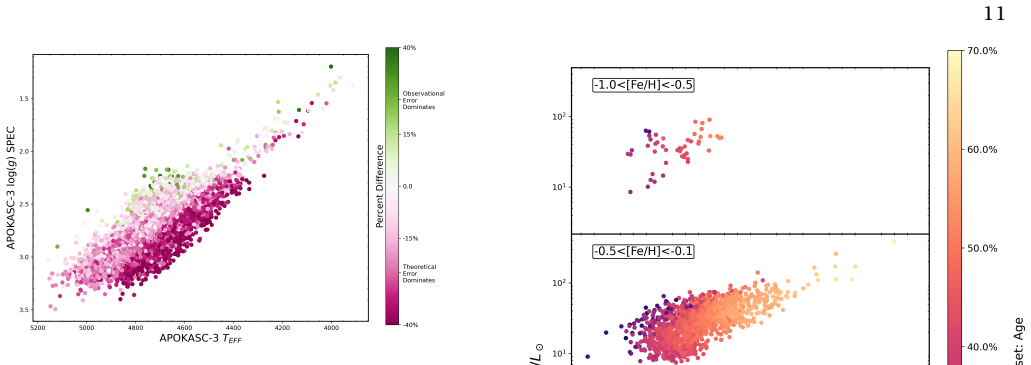
The paper's central claim is that, for red giant stars, the choice of stellar evolution model grid is a first-order, usually unquantified source of age uncertainty, and that its size is set by whether the star's mass is known. Resampling the YREC, MIST, DSEP, and GARSTEC grids into a common evolutionary-phase coordinate system, the authors find that when mass, metallicity, and surface gravity are all supplied, the four grids agree on age to a mean of roughly 10 percent (9 to 12 percent depending on metallicity). When mass is removed and age is instead inferred from spectroscopic or photometric observables, grid-to-grid differences reach about 60 percent before the red-giant-branch bump and roughly 90 percent above it in the synthetic demonstrations, with mean offsets of 51 to 69 percent; applying the same procedure to the APOKASC-3 sample gives mean offsets of 77 to 83 percent using spectroscopic parameters and 42 to 57 percent using Gaia photometry. Comparison with Monte Carlo error propagation shows that model choice exceeds the observational error budget for most giants in the spectroscopy-only case and for giants cooler than about 4900 K in the Gaia case. The paper concludes by proposing that the inter-grid age spread be adopted as a theoretical uncertainty term in age inference, so that catalog ages reflect the model dependence explicitly.
Load-bearing premise
The comparison assumes that the four grids, resampled onto a common evolutionary-phase grid, truly span the range of physically plausible model predictions at every point of the red giant branch—including the region near the RGB bump where MIST is only available at downsampled resolution, so the claimed offsets could partly be numerical artifacts of the resampling rather than physical model differences.
Editorial extensions
If this is right
- For the majority of observed giants that lack asteroseismic masses, single-grid ages carry an implicit model-dependent error of order 50 to 90 percent, and galaxy-archaeology catalogs built from those ages inherit that as a systematic bias.
- Multi-grid averaging with the grid-to-grid spread as the error, as the paper proposes, roughly doubles or triples the quoted age uncertainty for spectroscopic-only samples, making the uncertainty budget honest rather than optimistic.
- Because the offsets grow with decreasing surface gravity and with distance from solar metallicity, studies of the most luminous giants and of metal-poor halo populations are the ones most in need of this correction.
- The pattern of offsets as a function of the observable set indicates that luminosity-based coordinates (photometric or astrometric) produce smaller, though still large, model dependence than surface-gravity-based coordinates, so analyses should tailor uncertainty prescriptions to their specific observable set.
Reading between the lines
- The uncertainty floor the paper establishes is set by its four grids; a grid with substantially different physics (rotation, magnetic braking, alternative convective models) could widen the quoted spread, so the 90 percent figure is best read as a floor on model-choice error, not the full range of plausible stellar physics.
- The largest offsets concentrate at the RGB bump, the luminosity of which the paper notes shifts between grids because of convective-overshoot treatment; this suggests a testable physics discriminator, since observed bump luminosities across metallicity could favor one overshoot prescription over another.
- A natural extension is to run the same multi-grid pipeline on subgiant stars, where age correlates tightly with luminosity and model agreement is expected to be better; mapping where the offsets start rising would identify the precise evolutionary stage at which model choice begins to dominate.
- The grid-by-grid mass comparison against asteroseismic masses could be turned into an empirical ranking of the grids' temperature scales; the paper refrains from endorsing any single grid, but the data products it releases make such a ranking straightforward.
Signed reviews
Editorial analysis
A structured set of objections, weighed in public.
Referee Report
Summary. The manuscript compares age estimates for red giants inferred from four common stellar evolution grids (YREC, MIST, DSEP, GARSTEC) using the kiauhoku EEP-interpolation package. For synthetic stars with known mass, metallicity, and surface gravity, the maximum fractional age offset among grids is small, with mean offsets of 9–12%; when mass is not known and age is inferred from spectroscopic observables (effective temperature, surface gravity, metallicity) or Gaia photometric observables (luminosity, effective temperature, metallicity), maximum offsets grow to roughly 60–90% and are largest after the RGB bump. The same pattern appears in an APOKASC-3 sample of about 4,300 giants: asteroseismic input gives mean grid-to-grid offsets of 5–9%, spectroscopic input gives 77–83%, and Gaia input gives 42–57%. The paper argues that model choice, not observational precision, dominates the age error budget for red giants without mass constraints and recommends adding a multi-grid theoretical uncertainty; it releases the resampled grids on Zenodo and a Jupyter notebook for reproduction.
Significance. If the quantitative claims are secure, the paper addresses an important practical problem: red giant ages used in Galactic archaeology are often derived without direct mass measurements, and the paper shows that the choice among standard grids can matter more than measurement error. The qualitative finding is robust across synthetic grids and the APOKASC-3 sample, and the use of open-source interpolation, published grids, and a reproducible notebook is a real strength. I see no circularity concern, since the multi-grid spread is an output of the comparison rather than a fitted target. The quantitative headline values and the proposed uncertainty recipe are not yet secure, however, because the grids are compared at unequal EEP resolution and the central statistic is a maximum across four grids; these issues do not negate the central argument but require validation or reinterpretation before the 80–90% numbers can be taken at face value.
major comments (4)
- [§2.1, §2.2.2, Figures 3 and 4] The comparison is not at equal EEP fidelity. The text states that YREC, DSEP, and GARSTEC tracks were resampled with additional EEPs at the late end, while MIST is used only at the default downsampled EEP resolution because full-resolution tracks are not publicly available. No test is reported that MIST's default EEP spacing resolves the RGB bump and the rapid ascent to the tip, which are precisely the regions where Figures 3 and 4 place the maximum age offsets (≈60–90%) and where Section 5.2's multi-grid spread is calibrated. If kiauhoku's interpolation across a coarse EEP interval smooths the bump/tip structure in Teff–logg–L, MIST's inferred masses and ages acquire a numerical error, and because the headline statistic is the maximum across only four grids, a single grid's resampling artifact can set the headline value. I ask for a validation: compare MIST default-EEP and full-resolution or artificially EEP-densified tracks over the RGB, and show that the maximum-offset regions are not dominated by EEP-spacing differences; if full-resolution MIST is truly unavailable, the 80–90% claims and the Section 5.2 prescription should be explicitly downgraded to illustrative.
- [§3.3–3.4, Figures 3 and 4] The headline statistic is the maximum fractional offset among four grids. A maximum over N=4 grids is a noisy and upward-biased estimator of model uncertainty, and the reported means are substantially lower than the maxima: mean offsets are 57–74% in Figure 4 and 77–83% in the APOKASC-3 spectroscopic case, while the maxima reach ≈90%. The paper should report the full distribution of offsets, including per-grid pairwise differences and median/percentile spreads, and the Section 5.2 uncertainty recipe should be defined with a robust statistic rather than the maximum, otherwise the proposed uncertainties inherit the fragility of a four-grid maximum.
- [§4.1.2, Figures 7 and A.2] The APOKASC-3 spectroscopic comparison mixes two different comparisons. The grid-versus-grid offsets in Figure 7 are computed with each grid interpolating from the same spectroscopic parameters, which is appropriate, but the grid-versus-catalog offsets in Figure A.2 compare each grid to ages from the APOKASC-3 variant of GARSTEC, so the GARSTEC row is a code-variant comparison and the average values (37%, 100%, 45%, 67%) depend on this variant choice. The text acknowledges this, but the 15 Gyr exclusion also interacts with GARSTEC's hotter temperature scale, and the reported sensitivity (mean offset decreases to 66% when all GARSTEC stars with ages above 15 Gyr are removed) shows that the mean is not stable under a small selection change. Please report the spectroscopic grid-versus-grid offsets after removing the GARSTEC-variant complication, or present a sensitivity analysis over the exclusion threshold.
- [§5.2] The paper describes a method for including theoretical uncertainties but gives no concrete prescription in the text. It states that age inference uncertainties should at a minimum account for the variation across multiple grids and points to a notebook, but it does not specify how to combine the per-grid ages into a point estimate and uncertainty (for example, mean and standard deviation, median and percentile range, or maximum spread), how to handle grids that fail to converge, or when the theoretical term should be added in quadrature to the observational term. Add a section with a precise algorithm so that the claimed deliverable is reproducible from the text alone.
minor comments (4)
- [Conclusions, bullet 2] The second bullet says 'reaching a mean offset of 90%', but the reported means are 57–74% in the synthetic runs and 77–83% in the APOKASC-3 spectroscopic case; 90% is a maximum, so the bullet should distinguish 'mean' from 'maximum'.
- [Figure 9 caption] The caption's second metallicity interval is printed as '−0.5 < [Fe/H] < −0.'; it should read '−0.5 < [Fe/H] < −0.1'.
- [§3.3] The text says model differences reach ≈90% after the bump, while the Figure 3 caption says the mean age offset increases to 80% beyond the bump; the quantity being quoted (mean versus pointwise maximum) should be made consistent in both places.
- [§2.2.2] The statement that the MIST website 'only provides the downsampled EEP tracks' should include the version and date accessed, since the availability of full-resolution tracks is part of the reproducibility record and the distribution could change.
Circularity Check
No significant circularity: the paper's central claim is an inter-grid comparison, and the proposed uncertainty is the measured spread of independent published grids rather than a fitted or self-cited target.
full rationale
The paper's central claim is that different published stellar model grids infer substantially different ages when mass is not known, with offsets reaching 60-90%. This claim is not derived from any parameter fitted to the target result; it is a direct comparison of four grids (YREC, MIST, DSEP, GARSTEC), three of which are external to the authors and all of which are published independently. The proposed 'theoretical uncertainty' in Section 5.2 is defined as the multi-grid spread itself, which is a measurement or prescription rather than a prediction that reduces to its inputs. No self-defined quantity is used to predict itself, and no fitted parameter is renamed as a prediction. The self-citations present (kiauhoku, Tayar et al. 2022 YREC grid, Pinsonneault et al. 2025 APOKASC-3) are normal citations to code and prior work; they do not invoke a uniqueness theorem, forbid alternatives, or smuggle in an ansatz. The MIST default-resolution caveat in Sections 2.1 and 2.2 is a legitimate fidelity concern about whether the coarse EEP spacing distorts the comparison near the RGB bump, but that is a correctness/robustness issue, not circularity. Because the argument does not require any particular grid to be correct and uses external grids as independent evidence, there is no circular step.
Assumptions & free parameters
assumptions (3)
- domain assumption The EEP-resampled tracks in kiauhoku preserve each grid's native age-mass-temperature relation at the sampled resolution.
- domain assumption The four chosen grids span the range of physically plausible model assumptions relevant to the red giant branch.
- domain assumption For a red giant of fixed mass and composition, age is determined mainly by main-sequence lifetime, so mass is the dominant constraint on age.
Cite this review
Pith. "Pith review of Model Choice Matters for Age Inference on the Red Giant Branch." pith.science (2026). https://pith.science/paper/DWR2ZT2N
@misc{pith2026250417600,
  author       = {Pith},
  title        = {Pith review of: Model Choice Matters for Age Inference on the Red Giant Branch},
  year         = {2026},
  howpublished = {\url{https://pith.science/paper/DWR2ZT2N}},
  note         = {Machine review of arXiv:2504.17600}
}
abstract
Galactic archaeology relies on accurate stellar parameters to reconstruct the galaxy's history, including information on stellar ages. While the precision of data has improved significantly in recent years, stellar models used for age inference have not improved at a similar rate. In fact, different models yield notably different age predictions for the same observational data. In this paper, we assess the difference in age predictions of various widely used model grids for stars along the red giant branch. Using open source software, we conduct a comparison of four different evolution grids and we find that age estimations become less reliable if stellar mass is not known, with differences occasionally exceeding $80\%$. Additionally, we note significant disagreements in the models' age estimations at non-solar metallicity. Finally, we present a method for including theoretical uncertainties from stellar evolutionary tracks in age inferences of red giants, aimed at improving the accuracy of age estimation techniques used in the galactic archaeology community.
Figures


Figures from the paper (6 more)




Reference graph
Works this paper leans on
-
[1]
Adelberger, E. G., Austin, S. M., Bahcall, J. N., et al. 1998, Reviews of Modern Physics, 70, 1265, doi: 10.1103/RevModPhys.70.1265
-
[2]
Adelberger, E. G., García, A., Robertson, R. G. H., et al. 2011, Reviews of Modern Physics, 83, 195, doi: 10.1103/RevModPhys.83.195
-
[3]
2019, arXiv e-prints, arXiv:1902.05569, doi: 10.48550/arXiv.1902.05569
Akeson, R., Armus, L., Bachelet, E., et al. 2019, arXiv e-prints, arXiv:1902.05569, doi: 10.48550/arXiv.1902.05569
-
[4]
1978, ApJ, 226, 1034, doi: 10.1086/156681
Alastuey, A., & Jancovici, B. 1978, ApJ, 226, 1034, doi: 10.1086/156681
doi:10.1086/156681 1978
-
[5]
F., Argudo-Fernández, M., et al
Almeida, A., Anderson, S. F., Argudo-Fernández, M., et al. 2023, ApJS, 267, 44, doi: 10.3847/1538-4365/acda98
-
[6]
2023, A&A, 678, A158, doi: 10.1051/0004-6361/202346666
Anders, F., Gispert, P., Ratcliffe, B., et al. 2023, A&A, 678, A158, doi: 10.1051/0004-6361/202346666
-
[7]
2023, ApJS, 267, 8, doi: 10.3847/1538-4365/acd53e
Andrae, R., Rix, H.-W., & Chandra, V. 2023, ApJS, 267, 8, doi: 10.3847/1538-4365/acd53e
-
[8]
2018, A&A, 616, A8, doi: 10.1051/0004-6361/201732516
Andrae, R., Fouesneau, M., Creevey, O., et al. 2018, A&A, 616, A8, doi: 10.1051/0004-6361/201732516
Show all 152 references
-
[9]
1999, Nuclear Physics A, 656, 3, doi: 10.1016/S0375-9474(99)00030-5
Angulo, C., Arnould, M., Rayet, M., et al. 1999, Nuclear Physics A, 656, 3, doi: 10.1016/S0375-9474(99)00030-5
1999 doi
-
[10]
J., & Scott, P
Asplund, M., Grevesse, N., Sauval, A. J., & Scott, P. 2009, ARA&A, 47, 481, doi: 10.1146/annurev.astro.46.060407.145222
2009
-
[11]
Aumer, M., & Binney, J. J. 2009, MNRAS, 397, 1286, doi: 10.1111/j.1365-2966.2009.15053.x
2009
-
[12]
Barnes, S. A. 2003, ApJ, 586, 464, doi: 10.1086/367639 —. 2007, ApJ, 669, 1167, doi: 10.1086/519295
2003 doi
-
[13]
A., Däppen, W., Morel, P., et al
Baturin, V. A., Däppen, W., Morel, P., et al. 2017, A&A, 606, A129, doi: 10.1051/0004-6361/201731248
2017 doi
-
[14]
2023, MNRAS, 520, 1832, doi: 10.1093/mnras/stad094
Binney, J., & Vasiliev, E. 2023, MNRAS, 520, 1832, doi: 10.1093/mnras/stad094
2023 doi
-
[15]
2016, ARA&A, 54, 529, doi: 10.1146/annurev-astro-081915-023441
Bland-Hawthorn, J., & Gerhard, O. 2016, ARA&A, 54, 529, doi: 10.1146/annurev-astro-081915-023441
2016 doi
-
[16]
R., Bershady, M
Blanton, M. R., Bershady, M. A., Abolfathi, B., et al. 2017, AJ, 154, 28, doi: 10.3847/1538-3881/aa7567 Böhm-Vitense, E. 1958, ZA, 46, 108
2017 doi
-
[17]
Lane, R. R. 2023, ApJ, 959, 123, doi: 10.3847/1538-4357/acf9a5
2023 doi
-
[18]
J., Casanova, V., & Tobaruela, Á
Casal, E., Fernández, M., Alfaro, E. J., Casanova, V., & Tobaruela, Á. 2020, MNRAS, 497, 2562, doi: 10.1093/mnras/staa2093
2020 doi
-
[19]
2019, A&A, 629, A62, doi: 10.1051/0004-6361/201935282
Casali, G., Magrini, L., Tognelli, E., et al. 2019, A&A, 629, A62, doi: 10.1051/0004-6361/201935282
2019 doi
-
[20]
2013, Old Stellar Populations: How to Study the Fossil Record of Galaxy Formation
Cassisi, S., & Salaris, M. 2013, Old Stellar Populations: How to Study the Fossil Record of Galaxy Formation
2013
-
[21]
2023, MNRAS, 524, 471, doi: 10.1093/mnras/stad1862
Cehula, J., & Pejcha, O. 2023, MNRAS, 524, 471, doi: 10.1093/mnras/stad1862
2023 doi
-
[22]
H., Nelan, J
Chaboyer, B., Fenton, W. H., Nelan, J. E., Patnaude, D. J., & Simon, F. E. 2001, ApJ, 562, 521, doi: 10.1086/323872
2001 doi
-
[23]
1995, ApJ, 454, 767, doi: 10.1086/176529
Chaboyer, B., & Kim, Y.-C. 1995, ApJ, 454, 767, doi: 10.1086/176529
1995 doi
-
[24]
1917a, MNRAS, 77, 540, doi: 10.1093/mnras/77.7.540 —
Chapman, S. 1917a, MNRAS, 77, 540, doi: 10.1093/mnras/77.7.540 —. 1917b, MNRAS, 77, 539, doi: 10.1093/mnras/77.7.539
-
[25]
2023, Proceedings of the National Academy of Science, 120, e2304179120, doi: 10.1073/pnas.2304179120
Chen, D.-C., Xie, J.-W., Zhou, J.-L., et al. 2023, Proceedings of the National Academy of Science, 120, e2304179120, doi: 10.1073/pnas.2304179120
2023 doi
-
[26]
2015, MNRAS, 452, 1068, doi: 10.1093/mnras/stv1281
Chen, Y., Bressan, A., Girardi, L., et al. 2015, MNRAS, 452, 1068, doi: 10.1093/mnras/stv1281
2015 doi
-
[27]
2014, MNRAS, 444, 2525, doi: 10.1093/mnras/stu1605
Chen, Y., Girardi, L., Bressan, A., et al. 2014, MNRAS, 444, 2525, doi: 10.1093/mnras/stu1605
2014 doi
-
[28]
2016, ApJ, 823, 102, doi: 10.3847/0004-637X/823/2/102
Choi, J., Dotter, A., Conroy, C., et al. 2016, ApJ, 823, 102, doi: 10.3847/0004-637X/823/2/102
2016 doi
-
[29]
2018, ApJ, 860, 131, doi: 10.3847/1538-4357/aac435
Choi, J., Dotter, A., Conroy, C., & Ting, Y.-S. 2018, ApJ, 860, 131, doi: 10.3847/1538-4357/aac435
2018 doi
-
[30]
2015, MNRAS, 453, 666, doi: 10.1093/mnras/stv1656
Christensen-Dalsgaard, J. 2015, MNRAS, 453, 666, doi: 10.1093/mnras/stv1656
2015 doi
-
[31]
C., & Joyce, M
Cinquegrana, G. C., & Joyce, M. 2022, Research Notes of the American Astronomical Society, 6, 77, doi: 10.3847/2515-5172/ac6611
2022 doi
-
[32]
2007, A&A, 475, 1019, doi: 10.1051/0004-6361:20078024
Claret, A. 2007, A&A, 475, 1019, doi: 10.1051/0004-6361:20078024
2007 doi
-
[33]
2016, A&A, 592, A15, doi: 10.1051/0004-6361/201628779
Claret, A., & Torres, G. 2016, A&A, 592, A15, doi: 10.1051/0004-6361/201628779
2016 doi
-
[34]
R., van Saders, J
Claytor, Z. R., van Saders, J. L., Santos, Â. R. G., et al. 2020a, ApJ, 888, 43, doi: 10.3847/1538-4357/ab5c24 —. 2020b, kiauhoku: Stellar model grid interpolation, Astrophysics Source Code Library, record ascl:2011.027
2011 doi
-
[35]
P., Magee, N
Colgan, J., Kilcrease, D. P., Magee, N. H., et al. 2016, ApJ, 817, 116, doi: 10.3847/0004-637X/817/2/116
2016 doi
-
[36]
P., & Giuli, R
Cox, J. P., & Giuli, R. T. 1968, Principles of stellar structure
1968
-
[37]
2024, A&A, 689, A243, doi: 10.1051/0004-6361/202449534
Pietrinferni, A. 2024, A&A, 689, A243, doi: 10.1051/0004-6361/202449534
2024 doi
-
[38]
H., Amthor, A
Cyburt, R. H., Amthor, A. M., Ferguson, R., et al. 2010, ApJS, 189, 240, doi: 10.1088/0067-0049/189/1/240 15
2010 doi
-
[39]
Das, P., & Sanders, J. L. 2019, MNRAS, 484, 294, doi: 10.1093/mnras/sty2776 Daszyńska-Daszkiewicz, J., Walczak, P., Pamyatnykh, A., Szewczuk, W., & Niewiadomski, W. 2023, ApJL, 942, L38, doi: 10.3847/2041-8213/acade2
2019 doi
-
[40]
2023, Physics Letters B, 844, 138093, doi: 10.1016/j.physletb.2023.138093
De-Leon, H., & Gazit, D. 2023, Physics Letters B, 844, 138093, doi: 10.1016/j.physletb.2023.138093
2023
-
[41]
J., & Belokurov, V
Deason, A. J., & Belokurov, V. 2024, NewAR, 99, 101706, doi: 10.1016/j.newar.2024.101706 Dell’Omodarme, M., Valle, G., Degl’Innocenti, S., & Prada Moroni, P. G. 2012, A&A, 540, A26, doi: 10.1051/0004-6361/201118632
2024
-
[42]
2016, ApJS, 222, 8, doi: 10.3847/0067-0049/222/1/8
Dotter, A. 2016, ApJS, 222, 8, doi: 10.3847/0067-0049/222/1/8
2016 doi
-
[43]
2008, ApJS, 178, 89, doi: 10.1086/589654
Dotter, A., Chaboyer, B., Jevremović, D., et al. 2008, ApJS, 178, 89, doi: 10.1086/589654
2008 doi
-
[44]
2017, ApJ, 840, 99, doi: 10.3847/1538-4357/aa6d10
Dotter, A., Conroy, C., Cargile, P., & Asplund, M. 2017, ApJ, 840, 99, doi: 10.3847/1538-4357/aa6d10
2017 doi
-
[45]
2010, ApJ, 708, 698, doi: 10.1088/0004-637X/708/1/698
Dotter, A., Sarajedini, A., Anderson, J., et al. 2010, ApJ, 708, 698, doi: 10.1088/0004-637X/708/1/698
2010 doi
-
[46]
2021, A&A, 652, A137, doi: 10.1051/0004-6361/202141222
Eggenberger, P., Ekström, S., Georgy, C., et al. 2021, A&A, 652, A137, doi: 10.1051/0004-6361/202141222
2021 doi
-
[47]
J., Weinberg, D
Eisenstein, D. J., Weinberg, D. H., Agol, E., et al. 2011, AJ, 142, 72, doi: 10.1088/0004-6256/142/3/72 Ekström, S., Georgy, C., Eggenberger, P., et al. 2012, A&A, 537, A146, doi: 10.1051/0004-6361/201117751
2011 doi
-
[48]
W., Alexander, D
Ferguson, J. W., Alexander, D. R., Allard, F., et al. 2005, ApJ, 623, 585, doi: 10.1086/428642
2005 doi
-
[49]
K., Bovy, J., Holtzman, J., et al
Feuillet, D. K., Bovy, J., Holtzman, J., et al. 2016, ApJ, 817, 40, doi: 10.3847/0004-637X/817/1/40
2016 doi
-
[50]
G., & Steffen, M
Freytag, B., Ludwig, H. G., & Steffen, M. 1996, A&A, 313, 497 Gaia Collaboration, Vallenari, A., Brown, A. G. A., et al. 2023, A&A, 674, A1, doi: 10.1051/0004-6361/202243940
1996 doi
-
[51]
2005, ARA&A, 43, 387, doi: 10.1146/annurev.astro.43.072103.150608
Gallart, C., Zoccali, M., & Aparicio, A. 2005, ARA&A, 43, 387, doi: 10.1146/annurev.astro.43.072103.150608
2005 arXiv
-
[52]
2015, A&A, 577, A98, doi: 10.1051/0004-6361/201525660
Gallet, F., & Bouvier, J. 2015, A&A, 577, A98, doi: 10.1051/0004-6361/201525660
2015 doi
-
[53]
2012, A&A, 542, A29, doi: 10.1051/0004-6361/201118340
Georgy, C., Ekström, S., Meynet, G., et al. 2012, A&A, 542, A29, doi: 10.1051/0004-6361/201118340
2012 doi
-
[54]
2013, A&A, 558, A103, doi: 10.1051/0004-6361/201322178
Georgy, C., Ekström, S., Eggenberger, P., et al. 2013, A&A, 558, A103, doi: 10.1051/0004-6361/201322178
2013 doi
-
[55]
H., et al
Godoy-Rivera, D., Tayar, J., Pinsonneault, M. H., et al. 2021, ApJ, 915, 19, doi: 10.3847/1538-4357/abf8ba
2021 doi
-
[56]
A., Khovritchev, M
Gontcharov, G. A., Khovritchev, M. Y., & Mosenkov, A. V. 2020, MNRAS, 497, 3674, doi: 10.1093/mnras/staa1694
2020 doi
-
[57]
A., Bonatto, C
Gontcharov, G. A., Bonatto, C. J., Ryutina, O. S., et al. 2023, MNRAS, 526, 5628, doi: 10.1093/mnras/stad3134
2023 doi
-
[58]
2021, ApJ, 912, 65, doi: 10.3847/1538-4357/abebdf
Gossage, S., Dotter, A., Garraffo, C., et al. 2021, ApJ, 912, 65, doi: 10.3847/1538-4357/abebdf
2021 doi
-
[59]
2024, A&A, 690, A315, doi: 10.1051/0004-6361/202449543
Gozaliasl, G., Finoguenov, A., Babul, A., et al. 2024, A&A, 690, A315, doi: 10.1051/0004-6361/202449543
2024 doi
-
[60]
Cooper, M. S. 1973, ApJ, 181, 457, doi: 10.1086/152062
1973 doi
-
[61]
1993, in In: Origin and Evolution of the elements
Grevesse, N., & Noels, A. 1993, in In: Origin and Evolution of the elements. https: //api.semanticscholar.org/CorpusID:116690371
1993
-
[62]
Grevesse, N., & Sauval, A. J. 1998, SSRv, 85, 161, doi: 10.1023/A:1005161325181
1998 doi
-
[63]
H., Ekström, S., Georgy, C., et al
Groh, J. H., Ekström, S., Georgy, C., et al. 2019, A&A, 627, A24, doi: 10.1051/0004-6361/201833720
2019 doi
-
[64]
H., & Schlaufman, K
Hamer, J. H., & Schlaufman, K. C. 2022, AJ, 164, 26, doi: 10.3847/1538-3881/ac69ef
2022 doi
-
[65]
H., Allard, F., & Baron, E
Hauschildt, P. H., Allard, F., & Baron, E. 1999a, ApJ, 512, 377, doi: 10.1086/306745
-
[66]
Alexander, D. R. 1999b, ApJ, 525, 871, doi: 10.1086/307954
-
[67]
L., Pietrinferni, A., Cassisi, S., et al
Hidalgo, S. L., Pietrinferni, A., Cassisi, S., et al. 2018, ApJ, 856, 125, doi: 10.3847/1538-4357/aab158
2018 doi
-
[68]
Price-Whelan, A. M. 2024, ApJ, 971, 170, doi: 10.3847/1538-4357/ad58de
2024 doi
-
[69]
M., Lindegren, L., Feltzing, S., Church, R
Howes, L. M., Lindegren, L., Feltzing, S., Church, R. P., & Bensby, T. 2019, A&A, 622, A27, doi: 10.1051/0004-6361/201833280
2019 doi
-
[70]
A., & Rogers, F
Iglesias, C. A., & Rogers, F. J. 1993, ApJ, 412, 752, doi: 10.1086/172958 —. 1996, ApJ, 464, 943, doi: 10.1086/177381
1993 doi
-
[71]
2004, A&A, 420, 625, doi: 10.1051/0004-6361:20040981
Imbriani, G., Costantini, H., Formicola, A., et al. 2004, A&A, 420, 625, doi: 10.1051/0004-6361:20040981
2004 doi
-
[72]
Irwin, A. W. 2004, The FreeEOS Code for Calculating the Equation of State for Stellar Interiors I: An Improved EFF-Style Approximation for the Fermi-Dirac Integrals. http://freeeos.sourceforge.net/eff_fit.pdf Ivezić, Ž., Kahn, S. M., Tyson, J. A., et al. 2019, ApJ, 873, 111, d...
2004 doi
-
[73]
2023, Galaxies, 11, 75, doi: 10.3390/galaxies11030075
Joyce, M., & Tayar, J. 2023, Galaxies, 11, 75, doi: 10.3390/galaxies11030075
2023 doi
-
[74]
J., Miglio, A., et al
Khan, S., Hall, O. J., Miglio, A., et al. 2018, ApJ, 859, 156, doi: 10.3847/1538-4357/aabf90
2018 doi
-
[75]
2013, Stellar Structure and Evolution, doi: 10.1007/978-3-642-30304-3
Kippenhahn, R., Weigert, A., & Weiss, A. 2013, Stellar Structure and Evolution, doi: 10.1007/978-3-642-30304-3
2013 doi
-
[76]
2002, ApJ, 567, 643, doi: 10.1086/338384
Kunz, R., Fey, M., Jaeger, M., et al. 2002, ApJ, 567, 643, doi: 10.1086/338384
2002 doi
-
[77]
1993, Robert Kurucz CD-ROM, 18
Kurucz, R. 1993, Robert Kurucz CD-ROM, 18
1993
-
[78]
C., Reylé, C., & Nasello, G
Lagarde, N., Robin, A. C., Reylé, C., & Nasello, G. 2017, A&A, 601, A27, doi: 10.1051/0004-6361/201630253
2017 doi
-
[79]
L., Schaefer, G
Lam, R., Sandquist, E. L., Schaefer, G. H., et al. 2023, AJ, 166, 29, doi: 10.3847/1538-3881/accddb
2023 doi
-
[80]
2025, arXiv e-prints, arXiv:2501.13207, doi: 10.48550/arXiv.2501.13207
Li, Y., & Joyce, M. 2025, arXiv e-prints, arXiv:2501.13207, doi: 10.48550/arXiv.2501.13207
2025 doi
-
[81]
J., Ong, J
Lindsay, C. J., Ong, J. M. J., & Basu, S. 2022, ApJ, 931, 116, doi: 10.3847/1538-4357/ac67ed
2022 doi
-
[82]
2021, AJ, 161, 189, doi: 10.3847/1538-3881/abe4d6
Kiman, R. 2021, AJ, 161, 189, doi: 10.3847/1538-3881/abe4d6
2021 doi
-
[83]
2021, A&A, 646, A125, doi: 10.1051/0004-6361/202039441
Lucertini, F., Nardiello, D., & Piotto, G. 2021, A&A, 646, A125, doi: 10.1051/0004-6361/202039441
2021 doi
-
[84]
MacDonald, J., & Mullan, D. J. 2012, MNRAS, 421, 3084, doi: 10.1111/j.1365-2966.2012.20531.x
2012
-
[85]
2022, A&A, 661, A140, doi: 10.1051/0004-6361/202142971 Miller Bertolami, M
Magg, E., Bergemann, M., Serenelli, A., et al. 2022, A&A, 661, A140, doi: 10.1051/0004-6361/202142971 Miller Bertolami, M. M. 2023, ApJ, 943, 45, doi: 10.3847/1538-4357/acac8a
2022 doi
-
[86]
2022, A&A, 666, A43, doi: 10.1051/0004-6361/202243210
Moedas, N., Deal, M., Bossini, D., & Campilho, B. 2022, A&A, 666, A43, doi: 10.1051/0004-6361/202243210
2022 doi
-
[87]
Mombarg, J. S. G., Rieutord, M., & Espinosa Lara, F. 2023, A&A, 677, L5, doi: 10.1051/0004-6361/202347454
2023 doi
-
[88]
M., Sandquist, E
Morales, L. M., Sandquist, E. L., Schaefer, G. H., et al. 2022, AJ, 164, 34, doi: 10.3847/1538-3881/ac7329
2022 doi
-
[89]
J., Groh, J
Murphy, L. J., Groh, J. H., Ekström, S., et al. 2021, MNRAS, 501, 2745, doi: 10.1093/mnras/staa3803
2021 doi
- [90]
-
[91]
A., & Mead, R
Nelder, J. A., & Mead, R. 1965, The Computer Journal, 7, 308, doi: 10.1093/comjnl/7.4.308
1965 doi
-
[92]
W., Rix, H
Ness, M., Hogg, D. W., Rix, H. W., et al. 2016, ApJ, 823, 114, doi: 10.3847/0004-637X/823/2/114
2016 doi
-
[93]
T., Costa, G., Girardi, L., et al
Nguyen, C. T., Costa, G., Girardi, L., et al. 2022, A&A, 665, A126, doi: 10.1051/0004-6361/202244166 Nordström, B., Mayor, M., Andersen, J., et al. 2004, A&A, 418, 989, doi: 10.1051/0004-6361:20035959
2022 doi
-
[94]
A., Pinsonneault, M
Patton, R. A., Pinsonneault, M. H., Cao, L., et al. 2024, MNRAS, 528, 3232, doi: 10.1093/mnras/stae074
2024 doi
-
[95]
2011, ApJS, 192, 3, doi: 10.1088/0067-0049/192/1/3
Paxton, B., Bildsten, L., Dotter, A., et al. 2011, ApJS, 192, 3, doi: 10.1088/0067-0049/192/1/3
2011 doi
-
[96]
2013, ApJS, 208, 4, doi: 10.1088/0067-0049/208/1/4
Paxton, B., Cantiello, M., Arras, P., et al. 2013, ApJS, 208, 4, doi: 10.1088/0067-0049/208/1/4
2013 doi
-
[97]
2015, ApJS, 220, 15, doi: 10.1088/0067-0049/220/1/15
Paxton, B., Marchant, P., Schwab, J., et al. 2015, ApJS, 220, 15, doi: 10.1088/0067-0049/220/1/15
2015 doi
-
[98]
B., et al
Paxton, B., Schwab, J., Bauer, E. B., et al. 2018, ApJS, 234, 34, doi: 10.3847/1538-4365/aaa5a8
2018 doi
-
[99]
2019, ApJS, 243, 10, doi: 10.3847/1538-4365/ab2241
Paxton, B., Smolec, R., Schwab, J., et al. 2019, ApJS, 243, 10, doi: 10.3847/1538-4365/ab2241
2019 doi
-
[100]
2010, A&A, 522, A76, doi: 10.1051/0004-6361/201015065
Pietrinferni, A., Cassisi, S., & Salaris, M. 2010, A&A, 522, A76, doi: 10.1051/0004-6361/201015065
2010 doi
-
[101]
2024, MNRAS, 527, 2065, doi: 10.1093/mnras/stad3267
Pietrinferni, A., Salaris, M., Cassisi, S., et al. 2024, MNRAS, 527, 2065, doi: 10.1093/mnras/stad3267
2024 doi
-
[102]
2021, ApJ, 908, 102, doi: 10.3847/1538-4357/abd4d5
Pietrinferni, A., Hidalgo, S., Cassisi, S., et al. 2021, ApJ, 908, 102, doi: 10.3847/1538-4357/abd4d5
2021 doi
-
[103]
1989, ApJ, 338, 424, doi: 10.1086/167210
Demarque, P. 1989, ApJ, 338, 424, doi: 10.1086/167210
1989 doi
-
[104]
H., Zinn, J
Pinsonneault, M. H., Zinn, J. C., Tayar, J., et al. 2025, ApJS, 276, 69, doi: 10.3847/1538-4365/ad9fef
2025 doi
-
[105]
Pradhan, A. K. 2024, MNRAS, 527, L179, doi: 10.1093/mnrasl/slad154
2024 doi
-
[106]
2024, MNRAS, 532, 2860, doi: 10.1093/mnras/stae1650
Reyes, C., Stello, D., Hon, M., et al. 2024, MNRAS, 532, 2860, doi: 10.1093/mnras/stae1650
2024 doi
-
[107]
J., & Nayfonov, A
Rogers, F. J., & Nayfonov, A. 2002a, ApJ, 576, 1064, doi: 10.1086/341894 —. 2002b, ApJ, 576, 1064, doi: 10.1086/341894
-
[108]
J., Swenson, F
Rogers, F. J., Swenson, F. J., & Iglesias, C. A. 1996, ApJ, 456, 902, doi: 10.1086/176705
1996 doi
-
[109]
Roxburgh, I. W. 1965, MNRAS, 130, 223, doi: 10.1093/mnras/130.3.223
1965 doi
-
[110]
2021, PhD thesis, University of Lund, Sweden
Sahlholdt, C. 2021, PhD thesis, University of Lund, Sweden
2021
-
[111]
L., & Lindegren, L
Sahlholdt, C. L., & Lindegren, L. 2021, MNRAS, 502, 845, doi: 10.1093/mnras/stab034
2021 doi
-
[112]
2005, Evolution of Stars and Stellar Populations
Salaris, M., & Cassisi, S. 2005, Evolution of Stars and Stellar Populations
2005
-
[113]
2022, MNRAS, 509, 5197, doi: 10.1093/mnras/stab3359
Salaris, M., Cassisi, S., Pietrinferni, A., & Hidalgo, S. 2022, MNRAS, 509, 5197, doi: 10.1093/mnras/stab3359
2022 doi
-
[114]
P., & Pietrinferni, A
Salaris, M., Cassisi, S., Schiavon, R. P., & Pietrinferni, A. 2018, A&A, 612, A68, doi: 10.1051/0004-6361/201732340
2018 doi
-
[115]
2002, PASP, 114, 375, doi: 10.1086/342498 17
Salaris, M., Cassisi, S., & Weiss, A. 2002, PASP, 114, 375, doi: 10.1086/342498 17
2002 doi
-
[116]
1993, ApJ, 414, 580, doi: 10.1086/173105
Salaris, M., Chieffi, A., & Straniero, O. 1993, ApJ, 414, 580, doi: 10.1086/173105
1993 doi
-
[117]
2015, A&A, 583, A87, doi: 10.1051/0004-6361/201526951
Cassisi, S. 2015, A&A, 583, A87, doi: 10.1051/0004-6361/201526951
2015 doi
-
[118]
Salpeter, E. E. 1954, Australian Journal of Physics, 7, 373, doi: 10.1071/PH540373
1954 doi
-
[119]
L., Buckner, A
Sandquist, E. L., Buckner, A. J., Shetrone, M. D., et al. 2023, AJ, 165, 6, doi: 10.3847/1538-3881/ac9c59
2023 doi
-
[120]
2009, in IAU Symposium, Vol
Sarajedini, A. 2009, in IAU Symposium, Vol. 258, The Ages of Stars, ed. E. E. Mamajek, D. R. Soderblom, & R. F. G. Wyse, 221–232, doi: 10.1017/S1743921309031871
2009 doi
-
[121]
C., & Schwarzschild, M
Saslaw, W. C., & Schwarzschild, M. 1965, ApJ, 142, 1468, doi: 10.1086/148430
1965 doi
-
[122]
Saumon, D., Chabrier, G., & van Horn, H. M. 1995, ApJS, 99, 713, doi: 10.1086/192204
1995 doi
-
[123]
C., & Winn, J
Schlaufman, K. C., & Winn, J. N. 2013, ApJ, 772, 143, doi: 10.1088/0004-637X/772/2/143
2013 doi
-
[124]
Seaton, M. J. 2005, MNRAS, 362, L1, doi: 10.1111/j.1365-2966.2005.00019.x
2005
-
[125]
2013, MNRAS, 429, 3645, doi: 10.1093/mnras/sts648
Casagrande, L. 2013, MNRAS, 429, 3645, doi: 10.1093/mnras/sts648
2013 doi
-
[126]
G., Yusof, N., et al
Sibony, Y., Shepherd, K. G., Yusof, N., et al. 2024, A&A, 690, A91, doi: 10.1051/0004-6361/202450180 Silva Aguirre, V., Christensen-Dalsgaard, J., Cassisi, S., et al. 2020, A&A, 635, A164, doi: 10.1051/0004-6361/201935843
2024 doi
-
[127]
1972, ApJ, 171, 565, doi: 10.1086/151310
Skumanich, A. 1972, ApJ, 171, 565, doi: 10.1086/151310
1972 doi
-
[128]
Soderblom, D. R. 2010, ARA&A, 48, 581, doi: 10.1146/annurev-astro-081309-130806
2010 doi
-
[129]
Brewer, J. M. 2017, ApJ, 838, 161, doi: 10.3847/1538-4357/aa661d
2017 doi
- [130]
-
[131]
R., Huber, D., & van Saders, J
Tayar, J., Claytor, Z. R., Huber, D., & van Saders, J. 2022, ApJ, 927, 31, doi: 10.3847/1538-4357/ac4bbc
2022 doi
-
[132]
2022, ApJL, 935, L30, doi: 10.3847/2041-8213/ac85ab
Tayar, J., & Joyce, M. 2022, ApJL, 935, L30, doi: 10.3847/2041-8213/ac85ab
2022 doi
-
[133]
Tayar, J., & Pinsonneault, M. H. 2018, ApJ, 868, 150
2018
-
[134]
H., et al
Tayar, J., Somers, G., Pinsonneault, M. H., et al. 2017, ApJ, 840, 17, doi: 10.3847/1538-4357/aa6a1e
2017 doi
-
[135]
2017, A&A, 602, A35, doi: 10.1051/0004-6361/201628141
Thomas, R., Le Fèvre, O., Scodeggio, M., et al. 2017, A&A, 602, A35, doi: 10.1051/0004-6361/201628141
2017 doi
-
[136]
2019, ApJ, 878, 21, doi: 10.3847/1538-4357/ab1ea5
Ting, Y.-S., & Rix, H.-W. 2019, ApJ, 878, 21, doi: 10.3847/1538-4357/ab1ea5
2019 doi
-
[137]
G., & Degl’Innocenti, S
Tognelli, E., Prada Moroni, P. G., & Degl’Innocenti, S. 2011, A&A, 533, A109, doi: 10.1051/0004-6361/200913913
2011 doi
-
[138]
Forbes, D. A. 2024, A&A, 687, A104, doi: 10.1051/0004-6361/202348010
2024 doi
-
[139]
G., & Degl’Innocenti, S
Valle, G., Dell’Omodarme, M., Prada Moroni, P. G., & Degl’Innocenti, S. 2013a, A&A, 549, A50, doi: 10.1051/0004-6361/201220069 —. 2013b, A&A, 554, A68, doi: 10.1051/0004-6361/201321142 —. 2014a, A&A, 561, A125, doi: 10.1051/0004-6361/201322210 —. 2014b, A&A, 567, A133, doi: 10...
-
[140]
G., & Degl’Innocenti, S
Moroni, P. G., & Degl’Innocenti, S. 2018, A&A, 619, A158, doi: 10.1051/0004-6361/201833928 van de Sande, J., Scott, N., Bland-Hawthorn, J., et al. 2018, Nature Astronomy, 2, 483, doi: 10.1038/s41550-018-0436-x van Saders, J. L., Pinsonneault, M. H., & Barbieri, M. 2019, ApJ, 8...
2018 doi
-
[141]
2013, ApJ, 775, 134, doi: 10.1088/0004-637X/775/2/134
Casagrande, L. 2013, ApJ, 775, 134, doi: 10.1088/0004-637X/775/2/134
2013 doi
-
[142]
2008, ApJ, 675, 746, doi: 10.1086/521600
Gustafsson, B. 2008, ApJ, 675, 746, doi: 10.1086/521600
2008 doi
-
[143]
A., Richard, O., Michaud, G., & Richer, J
VandenBerg, D. A., Richard, O., Michaud, G., & Richer, J. 2002, ApJ, 571, 487, doi: 10.1086/339895
2002 doi
-
[144]
E., et al
Virtanen, P., Gommers, R., Oliphant, T. E., et al. 2020, Nature Methods, 17, 261, doi: 10.1038/s41592-019-0686-2
2020 doi
-
[145]
2023, MNRAS, 520, 1774, doi: 10.1093/mnras/stad262
Wang, K., Mo, H., Li, C., & Chen, Y. 2023, MNRAS, 520, 1774, doi: 10.1093/mnras/stad262
2023 doi
-
[146]
2008, Ap&SS, 316, 99, doi: 10.1007/s10509-007-9606-5
Weiss, A., & Schlattl, H. 2008, Ap&SS, 316, 99, doi: 10.1007/s10509-007-9606-5
2008 doi
-
[147]
2005, A&A, 441, 1129, doi: 10.1051/0004-6361:20053084
Christensen-Dalsgaard, J. 2005, A&A, 441, 1129, doi: 10.1051/0004-6361:20053084
2005 doi
-
[148]
2022, Nature, 603, 599, doi: 10.1038/s41586-022-04496-5
Xiang, M., & Rix, H.-W. 2022, Nature, 603, 599, doi: 10.1038/s41586-022-04496-5
2022 doi
-
[149]
G., Adelman, J., Anderson, John E., J., et al
York, D. G., Adelman, J., Anderson, John E., J., et al. 2000, AJ, 120, 1579, doi: 10.1086/301513 18
2000 doi
-
[150]
2018, MNRAS, 475, 1093, doi: 10.1093/mnras/stx3204
Yu, J., & Liu, C. 2018, MNRAS, 475, 1093, doi: 10.1093/mnras/stx3204
2018 doi
-
[151]
2022, MNRAS, 511, 2814, doi: 10.1093/mnras/stac230
Yusof, N., Hirschi, R., Eggenberger, P., et al. 2022, MNRAS, 511, 2814, doi: 10.1093/mnras/stac230
2022 doi
-
[152]
2024, A&A, 683, A163, doi: 10.1051/0004-6361/202347994 19 APPENDIX A
Zhang, M., Wu, F., Bu, Y., et al. 2024, A&A, 683, A163, doi: 10.1051/0004-6361/202347994 19 APPENDIX A. APOKASC-3 A.1. Age inference Using Asteroseismic Data Figure A.1. Mass vs surface gravity for red giants in the APOKASC-3 sample. We show the offset between APOKASC-3 ages a...
2024 doi
Reviewed August 16, 2026 · model on record in the stance chip above.
Discussion (0). Continue with ORCID to comment.