REVIEW 5 major objections 6 minor 51 references
An Accelerating Flat FLRW Model with Observation Constraints and Dynamic $\Lambda$
T0 review · 5 major / 6 minor · reviewed 2026-08-16 · deepseek-v4-flash
Pith's one-line read The paper claims that a single power-law Hubble parameter, derived from a linear dynamical $\Lambda(t)$ ansatz, fits both early- and late-universe $H_0$ measurements.
desk verdict A power-law dark energy model that is not well-defined because the equation-of-state parameter w is never fixed; the fits and BAO analysis are internally inconsistent, so reject. read the letter →
The pith
A machine-rendered reading of the paper's core claim, the machinery that carries it, and where it could break.
The reading
What carries the argument
The load-bearing object is the functional form chosen for the dynamical cosmological term, $\Lambda(t)=\alpha\,\ddot{a}/a+\beta\,(\dot{a}/a)^2+4\pi G\gamma\rho$ (Eq. 6), with $\alpha$, $\beta$, $\gamma$ constant. Because each of the three terms is linear in curvature and energy-density quantities, the field equations reduce to relations that integrate to simple powers of the scale factor; after imposing $H=H_0$ at $t=t_0$ and converting $a_0/a$ to $1+z$, every observable the paper reports - $H(z)$, $\rho(z)$, $\Lambda(z)$, $\Omega_m$, $\Omega_\Lambda$, $q$, $j$, and the redshift-time integral - becomes an explicit power law in $(1+z)$. The ansatz therefore carries the argument: the fitted coefficients simultaneously determine the expansion history, the densities, and the age of the universe.
What would settle it
Measure the deceleration parameter $q(z)$ at several redshifts from a model-independent expansion history (for example, cosmic-chronometer $H(z)$ estimates or standard-siren distances) with errors small enough to detect variation in $q$: Eq. (16) demands that $q$ be constant in redshift, so any statistically significant drift of $q$ with $z$ would falsify the assumed $\Lambda(t)$ form.
Extended reading notes
Core claim
On its own terms, the central discovery is that the linear ansatz for $\Lambda(t)$ turns the Friedmann equations into an integrable system. Solving Eqs. (4)-(6) gives $H(z)=H_0(1+z)^{(w+1)(\alpha+\beta-3)/(-\gamma+\alpha(w+1)-2)}$ (Eq. 13), with $\rho(z)$ and $\Lambda(z)$ following the same redshift power law and $\Omega_m+\Omega_\Lambda=1$ identically. The expansion has constant deceleration parameter $q$ and constant jerk $j$, and the paper describes the result as an accelerating Einstein-de Sitter-type universe. The observational payload is that MCMC fits to the four data sets and their combinations place $H_0$ at values matching both the CMB-calibrated early-universe estimate and the local distance-ladder estimate, so the model's claimed significance is a one-family phenomenological resolution of the Hubble tension without modifying gravity or adding a separate dark-energy component.
Load-bearing premise
The model's results rest on Eq. (6) - a stipulated linear relation between the cosmological term, the acceleration, the square of the Hubble rate, and the matter density - which is assumed rather than derived; if the real vacuum dynamics are not of this exact form, the fitted parameters and all predictions derived from them do not survive.
Editorial extensions
If this is right
- With the fitted coefficients, $H(z)$ stays a pure power law at every redshift, so the model predicts constant deceleration $q$ and jerk $j$; it has no transition epoch from deceleration to acceleration, only a fixed expansion class.
- The combined OHD+BAO+Union and OHD+Pan+BAO+Union fits give $H_0=67.427^{+0.197}_{-0.199}$ and $74.997^{+0.143}_{-0.145}$ km/s/Mpc, so a single model lands close to both sides of the Hubble tension.
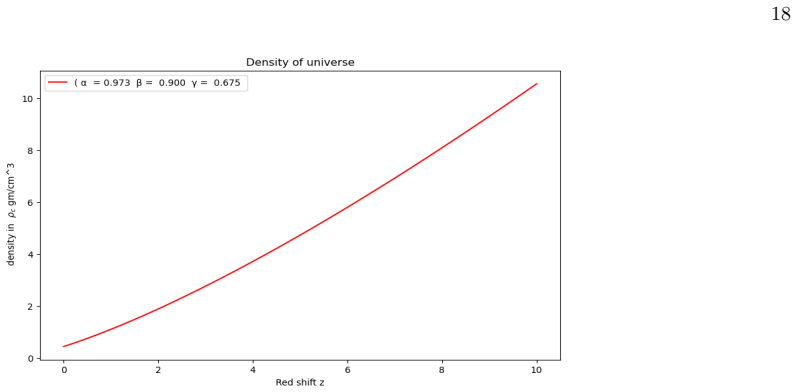
- Matter and vacuum densities both scale as powers of $(1+z)$, and the present vacuum density is larger than the present matter density, matching the observed late-time acceleration regime.
- The redshift-time integral (Eq. 32) gives a present age of 21.73 or 22.78 billion years depending on the combined data set, a value the paper notes is considerably higher than the $\Lambda$CDM age.
Reading between the lines
- Because Eq. (16) makes $q$ a constant for any fitted coefficients, the model cannot describe a transition from decelerated to accelerated expansion; a future model-independent detection that $q(z)$ varies with redshift would rule it out even if the current $H_0$ fits look good.
- Equation (6) is a linear parametrization of the vacuum energy; relating $\alpha$, $\beta$, $\gamma$ to a scalar-field potential or a modified-gravity action would be needed to turn the empirical fit into a physical mechanism rather than a curve-fitting scheme.
- The paper is not consistent about which symbol is the barotropic index - $w$ appears in the derived formulas while $\gamma$ is sometimes also called the equation-of-state parameter - so the reported parameter bounds should be read as conditional on $w=0$ until a refit with $w$ free is done.
- The predicted age near 22 Gyr is high enough that an independent lower bound on the age of the oldest stellar populations, or a direct low-redshift measurement of $H(z)$, would discriminate this model from $\Lambda$CDM more sharply than the current $H_0$ scatter.
Signed reviews
Editorial analysis
A structured set of objections, weighed in public.
Referee Report
Summary. The manuscript presents a spatially flat FLRW model with a time-varying cosmological constant Λ(t) = α ä/a + β(ȧ/a)^2 + 4πGγρ, derives a power-law Hubble parameter H(z) = H0(1+z)^((w+1)(α+β−3)/(−γ+α(w+1)−2)), and fits H0, α, β, γ to the 46-point OHD sample, the 580-point Union 2.1 compilation, the 1048-point Pantheon sample, and a BAO distance-ratio sample, both individually and in various combinations. It then computes Ωm, ΩΛ, ρ0, ρΛ0, and the age of the universe from the fitted parameters, and claims that the combined fits produce H0 values close to both the early-universe (67.7 km/s/Mpc) and late-universe (73 km/s/Mpc) measurements, thereby resolving the Hubble tension.
Significance. If the model and fits were correct, the paper would offer a compact phenomenological parametrization of a dynamical cosmological term and a possible way to bridge the Hubble tension. The manuscript has some positive features: the analytic formulas for H(z), q, j, densities, and age are explicit, and the MCMC methodology using emcee is a standard and appropriate tool for parameter estimation. However, the analysis is not reproducible as written: the equation-of-state parameter w in the fitted Hubble law is never defined or fitted, the BAO dataset is internally inconsistent, the Pantheon analysis fixes a poorly justified absolute magnitude, and the Data Availability statement contradicts the use of four public datasets. These issues affect every reported parameter and the central conclusion, so the claimed resolution of the Hubble tension is not established.
major comments (5)
- [Section II, Eq. (13); Section III] The fitted Hubble law is not well defined because the equation-of-state parameter w is never specified. The text first sets p = γρ and calls γ the equation-of-state parameter, then writes p = wρ in Eqs. (8)–(9) without relating w to γ. Eq. (13), the relation used for every dataset, contains w, but Section III and Tables I–V report only H0, α, β, γ, with no prior or posterior for w. If w = 0 (dust) is intended, the exponent for the OHD+BAO+Union best fit (α = 0.973, β = 0.901, γ = 0.676) is 0.661; if w = γ, the exponent is 1.806, a factor of about 2.7 difference that changes H(z) and hence every H0, density, and age in Tables I–VIII. If w is instead a fifth free parameter, the quoted posteriors are marginal over an unspecified w. The manuscript must state which interpretation is used and rerun the fits accordingly. In addition, because H(z) depends only on H0 and the combination E = (w+1)(α+β−3)/(−γ+α(w+1)−2), the datasets used here cannot separately pin down α, β, and γ; the individual parameter constraints in Tables I–V are therefore not meaningful tests of the Λ ansatz.
- [Section III.D, Eqs. (27)–(30)] The BAO analysis is internally inconsistent. The text lists six data points z = (0.106, 0.2, 0.35, 0.44, 0.6, 0.73) with dz = (30.95, 17.55, 10.11, 8.44, 6.69, 5.45), but the vector X in Eq. (29) uses z = 0.57 with value 6.72, omits the z = 0.2 and z = 0.73 entries, and uses reference values 30.84, 10.33, 6.72, 8.41, 6.66, 5.43 that do not correspond to the listed dz values. Equation (27) defines dz as rs(z*)/Dv(z), while Eq. (29) uses dA(z*)/Dv(z). The abstract states that the BAO sample has 5 redshifts, but the text and the 6×6 covariance matrix use 6. These inconsistencies make Table IV and the combined fits unverifiable as written.
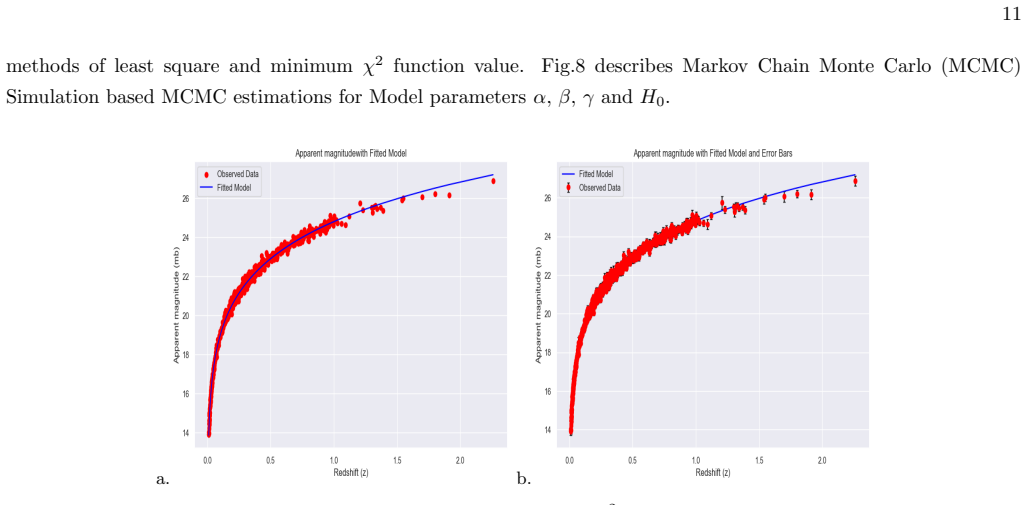
- [Section III.C, Eqs. (25)–(26)] The Pantheon fit fixes the absolute magnitude M = −19.09 and treats mb0 = 23.29 − 5 log h as a known constant. Pantheon supernova analyses normally marginalize over M because M and H0 are degenerate in the distance modulus. Fixing M to a single value without a systematic uncertainty can shift the inferred H0 by several km/s/Mpc, so the reported H0 = 78.116^{+0.480}_{−0.479} and the combined constraints involving Pantheon depend on an unjustified assumption. The authors should either marginalize over M with a suitable prior or demonstrate that the results are insensitive to M.
- [Section IV, Tables VI–VIII; Eqs. (18)–(21)] The claim that the model resolves the Hubble tension is not supported by the analysis. H0 is a free parameter in every fit, so obtaining values near 67.7 or 73 is not a prediction of the model; the four single-dataset fits already span 61.5 to 78.1 km/s/Mpc, and the two combined fits give 67.4 and 75.0, which merely reproduce the input datasets rather than providing a single model value. Moreover, Ωm, ΩΛ, ρ0, Λ0, and the age are algebraic functions of the fitted α, β, γ, and H0 through Eqs. (18)–(21) and (32), so their stated agreement with observations is not an independent test of the model.
- [Data Availability statement (end of manuscript)] The statement 'No data was used for the research described in the article' directly contradicts Section III, which fits the 46-point OHD sample, the 580-point Union 2.1 sample, the 1048-point Pantheon sample, and a BAO sample, and presents numerical results derived from those fits. This statement must be corrected to identify the public data products and their sources; as written, it makes the analysis impossible to reproduce and raises a serious integrity concern.
minor comments (6)
- [Section II, text near Eq. (16)] The text says the model is valid 'provided that the deceleration constant given by Eq. (16) is positive' and claims it will be seen to be positive, but an accelerating universe requires q < 0, and the reported fits give q ≈ −0.34. This should be corrected.
- [Section III.B, Eq. (24)] The section heading says 'Union 2.1 Compilation 680 data set' while the text and Table II use 580 data points, and Eq. (24) labels the fitted quantity mbth although the Union analysis is for distance moduli μth. These mismatches should be reconciled.
- [Table III and Fig. 5] The MCMC value β = 0.083 ± 0.490 differs from the least-χ² value β = 0.880 ± 0.490 by almost 10σ, and the figure caption lists parameter values that do not match the table entries. This suggests either a typographical error or a convergence problem; it needs clarification.
- [Table IV and Fig. 7] The caption of Fig. 7 reports H0 = 65 ± 1, α = 0.11 ± 0.020, β = 0.41 ± 0.020, γ = 0.91 ± 0.01, whereas Table IV reports H0 = 71.386, α = 1.456, β = 1.556, γ = 1.899. These are substantially different and should be reconciled.
- [Fig. 2 caption] The caption says 'Corner plots for 36 Hubble data set', but the text and Table I refer to the 46-point Hubble dataset.
- [Section III.A–III.E] The MCMC implementation is not described in enough detail: no prior ranges, chain lengths, burn-in, or convergence diagnostics are given, and no code or reproducibility instructions are provided. This should be added if the paper is resubmitted.
Circularity Check
No significant circularity: the paper reports best-fit values and derived quantities from an explicit Λ ansatz; it does not relabel fitted parameters as predictions.
full rationale
The central derivation starts from the explicit ansatz Λ(t)=αä/a+β(ȧ/a)^2+4πGγρ (Eq. 6) and solves the Friedmann equations to obtain H(z)=H0(1+z)^((w+1)(α+β−3)/(−γ+α(w+1)−2)) (Eq. 13). This is a legitimate model-calculation step: the power-law Hubble law is a consequence of the assumed Λ form, not an input smuggled into the output. The paper then fits H0, α, β, γ to OHD, Union, Pantheon and BAO data using χ²/MCMC and reports the best-fit H0 values (Tables I–V); these are explicitly called 'best fit values', and the comparison with 67.7 and 73 km/s/Mpc is a fit-and-compare summary, not a claim that H0 was predicted from first principles. Likewise, Ωm, ΩΛ, ρ0, ρΛ0 and the age are computed by substituting the fitted parameters into the already-derived expressions (Eqs. 18–21, 32); propagating fitted parameters into derived observables is not circular because those observables were not used to constrain the parameters. The self-citations ([27–30], [35]) are contextual or data-source citations and are not load-bearing for the derivation, and no uniqueness theorem is imported. One should note a serious non-circular flaw: Eq. (13) depends on an equation-of-state parameter w that is never fixed or estimated, while Section II also calls γ the equation-of-state parameter. The reported fits appear to use w=0 implicitly, making the quoted central results underdetermined until w is specified; however, this is an underdetermination/reproducibility defect, not a case in which a derived result is equivalent to its input by construction.
Assumptions & free parameters
free parameters (4)
- α =
1.234 (OHD), 0.987 (Union), 1.521 (Pantheon), 1.454 (BAO)
- β =
0.817 (OHD), 0.961 (Union), 0.083 (Pantheon), 1.574 (BAO)
- γ =
0.685 (OHD), 0.866 (Union), 1.156 (Pantheon), 1.920 (BAO)
- H0 =
61.53 (OHD), 69.27 (Union), 78.12 (Pantheon), 71.32 (BAO), 67.43 (OHD+BAO+Union), 75.00 (OHD+Pan+BAO+Union)
assumptions (6)
- standard math Einstein field equations with a cosmological constant
- domain assumption Spatially flat FLRW metric (k=0)
- domain assumption Perfect fluid energy-momentum tensor with pressure p = wρ
- ad hoc to paper The cosmological constant takes the form Λ(t) = α ä/a + β (ȧ/a)^2 + 4πGγρ
- ad hoc to paper Equation-of-state parameter w is fixed to 0 (dust) without being fitted
- domain assumption BAO sound horizon and decoupling redshift z* = 1090 taken from standard values
Cite this review
Pith. "Pith review of An Accelerating Flat FLRW Model with Observation Constraints and Dynamic $\Lambda$." pith.science (2026). https://pith.science/paper/CD4FSUH5
@misc{pith2026250417798,
  author       = {Pith},
  title        = {Pith review of: An Accelerating Flat FLRW Model with Observation Constraints and Dynamic $\Lambda$},
  year         = {2026},
  howpublished = {\url{https://pith.science/paper/CD4FSUH5}},
  note         = {Machine review of arXiv:2504.17798}
}
abstract
In this paper, we explore power law solution of FLRW universe model that is associated with a variable cosmological term $\Lambda(t)$ as a linear function of $\frac{\ddot{a}}{a}, (\frac{\dot{a}}{a})^2$ and $\rho$. The model parameters were estimated on the basis of the four data sets: The Hubble 46 data, the Union 2.1 compilation data sets comprising of distance modulus of 580 SNIa supernovae at different redshifts, the Pantheon data set which contains Apparent magnitudes of 1048 SNIa supernovae at various redshifts and finally BAO data set of volume averaged distances at 5 redshifts. We employ the conventional Bayesian methodology to analyze the observational data and also the Markov Chain Monte Carlo (MCMC) technique to derive the posterior distributions of the parameters. The best fit values of Hubble parameter $H_0$ as per the four data sets are found as $61.53^{+0.453}_{-0.456}$, $ 69.270^{+0.229}_{-0.228}$, $78.116^ {+0.480}_{-0.479}$, and $ 71.318 ^{+2.473}_{-2.283}$ respectively. Off late the present value of Hubble parameters $H_0$ were empirically given as 73 and 67.7 (km/s)/Mpc using distance ladder techniques and measurements of the cosmic microwave background. The OHD+BAO+Union and ~OHD+Pan+BAO+Union combined data sets provide the best fit Hubble parameter value $H_0$ as $67.427^{+0.197}_{-0.199}$ and $74.997^{+0.143}_{-0.145}$ respectively. The various geometrical and physical properties of the model were also investigated and were found in good agreements with observations.
Figures


Figures from the paper (8 more)




Reference graph
Works this paper leans on
-
[1]
S. Perlmutter et al. [Supernova Cosmology Project Collab.], Measurements of the cosmological Parameters Omega and Lambda from the first 7 Supernovae at z ≥ 0.35, Astrophys. J. 83 (1997) 565, arXiv: astro-ph/9608192
arXiv 1997
-
[2]
S. Perlmutter et al.[Supernova Cosmology Project Collab.], Discovery of a supernova explosion at half the age of the universe and its cosmological implications, Nature 91 (1998) 51, arXiv: astro-ph/9712212
arXiv 1998
-
[3]
S. Perlmutter et al. [Supernova Cosmology Project Collab.], Measurements of Omega and Lambda from 42 high-redshift supernovae, Astrophys. J. 17 (1999) 565, arXiv: astro-ph/9812133
arXiv 1999
-
[4]
G. Hinshaw, M. R. Nolta, C. L. Bennett et al., Three-Year Wilkinson Microwave Anisotropy Probe (WMAP) observations: Temperature analysis, Astrophys. J. Supp. 170 (2007) 288, arXiv:astro-ph/0603451
arXiv 2007
-
[5]
L. Page, G. Hinshaw, E. Komatsu et al., Three year Wilkinson Microwave Anisotropy Probe (WMAP) observations: Polarization analysis, Astrophys. J. Supp. 170 (2007) 335, arXiv:astro-ph/0603450
arXiv 2007
-
[6]
C. L. Bennett et al., First year Wilkinson Microwave Anisotropy Probe (WMAP) observations: preliminary maps and basic results, Astrophys. J. Suppl. 148 (2003) 1–43, arXiv:astro-ph/0302207
arXiv 2003
-
[7]
D. N. Spergel et al. [WMAP Collaboration], Three-year wilkinson microwave anisotropy probe (WMAP) observations: implications for cosmology, Astrophys. J. Suppl. Ser. 170 (2007) 377, arXiv:astro-ph/0603449
arXiv 2007
-
[8]
L. Anderson et al. [BOSSCollaboration], The clustering of galaxies in the SDSS-III Baryon Oscillation Spectroscopic Survey: baryon acoustic oscillations in the Data Releases 10 and 11 Galaxy samples, Month. Not. R. Astron. Soc. 441 (2014) 24–62
work page 2014
Show all 51 references
-
[9]
Aubourg et al
E. Aubourg et al. [BOSS Collaboration], Cosmological implications of baryon acoustic oscillation measurements, Phys. Rev. D 92 (2015) 123516
2015
-
[10]
Blake, S
C. Blake, S. Brough, M. Colless et al., The WiggleZ Dark Energy Survey: Joint measurements of the expansion and growth history at z <1, Mon. Not. R. Astron. Soc. 425 (2012) 405
2012
-
[11]
Louis, E
T. Louis, E. Grace, M. Hasselfield, et al., The Atacama Cosmology Telescope: two-season ACTPol spectra and parameters, JCAP 2017 (06) (2017) 031
2017
-
[12]
E. J. Copeland, M. Sami, S. Tsujikawa, Dynamics of dark energy, Int. J. Mod. Phys. D 15 (2006) 1753
2006
-
[13]
Grøn, and S
ø. Grøn, and S. Hervik. Einstein’s general theory of relativity with modern applications in cosmology. Springer Publication (2007)
2007
-
[14]
Abazajian, J
K. Abazajian, J. K. Adelman-McCarthy, M. A. Ag¨ueros, et al., The Second Data Release of the Sloan Digital Sky Survey, Astron. J. 128, 502 (2004)
2004
-
[15]
Sahni and A
V. Sahni and A. Starobinsky, The Case for a Positive Cosmological Lambda-term, Int. J. Mod. Phys. D 9 (2000) 373-443
2000
-
[16]
R. G. Vishwakarma, Consequences on variable Lambda-models from distant Type Ia supernovae and compact radio sources. Class. Quantum Gravity, 18 (2021) 1159-1172
2021
-
[17]
H. Azri, A. Bounames, Cosmological consequences of a variable cosmological constant model, Int. J. Mod. Phys. D 26 (2017) 1750060
2017
-
[18]
H. Azri, A. Bounames, Geometrical origin of the cosmological constant, Gen. Relat. Gravit. 44 (2012) 2547-2561
2012
-
[19]
Szydlowski, Cosmological model with decaying vacuum energy from quantum mechanics, Phys
M. Szydlowski, Cosmological model with decaying vacuum energy from quantum mechanics, Phys. Rev. D 91 (2015) 123538. 22
2015
-
[20]
Koussour , N
M. Koussour , N. Myrzakulov , J. Rayimbaev, Cosmological constraints on time-varying cosmological terms: A study of FLRW universe models with ΛCDM cosmology, Advan. Space Resear. 74 (2024) 1343-1351
2024
-
[21]
L. M. Krauss, M. S. Turner, The cosmological constant is back, Gen. Relat. Gravit. 27 (1995) 1137-1144
1995
-
[22]
K. Croswell, A death in the neighbourhood: Why did a giant red star turn orange before it died? Who stole its hydrogen? And what does it mean for the astronomers on the case? New Scientist 26 March, (1994)
1994
-
[23]
A. D. Dolgov, in The Very Early Universe, eds. G. W. Gibbons, S. W. Hawking, S. T. C. Siklos, Cambridge University Press, Cambridge (1983)
1983
-
[24]
A. D. Dolgov, M. V. Sazhin, Ya. B. Zeldovich, Basics of Modern Cosmology, Editions Frontiers (1990)
1990
-
[25]
A. D. Dolgov, Higher spin fields and the problem of the cosmological constant, Phys. Rev. D 55 (1997) 5881
1997
-
[26]
Ratra and P
B. Ratra and P. J. E. Peebles, Cosmological Consequences of a Rolling Homogeneous Scalar Field, Phys. Rev. D 37 (1988) 3406-3427
1988
-
[27]
Pradhan, G
A. Pradhan, G. Goswami, R. Rani, A. Beesham, An f(R, T) gravity based FLRW model and observational constraints, Astronomy and Computing 44 (2023) 100737, arXiv:2210.15433[gr-qc]
2023 arXiv
-
[28]
Pradhan, G
A. Pradhan, G. K. Goswami, S. Krishnannair, The reconstruction of constant Jerk parameter with f(R,T ) gravity in Bianchi-I spacetime, Eur. Phys. J. Plus 138 (2023) 451, arXiv:2305.14400[gr-qc]
2023 arXiv
-
[29]
Pradhana, G
A. Pradhana, G. K. Goswami, A. Beesham, The reconstruction of constant Jerk parameter with f(R,T ) gravity, JHEAP, 38 (2023) 12–21, arXiv:2303.14136[gr-qc]
2023 arXiv
-
[30]
Pradhana, G
A. Pradhana, G. K. Goswami, A. Beesham, Reconstruction of an observationally constrained f(R,T ) gravity mode, IJGMMP, 20 (2023) 2350169, arXiv:2304.11616[gr-qc]
2023 arXiv
-
[31]
Suzuki et al., The Hubble space telescope cluster supernova survey V improving the dark energy constraints above z >1 and building an early-type-hosted supernova sample, Astrophys
N. Suzuki et al., The Hubble space telescope cluster supernova survey V improving the dark energy constraints above z >1 and building an early-type-hosted supernova sample, Astrophys. J. 746 (2012) 85–115
2012
-
[32]
Scolnic, D
D. Scolnic, D. Brout, A. Carr et al., The Pantheon+ analysis: the full data set and light-curve release, Astrophys. J. 938 (2022) 113
2022
-
[33]
D. D. M. Scolnic, D. O. Jones, A. Rest et al. The complete light-curve sample of spectroscopically confirmed SNe Ia from Pan-STARRS1 and cosmological constraints from the combined Pantheon sample, Astrophys. J. 859 (2018) 101, arXiv:1710.00845 [astro-ph.CO]
2018 arXiv
-
[34]
Giostri, M
R. Giostri, M. V. dSantos, I. Waga, R. R. R. Reis, M. O. Calvao, B. L. Lago, From cosmic deceleration to acceleration: new constraints from SN Ia and BAO/CMB, J. Cosmol. Astropart. Phys, 1203 027 (2012)
2012
-
[35]
Goswami, and Anirudh Pradhan, An axially symmetric transi- tioning model with observational constraints, Chin J Phys, 80, 261–274(2022)
Vinod Kumar Bhardwaj, Archana Dixit, Rita Rani, G.K. Goswami, and Anirudh Pradhan, An axially symmetric transi- tioning model with observational constraints, Chin J Phys, 80, 261–274(2022)
2022
-
[36]
Padmanabhan, X
N. Padmanabhan, X. Xu, D. J. Eisenstein, R. Scalzo, A. J. Cuesta, K. T. Mehta, E. Kazin, A 2 per cent distance to z=0.35 by reconstructing baryon acoustic oscillations - I. Methods and application to the Sloan Digital Sky Survey, Mon. Not. Roy. Astron. Soc. 427 (2012) 2132-214...
2012 arXiv
-
[37]
Beutler, C
F. Beutler, C. Blake, M. Colless, D. H. Jones, L. Staveley-Smith, L. Campbell, Q. Parker, W. Saunders, F. Watson, The 6dF Galaxy Survey: Baryon Acoustic Oscillations and the Local Hubble Constant, Mon. Not. Roy. Astron. Soc. 416 (2011) 3017-3032, arXiv:1106.3366 [astro-ph.CO]
2011 arXiv
-
[38]
L. Anderson et al.[BOSS], The clustering of galaxies in the SDSS-III Baryon Oscillation Spectroscopic Survey: baryon acoustic oscillations in the Data Releases 10 and 11 Galaxy samples, Mon. Not. Roy. Astron. Soc. 441 (2014) 24-62 (2014), arXiv:1312.4877 [astro-ph.CO]
2014 arXiv
-
[39]
Blake, S
C. Blake, S. Brough, M. Colless, C. Contreras, W. Couch, S. Croom, D. Croton, T. Davis, M. J. Drinkwater, K. Forster et al., The WiggleZ Dark Energy Survey: Joint measurements of the expansion and growth history at z < 1, Mon. Not. Roy. Astron. Soc. 425 (2012) 405-414 (2012), ...
2012 arXiv
-
[40]
Blake, E
C. Blake, E. Kazin, F. Beutler, T. Davis, D. Parkinson, S. Brough, M. Colless, C. Contreras, W. Couch, S. Croom et al., The WiggleZ Dark Energy Survey: mapping the distance-redshift relation with baryon acoustic oscillations, Mon. Not. Roy. Astron. Soc. 418 (2011) 1707-1724, a...
2011 arXiv
-
[41]
W. J. Percival et al. [SDSS], Baryon Acoustic Oscillations in the Sloan Digital Sky Survey Data Release 7 Galaxy Sample, Mon. Not. Roy. Astron. Soc. 401 (2010) 2148-2168, arXiv:0907.1660 [astro-ph.CO]. 23
2010 arXiv
-
[42]
D. J. Eisenstein et al. [SDSS], Detection of the Baryon Acoustic Peak in the Large-Scale Correlation Function of SDSS Luminous Red Galaxies, Astrophys. J. 633 (2005) 560-574, arXiv:astro-ph/0501171
2005 arXiv
-
[43]
W. L. Freedman, B. F. Madore, Progress in direct measurements of the Hubble constant, JCAP 11 (2023) (2023) 050, arXiv:2309.05618
2023 arXiv
-
[44]
Mann, One Number Shows Something Is Fundamentally Wrong with Our Conception of the Universe – This fight has universal implications”, Live Science, Retrieved 26 August 2019
A. Mann, One Number Shows Something Is Fundamentally Wrong with Our Conception of the Universe – This fight has universal implications”, Live Science, Retrieved 26 August 2019
2019
-
[45]
E. D. Valentino, et al., In the realm of the Hubble tension—a review of solutions, Class. Quant. Grav. 38 (15) (2021) 153001, arXiv:2103.01183
2021 arXiv
-
[46]
Brout, D
D. Brout, D. Scolnic, B. Popovic et al., The Pantheon+ analysis: Cosmological constraints, The Astrophys. Jour. 938 (2022) 110
2022
-
[47]
de Jaeger, L
T. de Jaeger, L. Galbany, A. G. Riess, et al., A 5 per cent measurement of the Hubble-Lemaitre constant from Type II supernovae, MNRAS, 514 (2022) 4620–4628
2022
-
[48]
A. G. Riess, W. Yuan, L. M. Macri, et al., A Comprehensive Measurement of the Local Value of the Hubble Constant with 1 km/s/Mpc Uncertainty from the Hubble Space Telescope and the SH0ES Team, The Astrophys. Jour. 934 (2022) L7
2022
-
[49]
Contarini, A
S. Contarini, A. Pisani, N. Hamaus, F. Marulli, L. Moscardini, M. Baldi, The perspective of voids on rising cosmology tensions, Astronomy & Astrophysics, 682 (2023) A20
2023
-
[50]
Sneppen, D
A. Sneppen, D. Watson, A. Bauswein, et al. Spherical symmetry in the kilonova AT2017gfo/GW170817, Nature614 (2023) 436–439
2023
-
[51]
Balkenhol, D
L. Balkenhol, D. Dutcher, M. Spurio et al. [SPT-3G Collaboration], Measurement of the CMB temperature power spectrum and constraints on cosmology from the SPT-3G 2018 TT, TE, and EE dataset, Phys. Rev. D 108 (2023) 023510
2023
Reviewed August 16, 2026 · model on record in the stance chip above.
Discussion (0). Continue with ORCID to comment.