REVIEW 4 major objections 4 minor 4 cited by
Virtual Roads, Smarter Safety: A Digital Twin Framework for Mixed Autonomous Traffic Safety Analysis
T0 review · 4 major / 4 minor · reviewed 2026-08-16 · deepseek-v4-flash
Pith's one-line read This paper claims that a digital twin platform integrating aerial LiDAR, OpenStreetMap data, vehicle sensors, CARLA, SUMO, and PhysX can reproduce realistic mixed-traffic dynamics, and that its high-fidelity time-to-collision metric cuts…
desk verdict Useful digital-twin pipeline, but its headline TTC accuracy claim rests on the simulator as its own ground truth and a text/table inversion that undermines trust. read the letter →
The pith
A machine-rendered reading of the paper's core claim, the machinery that carries it, and where it could break.
The reading
What carries the argument
The central object is the high-fidelity time-to-collision computation, defined as the earliest time $t_c^*$ at which either the inter-vehicle distance condition $g_v(Z_i,Z_j)=0$ or the vehicle-obstacle distance condition $g_r(Z_i,R_k)=0$ is satisfied, under a state-space vehicle model $dZ_i/dt = f_i(Z_i,u_i)$. The paper instantiates this model as a 3D bicycle model, a simplified two-wheel kinematic vehicle model incorporating heading, speed, steering angle, road slope $\theta(x,y)$, and the gravity term $-g\sin\theta$, so that TTC responds to slope, tire friction, and mass through the PhysX-simulated dynamics. The companion machinery is the data pipeline: semantic segmentation of aerial LiDAR, georeferencing with ground control points, OSM road-network alignment, and DBSCAN-based junction assignment, which feed the same maps into CARLA and SUMO.
What would settle it
Run the platform's time-to-collision predictions against a corpus of real near-miss and crash events captured by roadside or drone sensors at the same intersections; if the high-fidelity TTC is not systematically closer to observed collision or near-miss instants than the traditional constant-speed TTC, the advertised 59% and 67% advantages do not transfer from simulation to the real road.
Extended reading notes
Core claim
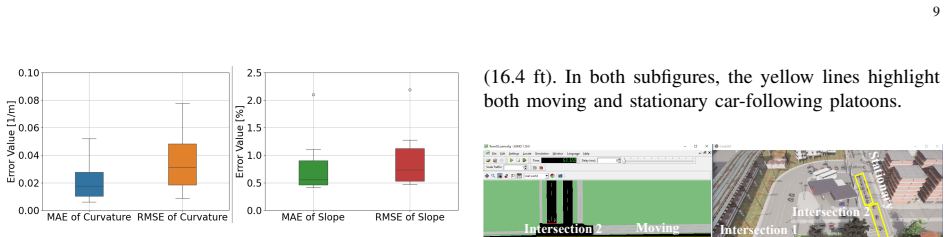
The paper's central claim is that an integrated digital twin can serve as a physics-informed testbed for active safety in mixed traffic, and that its high-fidelity time-to-collision metric is systematically more accurate than the traditional TTC. In six comparable synthetic scenarios, covering rear-end, sideswipe, left-turn-across-path, and right-angle collisions, the high-fidelity TTC has mean absolute error 0.29 seconds and RMSE 0.32 seconds against the simulator's own collision times, versus 0.71 seconds and 0.97 seconds for traditional TTC. The improvement is attributed to replacing constant-speed assumptions with a three-degree-of-freedom bicycle model that includes road slope, gravity, steering input, and acceleration, while low-friction and low-mass variants are shown to change collision outcomes in ways the traditional metric cannot capture. The paper also reports that the LiDAR-plus-OSM reconstruction reproduces lane curvature with RMSE 0.0351 and slope with RMSE 0.8862, with inclinometer data correcting vertical-grade errors.
Load-bearing premise
The load-bearing premise is that the simulated collision times produced by the combined CARLA, SUMO, and PhysX stack are correct ground truth, even though no real-world crash or near-miss data validates the simulator; if those simulated times are biased, the claimed 59% and 67% improvements are comparisons of two models against the simulator that generated both.
Editorial extensions
If this is right
- Safety engineers can test autonomous-vehicle behavior in reproducible mixed-traffic scenarios before deployment, without depending on scarce real-world crash data.
- Accounting for road slope, tire friction, and vehicle mass in time-to-collision reduces systematic underestimation of collision risk, so hazards can be identified earlier.
- The OSM-plus-LiDAR reconstruction captures horizontal geometry well, with curvature RMSE of 0.0351, while inclinometer fine-tuning improves vertical grade accuracy.
- The CARLA-SUMO synchronization loop lets one simulation contain both network-scale traffic flow and sensor-level ego-vehicle dynamics.
- The same joint-simulation platform can generate rare and severe scenarios that are difficult to observe empirically, supporting proactive safety evaluation.
Reading between the lines
- Because the reference values are outputs of the same simulator stack, an immediate testable extension is to replay the eight scenarios in a second independent high-fidelity simulator and check whether the 59% and 67% improvements persist.
- The generic surrogate-safety framework behind the high-fidelity TTC could define other safety metrics, such as post-encroachment time or deceleration rate to avoid a crash, making the digital twin a general proactive safety testbed rather than a single-metric tool.
- Coupling the twin to live roadside or vehicle sensors could turn it from a scenario-replay testbed into a real-time proactive warning system, but only after the simulator is validated on real incident data.
Signed reviews
Editorial analysis
A structured set of objections, weighed in public.
Referee Report
Summary. The paper presents a digital-twin framework for active safety analysis in mixed autonomous traffic, combining drone-based aerial LiDAR, OpenStreetMap data, and vehicle-mounted sensor measurements to reconstruct road geometry, and integrating CARLA, SUMO, and NVIDIA PhysX for joint simulation. The authors propose a high-fidelity time-to-collision (TTC) metric based on a three-dimensional bicycle model with road slope, and they report that this metric outperforms traditional TTC by 59% in mean absolute error and 67% in root mean square error across six synthetic collision scenarios. The paper also describes a clustering-based method for junction assignment and reports curvature and slope errors for the reconstructed road geometry.
Significance. If the quantitative claims were established, the platform would be a useful scenario-based tool for proactive safety analysis in mixed traffic, and the high-fidelity TTC would be a meaningful improvement over constant-speed TTC. The paper's strengths include the end-to-end integration of heterogeneous data sources, the use of measured roadway data for map refinement, and the explicit comparison of two surrogate safety measures. However, the core experimental evidence is limited: the reference 'Simulated' TTC comes from the same simulation stack that is being proposed, the scenarios are synthetic and run once, and an internal inconsistency exists between the text and Table II for Scenario I. The paper is within the scope of the journal and the central idea is defensible, but the current evidence does not yet support the headline accuracy claim.
major comments (4)
- [Section IV-C, Table II] The 'Simulated' TTC values used as the reference are generated by the same CARLA/SUMO/PhysX platform whose safety-analysis utility is being demonstrated, and no real-world crash, near-miss, or naturalistic driving data are used to validate that reference. The reported 59% and 67% error reductions therefore measure agreement with an internal simulator, and a biased simulator could inflate or invert the comparison. The comparison is not definitionally circular because the high-fidelity TTC is not fitted to the simulated outputs, but the reference itself still needs external validation. Please validate the simulator's collision timing against independent data, or at minimum report simulator bias for each scenario type and rephrase the conclusion as 'better agreement with the simulator.'
- [Section IV-C, Scenario I vs. Table II] There is a direct internal inconsistency: the text states that for Scenario I 'the simulated TTC is 1.06 seconds, while the traditional TTC is 1.60 seconds,' but Table II lists Traditional=1.06 and Simulated=1.60. Since Table II is the basis for the headline error-reduction claim, these numbers must be reconciled; otherwise the reader cannot determine which set of values is correct.
- [Section IV-A through IV-C, experimental design] Only one simulation run is reported for each of the eight scenarios, with no error bars, seed variation, or sensitivity analysis. CARLA and SUMO simulations contain stochastic elements (vehicle spawning, traffic controls, and sensor noise), so run-to-run variability could be comparable to the reported RMSE differences of 0.32 s versus 0.97 s. Additionally, Scenarios II and III are excluded from the comparison after the fact with a one-sentence justification, and the ablation study promised at the start of Section IV is never reported. The quantitative comparison cannot support the conclusion until these issues are addressed.
- [Section IV-A, Fig. 12] The curvature and slope errors are said to be computed against 'a ground truth reference,' but the reference is never identified. If that reference is the same inclinometer data used to fine-tune the road geometry, the comparison is partly circular; if it is an independent survey, that should be stated explicitly. Please specify the data source, the number of validation points, and the error calculation procedure.
minor comments (4)
- [Section IV-C, Scenario II] The claim that the friction coefficient is reduced 'from 5 to 2' is nonphysical if these are actual tire-road friction coefficients, which typically lie between 0 and 1; please clarify whether these are dimensionless scale factors in CARLA's tire_friction parameter and provide the corresponding physical values.
- [Section III-C, Eqs. (8)-(10)] The high-fidelity TTC assumes constant control inputs after the evaluation time and uses a Euclidean-distance threshold with point-mass vehicle positions; the 'high-fidelity' label should be accompanied by an explicit acknowledgment of these simplifications and a discussion of their expected effect on the TTC error.
- [Section III-B, Table I] Table I lists WheelPhysics, VehiclePhysics, and GearPhysics attributes but does not explain how they are configured for the ego vehicle; please provide parameter values or a reference so that the dynamics model is reproducible.
- [General] The manuscript does not state the CARLA and SUMO versions, the random seeds, or the number of repeated runs, and no code or data archive is provided; adding these details would substantially improve reproducibility.
Circularity Check
No definitional circularity: the high-fidelity TTC is computed from an independent ODE model rather than fitted to the simulated TTC, and the prior-work citation is not load-bearing. The simulator-as-ground-truth issue is a validation limitation, not a circularity.
full rationale
The paper's central quantitative claim is a comparison between 'traditional TTC', 'simulated TTC', and 'high-fidelity TTC' in Table II. The high-fidelity TTC is not fitted to the simulated values: it is obtained by numerically solving the ODE model in Eq. (8) through the collision conditions in Eqs. (6)-(7), with the constant-control assumption stated explicitly. The traditional TTC is an independent constant-speed formula. Thus the reported MAE/RMSE improvements do not reduce by construction to the reference column. The analytical framework is attributed to the authors' prior work [1], but the current paper restates the equations in full, so no load-bearing step is carried by a bare self-citation. The main concern—that the 'simulated' TTC used as ground truth is generated by the same CARLA/SUMO/PhysX platform under evaluation—is a real external-validity limitation, not a definitional or fitted-input circularity; likewise, the textual/table inconsistency for Scenario I (Section IV-C says simulated=1.06 and traditional=1.60, while Table II lists the reverse) and the missing ablation study affect correctness and completeness, not circularity. Since no step in the derivation chain is equivalent to its own input by definition, the circularity score is 0.
Assumptions & free parameters
free parameters (1)
- zeta (lateral slip tuning coefficient) =
Not specified
assumptions (5)
- domain assumption Control inputs are held constant at t=0 values when computing high-fidelity TTC
- domain assumption The CARLA/SUMO/PhysX simulation yields true collision times
- domain assumption A bicycle model with road slope suffices for collision-relevant motion
- domain assumption Collision is approximated by Euclidean distance thresholds
- standard math ODE solutions exist and RK4 integration is accurate enough for TTC
Cite this review
Pith. "Pith review of Virtual Roads, Smarter Safety: A Digital Twin Framework for Mixed Autonomous Traffic Safety Analysis." pith.science (2026). https://pith.science/paper/OX7APSAJ
@misc{pith2026250417968,
  author       = {Pith},
  title        = {Pith review of: Virtual Roads, Smarter Safety: A Digital Twin Framework for Mixed Autonomous Traffic Safety Analysis},
  year         = {2026},
  howpublished = {\url{https://pith.science/paper/OX7APSAJ}},
  note         = {Machine review of arXiv:2504.17968}
}
read the original abstract
This paper presents a digital-twin platform for active safety analysis in mixed traffic environments. The platform is built using a multi-modal data-enabled traffic environment constructed from drone-based aerial LiDAR, OpenStreetMap, and vehicle sensor data (e.g., GPS and inclinometer readings). High-resolution 3D road geometries are generated through AI-powered semantic segmentation and georeferencing of aerial LiDAR data. To simulate real-world driving scenarios, the platform integrates the CAR Learning to Act (CARLA) simulator, Simulation of Urban MObility (SUMO) traffic model, and NVIDIA PhysX vehicle dynamics engine. CARLA provides detailed micro-level sensor and perception data, while SUMO manages macro-level traffic flow. NVIDIA PhysX enables accurate modeling of vehicle behaviors under diverse conditions, accounting for mass distribution, tire friction, and center of mass. This integrated system supports high-fidelity simulations that capture the complex interactions between autonomous and conventional vehicles. Experimental results demonstrate the platform's ability to reproduce realistic vehicle dynamics and traffic scenarios, enhancing the analysis of active safety measures. Overall, the proposed framework advances traffic safety research by enabling in-depth, physics-informed evaluation of vehicle behavior in dynamic and heterogeneous traffic environments.
Figures


Figures from the paper (13 more)




Forward citations
Cited by 4 Pith papers
-
AI2-Active Safety: AI-enabled Interaction-aware Active Safety Analysis with Vehicle Dynamics
A highway safety framework uses a gradient-aware bicycle model plus a hypergraph transformer to produce probability-weighted time-to-collision distributions that beat constant-velocity TTC.
-
Edge-Based Multimodal Sensor Data Fusion with Vision Language Models (VLMs) for Real-time Autonomous Vehicle Accident Avoidance
A lightweight vision-language model on an edge device fuses roadside hazard alerts with onboard camera views to adjust trajectories, and the authors report a 77% simulated collision reduction over a vision-only baseline.
-
Simulating the Unseen: Crash Prediction Must Learn from What Did Not Happen
Crash prediction should learn from near-miss events and synthetic counterfactual scenarios, not just recorded crashes.
-
Automated Vehicles Should be Connected with Natural Language
A vision paper recommending natural language as the universal communication medium for connected and automated vehicles.
Reference graph
Works this paper leans on
-
[1]
S. Li, M. Anis, D. Lord, H. Zhang, Y . Zhou, and X. Ye, “Beyond 1d and oversimplified kinematics: A generic analytical framework for surrogate safety measures,” Accident Analysis & Prevention , vol. 204, p. 107649, 2024
work page 2024
-
[2]
Z. Li, Y . Zhou, D. Chen, and Y . Zhang, “Distur- bances and safety analysis of linear adaptive cruise control for cut-in scenarios: A theoretical frame- work,” Transportation Research Part C: Emerging Technologies, vol. 168, p. 104576, 2024
work page 2024
-
[3]
H. Zhang, S. Li, Z. Li, M. Anis, D. Lord, and Y . Zhou, “Why anticipatory sensing matters in commercial acc systems under cut-in scenarios: A perspective from stochastic safety analysis,” arXiv preprint arXiv:2411.13456, 2024
work page Pith review arXiv 2024
-
[4]
A. Pauwels, N. Pourmohammad-Zia, and F. Schulte, “Safety and sustainable development of automated driving in mixed-traffic urban areas—considering vulnerable road users and network efficiency,” Sustainability, vol. 14, no. 20, p. 13486, 2022
work page 2022
-
[5]
Digital twin analysis to promote safety and security in autonomous vehicles,
S. Almeaibed, S. Al-Rubaye, A. Tsourdos, and N. P. Avdelidis, “Digital twin analysis to promote safety and security in autonomous vehicles,” IEEE Communications Standards Magazine, vol. 5, no. 1, pp. 40–46, 2021
work page 2021
-
[6]
K. Ku ˇsi´c, R. Schumann, and E. Ivanjko, “A digital twin in transportation: Real-time synergy of traffic data streams and simulation for virtualizing motor- way dynamics,” Advanced Engineering Informat- ics, vol. 55, p. 101858, 2023
work page 2023
-
[7]
Digital twin- assisted cooperative driving at non-signalized in- tersections,
Z. Wang, K. Han, and P. Tiwari, “Digital twin- assisted cooperative driving at non-signalized in- tersections,” IEEE Transactions on Intelligent Ve- hicles, vol. 7, no. 2, pp. 198–209, 2021
work page 2021
-
[8]
S. Mahmud, L. Ferreira, and A. Tavassoli, “Tra- ditional approaches to traffic safety evaluation (tse): Application challenges and future directions,” Bridging the east and west , pp. 242–262, 2016
work page 2016
Show all 41 references
-
[9]
The statistical analysis of crash-frequency data: A review and assessment of methodological alternatives,
D. Lord and F. Mannering, “The statistical analysis of crash-frequency data: A review and assessment of methodological alternatives,” Transportation re- search part A: policy and practice , vol. 44, no. 5, pp. 291–305, 2010
2010
-
[10]
Advancing traffic safety through the safe system approach: A systematic review,
M. N. Khan and S. Das, “Advancing traffic safety through the safe system approach: A systematic review,” Accident Analysis & Prevention , vol. 199, p. 107518, 2024
2024
-
[11]
More aware, more protected: a cross-sectional study on road safety skills predicting the use of passive safety elements among spanish teenagers,
S. Useche, F. Alonso, L. Montoro, and L. Garrig ´os, “More aware, more protected: a cross-sectional study on road safety skills predicting the use of passive safety elements among spanish teenagers,” BMJ open, vol. 9, no. 11, p. e035007, 2019
2019
-
[12]
Examining accident reports involving autonomous vehicles in california,
F. M. Favar `o, N. Nader, S. O. Eurich, M. Tripp, and N. Varadaraju, “Examining accident reports involving autonomous vehicles in california,” PLoS one, vol. 12, no. 9, p. e0184952, 2017
2017
-
[13]
Collision risk in autonomous vehicles: classification, challenges, and open research areas,
P. Goudarzi and B. Hassanzadeh, “Collision risk in autonomous vehicles: classification, challenges, and open research areas,” Vehicles, vol. 6, no. 1, pp. 157–190, 2024
2024
-
[14]
Surrogate safety measures from traffic simulation models a comparison of different models for inter- section safety evaluation,
V . Astarita, D. C. Festa, V . P. Giofr`e, and G. Guido, “Surrogate safety measures from traffic simulation models a comparison of different models for inter- section safety evaluation,” Transportation research procedia, vol. 37, pp. 219–226, 2019
2019
-
[15]
Adaptive cruise control under threat: A stochastic active safety analysis of sensing attacks in mixed traffic,
Z. Li, Y . Zhou, J. Jiang, Y . Zhang, and M. M. Kulkarni, “Adaptive cruise control under threat: A stochastic active safety analysis of sensing attacks in mixed traffic,” Accident Analysis & Prevention , vol. 209, p. 107813, 2025
2025
-
[16]
A review of surrogate safety measures and their applications in connected and automated vehicles safety model- ing,
C. Wang, Y . Xie, H. Huang, and P. Liu, “A review of surrogate safety measures and their applications in connected and automated vehicles safety model- ing,” Accident Analysis & Prevention , vol. 157, p. 106157, 2021
2021
-
[17]
Carla: An open urban driving sim- ulator,
A. Dosovitskiy, G. Ros, F. Codevilla, A. Lopez, and V . Koltun, “Carla: An open urban driving sim- ulator,” in Conference on robot learning . PMLR, 2017, pp. 1–16. 13
2017
-
[18]
Sumo–simulation of urban mobility: an overview,
M. Behrisch, L. Bieker, J. Erdmann, and D. Kra- jzewicz, “Sumo–simulation of urban mobility: an overview,” in Proceedings of SIMUL 2011, The Third International Conference on Advances in System Simulation. ThinkMind, 2011
2011
-
[19]
Validation of a real-time capable multi- body vehicle dynamics formulation for automotive testing frameworks based on simulation,
A. Parra, A. J. RODR ´ıGUEZ, A. Zubizarreta, and J. Perez, “Validation of a real-time capable multi- body vehicle dynamics formulation for automotive testing frameworks based on simulation,” IEEE Access, vol. 8, pp. 213 253–213 265, 2020
2020
-
[20]
Optimizing vehicle dynamics co-simulation performance by introducing mesoscopic traffic simulation,
B. Varga, D. Doba, and T. Tettamanti, “Optimizing vehicle dynamics co-simulation performance by introducing mesoscopic traffic simulation,” Simu- lation modelling practice and theory , vol. 125, p. 102739, 2023
2023
-
[21]
A combined use of microscopic traffic simulation and extreme value methods for traffic safety evalua- tion,
C. Wang, C. Xu, J. Xia, Z. Qian, and L. Lu, “A combined use of microscopic traffic simulation and extreme value methods for traffic safety evalua- tion,” Transportation Research Part C: Emerging Technologies, vol. 90, pp. 281–291, 2018
2018
-
[22]
Dig- ital twin in intelligent transportation systems: A review,
W. A. Ali, M. Roccotelli, and M. P. Fanti, “Dig- ital twin in intelligent transportation systems: A review,” in 2022 8th International Conference on Control, Decision and Information Technologies (CoDIT), vol. 1. IEEE, 2022, pp. 576–581
2022
-
[23]
The role of digital twins in connected and automated vehicles,
C. Schwarz and Z. Wang, “The role of digital twins in connected and automated vehicles,” IEEE Intel- ligent Transportation Systems Magazine , vol. 14, no. 6, pp. 41–51, 2022
2022
-
[24]
Sensor fusion of camera and cloud digital twin information for intelligent vehicles,
Y . Liu, Z. Wang, K. Han, Z. Shou, P. Tiwari, and J. H. Hansen, “Sensor fusion of camera and cloud digital twin information for intelligent vehicles,” in 2020 IEEE Intelligent Vehicles Symposium (IV) . IEEE, 2020, pp. 182–187
2020
-
[25]
Mobility digital twin: Concept, architecture, case study, and future chal- lenges,
Z. Wang, R. Gupta, K. Han, H. Wang, A. Ganlath, N. Ammar, and P. Tiwari, “Mobility digital twin: Concept, architecture, case study, and future chal- lenges,” IEEE Internet of Things Journal , vol. 9, no. 18, pp. 17 452–17 467, 2022
2022
-
[26]
Architecting digital twins for intelligent transportation systems,
H. Bhatt, K. Vaidhyanathan, R. Biju, D. Gangadha- ran, R. Trestian, P. Shah et al., “Architecting digital twins for intelligent transportation systems,” arXiv preprint arXiv:2502.17646, 2025
2025 arXiv
-
[27]
M. Jaud, S. Passot, P. Allemand, N. Le Dantec, P. Grandjean, and C. Delacourt, “Suggestions to limit geometric distortions in the reconstruction of linear coastal landforms by sfm photogrammetry with photoscan® and micmac® for uav surveys with restricted gcps pattern,” Drones,...
2018
-
[28]
Validating realitycap- ture for point cloud creation using suas imagery,
E. Barreiro and N. Carter, “Validating realitycap- ture for point cloud creation using suas imagery,” SAE Technical Paper, Tech. Rep., 2024
2024
-
[29]
RealityCapture (Ver- sion 1.2) [computer software],
Capturing Reality s.r.o., “RealityCapture (Ver- sion 1.2) [computer software],” https://www. capturingreality.com, 2024, accessed: 2025-04-10
2024
-
[30]
Learning seman- tic segmentation of large-scale point clouds with random sampling,
Q. Hu, B. Yang, L. Xie, S. Rosa, Y . Guo, Z. Wang, N. Trigoni, and A. Markham, “Learning seman- tic segmentation of large-scale point clouds with random sampling,” IEEE Transactions on Pattern Analysis and Machine Intelligence , vol. 44, no. 11, pp. 8338–8354, 2021
2021
-
[31]
A density-based algorithm for discovering clusters in large spatial databases with noise,
M. Ester, H.-P. Kriegel, J. Sander, X. Xu et al., “A density-based algorithm for discovering clusters in large spatial databases with noise,” in kdd, vol. 96, no. 34, 1996, pp. 226–231
1996
-
[32]
Stabilizing mixed vehicular platoons with con- nected automated vehicles: An h-infinity approach,
Y . Zhou, S. Ahn, M. Wang, and S. Hoogendoorn, “Stabilizing mixed vehicular platoons with con- nected automated vehicles: An h-infinity approach,” Transportation Research Part B: Methodological , vol. 132, pp. 152–170, 2020
2020
-
[33]
A review of some pure-pursuit based path tracking techniques for control of autonomous vehicle,
M. Samuel, M. Hussein, and M. B. Mohamad, “A review of some pure-pursuit based path tracking techniques for control of autonomous vehicle,” In- ternational Journal of Computer Applications , vol. 135, no. 1, pp. 35–38, 2016
2016
-
[34]
NVIDIA PhysX SDK,
N. Corporation, “NVIDIA PhysX SDK,” https:// github.com/NVIDIAGameWorks/PhysX, 2018, ac- cessed: 2025-04-10
2018
-
[35]
A new 4th order runge-kutta method for initial value problems with error control,
D. J. Evans, “A new 4th order runge-kutta method for initial value problems with error control,” International Journal of Computer Mathematics , vol. 39, no. 3-4, pp. 217–227, 1991
1991
-
[36]
Graph- based interaction-aware multimodal 2d vehicle tra- jectory prediction using diffusion graph convolu- tional networks,
K. Wu, Y . Zhou, H. Shi, X. Li, and B. Ran, “Graph- based interaction-aware multimodal 2d vehicle tra- jectory prediction using diffusion graph convolu- tional networks,” IEEE Transactions on Intelligent Vehicles, vol. 9, no. 2, pp. 3630–3643, 2023
2023
-
[37]
Hypergraph-based motion generation with multi-modal interaction relational reasoning,
K. Wu, Y . Zhou, H. Shi, D. Lord, B. Ran, and X. Ye, “Hypergraph-based motion generation with multi-modal interaction relational reasoning,” arXiv preprint arXiv:2409.11676, 2024
2024 arXiv
-
[38]
A tempo- ral fusion transformer for short-term freeway traffic speed multistep prediction,
H. Zhang, Y . Zou, X. Yang, and H. Yang, “A tempo- ral fusion transformer for short-term freeway traffic speed multistep prediction,” Neurocomputing, vol. 500, pp. 329–340, 2022
2022
-
[39]
A deep reinforcement learning based dis- tributed control strategy for connected automated vehicles in mixed traffic platoon,
H. Shi, D. Chen, N. Zheng, X. Wang, Y . Zhou, and B. Ran, “A deep reinforcement learning based dis- tributed control strategy for connected automated vehicles in mixed traffic platoon,” Transportation Research Part C: Emerging Technologies, vol. 148, p. 104019, 2023
2023
-
[40]
Scenario diffusion: Controllable driving scenario generation with diffusion,
E. Pronovost, M. R. Ganesina, N. Hendy, Z. Wang, A. Morales, K. Wang, and N. Roy, “Scenario diffusion: Controllable driving scenario generation with diffusion,” Advances in Neural Information Processing Systems , vol. 36, pp. 68 873–68 894, 2023. 14 Hao Zhang received a B.S. d...
2023
-
[2022]
in Civil Engi- neering at Southeast University in Nanjing, China in 2017
He completed his B.S. in Civil Engi- neering at Southeast University in Nanjing, China in 2017. His research interests include the application and innovation of artificial intelligence and deep learning techniques in connected automated driving, intelligent transportation syst...
2017
Reviewed August 16, 2026 · model on record in the stance chip above.
Discussion (0). Continue with ORCID to comment.