REVIEW 5 major objections 5 minor 63 references
Self-Balancing, Memory Efficient, Dynamic Metric Space Data Maintenance, for Rapid Multi-Kernel Estimation
T0 review · 5 major / 5 minor · reviewed 2026-08-16 · deepseek-v4-flash
Pith's one-line read The paper claims a two-parameter $(K,\alpha)$ dynamic octree gives logarithmic-time updates and queries in evolving metric spaces, replacing full rebuilds in SVGD, incremental KNN, RAG, and OT-Flow.
desk verdict The paper's central O(log n) guarantee is asserted without proof and its own appendix shows a case where KD-tree beats it on neighborhood queries, but the four ML integrations and the dynamic-bounding-volume work are real extensions worth a careful revision. read the letter →
The pith
A machine-rendered reading of the paper's core claim, the machinery that carries it, and where it could break.
The reading
What carries the argument
The load-bearing object is the $(K,\alpha)$-admissible dynamic octree, a recursive space partition whose cells split when a leaf would exceed $\alpha K$ points and merge when an internal node would hold fewer than $K/\alpha$ points; $K$ and $\alpha$ set the density-adaptive operating point. It carries the argument by making heavy operations local: nearest-neighbor queries exclude nodes whose center lies beyond the interaction range, pairwise interactions are computed only for points within cutoff distance, and updates touch only the path between the old and new containing nodes plus affected neighborhoods. The structure also maintains a dynamic bounding volume and cache-friendly memory layout. The claimed $O(\log n)$ update bound rests on the assertion in Section 3.2.3 that this local splitting, merging, and rebalancing keeps the tree balanced as distributions evolve.
What would settle it
Enforce the $(K,\alpha)$ rule on a growing point set in which new points are repeatedly inserted into one small dense region or along a highly skewed wave pattern, and record tree depth and per-operation time as the number of points $n$ increases; if either depth or average update time grows super-logarithmically with $n$ under the enforced admissibility conditions, the central $O(\log n)$ guarantee is false.
Extended reading notes
Core claim
The central claim is that the $(K,\alpha)$-admissible octree—a spatial partition in which no leaf holds more than $\alpha K$ points and no internal node holds fewer than $K/\alpha$ points—maintains a self-balancing structure under streaming updates without ever rebuilding from scratch. The structure adjusts its bounding volume as points enter or leave, prunes nearest-neighbor traversal using cell centers and an interaction radius, and rebalances only the affected regions after each movement. The paper argues this three-step localized process yields $O(\log n)$ updates and queries, and presents measurements supporting it: 22× faster updates than i-Octree at 20,000 objects, 14.3× faster neighborhood-list construction at 200,000 points, 5.6× SVGD speedup with 10× more particles, 5.3–9.4× faster incremental KNN updates, 4.2× faster RAG retrieval with logarithmic insertion, and reductions of up to 99% in reconstruction error for octree-constrained OT-Flow.
Load-bearing premise
The logarithmic-time guarantee rests on the unproven assumption that the $(K,\alpha)$ balance rule keeps the tree's depth logarithmic even when points cluster densely or move adversarially; if depth grows faster in non-uniform distributions, the complexity bounds and all reported speedups inherit the failure.
Editorial extensions
If this is right
- SVGD can scale to 10× more particles at $O(n\log n)$ per iteration instead of $O(n^2)$, improving posterior approximation for Bayesian inference.
- Incremental KNN classifiers can absorb new labeled batches in logarithmic time while keeping accuracy within 0.2% of a full rebuild, enabling real-time adaptation.
- RAG systems can insert new documents into their embedding index in $O(\log n)$ time and retrieve semantically relevant content faster, turning static knowledge bases into streamable ones.
- OT-Flow trained with octree-based neighborhood consistency preserves local structure during transport, with neighborhood Jaccard similarity rising from 0.415 to 0.787 and reconstruction error dropping by up to 99%.
- Across all four applications, the paper claims exponential performance improvements over standard methods while maintaining accuracy, with the gap widening as data size grows.
Reading between the lines
- The same truncation principle should extend to any kernel method with a decaying kernel, such as mean-shift clustering, spectral methods, or approximate Gaussian-process inference, because the complexity argument depends only on locality of interactions, not on the four chosen applications.
- The parameter-sensitivity results (a 36× difference in neighborhood-list time between $K=1000$ and $K=10$) imply that a fixed configuration cannot dominate all workloads, so a deployment system would likely need to adapt $K$ and $\alpha$ online—something the paper lists as future direction.
- A direct experimental extension would test whether octree-based neighborhood consistency improves other generative models with evolving latent codes, such as VAEs or diffusion models, since the paper's OT-Flow result suggests the mechanism generalizes to any transport-like training trajectory.
- Because the RAG accuracy relies on projecting embeddings into 3D, replacing that projection with a local-isometry-preserving embedding might recover exact retrieval accuracy while keeping logarithmic updates; this is a testable extension rather than something the paper establishes.
Signed reviews
Editorial analysis
A structured set of objections, weighed in public.
Referee Report
Summary. The paper introduces a dynamic octree parameterized by two integers (K, alpha), claimed to support logarithmic-time updates and queries in evolving metric spaces without full rebuilding. The structure is applied to four machine learning settings: accelerating Stein Variational Gradient Descent, incremental KNN classification, retrieval-augmented generation indexing, and an OT-Flow variant with a neighborhood-consistency loss. The theoretical contribution is an asserted O(log n) guarantee for a self-balancing octree, and the empirical contribution is a set of benchmarks comparing against KD-trees and i-Octree on synthetic distributions and real applications.
Significance. If the O(log n) update/query guarantee and the reported speedups were established, the structure would be a useful tool for streaming spatial indexing in several ML pipelines. The paper is clearly written, covers a broad range of applications, and is candid in Appendix B.3 about a limitation on highly non-uniform data. However, the central theoretical claim is not proven and is contradicted by that same appendix; the experiments lack statistical reporting; and key numbers are internally inconsistent. As it stands, the manuscript does not support its headline guarantees.
major comments (5)
- [Section 3.2.3 and Section 1.2] The claimed O(log n) update/query guarantee is asserted without proof. The (K,alpha)-admissibility conditions defined in Section 3.2 (no leaf contains more than alpha*K points; each internal node contains more than K/alpha points) do not by themselves bound tree depth. For a point set with exponentially decreasing spacing along one ray, the octree must subdivide along a single chain until leaves hold at most alpha*K points, giving depth as large as Omega(n/(alpha*K)) rather than O(log n). The 'three-step localized process' in Section 3.2.3 needs an invariant showing that insertion, deletion, and movement preserve both admissibility and depth O(log n); no such invariant is given. This is the load-bearing theoretical claim of the paper, and it is unsupported.
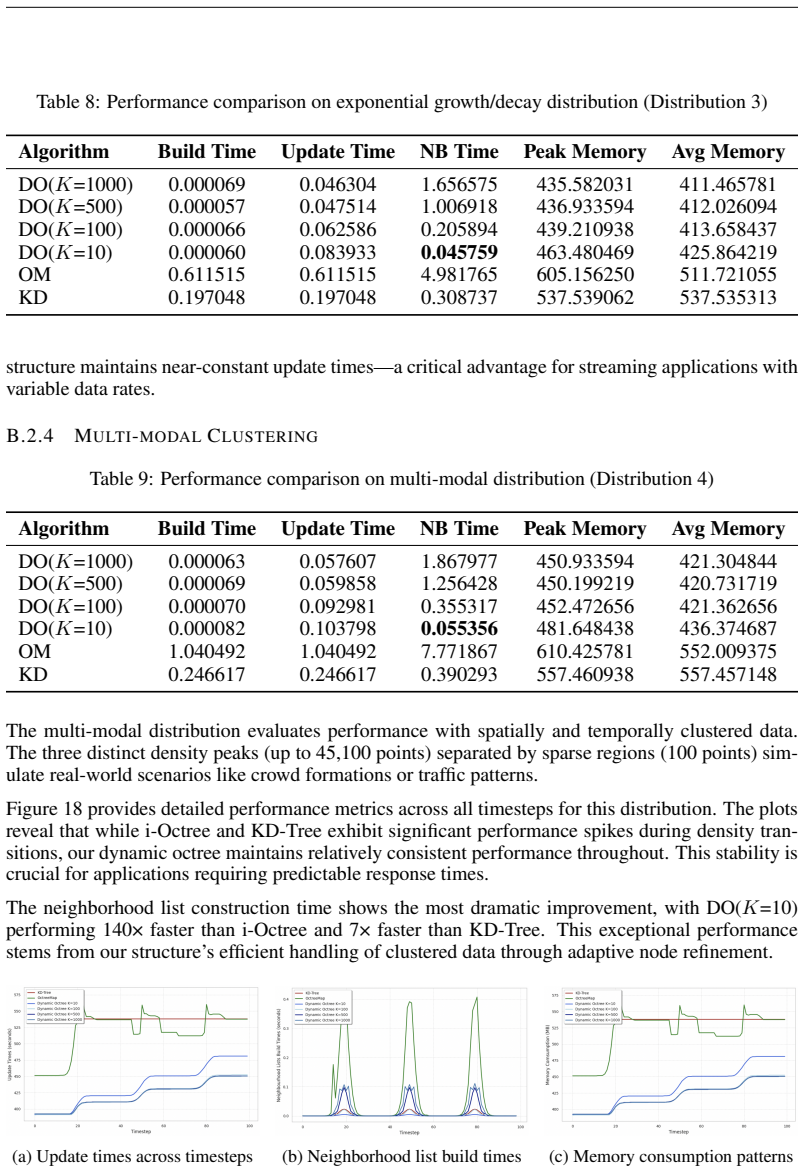
- [Appendix B.3 and Section 5.4] The claimed universal logarithmic bound is contradicted by the paper's own limitation analysis. Figure 21(b) shows DO having higher neighborhood-list construction times than KD-Tree on the wave distribution, and Section B.3.2 states that in the particle simulator KD-Tree shows better neighborhood-list construction performance. Since Section 5.4 claims 'guaranteed logarithmic-time bounds for both update and query operations' across all experiments, the guarantee cannot hold for the presented application settings. At minimum, the scope of the guarantee must be restricted and the theoretical statement revised accordingly.
- [Section 3.2.2] The expression O(n d^2 (delta d + K^{1/3})) is not a logarithmic query bound. The displayed formula is offered as the complexity of 'efficient nearest neighbor maintenance,' but it depends on the cutoff distance d and on the ambient dimension through the d^2 factor, and no derivation is provided. This does not support the abstract's statement of logarithmic-time queries, and the relationship between this expression and the claimed O(log n) behavior is unexplained.
- [Tables 2, 3, 5, 6-10, and 12] The experimental reporting is insufficient to support the performance claims. No standard deviations, error bars, or numbers of seeds are reported, even though Table 2 says results are averaged over 10 time steps. In Table 2, the parameter K is selected separately per operation (DO(K=10) for neighborhood lists versus DO(K=1000) for build), so the reported speedups are post-hoc parameter fits rather than a fixed-configuration comparison. This weakens the 'exponential performance improvements' claim in Section 5.4.
- [Section 5.3.4, Figure 15, and Appendix B.7.3] The reconstruction-error improvement in OT-Flow is reported inconsistently. Section 5.3.4 states an '83% reduction (from 1.78e-06 to 3.05e-07),' while Figure 15's caption and Section B.7.3/Table 12 report a '99% reduction (from 9.14e-05 to 5.54e-07).' These are different baseline values and different percentage reductions; the discrepancy must be resolved before the result can be evaluated.
minor comments (5)
- [Abstract and Section 1.2] The abstract lists four application areas, but Section 1.2 first says 'three key machine learning applications' and then lists four; please make the count consistent.
- [Table 4] Several memory numbers in Table 4 appear suspiciously identical across different point counts and across structures (e.g., DO Peak at 40,000 equals KD-Tree at 30,000, and multiple DO rows exactly match KD-Tree values). Please verify the data or clarify whether these are reporting artifacts.
- [Figure 7] The four panels of Figure 7 are described collectively in the caption but are not individually referenced in the text, making it hard to map the discussion of build, update, neighborhood, and memory to the correct subplot.
- [Algorithm 1] Algorithm 1 normalizes the SVGD update by |N(i)|, the number of neighbors, rather than by the total number of particles n as in the standard SVGD update in Equation (1). This changes the dynamics and should be justified or corrected.
- [Section B.2.3] The claim of '10,728x faster than i-Octree' for build time is based on tiny absolute times (0.000057s versus 0.611515s); such extreme ratios should be reported with appropriate precision and context.
Circularity Check
No circular reduction: complexity bounds are asserted rather than derived from the (K,alpha) definition, benchmark parameters are tuned, and the self-citation is not used to force a conclusion.
full rationale
The paper's central claims are asserted rather than rigorously derived, but an unsupported assertion is not a circular reduction. Section 3.2 defines (K,alpha)-admissibility only through local occupancy bounds, and Section 3.2.3 describes a 'three-step localized process' without proving an invariant that bounds tree depth; this is a proof gap, not a case where an output equals an input by construction. The K values in Tables 6-9 are explicitly reported as tuned choices ('DO(K=10) optimizes for neighborhood queries while DO(K=1000) excels at build operations'), so they are parameter selection rather than a fitted quantity renamed as a prediction. The only self-citation, [21], is used as the source of the base (K,alpha) octree and includes co-author Bajaj, but no uniqueness theorem or unsupported prior result is invoked to forbid alternatives, and the empirical comparisons are against external i-Octree, KD-Tree, and scikit-learn baselines. Appendix B.3.1 concedes limitations for the wave distribution, and the O(log n) guarantee is not proven, but these are correctness and consistency concerns, not circularity. No equation or fitted value in the paper is equivalent by construction to the claimed speedups or complexity bounds.
Assumptions & free parameters
free parameters (5)
- K =
10, 100, 500, 1000 depending on experiment
- alpha =
not reported
- SVGD cutoff radius r = sqrt(4h) =
depends on kernel bandwidth h, not specified
- Adaptive sampling weight lambda =
0.7 (Appendix B.7.1)
- Neighborhood consistency loss weight =
not reported
assumptions (5)
- domain assumption The prior (K,alpha)-octree from Chowdhury et al. [21] provides the claimed space and neighbor-query complexity.
- ad hoc to paper An admissible octree remains balanced with depth O(log n) under arbitrary insertion, deletion, and movement of points.
- ad hoc to paper Kernel interactions beyond distance sqrt(4h) are negligible for SVGD and can be truncated without biasing the approximation.
- domain assumption High-dimensional embeddings can be clustered and projected to 3D without destroying retrieval neighborhoods needed for RAG.
- ad hoc to paper The OT-Flow neighborhood consistency term does not conflict with the optimal transport objective; higher training loss is acceptable.
Cite this review
Pith. "Pith review of Self-Balancing, Memory Efficient, Dynamic Metric Space Data Maintenance, for Rapid Multi-Kernel Estimation." pith.science (2026). https://pith.science/paper/APE26S3U
@misc{pith2026250418003,
  author       = {Pith},
  title        = {Pith review of: Self-Balancing, Memory Efficient, Dynamic Metric Space Data Maintenance, for Rapid Multi-Kernel Estimation},
  year         = {2026},
  howpublished = {\url{https://pith.science/paper/APE26S3U}},
  note         = {Machine review of arXiv:2504.18003}
}
read the original abstract
We present a dynamic self-balancing octree data structure that enables efficient neighborhood maintenance in evolving metric spaces, a key challenge in modern machine learning systems. Many learning and generative models operate as dynamical systems whose representations evolve during training, requiring fast, adaptive spatial organization. Our two-parameter octree supports logarithmic-time updates and queries, eliminating the need for costly full rebuilds as data distributions shift. We demonstrate its effectiveness in four areas: (1) accelerating Stein variational gradient descent by supporting more particles with lower overhead; (2) enabling real-time, incremental KNN classification with logarithmic complexity; (3) facilitating efficient, dynamic indexing and retrieval for retrieval-augmented generation; and (4) improving sample efficiency by jointly optimizing input and latent spaces. Across all applications, our approach yields exponential speedups while preserving accuracy, particularly in high-dimensional spaces where maintaining adaptive spatial structure is critical.
Figures


Figures from the paper (25 more)




Reference graph
Works this paper leans on
-
[1]
Octree-Related Data Structures and Algorithms,
Fujimura, K., Kunii, T., Yamaguchi, K., and Toriya, H., “Octree-Related Data Structures and Algorithms,” IEEE Computer Graphics and Applications, vol. 4, no. 01, pp. 53–59, Jan. 1984
work page 1984
-
[2]
An algorithm for finding best matches in logarithmic expected time,
Friedman, J. H., Bentley, J. L., and Finkel, R. A., “An algorithm for finding best matches in logarithmic expected time,” ACM Transactions on Mathematical Software (TOMS), vol. 3, no. 3, pp. 209–226, 1977
work page 1977
-
[3]
i-Octree: A Fast, Lightweight, and Dynamic Octree for Proximity Search
Zhu, J., Li, H., Wang, Z., Wang, S., and Zhang, T., “i-Octree: A Fast, Lightweight, and Dy- namic Octree for Proximity Search,” arXiv preprint arXiv:2309.08315, 2024
work page Pith review arXiv 2024
-
[5]
The R*-tree: An efficient and robust access method for points and rectangles,
Beckmann, N., Kriegel, H. P., Schneider, R., and Seeger, B., “The R*-tree: An efficient and robust access method for points and rectangles,” in Proceedings of the 1990 ACM SIGMOD international conference on Management of data, pp. 322–331, 1990
work page 1990
-
[6]
A generalization of A VL trees,
Foster, C. C., “A generalization of A VL trees,”Communications of the ACM, vol. 16, no. 8, pp. 513–517, 1973
work page 1973
-
[7]
Besa, J. and Eterovic, Y ., “A concurrent red–black tree,” Journal of Parallel and Distributed Computing, vol. 73, no. 4, pp. 434–449, 2013
work page 2013
-
[8]
Skip lists: a probabilistic alternative to balanced trees,
Pugh, W., “Skip lists: a probabilistic alternative to balanced trees,” Communications of the ACM, vol. 33, no. 6, pp. 668–676, 1990
work page 1990
-
[9]
Fast set operations using treaps,
Blelloch, G. E. and Reid-Miller, M., “Fast set operations using treaps,” in Proceedings of the tenth annual ACM symposium on Parallel algorithms and architectures, pp. 16–26, 1998
work page 1998
Show all 63 references
-
[10]
Splay trees for data compres- sion,
Grinberg, D., Rajagopalan, S., Venkatesan, R., and Wei, V . K., “Splay trees for data compres- sion,” in Proceedings of the sixth annual ACM-SIAM symposium on Discrete algorithms , pp. 522–530, 1995
1995
-
[11]
Fast kd-tree construction with an adaptive error-bounded heuristic,
Hunt, W., Mark, W. R., and Stoll, G., “Fast kd-tree construction with an adaptive error-bounded heuristic,” in 2006 IEEE Symposium on Interactive Ray Tracing, pp. 81–88, 2006
2006
-
[12]
Bkd-tree: A dynamic scalable kd- tree,
Procopiuc, O., Agarwal, P. K., Arge, L., and Vitter, J. S., “Bkd-tree: A dynamic scalable kd- tree,” in Advances in Spatial and Temporal Databases: 8th International Symposium, SSTD 2003, pp. 46–65, 2003
2003
-
[13]
ikd-tree: An incremental kd tree for robotic applications,
Cai, Y ., Xu, W., and Zhang, F., “ikd-tree: An incremental kd tree for robotic applications,” arXiv preprint arXiv:2102.10808, 2021
2021 arXiv
-
[14]
cKd-tree: A Compact Kd-tree,
Guti ´errez, G., Torres-Avil ´es, R., and Caniup ´an, M., “cKd-tree: A Compact Kd-tree,” IEEE Access, vol. 12, pp. 28666–28676, 2024. 15
2024
-
[15]
Battaglia, Learning to Simulate Complex Physics with Graph Networks , arXiv preprint arXiv:2002.09405, 2020, https://arxiv.org/abs/2002.09405
Alvaro Sanchez-Gonzalez, Jonathan Godwin, Tobias Pfaff, Rex Ying, Jure Leskovec, and Peter W. Battaglia, Learning to Simulate Complex Physics with Graph Networks , arXiv preprint arXiv:2002.09405, 2020, https://arxiv.org/abs/2002.09405
2002 arXiv
-
[16]
Flann-fast library for approximate nearest neighbors user manual,
Muja, M. and Lowe, D., “Flann-fast library for approximate nearest neighbors user manual,” Computer Science Department, University of British Columbia, Vancouver, BC, Canada, vol. 5, no. 6, 2009
2009
-
[17]
Basch, J., Kinetic data structures, Stanford University, 1999
1999
-
[18]
A progressive kd tree for approximate k-nearest neighbors,
Jo, J., Seo, J., and Fekete, J. D., “A progressive kd tree for approximate k-nearest neighbors,” in 2017 IEEE workshop on data systems for interactive analysis (DSIA), pp. 1–5, 2017
2017
-
[19]
A study of learning data structure invariants using off-the-shelf tools,
Usman, M., Wang, W., Wang, K., Yelen, C., Dini, N., and Khurshid, S., “A study of learning data structure invariants using off-the-shelf tools,” inModel Checking Software: 26th Interna- tional Symposium, SPIN 2019, pp. 226–243, 2019
2019
-
[20]
Learned Indexes with Distribution Smoothing via Virtual Points,
Amarasinghe, K., Choudhury, F., Qi, J., and Bailey, J., “Learned Indexes with Distribution Smoothing via Virtual Points,”arXiv preprint arXiv:2408.06134, 2024
2024 arXiv
-
[21]
Efficient maintenance and update of nonbonded lists in macromolecular simulations,
Chowdhury, R., Beglov, D., Moghadasi, M., Paschalidis, I. C., Vakili, P., Vajda, S., Bajaj, C., and Kozakov, D., “Efficient maintenance and update of nonbonded lists in macromolecular simulations,” Journal of chemical theory and computation , vol. 10, no. 10, pp. 4449–4454, 2014
2014
-
[22]
Octree generating networks: Efficient convo- lutional architectures for high-resolution 3d outputs,
Tatarchenko, M., Dosovitskiy, A., and Brox, T., “Octree generating networks: Efficient convo- lutional architectures for high-resolution 3d outputs,” inProceedings of the IEEE international conference on computer vision, pp. 2088–2096, 2017
2017
-
[23]
Variational autoencoder with learned latent structure,
Connor, M., Canal, G., and Rozell, C., “Variational autoencoder with learned latent structure,” in International conference on artificial intelligence and statistics, pp. 2359–2367, 2021
2021
-
[24]
Fast approximate geodesics for deep generative models,
Chen, N., Ferroni, F., Klushyn, A., Paraschos, A., Bayer, J., and van der Smagt, P., “Fast approximate geodesics for deep generative models,” inArtificial Neural Networks and Machine Learning–ICANN 2019: Deep Learning: 28th International Conference on Artificial Neural Network...
2019
-
[25]
Data structures and algorithms for high-dimensional structured adaptive mesh refinement,
Grandin, M., “Data structures and algorithms for high-dimensional structured adaptive mesh refinement,” Advances in Engineering Software, vol. 82, pp. 75–86, 2015
2015
-
[26]
Feature-driven topology optimization of continuum structures with tai- lored octree meshing,
Liu, Z. and Xia, L., “Feature-driven topology optimization of continuum structures with tai- lored octree meshing,” Finite Elements in Analysis and Design, vol. 244, p. 104308, 2025
2025
-
[27]
Sample efficient reinforcement learning method via high efficient episodic memory,
Yang, D., Qin, X., Xu, X., Li, C., and Wei, G., “Sample efficient reinforcement learning method via high efficient episodic memory,”IEEE Access, vol. 8, pp. 129274–129284, 2020
2020
-
[28]
Deep reinforcement learning in large discrete action spaces,
Dulac-Arnold, G., Evans, R., van Hasselt, H., Sunehag, P., Lillicrap, T., Hunt, J., Mann, T., Weber, T., Degris, T., and Coppin, B., “Deep reinforcement learning in large discrete action spaces,” arXiv preprint arXiv:1512.07679, 2015
2015 arXiv
-
[29]
Modeling shifting workloads for learned database systems,
Wu, P. and Ives, Z. G., “Modeling shifting workloads for learned database systems,” Proceed- ings of the ACM on Management of Data, vol. 2, no. 1, pp. 1–27, 2024
2024
-
[30]
OT-Flow: Fast and Accurate Continuous Normalizing Flows via Optimal Transport
Derek Onken, Samy Wu Fung, Xingjian Li, and Lars Ruthotto. OT-Flow: Fast and Accurate Continuous Normalizing Flows via Optimal Transport. 2021. 16 A D YNAMIC OCTREE : T HE BACKBONE OF EFFICIENT GENERATIVE SPACE NAVIGATION Figure 16: Dynamic Octree for Evolving Generative Laten...
2021
-
[31]
Build Time Efficiency: Our dynamic octree demonstrates consistently superior build times, requiring only 0.0276 seconds to construct a structure for 100,000 points—5.2× faster than i-Octree and 2.3× faster than KD-Tree
-
[32]
For 100,000 points, our structure completes updates in 0.0826 seconds compared to i-Octree’s 0.2528 seconds—a 3.1× improvement
Update Operation Superiority: The update time measurements reveal a significant ad- vantage for our approach, particularly at scale. For 100,000 points, our structure completes updates in 0.0826 seconds compared to i-Octree’s 0.2528 seconds—a 3.1× improvement
-
[33]
Neighborhood Construction: The most dramatic performance difference appears in neighborhood list construction, where our approach outperforms i-Octree by a factor of 75.6× at 100,000 points (0.0211 seconds versus 1.5950 seconds)
-
[34]
As point counts increase from 10,000 to 100,000, our approach shows only a 12× increase in build time, compared to 20.6× for i-Octree
Scaling Behavior: All three key metrics (build time, update time, and neighborhood construction) show substantially better scaling characteristics for our approach. As point counts increase from 10,000 to 100,000, our approach shows only a 12× increase in build time, compared ...
-
[35]
Current data density and distribution characteristics
-
[36]
nearest neighbor queries)
Expected query patterns (frequency of range vs. nearest neighbor queries)
-
[37]
Update frequency and patterns
-
[38]
Memory constraints Our findings demonstrate that no single parameter configuration is optimal for all scenarios, un- derscoring the potential value of a data-dependent control policy. This represents a fundamental advance in spatial data structure design—moving from static, pr...
-
[39]
This regularity, while beneficial for uniform dis- tributions, becomes restrictive with highly skewed data
Dimensional Constraints: Octrees divide space using axis-aligned, equal-sized partitions along all dimensions simultaneously. This regularity, while beneficial for uniform dis- tributions, becomes restrictive with highly skewed data. KD-trees, being inherently one- dimensional...
-
[40]
This allows KD-trees to create tighter 22 Figure 20: Wave distribution featuring sinusoidal density patterns
Adaptive Partitioning: KD-trees can place splits at arbitrary positions along each dimen- sion, effectively adapting to data concentrations. This allows KD-trees to create tighter 22 Figure 20: Wave distribution featuring sinusoidal density patterns. This distribution maintain...
-
[41]
Imbalance Tolerance: While our dynamic octree maintains balance as a primary optimiza- tion goal through the (K,α ) parameters, KD-trees can strategically accept local imbalance to better match data distribution
-
[42]
In highly non-uniform distributions, these approximations become less accurate
Query Pattern Sensitivity: The neighborhood computation algorithm relies on node-level approximations that work efficiently when points within nodes have relatively uniform dis- tance distributions. In highly non-uniform distributions, these approximations become less accurate...
-
[43]
Hybrid Partitioning Strategies: Implementing partition-selection heuristics that dynam- ically switch between octree-style and KD-tree-style splitting based on local distribution characteristics
-
[44]
Distribution-Aware Parameter Control: A more sophisticated control policy could dy- namically adjust parameters based on local distribution metrics (entropy, skewness, kurto- sis)
-
[45]
Query Algorithm Optimization: The current neighborhood computation algorithm could be enhanced with distribution-aware optimizations to improve node-level approximations. 24
-
[46]
It is important to note that the current performance limitation appears primarily in the most extreme non-uniform distributions
Learned Query Patterns : Since different applications exhibit characteristic query pat- terns, a learning-based approach could optimize neighborhood search strategies based on historical query distribution and results. It is important to note that the current performance limit...
-
[47]
Determine the appropriate cluster for the new embedding
-
[48]
Project it to 3D using the cluster’s projection operator 25
-
[49]
Comparative analysis with FAISS-IVF shows our approach achieves 4.2× faster semantic retrieval while maintaining 96% retrieval accuracy
Insert it into the corresponding octree with O(logn) complexity This enables RAG systems to continuously incorporate new knowledge without performance degra- dation. Comparative analysis with FAISS-IVF shows our approach achieves 4.2× faster semantic retrieval while maintainin...
-
[50]
This confirms our theoretical predictions and enables practical use with much larger particle counts
Computational Scaling : While the naive implementation shows quadratic growth in iteration time ( O(n2)), our octree-accelerated approach exhibits near-linear scaling 26 Algorithm 1 Octree-Accelerated SVGD 1: Input: Initial particlesxin i=1, target distributionp(x), step sizeϵ...
-
[51]
Posterior Quality: Even more significant than the computational advantage is the im- provement in posterior quality. The naive implementation shows degrading posterior val- ues (more negative log posterior) as particle count increases, while our approach main- tains stable, hi...
-
[52]
At 1,000 particles, the naive implementation requires approximately 2.8× more memory than our octree-accelerated approach
Memory Efficiency : Our approach also demonstrates superior memory efficiency. At 1,000 particles, the naive implementation requires approximately 2.8× more memory than our octree-accelerated approach. SVGD has been theoretically promising for Bayesian inference but practicall...
-
[53]
Input Space Octree : Organizes the original data points xi for efficient neighborhood queries
-
[54]
This computational advantage becomes crucial during training, where neighborhood relationships must be continuously reevaluated
Latent Space Octree: Organizes the transformed pointszi as they evolve during training For a point xi, the k-nearest neighbors are retrieved using our octree query algorithm with O(logn +k) complexity compared to O(n×k) for brute force approaches. This computational advantage ...
-
[55]
Error Mapping: For each octree cell, we track: • Average loss within the cell 29 • Neighborhood distortion within the cell
-
[56]
Figure 27: Octree-based adaptive sampling comparison
Adaptive Sampling: During training, we sample points with a bias toward difficult regions: p(x)∝ (1−λ)·puniform(x) +λ·perror(x) (4) Where: • perror(x) is proportional to the error in the cell containingx • λ controls the exploration-exploitation trade-off (typically 0.7) • We ...
-
[57]
OctreeOTFlow Class: Extends the standard OT-Flow with neighborhood consistency eval- uation and efficient k-NN computations
-
[58]
Modified Training Objective : Incorporates the neighborhood consistency term with a weight that balances structure preservation against other OT objectives
-
[59]
Dual-Octree Management: Maintains separate octrees for input and latent spaces, updat- ing the latent space octree after each gradient step to reflect the evolving transport map
-
[60]
B.7.3 E XPERIMENTAL RESULTS We conducted extensive experiments comparing standard OT-Flow with our octree-enhanced variant across several key metrics
Error Tracking: Records distortion metrics for each octree cell to guide adaptive sampling The integration leverages our dynamic octree’s efficient update operations, enabling real-time struc- tural analysis during training without prohibitive computational overhead. B.7.3 E X...
-
[61]
5.54e-07)
Superior Reconstruction Accuracy: 99% reduction in reconstruction error (9.14e-05 vs. 5.54e-07)
-
[62]
Better Structure Preservation: 23.5% reduction in neighborhood distortion and 89.6% improvement in neighborhood Jaccard similarity
-
[63]
Smoother Trajectories: 69% reduction in trajectory curvature, indicating more efficient transport paths
-
[64]
While the octree-enhanced approach shows slightly higher training and validation losses, these are outweighed by the substantial improvements in structural preservation metrics
Computational Efficiency: The octree-based k-NN computation provides O(logn +k) complexity versusO(n×k) for brute force approaches 34 The integration of our dynamic octree with OT-Flow represents a successful application of our spa- tial data structure to complex generative mo...
Reviewed August 16, 2026 · model on record in the stance chip above.
Discussion (0). Continue with ORCID to comment.