REVIEW 4 major objections 6 minor 58 references
Federated Client-tailored Adapter for Medical Image Segmentation
T0 review · 4 major / 6 minor · reviewed 2026-08-16 · deepseek-v4-flash
Pith's one-line read Federated adapters split shared and private units to beat global models
desk verdict Consistent gains from a plausible unit-level adapter decomposition, but the entropy-based split (Eq. 4) is mathematically undefined as written and the paper needs error bars before the SOTA claim is taken seriously. read the letter →
The pith
A machine-rendered reading of the paper's core claim, the machinery that carries it, and where it could break.
The reading
What carries the argument
The load-bearing object is the Global-local Decomposer (GLD), a branch attached to every adapter layer (GLDConv for channels, GLD-FC for neurons) that turns a pretext client-discrimination task into a per-unit contribution score. For an input feature, global average pooling gives $F_d$, and the discriminator's classifier weights $W_d$ and predicted client probabilities are combined as $S = \mathrm{broadcast}(F_d) \odot W_d$ and $S = \hat{S} \otimes P(\hat{y} \mid F_{\mathrm{in}})$ (Eqs. 2-3). The normalized entropy of $S$ over clients (Eq. 4) is then used to mask units as global or local in the binary strategy, or to weight client-to-client parameter updates in the smooth strategy (Eqs. 5-7). A gradient reversal layer keeps the discriminator loss from perturbing the segmentation features. This machinery is what lets the framework keep one global update channel for shared knowledge and one local update channel for personalization.
What would settle it
Train FCA on synthetic clients that differ only in a clinically irrelevant factor (e.g., global brightness or mild blur) while keeping the anatomical labels and distributions identical; if the discriminator still pushes many units into the local set and the local/global split visibly changes the segmentation outputs, the score is capturing nuisance artifacts. A direct check is to compare the global-unit mask selected by Eq. 5 with the mask obtained after permuting client labels during discriminator training: if the selected units change substantially, the decomposition is not a stable evidence of client-specificity.
Extended reading notes
Core claim
The central claim is that client-wise heterogeneity in federated medical segmentation is best handled not by making one global model more robust, but by explicitly separating each client's parameters into a globally shared subset and a locally held subset. To find that split, the framework trains a client discriminator on average-pooled features and computes, for each adapter channel or neuron, a contribution score $S$ that says how strongly that unit votes for each client identity. Units whose scores are near-uniform across clients are treated as client-invariant and federated globally; units whose scores concentrate on one or few clients are treated as client-specific and updated locally. The binary strategy (BFU) hard-thresholds the normalized entropy of $S$, while the smooth strategy (SFU) uses $S$ directly as weights in the aggregation formula. On the CXRS-HG, HLS, and AMD-SD-HG datasets, the paper reports mean Dice scores of 64.15, 92.44, and 63.40 for FCA-SFU, exceeding the MFM-enhanced FedAvg baselines by 3.51, 1.65, and 2.98 points respectively and outperforming all compared personalized federated baselines.
Load-bearing premise
The whole framework rests on trusting that the contribution score computed from the client discriminator is a genuine measure of whether each adapter unit is client-specific, rather than an artifact of easy-to-tell-apart image differences or of discriminator overfitting.
Editorial extensions
If this is right
- Each hospital deploying FCA ends up with its own model tuned to its own data distribution, so federation no longer forces a single compromise model on everyone.
- The decomposition is agnostic to the specific medical foundation model: the paper reports consistent gains when the same FCA-SFU pipeline is built on SAM-Med2D, H-SAM, or Med-SA.
- Because only lightweight adapter parameters are split and shared, the overhead over the plain MFM baseline is small (about 0.09M additional parameters out of 180.5M).
- The smooth strategy's consistent advantage over the binary one suggests that soft, contribution-weighted aggregation is a better recipe for heterogeneous medical data than hard global/local assignment.
- The instability problem reported for conventional FL under class imbalance and distribution diversity is reduced: on the CXRS-HG variant, adding full heterogeneity costs FCA-SFU almost nothing, while it hurts the FedAvg baseline substantially.
Reading between the lines
- The same contribution-score idea could transfer to other parameter-efficient structures (LoRA, prompts, or bias terms) and to federated classification or detection, since nothing in the mechanism is segmentation-specific.
- The discriminator's score $S$ is trained to separate clients by any signal available, so it may treat easy-to-see acquisition differences (brightness, blur, resolution) as client-specific even when those differences carry no anatomical meaning; a test with controlled nuisance-only shifts would reveal how much of the decomposition is domain specificity versus clinically meaningful personalization.
- The fixed entropy threshold $\delta = 0.25$ in the binary strategy is an empirical choice; a per-layer or adaptive threshold, or a warmup schedule that lets the discriminator stabilize before fixing the split, could be tested against the reported results.
Signed reviews
Editorial analysis
A structured set of objections, weighed in public.
Referee Report
Summary. The manuscript proposes the Federated Client-tailored Adapter (FCA), a framework for federated medical image segmentation based on the SAM-Med2D foundation model. The central idea is to insert lightweight adapters into the frozen encoder and decompose adapter units into client-invariant 'global' and client-specific 'local' components using a contribution score derived from a client discriminator. Two updating strategies are introduced: a binary strategy (BFU) that globally averages global units and leaves local units untouched, and a smooth strategy (SFU) that uses the contribution scores as probabilistic aggregation weights. Experiments on three distributed datasets (CXRS-HG, HLS, AMD-SD-HG) report consistent improvements over several federated baselines and personalized methods, and the framework is shown to generalize across three medical foundation models.
Significance. If the reported results hold, the paper makes a useful empirical contribution to personalized federated medical segmentation, demonstrating that parameter-efficient adapters plus client-specific aggregation can improve mDice over strong MFM-based baselines, with consistent gains across datasets and foundation models. The paper also includes a computational-efficiency analysis. However, the theoretical basis of the core decomposition mechanism is not sound as written, and several experimental details are missing, so the significance of the contribution is tempered by reproducibility and validity concerns.
major comments (4)
- [§III-D1, Eq. (4)] Equation (4) defines D_{u,k} = (Σ_j S_{u,k,j} log2 S_{u,k,j}) / log2 K and calls it a normalized entropy over the client-wise score distribution. This is not a valid entropy because S_{u,k,j} is not a probability distribution: it is not normalized to sum to 1, and its entries are not guaranteed to be nonnegative, since they are products of the learned classifier weights W_d and the pooled features F_d, both of which can take negative values. Consequently, the logarithm is undefined for negative entries, and D can be negative or exceed 1. The threshold δ = 0.25 in Eq. (5) therefore has no well-defined meaning, and the subsequent global/local mask in Eq. (6) and the aggregation weights in Eq. (7) inherit this ill-posedness. The paper provides no normalization convention, no sensitivity analysis for δ, and no synthetic experiment showing that S separates known client-specific from client-invariant units. Please either redefine D as a proper normalized entropy over a nonnegative vector that sums to one, or provide a rigorous justification for the current formula.
- [§III-D, Algorithm 1] The paper does not specify how the per-client contribution scores are aggregated to form the three-index array S_{u,k,j} used in Eqs. (4) and (7). In Section III-C, S(i) is computed for each sample and averaged locally, and the text states that 'the final contribution score S will be delivered to the central server and then broadcast to every client.' However, Eq. (7) uses S_{u,k,j} with both a source-client index k and a target-client index j, and the manuscript does not explain whether S_{u,k,j} is the score uploaded by client k, how server-side aggregation of these scores is performed, or how the algorithm handles normalization. Algorithm 1 likewise omits the server-side integration step for S. This makes the BFU and SFU updating rules non-reproducible as written.
- [§III-C, GRL description] The description of the Gradient Reversal Layer is internally inconsistent. The text says the GRL is inserted 'to truncate the gradients from the above discrimination loss,' which is a stop-gradient operation, but the name 'Gradient Reversal Layer' in the literature denotes a layer that reverses gradients during backpropagation. If a true reversal is used, the discriminator would encourage domain-invariant features, which would suppress the client-specific signal that the contribution score S is intended to measure. If a stop-gradient is used, the layer should be described as such, and the implications for the validity of S as a client-specificity measure should be discussed. Please clarify the exact forward/backward behavior of this layer and justify that the resulting S is a meaningful estimator of unit-level client-specificity.
- [§IV.A.2 and Table I] The HLS dataset is described as comprising four independent subsets (references [53]–[56]), but Table I reports results for exactly three clients on this dataset. The mapping from the four subsets to the three clients is not described, which prevents reproducibility of the HLS experiments. Please specify which subset(s) are assigned to each client, or how the fourth subset is used (e.g., held out, merged, or split).
minor comments (6)
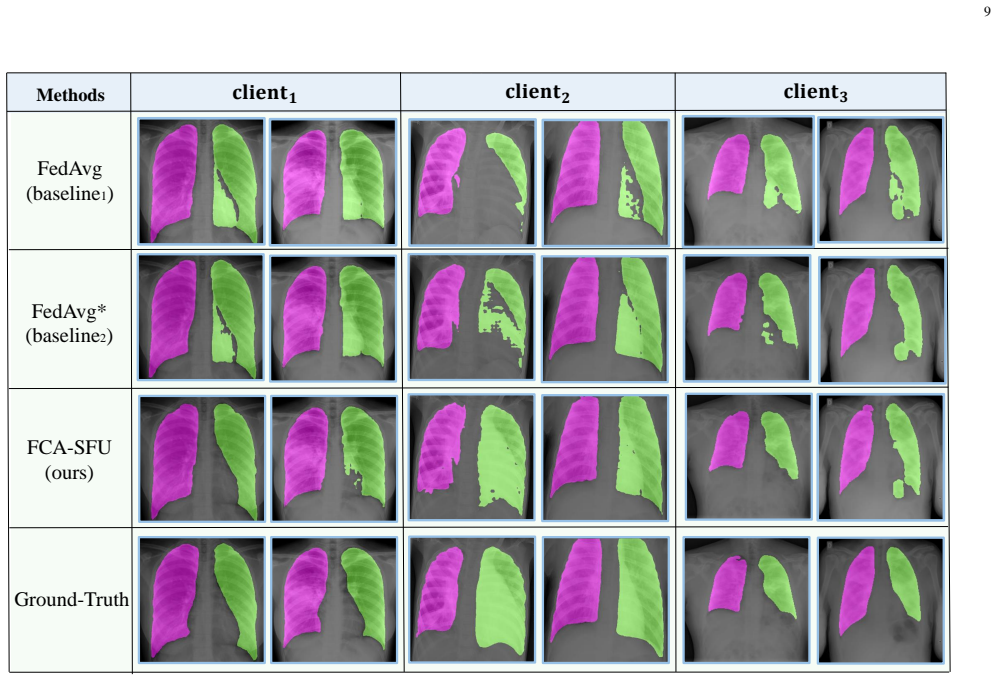
- [§IV.C, text before Fig. 5] The text 'our FCA-SBU achieves more precision segmentation' contains a typo: it should read 'our FCA-SFU.'
- [§IV.D] The phrase 'sets a new start-of-art result' should read 'sets a new state-of-the-art result.'
- [§III-C, Eq. (1)] The symbol W_d is used both for the discriminator network (in Eq. (1)) and for the classifier weight matrix (in Eqs. (2)–(3)); please use distinct notation to avoid ambiguity.
- [§III-D1] The sentence 'If the weighted contribution scores are similar across all clients, it suggests that the parameter group in this unit is client-specific and thus can be considered a global parameter' appears to state the opposite of the intended meaning; 'client-specific' should likely read 'client-invariant.'
- [§IV.C] The list of compared methods includes 'IOP-FL [17]' twice; please remove the duplicate.
- [Tables I–IV] All main tables report single-run results without standard deviations; please report mean and standard deviation over multiple seeds, especially given the small margins on HLS, to support the superiority claims.
Circularity Check
No significant circularity: the FCA decomposition signal and client-tailored update rules are auxiliary mechanisms evaluated against external baselines, not fitted quantities relabeled as predictions.
full rationale
The paper's central claim is that its client discriminator contribution score S (Eqs. 2-3) allows adapter units to be split into global and local components, and that the BFU/SFU update rules (Eqs. 5-7) improve federated medical image segmentation. This chain is not circular. S is computed from the frozen-feature GAP output F_d, the learned discriminator classifier W_d, and the discriminator's predicted client probability P, and it is used only to construct masks or aggregation weights. It is not a fit to the reported evaluation metric (mDice), nor is mDice used to define S, the masks, or the update rules. The segmentation loss and the pretext client-discrimination loss are distinct objectives, and the final tables compare against external baselines (FedAvg, FedProx, FedSeg, IOP-FL, FedA3I, etc.), so the reported improvements are empirical findings rather than consequences of a definitional identity. The only self-citations in load-bearing positions are [50], used as the data source for the CXRS-HG benchmark, and [25]-[28], general related-work references; none supplies a uniqueness theorem or an unverified premise on which the method's derivation depends. The skeptic's concern about Eq. 4 - that S can contain negative entries and is not normalized into a valid probability distribution before being fed into a Shannon-entropy formula - is a legitimate correctness and statistical-validity concern about whether the diversity score D and threshold delta (0.25) are well defined. However, a flawed or unjustified statistic is not circularity: the paper does not define S in terms of D, nor D in terms of the final segmentation outcome. The absence of sensitivity analysis for delta and the lack of synthetic validation for the S proxy weaken the evidence for the method's mechanism, but they do not reduce the claimed contribution to its own inputs. Under the review rules, this is an honest non-finding: the derivation is self-contained against external benchmarks, so the circularity score is 0.
Assumptions & free parameters
free parameters (4)
- BFU entropy threshold delta =
0.25
- Number of local epochs Ne =
5 for CXRS-HG, 3 for HLS
- Global rounds T =
60
- Learning rate and weight decay =
0.001 and 0.001
assumptions (4)
- domain assumption A unit's contribution to client-discriminator classification (Eqs. 2-3) proxies the unit's client-specificity.
- domain assumption Frozen SAM-Med2D encoder provides universal medical knowledge that can be distilled by lightweight adapters and prompt/mask decoder fine-tuning.
- domain assumption Simulated heterogeneity in CXRS-HG and AMD-SD-HG (Dirichlet split and fixed augmentations) is representative of real-world distributed medical data.
- standard math The Gradient Reversal Layer behaves as intended and does not break main-branch training.
invented entities (1)
-
Global-local Decomposer (GLD) with client discriminator branch
Cite this review
Pith. "Pith review of Federated Client-tailored Adapter for Medical Image Segmentation." pith.science (2026). https://pith.science/paper/CXW7MZAR
@misc{pith2026250418020,
  author       = {Pith},
  title        = {Pith review of: Federated Client-tailored Adapter for Medical Image Segmentation},
  year         = {2026},
  howpublished = {\url{https://pith.science/paper/CXW7MZAR}},
  note         = {Machine review of arXiv:2504.18020}
}
read the original abstract
Medical image segmentation in X-ray images is beneficial for computer-aided diagnosis and lesion localization. Existing methods mainly fall into a centralized learning paradigm, which is inapplicable in the practical medical scenario that only has access to distributed data islands. Federated Learning has the potential to offer a distributed solution but struggles with heavy training instability due to client-wise domain heterogeneity (including distribution diversity and class imbalance). In this paper, we propose a novel Federated Client-tailored Adapter (FCA) framework for medical image segmentation, which achieves stable and client-tailored adaptive segmentation without sharing sensitive local data. Specifically, the federated adapter stirs universal knowledge in off-the-shelf medical foundation models to stabilize the federated training process. In addition, we develop two client-tailored federated updating strategies that adaptively decompose the adapter into common and individual components, then globally and independently update the parameter groups associated with common client-invariant and individual client-specific units, respectively. They further stabilize the heterogeneous federated learning process and realize optimal client-tailored instead of sub-optimal global-compromised segmentation models. Extensive experiments on three large-scale datasets demonstrate the effectiveness and superiority of the proposed FCA framework for federated medical segmentation.
Figures


Figures from the paper (3 more)


Reference graph
Works this paper leans on
-
[53]
covid-19-xray-dataset, https://github.com/v7labs/covid- 19-xray-dataset,
S. Edwardsson, “covid-19-xray-dataset, https://github.com/v7labs/covid- 19-xray-dataset,” 2020
work page 2020
-
[56]
A. N. M. Sakib, “covid-19-chest-xray-segmentations-dataset, https://github.com/generalblockchain/covid-19-chest-xray- segmentations-dataset,” 2020
work page 2020
-
[1]
Anatomy-aided deep learning for medical image segmentation: a review,
L. Liu, J. M. Wolterink, C. Brune, and R. N. Veldhuis, “Anatomy-aided deep learning for medical image segmentation: a review,” Physics in Medicine & Biology , vol. 66, no. 11, p. 11TR01, 2021
work page 2021
-
[2]
J. Sun, Y . Peng, Y . Guo, and D. Li, “Segmentation of the multimodal brain tumor image used the multi-pathway architecture method based on 3d fcn,” Neurocomputing, vol. 423, pp. 34–45, 2021
work page 2021
-
[3]
U-net: Convolutional networks for biomedical image segmentation,
O. Ronneberger, P. Fischer, and T. Brox, “U-net: Convolutional networks for biomedical image segmentation,” in MICCAI, 2015
2015
-
[4]
nnu-net: a self-configuring method for deep learning-based biomedical image segmentation,
F. Isensee, P. F. Jaeger, S. A. Kohl, J. Petersen, and K. H. Maier-Hein, “nnu-net: a self-configuring method for deep learning-based biomedical image segmentation,” in Nature methods, vol. 18, pp. 203–211, 2021
work page 2021
-
[5]
A nested u-net architecture for medical image segmentation,
Z. Zhou, M. Siddiquee, N. Tajbakhsh, and J. Liang, “A nested u-net architecture for medical image segmentation,” in MICCAI, 2018
work page 2018
-
[6]
Cotr: Efficiently bridging cnn and transformer for 3d medical image segmentation,
Y . Xie, J. Zhang, C. Shen, and Y . Xia, “Cotr: Efficiently bridging cnn and transformer for 3d medical image segmentation,” in MICCAI, 2021
work page 2021
Show all 58 references
-
[7]
Resvit: residual vision transformers for multimodal medical image synthesis,
O. Dalmaz, M. Yurt, and T. C ¸ ukur, “Resvit: residual vision transformers for multimodal medical image synthesis,” IEEE Transactions on Medical Imaging, vol. 41, no. 10, pp. 2598–2614, 2022
2022
-
[8]
Medical sam adapter: Adapting segment anything model for medical image segmentation,
J. Wu, R. Fu, H. Fang, Y . Liu, Z. Wang, Y . Xu, Y . Jin, and T. Arbel, “Medical sam adapter: Adapting segment anything model for medical image segmentation,” arXiv preprint arXiv:2304.12620 , 2023
2023 arXiv
-
[9]
Universeg: Universal medical image segmentation,
V . I. Butoi, J. J. G. Ortiz, T. Ma, M. R. Sabuncu, J. Guttag, and A. V . Dalca, “Universeg: Universal medical image segmentation,” in ICCV, pp. 21438–21451, 2023
2023
-
[10]
Sam-med2d,
J. Cheng, J. Ye, Z. Deng, J. Chen, T. Li, H. Wang, Y . Su, Z. Huang, J. Chen, L. Jiang, et al. , “Sam-med2d,” arXiv preprint arXiv:2308.16184, 2023
2023 arXiv
-
[11]
Privacy-preserving object detection for medical images with faster r-cnn,
Y . Liu, Z. Ma, X. Liu, S. Ma, and K. Ren, “Privacy-preserving object detection for medical images with faster r-cnn,” IEEE Transactions on Information Forensics and Security , vol. 17, pp. 69–84, 2019
2019
-
[12]
Privacy-enhanced federated learning against poisoning adversaries,
X. Liu, H. Li, G. Xu, Z. Chen, X. Huang, and R. Lu, “Privacy-enhanced federated learning against poisoning adversaries,” IEEE Transactions on Information Forensics and Security , vol. 16, pp. 4574–4588, 2021
2021
-
[13]
Federated semi- supervised learning for medical image segmentation via pseudo-label denoising,
L. Qiu, J. Cheng, H. Gao, W. Xiong, and H. Ren, “Federated semi- supervised learning for medical image segmentation via pseudo-label denoising,” IEEE journal of biomedical and health informatics , vol. 27, no. 10, pp. 4672–4683, 2023
2023
-
[14]
Cross-modal federated human activity recognition,
X. Yang, B. Xiong, Y . Huang, and C. Xu, “Cross-modal federated human activity recognition,” IEEE Transactions on Pattern Analysis and Machine Intelligence, vol. 46, no. 8, pp. 5345–5361, 2024
2024
-
[15]
Communication-efficient learning of deep networks from decentralized data,
B. McMahan, E. Moore, D. Ramage, S. Hampson, and B. A. y Arcas, “Communication-efficient learning of deep networks from decentralized data,” in Artificial intelligence and statistics , pp. 1273–1282, PMLR, 2017
2017
-
[16]
Memory-aware curriculum federated learning for breast cancer classification,
A. Jim ´enez-S´anchez, M. Tardy, M. A. G. Ballester, D. Mateus, and G. Piella, “Memory-aware curriculum federated learning for breast cancer classification,” Computer Methods and Programs in Biomedicine, vol. 229, p. 107318, 2023
2023
-
[17]
Iop-fl: inside-outside person- alization for federated medical image segmentation,
M. Jiang, H. Yang, C. Cheng, and Q. Dou, “Iop-fl: inside-outside person- alization for federated medical image segmentation,” IEEE Transactions on Medical Imaging , 2023
2023
-
[18]
Fedseg: Class-heterogeneous federated learning for semantic segmentation,
J. Miao, Z. Yang, L. Fan, and Y . Yang, “Fedseg: Class-heterogeneous federated learning for semantic segmentation,” in CVPR, pp. 8042–8052, 2023
2023
-
[19]
Cd2-pfed: Cyclic distillation-guided channel decoupling for model personalization in federated learning,
Y . Shen, Y . Zhou, and L. Yu, “Cd2-pfed: Cyclic distillation-guided channel decoupling for model personalization in federated learning,” in Proceedings of the IEEE/CVF Conference on Computer Vision and Pattern Recognition, pp. 10041–10050, 2022
2022
-
[20]
pflfe: Cross-silo personalized federated learning via feature enhancement on medical image segmentation,
L. Xie, M. Lin, S. Liu, C. Xu, T. Luan, C. Li, Y . Fang, Q. Shen, and Z. Wu, “pflfe: Cross-silo personalized federated learning via feature enhancement on medical image segmentation,” in International Confer- ence on Medical Image Computing and Computer-Assisted Intervention ,...
2024
-
[21]
Towards optimal customized architecture for heterogeneous federated learning with contrastive cloud-edge model decoupling,
X. Chen, T. Du, M. Wang, T. Gu, Y . Zhao, G. Kou, C. Xu, and D. O. Wu, “Towards optimal customized architecture for heterogeneous federated learning with contrastive cloud-edge model decoupling,” IEEE Transactions on Computers, 2024
2024
-
[22]
Transunet: Transformers make strong encoders for medical image segmentation,
J. Chen, Y . Lu, Q. Yu, X. Luo, E. Adeli, Y . Wang, L. Lu, A. L. Yuille, and Y . Zhou, “Transunet: Transformers make strong encoders for medical image segmentation,” arXiv preprint arXiv:2102.04306 , 2021
2021 arXiv
-
[23]
An image is worth 16x16 words: Transformers for image recognition at scale,
A. Dosovitskiy, L. Beyer, A. Kolesnikov, D. Weissenborn, X. Zhai, T. Unterthiner, M. Dehghani, M. Minderer, G. Heigold, S. Gelly, et al., “An image is worth 16x16 words: Transformers for image recognition at scale,” arXiv preprint arXiv:2010.11929 , 2020
2010 arXiv
-
[24]
Vm-unet: Vision mamba unet for medical image segmentation,
J. Ruan and S. Xiang, “Vm-unet: Vision mamba unet for medical image segmentation,” arXiv preprint arXiv:2402.02491 , 2024
2024 arXiv
-
[25]
Compositional prompting video-language models to understand procedure in instructional videos,
G. Hu, B. He, and H. Zhang, “Compositional prompting video-language models to understand procedure in instructional videos,” Machine Intel- ligence Research, vol. 20, no. 2, pp. 249–262, 2023
2023
-
[26]
Contrastive learning via local activity,
H. Zhu, Y . Chen, G. Hu, and S. Yu, “Contrastive learning via local activity,” Electronics, vol. 12, no. 1, p. 147, 2022
2022
-
[27]
Joint learning in the spatio-temporal and frequency domains for skeleton-based action recognition,
G. Hu, B. Cui, and S. Yu, “Joint learning in the spatio-temporal and frequency domains for skeleton-based action recognition,” IEEE Transactions on Multimedia , vol. 22, no. 9, pp. 2207–2220, 2019. 12
2019
-
[28]
Information-density masking strategy for masked image modeling,
H. Zhu, Y . Chen, G. Hu, and S. Yu, “Information-density masking strategy for masked image modeling,” in 2023 IEEE International Conference on Multimedia and Expo (ICME) , pp. 1619–1624, IEEE, 2023
2023
-
[29]
Segment anything in medical images,
J. Ma, Y . He, F. Li, L. Han, C. You, and B. Wang, “Segment anything in medical images,” Nature Communications, vol. 15, no. 1, p. 654, 2024
2024
-
[30]
nnsam: Plug-and-play segment anything model improves nnunet performance,
Y . Li, B. Jing, X. Feng, Z. Li, Y . He, J. Wang, and Y . Zhang, “nnsam: Plug-and-play segment anything model improves nnunet performance,” arXiv preprint arXiv:2309.16967 , 2023
2023 arXiv
-
[31]
Nwpu-moc: A benchmark for fine-grained multi-category object counting in aerial images,
J. Gao, L. Zhao, and X. Li, “Nwpu-moc: A benchmark for fine-grained multi-category object counting in aerial images,” IEEE Transactions on Geoscience and Remote Sensing , 2024
2024
-
[32]
Contrastive tokens and label activation for remote sensing weakly supervised semantic segmentation,
Z. Hu, J. Gao, Y . Yuan, and X. Li, “Contrastive tokens and label activation for remote sensing weakly supervised semantic segmentation,” IEEE Transactions on Geoscience and Remote Sensing , 2024
2024
-
[33]
Feddc: Federated learning with non-iid data via local drift decoupling and correction,
L. Gao, H. Fu, L. Li, Y . Chen, M. Xu, and C.-Z. Xu, “Feddc: Federated learning with non-iid data via local drift decoupling and correction,” in CVPR, pp. 10112–10121, 2022
2022
-
[34]
Federated optimization in heterogeneous networks,
T. Li, A. K. Sahu, M. Zaheer, M. Sanjabi, A. Talwalkar, and V . Smith, “Federated optimization in heterogeneous networks,” Proceedings of Machine learning and systems , vol. 2, pp. 429–450, 2020
2020
-
[35]
Closing the generalization gap of cross- silo federated medical image segmentation,
A. Xu, W. Li, P. Guo, D. Yang, H. R. Roth, A. Hatamizadeh, C. Zhao, D. Xu, H. Huang, and Z. Xu, “Closing the generalization gap of cross- silo federated medical image segmentation,” in CVPR, pp. 20866–20875, 2022
2022
-
[36]
Tackling data heterogeneity in federated learning with class prototypes,
Y . Dai, Z. Chen, J. Li, S. Heinecke, L. Sun, and R. Xu, “Tackling data heterogeneity in federated learning with class prototypes,” in Proceedings of the AAAI Conference on Artificial Intelligence , vol. 37, pp. 7314–7322, 2023
2023
-
[37]
Fed-cbs: A heterogeneity-aware client sampling mechanism for federated learning via class-imbalance reduction,
J. Zhang, A. Li, M. Tang, J. Sun, X. Chen, F. Zhang, C. Chen, Y . Chen, and H. Li, “Fed-cbs: A heterogeneity-aware client sampling mechanism for federated learning via class-imbalance reduction,” in International Conference on Machine Learning , pp. 41354–41381, PMLR, 2023
2023
-
[38]
Scaffold: Stochastic controlled averaging for federated learn- ing,
S. P. Karimireddy, S. Kale, M. Mohri, S. Reddi, S. Stich, and A. T. Suresh, “Scaffold: Stochastic controlled averaging for federated learn- ing,” in International conference on machine learning , pp. 5132–5143, 2020
2020
-
[39]
Fednp: Towards non-iid federated learning via federated neural propagation,
X. Wu, H. Huang, Y . Ding, H. Wang, Y . Wang, and Q. Xu, “Fednp: Towards non-iid federated learning via federated neural propagation,” in AAAI, vol. 37, pp. 10399–10407, 2023
2023
-
[40]
Fedst: Federated style transfer learning for non-iid image segmentation,
B. Ma, X. Yin, J. Tan, Y . Chen, H. Huang, H. Wang, W. Xue, and X. Ban, “Fedst: Federated style transfer learning for non-iid image segmentation,” in AAAI, vol. 38, pp. 4053–4061, 2024
2024
-
[41]
Feda3i: Annotation quality- aware aggregation for federated medical image segmentation against heterogeneous annotation noise,
N. Wu, Z. Sun, Z. Yan, and L. Yu, “Feda3i: Annotation quality- aware aggregation for federated medical image segmentation against heterogeneous annotation noise,” in AAAI, vol. 38, pp. 15943–15951, 2024
2024
-
[42]
Fsar: Federated skeleton-based action recognition with adaptive topology structure and knowledge distillation,
J. Guo, H. Liu, S. Sun, T. Guo, M. Zhang, and C. Si, “Fsar: Federated skeleton-based action recognition with adaptive topology structure and knowledge distillation,” in ICCV, pp. 10400–10410, 2023
2023
-
[43]
Segment anything,
A. Kirillov, E. Mintun, N. Ravi, H. Mao, C. Rolland, L. Gustafson, T. Xiao, S. Whitehead, A. C. Berg, W.-Y . Lo,et al., “Segment anything,” in ICCV, pp. 4015–4026, 2023
2023
-
[44]
Scaling down to scale up: A guide to parameter-efficient fine-tuning,
V . Lialin, V . Deshpande, and A. Rumshisky, “Scaling down to scale up: A guide to parameter-efficient fine-tuning,” arXiv preprint arXiv:2303.15647, 2023
2023 arXiv
-
[45]
Segment anything model for medical image segmentation: Current applications and future directions,
Y . Zhang, Z. Shen, and R. Jiao, “Segment anything model for medical image segmentation: Current applications and future directions,” Com- puters in Biology and Medicine , p. 108238, 2024
2024
-
[46]
Harmofl: Harmonizing local and global drifts in federated learning on heterogeneous medical images,
M. Jiang, Z. Wang, and Q. Dou, “Harmofl: Harmonizing local and global drifts in federated learning on heterogeneous medical images,” in AAAI, vol. 36, pp. 1087–1095, 2022
2022
-
[47]
Personalized and privacy-preserving federated heterogeneous medical image analysis with pppml-hmi,
J. Zhou, L. Zhou, D. Wang, X. Xu, H. Li, Y . Chu, W. Han, and X. Gao, “Personalized and privacy-preserving federated heterogeneous medical image analysis with pppml-hmi,” Computers in Biology and Medicine , vol. 169, p. 107861, 2024
2024
-
[48]
Federated cross learning for medical image segmentation,
X. Xu, H. H. Deng, T. Chen, T. Kuang, J. C. Barber, D. Kim, J. Gateno, J. J. Xia, and P. Yan, “Federated cross learning for medical image segmentation,” in Medical Imaging with Deep Learning, pp. 1441–1452, PMLR, 2024
2024
-
[49]
Map: model aggregation and personalization in federated learning with incomplete classes,
X.-C. Li, S. Song, Y . Li, B. Li, Y . Shao, Y . Yang, and D.-C. Zhan, “Map: model aggregation and personalization in federated learning with incomplete classes,” IEEE Transactions on Knowledge and Data Engineering, 2024
2024
-
[50]
Dynamic strip convolution and adaptive morphology perception plugin for medical anatomy segmentation,
G. Hu, Y . Kang, G. Zhao, Z. Jin, C. Li, and J. Tang, “Dynamic strip convolution and adaptive morphology perception plugin for medical anatomy segmentation,” IEEE Transactions on Medical Imaging, pp. 1– 1, 2025
2025
-
[51]
Fedproc: Prototypical contrastive federated learning on non-iid data,
X. Mu, Y . Shen, K. Cheng, X. Geng, J. Fu, T. Zhang, and Z. Zhang, “Fedproc: Prototypical contrastive federated learning on non-iid data,” Future Generation Computer Systems , vol. 143, pp. 93–104, 2023
2023
-
[52]
Feddp: Dual personaliza- tion in federated medical image segmentation,
J. Wang, Y . Jin, D. Stoyanov, and L. Wang, “Feddp: Dual personaliza- tion in federated medical image segmentation,” IEEE Transactions on Medical Imaging, 2023
2023
-
[54]
Covid-19 image data collection: Prospective predictions are the future,
J. P. Cohen, P. Morrison, L. Dao, K. Roth, T. Q. Duong, and M. Ghas- semi, “Covid-19 image data collection: Prospective predictions are the future,” arXiv 2006.11988, 2020
2006 arXiv
-
[55]
Osegnet: Operational segmentation network for covid-19 detection using chest x-ray images,
A. Degerli, S. Kiranyaz, M. E. H. Chowdhury, and M. Gabbouj, “Osegnet: Operational segmentation network for covid-19 detection using chest x-ray images,” in 2022 IEEE International Conference on Image Processing (ICIP) , pp. 2306–2310, 2022
2022
-
[57]
Amd-sd: An optical coherence tomography image dataset for wet amd lesions segmentation,
Y . Hu, Y . Gao, W. Gao, W. Luo, Z. Yang, F. Xiong, Z. Chen, Y . Lin, X. Xia, X. Yin, et al., “Amd-sd: An optical coherence tomography image dataset for wet amd lesions segmentation,” Scientific Data, vol. 11, no. 1, p. 1014, 2024
2024
-
[58]
Unleashing the potential of sam for medical adaptation via hierarchical decoding,
Z. Cheng, Q. Wei, H. Zhu, Y . Wang, L. Qu, W. Shao, and Y . Zhou, “Unleashing the potential of sam for medical adaptation via hierarchical decoding,” in CVPR, 2024
2024
Reviewed August 16, 2026 · model on record in the stance chip above.
Discussion (0). Continue with ORCID to comment.