REVIEW 4 major objections 6 minor 72 references
Modes of Sequence Models and Learning Coefficients
T0 review · 4 major / 6 minor · reviewed 2026-08-16 · deepseek-v4-flash
Pith's one-line read Local learning coefficient estimates from SGLD characterise a mode-truncated 'effective' data distribution rather than the full transformer sequence distribution.
desk verdict A serious, honestly-written conditional theorem linking mode truncation to LLC insensitivity, with a practical claim that outruns what the assumptions currently support. read the letter →
The pith
A machine-rendered reading of the paper's core claim, the machinery that carries it, and where it could break.
The reading
What carries the argument
The load-bearing object is the mode decomposition of the conditional-probability map $C_{k,l}: V_k\to \mathbb{R}^{\Sigma^l}$, defined by $C_{k,l}(x)=\sum_y q(y|x)y$, where $V_k$ is the $q$-weighted Hilbert space on length-$k$ contexts. SVD produces right vectors $v_\alpha$, left vectors $u_\alpha$, and singular values $s_\alpha$; the index $\alpha$ is a mode with propensity $s_\alpha^2$, and truncating to modes $\alpha\le\chi$ followed by KL projection gives the effective true distribution $q^{(\chi)}$. The proof couples two SGLD chains driven by the empirical gradient $\nabla L_m$ and the truncated gradient $\nabla L_m^{(\chi)}$, and uses the two insensitivity conditions together with Lipschitz continuity to bound both the chain distance and the difference of the resulting LLC estimates.
What would settle it
Measure the spectral norm of the minibatch Hessian along an SGLD chain in a large transformer: if the resulting Lipschitz constant $M$ is not below $\gamma/(n\beta)$ (about 30 under the paper's Pythia-style settings), the central hypothesis $Mn\beta<\gamma$ fails and the theorem's conclusion does not apply.
Extended reading notes
Core claim
The paper's central discovery is that the geometry probed by SGLD-based LLC estimation is the geometry of an effective distribution obtained by truncating the small modes of the data. Starting from the conditional-probability map $C_{k,l}(x)=\sum_{y\in\Sigma^l} q(y|x)y$, the paper performs an SVD in a natural Hilbert space; the singular components are the modes, whose propensities are the squared singular values, and retaining modes up to a cutoff $\chi$ defines an effective true distribution $q^{(\chi)}$. Theorem 7.4 then shows that if the model is gradient-insensitive and log-probability-insensitive to $q-q^{(\chi)}$ on a region containing the SGLD chain, and if the relevant losses are Lipschitz with $Mn\beta<\gamma$, the SGLD-based LLC estimates computed from $L$ and from $L^{(\chi)}$ cannot be distinguished within a bound controlled by the insensitivity constants. The paper's conclusion is that LLC estimates calculated in practice characterise the effective, mode-truncated distribution rather than the full sequence distribution.
Load-bearing premise
Everything hinges on the assumption that, in the region where SGLD runs, a transformer's gradients and log probabilities barely change when the small modes are removed, and that the loss is smooth enough that its gradient's Lipschitz constant $M$ satisfies $Mn\beta<\gamma$; with the paper's Pythia-style hyperparameters this requires $M<30$, which the paper does not measure for large transformers.
Editorial extensions
If this is right
- LLC estimates on transformer language models should be read as measuring the geometry of an effective, mode-truncated distribution rather than the full sequence distribution.
- Stable LLC estimates at parameters that are not local minimisers of the population loss become less puzzling, because such parameters can be stationary points of the effective potential $L^{(\chi)}$.
- The inverse temperature $\beta$ acts as a resolution dial: raising $\beta$ lets the estimate count contributions from rarer modes, while lowering $\beta$ restricts the estimate to the dominant modes.
- Reported LLC values carry meaning only relative to the SGLD hyperparameters, since the bound depends on $n\beta$, $\gamma$, the step sizes, and the Lipschitz constants of the loss.
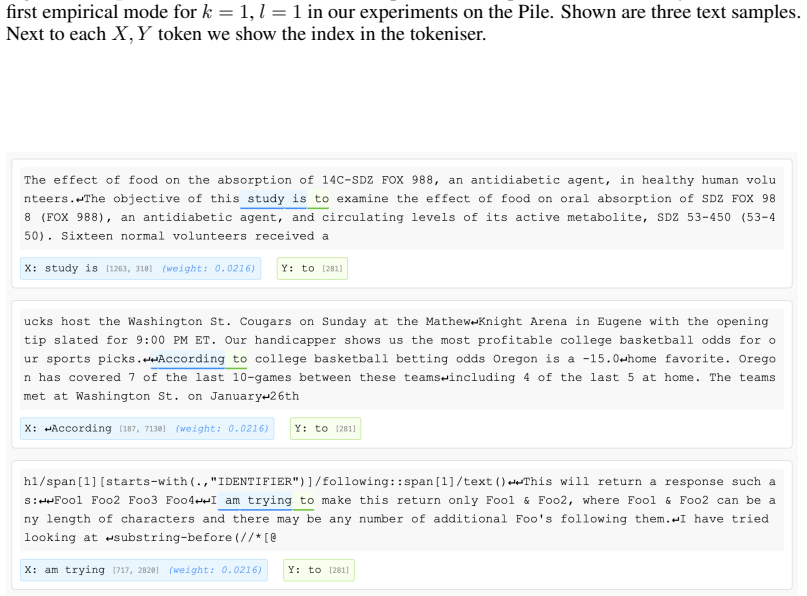
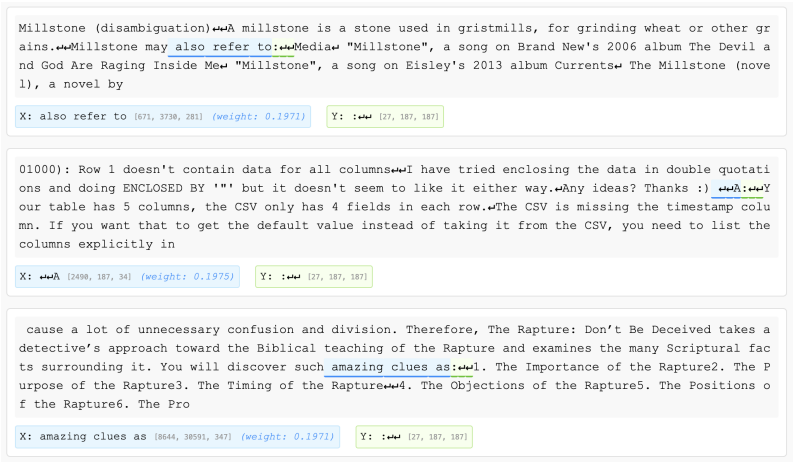
- The mode decomposition offers a principled coarse-graining of sequence data, and the leading empirical modes correspond to interpretable patterns such as punctuation and common subword collocations.
Reading between the lines
- If the theorem survives contact with real transformers, systematic $\beta$-scans of LLC estimates become a way to map the mode spectrum of a model's training distribution, since lower $\beta$ sees only dominant modes and higher $\beta$ resolves rarer ones.
- The result implies that comparing LLC values across models or training runs is only meaningful when SGLD hyperparameters are matched, because the effective mode cutoff that an estimate sees depends on those hyperparameters.
- The paper's connection to tensor renormalisation group suggests a testable extension: hierarchical or entanglement-guided truncations of the fundamental tensor could yield effective potentials that make LLC estimation both more accurate and more interpretable.
- A direct experimental check on synthetic sequence distributions with known mode spectra could measure how much LLC estimates change when small modes are removed at fixed $\beta$; large changes would indicate the insensitivity constants are bigger than the theorem requires.
Signed reviews
Editorial analysis
A structured set of objections, weighed in public.
Referee Report
Summary. The paper develops a tensor-decomposition framework for conditional sequence distributions, defines a Hilbert-space basis of 'modes' via SVD of the conditional-probability operator C_{k,l}, and introduces a coarse-grained 'effective true distribution' q^(χ) by truncating modes. It then introduces two formal conditions—-gradient-insensitivity and log-probability-insensitivity (Definitions 6.3 and 6.4)—-and proves, in Theorems 7.3 and 7.4, that under these conditions plus Lipschitz and hyperparameter assumptions, SGLD-based LLC estimates of the true loss L and of the truncated loss L^(χ) are close. The authors conclude that LLC estimates computed in practice characterize the effective, mode-truncated distribution rather than the full sequence distribution, and that the inverse temperature β acts as a resolution dial. The paper also reports empirical SVD modes computed on the Pile with a Pythia tokenizer.
Significance. If the main theorem could be turned into a quantitative statement about real transformers, the paper would make a useful conceptual contribution to singular learning theory and to the interpretation of LLC measurements in language models: it would explain why LLC estimates can be stable at parameters that are not strict minimizers of the population loss, and it would connect mode truncation to tempered posterior sampling. The tensor-algebraic setup is clean and the proofs of Theorems 7.3 and 7.4 are internally coherent given their hypotheses. The paper is also honest in Remark 7.5 about the strength of the Lipschitz assumption. The central limitation is that the insensitivity constants A and B and the Lipschitz constant M are never measured or bounded for transformers, and the theorem's bound is not shown to be smaller than the resolution of real LLC estimates. The practical conclusion in the abstract and conclusion therefore remains a conditional statement rather than an established fact.
major comments (4)
- [§7, Theorem 7.4 and Remark 7.5] The quantitative gap between the theorem and the paper's central claim is load-bearing and unresolved. The bound in Eq. (75) with ξ=κ=0 is (ϵmax/ϵmin)·nβQA/(γ/(nβ)−M) + 2nβB. Under the paper's own hyperparameters (Remark 7.5: nβ=10, γ=300, ϵmax=ϵmin) and the plausible estimate Q≈10, the first term is 100A/(30−M), which is 20A at M=25 and 100A at M=29, and the second term is 20B. For the theorem to support the statement that 'LLC calculated in practice characterises the effective rather than the true distribution,' the entire bound must be small compared with the resolution of the LLC estimator. The manuscript provides no estimates of A or B, no transformer Hessian spectral bound for M, and no comparison of the bound with estimator variance. Remark 7.5 concedes that the M<30 condition would not be realistic if the Lipschitz constant were orders of magnitude larger and that no Hessian estimates for large transformers were found. This is a fixable but essential gap: the abstract and conclusion assert a practical fact that the theorem, as quantified, does not deliver.
- [§6, Definitions 6.3 and 6.4] The two insensitivity conditions are effectively a formal restatement of the conclusion they are used to prove. Gradient-insensitivity for constant A requires that the pairing of Ψ_{w∗} with q−q^(χ) have norm less than A over W′, and log-probability-insensitivity similarly bounds ⟨Φ(w∗), q−q^(χ)⟩. For q^(χ) obtained by mode truncation, these conditions say precisely that the model's gradients and log-probabilities do not see the truncated modes. The proof then propagates this insensitivity through SGLD. Since A and B are never measured, the theorem is conditional on the very phenomenon it is meant to establish. The motivation in §6.1 appeals to finite capacity but gives no capacity-dependent bound, and the plausibility argument in §6.2 relies on the auxiliary assumptions that all large modes are absolute bigrams, that q(στ)≤2^{−(k+l)H}, and that ∥P_{≤χ}(q)−q^(χ)∥ is small; these are stated as reasonable rather than verified. A direct measurement of A, B, and the gradient/log-probability differences for a small transformer would be needed to make the bridge from the conditional theorem to the practical claim.
- [§4.5 and Theorem 7.4] The threshold χ is not given an operational characterization. The effective distribution q^(χ) is defined as the KL projection of q onto the submanifold P_{≤χ}, which is not the same as the orthogonal projection P_{≤χ}(q); Remark 4.18 explicitly notes that the naive truncation need not be a probability distribution. The main theorem is stated for an arbitrary q^(χ) satisfying the insensitivity conditions, but the paper never proves or estimates for which mode cutoffs χ those conditions hold with small A and B. Consequently, the 'data-dependent threshold' mentioned in the abstract remains unspecified, and the theorem cannot be used to predict, for a given model and dataset, which modes will be invisible to LLC estimation.
- [§7, Theorem 7.4 and Remark 7.5] The asymptotic regime of the theorem is not tied to a scaling of β with n. The theorem says 'there exists large enough n' while imposing Mnβ∈(γ−2/ϵmax,γ). If β is taken as the standard β0/logn from Watanabe (2013), then nβ grows with n and the condition eventually fails because γ/(nβ)→0. If instead nβ is held fixed at the practical value 10 used in Remark 7.5, then β shrinks as 1/n and it is unclear whether the Glivenko-Cantelli and local-minimum hypotheses of LLC estimation are satisfied in the asymptotic regime. The proof needs a precise statement of how n, β, m, and the insensitivity constants scale; otherwise the bound in Eq. (73) is not a well-defined asymptotic guarantee.
minor comments (6)
- [§4.5, Definition 4.16] The word 'minises' in Definition 4.16 should be 'minimizes'.
- [§7, paragraph before Eq. (61)] The text refers to 'Theorem 4.16' when citing the construction of q^(χ); this should be 'Definition 4.16'.
- [§7, Eq. (73)] The probability lower bound 1−12T(T+1)δ−κ can be negative or meaningless for large T unless T is restricted, for example Tδ<1; the theorem should state this restriction explicitly.
- [§6, Definitions 6.3 and 6.4] The notation would be clearer if the dependence of A and B on W′, q, and q′ were made explicit, since the constants are used later without restating their domain of validity.
- [§5.2 and Appendix B] The empirical modes are computed from smoothed, filtered conditional probability matrices, not from the exact q; this is described in Appendix B, but a sentence in Section 5.2 reminding the reader that these are approximate empirical modes would improve clarity.
- [§3.2, Example 3.3] The tokenized example is not typeset as a quoted string and is hard to read; using a monospaced or quoted format would improve presentation.
Circularity Check
Theorem 7.4 mainly restates its insensitivity premises as the LLC insensitivity conclusion; the link from mode amplitudes to constants A and B is asserted, not derived.
-
self definitional
[Definitions 6.3–6.4 and Lemma 7.1 / Theorem 7.4 (Section 7, Eqs. (52)–(73))]
"Definition 6.3: 'The model is gradient-insensitive for the constant A at w∗ if ‖⟨Ψ_{w∗}(−), q−q′⟩_H‖_2 < A.' Lemma 7.1 proof: 'By the hypothesis of gradient-insensitivity we have that ‖∇_w L(w)−∇_w L^(χ)(w)‖_2 = ‖Σ_{x∈Σ^k,y∈Σ}(q^(χ)(x,y)−q(x,y))∇_w log p(y|x,w)‖_2 is less than A.' Definition 6.4 similarly bounds |⟨Φ(w∗), q−q′⟩_H| < B."
The two insensitivity definitions are literally bounds on the differences that Theorem 7.4 concludes LLC cannot detect: Eq. (52) identifies gradient-insensitivity with ‖∇_w L(w)−∇_w L^(χ)(w)‖ < A, and Eq. (53) identifies log-probability-insensitivity with |L(w)−L^(χ)(w)| < B. The theorem then propagates these assumed small quantities through Lipschitz constants and a coupling argument to bound the difference of the LLC estimators. So the statement 'LLC cannot distinguish L from L^(χ)' is the same smallness that was assumed of the model's loss/gradients; the mode cutoff χ is never derived from the singular-value amplitudes, and A,B are never estimated.
full rationale
The tensor/SVD formalism and the SGLD coupling proof are mathematically self-contained, and there is no fitted input renamed as a prediction and no load-bearing self-citation: the citations to the authors' prior LLC work supply context, while the theorem is proved in-text. The circularity concern is narrower but central: the insensitivity hypotheses are defined as smallness of exactly the loss and gradient differences whose invisibility to LLC is then announced as the paper's main finding. Theorem 7.4 is a conditional continuity statement rather than a derivation of mode insensitivity from the mode spectrum. Remark 7.5's admission that no transformer Hessian estimates are available, together with the unmeasured constants A and B, leaves the practical conclusion numerically unsupported; that gap is an evidential weakness rather than a distinct circular step.
Assumptions & free parameters
free parameters (4)
- Mode cutoff chi
- Gradient-insensitivity constant A
- Log-probability-insensitivity constant B
- Entropy rate H =
assumed within [1,10]
assumptions (10)
- domain assumption q(x) > 0 for all sequences, and the language condition ties all sequence lengths into one consistent distribution.
- domain assumption The parametric model is defined on a compact W, is continuously differentiable, and is bounded away from zero.
- domain assumption Gradient-insensitivity holds with constant A on W'.
- domain assumption Log-probability-insensitivity holds with constant B on W'.
- domain assumption grad L_m and L_n are Lipschitz with constants M and Q on W', with M n beta in (gamma - 2/epsilon_max, gamma).
- domain assumption SGLD chains remain inside W' and the two chains use the same injected noise.
- ad hoc to paper In the plausibility argument, modes are absolute bigrams and q(sigma tau) <= 2^{-(k+l)H} for an entropy rate H.
- ad hoc to paper q^(chi) is close to the orthogonal projection P_{<=chi}(q) for large chi.
- standard math Glivenko-Cantelli and uniform convergence results from Vaart (1998, Section 19.2).
- standard math SVD, spectral theorem, and Perron-Frobenius theorem.
invented entities (1)
-
Effective true distribution q^(chi)
Cite this review
Pith. "Pith review of Modes of Sequence Models and Learning Coefficients." pith.science (2026). https://pith.science/paper/VW7LQMCL
@misc{pith2026250418048,
  author       = {Pith},
  title        = {Pith review of: Modes of Sequence Models and Learning Coefficients},
  year         = {2026},
  howpublished = {\url{https://pith.science/paper/VW7LQMCL}},
  note         = {Machine review of arXiv:2504.18048}
}
read the original abstract
We develop a geometric account of sequence modelling that links patterns in the data to measurable properties of the loss landscape in transformer networks. First, we cast conditional sequence distributions into a Hilbert-space framework and apply tensor decompositions to identify their principal modes. Truncating the small-amplitude modes yields an effective data distribution that preserves dominant structure while discarding statistical detail. Second, we show theoretically that Local Learning Coefficient (LLC) estimates are insensitive to modes below a data-dependent threshold. Consequently, the LLC calculated in practice characterises the geometry of the effective rather than the true distribution. This insight clarifies why reliable LLC estimates can be obtained even when a network parameter is not a strict minimiser of the population loss, and it highlights how the inverse temperature in SGLD acts as a resolution dial on the landscape structure.
Figures


Figures from the paper (2 more)

Reference graph
Works this paper leans on
-
[1]
write newline
" write newline "" before.all 'output.state := FUNCTION n.dashify 't := "" t empty not t #1 #1 substring "-" = t #1 #2 substring "--" = not "--" * t #2 global.max substring 't := t #1 #1 substring "-" = "-" * t #2 global.max substring 't := while if t #1 #1 substring * t #2 global.max substring 't := if while FUNCTION format.date year duplicate empty "emp...
-
[2]
@esa (Ref
\@ifxundefined[1] #1\@undefined \@firstoftwo \@secondoftwo \@ifnum[1] #1 \@firstoftwo \@secondoftwo \@ifx[1] #1 \@firstoftwo \@secondoftwo [2] @ #1 \@temptokena #2 #1 @ \@temptokena \@ifclassloaded agu2001 natbib The agu2001 class already includes natbib coding, so you should not add it explicitly Type <Return> for now, but then later remove the command n...
-
[3]
\@lbibitem[] @bibitem@first@sw\@secondoftwo \@lbibitem[#1]#2 \@extra@b@citeb \@ifundefined br@#2\@extra@b@citeb \@namedef br@#2 \@nameuse br@#2\@extra@b@citeb \@ifundefined b@#2\@extra@b@citeb @num @parse #2 @tmp #1 NAT@b@open@#2 NAT@b@shut@#2 \@ifnum @merge>\@ne @bibitem@first@sw \@firstoftwo \@ifundefined NAT@b*@#2 \@firstoftwo @num @NAT@ctr \@secondoft...
-
[4]
@open @close @open @close and [1] URL: #1 \@ifundefined chapter * \@mkboth \@ifxundefined @sectionbib * \@mkboth * \@mkboth\@gobbletwo \@ifclassloaded amsart * \@ifclassloaded amsbook * \@ifxundefined @heading @heading NAT@ctr thebibliography [1] @ \@biblabel @NAT@ctr \@bibsetup #1 @NAT@ctr @ @openbib .11em \@plus.33em \@minus.07em 4000 4000 `\.\@m @bibit...
work page 2024
-
[5]
Information Geometry and Its Applications: Convex Function and Dually Flat Manifold, pp.\ 75--102
Amari, S.-i. Information Geometry and Its Applications: Convex Function and Dually Flat Manifold, pp.\ 75--102. Springer Berlin Heidelberg, 2009
work page 2009
-
[6]
Information Geometry and its Applications
Amari, S.-i. Information Geometry and its Applications. Springer, 2016
work page 2016
-
[7]
Anandkumar, A., Ge, R., Hsu, D., Kakade, S. M., and Telgarsky, M. A method of moments for mixture models and hidden M arkov models. Conference on Learning Theory, pp.\ 33--1, 2012
work page 2012
-
[8]
Anandkumar, A., Ge, R., Hsu, D. J., Kakade, S. M., Telgarsky, M., et al. Tensor decompositions for learning latent variable models. J. Mach. Learn. Res., 15 0 (1): 0 2773--2832, 2014
work page 2014
Show all 72 references
-
[9]
Consideration on the learning efficiency of multiple-layered neural networks with linear units
Aoyagi, M. Consideration on the learning efficiency of multiple-layered neural networks with linear units. Neural Networks, 172: 0 106132, 2024. ISSN 0893-6080
2024
-
[10]
Studying S mall L anguage M odels with S usceptibilities, 2025
Baker, G., Wang, G., Hoogland, J., and Murfet, D. Studying S mall L anguage M odels with S usceptibilities, 2025
2025
-
[11]
S., Lepage, G., Svetitsky, B., and Wilson, K
Batrouni, G., Katz, G., Kronfeld, A. S., Lepage, G., Svetitsky, B., and Wilson, K. Langevin simulations of lattice field theories. Physical Review D, 32 0 (10): 0 2736, 1985
1985
-
[12]
A neural probabilistic language model
Bengio, Y., Ducharme, R., Vincent, P., and Jauvin, C. A neural probabilistic language model. Journal of machine learning research, 3 0 (Feb): 0 1137--1155, 2003
2003
-
[13]
G., Bradley, H., O’Brien, K., Hallahan, E., Khan, M
Biderman, S., Schoelkopf, H., Anthony, Q. G., Bradley, H., O’Brien, K., Hallahan, E., Khan, M. A., Purohit, S., Prashanth, U. S., Raff, E., et al. Pythia: A suite for analyzing large language models across training and scaling. In International Conference on Machine Learning, ...
2023
-
[14]
Gpt-neox-20b: An open-source autoregressive language model
Black, S., Biderman, S., Hallahan, E., Anthony, Q., Gao, L., Golding, L., He, H., Leahy, C., McDonell, K., Phang, J., et al. Gpt-neox-20b: An open-source autoregressive language model. arXiv preprint arXiv:2204.06745, 2022
2022 arXiv
-
[15]
E ckart- Y oung
Carroll, J. D. and Chang, J.-J. Analysis of individual differences in multidimensional scaling via an N -way generalization of " E ckart- Y oung" decomposition. Psychometrika, 35 0 (3): 0 283--319, 1970
1970
-
[16]
Dynamics of transient structure in in-context linear regression transformers, 2025
Carroll, L., Hoogland, J., Farrugia-Roberts, M., and Murfet, D. Dynamics of transient structure in in-context linear regression transformers, 2025. URL https://arxiv.org/abs/2501.17745
2025 arXiv
-
[17]
Dynamical versus Bayesian phase transitions in a toy model of superposition
Chen, Z., Lau, E., Mendel, J., Wei, S., and Murfet, D. Dynamical versus Bayesian phase transitions in a toy model of superposition. Preprint arXiv:2310.06301 [cs.LG], 2023
2023 arXiv
-
[18]
Cover, T. M. and Thomas, J. A. Elements of Information Theory (Wiley Series in Telecommunications and Signal Processing). Wiley-Interscience, USA, 2006
2006
-
[19]
and Weber, M
Deuflhard, P. and Weber, M. Robust P erron cluster analysis in conformation dynamics. Linear algebra and its applications, 398: 0 161--184, 2005
2005
-
[20]
Identification of almost invariant aggregates in reversible nearly uncoupled M arkov chains
Deuflhard, P., Huisinga, W., Fischer, A., and Sch \"u tte, C. Identification of almost invariant aggregates in reversible nearly uncoupled M arkov chains. Linear Algebra and its Applications, 315 0 (1-3): 0 39--59, 2000
2000
-
[21]
Monology/pile-uncopyrighted
Devin Gulliver . Monology/pile-uncopyrighted. https://huggingface.co/datasets/monology/pile-uncopyrighted, March 2025
2025
-
[22]
Efrati, E., Wang, Z., Kolan, A., and Kadanoff, L. P. Real-space renormalization in statistical mechanics. Reviews of Modern Physics, 86 0 (2): 0 647--667, 2014
2014
-
[23]
and Vidal, G
Evenbly, G. and Vidal, G. Tensor network renormalization. Physical review letters, 115 0 (18): 0 180405, 2015
2015
-
[24]
HLAT : H igh-quality large language model pre-trained on AWS T rainium
Fan, H., Zhou, H., Huang, G., Raman, P., Fu, X., Gupta, G., Ram, D., Wang, Y., and Huan, J. HLAT : H igh-quality large language model pre-trained on AWS T rainium. In 2024 IEEE International Conference on Big Data (BigData), pp.\ 2100--2109. IEEE, 2024
2024
-
[25]
Firth, J. R. A synopsis of linguistic theory, 1930-1955. In Studies in Linguistic Analysis, pp.\ 1--32. Philological Society, 1957
1930
-
[26]
An SVD approach to identifying meta-stable states of M arkov chains
Fritzsche, D., Mehrmann, V., Szyld, D., and Virnik, E. An SVD approach to identifying meta-stable states of M arkov chains. Electron. Trans. Numer. Anal., 2007
2007
-
[27]
The Pile: an 800GB dataset of diverse text for language modeling
Gao, L., Biderman, S., Black, S., Golding, L., Hoppe, T., Foster, C., Phang, J., He, H., Thite, A., Nabeshima, N., Presser, S., and Leahy, C. The Pile: an 800GB dataset of diverse text for language modeling. Preprint arXiv:2101.00027 [cs.CL], 2020
2020 arXiv
-
[28]
C., Petrov, T., Kubin, G., and Koeppl, H
Geiger, B. C., Petrov, T., Kubin, G., and Koeppl, H. Optimal K ullback-- L eibler aggregation via information bottleneck. IEEE Transactions on Automatic Control, 60 0 (4): 0 1010--1022, 2014
2014
-
[29]
Harris, Z. S. Distributional structure. Word, 10 0 (2-3): 0 146--162, 1954
1954
-
[30]
explanatory
Harshman, R. A. Foundations of the parafac procedure: Models and conditions for an "explanatory" multimodal factor analysis. UCLA Working Papers in Phonetics, 16: 0 1--84, 1970
1970
-
[31]
The developmental landscape of in-context learning, 2024
Hoogland, J., Wang, G., Farrugia-Roberts, M., Carroll, L., Wei, S., and Murfet, D. The developmental landscape of in-context learning, 2024. URL https://arxiv.org/abs/2402.02364
2024 arXiv
-
[32]
M., and Zhang, T
Hsu, D., Kakade, S. M., and Zhang, T. A spectral algorithm for learning hidden markov models. Journal of Computer and System Sciences, 78 0 (5): 0 1460--1480, 2012
2012
-
[33]
Universal artificial intelligence: Sequential decisions based on algorithmic probability
Hutter, M. Universal artificial intelligence: Sequential decisions based on algorithmic probability. Springer Science & Business Media, 2005
2005
-
[34]
Kim, Y., Jernite, Y., Sontag, D., and Rush, A. M. Character-aware neural language models. In Proceedings of the AAAI Conference on Artificial Intelligence, volume 30, 2016
2016
-
[35]
Kolda, T. G. and Bader, B. W. Tensor decompositions and applications. SIAM review, 51 0 (3): 0 455--500, 2009
2009
-
[36]
and Richardson, J
Kudo, T. and Richardson, J. Sentencepiece: A simple and language independent subword tokenizer and detokenizer for neural text processing. arXiv preprint arXiv:1808.06226, 2018
2018 arXiv
-
[37]
The local learning coefficient: A singularity-aware complexity measure, 2024
Lau, E., Furman, Z., Wang, G., Murfet, D., and Wei, S. The local learning coefficient: A singularity-aware complexity measure, 2024. URL https://arxiv.org/abs/2308.12108
2024 arXiv
-
[38]
P., Hoogland, J., Farrugia-Roberts, M., Wei, S., Oldenziel, A
Lehalleur, S. P., Hoogland, J., Farrugia-Roberts, M., Wei, S., Oldenziel, A. G., Wang, G., Carroll, L., and Murfet, D. You are what you eat -- ai alignment requires understanding how data shapes structure and generalisation, 2025. URL https://arxiv.org/abs/2502.05475
2025 arXiv
-
[39]
and Nave, C
Levin, M. and Nave, C. P. Tensor renormalization group approach to two-dimensional classical lattice models. Physical review letters, 99 0 (12): 0 120601, 2007
2007
-
[40]
J., Alyafeai, Z., Salesky, E., Raffel, C., Dey, M., Gallé, M., Raja, A., Si, C., Lee, W
Mielke, S. J., Alyafeai, Z., Salesky, E., Raffel, C., Dey, M., Gallé, M., Raja, A., Si, C., Lee, W. Y., Sagot, B., and Tan, S. Between words and characters: A B rief H istory of O pen- V ocabulary M odeling and T okenization in NLP , 2021. URL https://arxiv.org/abs/2112.10508
2021 arXiv
-
[41]
Efficient estimation of word representations in vector space
Mikolov, T., Chen, K., Corrado, G., and Dean, J. Efficient estimation of word representations in vector space. arXiv preprint arXiv:1301.3781, 2013 a
2013 arXiv
-
[42]
S., and Dean, J
Mikolov, T., Sutskever, I., Chen, K., Corrado, G. S., and Dean, J. Distributed representations of words and phrases and their compositionality. Advances in neural information processing systems, 26, 2013 b
2013
-
[43]
Pattern theory: a unifying perspective
Mumford, D. Pattern theory: a unifying perspective. In First European Congress of Mathematics: Paris, July 6-10, 1992 Volume I Invited Lectures (Part 1), pp.\ 187--224. Springer, 1994
1992
-
[44]
G., and Segarra, S
Navarro, M., Rozada, S., Marques, A. G., and Segarra, S. Low-rank tensors for multi-dimensional markov models. arXiv preprint arXiv:2411.02098, 2024
2024 arXiv
-
[45]
On the realization of hidden markov models and tensor decomposition
Ohta, Y. On the realization of hidden markov models and tensor decomposition. IFAC-PapersOnLine, 54 0 (9): 0 725--730, 2021
2021
-
[46]
and Faccioli, P
Orioli, S. and Faccioli, P. Dimensional reduction of markov state models from renormalization group theory. The Journal of chemical physics, 145 0 (12), 2016
2016
-
[47]
Oseledets, I. V. Tensor-train decomposition. SIAM Journal on Scientific Computing, 33 0 (5): 0 2295--2317, 2011
2011
-
[48]
Future lens: Anticipating subsequent tokens from a single hidden state
Pal, K., Sun, J., Yuan, A., Wallace, B., and Bau, D. Future lens: Anticipating subsequent tokens from a single hidden state. In Jiang, J., Reitter, D., and Deng, S. (eds.), Proceedings of the 27th Conference on Computational Natural Language Learning (CoNLL), pp.\ 548--560, Si...
2023 doi
-
[49]
Pennington, J., Socher, R., and Manning, C. D. Glove: Global vectors for word representation. In Proceedings of the 2014 conference on empirical methods in natural language processing (EMNLP), pp.\ 1532--1543, 2014
2014
-
[50]
and Hutter, M
Phuong, M. and Hutter, M. Formal algorithms for transformers. Preprint arXiv:2207.09238 [cs.LG], 2022
2022 arXiv
-
[51]
Renormalization and effective lagrangians
Polchinski, J. Renormalization and effective lagrangians. Nuclear Physics B, 231 0 (2): 0 269--295, 1984
1984
-
[52]
and Simon, B
Reed, M. and Simon, B. Methods of modern mathematical physics i: Functional analysis, acad. Press, San Diego, 1980
1980
-
[53]
Rogers, T. T. and McClelland, J. L. Semantic Cognition: A Parallel Distributed Processing Approach. MIT Press, 2004
2004
-
[54]
How good is your tokenizer? on the monolingual performance of multilingual language models
Rust, P., Pfeiffer, J., Vuli \'c , I., Ruder, S., and Gurevych, I. How good is your tokenizer? on the monolingual performance of multilingual language models. In Zong, C., Xia, F., Li, W., and Navigli, R. (eds.), Proceedings of the 59th Annual Meeting of the Association for Co...
2021 doi
-
[55]
and Wiskott, L
Seabrook, E. and Wiskott, L. A tutorial on the spectral theory of markov chains. Neural Computation, 35 0 (11): 0 1713--1796, 2023
2023
-
[56]
Neural machine translation of rare words with subword units
Sennrich, R., Haddow, B., and Birch, A. Neural machine translation of rare words with subword units. In Proceedings of the 54th Annual Meeting of the Association for Computational Linguistics (Volume 1: Long Papers), pp.\ 1715--1725, 2016
2016
-
[57]
Transformers represent belief state geometry in their residual stream
Shai, A., Teixeira, L., Oldenziel, A., Marzen, S., and Riechers, P. Transformers represent belief state geometry in their residual stream. Advances in Neural Information Processing Systems, 37: 0 75012--75034, 2024
2024
-
[58]
Shannon, C. E. A mathematical theory of communication. The Bell system technical journal, 27 0 (3): 0 379--423, 1948
1948
-
[59]
The low-rank hypothesis of complex systems
Thibeault, V., Allard, A., and Desrosiers, P. The low-rank hypothesis of complex systems. Nature Physics, 20 0 (2): 0 294--302, 2024
2024
-
[60]
Tucker, L. R. Some mathematical notes on three-mode factor analysis. Psychometrika, 31 0 (3): 0 279--311, 1966
1966
-
[61]
and Urdshals, J
Urdshals, E. and Urdshals, J. Structure development in list-sorting transformers, 2025. URL https://arxiv.org/abs/2501.18666
2025 arXiv
-
[62]
Vaart, A. W. v. d. Asymptotic Statistics. Cambridge Series in Statistical and Probabilistic Mathematics. Cambridge University Press, 1998
1998
-
[63]
The generalization phase diagram
Vaintrob, D. The generalization phase diagram. https://www.lesswrong.com/posts/TSe3qhe4kxgKPJmfD/the-generalization-phase-diagram, 2025
2025
-
[64]
N., Kaiser, ., and Polosukhin, I
Vaswani, A., Shazeer, N., Parmar, N., Uszkoreit, J., Jones, L., Gomez, A. N., Kaiser, ., and Polosukhin, I. Attention is all you need. Advances in neural information processing systems, 30, 2017
2017
-
[65]
Differentiation and specialization of attention heads via the refined local learning coefficient, 2024
Wang, G., Hoogland, J., van Wingerden, S., Furman, Z., and Murfet, D. Differentiation and specialization of attention heads via the refined local learning coefficient, 2024. URL https://arxiv.org/abs/2410.02984
2024 arXiv
-
[66]
Algebraic Geometry and Statistical Learning Theory
Watanabe, S. Algebraic Geometry and Statistical Learning Theory . Cambridge University Press , USA , 2009
2009
-
[67]
A Widely Applicable Bayesian Information Criterion
Watanabe, S. A Widely Applicable Bayesian Information Criterion . Journal of Machine Learning Research, 14: 0 867--897, 2013
2013
-
[68]
Mathematical Theory of Bayesian Statistics
Watanabe, S. Mathematical Theory of Bayesian Statistics . CRC Press, Taylor and Francis group , USA , 2018
2018
-
[69]
and Teh, Y
Welling, M. and Teh, Y. W. Bayesian L earning via S tochastic G radient L angevin D ynamics. In Proceedings of the 28th International Conference on Machine Learning , 2011
2011
-
[70]
X., and Levine, L
Wu, W., Morris, J. X., and Levine, L. Do language models plan ahead for future tokens? In First Conference on Language Modeling, 2024. URL https://openreview.net/forum?id=BaOAvPUyBO
2024
-
[71]
Pyhessian: Neural networks through the lens of the hessian, 2020
Yao, Z., Gholami, A., Keutzer, K., and Mahoney, M. Pyhessian: Neural networks through the lens of the hessian, 2020. URL https://arxiv.org/abs/1912.07145
2020 arXiv
-
[72]
and Wang, M
Zhang, A. and Wang, M. Spectral state compression of markov processes. IEEE transactions on information theory, 66 0 (5): 0 3202--3231, 2019
2019
Reviewed August 16, 2026 · model on record in the stance chip above.
Discussion (0). Continue with ORCID to comment.