REVIEW 5 major objections 6 minor 88 references
Why Does My Transaction Fail? A First Look at Failed Transactions on the Solana Blockchain
T0 review · 5 major / 6 minor · reviewed 2026-08-16 · deepseek-v4-flash
Pith's one-line read Bots fail 58.43% of Solana transactions; humans 6.22%
desk verdict Worth taking seriously, but the bot-vs-human headline is built on a classifier that labels only a quarter of the data; the error taxonomy alone justifies a revised publication. read the letter →
The pith
A machine-rendered reading of the paper's core claim, the machinery that carries it, and where it could break.
The reading
What carries the argument
The load-bearing machinery is a large curated dataset plus two classification layers. The dataset joins on-chain block and transaction records retrieved through an RPC provider with off-chain program names and source code, covering 2,898,175,006 non-vote transactions. On top of it, the paper builds a random-forest account classifier that labels 12,712,516 accounts as bot or human from transaction frequency and volume features, validated at 96.91% accuracy on a manually labeled sample, and an error taxonomy constructed by extracting 2,311 unique error messages and grouping them through thematic analysis into ten error types. The account classifier makes the bot-versus-human failure-rate contrast possible; the error taxonomy carries the finding that most failures reduce to price, state, and validity checks.
What would settle it
Recompute the six headline statistics (bot failure rate, human failure rate, top-ten program share, and the three largest error-type shares) from all 365 days of August 2023 through July 2024 rather than the 53 sampled days; if any figure moves outside the paper's stated ±0.06% margin, or materially away from the reported values, the characterization fails.
Extended reading notes
Core claim
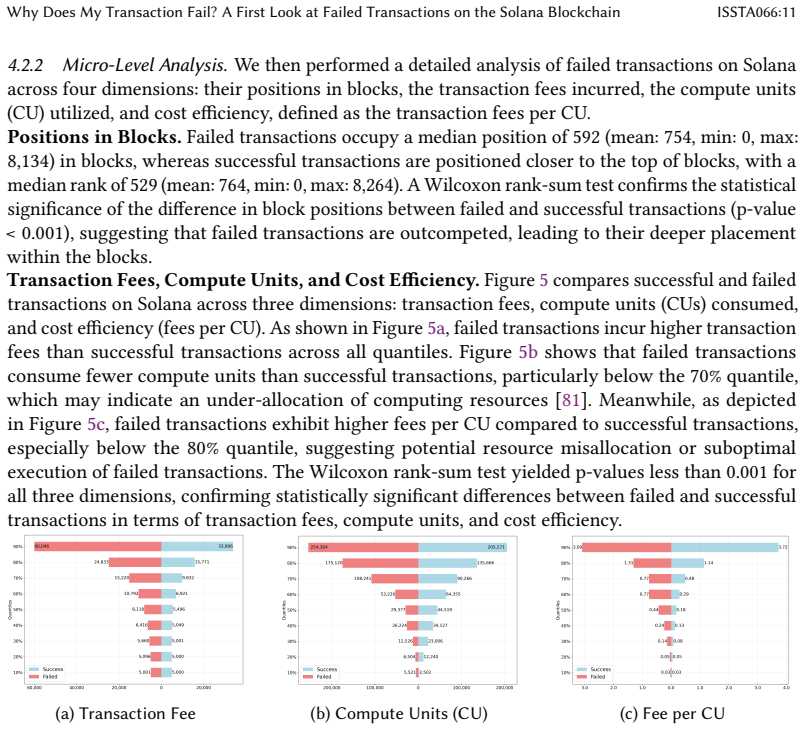
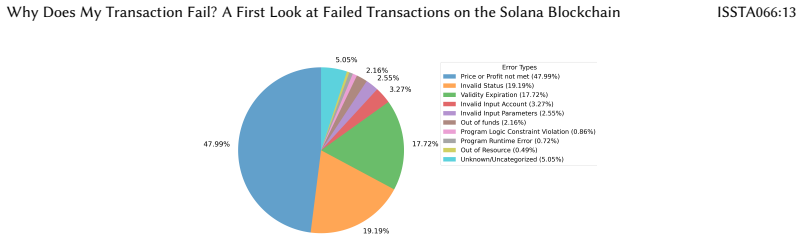
The paper's central discovery is a quantitative map of why Solana transactions fail at the ecosystem scale. Mining 1,510,834,168 failed non-vote transactions from 72,123,900 blocks, it reports that bots experience a transaction failure rate of 58.43% versus 6.22% for humans, that the top ten programs responsible for failures account for 77.95% of all failed transactions, and that just three error categories—price or profit not met (47.99%), invalid status (19.19%), and validity expiration (17.72%)—account for 84.90% of all failures. The paper also reports that failed transactions sit deeper in blocks (median position 592 versus 529) while paying higher fees per compute unit, that DEX aggregators fail mainly on price or profit conditions, and that AMMs fail mainly on invalid status checks, often because sniper bots trade before a pool is initialized. The intended upshot is that Solana's failure problem is a bot-driven, DeFi-concentrated phenomenon rather than a general user-experience defect.
Load-bearing premise
Every headline percentage is computed from 53 sampled days—one randomly chosen day per week—and the paper asserts, without derivation, that the sample represents the whole year at a 99.999% confidence level; if those days miss memecoin surges or protocol-upgrade periods, all of the aggregate figures shift.
Editorial extensions
If this is right
- If bots are the main source of failed transactions, then reducing bot spam—for example through dynamic fees on rapid repeated submissions—should lower both failure counts and network congestion.
- Failure diagnosis can be prioritized: a transaction that fails on a DEX aggregator should first be checked for unmet price or profit conditions, and a transaction that fails on an AMM should first be checked for pool state readiness.
- Human-focused tooling should target out-of-funds checks and input validation, since humans fail less often and on a narrower set of errors.
- The 24-hour periodicity in failure rates means failure load is partly predictable, opening the door to time-aware fee or retry strategies.
- Architecture-level comparison: Solana's low fees and parallel execution appear to enable the bot behavior; ecosystems with gas auctions show lower bot-driven failure rates.
Reading between the lines
- If the 47.99% price-or-profit-not-met share reflects rational bot strategy rather than user error, then a large share of 'failed' transactions are actually expected costs of a search process: bots intentionally fire unprofitable transactions and let rejection filter them, so a testable extension is measuring how failure rates respond when the fee for repeated submissions from one account rises.
- The drop in failure rates after the June 2024 validator update, noted in the paper, suggests a quasi-natural experiment; comparing failure rates around that update with and without bot-account filtering could isolate how much of the reduction comes from protocol changes versus reduced spam.
- The paper's taxonomy could be applied prospectively: if invalid-status errors spike around new pool creations, real-time detection of sniper-bot waves could be built from the error logs alone.
Signed reviews
Editorial analysis
A structured set of objections, weighed in public.
Referee Report
Summary. The paper presents a large-scale empirical study of failed non-vote transactions on the Solana blockchain. The authors sample 53 days (one per week) between August 1, 2023 and July 31, 2024, collect 2,898,175,006 non-vote transactions, classify initiator accounts as bot or human using a random forest with a 0.9 confidence threshold, characterize failures by program, time, block position, and cost, extract error messages, and derive a ten-category error taxonomy via thematic analysis. The main findings are that bot accounts have a 58.43% failure rate versus 6.22% for human accounts; the top ten programs account for 77.95% of failures; price/profit-not-met, invalid-status, and validity-expiration errors account for 84.90% of failures; and DEX aggregators and AMMs exhibit distinct error profiles. The paper concludes with ecosystem-level recommendations and a public replication package.
Significance. If the results are robust, this is a valuable first systematic account of failed transactions on Solana, with direct relevance to protocol design, DeFi program development, and user tooling. The dataset is unusually large, the data-processing pipeline is described in detail, the error taxonomy is built through manual coding with consensus procedures, and a replication package is provided. The headline conclusion that Solana's transaction-failure problem is largely bot-driven is plausible and practically important, but it currently rests on the classified subset of accounts, and several statistical claims are under-supported. I also note that the random forest is a labeling tool rather than a model of the outcome being estimated, so I do not see a circularity problem here; the issue is coverage and validation of the labels, not circularity.
major comments (5)
- [§3.2, Table 1] Finding 1 is computed only from accounts classified with random-forest probability above 0.9. These accounts produce 779.3M transactions, i.e., 26.9% of the 2,898.2M sampled non-vote transactions. The remaining 2,118.8M transactions—including 1,057.1M failed transactions, or 70.0% of all failures in the sample—come from 'unknown' accounts and are excluded from the bot-versus-human comparison. The unknown-account failure rate is 49.9%, close to the overall sample failure rate of 52.1%, so the claim that Solana's failures are largely bot-driven depends on an unverified assumption about the initiator type of unknown-account failures. Since §7.3 does not discuss this coverage threat, please report a sensitivity analysis (e.g., lower the threshold, or manually label a sample of unknown-account failures) and bound Finding 1 under worst-case assumptions about the unknown set.
- [§3.1] The claim that stratified weekly sampling achieves a '99.999% confidence level with a margin of error of ±0.06%' is asserted without derivation. The failure rate is highly non-stationary—the paper itself notes memecoin-mania episodes and the June 10, 2024 validator update—so a textbook simple-random-sampling formula cannot be applied to one randomly selected day per week. Please provide the exact estimator, its variance, and the assumptions; otherwise, the aggregate percentages in Findings 2 and 5 are not shown to represent the full year.
- [§3.2] The classifier is trained on 200 manually labeled accounts and validated on 194 sampled accounts, yielding 96.91% accuracy. This measures agreement on a hand-picked validation set, not whether the high-confidence subsets are representative of bots and humans at large. The imbalance is striking: classified human accounts average about 2.3 transactions per account-year, while classified bot accounts average about 966, so the random forest may be separating high-activity from low-activity accounts rather than automated from human initiators. Please report per-class precision and recall, class-balance information, and validation results for accounts near the 0.9 threshold.
- [§4.2.2] The Wilcoxon rank-sum tests are applied to billions of transactions, so p<0.001 is essentially guaranteed and does not convey the magnitude of the observed differences. Please report standardized effect sizes (e.g., rank-biserial correlation) and confidence intervals for the block-position, fee, compute-unit, and cost-efficiency comparisons, so readers can gauge whether the reported differences are practically meaningful.
- [§4.2.1, Finding 3] Finding 3 states that failure rates exhibit a strong positive correlation with the volume of failed transactions, but the surrounding text describes correlation with hourly transaction volume, and no correlation coefficient is reported. Please state the exact statistic (e.g., Spearman's r), its lag, and its confidence interval; otherwise the 'strong positive correlation' claim is not quantitatively supported.
minor comments (6)
- [§7.1] The reference '[73? ]' is a broken citation placeholder and should be corrected.
- [§4.2.1 and §4.2.2] The sentence 'A Wilcoxon rank-sum test confirms the statistical significance of the difference in block positions...' appears twice; the duplicate in the Temporal Trends paragraph should be removed.
- [§5.2, Finding 5] Finding 5 lists the top three error types as 'price or profit not met, validity expiration, and invalid status', whereas the preceding text and Figure 6 present the second and third types in the order invalid status then validity expiration. Please make the order consistent.
- [§4.2.2] The phrase 'the failed transactions have be outcompeted' is a grammatical error; it should read 'have been outcompeted'.
- [Abstract and §3.1] The abstract says the dataset spans 'more than 72 million blocks', but the sampling procedure selected 10,458,452 blocks from the 72,123,900-block range; please clarify that 72 million is the full-year block range, not the sampled block count.
- [Table 1] Consider adding a row for unknown accounts in Table 1, since their exclusion is material to the interpretation of the bot/human comparison.
Circularity Check
No significant circularity: the study's findings are direct measurements and manual taxonomies, not predictions fitted to their own outcomes.
full rationale
The paper is an observational empirical study; its headline numbers are computed directly from blockchain data rather than produced by a model fitted to those same numbers. Account typing in Section 3.2 uses a random forest trained on 200 manually labeled accounts with features (transaction frequency and volume) drawn from prior work [62, 71]; the failure/success outcome is not an input feature, and the reported 58.43% vs 6.22% failure rates are subsequently computed over transactions of the classified accounts, so the rates are not forced by the classifier. The error taxonomy (RQ2) comes from manual coding of error log messages (Section 5.1), and the percentages in Finding 5 are direct frequency counts over the coded messages, not outputs of a fitted model. No load-bearing step cites an unverified self-result: the bot-detection features cite external prior work [62, 71], and no uniqueness theorem or author-supplied ansatz is invoked to exclude alternatives. Points such as the unsubstantiated 99.999% confidence claim for weekly sampling and the exclusion of 73.1% of transactions below the 0.9 classification threshold are validity and representativeness concerns, not circularity: they do not make any measured quantity equal to an input by construction. Accordingly, the appropriate score is 0.
Assumptions & free parameters
free parameters (2)
- account classification confidence threshold =
0.9
- random forest hyperparameters =
scikit-learn defaults
assumptions (5)
- domain assumption A transaction is classified as failed iff its error metadata field is non-empty (Section 3.1).
- domain assumption The sampled 53 days (one per week) are representative of the full year, with 99.999% confidence and ±0.06% margin of error asserted in Section 3.1.
- domain assumption The outermost program in an error log's call stack is responsible for the failure (Section 2.2).
- domain assumption Failed transactions with incomplete or missing error messages can be excluded without biasing the error-type distribution (Section 5.1).
- domain assumption Thematic analysis codes derived from 173 error messages generalize to the full set of 2,311 unique messages (Section 5.1).
Cite this review
Pith. "Pith review of Why Does My Transaction Fail? A First Look at Failed Transactions on the Solana Blockchain." pith.science (2026). https://pith.science/paper/2PUTGM6W
@misc{pith2026250418055,
  author       = {Pith},
  title        = {Pith review of: Why Does My Transaction Fail? A First Look at Failed Transactions on the Solana Blockchain},
  year         = {2026},
  howpublished = {\url{https://pith.science/paper/2PUTGM6W}},
  note         = {Machine review of arXiv:2504.18055}
}
read the original abstract
Solana is an emerging blockchain platform, recognized for its high throughput and low transaction costs, positioning it as a preferred infrastructure for Decentralized Finance (DeFi), Non-Fungible Tokens (NFTs), and other Web 3.0 applications. In the Solana ecosystem, transaction initiators submit various instructions to interact with a diverse range of Solana smart contracts, among which are decentralized exchanges (DEXs) that utilize automated market makers (AMMs), allowing users to trade cryptocurrencies directly on the blockchain without the need for intermediaries. Despite the high throughput and low transaction costs of Solana, the advantages have exposed Solana to bot spamming for financial exploitation, resulting in the prevalence of failed transactions and network congestion. Prior work on Solana has mainly focused on the evaluation of the performance of the Solana blockchain, particularly scalability and transaction throughput, as well as on the improvement of smart contract security, leaving a gap in understanding the characteristics and implications of failed transactions on Solana. To address this gap, we conducted a large-scale empirical study of failed transactions on Solana, using a curated dataset of over 1.5 billion failed transactions across more than 72 million blocks. Specifically, we first characterized the failed transactions in terms of their initiators, failure-triggering programs, and temporal patterns, and compared their block positions and transaction costs with those of successful transactions. We then categorized the failed transactions by the error messages in their error logs, and investigated how specific programs and transaction initiators are associated with these errors...
Figures


Figures from the paper (2 more)

Reference graph
Works this paper leans on
-
[1]
[n. d.]. Alchemy Official Website. https://www.alchemy.com/solana Accessed: 2025-04-08
2025
-
[2]
[n. d.]. The Arbitrum Network Explained. https://www.hord.fi/blog/arbitrum-network-explained Accessed: 2025-01-02. Proc. ACM Softw. Eng., Vol. 2, No. ISSTA, Article ISSTA066. Publication date: July 2025. Why Does My Transaction Fail? A First Look at Failed Transactions on the Solana Blockchain ISSTA066:21
2025
-
[3]
[n. d.]. Associated Token Account. https://spl.solana.com/associated-token-account Accessed: 2024-10-28
2024
-
[4]
[n. d.]. Chainlink Data Store Program. https://solscan.io/account/cjg3oHmg9uuPsP8D6g29NWvhySJkdYdAo9D25PRbKXJ Accessed: 2025-01-21
2025
-
[5]
[n. d.]. Jupiter Swap API V6 . https://station.jup.ag/docs/apis/swap-api Accessed: 2024-10-28
2024
-
[6]
[n. d.]. Priority Fees: Understanding Solana’s Transaction Fee Mechanics . https://www.helius.dev/blog/priority-fees- understanding-solanas-transaction-fee-mechanics Accessed: 2025-01-02
2025
-
[7]
[n. d.]. Raydium. https://docs.raydium.io/raydium Accessed: 2024-10-28
2024
-
[8]
[n. d.]. Sequence Enforcer. https://solscan.io/account/GDDMwNyyx8uB6zrqwBFHjLLG3TBYk2F8Az4yrQC5RzMp Accessed: 2024-10-28
2024
Show all 88 references
-
[9]
[n. d.]. Token Spammers, Rug Pulls, and Sniper Bots: An Analysis of the Ecosystem of Tokens in Ethereum and in the Binance Smart Chain (BNB), author=Cernera, Federico and La Morgia, Massimo and Mei, Alessandro and Sassi, Francesco, booktitle=32nd USENIX Security Symposium (USE...
2023
-
[10]
[n. d.]. What are the Reasons for Failed Transactions? https://info.etherscan.com/reason-for-failed-transaction/ Accessed: 2025-01-02
2025
-
[11]
Chainlink Data Feeds, Security Researcher’s Perspective
2023. Chainlink Data Feeds, Security Researcher’s Perspective . https://ackee.xyz/blog/chainlink-data-feeds/ Accessed: 2025-01-28
2023
-
[12]
Network Performance Report: July 2023
2023. Network Performance Report: July 2023 . https://solana.com/news/network-performance-report-july-2023 Accessed: 2024-10-28
2023
-
[13]
Error: memory allocation failed, out of memory
2023. Program logged: “Error: memory allocation failed, out of memory” . https://solana.stackexchange.com/questions/ 6876/program-logged-error-memory-allocation-failed-out-of-memory Accessed: 2024-10-28
2023
-
[14]
Solana: Past, Present, and Future
2023. Solana: Past, Present, and Future . https://research.nansen.ai/articles/solana-past-present-and-future Accessed: 2024-10-28
2023
-
[15]
Transaction 3HdLQWvpANEHTzhjUdQ71m81DegUCckpqXqgU2oWKBiCSfrdGuDqXFWg41Qidch26KwtjpRh- Vj7GqNvXHmGQ2njv
2023. Transaction 3HdLQWvpANEHTzhjUdQ71m81DegUCckpqXqgU2oWKBiCSfrdGuDqXFWg41Qidch26KwtjpRh- Vj7GqNvXHmGQ2njv. https://bit.ly/4irDawA Accessed: 2024-10-28
2023
-
[16]
9uW2TqLyf YyrcNVrgCy4jPpqDKQoBZhXWypzzFxbixQE
2024. 9uW2TqLyf YyrcNVrgCy4jPpqDKQoBZhXWypzzFxbixQE. https://www.reddit.com/r/solana/comments/1cc9g05/ 9uw2tqlyfyyrcnvrgcy4jppqdkqobzhxwypzzfxbixqe/ Accessed: 2024-10-28
2024
-
[17]
Bots suspected of pushing Solana over Ethereum — Research
2024. Bots suspected of pushing Solana over Ethereum — Research . https://cointelegraph.com/news/bots-pushing- solana-over-ethereum-research Accessed: 2024-10-28
2024
-
[18]
Common JSON Data Structures for Solana RPC Methods
2024. Common JSON Data Structures for Solana RPC Methods . https://solana.com/docs/rpc/json-structures Accessed: 2024-10-28
2024
-
[19]
Consensus on Solana
2024. Consensus on Solana. https://www.helius.dev/blog/consensus-on-solana Accessed: 2024-10-28
2024
-
[20]
Fees on Solana
2024. Fees on Solana. https://solana.com/docs/core/fees. Accessed: 2024-10-28
2024
-
[21]
Mainnet Beta Validators: Please upgrade to
2024. Mainnet Beta Validators: Please upgrade to . https://x.com/SolanaStatus/status/1800027464896328153 Accessed: 2025-01-28
2024
-
[22]
Memecoin Mania Drives Solana Toward All-Time Highs
2024. Memecoin Mania Drives Solana Toward All-Time Highs . https://www.bloomberg.com/news/articles/2024-03- 18/slerf-snap-memecoin-mania-drives-solana-toward-all-time-highs Accessed: 2024-10-28
2024
-
[23]
2024. Raydium says Insufficient SOL balance if I try to buy anything more than 90% of my balance - any advice? https://www.reddit.com/r/solana/comments/qo15jc/raydium_says_insufficient_sol_balance_if_i_try_to Accessed: 2024-10-28
2024
-
[24]
Solana Account Model
2024. Solana Account Model. https://solana.com/docs/core/accounts. Accessed: 2024-10-28
2024
-
[25]
Solana: Efficiently Minimizing Transaction Duration
2024. Solana: Efficiently Minimizing Transaction Duration . https://web3engineering.co.uk/solana-ioc-orders Accessed: 2024-10-28
2024
-
[26]
Solana MEV: An Introduction
2024. Solana MEV: An Introduction. https://www.helius.dev/blog/solana-mev-an-introduction Accessed: 2024-10-28
2024
-
[27]
Solana MEV Bots: A Detailed Explanation
2024. Solana MEV Bots: A Detailed Explanation . https://www.coinfeeds.ai/crypto-blog/solana-mev-bots Accessed: 2024-10-28
2024
-
[28]
Solana Network Faces High Failure Rate in Transactions Amid Memecoin Mania
2024. Solana Network Faces High Failure Rate in Transactions Amid Memecoin Mania . https://coinmarketcap.com/ academy/article/solana-network-faces-high-failure-rate-in-transactions-amid-memecoin-mania Accessed: 2025-01- 28
2024
-
[29]
Solana struggles: Record 75% of user txs are failing
2024. Solana struggles: Record 75% of user txs are failing... or are they? https://cointelegraph.com/news/solana- struggling-record-seventy-five-percent-trasnactions-fail-memecoin-mania Accessed: 2024-10-28
2024
-
[30]
Solana Terminology
2024. Solana Terminology. https://solana.com/docs/terminology Accessed: 2024-10-28
2024
-
[31]
Solana Transactions
2024. Solana Transactions. https://github.com/solana-foundation/developer-content/blob/main/docs/core/transactions. md Accessed: 2024-10-28
2024
-
[32]
Solana Tx Fail Rate
2024. Solana Tx Fail Rate. https://dune.com/scarn_eth/solana-tx-fail-rate Accessed: 2025-01-28
2024
-
[33]
Token Account Frozen! Anyone Know how to fix? https://www.reddit.com/r/solana/comments/1ajnurc/token_ account_frozen_anyone_know_how_to_fix/ Accessed: 2024-10-28
2024. Token Account Frozen! Anyone Know how to fix? https://www.reddit.com/r/solana/comments/1ajnurc/token_ account_frozen_anyone_know_how_to_fix/ Accessed: 2024-10-28. Proc. ACM Softw. Eng., Vol. 2, No. ISSTA, Article ISSTA066. Publication date: July 2025. ISSTA066:22 Xiaoye ...
2024
-
[34]
Token swap error 0x26 InvalidSplTokenProgram on raydium rust
2024. Token swap error 0x26 InvalidSplTokenProgram on raydium rust . https://solana.stackexchange.com/questions/ 13208/token-swap-error-0x26-invalidspltokenprogram-on-raydium-rust Accessed: 2024-10-28
2024
-
[35]
Transaction 26hZfeUESwWx8qykY9BbKEbadnhQSHmy1cH9DhrDBVJBh7d6Jh3LuqomqBoCetPuQ5xGN1j2eMW- Ms9fv8YgXKd8L
2024. Transaction 26hZfeUESwWx8qykY9BbKEbadnhQSHmy1cH9DhrDBVJBh7d6Jh3LuqomqBoCetPuQ5xGN1j2eMW- Ms9fv8YgXKd8L. https://bit.ly/4lEmHI3 Accessed: 2024-10-28
2024
-
[36]
Transaction 5AnmV4Sx6HiXWXzCzBkzu8NMas4HmAiV3ZxZ9H81Q8JegM7NJ8YVi9c1KVUT452unMXTfULGFk- jZ2En6DYvd4Jv8
2024. Transaction 5AnmV4Sx6HiXWXzCzBkzu8NMas4HmAiV3ZxZ9H81Q8JegM7NJ8YVi9c1KVUT452unMXTfULGFk- jZ2En6DYvd4Jv8. https://bit.ly/3RqJWaI Accessed: 2024-10-28
2024
-
[37]
Transaction 5BB13YdeDP8ke37ZcU3yonEGsnVUKa24t5uctSRLQQupikejFtj2fcEwKVVSBUUfbbVxcJxKi9zVyyVB- 6KtQXCiv
2024. Transaction 5BB13YdeDP8ke37ZcU3yonEGsnVUKa24t5uctSRLQQupikejFtj2fcEwKVVSBUUfbbVxcJxKi9zVyyVB- 6KtQXCiv. https://surl.li/goodup Accessed: 2024-10-28
2024
-
[38]
Transaction Confirmation and Expiration
2024. Transaction Confirmation and Expiration . https://solana.com/docs/advanced/confirmation Accessed: 2024-10-28
2024
-
[39]
Transaction ebX6rwknxsXPvo1DDGq3far8uUtGywz2RBgLNZLBRF8Ws1pgmnstYVhsi2KQdTsXbvtWWt27P- oittqgiUaEP8Dr
2024. Transaction ebX6rwknxsXPvo1DDGq3far8uUtGywz2RBgLNZLBRF8Ws1pgmnstYVhsi2KQdTsXbvtWWt27P- oittqgiUaEP8Dr. https://bit.ly/4itS6Kl Accessed: 2024-10-28
2024
-
[40]
Transaction zxFnAz3WEYRJeKPtbFppM4SoEiRxvkJ9KqiZzdSbbQFGQf7sHJMEJJfgWYy7G6PMoj7K3VwV4QB- u4CUr1miEB16
2024. Transaction zxFnAz3WEYRJeKPtbFppM4SoEiRxvkJ9KqiZzdSbbQFGQf7sHJMEJJfgWYy7G6PMoj7K3VwV4QB- u4CUr1miEB16. https://bit.ly/42zBFGE Accessed: 2024-10-28
2024
-
[41]
Turbine: Block Propagation on Solana
2024. Turbine: Block Propagation on Solana . https://www.helius.dev/blog/turbine-block-propagation-on-solana Accessed: 2024-10-28
2024
-
[42]
What is PepperMints? https://solanabox.tools/tools/peppermints Accessed: 2024-10-28
2024. What is PepperMints? https://solanabox.tools/tools/peppermints Accessed: 2024-10-28
2024
-
[43]
What is this contract doing?
2024. What is this contract doing?... https://www.reddit.com/r/solana/comments/1adoj2n/what_is_this_contract_doing Accessed: 2024-10-28
2024
-
[44]
Dune Analytics. [n. d.]. Daily Transaction Failure Rate across Ethereum, Optimism and Arbitrum. https://dune.com/ queries/2839305/4741938 Accessed: 2025-01-02
2025
-
[45]
Maurice S Bartlett. 1946. On the theoretical specification and sampling properties of autocorrelated time-series. Supplement to the Journal of the Royal Statistical Society 8, 1 (1946), 27–41
1946
-
[46]
Jeeta Ann Chacko, Ruben Mayer, and Hans-Arno Jacobsen. 2021. Why do my blockchain transactions fail? a study of hyperledger fabric. In Proceedings of the 2021 international conference on management of data . 221–234
2021
-
[47]
Wren Chan and Aspen Olmsted. 2017. Ethereum transaction graph analysis. In 2017 12th international conference for internet technology and secured transactions (ICITST) . IEEE, 498–500
2017
-
[48]
Ting Chen, Zihao Li, Yuxiao Zhu, Jiachi Chen, Xiapu Luo, John Chi-Shing Lui, Xiaodong Lin, and Xiaosong Zhang
-
[49]
Yan Chen and Cristiano Bellavitis. 2020. Blockchain disruption and decentralized finance: The rise of decentralized business models. Journal of Business Venturing Insights 13 (2020), e00151
2020
-
[50]
Ryan Chern. [n. d.]. Solana Fees in Theory and Practice . https://www.helius.dev/blog/solana-fees-in-theory-and- practice Accessed: 2025-01-02
2025
-
[51]
Usman W Chohan. 2021. Non-fungible tokens: Blockchains, scarcity, and value. In Non-Fungible Tokens. Routledge, 1–11
2021
-
[52]
Coinbase. [n. d.]. What are Ethereum Layer-2 blockchains and how do they work? https://www.coinbase.com/learn/ crypto-basics/what-are-ethereum-layer-2-blockchains-and-how-do-they-work Accessed: 2025-01-02
2025
-
[53]
Daniela S Cruzes and Tore Dyba. 2011. Recommended steps for thematic synthesis in software engineering. In 2011 international symposium on empirical software engineering and measurement . IEEE, 275–284
2011
-
[54]
Siwei Cui, Gang Zhao, Yifei Gao, Tien Tavu, and Jeff Huang. 2022. VRust: Automated vulnerability detection for solana smart contracts. In Proceedings of the 2022 ACM SIGSAC Conference on Computer and Communications Security . 639–652
2022
-
[55]
Philip Daian, Steven Goldfeder, Tyler Kell, Yunqi Li, Xueyuan Zhao, Iddo Bentov, Lorenz Breidenbach, and Ari Juels
-
[56]
Damiano Di Francesco Maesa, Andrea Marino, and Laura Ricci. 2017. An analysis of the bitcoin users graph: inferring unusual behaviours. In Complex Networks & Their Applications V: Proceedings of the 5th International Workshop on Complex Networks and their Applications (COMPLEX...
2017
-
[57]
In 2020 IEEE symposium on security and privacy (SP)
Flash boys 2.0: Frontrunning in decentralized exchanges, miner extractable value, and consensus instability. In 2020 IEEE symposium on security and privacy (SP) . IEEE, 910–927
2020
-
[58]
Youssef Faqir-Rhazoui, Miller-Janny Ariza-Garzón, Javier Arroyo, and Samer Hassan. 2021. Effect of the gas price surges on user activity in the daos of the ethereum blockchain. In Extended Abstracts of the 2021 CHI Conference on Human Factors in Computing Systems . 1–7
2021
-
[59]
Fintan Duffy, Malika Bendechache, and Irina Tal. 2021. Can Solana’s high throughput be an enabler for IoT?. In 2021 IEEE 21st International Conference on Software Quality, Reliability and Security Companion (QRS-C) . IEEE, 615–621
2021
-
[60]
Liezl Gambe. [n. d.]. Ethereum layer 2 networks struggle with increased transaction failures . https://www.bitget.com/ news/detail/12560604172286 Accessed: 2025-01-02
2025
-
[61]
Michael Fleder, Michael S Kester, and Sudeep Pillai. 2015. Bitcoin transaction graph analysis. arXiv preprint arXiv:1502.01657 (2015)
2015 arXiv
-
[62]
Yuheng Huang, Haoyu Wang, Lei Wu, Gareth Tyson, Xiapu Luo, Run Zhang, Xuanzhe Liu, Gang Huang, and Xuxian Jiang. 2020. Understanding (mis) behavior on the eosio blockchain. Proceedings of the ACM on Measurement and Analysis of Computing Systems 4, 2 (2020), 1–28
2020
-
[63]
Jim Hendler. 2009. Web 3.0 Emerging. Computer 42, 1 (2009), 111–113. Proc. ACM Softw. Eng., Vol. 2, No. ISSTA, Article ISSTA066. Publication date: July 2025. Why Does My Transaction Fail? A First Look at Failed Transactions on the Solana Blockchain ISSTA066:23
2009
-
[64]
Jupiter. [n. d.]. Jupiter Swap API V4 . https://station.jup.ag/docs/legacy/apis/swap-api Accessed: 2024-10-28
2024
-
[65]
Hai Jin, Chenchen Li, Jiang Xiao, Teng Zhang, Xiaohai Dai, and Bo Li. 2022. Detecting arbitrage on ethereum through feature fusion and positive-unlabeled learning. IEEE Journal on Selected Areas in Communications 40, 12 (2022), 3660–3671
2022
-
[66]
Ledger. [n. d.]. Transaction failed - Out of Gas . https://support.ledger.com/article/4406279901969-zd Accessed: 2025-01-02
2025
-
[67]
LaToza, Gina Venolia, and Robert DeLine
Thomas D. LaToza, Gina Venolia, and Robert DeLine. 2006. Maintaining Mental Models: A Study of Developer Work Habits. In Proceedings of the 28th International Conference on Software Engineering (Shanghai, China) (ICSE ’06). ACM, New York, NY, USA, 492–501. doi:10.1145/1134285.1134355
2006
-
[68]
Xiangyu Li, Xinyu Wang, Tingli Kong, Junhao Zheng, and Min Luo. 2021. From bitcoin to solana–innovating blockchain towards enterprise applications. In International Conference on Blockchain . Springer, 74–100
2021
-
[69]
Kai Li, Shixuan Guan, and Darren Lee. 2023. Towards understanding and characterizing the arbitrage bot scam in the wild. Proceedings of the ACM on Measurement and Analysis of Computing Systems 7, 3 (2023), 1–29
2023
-
[70]
Metamask. [n. d.]. User Guide: Transactions and Failed Transactions . https://support.metamask.io/manage-crypto/ tokens/user-guide-transactions-and-failed-transactions/ Accessed: 2025-01-02
2025
-
[71]
Xingyu Lyu, Mengya Zhang, Xiaokuan Zhang, Jianyu Niu, Yinqian Zhang, and Zhiqiang Lin. 2022. An empirical study on ethereum private transactions and the security implications. arXiv preprint arXiv:2208.02858 (2022)
2022 arXiv
-
[72]
Gustavo A Oliva, Ahmed E Hassan, and Zhen Ming Jiang. 2020. An exploratory study of smart contracts in the Ethereum blockchain platform. Empirical Software Engineering 25 (2020), 1864–1904
2020
-
[73]
Thomas Niedermayer, Pietro Saggese, and Bernhard Haslhofer. 2024. Detecting Financial Bots on the Ethereum Blockchain. In Companion Proceedings of the ACM on Web Conference 2024 . 1742–1751
2024
-
[74]
Chorus One. [n. d.]. Transction Latency on Solana . https://chorus.one/articles/transaction-latency-on-solana-do- swqos-priority-fees-and-jito-tips-make-your-transactions-land-faster Accessed: 2025-01-02
2025
-
[75]
Sousa, Alex Borges Vieira, Heder Soares Bernardino, Saulo Moraes Villela, and Glauber Dias Goncalves
Vinicius C Oliveira, Julia Almeida Valadares, Jose Eduardo A. Sousa, Alex Borges Vieira, Heder Soares Bernardino, Saulo Moraes Villela, and Glauber Dias Goncalves. 2021. Analyzing transaction confirmation in ethereum using machine learning techniques. ACM SIGMETRICS Performanc...
2021
-
[76]
Mahesh Pal. 2005. Random forest classifier for remote sensing classification. International journal of remote sensing 26, 1 (2005), 217–222
2005
-
[77]
Michael Pacheco, Gustavo Oliva, Gopi Krishnan Rajbahadur, and Ahmed Hassan. 2023. Is my transaction done yet? an empirical study of transaction processing times in the ethereum blockchain platform. ACM Transactions on Software Engineering and Methodology 32, 3 (2023), 1–46
2023
-
[78]
Giuseppe Antonio Pierro and Roberto Tonelli. 2022. Can solana be the solution to the blockchain scalability problem?. In 2022 IEEE International Conference on Software Analysis, Evolution and Reengineering (SANER) . IEEE, 1219–1226
2022
-
[80]
Sven Smolka, Jens-Rene Giesen, Pascal Winkler, Oussama Draissi, Lucas Davi, Ghassan Karame, and Klaus Pohl. 2023. Fuzz on the beach: Fuzzing solana smart contracts. In Proceedings of the 2023 ACM SIGSAC Conference on Computer and Communications Security. 1197–1211
2023
-
[81]
Kaihua Qin, Liyi Zhou, and Arthur Gervais. 2022. Quantifying blockchain extractable value: How dark is the forest?. In 2022 IEEE Symposium on Security and Privacy (SP) . IEEE, 198–214
2022
-
[82]
Solana Foundation. [n. d.]. How to Optimize Compute Usage on Solana. https://solana.com/developers/guides/advanced/ how-to-optimize-compute Accessed: 2025-01-02
2025
-
[83]
Solana. [n. d.]. How to use Priority Fees on Solana. https://solana.com/developers/guides/advanced/how-to-use-priority- fees Accessed: 2025-01-02
2025
-
[84]
Michael Spain, Sean Foley, and Vincent Gramoli. 2020. The impact of ethereum throughput and fees on transaction latency during icos. In International Conference on Blockchain Economics, Security and Protocols (Tokenomics 2019) . Schloss-Dagstuhl-Leibniz Zentrum für Informatik
2020
-
[85]
Solscan. [n. d.]. Solscan Official Website. https://solscan.io/ Accessed: 2025-04-08
2025
-
[86]
Bishenghui Tao, Hong-Ning Dai, Jiajing Wu, Ivan Wang-Hei Ho, Zibin Zheng, and Chak Fong Cheang. 2021. Complex network analysis of the bitcoin transaction network. IEEE Transactions on Circuits and Systems II: Express Briefs 69, 3 (2021), 1009–1013
2021
-
[87]
Donna Spencer. 2009. Card sorting: Designing usable categories . Rosenfeld Media
2009
-
[89]
Liyi Zhou, Kaihua Qin, Christof Ferreira Torres, Duc V Le, and Arthur Gervais. 2021. High-frequency trading on decentralized on-chain exchanges. In 2021 IEEE Symposium on Security and Privacy (SP) . IEEE, 428–445. Proc. ACM Softw. Eng., Vol. 2, No. ISSTA, Article ISSTA066. Pub...
2021
-
[2020]
ACM Transactions on Internet Technology (TOIT) 20, 2 (2020), 1–32
Understanding ethereum via graph analysis. ACM Transactions on Internet Technology (TOIT) 20, 2 (2020), 1–32
2020
Reviewed August 16, 2026 · model on record in the stance chip above.
Discussion (0). Continue with ORCID to comment.