REVIEW 3 major objections 4 minor 68 references
E-InMeMo: Enhanced Prompting for Visual In-Context Learning
T0 review · 3 major / 4 minor · reviewed 2026-08-16 · deepseek-v4-flash
Pith's one-line read Adding a shared learnable pixel perturbation to the retrieved in-context pair raises mean mIoU from 35.92 to 43.91 on foreground segmentation and from 27.18 to 44.22 on single-object detection.
desk verdict A useful but incremental extension of visual prompting to visual ICL: clean ablations, small gains over the authors' own InMeMo, and a missing control that leaves the 'enhanced in-context pair' mechanism underdetermined. read the letter →
The pith
A machine-rendered reading of the paper's core claim, the machinery that carries it, and where it could break.
The reading
What carries the argument
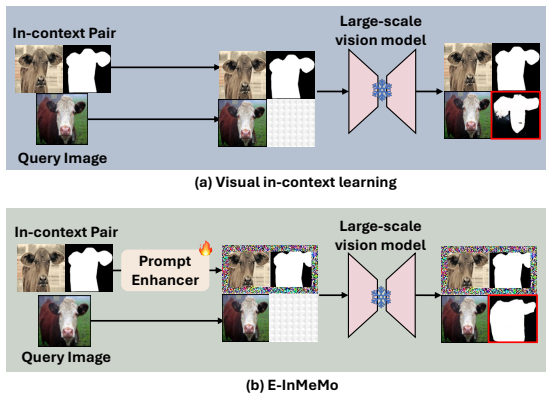
The load-bearing object is the prompt enhancer $t_\phi$: a 15-pixel-wide border of learnable pixels (27,540 parameters) that is added, with unit strength, to both the example input and the example label in the retrieved pair. The same $t_\phi$ is shared across all queries for a task, making it a task-specific identifier rather than a per-example edit. It is optimized by minimizing the cross-entropy between the frozen MAE's predicted VQGAN tokens in the empty output cell and the VQGAN-encoded tokens of the ground-truth canvas (Eq. 8). The paper's interpretation is that this aligns the latent distribution of the incomplete canvas with the distribution of a canvas that already contains the correct label, so the frozen decoder sees more plausible tokens. The second supporting mechanism is the feature-map-level retriever using DINOv2 features, which selects the in-context pair that the enhancer then refines.
What would settle it
A decisive experiment is to replace the learned $t_\phi$ with a fixed random border pattern of the same shape and magnitude after training. If a random pattern gives most of the same mIoU gains, then the effect is not learned task alignment but a generic input perturbation; if it gives no gain, the learned optimization is doing the work.
Extended reading notes
Core claim
E-InMeMo's central claim is that the retrieved in-context pair can be improved, not just selected: a learnable, input-agnostic perturbation $t_\phi$ added to both the example input and its label (Eq. 4) shifts the visual prompt so that a frozen MAE-VQGAN produces better output tokens. The perturbation is trained only on the task dataset with a cross-entropy loss between the predicted tokens in the empty canvas cell and the ground-truth tokens from a VQGAN encoder (Eq. 8). In the paper's experiments this raises mean mIoU from 35.92 to 43.91 on Pascal-5i foreground segmentation and from 27.18 to 44.22 on PASCAL VOC single object detection, with the same trend on the Kvasir and ISIC medical datasets. The authors interpret this as the prompt encoding task-specific distributional information that compensates for imperfect retrieval.
Load-bearing premise
The central assumption is that one fixed border pattern, trained once per task, can push the frozen model toward correct outputs for every query in that task, and that making VQGAN token predictions more accurate is a faithful proxy for making pixel-level segmentations more accurate.
Editorial extensions
If this is right
- Reported gains of 7.99 mIoU on Pascal-5i and 17.04 on PASCAL VOC indicate that prompt quality, not just retrieval quality, is a controllable lever in visual in-context learning.
- At only 27,540 trainable parameters and a single inference per query, the method offers a parameter-efficient alternative to prompt-ensemble approaches like prompt-SelF.
- The data-efficiency experiments show that the method with 10% of the retrieval set beats the no-prompt DINOv2 retriever using 100%, so the approach is useful when labeled data is scarce.
- Domain-shift results (COCO to Pascal) show a smaller relative drop than the baseline, so the learned prompt partly absorbs distribution shift.
- Ablations show that prompt placement matters: perturbing both the example and the query hurts, so future designs should keep the perturbation on the in-context pair.
Reading between the lines
- The paper leaves untested whether prompts trained on class groupings (e.g., all transportation classes together) could replace per-fold prompts; the inter-class generalization matrix suggests such grouped prompts might retain most of the gain with fewer trained parameters.
- An untested corollary of the mechanism is that the same border-perturbation recipe should improve other MAE-VQGAN inpainting-style tasks such as style transfer or image inpainting, since the loss is defined purely over visual tokens.
- The ablation showing that perturbing both query and example hurts implies that a single shared additive pattern is a constrained design; pair-specific or query-conditioned prompts are a natural next step and could close more of the gap to oracle in-context pairs.
Signed reviews
Editorial analysis
A structured set of objections, weighed in public.
Referee Report
Summary. The paper proposes E-InMeMo, a parameter-efficient visual prompting method for MAE-VQGAN-based in-context learning. A shared learnable pixel perturbation t_phi is added, via Eq. (4), to the retrieved in-context pair (x,y) before the pair is assembled with the query into a four-cell canvas; only t_phi is trained, using a cross-entropy loss (Eq. 8) between the MAE's predicted VQGAN tokens and the ground-truth VQGAN tokens. Retrieval is performed with a feature-map-level retriever (FMLR) using CLIP or DINOv2 features. Experiments report mean mIoU of 43.91 on Pascal-5i foreground segmentation (vs 35.92 for FMLR-DINOv2) and 44.22 on PASCAL VOC single-object detection (vs 27.18), together with results on two medical datasets, ablations of prompt placement and padding size, retrieval-set-size and dataset-size sensitivity, class-generalization matrices, and a COCO-to-Pascal domain-shift experiment. The paper frames the contribution as enhancing the in-context pair rather than simply adding a task prior.
Significance. The empirical core is clean: the FMLR-DINOv2 baseline isolates retrieval, and the only difference in E-InMeMo is the added learnable prompt, so the reported gains are attributable to the prompt under the stated protocol. The ablations in Table 4 show that prompt placement matters, and the method is lightweight (27,540 trainable parameters) with publicly available code. If the mechanism claim is established, this is a useful PEFT strategy for visual ICL. I do not see a circularity problem: Eq. (8) is a standard supervised cross-entropy on VQGAN tokens, and the comparison baselines are independent. The main gap is interpretational: because t_phi is shared across all pairs and trained on the task, the experiments do not yet rule out that it acts as a dataset-level prior rather than as an enhancement of the specific in-context pair; the domain-shift and near-tie conclusions also need support.
major comments (3)
- [Section 3.4, Eq. (4), Table 4] No control condition removes or replaces the in-context pair, or freezes t_phi at random initialization. Since t_phi is trained on the task dataset and shared across all pairs (Section 3.4 calls it a task-specific identifier and Section 3.7 says it captures the distribution of yq), the 7.99 and 17.04 gains are compatible with an unconditional task prior rather than with enhancing the retrieved pair. Please add a blank/random/irrelevant in-context pair condition and an untrained-random-prompt condition, and report whether the gains persist; if they do, the contribution should be described as visual PEFT rather than in-context-pair enhancement.
- [Section 4.4, Table 3] The robustness conclusion is not supported by the reported numbers. The absolute drops are 2.32 (FMLR) versus 2.49 (E-InMeMo), a 0.17-point difference, and the relative drops are 6.46% versus 5.67%; these differences are negligible and no variance is reported. The sentence stating that the performance gap between the two methods under domain shifts is minimal (0.17 points) is also misleading, since the actual cross-domain gap in mIoU is about 7.8 points, essentially unchanged from the in-domain gap. The claim that E-InMeMo enhances cross-domain generalization should be removed or supported by proper statistical evidence.
- [Section 4.5, Table 5; Section 4.4] All experiments are single runs, but several conclusions depend on near-tie or small differences. In Table 5, padding size 10 (mean 43.89) and padding size 15 (mean 43.91) are statistically indistinguishable, with fold-level reversals; in Table 3, the claimed robustness rests on a 0.17-point difference. I request mean and standard deviation over at least three seeds, or a significance test, for these comparisons, and correspondingly softer claims of optimality and robustness.
minor comments (4)
- [Section 4.1] The reported parameter count of 27,540 is not derivable from the stated 15-pixel border on 111 by 111 images combined with Eq. (4); please specify whether t_phi is applied per image or to the combined pair, including channel and gap handling.
- [Section 4.5, Figure 6] The text says The full results are shown in Table 1 when describing the intra- and inter-class generalization matrix; this should refer to Figure 6.
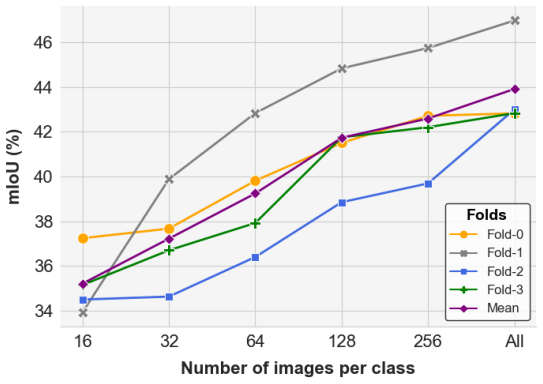
- [Section 5, Limitations; Figure 8] The statement that E-InMeMo requires a minimum of 32 images per class is not consistent with Figure 8, where Fold-0 reaches 37.24 with 16 images per class and the mean first exceeds the 35.92 baseline at 64 images; please reconcile the statement with the figure.
- [Section 3.1 and Eq. (8)] The notation g_l is used both for the assignment-score vector in Eq. (1) and for probability-like quantities in the cross-entropy loss in Eq. (8); please state explicitly how softmax normalization is applied.
Circularity Check
No significant circularity: the enhanced prompt is trained with a supervised token-level cross-entropy loss and evaluated on held-out data; no Eq. X = Eq. Y by construction.
full rationale
The claimed contribution is that a learnable, input-agnostic border perturbation t_phi, applied to the retrieved in-context pair (Eq. 4), improves MAE-VQGAN visual ICL. The training objective (Eq. 8) is cross-entropy between predicted VQGAN tokens for the empty cell and ground-truth tokens derived from the query label; this is a standard supervised loss on training pairs, not a quantity that already encodes the reported mIoU. Evaluation is performed on held-out queries using the standard split protocols, so the reported gains are not forced by construction. FMLR/DINOv2 is an independent retrieval baseline, and Table 4 isolates prompt placement while holding the retrieval pipeline fixed, showing that the learnable-prompt condition is the only change relative to the baseline. The only self-citation, the earlier InMeMo [28], is used as a comparison baseline and as provenance in the introduction; it is not invoked as evidence for the enhancement's effectiveness. The stated limitation that prompts are task-specific confirms the method is fitted per task, but that is the intended parameter-efficient tuning behavior, not circularity. The skeptical concern that t_phi might act as an unconditional task prior rather than as an enhancer of the specific in-context pair is a missing-control mechanistic question, not a circular reduction: it does not make the reported mIoU equal to a fitted input, and the paper's loss and evaluation pipeline are self-contained against external benchmarks. Hence no circular step can be quoted and exhibited under the required standard.
Assumptions & free parameters
free parameters (4)
- padding_size =
15 pixels
- perturbation_strength_delta =
1
- learning_rate =
15
- train_epochs =
70
assumptions (4)
- domain assumption The frozen MAE-VQGAN model and the VQGAN tokenizer from [15] provide a valid and sufficient backbone for visual ICL, and token-level cross-entropy is a good training signal.
- domain assumption The retrieval set S contains in-context pairs semantically similar enough to the query that a prompt can compensate for residual mismatch.
- domain assumption The evaluation protocol (dataset splits, resizing to 111x111, four-cell canvas) follows [15] and is a standard benchmark for visual ICL.
- ad hoc to paper A single additive border perturbation in pixel space (Eq. 4) can meaningfully shift the distribution of the in-context pair as perceived by the frozen MAE.
Cite this review
Pith. "Pith review of E-InMeMo: Enhanced Prompting for Visual In-Context Learning." pith.science (2026). https://pith.science/paper/S2RCLDOR
@misc{pith2026250418158,
  author       = {Pith},
  title        = {Pith review of: E-InMeMo: Enhanced Prompting for Visual In-Context Learning},
  year         = {2026},
  howpublished = {\url{https://pith.science/paper/S2RCLDOR}},
  note         = {Machine review of arXiv:2504.18158}
}
read the original abstract
Large-scale models trained on extensive datasets have become the standard due to their strong generalizability across diverse tasks. In-context learning (ICL), widely used in natural language processing, leverages these models by providing task-specific prompts without modifying their parameters. This paradigm is increasingly being adapted for computer vision, where models receive an input-output image pair, known as an in-context pair, alongside a query image to illustrate the desired output. However, the success of visual ICL largely hinges on the quality of these prompts. To address this, we propose Enhanced Instruct Me More (E-InMeMo), a novel approach that incorporates learnable perturbations into in-context pairs to optimize prompting. Through extensive experiments on standard vision tasks, E-InMeMo demonstrates superior performance over existing state-of-the-art methods. Notably, it improves mIoU scores by 7.99 for foreground segmentation and by 17.04 for single object detection when compared to the baseline without learnable prompts. These results highlight E-InMeMo as a lightweight yet effective strategy for enhancing visual ICL. Code is publicly available at: https://github.com/Jackieam/E-InMeMo
Figures


Figures from the paper (5 more)


Reference graph
Works this paper leans on
-
[1]
R. Bommasani, D. A. Hudson, E. Adeli, R. Altman, S. Arora, S. von Arx, M. S. Bernstein, J. Bohg, A. Bosselut, E. Brunskill, et al., On the opportunities and risks of foundation models, arXiv preprint arXiv:2108.07258 (2021)
arXiv 2021
-
[2]
A. Dosovitskiy, L. Beyer, A. Kolesnikov, D. Weissenborn, X. Zhai, T. Unterthiner, M. Dehghani, M. Minderer, G. Heigold, S. Gelly, et al., An image is worth 16x16 words: Transformers for image recognition at scale, arXiv preprint arXiv:2010.11929 (2020)
arXiv 2020
-
[3]
Radford, J
A. Radford, J. W. Kim, C. Hallacy, A. Ramesh, G. Goh, S. Agarwal, G. Sastry, A. Askell, P. Mishkin, J. Clark, et al., Learning transfer- able visual models from natural language supervision, in: International conference on machine learning, PMLR, 2021, pp. 8748–8763
2021
-
[4]
GPT-4o, https://openai.com/index/hello-gpt-4o/, last accessed 21 February, 2025
work page 2025
-
[5]
G. Team, R. Anil, S. Borgeaud, J.-B. Alayrac, J. Yu, R. Soricut, J. Schalkwyk, A. M. Dai, A. Hauth, K. Millican, et al., Gemini: a family of highly capable multimodal models, arXiv preprint arXiv:2312.11805 (2023)
arXiv 2023
- [6]
- [7]
-
[8]
Z. Wu, Y. Wang, J. Ye, L. Kong, Self-adaptive in-context learning, arXiv preprint arXiv:2212.10375 (2022)
arXiv 2022
Show all 68 references
-
[9]
Sorensen, J
T. Sorensen, J. Robinson, C. M. Rytting, A. G. Shaw, K. J. Rogers, A. P. Delorey, M. Khalil, N. Fulda, D. Wingate, An information-theoretic approach to prompt engineering without ground truth labels, arXiv preprint arXiv:2203.11364 (2022). 25
2022 arXiv
-
[10]
Honovich, U
O. Honovich, U. Shaham, S. R. Bowman, O. Levy, Instruction induction: From few examples to natural language task descriptions, arXiv preprint arXiv:2205.10782 (2022)
2022 arXiv
-
[11]
Y. Wang, Y. Kordi, S. Mishra, A. Liu, N. A. Smith, D. Khashabi, H. Ha- jishirzi, Self-instruct: Aligning language model with self generated in- structions, arXiv preprint arXiv:2212.10560 (2022)
2022 arXiv
-
[12]
S. Min, M. Lewis, H. Hajishirzi, L. Zettlemoyer, Noisy channel lan- guage model prompting for few-shot text classification, arXiv preprint arXiv:2108.04106 (2021)
2021 arXiv
-
[13]
Zhang, R
J. Zhang, R. Yoshihashi, S. Kitada, A. Osanai, Y. Nakashima, Vascar: Content-aware layout generation via visual-aware self-correction, arXiv preprint arXiv:2412.04237 (2024)
2024 arXiv
-
[14]
B. Wang, J. Chang, Y. Qian, G. Chen, J. Chen, Z. Jiang, J. Zhang, Y. Nakashima, H. Nagahara, Direct: Diagnostic reasoning for clinical notes via large language models, Vol. 37, 2024, pp. 74999–75011
2024
-
[15]
A. Bar, Y. Gandelsman, T. Darrell, A. Globerson, A. Efros, Visual prompting via image inpainting, Advances in Neural Information Pro- cessing Systems 35 (2022) 25005–25017
2022
-
[16]
Zhang, K
Y. Zhang, K. Zhou, Z. Liu, What makes good examples for visual in- context learning?, arXiv preprint arXiv:2301.13670 (2023)
2023 arXiv
-
[17]
X. Wang, W. Wang, Y. Cao, C. Shen, T. Huang, Images speak in images: A generalist painter for in-context visual learning, in: Proceedings of the IEEE/CVF Conference on Computer Vision and Pattern Recognition, 2023, pp. 6830–6839
2023
-
[18]
Y. Sun, Q. Chen, J. Wang, J. Wang, Z. Li, Exploring effective factors for improving visual in-context learning, arXiv preprint arXiv:2304.04748 (2023)
2023
-
[19]
Bahng, A
H. Bahng, A. Jahanian, S. Sankaranarayanan, P. Isola, Explor- ing visual prompts for adapting large-scale models, arXiv preprint arXiv:2203.17274 (2022). 26
2022 arXiv
-
[20]
A. Chen, Y. Yao, P.-Y. Chen, Y. Zhang, S. Liu, Understanding and improving visual prompting: A label-mapping perspective, in: Proceed- ings of the IEEE/CVF Conference on Computer Vision and Pattern Recognition, 2023, pp. 19133–19143
2023
-
[21]
C. Oh, H. Hwang, H.-y. Lee, Y. Lim, G. Jung, J. Jung, H. Choi, K. Song, Blackvip: Black-box visual prompting for robust transfer learning, in: Proceedings of the IEEE/CVF Conference on Computer Vision and Pat- tern Recognition, 2023, pp. 24224–24235
2023
-
[22]
M. Jia, L. Tang, B.-C. Chen, C. Cardie, S. Belongie, B. Hariharan, S.- N. Lim, Visual prompt tuning, in: European Conference on Computer Vision, Springer, 2022, pp. 709–727
2022
-
[23]
Lester, R
B. Lester, R. Al-Rfou, N. Constant, The power of scale for parameter- efficient prompt tuning, arXiv preprint arXiv:2104.08691 (2021)
2021 arXiv
-
[24]
X. L. Li, P. Liang, Prefix-tuning: Optimizing continuous prompts for generation, arXiv preprint arXiv:2101.00190 (2021)
2021 arXiv
-
[25]
K. Zhou, J. Yang, C. C. Loy, Z. Liu, Learning to prompt for vision- language models, International Journal of Computer Vision 130 (9) (2022) 2337–2348
2022
-
[26]
G. F. Elsayed, I. Goodfellow, J. Sohl-Dickstein, Adversarial reprogram- ming of neural networks, arXiv preprint arXiv:1806.11146 (2018)
2018 arXiv
-
[27]
Neekhara, S
P. Neekhara, S. Hussain, J. Du, S. Dubnov, F. Koushanfar, J. McAuley, Cross-modal adversarial reprogramming, in: Proceedings of the IEEE/CVF Winter Conference on Applications of Computer Vision, 2022, pp. 2427–2435
2022
-
[28]
Zhang, B
J. Zhang, B. Wang, L. Li, Y. Nakashima, H. Nagahara, Instruct me more! random prompting for visual in-context learning, in: Proceed- ings of the IEEE/CVF Winter Conference on Applications of Computer Vision, 2024, pp. 2597–2606
2024
-
[29]
Oquab, T
M. Oquab, T. Darcet, T. Moutakanni, H. Vo, M. Szafraniec, V. Khali- dov, P. Fernandez, D. Haziza, F. Massa, A. El-Nouby, et al., Dinov2: Learning robust visual features without supervision, arXiv preprint arXiv:2304.07193 (2023). 27
2023 arXiv
-
[30]
Brown, B
T. Brown, B. Mann, N. Ryder, M. Subbiah, J. D. Kaplan, P. Dhariwal, A. Neelakantan, P. Shyam, G. Sastry, A. Askell, et al., Language models are few-shot learners, Advances in neural information processing systems 33 (2020) 1877–1901
2020
-
[31]
Q. Dong, L. Li, D. Dai, C. Zheng, Z. Wu, B. Chang, X. Sun, J. Xu, Z. Sui, A survey for in-context learning, arXiv preprint arXiv:2301.00234 (2022)
2022 arXiv
-
[32]
J. Liu, D. Shen, Y. Zhang, B. Dolan, L. Carin, W. Chen, What makes good in-context examples for gpt-3?, arXiv preprint arXiv:2101.06804 (2021)
2021 arXiv
-
[33]
Y. Lu, M. Bartolo, A. Moore, S. Riedel, P. Stenetorp, Fantastically ordered prompts and where to find them: Overcoming few-shot prompt order sensitivity, arXiv preprint arXiv:2104.08786 (2021)
2021 arXiv
-
[34]
P. H. Winston, Learning and reasoning by analogy, Communications of the ACM 23 (12) (1980) 689–703
1980
-
[35]
T. Sun, Y. Shao, H. Qian, X. Huang, X. Qiu, Black-box tuning for language-model-as-a-service, in: International Conference on Machine Learning, PMLR, 2022, pp. 20841–20855
2022
-
[36]
Chowdhery, S
A. Chowdhery, S. Narang, J. Devlin, M. Bosma, G. Mishra, A. Roberts, P. Barham, H. W. Chung, C. Sutton, S. Gehrmann, et al., Palm: Scal- ing language modeling with pathways, arXiv preprint arXiv:2204.02311 (2022)
2022 arXiv
-
[37]
S. Min, M. Lewis, L. Zettlemoyer, H. Hajishirzi, Metaicl: Learning to learn in context, arXiv preprint arXiv:2110.15943 (2021)
2021 arXiv
-
[38]
H. J. Kim, H. Cho, J. Kim, T. Kim, K. M. Yoo, S.-g. Lee, Self-generated in-context learning: Leveraging auto-regressive language models as a demonstration generator, arXiv preprint arXiv:2206.08082 (2022)
2022 arXiv
-
[39]
J. Wei, X. Wang, D. Schuurmans, M. Bosma, F. Xia, E. Chi, Q. V. Le, D. Zhou, et al., Chain-of-thought prompting elicits reasoning in large language models, Advances in Neural Information Processing Systems 35 (2022) 24824–24837. 28
2022
-
[40]
Press, M
O. Press, M. Zhang, S. Min, L. Schmidt, N. A. Smith, M. Lewis, Measur- ing and narrowing the compositionality gap in language models, arXiv preprint arXiv:2210.03350 (2022)
2022 arXiv
-
[41]
S. An, Z. Lin, Q. Fu, B. Chen, N. Zheng, J.-G. Lou, D. Zhang, How do in-context examples affect compositional generalization?, arXiv preprint arXiv:2305.04835 (2023)
2023 arXiv
-
[42]
Hosseini, A
A. Hosseini, A. Vani, D. Bahdanau, A. Sordoni, A. Courville, On the compositional generalization gap of in-context learning, arXiv preprint arXiv:2211.08473 (2022)
2022 arXiv
-
[43]
Alayrac, J
J.-B. Alayrac, J. Donahue, P. Luc, A. Miech, I. Barr, Y. Hasson, K. Lenc, A. Mensch, K. Millican, M. Reynolds, et al., Flamingo: a visual language model for few-shot learning, Advances in Neural Information Processing Systems 35 (2022) 23716–23736
2022
-
[44]
Y. Bai, X. Geng, K. Mangalam, A. Bar, A. L. Yuille, T. Darrell, J. Ma- lik, A. A. Efros, Sequential modeling enables scalable learning for large vision models, in: Proceedings of the IEEE/CVF Conference on Com- puter Vision and Pattern Recognition, 2024, pp. 22861–22872
2024
-
[45]
X. Wang, X. Zhang, Y. Cao, W. Wang, C. Shen, T. Huang, Seg- gpt: Towards segmenting everything in context, in: Proceedings of the IEEE/CVF International Conference on Computer Vision, 2023, pp. 1130–1140
2023
-
[46]
P. Liu, W. Yuan, J. Fu, Z. Jiang, H. Hayashi, G. Neubig, Pre-train, prompt, and predict: A systematic survey of prompting methods in natural language processing, ACM Computing Surveys 55 (9) (2023) 1–35
2023
-
[47]
Pfeiffer, A
J. Pfeiffer, A. Kamath, A. R¨ uckl´ e, K. Cho, I. Gurevych, Adapterfusion: Non-destructive task composition for transfer learning, arXiv preprint arXiv:2005.00247 (2020)
2020 arXiv
-
[48]
Houlsby, A
N. Houlsby, A. Giurgiu, S. Jastrzebski, B. Morrone, Q. De Laroussilhe, A. Gesmundo, M. Attariyan, S. Gelly, Parameter-efficient transfer learn- ing for nlp, in: International Conference on Machine Learning, PMLR, 2019, pp. 2790–2799. 29
2019
-
[49]
Zhang, J
R. Zhang, J. Han, C. Liu, P. Gao, A. Zhou, X. Hu, S. Yan, P. Lu, H. Li, Y. Qiao, Llama-adapter: Efficient fine-tuning of language models with zero-init attention, arXiv preprint arXiv:2303.16199 (2023)
2023 arXiv
-
[50]
S. Hu, N. Ding, H. Wang, Z. Liu, J. Wang, J. Li, W. Wu, M. Sun, Knowledgeable prompt-tuning: Incorporating knowledge into prompt verbalizer for text classification, arXiv preprint arXiv:2108.02035 (2021)
2021 arXiv
-
[51]
Tsai, P.-Y
Y.-Y. Tsai, P.-Y. Chen, T.-Y. Ho, Transfer learning without knowing: Reprogramming black-box machine learning models with scarce data and limited resources, in: International Conference on Machine Learn- ing, PMLR, 2020, pp. 9614–9624
2020
-
[52]
S. Chen, C. Ge, Z. Tong, J. Wang, Y. Song, J. Wang, P. Luo, Adapt- former: Adapting vision transformers for scalable visual recognition, Advances in Neural Information Processing Systems 35 (2022) 16664– 16678
2022
-
[53]
K. Zhou, J. Yang, C. C. Loy, Z. Liu, Conditional prompt learning for vision-language models, in: Proceedings of the IEEE/CVF Conference on Computer Vision and Pattern Recognition, 2022, pp. 16816–16825
2022
-
[54]
P. Gao, S. Geng, R. Zhang, T. Ma, R. Fang, Y. Zhang, H. Li, Y. Qiao, Clip-adapter: Better vision-language models with feature adapters, In- ternational Journal of Computer Vision 132 (2) (2024) 581–595
2024
-
[55]
H.-A. Tsao, L. Hsiung, P.-Y. Chen, S. Liu, T.-Y. Ho, Autovp: An au- tomated visual prompting framework and benchmark, arXiv preprint arXiv:2310.08381 (2023)
2023 arXiv
-
[56]
X. Han, W. Zhao, N. Ding, Z. Liu, M. Sun, Ptr: Prompt tuning with rules for text classification, AI Open 3 (2022) 182–192
2022
-
[57]
K. He, X. Chen, S. Xie, Y. Li, P. Doll´ ar, R. Girshick, Masked autoen- coders are scalable vision learners, in: Proceedings of the IEEE/CVF conference on computer vision and pattern recognition, 2022, pp. 16000– 16009
2022
-
[58]
Esser, R
P. Esser, R. Rombach, B. Ommer, Taming transformers for high- resolution image synthesis, in: Proceedings of the IEEE/CVF conference on computer vision and pattern recognition, 2021, pp. 12873–12883. 30
2021
-
[59]
Shaban, S
A. Shaban, S. Bansal, Z. Liu, I. Essa, B. Boots, One-shot learning for semantic segmentation, arXiv preprint arXiv:1709.03410 (2017)
2017 arXiv
-
[60]
Everingham, L
M. Everingham, L. Van Gool, C. K. Williams, J. Winn, A. Zisserman, The pascal visual object classes (voc) challenge, International journal of computer vision 88 (2010) 303–338
2010
-
[61]
D. Jha, P. H. Smedsrud, M. A. Riegler, P. Halvorsen, T. De Lange, D. Jo- hansen, H. D. Johansen, Kvasir-seg: A segmented polyp dataset, in: MultiMedia Modeling: 26th International Conference, MMM 2020, Dae- jeon, South Korea, January 5–8, 2020, Proceedings, Part II 26, Springe...
2020
-
[62]
Gutman, N
D. Gutman, N. C. Codella, E. Celebi, B. Helba, M. Marchetti, N. Mishra, A. Halpern, Skin lesion analysis toward melanoma detec- tion: A challenge at the international symposium on biomedical imag- ing (isbi) 2016, hosted by the international skin imaging collaboration (isic), ...
2016 arXiv
-
[63]
W. Suo, L. Lai, M. Sun, H. Zhang, P. Wang, Y. Zhang, Rethinking and improving visual prompt selection for in-context learning segmentation, in: European Conference on Computer Vision, Springer, 2025, pp. 18– 35
2025
-
[64]
C. Xu, C. Liu, Y. Wang, Y. Yao, Y. Fu, Towards global optimal vi- sual in-context learning prompt selection, in: The Thirty-eighth Annual Conference on Neural Information Processing Systems, 2024
2024
-
[65]
Rakelly, E
K. Rakelly, E. Shelhamer, T. Darrell, A. Efros, S. Levine, Conditional networks for few-shot semantic segmentation (2018)
2018
-
[66]
D. P. Kingma, J. Ba, Adam: A method for stochastic optimization, arXiv preprint arXiv:1412.6980 (2014)
2014 arXiv
-
[67]
K. Zhou, Z. Liu, Y. Qiao, T. Xiang, C. C. Loy, Domain generalization: A survey, IEEE Transactions on Pattern Analysis and Machine Intelligence (2022)
2022
-
[68]
T.-Y. Lin, M. Maire, S. Belongie, J. Hays, P. Perona, D. Ramanan, P. Doll´ ar, C. L. Zitnick, Microsoft coco: Common objects in context, in: Computer Vision–ECCV 2014: 13th European Conference, Zurich, 31 Switzerland, September 6-12, 2014, Proceedings, Part V 13, Springer, 201...
2014
Reviewed August 16, 2026 · model on record in the stance chip above.
Discussion (0). Continue with ORCID to comment.