REVIEW 4 major objections 6 minor 45 references
Optimizing Multi-Round Enhanced Training in Diffusion Models for Improved Preference Understanding
T0 review · 4 major / 6 minor · reviewed 2026-08-16 · deepseek-v4-flash
Pith's one-line read A multi-round dialogue loop with diversity, consistency, and a DPO-trained preference reward can steer diffusion image generation to match user intent better than single-shot models.
desk verdict A plausible multi-turn reward-tuning pipeline undermined by invalid theory, a mislabeled reward model, and circular evaluation. read the letter →
The pith
A machine-rendered reading of the paper's core claim, the machinery that carries it, and where it could break.
The reading
What carries the argument
The load-bearing object is the dynamic total reward $R_{\mathrm{total}}(t) = \lambda_{\mathrm{div}}(t) R_{\mathrm{div}} + \lambda_{\mathrm{cons}}(t) R_{\mathrm{cons}} + \lambda_{\mathrm{MI}}(t) R_{\mathrm{MI}}$, with $\lambda_{\mathrm{div}}(t)=e^{-\alpha t}$, $\lambda_{\mathrm{cons}}(t)=1-e^{-\beta t}$, and $\lambda_{\mathrm{MI}}(t)=\frac12 e^{-\gamma t}$. $R_{\mathrm{div}}$ pushes early-round samples apart in the U-Net feature space, $R_{\mathrm{cons}}$ rewards cosine similarity between consecutive dialogue rounds, and $R_{\mathrm{MI}}$, called the preference score, comes from a Qwen-VL model fine-tuned with DPO on positive/negative image pairs. PPO converts $R_{\mathrm{total}}$ into gradient updates for LoRA adapters inserted in the attention layers, while the base diffusion weights stay fixed. The time-dependent weights shift training from exploration (diversity) to stability (consistency) and intent alignment as dialogue rounds proceed.
What would settle it
Collect independent human preference judgments on held-out multi-turn dialogues and compare the orderings produced by the $R_{\mathrm{MI}}$ preference score, CLIP, aesthetic, and BLIP scores; if the preference score does not match human rankings better than the other metrics, or if PPO updates that raise $R_{\mathrm{MI}}$ lower human satisfaction, the central claim fails.
Extended reading notes
Core claim
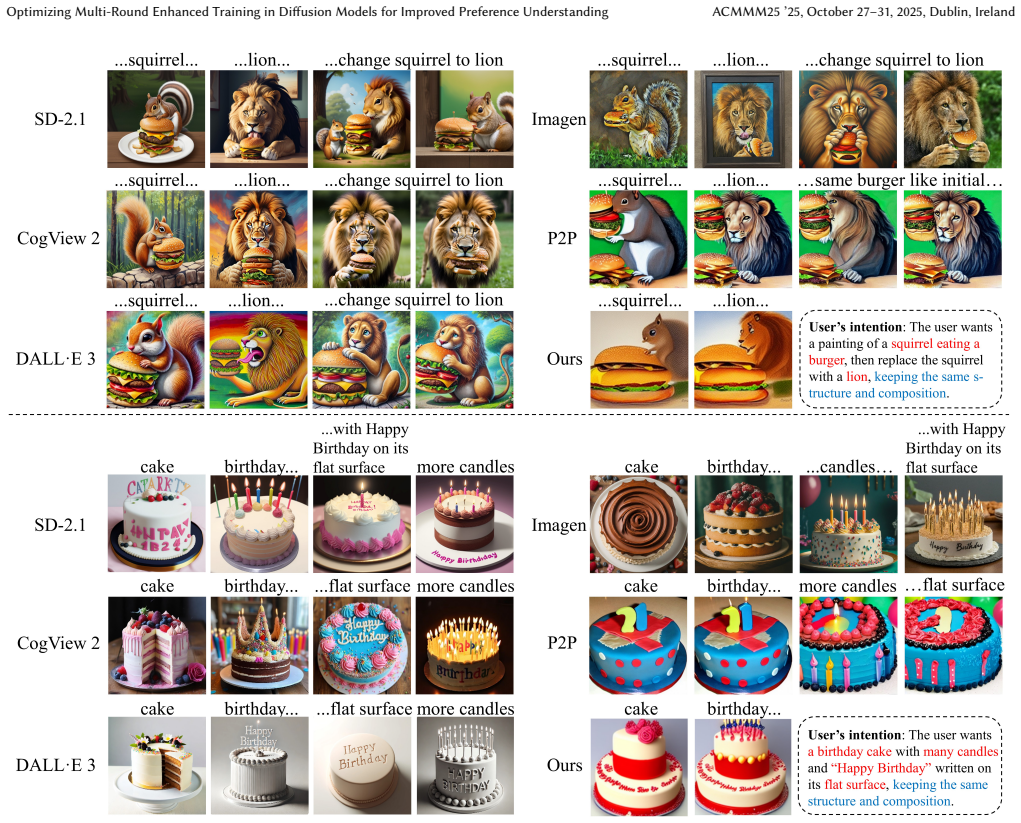
The central claim is that mutual-information maximization—implemented as a preference score from a Qwen-VL reward model trained with DPO—captures user intent more faithfully than both standard reinforcement learning and CLIP-style metrics, and that this reward can guide a multi-round diffusion process. The paper argues that optimizing $R_{\mathrm{total}}$ with PPO while updating only LoRA adapters produces images that are diverse in early rounds, consistent across rounds, and increasingly aligned with the user's stated intent. In the reported evaluations, the method ranks first on human satisfaction, BLIP and CLIP scores, and the number of dialogue rounds needed, and it outperforms baseline models in win rates across eight dialogue rounds.
Load-bearing premise
The load-bearing premise is that the DPO-trained Qwen-VL reward model's preference score is a faithful and stable proxy for what human users actually want across dialogue rounds, so that PPO updates driven by it improve real intent rather than a heuristic artifact.
Editorial extensions
If this is right
- Interactive text-to-image systems can be trained directly on multi-round dialogue data, so each user refinement becomes part of the learning signal rather than a one-off edit.
- A time-dependent reward schedule offers a general recipe for balancing exploration and convergence in iterative generative tasks.
- A DPO-trained vision-language reward model can serve as a reusable preference oracle that is more discriminative than CLIP for selecting images that match intent.
- LoRA-based reward-driven updates let a diffusion model be adapted to new preferences without retraining the full backbone, making per-user or per-dialogue personalization feasible.
Reading between the lines
- The same reward decomposition could transfer to other iterative generative settings—image editing, video generation, or embodied instruction following—with the dynamic weighting schedule as the reusable component.
- Because the reward model's negative examples are built by heuristics (low-scoring images, random mismatches, LLM-generated unrelated images), a testable prediction is that the preference score is vulnerable to shortcuts based on surface style rather than genuine intent; independent human labels would settle this.
- An extension the paper does not explore is replacing the fixed DPO-trained reward with the user's own in-dialogue selections, which would make co-adaptation fully personal and remove the need for a separate reward model.
- The convergence results assume the prompt-refinement process reaches an ideal fixed point; taken literally, this predicts that remaining failures will concentrate in the LLM's prompt-update step rather than in the diffusion sampler.
Signed reviews
Editorial analysis
A structured set of objections, weighed in public.
Referee Report
Summary. The paper proposes Visual Co-Adaptation (VCA), a framework for multi-round, human-in-the-loop text-to-image generation. It constructs multi-turn dialogue prompt-image datasets, trains a reward model by applying DPO to Qwen-VL, and fine-tunes Stable Diffusion v2.1 with LoRA using a total reward that combines diversity, consistency, and a so-called mutual information term. The authors state two theorems: convergence of the multi-round latent distribution to a target distribution in total variation (Theorem 3.1), and convergence of the dynamically weighted reward optimization to the Pareto optimal set (Theorem 3.2). The experimental section compares VCA with several text-to-image baselines on preference scores, CLIP/BLIP/LPIPS, modality-switching tasks, ablations, and a 2706-user human evaluation, concluding that VCA is consistently superior, especially in multi-turn dialogue scenarios.
Significance. If the claims were substantiated, the framework would be a practically useful contribution to interactive text-to-image generation, and the described multi-turn dialogue dataset could be a reusable resource. The paper has concrete strengths: a large constructed dataset, a systematic combination of three reward terms, ablations of the reward components, and a clear system design. However, the evaluation is compromised by the fact that the headline 'preference score' is the same DPO-trained reward used as the training objective, the human study lacks statistical detail, and the theoretical results are not correct as stated. In its current form, the paper does not establish its central claims; the useful components could be salvaged only with substantially revised evaluation and theory.
major comments (4)
- [Theoretical Analysis in §3.1 and Appendix A.1 (Theorem 3.1, Eq. 7)] Theorem 3.1 is mathematically invalid as stated. The proof explicitly identifies the limiting object p_target with a Dirac delta, but each iterate p_T is an absolutely continuous Gaussian density. Total variation distance between an absolutely continuous probability measure and a Dirac measure is 1, not 0, and Scheffé's lemma cannot be invoked because the limit is not a density. The argument that pointwise convergence p_T(z) to 0 for z ≠ z_target combined with distributional convergence to delta implies convergence in TV is false. Because this theorem is listed as a key contribution, the error is load-bearing.
- [Appendix A.2 (Theorem A.10 / Theorem 3.2)] The proof of Theorem 3.2 relies on incorrect geometric and variational claims. Cosine similarity on the unit sphere is not an affine function, and the same normalized inner product cannot be simultaneously concave for R_div and convex for R_cons as asserted. The step that dV/dt tends to 0 does not imply that the sequence z_t* converges to a maximizer, and the negative-definiteness of d^2V/dt^2 is asserted without checking the signs of the reward terms. The scalarization argument shows at most that each z_t* is Pareto optimal for its own fixed weights, not that the sequence converges to a balanced Pareto point as t tends to infinity. Thus Theorem 3.2 is unproven.
- [§3.2 (Eq. 10) and §4.3 (Figs. 4-6)] Eq. (10) defines R_MI = I(X;Y), but the implementation is a DPO-trained Qwen-VL model whose reward is the mean logit; no identity with mutual information is established. Figures 4, 5, and 6 evaluate methods using this same 'preference score' (R_MI). Since VCA is optimized against R_MI, comparing methods on this metric is partly circular for the claim of improved preference understanding, and the metric is never validated against independent human preference judgments. The DPO negative examples are constructed by heuristic mismatch, which may not reflect genuine user dissatisfaction in multi-turn correction. This leaves the central empirical claim unsubstantiated.
- [Table 1 (Human Eval)] The human evaluation is reported only as ranks and win counts for 2706 users. There are no confidence intervals, no significance tests, no inter-rater agreement measure, and the protocol description ('blind cross-over design') lacks essential details: how prompts were sampled, how many images each user saw, how the composite 0-5 scores for response time, aesthetics, intent reflection, and round number were aggregated, and whether the comparison was paired. Without this information, the conclusion that VCA 'consistently surpasses' competing models in user satisfaction is not supported by the reported evidence.
minor comments (6)
- [§4.5] Section 4.5 appears to duplicate the ablation paragraph from Section 4.4 ('Ablation Study on Reward Coefficient Impact'); this is likely a copy-paste error.
- [§3.1 (Eq. 2 vs. Eq. 6)] Notation is inconsistent: Eq. (2) writes DM(t,τ), while Eq. (6) writes DM(t); the indexing should be made uniform and precise.
- [Table 1 header] The header 'Lpips [38]↓ Aesthetic Score CLIP [20] ↑ BLIP [14]↑ Round↓' is confusing because the row entries alternate 'Rank' and 'Score'; clarifying which columns are ranks and which are scores would improve readability.
- [Figure 8] Figure 8 reports user satisfaction, BLIP, CLIP, and LPIPS curves without error bars; given the plateau claim between 10k and 15k samples, variance information is needed.
- [§3.2 (Eq. 10) and §4.3] The same quantity is referred to as both 'mutual information reward' and 'preference score'; this conflation should be resolved and the terminology aligned.
- [References] Reference [6] ('Enhancing Intent Understanding for Ambiguous prompt: A Human-Machine Co-Adaption Strategy') lacks a venue, arXiv identifier, or year, and should be completed.
Circularity Check
Preference-score evaluation is partly circular because the metric is the same DPO-trained reward model used to train the system; theoretical proofs also assume their conclusions. The central user-satisfaction claim retains independent human-eval grounding.
-
fitted input called prediction
[Section 3.2, Eq. (10); Section 4.3 (Figure 5 paragraph)]
"The mutual information reward 𝐼(𝑋 ;𝑌) (In our later paper, we refer to this metric as the "preference score. ") is optimized to fine-tune the model’s outputs ... In this experiment (Figure 5), we compared the preference score win rates of various generative models ... Our model outperformed others, with the highest win rates of 0.84 against CogView 2 and 0.78 against Muse, showcasing superior handling of complex dialogues and intent capture."
The 'preference score' used for the win-rate comparison is R_MI, the DPO-trained Qwen-VL logit-mean reward that is also the optimization target in Eq. (11) and Algorithm 1's PPO update. A model trained to maximize R_MI is therefore expected to score higher on it even if human alignment is unchanged; comparing VCA to baselines on this metric does not independently measure 'intent capture'. The paper reports no held-out human validation of R_MI itself, so the Figure 4-6 preference-score results are partly forced by the training objective.
-
other
[Appendix A.1, proof of Theorem A.4 (main-text Theorem 3.1)]
"We assume that under the hypothesis of the multi-round diffusion process, the latent variable densities 𝑝𝑡(𝑧) (for 𝑡∈ N) converge pointwise almost everywhere to the target density 𝑝target(𝑧). ... Then, the proof proceeds as follows. Scheffé’s lemma states that if a sequence of probability densities {𝑞𝑛(𝑧)} converges pointwise almost everywhere to a probability density 𝑞(𝑧), then the total variation norm converges to zero."
The theorem promises TV convergence from Assumptions A.1–A.3, but the proof starts by assuming exactly the pointwise convergence of densities that is the substantive content of the convergence claim. Scheffé's lemma then converts that assumed pointwise convergence into the TV conclusion. The subsequent Gaussian-density argument shows convergence in distribution to a Dirac mass, not pointwise a.e. convergence to a density, so the proof does not close the gap. The 'theoretical guarantee' is thus imported as an assumption rather than derived.
2 more flagged steps
-
self definitional
[Appendix A.2, proof of Theorem A.10 (main-text Theorem 3.2)]
"Since the weighted-sum formulation is a scalarization of the multi-objective problem, it is well known that every optimal solution 𝑧∗𝑡 is Pareto optimal, provided the weights are strictly positive. ... Thus, we conclude that the dynamic weighting scheme yields a sequence {𝑧∗𝑡} that remains in the Pareto optimal set."
Pareto optimality of z*_t is a standard property of weighted-sum scalarization, not a consequence of the paper's dynamics; the conclusion is built into the definition of z*_t as the maximizer of R_total. The additional dV/dt→0 argument shows only that the value of V(t) stabilizes, not that the sequence z*_t converges to a balanced Pareto point. Hence the claimed convergence to the Pareto optimal set is an artifact of how the optimizer is defined.
-
renaming known result
[Section 3.2, Eq. (10)]
"The Mutual Information Reward is computed using a custom-trained reward model derived from Qwen-VL [2] (with the final linear layer of the Qwen-VL model removed, it calculates the logits’ mean as the reward and fine-tunes using QLoRA). The model is trained using a prompt paired with two contrasting images, each labeled with 0 or 1 to indicate poor or good alignment with human intent, and optimized through DPO. 𝑅MI = 𝐼(𝑋 ;𝑌) (10)"
The quantity denoted R_MI is the mean logit of a DPO-trained Qwen-VL preference model, not mutual information I(X;Y). No mutual-information estimator or information-theoretic derivation is provided. Calling this DPO-style reward 'mutual information' and claiming in the contributions that 'mutual information maximization outperforms conventional RL' renames a known reward-modeling technique rather than establishing an information-theoretic objective, so the contribution statement is not supported by the equations.
full rationale
Score 4. The main empirical claim (user satisfaction) is not fully circular: Table 1 reports a 2706-user blind cross-over human evaluation and the paper also reports CLIP, BLIP, LPIPS and aesthetic scores, which are external to the R_MI reward. The VCA framework itself is an engineering contribution with independent components (LoRA fine-tuning, multi-round dialogue data, dynamic reward weighting). However, the paper's preference-score evaluation (Figures 4-6) is partly circular because the 'preference score' is the same DPO-trained Qwen-VL reward model R_MI used as the PPO optimization target, and R_MI is not validated against held-out human judgments. The theoretical 'guarantees' (Theorems 3.1 and 3.2) are also weaker than stated: the first proof assumes pointwise convergence and the second concludes Pareto optimality by the standard scalarization property. There is no load-bearing self-citation chain: reference [6] is related prior work by two of the authors, but the central results do not rest on an imported uniqueness theorem. The renaming of a DPO reward as 'mutual information' is misleading but does not by itself make the empirical comparisons circular.
Assumptions & free parameters
free parameters (3)
- alpha, beta, gamma (dynamic reward weights) =
0.15, 0.1, 0.075
- LoRA rank and alpha for diffusion model =
rank=4, alpha=4
- QLoRA rank and alpha for reward model =
rank=64, alpha=16
assumptions (8)
- ad hoc to paper Assumption A.1: prompt embedding sequence converges geometrically to an ideal prompt
- ad hoc to paper Assumption A.2: the diffusion model is a beta-contraction in latent space
- ad hoc to paper Assumption A.3: noise variance decays as o(1/t)
- ad hoc to paper The limiting target p_target is identified with a Dirac delta
- ad hoc to paper Domain Z is compact and feature map f maps to the unit sphere with affine cosine properties
- ad hoc to paper The DPO-trained reward model approximates mutual information I(X;Y)
- standard math Scheffé's lemma
- standard math Weighted-sum maxima of continuous objectives over a compact set are Pareto optimal
Cite this review
Pith. "Pith review of Optimizing Multi-Round Enhanced Training in Diffusion Models for Improved Preference Understanding." pith.science (2026). https://pith.science/paper/TLK4TGR4
@misc{pith2026250418204,
  author       = {Pith},
  title        = {Pith review of: Optimizing Multi-Round Enhanced Training in Diffusion Models for Improved Preference Understanding},
  year         = {2026},
  howpublished = {\url{https://pith.science/paper/TLK4TGR4}},
  note         = {Machine review of arXiv:2504.18204}
}
read the original abstract
Generative AI has significantly changed industries by enabling text-driven image generation, yet challenges remain in achieving high-resolution outputs that align with fine-grained user preferences. Consequently, multi-round interactions are necessary to ensure the generated images meet expectations. Previous methods enhanced prompts via reward feedback but did not optimize over a multi-round dialogue dataset. In this work, we present a Visual Co-Adaptation (VCA) framework incorporating human-in-the-loop feedback, leveraging a well-trained reward model aligned with human preferences. Using a diverse multi-turn dialogue dataset, our framework applies multiple reward functions, such as diversity, consistency, and preference feedback, while fine-tuning the diffusion model through LoRA, thus optimizing image generation based on user input. We also construct multi-round dialogue datasets of prompts and image pairs aligned with user intent. Experiments demonstrate that our method outperforms state-of-the-art baselines, significantly improving image consistency and alignment with user intent. Our approach consistently surpasses competing models in user satisfaction, especially in multi-turn dialogue scenarios.
Figures


Figures from the paper (6 more)


Reference graph
Works this paper leans on
-
[1]
Jinze Bai, Shuai Bai, Yunfei Chu, Zeyu Cui, Kai Dang, Xiaodong Deng, Yang Fan, Wenbin Ge, Yu Han, Fei Huang, Binyuan Hui, Luo Ji, Mei Li, Junyang Lin, Runji Lin, Dayiheng Liu, Gao Liu, Chengqiang Lu, Keming Lu, Jianxin Ma, Rui Men, Xingzhang Ren, Xuancheng Ren, Chuanqi Tan, Sinan Tan, Jianhong Tu, Peng Wang, Shijie Wang, Wei Wang, Shengguang Wu, Benfeng X...
arXiv 2023
-
[2]
Jinze Bai, Shuai Bai, Shusheng Yang, Shijie Wang, Sinan Tan, Peng Wang, Jun- yang Lin, Chang Zhou, and Jingren Zhou. 2023. Qwen-VL: A Versatile Vision- Language Model for Understanding, Localization, Text Reading, and Beyond. arXiv:2308.12966 [cs.CV] https://arxiv.org/abs/2308.12966
arXiv 2023
-
[3]
Huiwen Chang, Han Zhang, Jarred Barber, AJ Maschinot, Jose Lezama, Lu Jiang, Ming-Hsuan Yang, Kevin Murphy, William T Freeman, Michael Rubinstein, et al
-
[4]
Tim Dettmers, Artidoro Pagnoni, Ari Holtzman, and Luke Zettlemoyer. 2023. QLoRA: Efficient Finetuning of Quantized LLMs. arXiv:2305.14314 [cs.LG] https://arxiv.org/abs/2305.14314
arXiv 2023
-
[5]
Ming Ding, Wendi Zheng, Wenyi Hong, and Jie Tang. 2022. CogView2: Faster and Better Text-to-Image Generation via Hierarchical Transformers. arXiv:2204.14217 [cs.CV] https://arxiv.org/abs/2204.14217
arXiv 2022
-
[6]
Yangfan He, Yuxuan Bai, and Tianyu Shi. 2024. Enhancing Intent Understanding for Ambiguous prompt: A Human-Machine Co-Adaption Strategy
work page 2024
-
[7]
Amir Hertz, Ron Mokady, Jay Tenenbaum, Kfir Aberman, Yael Pritch, and Daniel Cohen-Or. 2022. Prompt-to-prompt image editing with cross attention control
work page 2022
-
[8]
Jack Hessel, Ari Holtzman, Maxwell Forbes, Ronan Le Bras, and Yejin Choi
Show all 45 references
-
[9]
Hu, Yelong Shen, Phillip Wallis, Zeyuan Allen-Zhu, Yuanzhi Li, Shean Wang, Lu Wang, and Weizhu Chen
Edward J. Hu, Yelong Shen, Phillip Wallis, Zeyuan Allen-Zhu, Yuanzhi Li, Shean Wang, Lu Wang, and Weizhu Chen. 2021. LoRA: Low-Rank Adaptation of Large Language Models. arXiv:2106.09685 [cs.CL] https://arxiv.org/abs/2106.09685
2021 arXiv
-
[10]
Chengsong Huang, Qian Liu, Bill Yuchen Lin, Tianyu Pang, Chao Du, and Min Lin. 2024. LoraHub: Efficient Cross-Task Generalization via Dynamic LoRA Composition. arXiv:2307.13269 [cs.CL] https://arxiv.org/abs/2307.13269
2024 arXiv
-
[11]
Minbin Huang, Yanxin Long, Xinchi Deng, Ruihang Chu, Jiangfeng Xiong, Xiao- dan Liang, Hong Cheng, Qinglin Lu, and Wei Liu. 2024. DialogGen: Multi-modal Interactive Dialogue System for Multi-turn Text-to-Image Generation
2024
-
[12]
Harrison Lee, Samrat Phatale, Hassan Mansoor, Thomas Mesnard, Johan Ferret, Kellie Lu, Colton Bishop, Ethan Hall, Victor Carbune, Abhinav Rastogi, and Sushant Prakash. 2023. RLAIF: Scaling Reinforcement Learning from Human Feedback with AI Feedback. arXiv:2309.00267 [cs.CL] ht...
2023 arXiv
-
[13]
Kimin Lee, Hao Liu, Moonkyung Ryu, Olivia Watkins, Yuqing Du, Craig Boutilier, Pieter Abbeel, Mohammad Ghavamzadeh, and Shixiang Shane Gu. 2023. Aligning text-to-image models using human feedback
2023
-
[14]
Junnan Li, Dongxu Li, Caiming Xiong, and Steven Hoi. 2022. Blip: Bootstrapping language-image pre-training for unified vision-language understanding and generation. , 12888–12900 pages
2022
-
[15]
Junnan Li, Dongxu Li, Caiming Xiong, and Steven Hoi. 2022. BLIP: Bootstrapping Language-Image Pre-training for Unified Vision-Language Understanding and Generation. arXiv:2201.12086 [cs.CV] https://arxiv.org/abs/2201.12086
2022 arXiv
-
[16]
Youwei Liang, Junfeng He, Gang Li, Peizhao Li, Arseniy Klimovskiy, Nicholas Carolan, Jiao Sun, Jordi Pont-Tuset, Sarah Young, Feng Yang, et al. 2023. Rich Human Feedback for Text-to-Image Generation
2023
-
[17]
Ziwei Liu, Ping Luo, Shi Qiu, Xiaogang Wang, and Xiaoou Tang. 2016. DeepFash- ion: Powering Robust Clothes Recognition and Retrieval with Rich Annotations
2016
-
[18]
Kaisa Miettinen. 1999. Nonlinear Multiobjective Optimization
1999
-
[19]
OpenAI, Josh Achiam, Steven Adler, and Sandhini Agarwal et al. 2024. GPT-4 Technical Report. arXiv:2303.08774 [cs.CL] https://arxiv.org/abs/2303.08774
2024 arXiv
-
[20]
Alec Radford, Jong Wook Kim, Chris Hallacy, Aditya Ramesh, Gabriel Goh, Sandhini Agarwal, Girish Sastry, Amanda Askell, Pamela Mishkin, Jack Clark, et al. 2021. Learning transferable visual models from natural language supervision. , 8748–8763 pages
2021
-
[21]
Manning, and Chelsea Finn
Rafael Rafailov, Archit Sharma, Eric Mitchell, Stefano Ermon, Christopher D. Manning, and Chelsea Finn. 2024. Direct Preference Optimization: Your Language Model is Secretly a Reward Model. arXiv:2305.18290 [cs.LG] https://arxiv.org/ abs/2305.18290
2024 arXiv
-
[22]
Aditya Ramesh, Prafulla Dhariwal, Alex Nichol, Casey Chu, and Mark Chen
-
[23]
Siddharth Reddy, Sergey Levine, and Anca Dragan. 2022. First contact: Unsu- pervised human-machine co-adaptation via mutual information maximization. , 31542–31556 pages
2022
-
[24]
Robin Rombach, Andreas Blattmann, Dominik Lorenz, Patrick Esser, and Björn Ommer. 2022. High-resolution image synthesis with latent diffusion models. , 10684–10695 pages
2022
-
[25]
, 3 pages
Hierarchical text-conditional image generation with clip latents. , 3 pages
-
[26]
Chitwan Saharia, William Chan, Saurabh Saxena, Lala Li, Jay Whang, Emily L Denton, Kamyar Ghasemipour, Raphael Gontijo Lopes, Burcu Karagol Ayan, Tim Salimans, et al. 2022. Photorealistic text-to-image diffusion models with deep language understanding. , 36479–36494 pages
2022
-
[27]
Henry Scheffé. 1947. A Useful Convergence Theorem for Probability Distributions. Annals of Mathematical Statistics 18, 3 (1947), 434–438. https://doi.org/10.1214/ aoms/1177730386
1947
-
[28]
Robin Rombach, Andreas Blattmann, Dominik Lorenz, Patrick Esser, and Björn Ommer. 2022. High-Resolution Image Synthesis with Latent Diffusion Models. arXiv:2112.10752 [cs.CV] https://arxiv.org/abs/2112.10752
2022 arXiv
-
[29]
Yilin Wang, Sasi Inguva, and Balu Adsumilli. 2019. YouTube UGC dataset for video compression research. , 5 pages
2019
-
[30]
Zhijie Wang, Yuheng Huang, Da Song, Lei Ma, and Tianyi Zhang. 2024. PromptCharm: Text-to-Image Generation through Multi-modal Prompting and Refinement. , 21 pages
2024
-
[31]
John Schulman, Filip Wolski, Prafulla Dhariwal, Alec Radford, and Oleg Klimov
-
[32]
Yi Xin, Junlong Du, Qiang Wang, Zhiwen Lin, and Ke Yan. 2024. VMT-Adapter: Parameter-Efficient Transfer Learning for Multi-Task Dense Scene Understanding. In Proceedings of the AAAI Conference on Artificial Intelligence , Vol. 38. 16085– 16093
2024
-
[33]
Yi Xin, Junlong Du, Qiang Wang, Ke Yan, and Shouhong Ding. 2024. MmAP: Multi- modal Alignment Prompt for Cross-domain Multi-task Learning. In Proceedings of the AAAI Conference on Artificial Intelligence , Vol. 38. 16076–16084
2024
-
[34]
Yi Xin, Siqi Luo, Xuyang Liu, Haodi Zhou, Xinyu Cheng, Christina E Lee, Junlong Du, Haozhe Wang, MingCai Chen, Ting Liu, et al. 2024. V-petl bench: A unified visual parameter-efficient transfer learning benchmark. Advances in Neural Information Processing Systems 37 (2024), 80...
2024
-
[35]
Hui Wu, Yupeng Gao, Xiaoxiao Guo, Ziad Al-Halah, Steven Rennie, Kristen Grauman, and Rogerio Feris. 2020. Fashion IQ: A New Dataset Towards Retrieving Images by Natural Language Feedback. arXiv:1905.12794 [cs.CV] https://arxiv. org/abs/1905.12794
2020 arXiv
-
[36]
Jiazheng Xu, Xiao Liu, Yuchen Wu, Yuxuan Tong, Qinkai Li, Ming Ding, Jie Tang, and Yuxiao Dong. 2024. Imagereward: Learning and evaluating human preferences for text-to-image generation
2024
-
[37]
Lidong Zeng, Zhedong Zheng, Yinwei Wei, and Tat-seng Chua. 2024. Instilling Multi-round Thinking to Text-guided Image Generation
2024
-
[38]
Richard Zhang, Phillip Isola, Alexei A Efros, Eli Shechtman, and Oliver Wang
-
[39]
Yi Xin, Siqi Luo, Haodi Zhou, Junlong Du, Xiaohong Liu, Yue Fan, Qing Li, and Yuntao Du. 2024. Parameter-efficient fine-tuning for pre-trained vision models: A survey. arXiv preprint arXiv:2402.02242 (2024)
2024
-
[44]
There exists𝛽 < 1 such that for any𝑧,𝑧′ and embedding𝜓, DM(𝑡)(𝑧,𝜓)− DM(𝑡)(𝑧′,𝜓) 2≤𝛽 𝑧−𝑧′
(1) Assumption A.2 (Diffusion Model Stability). There exists𝛽 < 1 such that for any𝑧,𝑧′ and embedding𝜓, DM(𝑡)(𝑧,𝜓)− DM(𝑡)(𝑧′,𝜓) 2≤𝛽 𝑧−𝑧′
-
[45]
The noise term 𝜎𝑡 satisfies 𝜎𝑡 =𝑜 1 𝑡
(2) Assumption A.3 (Noise Decay Condition) . The noise term 𝜎𝑡 satisfies 𝜎𝑡 =𝑜 1 𝑡 . (3) Theorem A.4 (Conditional Convergence of Multi-Round Diffusion Process. Theorem 3.1). Given a user feedback sequence{∇(𝑡) feedback}𝑇 𝑡 =1 that generates prompt sequences {𝑃𝑡}𝑇 𝑡 =1 via the ...
1999
-
[2017]
arXiv:1707.06347 [cs.LG] https://arxiv.org/abs/1707.06347
Proximal Policy Optimization Algorithms. arXiv:1707.06347 [cs.LG] https://arxiv.org/abs/1707.06347
-
[2018]
, 586–595 pages
The unreasonable effectiveness of deep features as a perceptual metric. , 586–595 pages. ACMMM25 ’25, October 27–31, 2025, Dublin, Ireland Trovato et al. A THEORETICAL ANALYSIS A.1 Conditional Convergence of Multi-Round Diffusion Process Assumption A.1 (Prompt Convergence Cond...
2025
-
[2022]
arXiv:2104.08718 [cs.CV] https://arxiv.org/abs/2104.08718
CLIPScore: A Reference-free Evaluation Metric for Image Captioning. arXiv:2104.08718 [cs.CV] https://arxiv.org/abs/2104.08718
-
[2023]
Muse: Text-to-image generation via masked generative transformers
Reviewed August 16, 2026 · model on record in the stance chip above.
Discussion (0). Continue with ORCID to comment.