REVIEW 2 major objections 5 minor 27 references
Local Statistical Parity for the Estimation of Fair Decision Trees
T0 review · 2 major / 5 minor · reviewed 2026-08-16 · deepseek-v4-flash
Pith's one-line read This paper proves that a decision tree satisfies statistical parity if each decision-node split is conditionally independent of the protected attribute, and introduces C-LRT to enforce that condition during recursive tree construction.
desk verdict A correct local-parity theorem with an honest heuristic algorithm that needs a substantial empirical rework before its fairness claims are convincing. read the letter →
The pith
A machine-rendered reading of the paper's core claim, the machinery that carries it, and where it could break.
The reading
What carries the argument
The key objects are the domain indicator function $\mathrm{dom}_{T_t}(X)$ and the extended split function $I^*_t(X)$, which equals the actual split rule inside node $t$'s domain and a fixed dummy value $\alpha$ outside it. The local criterion is $A \perp \mathrm{dom}_{T_t}(X)$, and Lemma 6 shows that if each decision node's extended split is conditionally independent of $A$ within that node's domain, then every node, including leaves, satisfies the local criterion; Lemma 4 then lifts local parity at the leaves to global parity of the tree. For the algorithm, the machinery is Constrained Logistic Regression: at each node, for each predictor $X_j$, a logistic model $\mathrm{sign}(\theta^T X_j)$ is fit subject to $|\mathrm{Cov}(\mathrm{sd}_\theta(X_j), A)| \le c$, a convex relaxation of the independence required by the theorem.
What would settle it
On a dataset where C-LRT runs with a small constraint value $c$, compute the actual split indicator $I(\theta^T X_j < 0)$ chosen at an internal node and test whether it is independent of $A$ conditional on membership in that node, for example with a chi-square test; if the test rejects independence even as $c$ approaches zero while the tree remains non-constant, the algorithm's constraint does not implement the hypothesis of Theorem 7.
Extended reading notes
Core claim
The central claim is Theorem 7: for a decision tree $T$, if every decision node $t$ satisfies $A \perp I^*_t(X) \mid \mathrm{dom}_{T_t}(X)=1$, then $A \perp T(X)$, so the tree satisfies Statistical Parity. Here $I^*_t$ is the split test of node $t$ extended to the whole input space with a dummy value outside the node's domain, and $\mathrm{dom}_{T_t}(X)$ indicates whether a case falls into node $t$'s region. The proof proceeds by induction: the local independence condition implies every node satisfies Local Statistical Parity, and because the terminal-node domains partition the input space, local parity at the leaves implies global parity. This reduces a global fairness requirement to a condition that can be checked one split at a time during recursive tree construction.
Load-bearing premise
The practical fairness of C-LRT rests on the unproven step that bounding the covariance between a continuous score and the protected attribute is close enough to making the actual binary split independent of that attribute, and zero covariance does not imply that a thresholded score is independent.
Editorial extensions
If this is right
- Any recursive tree-growing method can promote global statistical parity by enforcing conditional independence of each split from the protected attribute within the split's node region.
- The condition in Theorem 7 is sufficient but not necessary: a tree can satisfy statistical parity even when some local splits depend on the protected attribute.
- C-LRT gives a tunable fairness-accuracy trade-off through the parameter $c$, and as $c$ grows large its behavior converges to the unconstrained logistic regression tree.
- Strong fairness constraints can push C-LRT toward degenerate single-node constant trees, so practical use requires choosing $c$ to avoid sacrificing all predictive capacity.
- Because each split is fit on a single predictor, the method remains viable in high-dimensional settings where fitting a full multivariate split would be expensive.
Reading between the lines
- The theorem is splitter-agnostic, so any node classifier that enforces conditional independence of the split indicator from $A$ could replace logistic regression and still inherit the global guarantee.
- A direct way to test the heuristic gap in the paper is to compare two C-LRT variants: one constrained on the continuous signed distance, as proposed, and one constrained directly on the binary split indicator; if fairness metrics diverge, the covariance proxy is the limiting step.
- The same local-to-global induction could be adapted to other fairness criteria, such as equalized odds, by stating the local condition jointly with the label $Y$, which the paper leaves as future work.
- The observed collapse to constant trees under strict constraints suggests that enforcing parity locally may conflict with representing any non-constant function, a structural limitation worth quantifying beyond the paper's experiments.
Signed reviews
Editorial analysis
A structured set of objections, weighed in public.
Referee Report
Summary. The paper proposes a local fairness criterion for decision trees, called Local Statistical Parity, and proves that if every decision node's split is conditionally independent of the protected attribute A given that the node is reached, then the whole tree satisfies Statistical Parity (Theorem 7, via Lemmas 4 and 6). Based on this theorem, the authors introduce C-LRT, a CART-like algorithm that builds logistic-regression splits subject to a covariance constraint between the signed distance and A, and evaluate it on Adult, COMPAS, Ricci, and Law School datasets. The paper reports that stronger constraints improve fairness metrics at some cost in accuracy, while noting that very strong constraints often produce degenerate constant trees.
Significance. The theoretical result is clean and potentially useful: it gives a local, recursively checkable sufficient condition for global statistical parity in decision trees, which is compatible with greedy tree induction. The proofs of Lemma 4 and Lemma 7 are straightforward and appear correct. However, the practical significance depends on whether the proposed algorithm actually enforces (or approximately enforces) the theorem's hypothesis. As discussed below, the covariance constraint used in C-LRT is only a heuristic proxy for the required conditional independence, and the empirical evaluation is partly obscured by the treatment of constant trees. If the gap between Theorem 7 and the algorithm were quantified or closed under explicit assumptions, the paper would be a solid contribution; in its current form, the applied claims need substantial revision.
major comments (2)
- [Section 3, Algorithm 1; Theorem 7] The link between the algorithm's constraint and Theorem 7's hypothesis is not established. Theorem 7 requires, for each decision node t, the conditional independence A ⊥ I(θ_t^T X_{j_t} > 0) given dom_{T_t}(X)=1. For binary A this is equivalent to zero covariance between the thresholded indicator and A within the node. Algorithm 1 instead bounds |Cov(θ_t^T X_{j_t}, A)|, the covariance of the continuous signed distance with A. A zero covariance of the continuous score does not imply zero covariance of a thresholded indicator: if A is Bernoulli(1/2), X|A=0 takes value 1 with probability 0.6 and -1.5 with probability 0.4, and X|A=1 takes value 1 with probability 0.4 and -2/3 with probability 0.6, then E[X|A=0]=E[X|A=1]=0, so Cov(X,A)=0, yet P(X>0|A=0)=0.6 and P(X>0|A=1)=0.4. Thus a C-LRT split with c=0 can violate the theorem's hypothesis, and no bound is given on how the split's statistical-parity violation grows with c. Section 5 explicitly acknowledges this as a relaxation, but the paper does not quantify the resulting gap, and because the fairness behavior of C-LRT is the central applied claim, this is a load-bearing missing step.
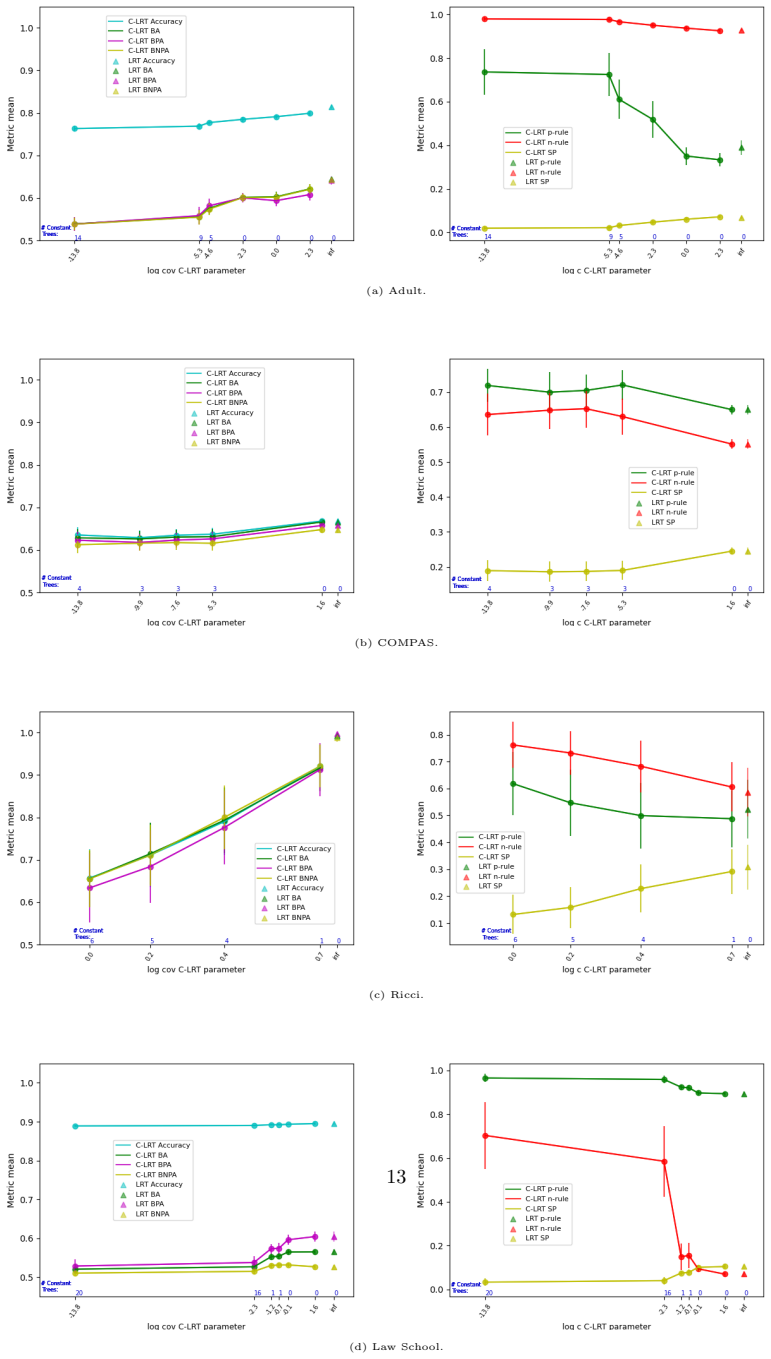
- [Section 4.1 and 4.2, Figure 1] The evaluation is weakened by the treatment of constant trees. The p-rule is defined to be 1 when the classifier is constant -1, and the n-rule is defined to be 1 when the classifier is constant 1. A constant tree trivially satisfies statistical parity, and Section 4.2 reports that stronger constraints select such degenerate trees more frequently. Consequently, the average fairness improvements shown in Figure 1 can be inflated by degenerate fits rather than by locally conditionally independent splits. The text notes this side effect but does not report fairness metrics restricted to non-degenerate trees or otherwise disentangle the two effects. This makes it difficult to assess the empirical claim that C-LRT balances accuracy and fairness through the proposed local criterion.
minor comments (5)
- [Section 4.2] The text says the experiments study the effects of parameters c and λ, but λ is never defined or used elsewhere; this appears to be a leftover from an earlier draft.
- [Definition 5 and Algorithm 1] The notation is inconsistent: Section 1.2 defines node tests as I(X_{j_t} < r_t), while Definition 5 and Algorithm 1 use tests of the form I(0 < θ_t^T X_{j_t}) without explicitly reconciling the two forms or explaining how θ_t and the threshold 0 relate to r_t.
- [Algorithm 1] There are typographical issues in the pseudocode, such as 'Dt,j←−{(xj,a,y)...' where the arrow and minus sign are conflated; this should be cleaned up.
- [Figure 1] The caption uses both 'LR T' and 'C-LR T' while the body uses LRT and C-LRT; the notation should be unified.
- [References] Reference [16] contains a typo: 'Pattern Recogonition' should be 'Pattern Recognition'.
Circularity Check
No significant circularity: the local-to-global parity theorem follows from definitions, and C-LRT's covariance constraint is explicitly a relaxation, so no claim reduces to its own inputs.
full rationale
The paper's theoretical contribution is self-contained: Lemma 4, Lemma 6, and Theorem 7 are proved directly from the definitions of domTt and I*_t using standard conditional-independence composition; no fitted parameter appears in the derivation, and the conclusion A⊥T(X) is not an input to the assumptions. The algorithmic step is explicitly labeled a relaxation rather than an equivalence: Section 5 states 'a relaxation is introduced: instead of requiring independence (A⊥ bY(X)), it only imposes that the magnitude of covariance is less than a certain value,' and the Results section concedes the method 'works with a relaxation of the independence requirement of Theorem 7.' Therefore the covariance constraint is not being presented as a derivation of the theorem's hypothesis, and no parameter fitted to fairness data is renamed as a prediction. The empirical evaluations use held-out test sets, and constant-tree degeneracies are reported rather than hidden. All cited work (especially C-LR [5]) is external, so no self-citation chain is load-bearing. The skeptic's point that bounded covariance does not imply conditional independence of the thresholded split is a correctness/approximation limitation, not a circularity; it belongs in a validity assessment, not in a circularity score.
Assumptions & free parameters
free parameters (2)
- c =
user-specified; reported grid of values (small to large)
- alpha =
any value in R \ {0,1}; not empirically meaningful
assumptions (4)
- domain assumption A is binary, is not among the predictors X, and the training sample is drawn i.i.d. from (X,A,Y)
- domain assumption Y is binary, predictors are numerical, and trees are binary
- standard math Standard probability independence and conditional independence definitions
- ad hoc to paper The covariance constraint |Cov(sd_theta(X_j), A)| <= c is a valid relaxation of the conditional independence required by Theorem 7
Cite this review
Pith. "Pith review of Local Statistical Parity for the Estimation of Fair Decision Trees." pith.science (2026). https://pith.science/paper/XSD4SZ4Z
@misc{pith2026250418262,
  author       = {Pith},
  title        = {Pith review of: Local Statistical Parity for the Estimation of Fair Decision Trees},
  year         = {2026},
  howpublished = {\url{https://pith.science/paper/XSD4SZ4Z}},
  note         = {Machine review of arXiv:2504.18262}
}
read the original abstract
Given the high computational complexity of decision tree estimation, classical methods construct a tree by adding one node at a time in a recursive way. To facilitate promoting fairness, we propose a fairness criterion local to the tree nodes. We prove how it is related to the Statistical Parity criterion, popular in the Algorithmic Fairness literature, and show how to incorporate it into standard recursive tree estimation algorithms. We present a tree estimation algorithm called Constrained Logistic Regression Tree (C-LRT), which is a modification of the standard CART algorithm using locally linear classifiers and imposing restrictions as done in Constrained Logistic Regression. Finally, we evaluate the performance of trees estimated with C-LRT on datasets commonly used in the Algorithmic Fairness literature, using various classification and fairness metrics. The results confirm that C-LRT successfully allows to control and balance accuracy and fairness.
Figures
Reference graph
Works this paper leans on
-
[1]
Learning optimal and fair decision trees for non-discriminative decision-making
Sina Aghaei, Mohammad Javad Azizi, and Phebe Vayanos. “Learning optimal and fair decision trees for non-discriminative decision-making”. In: Pro- ceedings of the AAAI Conference on Artificial In- telligence. Vol. 33. 01. 2019, pp. 1418–1426
work page 2019
-
[2]
Julia Angwin et al. “Machine bias”. In: Ethics of Data and Analytics . Auerbach Publications, 2016, pp. 254–264
work page 2016
-
[3]
Solon Barocas, Moritz Hardt, and Arvind Narayanan. Fairness and Machine Learning . http : / / www . fairmlbook . org. fairmlbook.org, 2019
work page 2019
-
[4]
D. Biddle. Adverse Impact and Test Validation: A Practitioner’s Guide to Valid and Defensible Em- ployment Testing . Taylor & Francis, 2017. isbn: 9781351960618. url: https : / / books . google . com.mx/books?id=%5C_AwkDwAAQBAJ
work page 2017
-
[5]
Fairness constraints: A flexible approach for fair classification
Muhammad Bilal et al. “Fairness constraints: A flexible approach for fair classification”. In: Journal of Machine Learning Research 20 (2019), pp. 1–42. issn: 15337928
work page 2019
-
[6]
Classification and Regression Trees
Leo Breiman et al. Classification and Regression Trees. Taylor & Francis, 1984. isbn: 0412048418
work page 1984
-
[7]
Cynthia Dwork et al. “Fairness through awareness”. In: ITCS 2012 - Innovations in Theoretical Com- puter Science Conference (2012), pp. 214–226. doi: 10.1145/2090236.2090255. arXiv: 1104.3913
arXiv 2012
-
[8]
Metric learning for individual fairness
Christina Ilvento. “Metric learning for individual fairness”. In: Leibniz International Proceedings in Informatics, LIPIcs 156.2 (2020), pp. 1–2. issn: 18688969. doi: 10 . 4230 / LIPIcs . FORC . 2020 . 2. arXiv: 1906.00250
arXiv 2020
Show all 27 references
-
[9]
An algo- rithm for removing sensitive information: Applica- tion to race-independent recidivism prediction
James E. Johndrow and Kristian Lum. “An algo- rithm for removing sensitive information: Applica- tion to race-independent recidivism prediction”. In: Annals of Applied Statistics 13.1 (2019), pp. 189–
2019
-
[10]
Discrimination aware decision tree learn- ing
Faisal Kamiran, Toon Calders, and Mykola Pech- enizkiy. “Discrimination aware decision tree learn- ing”. In: Proceedings - IEEE International Confer- ence on Data Mining, ICDM (2010), pp. 869–874. issn: 15504786. doi: 10.1109/ICDM.2010.50
2010 doi
-
[11]
Counterfactual fairness
Matt Kusner et al. “Counterfactual fairness”. In: Advances in Neural Information Processing Sys- tems 2017-Decem.NIPS (2017), pp. 4067–4077. issn: 10495258. arXiv: 1703.06856
2017 arXiv
-
[12]
A survey on datasets for fairness-aware machine learning
Tai Le Quy et al. “A survey on datasets for fairness-aware machine learning”. In: Wiley Inter- disciplinary Reviews: Data Mining and Knowledge Discovery 12.3 (2022), pp. 1–59. issn: 19424795. doi: 10.1002/widm.1452. arXiv: 2110.00530
2022 arXiv
-
[13]
A Survey on Bias and Fair- ness in Machine Learning
Ninareh Mehrabi et al. “A Survey on Bias and Fair- ness in Machine Learning”. In: ACM Computing Surveys 54.6 (2021), pp. 1–35. issn: 0360-0300. doi: 10.1145/3457607. arXiv: 1908.09635
2021 arXiv
-
[14]
Algorithmic fairness: Choices, assumptions, and definitions
Shira Mitchell et al. “Algorithmic fairness: Choices, assumptions, and definitions”. In: Annual Review of Statistics and Its Application 8 (2021), pp. 141– 11
2021
-
[15]
deste- fano
Supreme Court of the United States Ricci v. deste- fano. Ricci v. DeStefano, 557 U.S. 557 (2009)
2009
-
[16]
Pattern Recogonition and Neural Net- works
Brian Ripley. Pattern Recogonition and Neural Net- works. Cambridge University Press, 2005. isbn: 0 521 46086 7
2005
-
[17]
Stop explaining black box machine learning models for high stakes decisions and use interpretable models instead
Cynthia Rudin. “Stop explaining black box machine learning models for high stakes decisions and use interpretable models instead”. In: Nature machine intelligence 1.5 (2019), pp. 206–215
2019
-
[18]
Individually Fair Gradi- ent Boosting
Alexander Vargo et al. “Individually Fair Gradi- ent Boosting”. In: (2021). arXiv: 2103.16785. url: http://arxiv.org/abs/2103.16785
2021 arXiv
-
[19]
Fairness definitions explained
Sahil Verma and Julia Rubin. “Fairness definitions explained”. In: 2018 ieee/acm international work- shop on software fairness (fairware) . IEEE. 2018, pp. 1–7
2018
-
[20]
LSAC National Longitudinal Bar Passage Study. LSAC Research Report Series
Linda F Wightman. “LSAC National Longitudinal Bar Passage Study. LSAC Research Report Series.” In: (1998)
1998
-
[21]
Trustworthy ai
Jeannette M Wing. “Trustworthy ai”. In: Commu- nications of the ACM 64.10 (2021), pp. 64–71
2021
-
[22]
Numerical op- timization
Stephen Wright and Jorge Nocedal. Numerical op- timization. Springer Science, 1999
1999
-
[23]
Training individually fair ML models with Sensitive Subspace Robustness
Mikhail Yurochkin, Amanda Bower, and Yuekai Sun. “Training individually fair ML models with Sensitive Subspace Robustness”. In: (2019), pp. 1–
2019
-
[27]
url: http://arxiv.org/ abs/1907.00020
arXiv: 1907.00020. url: http://arxiv.org/ abs/1907.00020. 12 (a) Adult. (b) COMP AS. (c) Ricci. (d) Law School. Figure 1: Prediction metrics (left column) and fairness metrics (right column) for LR T and C-LR T. The x-axis is associated with the value of the parameter c of C-L...
1907 arXiv
-
[163]
issn: 2326831X. doi: 10 . 1146 / annurev - statistics-042720-125902
- [220]
-
[2009]
url: https://supreme.justia.com/cases/ federal/us/557/557/
Reviewed August 16, 2026 · model on record in the stance chip above.
Discussion (0). Continue with ORCID to comment.