REVIEW 2 major objections 5 minor 73 references
Eval3D: Interpretable and Fine-grained Evaluation for 3D Generation
T0 review · 2 major / 5 minor · reviewed 2026-08-16 · deepseek-v4-flash
Pith's one-line read Eval3D turns foundation-model disagreements into a human-aligned 3D quality score, with per-pixel and per-vertex artifact maps.
desk verdict Eval3D is a genuinely useful 3D evaluation framework with interpretable, localizable metrics, but the paper's headline human-alignment claim rests on threshold fitting and needs a proper validation pass. read the letter →
The pith
A machine-rendered reading of the paper's core claim, the machinery that carries it, and where it could break.
The reading
What carries the argument
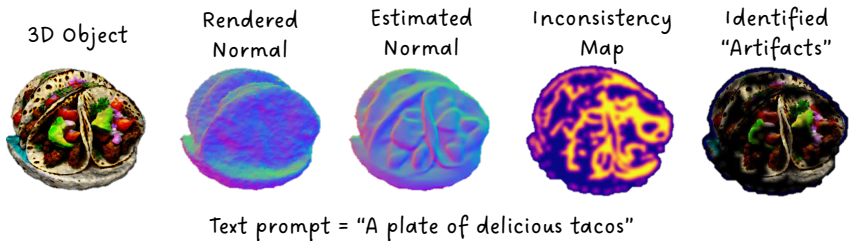
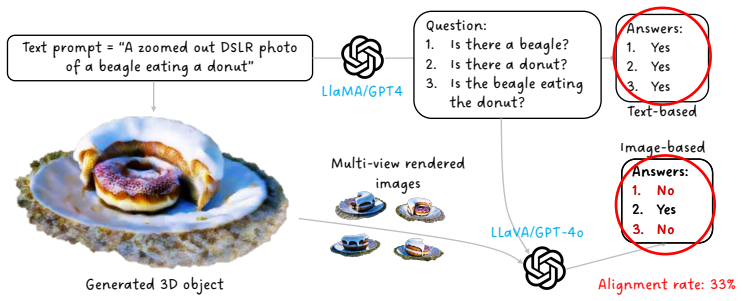
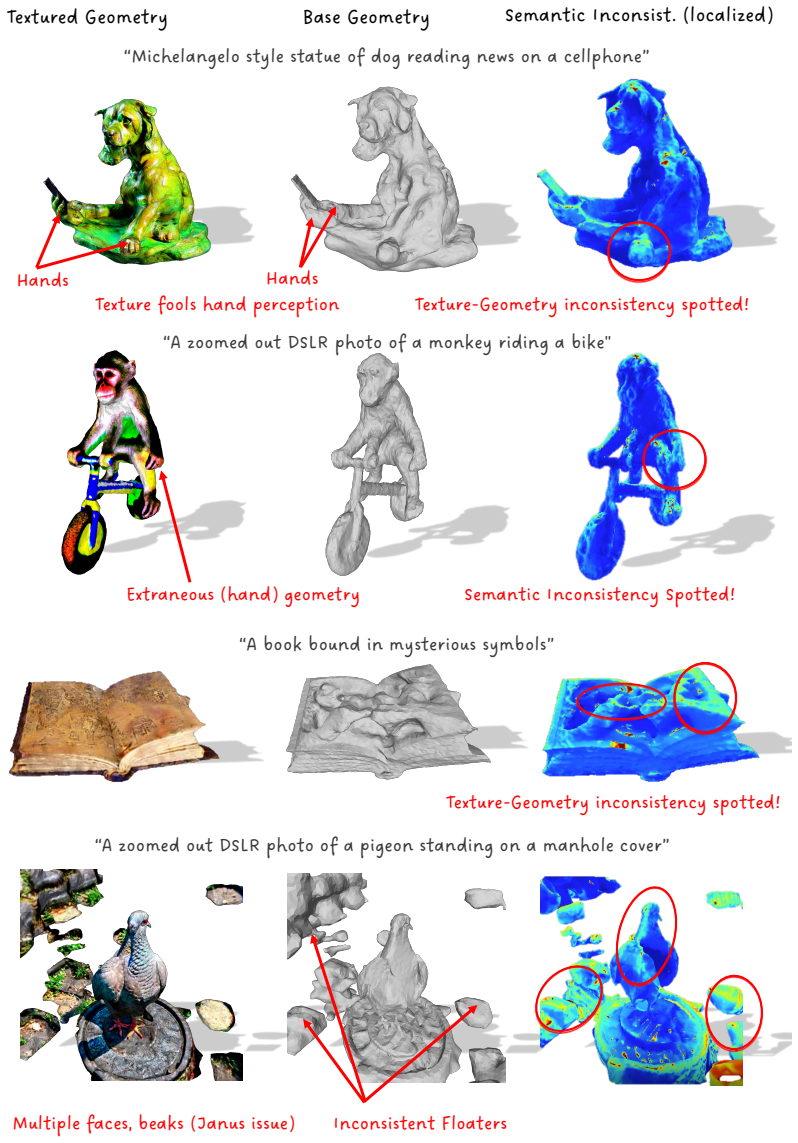
The load-bearing mechanism is the cross-representation consistency probe: for each quality dimension, Eval3D takes two independent estimates of the same underlying property (analytical normals vs. predicted normals, DINO features of the same 3D point seen from different views, a novel-view prediction vs. an actual rendering, an LLM's answer about the prompt vs. a VLM's answer about the renderings) and scores the asset by their agreement. The disagreement maps are then lifted into 3D by attaching per-vertex statistics to the extracted mesh, which yields spatial artifact localization and, as a by-product, a 3D uncertainty estimate usable for self-supervised refinement.
What would settle it
Find a generated asset where two independent experts disagree with the metric: e.g., a stylized or non-photorealistic object whose rendered normals are geometrically correct but whose appearance is intentionally non-geometric (flat-shaded cartoon surfaces, painted textures), and show that the geometric consistency score penalizes it heavily while human annotators rank it highly. A second decisive test is to take a human-annotated-generation pair and swap in a stronger monocular depth or feature model, then check whether the per-asset scores and rankings move substantially.
Extended reading notes
Core claim
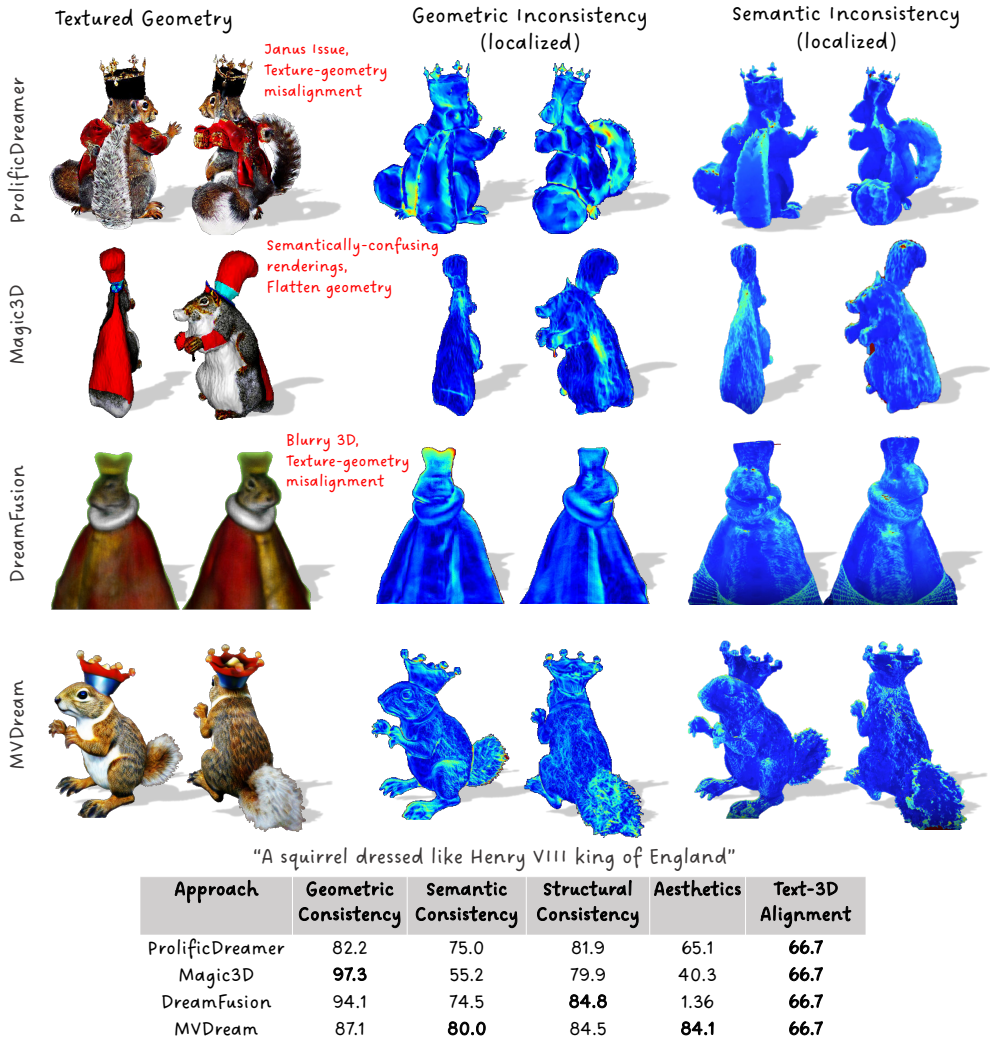
The paper's core claim is that consistency among diverse foundation models is a faithful proxy for the quality of a generated 3D asset, and that measuring inconsistency yields a fine-grained, interpretable, human-aligned evaluation without any task-specific training. Concretely, Eval3D computes five scores: it compares analytically rendered surface normals with normals predicted by Depth Anything from RGB views; it measures variance of DINOv2 features back-projected onto shared mesh vertices across viewpoints; it checks whether a novel-view synthesis model (Stable-Zero123) can predict held-out views as judged by DreamSim; it adapts TIFA-style question-answering with LLaVA to verify that prompts' entities, attributes, and relations survive across views; and it scores aesthetics with either GPT-4o Elo or ImageReward. The paper reports that Eval3D achieves the best alignment with human pairwise judgments among all baseline metrics on every dimension, including a 36% improvement over baselines for geometric consistency, and that by back-projecting the inconsistency maps onto mesh vertices it can localize Janus faces, extraneous geometry, and texture-geometry cheating in 3D.
Load-bearing premise
The scores rest on trusting that the foundation models used as probes are themselves reliable for the assets being evaluated; if Depth Anything, DINOv2, Stable-Zero123, LLaVA, or DreamSim misjudge a particular asset, the inconsistency scores will flag correct geometry or miss real artifacts.
Editorial extensions
If this is right
- If Eval3D's alignment with human judgment holds beyond the evaluated eight models, it gives the text-to-3D community an automatic metric that can rank models per criterion, isolating whether a method fails on geometry, semantics, structure, prompt adherence, or aesthetics.
- The per-vertex and per-pixel inconsistency maps can serve as training signal or refinement loss for 3D generators, since they point at exactly which surface regions are geometrically or semantically implausible.
- Because the probes are swappable, Eval3D inherits improvements in monocular depth, self-supervised features, novel-view synthesis, and VQA models, so its human alignment should improve as foundation models improve.
- The benchmark's dense expert annotations on 160 prompts across all five criteria provide a reusable reference for comparing future 3D evaluation metrics.
Reading between the lines
- A natural stress test the paper does not run: corrupt a high-quality asset with a known geometric or semantic perturbation and check that each Eval3D subscore drops only on the corresponding dimension, and that the localization maps mark exactly the perturbed region. This would separate probe accuracy from the metric's core consistency logic.
- The same consistency-probe recipe could transfer to other under-evaluated generative modalities, such as 4D (dynamic) generation or robot-simulator assets, where cross-view and cross-time consistency are equally load-bearing.
- Because the paper reports thresholds chosen on a hold-out set (23 degrees for normals, the 70th percentile for DINO variance, 75.8% for structural, 63.3% for semantic), the human-alignment numbers are partly a function of threshold choice; a robustness analysis across thresholds would clarify how sensitive the headline comparisons are.
Signed reviews
Editorial analysis
A structured set of objections, weighed in public.
Referee Report
Summary. This paper presents Eval3D, a multi-criteria evaluation framework for text/image-to-3D generation. The method measures five dimensions—geometric consistency (rendered vs. Depth-Anything-predicted normals), semantic consistency (cross-view DINOv2 feature variance per 3D vertex), structural consistency (novel-view synthesis disparity via Stable-Zero123 and DreamSim), text-3D alignment (VQA-style question answering with LLaVA), and aesthetics (ImageReward or GPT-4o Elo). The authors introduce a benchmark of 160 text prompts and 20 image-text pairs with dense expert annotations across six generation models, and report human-alignment results in Table 1 claiming superiority over CLIP-Score, ImageReward, T3-Bench, and GPT-4V. The paper also demonstrates pixel-wise 2D and vertex-level 3D artifact localization, and benchmarks six text-to-3D and two image-to-3D models, finding that high aesthetic scores can coexist with geometric and semantic inconsistencies.
Significance. If the human-alignment and localization claims hold, Eval3D is a substantial contribution: it is the first 3D evaluation tool to provide pixel-wise geometric and semantic inconsistency maps back-projected into 3D, it is fully open-source and modular with respect to the underlying foundation models, and it ships a benchmark with dense expert annotations substantially larger than prior evaluation datasets (e.g., GPT-4V's 3-prompts-per-pair comparison). The paper's honest treatment of failure cases and its explicit discussion of the dependence on foundation-model accuracy are commendable. The main value lies in the benchmark, the interpretable metric design, and the qualitative evidence for artifact localization, which are likely to be adopted by the 3D generation community. However, the paper's flagship quantitative claim—superior human alignment across all five dimensions—is undermined by the statistical issues detailed below, so the significance of the quantitative contribution is currently not fully established.
major comments (2)
- [Table 1, Appendix E.1, Eqs. (1)-(2), App. D.2] The central claim that 'Eval3D achieves the best alignment with humans' is not supported out-of-sample. Appendix E.1 states that for semantic and structural consistency, the paper reports 'the maximum value of human alignment given all possible thresholds'; this is a form of fitting to the test-set human labels and inflates the reported agreement. Additionally, the geometric threshold δnorm = 23° (Eq. 1) and the semantic threshold δDINO at the 70th percentile (Eq. 2) are selected on a hold-out validation set (App. D.2), so the reported alignment for those dimensions is also an upper bound rather than an unbiased estimate. No confidence intervals, bootstraps, or significance tests are provided anywhere in the paper; with 160 prompts and six models, the margins on structural (69.2 vs 68.9) and aesthetics (87.4 vs 85.6) are within plausible sampling noise. The 36% geometric-consistency advantage could shift when δnorm is re-selected under cross-validation. The paper should report nested cross-validation (or at least a single pre-registered threshold), bootstrap confidence intervals for every cell of Table 1, and a significance test for the pairwise differences against the strongest baseline.
- [Sec. 3 (key observation), Limitations, Appendix C] The load-bearing premise that consistency among foundation-model outputs is a valid proxy for 3D quality is acknowledged by the authors as imperfect, but the validation does not disentangle proxy errors from metric errors. The Limitations section states that Stable-Zero123, Depth Anything, and LLaVA 'may introduce errors,' and Appendix C documents specific failure cases (e.g., the MVDream and Gaussian-Splatting examples where the semantic consistency metric outputs '3D Plausible' with scores 81.2% while humans label the assets 'Not 3D Plausible'). These failures are qualitatively described but never quantified against the Table 1 alignment numbers, and the max-over-threshold procedure may hide systematic underperformance on certain asset classes. Concretely, the paper should (a) report per-prompt agreement between Eval3D and humans and identify the classes of prompts where the metric disagrees; (b) validate the geometric consistency signal on synthetic renderings with ground-truth normals; and (c) include an oracle experiment measuring how often each foundation model is the source of an incorrect Eval3D flag. Without this, the 'faithful evaluation' claim in the abstract is not fully established.
minor comments (5)
- [Table 1] For Semantic Consistency, no baseline is reported ('−'), so the statement that Eval3D achieves the 'best' alignment on this dimension is undefined; please either report a VLM-based baseline on the same pairwise comparison or explicitly state that Eval3D is the first to measure this dimension.
- [Sec. 4.2 and Tables 2-3] Section 4.2 lists five text-to-3D algorithms but the tables report six, including Gaussian Splatting; please name GaussianDreamer (or the specific Gaussian-splatting method used) explicitly in the algorithm list.
- [Eq. (4)] The notation Any_{v_i} All_{v in Adj(v_i)} is ambiguous; please define Adj(v_i) and specify how the 'any' quantifier is resolved when multiple viewpoints satisfy the condition.
- [Appendix D.2] Please report the size of the hold-out validation set, the number of prompts in it, and how the split was constructed (e.g., stratified by model or prompt) so that the threshold-selection procedure is reproducible.
- [Throughout] There are several typos, including 'freqently' in Sec. 4.3 and inconsistent capitalization such as 'Prolificdreamer-Human alignment' in Appendix C; a careful proofread is recommended.
Circularity Check
Table 1's reported human-alignment superiority for structural/semantic consistency is an in-sample maximum over thresholds, so the 'best in all dimensions' claim is partly a fitted upper bound.
-
fitted input called prediction
[Appendix E, 'Note on computing automatic evaluations' alignment with human']
"For semantic and structural consistency, humans annotate 'yes' 'no' while the automatic evaluation gives a continuous value. We process the automatic evaluation by finding a threshold to divide its scores into two classes. For all evaluation metrics, we report the maximum value of human alignment given all possible thresholds. For Eval3D, the threshold for structural consistency is 75.8%; for semantic consistency it is 63.3%."
The human-alignment numbers for semantic and structural consistency in Table 1 (68.0 and 69.2) are not out-of-sample measurements: the threshold converting each continuous metric into a binary consistent/inconsistent decision is chosen to maximize agreement with the same human annotations that define the reported alignment. The reported values are therefore fitted upper bounds rather than unbiased estimates of Eval3D's alignment with humans. Since the same max-over-threshold procedure is applied to baselines, the comparison is less biased, but the small margins (69.2 vs 68.9 over GPT-4V) and the 'best across all dimensions' claim are not established with any uncertainty quantification. The central claim in Sec.
full rationale
Eval3D's per-dimension metrics are not themselves derived from human labels: geometric, semantic, structural, and text-3D scores are consistency measures among foundation models, and the paper provides a large human-annotation benchmark as external validation. That is genuine independent evidence and is not circular. However, the headline claim that Eval3D 'achieves the best alignment with humans' (Sec. 4.3, Table 1) is weakened by the appendix's admission that, for semantic and structural consistency, the continuous metric is thresholded and the threshold is chosen to maximize human agreement on the same data. Thus the reported 68.0 and 69.2 alignment values are in-sample fitted upper bounds, not unbiased out-of-sample estimates, and the 0.3-point margin over GPT-4V on structural consistency is within the noise of such a procedure; no confidence intervals, bootstraps, or significance tests are reported. The geometric and semantic metric thresholds (δnorm = 23°, δDINO = 70th percentile) are chosen on a hold-out validation set, which is a more defensible practice, but the paper does not report uncertainty around the resulting 36% geometric improvement. The TIFA/DSG adaptation in Sec. 3.4 is a self-citation by overlapping authors, but it is not load-bearing: those prior methods are externally evaluated and the multi-view 3D aggregation in Eq. (4) is new content. Hence the circularity is partial and localized to the quantitative validation of the central alignment claim, not to the construction of the evaluation metrics themselves.
Assumptions & free parameters
free parameters (5)
- delta_norm =
23 degrees
- delta_DINO =
70th percentile of average DINO variance
- structural_consistency_threshold =
75.8%
- semantic_consistency_threshold =
63.3%
- viewpoint_count =
120 views for most metrics, 12 for text-3D alignment
assumptions (4)
- domain assumption Foundation model outputs (Depth Anything normals, DINOv2 features, Stable-Zero123 predictions, LLaVA answers, DreamSim similarities) are accurate enough proxies for the corresponding 3D properties.
- domain assumption Multi-view consistency of these probe outputs is a valid indicator of 3D asset quality.
- domain assumption Human annotations are ground truth for 3D quality.
- ad hoc to paper The 160-prompt Eval3D benchmark is representative of text-to-3D generation tasks.
Cite this review
Pith. "Pith review of Eval3D: Interpretable and Fine-grained Evaluation for 3D Generation." pith.science (2026). https://pith.science/paper/GQFLGE6W
@misc{pith2026250418509,
  author       = {Pith},
  title        = {Pith review of: Eval3D: Interpretable and Fine-grained Evaluation for 3D Generation},
  year         = {2026},
  howpublished = {\url{https://pith.science/paper/GQFLGE6W}},
  note         = {Machine review of arXiv:2504.18509}
}
read the original abstract
Despite the unprecedented progress in the field of 3D generation, current systems still often fail to produce high-quality 3D assets that are visually appealing and geometrically and semantically consistent across multiple viewpoints. To effectively assess the quality of the generated 3D data, there is a need for a reliable 3D evaluation tool. Unfortunately, existing 3D evaluation metrics often overlook the geometric quality of generated assets or merely rely on black-box multimodal large language models for coarse assessment. In this paper, we introduce Eval3D, a fine-grained, interpretable evaluation tool that can faithfully evaluate the quality of generated 3D assets based on various distinct yet complementary criteria. Our key observation is that many desired properties of 3D generation, such as semantic and geometric consistency, can be effectively captured by measuring the consistency among various foundation models and tools. We thus leverage a diverse set of models and tools as probes to evaluate the inconsistency of generated 3D assets across different aspects. Compared to prior work, Eval3D provides pixel-wise measurement, enables accurate 3D spatial feedback, and aligns more closely with human judgments. We comprehensively evaluate existing 3D generation models using Eval3D and highlight the limitations and challenges of current models.
Figures


Figures from the paper (14 more)





Reference graph
Works this paper leans on
-
[1]
Stable-zero123: Quality 3d object generation from single images, 2024
Stability AI. Stable-zero123: Quality 3d object generation from single images, 2024. 3, 4, 14
work page 2024
-
[2]
Mark Boss, Raphael Braun, V . Jampani, Jonathan T. Barron, Ce Liu, and Hendrik P. A. Lensch. Nerd: Neural reflectance decomposition from image collections. ICCV, 2020. 4
work page 2020
-
[3]
MVDiff: Scalable and Flexible Multi-View Diffusion for 3D Object Reconstruction from Single-View
Emmanuelle Bourigault and Pauline Bourigault. Mvdiff: Scal- able and flexible multi-view diffusion for 3d object recon- struction from single-view. arXiv preprint arXiv:2405.03894,
-
[4]
Generative and discriminative voxel mod- eling with convolutional neural networks
Andrew Brock, Theodore Lim, James M Ritchie, and Nick Weston. Generative and discriminative voxel mod- eling with convolutional neural networks. arXiv preprint arXiv:1608.04236, 2016. 3
arXiv 2016
-
[5]
Learning gradient fields for shape generation
Ruojin Cai, Guandao Yang, Hadar Averbuch-Elor, Zekun Hao, Serge Belongie, Noah Snavely, and Bharath Hariharan. Learning gradient fields for shape generation. In Computer Vision–ECCV 2020: 16th European Conference, Glasgow, UK, August 23–28, 2020, Proceedings, Part III 16 , pages 364–381. Springer, 2020. 3
2020
-
[6]
Shapenet: An information- rich 3d model repository
Angel X Chang, Thomas Funkhouser, Leonidas Guibas, Pat Hanrahan, Qixing Huang, Zimo Li, Silvio Savarese, Manolis Savva, Shuran Song, Hao Su, et al. Shapenet: An information- rich 3d model repository. arXiv preprint arXiv:1512.03012,
-
[7]
Fan- tasia3d: Disentangling geometry and appearance for high- quality text-to-3d content creation
Rui Chen, Yongwei Chen, Ningxin Jiao, and Kui Jia. Fan- tasia3d: Disentangling geometry and appearance for high- quality text-to-3d content creation. In Proceedings of the IEEE/CVF International Conference on Computer Vision , pages 22246–22256, 2023. 3
work page 2023
-
[8]
Learning to predict 3d objects with an interpolation-based differentiable renderer
Wenzheng Chen, Huan Ling, Jun Gao, Edward Smith, Jaakko Lehtinen, Alec Jacobson, and Sanja Fidler. Learning to predict 3d objects with an interpolation-based differentiable renderer. Advances in neural information processing systems, 32, 2019. 3
work page 2019
Show all 73 references
-
[9]
Decor-gan: 3d shape detailization by conditional refinement
Zhiqin Chen, Vladimir G Kim, Matthew Fisher, Noam Aiger- man, Hao Zhang, and Siddhartha Chaudhuri. Decor-gan: 3d shape detailization by conditional refinement. In Proceedings of the IEEE/CVF conference on computer vision and pattern recognition, pages 15740–15749, 2021. 3
2021
-
[10]
Davidsonian Scene Graph: Improving Reliabil- ity in Fine-Grained Evaluation for Text-to-Image Generation
Jaemin Cho, Yushi Hu, Roopal Garg, Peter Anderson, Ranjay Krishna, Jason Baldridge, Mohit Bansal, Jordi Pont-Tuset, and Su Wang. Davidsonian Scene Graph: Improving Reliabil- ity in Fine-Grained Evaluation for Text-to-Image Generation. In ICLR, 2024. 2, 5, 6, 7, 16
2024
-
[11]
Davidsonian scene graph: Improving reliability in fine-grained evaluation for text-to-image generation, 2024
Jaemin Cho, Yushi Hu, Roopal Garg, Peter Anderson, Ranjay Krishna, Jason Baldridge, Mohit Bansal, Jordi Pont-Tuset, and Su Wang. Davidsonian scene graph: Improving reliability in fine-grained evaluation for text-to-image generation, 2024. 3
2024
-
[12]
Loopdraw: a loop-based autoregressive model for shape synthesis and editing
Nam Anh Dinh, Haochen Wang, Greg Shakhnarovich, and Rana Hanocka. Loopdraw: a loop-based autoregressive model for shape synthesis and editing. ArXiv, abs/2212.04981, 2022. 3
2022 arXiv
-
[13]
Omnidata: A scalable pipeline for making multi-task mid-level vision datasets from 3d scans
Ainaz Eftekhar, Alexander Sax, Jitendra Malik, and Amir Zamir. Omnidata: A scalable pipeline for making multi-task mid-level vision datasets from 3d scans. In ICCV, 2021. 4
2021
-
[14]
Dreamsim: Learning new dimensions of human visual similarity using synthetic data
Stephanie Fu*, Netanel Tamir*, Shobhita Sundaram*, Lucy Chai, Richard Zhang, Tali Dekel, and Phillip Isola. Dreamsim: Learning new dimensions of human visual similarity using synthetic data. arXiv, 2023. 4
2023
-
[15]
Brandt, Axel Feld- mann, Zhoutong Zhang, and William T
Stephanie Fu, Mark Hamilton, Laura E. Brandt, Axel Feld- mann, Zhoutong Zhang, and William T. Freeman. Featup: A model-agnostic framework for features at any resolution. In The Twelfth International Conference on Learning Represen- tations, 2024. 7
2024
-
[16]
Get3d: A generative model of high quality 3d textured shapes learned from images
Jun Gao, Tianchang Shen, Zian Wang, Wenzheng Chen, Kangxue Yin, Daiqing Li, Or Litany, Zan Gojcic, and Sanja Fidler. Get3d: A generative model of high quality 3d textured shapes learned from images. Advances In Neural Information Processing Systems, 35:31841–31854, 2022. 3
2022
-
[17]
Tetgan: A convolutional neural net- work for tetrahedral mesh generation
William Gao, April Wang, Gal Metzer, Raymond A Yeh, and Rana Hanocka. Tetgan: A convolutional neural net- work for tetrahedral mesh generation. arXiv preprint arXiv:2210.05735, 2022. 3
2022 arXiv
-
[18]
threestudio: A unified framework for 3d content generation
Yuan-Chen Guo, Ying-Tian Liu, Ruizhi Shao, Christian Laforte, Vikram V oleti, Guan Luo, Chia-Hao Chen, Zi- Xin Zou, Chen Wang, Yan-Pei Cao, and Song-Hai Zhang. threestudio: A unified framework for 3d content generation. https://github.com/threestudio- project/ threestudio, 202...
2023
-
[19]
T3bench: Benchmarking current progress in text-to-3d generation
Yuze He, Yushi Bai, Matthieu Lin, Wang Zhao, Yubin Hu, Jenny Sheng, Ran Yi, Juanzi Li, and Yong jin Liu. T3bench: Benchmarking current progress in text-to-3d generation. arXiv, 2023. 2, 3, 5, 6, 7, 8
2023
-
[20]
Clipscore: A reference-free evaluation metric for image captioning, 2022
Jack Hessel, Ari Holtzman, Maxwell Forbes, Ronan Le Bras, and Yejin Choi. Clipscore: A reference-free evaluation metric for image captioning, 2022. 7
2022
-
[21]
Tifa: Accurate and interpretable text-to-image faithfulness evaluation with question answering
Yushi Hu, Benlin Liu, Jungo Kasai, Yizhong Wang, Mari Os- tendorf, Ranjay Krishna, and Noah A Smith. Tifa: Accurate and interpretable text-to-image faithfulness evaluation with question answering. In Proceedings of the IEEE/CVF Interna- tional Conference on Computer Vision, pa...
-
[22]
2d gaussian splatting for geometrically accu- rate radiance fields
Binbin Huang, Zehao Yu, Anpei Chen, Andreas Geiger, and Shenghua Gao. 2d gaussian splatting for geometrically accu- rate radiance fields. In SIGGRAPH 2024 Conference Papers. Association for Computing Machinery, 2024. 7
2024
-
[23]
Zero-shot text-guided object generation with dream fields
Ajay Jain, Ben Mildenhall, Jonathan T Barron, Pieter Abbeel, and Ben Poole. Zero-shot text-guided object generation with dream fields. In Proceedings of the IEEE/CVF conference on computer vision and pattern recognition, pages 867–876,
-
[24]
Journey to nanite
Brian Karis. Journey to nanite. https : / / www . highperformancegraphics . org / slides22 / 9 Journey_to_Nanite.pdf , 2022. Presented at High Performance Graphics 2022. 1
2022
-
[25]
3d gaussian splatting for real-time radiance field rendering
Bernhard Kerbl, Georgios Kopanas, Thomas Leimkühler, and George Drettakis. 3d gaussian splatting for real-time radiance field rendering. ACM Transactions on Graphics, 42(4):1–14,
-
[26]
Adver- sarial generation of continuous implicit shape representations
Marian Kleineberg, Matthias Fey, and Frank Weichert. Adver- sarial generation of continuous implicit shape representations. arXiv preprint arXiv:2002.00349, 2020. 3
2002 arXiv
-
[27]
Llava- next: Stronger llms supercharge multimodal capabilities in the wild, 2024
Bo Li, Kaichen Zhang, Hao Zhang, Dong Guo, Renrui Zhang, Feng Li, Yuanhan Zhang, Ziwei Liu, and Chunyuan Li. Llava- next: Stronger llms supercharge multimodal capabilities in the wild, 2024. 5, 8, 14
2024
-
[28]
Magic3d: High-resolution text-to- 3d content creation
Chen-Hsuan Lin, Jun Gao, Luming Tang, Towaki Takikawa, Xiaohui Zeng, Xun Huang, Karsten Kreis, Sanja Fidler, Ming- Yu Liu, and Tsung-Yi Lin. Magic3d: High-resolution text-to- 3d content creation. In CVPR, 2023. 3, 6, 7, 8, 13
2023
-
[29]
Zero-1-to-3: Zero-shot one image to 3d object
Ruoshi Liu, Rundi Wu, Basile Van Hoorick, Pavel Tokmakov, Sergey Zakharov, and Carl V ondrick. Zero-1-to-3: Zero-shot one image to 3d object. ICCV, 2023. 7, 8, 12
2023
-
[30]
Zero-1-to-3: Zero-shot one image to 3d object
Ruoshi Liu, Rundi Wu, Basile Van Hoorick, Pavel Tokmakov, Sergey Zakharov, and Carl V ondrick. Zero-1-to-3: Zero-shot one image to 3d object. In Proceedings of the IEEE/CVF International Conference on Computer Vision, pages 9298– 9309, 2023. 3
2023
-
[31]
Lorensen and Harvey E
William E. Lorensen and Harvey E. Cline. Marching cubes: A high resolution 3d surface construction algorithm. InProceed- ings of the 14th Annual Conference on Computer Graphics and Interactive Techniques, page 163–169, New York, NY , USA, 1987. Association for Computing Machinery. 7
1987
-
[32]
Occupancy networks: Learning 3d reconstruction in function space
Lars Mescheder, Michael Oechsle, Michael Niemeyer, Se- bastian Nowozin, and Andreas Geiger. Occupancy networks: Learning 3d reconstruction in function space. In Proceedings of the IEEE/CVF conference on computer vision and pattern recognition, pages 4460–4470, 2019. 3
2019
-
[33]
Latent-nerf for shape-guided generation of 3d shapes and textures
Gal Metzer, Elad Richardson, Or Patashnik, Raja Giryes, and Daniel Cohen-Or. Latent-nerf for shape-guided generation of 3d shapes and textures. In Proceedings of the IEEE/CVF Conference on Computer Vision and Pattern Recognition , pages 12663–12673, 2023. 3
2023
-
[34]
Text2mesh: Text-driven neural stylization for meshes
Oscar Michel, Roi Bar-On, Richard Liu, Sagie Benaim, and Rana Hanocka. Text2mesh: Text-driven neural stylization for meshes. In Proceedings of the IEEE/CVF Conference on Computer Vision and Pattern Recognition, pages 13492– 13502, 2022. 3
2022
-
[35]
Srinivasan, Matthew Tancik, Jonathan T
Ben Mildenhall, Pratul P. Srinivasan, Matthew Tancik, Jonathan T. Barron, Ravi Ramamoorthi, and Ren Ng. Nerf. Communications of the ACM, 2020. 4
2020
-
[36]
Nerf: Representing scenes as neural radiance fields for view syn- thesis
Ben Mildenhall, Pratul P Srinivasan, Matthew Tancik, Jonathan T Barron, Ravi Ramamoorthi, and Ren Ng. Nerf: Representing scenes as neural radiance fields for view syn- thesis. Communications of the ACM , 65(1):99–106, 2021. 3
2021
-
[37]
Point-e: A system for generating 3d point clouds from complex prompts
Alex Nichol, Heewoo Jun, Prafulla Dhariwal, Pamela Mishkin, and Mark Chen. Point-e: A system for generating 3d point clouds from complex prompts. ArXiv, abs/2212.08751,
-
[38]
Hello gpt-4o
OpenAI. Hello gpt-4o. 2024. 3, 5
2024
-
[39]
Maxime Oquab, Timoth’ee Darcet, Théo Moutakanni, Huy Q. V o, Marc Szafraniec, Vasil Khalidov, Pierre Fernandez, Daniel Haziza, Francisco Massa, Alaaeldin El-Nouby, Mahmoud Assran, Nicolas Ballas, Wojciech Galuba, Russ Howes, Po- Yao (Bernie) Huang, Shang-Wen Li, Ishan Misra, M...
2023
-
[40]
Florence, Julian Straub, Richard A
Jeong Joon Park, Peter R. Florence, Julian Straub, Richard A. Newcombe, and S. Lovegrove. Deepsdf: Learning con- tinuous signed distance functions for shape representation. 2019 IEEE/CVF Conference on Computer Vision and Pattern Recognition (CVPR), pages 165–174, 2019. 3
2019
-
[41]
Dreamfusion: Text-to-3d using 2d diffusion
Ben Poole, Ajay Jain, Jonathan T Barron, and Ben Mildenhall. Dreamfusion: Text-to-3d using 2d diffusion. 2023. 6, 7, 8, 13, 14
2023
-
[42]
Magic123: One image to high-quality 3d object generation using both 2d and 3d diffusion priors
Guocheng Qian, Jinjie Mai, Abdullah Hamdi, Jian Ren, Aliaksandr Siarohin, Bing Li, Hsin-Ying Lee, Ivan Sko- rokhodov, Peter Wonka, Sergey Tulyakov, and Bernard Ghanem. Magic123: One image to high-quality 3d object generation using both 2d and 3d diffusion priors. In Interna- t...
2024
-
[43]
Learning transferable visual models from natural language supervision
Alec Radford, Jong Wook Kim, Chris Hallacy, Aditya Ramesh, Gabriel Goh, Sandhini Agarwal, Girish Sastry, Amanda Askell, Pamela Mishkin, Jack Clark, Gretchen Krueger, and Ilya Sutskever. Learning transferable visual models from natural language supervision. In International Con...
2021
-
[44]
Learning transferable visual models from natural language supervision
Alec Radford, Jong Wook Kim, Chris Hallacy, Aditya Ramesh, Gabriel Goh, Sandhini Agarwal, Girish Sastry, Amanda Askell, Pamela Mishkin, Jack Clark, Gretchen Krueger, and Ilya Sutskever. Learning transferable visual models from natural language supervision. In ICML, 2021. 3
2021
-
[45]
Blattmann, Dominik Lorenz, Patrick Esser, and Björn Ommer
Robin Rombach, A. Blattmann, Dominik Lorenz, Patrick Esser, and Björn Ommer. High-resolution image synthesis with latent diffusion models. 2022 IEEE/CVF Conference on Computer Vision and Pattern Recognition (CVPR), pages 10674–10685, 2021
2022
-
[46]
Denton, Seyed Kamyar Seyed Ghasemipour, Burcu Karagol Ayan, Seyedeh Sara Mahdavi, Raphael Gontijo Lopes, Tim Salimans, Jonathan Ho, David J
Chitwan Saharia, William Chan, Saurabh Saxena, Lala Li, Jay Whang, Emily L. Denton, Seyed Kamyar Seyed Ghasemipour, Burcu Karagol Ayan, Seyedeh Sara Mahdavi, Raphael Gontijo Lopes, Tim Salimans, Jonathan Ho, David J. Fleet, and Mo- hammad Norouzi. Photorealistic text-to-image ...
-
[47]
Deep marching tetrahedra: a hybrid representa- tion for high-resolution 3d shape synthesis
Tianchang Shen, Jun Gao, Kangxue Yin, Ming-Yu Liu, and Sanja Fidler. Deep marching tetrahedra: a hybrid representa- tion for high-resolution 3d shape synthesis. In Advances in Neural Information Processing Systems (NeurIPS), 2021. 7
2021
-
[48]
Zero123++: a single image to consistent multi-view diffusion base model
Ruoxi Shi, Hansheng Chen, Zhuoyang Zhang, Minghua Liu, Chao Xu, Xinyue Wei, Linghao Chen, Chong Zeng, and Hao Su. Zero123++: a single image to consistent multi-view diffusion base model. arXiv preprint arXiv:2310.15110, 2023. 3 10
2023 arXiv
-
[49]
Yichun Shi, Peng Wang, Jianglong Ye, Mai Long, Kejie Li, and X. Yang. Mvdream: Multi-view diffusion for 3d genera- tion. arXiv, 2023. 3, 6, 7, 8
2023
-
[50]
Dreamsync: Aligning text- to-image generation with image understanding feedback
Jiao Sun, Deqing Fu, Yushi Hu, Su Wang, Royi Rassin, Da-Cheng Juan, Dana Alon, Charles Herrmann, Sjoerd van Steenkiste, Ranjay Krishna, et al. Dreamsync: Aligning text- to-image generation with image understanding feedback. In Synthetic Data for Computer Vision Workshop@ CVPR 2024,
2024
-
[51]
Dreamcraft3d: Hierarchical 3d generation with bootstrapped diffusion prior
Jingxiang Sun, Bo Zhang, Ruizhi Shao, Lizhen Wang, Wen Liu, Zhenda Xie, and Yebin Liu. Dreamcraft3d: Hierarchical 3d generation with bootstrapped diffusion prior. arXiv, 2023. 2, 6, 8
2023
-
[53]
Textmesh: Gener- ation of realistic 3d meshes from text prompts
Christina Tsalicoglou, Fabian Manhardt, Alessio Tonioni, Michael Niemeyer, and Federico Tombari. Textmesh: Gener- ation of realistic 3d meshes from text prompts. arXiv preprint arXiv:2304.12439, 2023. 3
2023 arXiv
-
[54]
Gta 5 costs 265 million to develop and market, making it the most expensive video game ever produced: Report
Luke Villapaz. Gta 5 costs 265 million to develop and market, making it the most expensive video game ever produced: Report. International Business Times, 2013. 1
2013
-
[55]
Neus: Learning neural implicit surfaces by volume rendering for multi-view reconstruction
Peng Wang, Lingjie Liu, Yuan Liu, Christian Theobalt, Taku Komura, and Wenping Wang. Neus: Learning neural implicit surfaces by volume rendering for multi-view reconstruction. arXiv, 2021. 4
2021
-
[56]
Prolificdreamer: High-fidelity and diverse text-to-3d generation with variational score distilla- tion
Zhengyi Wang, Cheng Lu, Yikai Wang, Fan Bao, Chongxuan Li, Hang Su, and Jun Zhu. Prolificdreamer: High-fidelity and diverse text-to-3d generation with variational score distilla- tion. NeurIPS, 2024. 6, 8, 14
2024
-
[57]
Prolificdreamer: High-fidelity and diverse text-to-3d generation with variational score distilla- tion
Zhengyi Wang, Cheng Lu, Yikai Wang, Fan Bao, Chongxuan Li, Hang Su, and Jun Zhu. Prolificdreamer: High-fidelity and diverse text-to-3d generation with variational score distilla- tion. Advances in Neural Information Processing Systems, 36,
-
[58]
Novel view synthesis with diffusion models
Daniel Watson, William Chan, Ricardo Martin-Brualla, Jonathan Ho, Andrea Tagliasacchi, and Mohammad Norouzi. Novel view synthesis with diffusion models. arXiv preprint arXiv:2210.04628, 2022. 3
2022 arXiv
-
[59]
Revisiting text-to-image evaluation with gecko: On metrics, prompts, and human ratings
Olivia Wiles, Chuhan Zhang, Isabela Albuquerque, Ivana Ka- ji´c, Su Wang, Emanuele Bugliarello, Yasumasa Onoe, Chris Knutsen, Cyrus Rashtchian, Jordi Pont-Tuset, et al. Revisiting text-to-image evaluation with gecko: On metrics, prompts, and human ratings. arXiv preprint arXiv...
2024 arXiv
-
[60]
Learning a probabilistic latent space of ob- ject shapes via 3d generative-adversarial modeling
Jiajun Wu, Chengkai Zhang, Tianfan Xue, Bill Freeman, and Josh Tenenbaum. Learning a probabilistic latent space of ob- ject shapes via 3d generative-adversarial modeling. Advances in neural information processing systems, 29, 2016. 3
2016
-
[61]
Gpt- 4v(ision) is a human-aligned evaluator for text-to-3d genera- tion
Tong Wu, Guandao Yang, Zhibing Li, Kai Zhang, Ziwei Liu, Leonidas Guibas, Dahua Lin, and Gordon Wetzstein. Gpt- 4v(ision) is a human-aligned evaluator for text-to-3d genera- tion. arXiv, 2024. 2, 3, 5, 6, 7, 8
2024
-
[62]
Imagereward: Learning and evaluating human preferences for text-to-image generation
Jiazheng Xu, Xiao Liu, Yuchen Wu, Yuxuan Tong, Qinkai Li, Ming Ding, Jie Tang, and Yuxiao Dong. Imagereward: Learning and evaluating human preferences for text-to-image generation. arXiv, 2023. 2, 3, 5, 7, 8
2023
-
[63]
Pointflow: 3d point cloud generation with continuous normalizing flows
Guandao Yang, Xun Huang, Zekun Hao, Ming-Yu Liu, Serge Belongie, and Bharath Hariharan. Pointflow: 3d point cloud generation with continuous normalizing flows. InProceedings of the IEEE/CVF international conference on computer vision, pages 4541–4550, 2019. 3
2019
-
[64]
Depth anything: Unleashing the power of large-scale unlabeled data
Lihe Yang, Bingyi Kang, Zilong Huang, Xiaogang Xu, Jiashi Feng, and Hengshuang Zhao. Depth anything: Unleashing the power of large-scale unlabeled data. In CVPR, 2024. 2, 3, 4, 8
2024
-
[65]
Holodeck: Language guided gener- ation of 3d embodied ai environments
Yue Yang, Fan-Yun Sun, Luca Weihs, Eli VanderBilt, Al- varo Herrasti, Winson Han, Jiajun Wu, Nick Haber, Ranjay Krishna, Lingjie Liu, et al. Holodeck: Language guided gener- ation of 3d embodied ai environments. InThe IEEE/CVF Con- ference on Computer Vision and Pattern Recogn...
2024
-
[66]
Universal dif- ferentiable renderer for implicit neural representations
Lior Yariv, Matan Atzmon, and Yaron Lipman. Universal dif- ferentiable renderer for implicit neural representations. arXiv,
-
[67]
What you see is what you read? improving text- image alignment evaluation
Michal Yarom, Yonatan Bitton, Soravit Changpinyo, Roee Aharoni, Jonathan Herzig, Oran Lang, Eran Ofek, and Idan Szpektor. What you see is what you read? improving text- image alignment evaluation. Advances in Neural Information Processing Systems, 36, 2024. 2
2024
-
[68]
Gaussian- dreamer: Fast generation from text to 3d gaussian splatting with point cloud priors
Taoran Yi, Jiemin Fang, Guanjun Wu, Lingxi Xie, Xiaopeng Zhang, Wenyu Liu, Qi Tian, and Xinggang Wang. Gaussian- dreamer: Fast generation from text to 3d gaussian splatting with point cloud priors. arXiv preprint arXiv:2310.08529,
-
[69]
Algorithm generation
Hongxiang Zhao, Xili Dai, Jianan Wang, Shengbang Tong, Jingyuan Zhang, Weida Wang, Lei Zhang, and Yi Ma. Ctrl123: Consistent novel view synthesis via closed-loop transcription. arXiv preprint arXiv:2403.10953, 2024. 3 11 A. Eval3D Qualitative Analysis Geometric Consistency: Fi...
2024 arXiv
-
[70]
Notable differences from the paper
displays an example where SDS-optimized generations can find unexpected or undesirable ways to satisfy the text prompt. 12 Algorithm Generation Algorithm Rendered Normal Depth Anything Normal Geometric Inconsistency Map Algorithm Generation Algorithm Rendered Normal Depth Anyt...
-
[71]
Is the beagle eating the donut? LlaMA/GPT4 Answers:
-
[72]
Y es T ext-based Answers:
-
[73]
No LLaVA/GPT-4o Image-based Answers:
-
[74]
yes” “no
No Alignment rate: 33% Generated 3D object Multi-view rendered images Figure 11. Illustration of Eval3D Text-3D alignment pipeline. Figure 12. Statistics of prompts in Eval3D Benchmark Left: The number of entities in a prompt. Right: Number of semantic elements in a Prompt. Fi...
Reviewed August 16, 2026 · model on record in the stance chip above.
Discussion (0). Continue with ORCID to comment.