REVIEW 4 major objections 5 minor 34 references
Collaborative Object Transportation in Space via Impact Interactions
T0 review · 4 major / 5 minor · reviewed 2026-08-16 · deepseek-v4-flash
Pith's one-line read Free-floating objects in space can be transported by a team of robots using only instantaneous impacts, and this paper shows a planner-replanner-MPC stack that realizes it under timed task specifications.
desk verdict Novel impact-based planning stack with credible simulation but hardware validation is confounded by an actively controlled object. read the letter →
The pith
A machine-rendered reading of the paper's core claim, the machinery that carries it, and where it could break.
The reading
What carries the argument
The load-bearing construction is the Bézier trajectory representation in which each physical trajectory $p(t)$ is written as $r(s) = p(h(s))$, a spatial Bézier curve reparameterized by a temporal Bézier curve, with impacts allowed only at curve endpoints. Around this sits the point-mass impact law, which gives linear relations between pre- and post-impact velocities; binary variables select impact versus smooth continuation; zonotopes, convex sets built as Minkowski sums of line segments, propagate the post-impact uncertainty set between impacts; and the impact-robustness margin $\delta$ measures how much the object's post-impact velocity may deviate before the task fails. Keeping all planning constraints linear is what allows the offline problem to be solved globally as a mixed-integer linear program.
What would settle it
Run a set of free-flyer collisions at several approach angles and offsets, and compare each measured post-impact object velocity with the prediction of the linear point-mass law using a single restitution coefficient; if the errors routinely exceed the planned margin $\delta$, the central claim that the planner's robustness metric captures execution uncertainty is falsified. The paper's own Pong experiment shows deviations large enough that this test is worth running.
Extended reading notes
Core claim
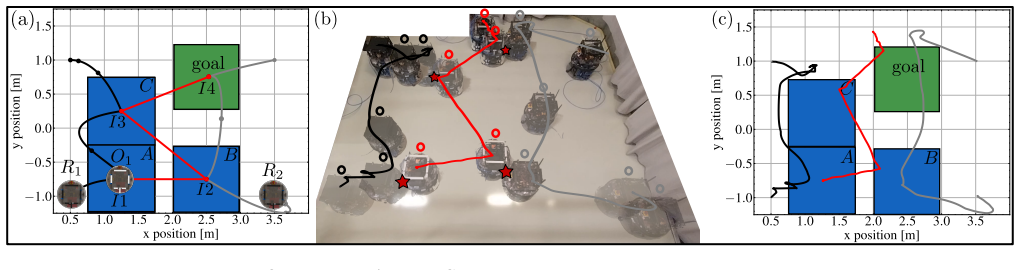
The central claim is that instantaneous impacts can be the only mechanism for changing a free-floating object's velocity, and that this interaction is simple enough to plan globally. Treating robots and objects as point masses, the planner embeds the linear restitution law as equality constraints on Bézier curve endpoints, with binary variables deciding whether each curve boundary is an impact or a smooth join; the resulting mixed-integer linear program maximizes either STL spatial robustness or an impact-robustness margin $\delta$. The online replanner relaxes the point-mass assumption by solving the two-body impact geometry with the physical radii, and the MPC tracks the curves while switching its weights near an impact so that the robot's priority is generating the object's desired post-impact velocity. The whole stack is demonstrated in a high-fidelity simulator and on a free-flyer platform for two-robot, one-object scenarios.
Load-bearing premise
The plan assumes impacts follow an idealized point-mass collision law with a fixed restitution coefficient and no rotation; if real collisions transfer spin or depend on shape and contact angle, the planned guarantees and the uncertainty margin $\delta$ are only approximations of what happens physically.
Editorial extensions
If this is right
- A team of free-floating robots can transport a passive object without any physical connection, using only bounces, removing the need for grippers or docking mechanisms for such tasks.
- Because the offline problem is a mixed-integer linear program, the planner returns globally optimal impact schedules for the simplified model rather than locally adjusted ones.
- The robustness variant suggests that extra impacts can shrink rather than grow the object's uncertainty funnel, since each impact can be planned to correct velocity errors.
- The same stack of offline planner, online replanner, and MPC applies to any timed task expressible as STL reach-avoid constraints, not only point-to-point transport.
- Simulation and hardware runs show that the approach is executable in real time on free-flyer platforms, subject to the idealized impact model.
Reading between the lines
- If the impact model were extended with online estimation of the restitution coefficient and rotational coupling, the same planning pipeline could become reliable enough for on-orbit servicing tasks such as nudging debris or repositioning modules.
- The uncertainty-margin formulation suggests a design principle beyond space: in any low-friction environment, choose impact sequences that maximize the allowable error in the impulse, which could transfer to air-hockey or billiards-style manipulation.
- A natural testable extension is to make the replanner consider the STL specification, which the paper notes it currently does not; this would trade some online computation for a guarantee that the updated plan remains satisfying rather than merely tracking the nearest impact.
- The constant-restitution assumption is the most promising place to add sensing: measuring the object's post-impact velocity after each collision and updating the model parameter would close the loop the current stack leaves open.
Signed reviews
Editorial analysis
A structured set of objections, weighed in public.
Referee Report
Summary. The paper proposes a hierarchical planning and control stack for collaborative transportation of passive free-floating objects in microgravity by teams of robots that interact with the objects only through impacts. The stack consists of an offline MILP planner that maximizes either spatial STL robustness or an impact-robustness metric, an online two-body impact replanner, and an impact-aware MPC for execution. The approach is evaluated in a high-fidelity Gazebo simulator and on an air-bearing freeflyer platform with two robots and one object. The authors also provide code and videos. The central claim is that the full stack synthesizes and executes impact-based transport satisfying STL specifications, validated both in simulation and on hardware.
Significance. If the claims hold, the paper provides a useful, computationally tractable framework for a nontrivial robotics problem: transporting objects without grasping, using impacts as the only interaction. The strengths include a complete offline/online/control pipeline, a clear MILP encoding of STL robustness and impact kinematics, the integration with Bezier-curve trajectory parameterization, and the documented open-source implementation. The impact-robustness formulation with zonotope propagation is an interesting idea for accounting for post-impact velocity uncertainty. However, the hardware validation does not support the central passive-object claim, because the object in the experiments runs a velocity-keeping MPC and is therefore actuated between impacts. This confound, together with the unproved Lemma 1 and the deferred robot-object collision avoidance, means that the paper's strongest claims are currently stronger than the evidence supports.
major comments (4)
- [VIII-B and Appendix C] The hardware validation does not support the central passive-object claim. Appendix C states that in the experiments "we run a velocity-keeping MPC on the object" and that the object "keeps position, detects an impact, turns off the controller ... and then draws a linear segment from the current state to a future state using this vector." This means the object is actuated between impacts, contradicting the zero-control assumption in Eq. (9d) and the abstract's assertion that impacts are "the only way to change an object's velocity." No object thrust or acceleration telemetry is reported, so the contribution of the object's own MPC to the observed motion is unknown. The Pong deviation and the impact-model mismatch discussed in Section IX are therefore ambiguous as evidence about the planner, since the object controller was active in those trials. Please either repeat the experiments with a truly passive object, or report the object's control inputs and re-analyze the data to separate the object-MPC contribution, or reduce the strength of the hardware-validation claim to what a passive-object experiment would support.
- [Section IV-C, Lemma 1] Lemma 1 is stated without proof, but it is load-bearing for the impact-robust planner. The lemma claims that if for every vertex of the interval hull zonotope there exists a robot trajectory intersecting that vertex at the final time, then for every point in the original zonotope there exists such a trajectory. This requires a convexity or reachability-preservation property that is not established for the B ezier-trajectory formulation with velocity bounds and collision constraints. As written, the lemma is not obviously true for a non-convex or constrained trajectory set. Please provide a proof or a counterexample, or weaken the claim to a conservative heuristic and adjust the statements in Section IV-C accordingly.
- [Section I and Section V.4] The introduction claims the MILP formulation provides "global optimality guarantees even in the presence of complex spatio-temporal goals and constraints." This is only valid for the abstracted point-mass model with Assumptions 1 and 2, and Section V.4 explicitly defers robot-object collision avoidance to the controller safety layer. Consequently, the solution is globally optimal for a relaxed problem, not for the original problem in Eq. (9). The paper's own Limitations section (Section IX) agrees that the robustness metric "only relates to an abstraction of the true model-based robustness." Please qualify the global-optimality statement in the abstract and introduction to refer to the idealized planning model, and state clearly that robot-object collision avoidance is not part of the planning optimization.
- [Section V.4] The planner only enforces collision avoidance between robots and between objects, and "defers any collision avoidance between robots and objects to safety constraints in the controller." This is a significant gap for the claimed "full planning and control stack": the STL specifications in the experiments include wall avoidance for all systems, but there is no planning-level guarantee that a robot and an object do not collide at unintended times. The controller-level collision avoidance is only mentioned as a Control Barrier Function in the obstacle scenario, with no formal guarantee or analysis. Please either integrate robot-object collision avoidance into the planning formulation (even conservatively) or explicitly state that unintended robot-object collisions are only filtered by the controller and are not covered by the planner's guarantees.
minor comments (5)
- [Section VI] The text says the desired pre-impact state is obtained "from solving Eq. (7) (see Appendix. A)" but the two-body impact problem is Eq. (6), and Eq. (7) is only the coordinate rotation. Please correct the cross-reference.
- [Section V.4, Eq. (26)] Equation (26) states the collision-avoidance constraint with "||pSi(t)-pSj(t)||2≤ radSi + radSj" but for avoidance the inequality should be ≥. Please fix the inequality and the corresponding textual explanation.
- [Section V.4, footnote 1] The footnote says "the restitution coefficient, c, is 1" but the rest of the paper uses e for the coefficient of restitution. Please unify the notation.
- [Section VI, after Eq. (29)] The sentence "It is ˙x+_O,i which is one the left-hand side of Eq. (7)" contains a spelling error: "one" should be "on." Also, the variable name for the desired post-impact object velocity appears as both ˙x+_O,i and ˙xdes_O,i; please make the notation consistent.
- [Throughout] The paper would benefit from a pass to harmonize notation for the number of B ezier curves (N vs N_i) and for the indices j in z(R,O)[i,j] and in the equations of Section V. Some indices are introduced but not clearly defined in the MILP encoding subsection.
Circularity Check
No load-bearing circularity: the objectives are stated optimizations, the only self-citations are non-load-bearing building blocks, and the hardware object-actuation issue is a confound rather than a circular derivation.
full rationale
The derivation chain is not circular. The offline planner in Eq. (15) maximizes the STL spatial robustness rho_phi, and the impact-robust planner in Eq. (20) maximizes the post-impact uncertainty bound delta; these are stated optimization objectives, not fitted parameters later relabeled as predictions, so the reported values (e.g., delta = 0.019 m/s in Section VIII-A.1) are the optimized costs and not independent outputs. The impact kinematics in Eq. (5) are a standard linear restitution law with no dependence on the paper's results. The STL-into-MILP encoding is delegated to [27] and [30]; [30] is a prior work by the authors, but it is a peer-reviewed method, an alternative citation [27] is also given, and the encoding is a building block rather than the central claim, so the self-citation is not load-bearing. The paper honestly flags in Section IX that delta "only relates to an abstraction of the true model-based robustness," and that the Pong deviation stems from the idealized impact model; this weakens the robustness interpretation but is not circularity. Appendix C reveals that in hardware the object runs a velocity-keeping MPC, so the experimental object is actuated and does not match the passive-object assumption in Eq. (9d); this is a validation confound, not a circular derivation from the model. Lemma 1 is asserted without proof, which is a proof gap for the zonotope propagation argument, but it is not a self-referential use of the paper's conclusions.
Assumptions & free parameters
free parameters (2)
- restitution coefficient e =
assumed e=1 in planning examples; hardware value not identified
- object curve time step =
constant but unspecified value
assumptions (5)
- domain assumption Planner impact model treats robots and objects as point masses with zero radii.
- domain assumption Planner state model ignores rotation of robots and objects.
- domain assumption Checking the vertices of the interval hull of the initial zonotope is sufficient for all points in the zonotope (Lemma 1).
- domain assumption The kinematic impact model with restitution coefficient e and no friction adequately describes impacts.
- domain assumption Objects follow frictionless double-integrator dynamics between impacts.
Cite this review
Pith. "Pith review of Collaborative Object Transportation in Space via Impact Interactions." pith.science (2026). https://pith.science/paper/ZRS2DE67
@misc{pith2026250418667,
  author       = {Pith},
  title        = {Pith review of: Collaborative Object Transportation in Space via Impact Interactions},
  year         = {2026},
  howpublished = {\url{https://pith.science/paper/ZRS2DE67}},
  note         = {Machine review of arXiv:2504.18667}
}
read the original abstract
We present a planning and control approach for collaborative transportation of objects in space by a team of robots. Object and robots in microgravity environments are not subject to friction but are instead free floating. This property is key to how we approach the transportation problem: the passive objects are controlled by impact interactions with the controlled robots. In particular, given a high-level Signal Temporal Logic (STL) specification of the transportation task, we synthesize motion plans for the robots to maximize the specification satisfaction in terms of spatial STL robustness. Given that the physical impact interactions are complex and hard to model precisely, we also present an alternative formulation maximizing the permissible uncertainty in a simplified kinematic impact model. We define the full planning and control stack required to solve the object transportation problem; an offline planner, an online replanner, and a low-level model-predictive control scheme for each of the robots. We show the method in a high-fidelity simulator for a variety of scenarios and present experimental validation of 2-robot, 1-object scenarios on a freeflyer platform.
Figures


Figures from the paper (9 more)


Reference graph
Works this paper leans on
-
[1]
Javier Alonso-Mora, Stuart Baker, and Daniela Rus. Multi-robot formation control and object transport in dynamic environments via constrained optimization. The International Journal of Robotics Research , 36(9):1000– 1021, 2017
work page 2017
-
[2]
CasADi: a software framework for nonlinear optimization and optimal con- trol
Joel AE Andersson, Joris Gillis, Greg Horn, James B Rawlings, and Moritz Diehl. CasADi: a software framework for nonlinear optimization and optimal con- trol. Mathematical Programming Computation, 11:1–36, 2019
work page 2019
-
[3]
Modeling and control of a space robot for active debris removal
Vincent Dubanchet, David Saussi ´e, Daniel Alazard, Car- oline B ´erard, and Catherine Le Peuv ´edic. Modeling and control of a space robot for active debris removal. CEAS Space Journal, 7(2):203–218, 2015
work page 2015
-
[4]
Fully decentralized controller for multi-robot collective transport in space applications
Hamed Farivarnejad, Amir Salimi Lafmejani, and Spring Berman. Fully decentralized controller for multi-robot collective transport in space applications. In 2021 IEEE Aerospace Conference (50100), pages 1–9. IEEE, 2021
work page 2021
-
[5]
A review of space robotics technologies for on- orbit servicing
Angel Flores-Abad, Ou Ma, Khanh Pham, and Steve Ulrich. A review of space robotics technologies for on- orbit servicing. Progress in aerospace sciences, 68:1–26, 2014
work page 2014
-
[6]
A smooth robustness measure of signal temporal logic for symbolic control
Yann Gilpin, Vince Kurtz, and Hai Lin. A smooth robustness measure of signal temporal logic for symbolic control. IEEE Control Systems Letters , 5(1):241–246, 2020
work page 2020
-
[7]
Reachability of uncertain linear sys- tems using zonotopes
Antoine Girard. Reachability of uncertain linear sys- tems using zonotopes. In International workshop on hybrid systems: Computation and control , pages 291–
-
[8]
Gurobi Optimizer Reference Manual, 2024
Gurobi Optimization, LLC. Gurobi Optimizer Reference Manual, 2024. URL https://www.gurobi.com
2024
Show all 34 references
-
[9]
Cooperative game method for on-orbit substructure transportation using modular robots
Nan Han, Jianjun Luo, and Lijun Zong. Cooperative game method for on-orbit substructure transportation using modular robots. IEEE Transactions on Aerospace and Electronic Systems , 58(2):1161–1175, 2021
2021
-
[10]
On-orbit transportation with non-conserved momenta by cooperative space robots
Yunhao Hu, Wei Zhang, Hao Wen, and Haiyan Hu. On-orbit transportation with non-conserved momenta by cooperative space robots. Advances in Space Research , 74(10):5179–5191, 2024
2024
-
[11]
Impact dynamic modeling and adaptive target capturing control for tethered space robots with uncertainties
Panfeng Huang, Dongke Wang, Zhongjie Meng, Fan Zhang, and Zhengxiong Liu. Impact dynamic modeling and adaptive target capturing control for tethered space robots with uncertainties. IEEE/ASME Transactions on Mechatronics, 21(5):2260–2271, 2016
2016
-
[12]
Design and operational elements of the robotic subsystem for the e
Steffen Jaekel, Roberto Lampariello, Wolfgang Rackl, Marco De Stefano, Nassir Oumer, Alessandro M Gior- dano, Oliver Porges, Markus Pietras, Bernhard Brunner, John Ratti, et al. Design and operational elements of the robotic subsystem for the e. deorbit debris removal mission....
2018
-
[13]
AiR- LIHockey: Highly Reactive Contact Control and Stochas- tic Optimal Shooting
Julius Jankowski, Ante Mari ´c, and Sylvain Calinon. AiR- LIHockey: Highly Reactive Contact Control and Stochas- tic Optimal Shooting. arXiv preprint arXiv:2401.14964 , 2024
2024 arXiv
-
[14]
A heuristic-based planner and improved con- troller for a two-layered approach for the game of bil- liards
Jean-Franc ¸ois Landry, Jean-Pierre Dussault, and Philippe Mahey. A heuristic-based planner and improved con- troller for a two-layered approach for the game of bil- liards. IEEE Transactions on Computational Intelligence and AI in Games , 5(4):325–336, 2013
2013
-
[15]
A survey of space robotic technologies for on-orbit assembly
Delun Li, Lou Zhong, Wei Zhu, Zhipeng Xu, Qirong Tang, and Wenhao Zhan. A survey of space robotic technologies for on-orbit assembly. Space: Science & Technology, 2022
2022
-
[16]
Monitoring temporal properties of continuous signals
Oded Maler and Dejan Nickovic. Monitoring temporal properties of continuous signals. In International sympo- sium on formal techniques in real-time and fault-tolerant systems, pages 152–166. Springer, 2004
2004
-
[17]
Motion planning around obstacles with convex optimization
Tobia Marcucci, Mark Petersen, David von Wrangel, and Russ Tedrake. Motion planning around obstacles with convex optimization. Science robotics , 8(84):eadf7843, 2023
2023
-
[18]
Impact analysis and post-impact motion control issues of a free- floating space robot subject to a force impulse
Dragomir N Nenchev and Kazuya Yoshida. Impact analysis and post-impact motion control issues of a free- floating space robot subject to a force impulse. IEEE Transactions on Robotics and Automation , 15(3):548– 557, 1999
1999
-
[19]
Robotic billiards: understanding humans in order to counter them
Thomas Nierhoff, Konrad Leibrandt, Tamara Lorenz, and Sandra Hirche. Robotic billiards: understanding humans in order to counter them. IEEE transactions on cybernetics, 46(8):1889–1899, 2015
2015
-
[20]
Fly-by-logic: Control of multi- drone fleets with temporal logic objectives
Yash Vardhan Pant, Houssam Abbas, Rhudii A Quaye, and Rahul Mangharam. Fly-by-logic: Control of multi- drone fleets with temporal logic objectives. In 2018 ACM/IEEE 9th International Conference on Cyber- Physical Systems (ICCPS) , pages 186–197. IEEE, 2018
2018
-
[21]
On Inertia and Stiffness Effects During Impact Docking
I Paraskevas, Zisos Mitros, and Evangelos Papadopoulos. On Inertia and Stiffness Effects During Impact Docking. In 13th Symp. on Advanced Space Technology in Robotics and Automation,(ASTRA ‘15) , 2015
2015
-
[22]
Motion planning for urban au- tonomous driving using B´ezier curves and MPC
Xiangjun Qian, I ˜naki Navarro, Arnaud de La Fortelle, and Fabien Moutarde. Motion planning for urban au- tonomous driving using B´ezier curves and MPC. In 2016 IEEE 19th international conference on intelligent trans- portation systems (ITSC) , pages 826–833. Ieee, 2016
2016
-
[23]
Model predictive control from signal temporal logic specifications: A case study
Vasumathi Raman, Mehdi Maasoumy, and Alexandre Donz´e. Model predictive control from signal temporal logic specifications: A case study. In Proceedings of the 4th ACM SIGBED International Workshop on Design, Modeling, and Evaluation of Cyber-Physical Systems , pages 52–55, 2014
2014
-
[24]
Towards Open-Source and Modular Space Systems with ATMOS
Pedro Roque, Sujet Phodapol, Elias Krantz, Jaeyoung Lim, Joris Verhagen, Frank J Jiang, David D ¨orner, Huina Mao, Gunnar Tibert, Roland Siegwart, et al. Towards Open-Source and Modular Space Systems with ATMOS. arXiv preprint arXiv:2501.16973 , 2025
2025 arXiv
-
[25]
Robust temporal logic model predictive control
Sadra Sadraddini and Calin Belta. Robust temporal logic model predictive control. In 2015 53rd Annual Allerton Conference on Communication, Control, and Computing (Allerton), pages 772–779. IEEE, 2015
2015
-
[26]
Astrobee: A new platform for free-flying robotics on the international space station
Trey Smith, Jonathan Barlow, Maria Bualat, Terrence Fong, Christopher Provencher, Hugo Sanchez, and Ernest Smith. Astrobee: A new platform for free-flying robotics on the international space station. In International Symposium on Artificial Intelligence, Robotics, and Au- toma...
2016
-
[27]
Multi-agent motion planning from signal temporal logic specifications
Dawei Sun, Jingkai Chen, Sayan Mitra, and Chuchu Fan. Multi-agent motion planning from signal temporal logic specifications. IEEE Robotics and Automation Letters , 7 (2):3451–3458, 2022
2022
-
[28]
Robust collaborative object transportation using multiple MA Vs
Andrea Tagliabue, Mina Kamel, Roland Siegwart, and Juan Nieto. Robust collaborative object transportation using multiple MA Vs. The International Journal of Robotics Research, 38(9):1020–1044, 2019
2019
-
[29]
Exper- imental evaluation of contact-impact dynamics between a space robot with a compliant wrist and a free-flying object
N Uyama, Y Fujii, K Nagaoka, and K Yoshida. Exper- imental evaluation of contact-impact dynamics between a space robot with a compliant wrist and a free-flying object. In International symposium on artificial intelli- gence, robotics and automation in space , 2012
2012
-
[30]
Temporally robust multi-agent stl motion planning in continuous time
Joris Verhagen, Lars Lindemann, and Jana Tumova. Temporally robust multi-agent stl motion planning in continuous time. In 2024 American Control Conference (ACC), pages 251–258. IEEE, 2024
2024
-
[31]
Using Graphs of Convex Sets to Guide Nonconvex Trajectory Opti- mization
David von Wrangel and Russ Tedrake. Using Graphs of Convex Sets to Guide Nonconvex Trajectory Opti- mization. In 2024 IEEE/RSJ International Conference on Intelligent Robots and Systems (IROS) , pages 9863–
2024
-
[32]
Minimal Impact Pokes to Place Objects on Planar Surfaces
Ahmed Zermane, L ´eo Moussafir, Youcan Yan, and Ab- derrahmane Kheddar. Minimal Impact Pokes to Place Objects on Planar Surfaces. IEEE Robotics and Automa- tion Letters, 2024
2024
-
[33]
Pre-impact trajectory planning for minimizing base attitude disturbance in space manipulator systems for a capture task
Long Zhang, Qingxuan Jia, Gang Chen, and Hanxu Sun. Pre-impact trajectory planning for minimizing base attitude disturbance in space manipulator systems for a capture task. Chinese Journal of Aeronautics , 28(4): 1199–1208, 2015. APPENDIX A. Two-body Impact Problem During repl...
2015
-
[34]
Weight-Scheduling: While an impact traverses through the horizon of the MPC, we adapt the weights Q, QN and R. As we are mainly interested in creating the desired post- impact vector of the object (at the cost of potentially having the robot deviate from its post-impact pre-pl...
Reviewed August 16, 2026 · model on record in the stance chip above.
Discussion (0). Continue with ORCID to comment.