REVIEW 4 major objections 5 minor 40 references
Multimodal graph representation learning for website generation based on visual sketch
T0 review · 4 major / 5 minor · reviewed 2026-08-16 · deepseek-v4-flash
Pith's one-line read The paper claims that feeding a vision-language model an explicit graph of webpage components — text blocks from OCR and visual regions from segmentation, linked by spatial overlap — improves the HTML it generates from a screenshot.
desk verdict The graph-versus-no-graph ablation is confounded by added per-component CLIP features, so the central claim isn't established—but the pipeline is a reasonable incremental contribution worth a conditional referee. read the letter →
The pith
A machine-rendered reading of the paper's core claim, the machinery that carries it, and where it could break.
The reading
What carries the argument
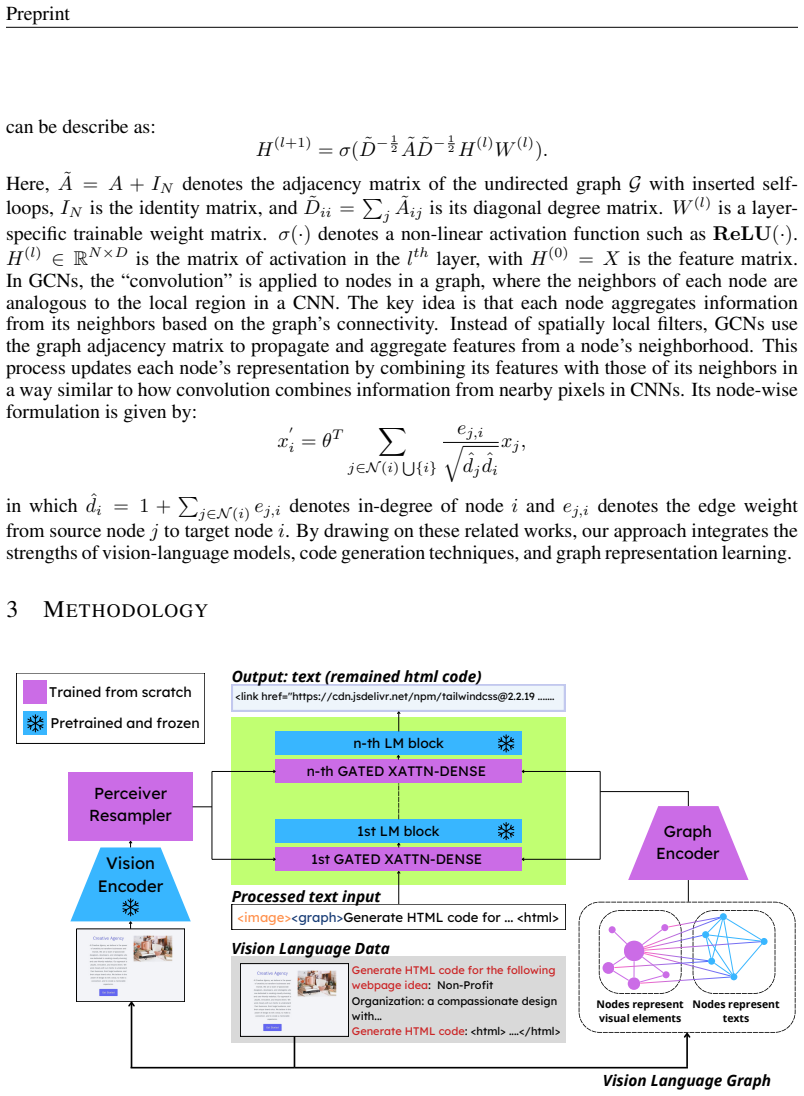
The machinery is the multimodal component graph and the gated cross-attention that fuses it into the language model. Each node is one extracted webpage component, with textual nodes coming from OCR and visual nodes from segmentation, and each edge encodes either full semantic connectivity among text nodes or spatial overlap above 80 percent IoU between visual-visual and text-visual nodes. A graph convolutional network, seeded with CLIP embeddings of the components, produces node representations that are passed alongside whole-screenshot features, reduced to a fixed number of tokens by a Perceiver resampler, into gated cross-attention layers interleaved between pretrained LM blocks. This design is what carries the argument: it makes page structure explicit and directly attendable at every generation step rather than leaving layout implicit in the screenshot.
What would settle it
Measure precision and recall of the extracted component graph against ground-truth layout annotations (or the DOM tree) on the WebSight test set, then compare OURS-graph fed the extracted graph against the same model fed a ground-truth graph. If the ground-truth graph does not outperform the extracted one, or if randomly corrupted graphs do not degrade performance, then the claim that explicit graph structure drives the reported gains is contradicted.
Extended reading notes
Core claim
The central claim is that the multimodal component graph is the active ingredient: adding it to a VLM improves HTML code generation on the metrics that measure visual layout, and does so beyond what the screenshot alone provides. The graph is constructed by extracting textual nodes with OCR, masking the text, segmenting the remaining visual nodes, and connecting text nodes to one another while linking visual and text-visual nodes by bounding-box overlap above 80 percent IoU. A graph convolutional network seeded with CLIP component embeddings encodes the graph, and these embeddings are fused into the language model through gated cross-attention interleaved with pretrained layers. In the reported experiments the graph-equipped model beats its no-graph counterpart on the WebSight benchmark across Block-Match, Text, Position, Color, and CLIP metrics, while on the harder Design2Code benchmark the comparison is mixed, with gains on some layout metrics offset by small drops on text and color.
Load-bearing premise
The load-bearing premise is that the OCR-plus-segmentation pipeline extracts webpage components faithfully enough that the graph passed to the model reflects the page's true structure; the paper never measures OCR or segmentation error and does not ablate the extraction step.
Editorial extensions
If this is right
- On the WebSight benchmark, graph conditioning improves every reported metric over the no-graph model, with the largest gains in Block-Match (24.94 vs 21.60) and Position (70.52 vs 66.21).
- The graph-enhanced model also improves BLEU, HTML-BLEU, SSIM, and TreeBLEU on the same benchmark, indicating that code and structure fidelity improve together with visual fidelity.
- The text-mask-then-segment pipeline is presented as the reason non-text components are extracted cleanly, making the two-step extraction a load-bearing part of the method.
- Because the graph is fused through interleaved cross-attention, the approach can be layered onto a frozen pretrained language model rather than training a new model from scratch.
- On the real-world Design2Code benchmark, the graph's advantage is smaller and inconsistent, suggesting the benefit is most reliable on synthetic pages with regular layouts.
Reading between the lines
- A natural test the paper does not run is to vary the edge rule: replacing the fixed 80 percent IoU threshold with containment, alignment, or learned edges would show how much of the gain comes from the edge definition itself.
- The graph's value is likely coupled to the quality of the OCR and segmentation pipeline; deliberately corrupting the graph, by shuffling nodes or deleting edges, and measuring the performance drop would isolate the structural contribution from the visual one.
- The same conditioning pattern may transfer to other structured generation tasks, such as mobile UI code or document layout generation, wherever components and spatial relations can be extracted from an input image.
- The mixed Design2Code results suggest that on real pages graph-induced structure may help some aspects while extraction errors hurt others, so an extension that falls back to vision-only when extraction confidence is low is plausible.
Signed reviews
Editorial analysis
A structured set of objections, weighed in public.
Referee Report
Summary. The paper proposes a graph-enhanced vision-language model for the Design2Code task, converting webpage screenshots into HTML code. The pipeline extracts textual components with PaddleOCR and masks them, then segments remaining visual components with SAM; these components become nodes in a multimodal graph with three edge types (text-text fully connected, visual-visual and text-visual by IoU > 0.8). Node features are CLIP embeddings refined by a GCN, and the resulting graph embedding conditions a frozen language model via gated cross-attention layers alongside the full-page image. The authors train on a 20,000-sample subset of WebSight v0.2 and evaluate on a 500-sample WebSight subset and the Design2Code benchmark, comparing OURS-graph against OURS-no-graph, Gemini prompting, and three open VLMs using visual and code metrics.
Significance. If the central claim were established, the contribution would be useful: explicit component graphs are a sensible inductive bias for layout-aware HTML generation, and the paper provides a clear pipeline, a code link, and an honest limitation statement. However, the current evidence does not isolate the effect of graph structure, because the OURS-graph variant differs from OURS-no-graph in both graph edges and per-component CLIP features. In addition, the abstract's efficiency claim is never measured, and the Design2Code results are mixed or reversed on several content metrics. The paper is a reasonable systems proposal that needs a tighter experimental design before its main claims can be accepted.
major comments (4)
- [Section 3.2 and Tables 2–3] The headline ablation is confounded: OURS-graph initializes each GCN node with a CLIP embedding of the corresponding OCR/SAM component, whereas OURS-no-graph, as described, appears to receive only the full-page image through the Vision Encoder. The WebSight gains (e.g., Block-Match 24.94 vs 21.60, Color 75.41 vs 69.70) can therefore be attributed to the added per-component CLIP features rather than to graph message passing. A control that keeps the component features but removes the edges (or randomly rewires them) is needed to support the paper's attribution of improvements to multimodal graph representation learning.
- [Section 4.3 and Tables 2–3] The text in Section 4.3 states that on the Design2Code benchmark 'OURS-graph maintains superiority over OURS-no-graph', but Table 2 shows the opposite for Text (47.15 vs 50.15), Color (40.07 vs 43.30), and CLIP (82.63 vs 82.90), and Table 3 shows TreeBLEU slightly lower (16.59 vs 16.71). This overstatement, together with the abstract's claim of 'significant improvements in both accuracy and efficiency', is not supported: no efficiency or runtime measurements appear anywhere in the paper.
- [Section 4.1 and Section 3] The experimental section lacks essential details: no training hyperparameters, model size, number of steps, batch size, learning rate, or number of seeds are reported, and Tables 2–3 show no error bars. Given that many reported differences are small (e.g., Design2Code CLIP 82.63 vs 82.90), it is not possible to assess whether the observed gains are statistically meaningful. Furthermore, the component-extraction pipeline is a critical assumption that is never validated: the paper does not report OCR or SAM accuracy on the test sets, nor does it ablate the impact of extraction errors on the generated HTML.
- [Section 3.1 and Section 4.2] The graph construction uses two ad-hoc heuristics without sensitivity analysis: all textual nodes are fully connected, and a fixed IoU threshold of 0.8 defines visual-visual and text-visual edges. These choices are free parameters of the method, and the paper provides no experiments varying them or justifying them beyond intuition. Since the central claim depends on the graph structure, the robustness of the results to these thresholds should be demonstrated.
minor comments (5)
- [Section 4.3 and Table 3 caption] The caption of Table 3 contains a typo, 'TrueBLEU', which should read 'TreeBLEU'.
- [Throughout] The benchmark name is inconsistently capitalized as 'Websight' in some places and 'WebSight' in others; the authors should standardize this.
- [Section 3.2] The heading 'Vision Encoder with Perceiver Resampler' is duplicated in the text; please remove the repeated phrase.
- [References] Several references have broken or awkwardly line-broken URLs (e.g., the OpenFlamingo and UNITER entries); please format them consistently with the journal's style.
- [Section 4.2] The baselines are described as 'state-of-the-art open-sourced VLMs', but they are used in a zero-shot setting with no fine-tuning, while OURS is fine-tuned; this comparison should be framed more carefully to avoid implying fairness that is not established.
Circularity Check
No significant circularity: the paper's central claim is an empirical comparison, and its graph construction is not definitionally tied to the evaluated outputs.
full rationale
The paper's central contribution is an experimental architecture comparison (OURS-graph vs OURS-no-graph vs prompting baselines) on WebSight and Design2Code benchmarks. No equation in the paper defines the predicted HTML metrics in terms of the graph inputs: the graph is built from OCR and SAM component boxes derived from the input screenshot, while the reported metrics compare generated HTML against ground-truth HTML. The graph node embeddings use CLIP features of those components, and the GCN message-passing is trained, but no fitted parameter is renamed as a prediction and no metric is computed from the training fit itself. The evaluation on a self-collected WebSight subset is an in-distribution benchmark choice, not a circular reduction, and the paper also reports results on the external Design2Code benchmark, so the central claim is not self-confirming. The strongest concern raised in review is that the OURS-graph vs OURS-no-graph ablation simultaneously changes graph structure and per-component CLIP feature injection, which is a genuine experimental confound, but a confound in attribution is not a definitional circularity of the kind required for a positive circularity finding. There are no load-bearing self-citations or imported uniqueness theorems, and the limitations section is candid about resource constraints and non-dynamic webpages without asserting a circular derivation. Accordingly, the appropriate finding is no significant circularity, score 0.
Assumptions & free parameters
free parameters (3)
- IoU threshold for edge construction =
0.80
- WebSight training subset size =
20000
- Graph encoder and cross-attention hyperparameters
assumptions (4)
- standard math The GCN message-passing update defined in Section 2.3 is a correct and suitable encoder for webpage component graphs.
- domain assumption OCR text masking followed by SAM segmentation reliably extracts the salient components of a webpage screenshot.
- domain assumption The synthetic WebSight distribution is representative enough to validate Design2Code methods.
- ad hoc to paper Fully connecting all text nodes and using an IoU threshold of 0.8 captures the semantic and spatial relationships needed for HTML generation.
Cite this review
Pith. "Pith review of Multimodal graph representation learning for website generation based on visual sketch." pith.science (2026). https://pith.science/paper/DZVPSMPG
@misc{pith2026250418729,
  author       = {Pith},
  title        = {Pith review of: Multimodal graph representation learning for website generation based on visual sketch},
  year         = {2026},
  howpublished = {\url{https://pith.science/paper/DZVPSMPG}},
  note         = {Machine review of arXiv:2504.18729}
}
read the original abstract
The Design2Code problem, which involves converting digital designs into functional source code, is a significant challenge in software development due to its complexity and time-consuming nature. Traditional approaches often struggle with accurately interpreting the intricate visual details and structural relationships inherent in webpage designs, leading to limitations in automation and efficiency. In this paper, we propose a novel method that leverages multimodal graph representation learning to address these challenges. By integrating both visual and structural information from design sketches, our approach enhances the accuracy and efficiency of code generation, particularly in producing semantically correct and structurally sound HTML code. We present a comprehensive evaluation of our method, demonstrating significant improvements in both accuracy and efficiency compared to existing techniques. Extensive evaluation demonstrates significant improvements of multimodal graph learning over existing techniques, highlighting the potential of our method to revolutionize design-to-code automation. Code available at https://github.com/HySonLab/Design2Code
Figures


Reference graph
Works this paper leans on
-
[1]
write newline
" write newline "" before.all 'output.state := FUNCTION n.dashify 't := "" t empty not t #1 #1 substring "-" = t #1 #2 substring "--" = not "--" * t #2 global.max substring 't := t #1 #1 substring "-" = "-" * t #2 global.max substring 't := while if t #1 #1 substring * t #2 global.max substring 't := if while FUNCTION format.date year duplicate empty "emp...
-
[2]
Flamingo: a visual language model for few-shot learning
Jean-Baptiste Alayrac, Jeff Donahue, Pauline Luc, Antoine Miech, Iain Barr, Yana Hasson, Karel Lenc, Arthur Mensch, Katherine Millican, Malcolm Reynolds, Roman Ring, Eliza Rutherford, Serkan Cabi, Tengda Han, Zhitao Gong, Sina Samangooei, Marianne Monteiro, Jacob Menick, Sebastian Borgeaud, Andrew Brock, Aida Nematzadeh, Sahand Sharifzadeh, Mikolaj Binkow...
work page 2022
-
[3]
Anas Awadalla, Irena Gao, Josh Gardner, Jack Hessel, Yusuf Hanafy, Wanrong Zhu, Kalyani Marathe, Yonatan Bitton, Samir Gadre, Shiori Sagawa, Jenia Jitsev, Simon Kornblith, Pang Wei Koh, Gabriel Ilharco, Mitchell Wortsman, and Ludwig Schmidt. Openflamingo: An open-source framework for training large autoregressive vision-language models, 2023. URL https://...
arXiv 2023
-
[4]
pix2code: Generating code from a graphical user interface screenshot
Tony Beltramelli. pix2code: Generating code from a graphical user interface screenshot. In Proceedings of the ACM SIGCHI Symposium on Engineering Interactive Computing Systems, EICS '18, New York, NY, USA, 2018. Association for Computing Machinery. ISBN 9781450358972. doi:10.1145/3220134.3220135. URL https://doi.org/10.1145/3220134.3220135
arXiv 2018
-
[5]
A novel code generator for graphical user interfaces
Cai Bo, Jian Luo, and Zhen Feng. A novel code generator for graphical user interfaces. Scientific Reports, 13, 11 2023. doi:10.1038/s41598-023-46500-6
-
[6]
Uniter: Universal image-text representation learning
Yen-Chun Chen, Linjie Li, Licheng Yu, Ahmed El Kholy, Faisal Ahmed, Zhe Gan, Yu Cheng, and Jingjing Liu. Uniter: Universal image-text representation learning. In Computer Vision – ECCV 2020: 16th European Conference, Glasgow, UK, August 23–28, 2020, Proceedings, Part XXX, pp.\ 104–120, Berlin, Heidelberg, 2020. Springer-Verlag. ISBN 978-3-030-58576-1. doi...
-
[7]
Bert: Pre-training of deep bidirectional transformers for language understanding, 2019
Jacob Devlin, Ming-Wei Chang, Kenton Lee, and Kristina Toutanova. Bert: Pre-training of deep bidirectional transformers for language understanding, 2019. URL https://arxiv.org/abs/1810.04805
arXiv 2019
-
[8]
Vision2ui: A real-world dataset with layout for code generation from ui designs
Yi Gui, Zhen Li, Yao Wan, Yemin Shi, Hongyu Zhang, Yi Su, Shaoling Dong, Xing Zhou, and Wenbin Jiang. Vision2ui: A real-world dataset with layout for code generation from ui designs. ArXiv, abs/2404.06369, 2024. URL https://api.semanticscholar.org/CorpusID:269010048
arXiv 2024
Show all 40 references
-
[9]
UIC opilot: Automating UI synthesis via hierarchical code generation from webpage designs
Yi Gui, Yao Wan, Zhen Li, Zhongyi Zhang, Dongping Chen, Hongyu Zhang, Yi Su, Bohua Chen, Xing Zhou, Wenbin Jiang, and Xiangliang Zhang. UIC opilot: Automating UI synthesis via hierarchical code generation from webpage designs. In THE WEB CONFERENCE 2025, 2025. URL https://open...
2025
-
[10]
Images in language space: Exploring the suitability of large language models for vision & language tasks
Sherzod Hakimov and David Schlangen. Images in language space: Exploring the suitability of large language models for vision & language tasks. In Anna Rogers, Jordan Boyd-Graber, and Naoaki Okazaki (eds.), Findings of the Association for Computational Linguistics: ACL 2023, pp...
2023 doi
-
[11]
Retrieval-enhanced contrastive vision-text models, 2024
Ahmet Iscen, Mathilde Caron, Alireza Fathi, and Cordelia Schmid. Retrieval-enhanced contrastive vision-text models, 2024. URL https://arxiv.org/abs/2306.07196
2024 arXiv
-
[12]
Perceiver: General perception with iterative attention
Andrew Jaegle, Felix Gimeno, Andy Brock, Oriol Vinyals, Andrew Zisserman, and Joao Carreira. Perceiver: General perception with iterative attention. In Marina Meila and Tong Zhang (eds.), Proceedings of the 38th International Conference on Machine Learning, volume 139 of Proce...
2021
-
[13]
Graph4gui: Graph neural networks for representing graphical user interfaces
Yue Jiang, Changkong Zhou, Vikas Garg, and Antti Oulasvirta. Graph4gui: Graph neural networks for representing graphical user interfaces. In Proceedings of the 2024 CHI Conference on Human Factors in Computing Systems, CHI '24, New York, NY, USA, 2024. Association for Computin...
2024
-
[14]
Kipf and Max Welling
Thomas N. Kipf and Max Welling. Semi-supervised classification with graph convolutional networks. In International Conference on Learning Representations, 2017. URL https://openreview.net/forum?id=SJU4ayYgl
2017
-
[15]
Obelics: An open web-scale filtered dataset of interleaved image-text documents
Hugo Lauren c on, Lucile Saulnier, Leo Tronchon, Stas Bekman, Amanpreet Singh, Anton Lozhkov, Thomas Wang, Siddharth Karamcheti, Alexander Rush, Douwe Kiela, Matthieu Cord, and Victor Sanh. Obelics: An open web-scale filtered dataset of interleaved image-text documents. In A. ...
2023
-
[16]
Unlocking the conversion of web screenshots into html code with the websight dataset, 2024
Hugo Laurençon, Léo Tronchon, and Victor Sanh. Unlocking the conversion of web screenshots into html code with the websight dataset, 2024. URL https://arxiv.org/abs/2403.09029
2024 arXiv
-
[17]
Align before fuse: Vision and language representation learning with momentum distillation
Junnan Li, Ramprasaath Selvaraju, Akhilesh Gotmare, Shafiq Joty, Caiming Xiong, and Steven Chu Hong Hoi. Align before fuse: Vision and language representation learning with momentum distillation. In M. Ranzato, A. Beygelzimer, Y. Dauphin, P.S. Liang, and J. Wortman Vaughan (ed...
2021
-
[18]
BLIP : Bootstrapping language-image pre-training for unified vision-language understanding and generation
Junnan Li, Dongxu Li, Caiming Xiong, and Steven Hoi. BLIP : Bootstrapping language-image pre-training for unified vision-language understanding and generation. In Kamalika Chaudhuri, Stefanie Jegelka, Le Song, Csaba Szepesvari, Gang Niu, and Sivan Sabato (eds.), Proceedings of...
2022
-
[19]
Visualbert: A simple and performant baseline for vision and language, 2019
Liunian Harold Li, Mark Yatskar, Da Yin, Cho-Jui Hsieh, and Kai-Wei Chang. Visualbert: A simple and performant baseline for vision and language, 2019. URL https://arxiv.org/abs/1908.03557
2019 arXiv
-
[20]
Vila: On pre-training for visual language models
Ji Lin, Hongxu Yin, Wei Ping, Pavlo Molchanov, Mohammad Shoeybi, and Song Han. Vila: On pre-training for visual language models. In Proceedings of the IEEE/CVF Conference on Computer Vision and Pattern Recognition (CVPR), pp.\ 26689--26699, June 2024
2024
-
[21]
Hyperbolic graph neural networks
Qi Liu, Maximilian Nickel, and Douwe Kiela. Hyperbolic graph neural networks. In H. Wallach, H. Larochelle, A. Beygelzimer, F. d Alch\' e -Buc, E. Fox, and R. Garnett (eds.), Advances in Neural Information Processing Systems, volume 32. Curran Associates, Inc., 2019. URL https...
2019
-
[22]
Lyu, Baishakhi Ray, Abhik Roychoudhury, Shin Hwei Tan, and Patanamon Thongtanunam
Michael R. Lyu, Baishakhi Ray, Abhik Roychoudhury, Shin Hwei Tan, and Patanamon Thongtanunam. Automatic programming: Large language models and beyond, 2024. URL https://arxiv.org/abs/2405.02213
2024 arXiv
-
[23]
Reverse engineering mobile application user interfaces with remaui (t)
Tuan Anh Nguyen and Christoph Csallner. Reverse engineering mobile application user interfaces with remaui (t). 2015 30th IEEE/ACM International Conference on Automated Software Engineering (ASE), pp.\ 248--259, 2015. URL https://api.semanticscholar.org/CorpusID:7499368
2015
-
[24]
Learning transferable visual models from natural language supervision
Alec Radford, Jong Wook Kim, Chris Hallacy, Aditya Ramesh, Gabriel Goh, Sandhini Agarwal, Girish Sastry, Amanda Askell, Pamela Mishkin, Jack Clark, Gretchen Krueger, and Ilya Sutskever. Learning transferable visual models from natural language supervision. In Marina Meila and ...
2021
-
[25]
Recipe for a general, powerful, scalable graph transformer
Ladislav Ramp\' a s ek, Michael Galkin, Vijay Prakash Dwivedi, Anh Tuan Luu, Guy Wolf, and Dominique Beaini. Recipe for a general, powerful, scalable graph transformer. In S. Koyejo, S. Mohamed, A. Agarwal, D. Belgrave, K. Cho, and A. Oh (eds.), Advances in Neural Information ...
2022
-
[26]
Sketch2code: Generating a website from a paper mockup, 2019
Alex Robinson. Sketch2code: Generating a website from a paper mockup, 2019. URL https://arxiv.org/abs/1905.13750
2019 arXiv
-
[27]
Gated graph recurrent neural networks
Luana Ruiz, Fernando Gama, and Alejandro Ribeiro. Gated graph recurrent neural networks. IEEE Transactions on Signal Processing, 68: 0 6303--6318, 2020. doi:10.1109/TSP.2020.3033962
2020
-
[28]
Sketch2Code , 12 2022
ShantamVijayputra. Sketch2Code , 12 2022. URL https://www.kaggle.com/datasets/vshantam/sketch2code
2022
-
[29]
Design2code: How far are we from automating front-end engineering?, 2024
Chenglei Si, Yanzhe Zhang, Zhengyuan Yang, Ruibo Liu, and Diyi Yang. Design2code: How far are we from automating front-end engineering?, 2024. URL https://arxiv.org/abs/2403.03163
2024 arXiv
-
[30]
Learning ui-to-code reverse generator using visual critic without rendering, 2023
Davit Soselia, Khalid Saifullah, and Tianyi Zhou. Learning ui-to-code reverse generator using visual critic without rendering, 2023. URL https://arxiv.org/abs/2305.14637
2023 arXiv
-
[31]
A survey of neural code intelligence: Paradigms, advances and beyond, 2024
Qiushi Sun, Zhirui Chen, Fangzhi Xu, Kanzhi Cheng, Chang Ma, Zhangyue Yin, Jianing Wang, Chengcheng Han, Renyu Zhu, Shuai Yuan, Qipeng Guo, Xipeng Qiu, Pengcheng Yin, Xiaoli Li, Fei Yuan, Lingpeng Kong, Xiang Li, and Zhiyong Wu. A survey of neural code intelligence: Paradigms,...
2024 arXiv
-
[32]
LXMERT : Learning cross-modality encoder representations from transformers
Hao Tan and Mohit Bansal. LXMERT : Learning cross-modality encoder representations from transformers. In Kentaro Inui, Jing Jiang, Vincent Ng, and Xiaojun Wan (eds.), Proceedings of the 2019 Conference on Empirical Methods in Natural Language Processing and the 9th Internation...
2019 doi
-
[33]
Cogvlm: Visual expert for pretrained language models, 2024
Weihan Wang, Qingsong Lv, Wenmeng Yu, Wenyi Hong, Ji Qi, Yan Wang, Junhui Ji, Zhuoyi Yang, Lei Zhao, Xixuan Song, Jiazheng Xu, Bin Xu, Juanzi Li, Yuxiao Dong, Ming Ding, and Jie Tang. Cogvlm: Visual expert for pretrained language models, 2024. URL https://arxiv.org/abs/2311.03079
2024 arXiv
-
[34]
Webui: A dataset for enhancing visual ui understanding with web semantics
Jason Wu, Siyan Wang, Siman Shen, Yi-Hao Peng, Jeffrey Nichols, and Jeffrey P Bigham. Webui: A dataset for enhancing visual ui understanding with web semantics. In Proceedings of the 2023 CHI Conference on Human Factors in Computing Systems, CHI '23, New York, NY, USA, 2023. A...
2023
-
[35]
Xing, Xiaodan Liang, and Zhiqiang Shen
Sukmin Yun, Haokun Lin, Rusiru Thushara, Mohammad Qazim Bhat, Yongxin Wang, Zutao Jiang, Mingkai Deng, Jinhong Wang, Tianhua Tao, Junbo Li, Haonan Li, Preslav Nakov, Timothy Baldwin, Zhengzhong Liu, Eric P. Xing, Xiaodan Liang, and Zhiqiang Shen. Web2code: A large-scale webpag...
2024 arXiv
-
[36]
Large language models meet nl2code: A survey, 2023
Daoguang Zan, Bei Chen, Fengji Zhang, Dianjie Lu, Bingchao Wu, Bei Guan, Yongji Wang, and Jian-Guang Lou. Large language models meet nl2code: A survey, 2023. URL https://arxiv.org/abs/2212.09420
2023 arXiv
-
[37]
Bridging design and development with automated declarative ui code generation, 2024
Ting Zhou, Yanjie Zhao, Xinyi Hou, Xiaoyu Sun, Kai Chen, and Haoyu Wang. Bridging design and development with automated declarative ui code generation, 2024. URL https://arxiv.org/abs/2409.11667
2024 arXiv
-
[38]
@esa (Ref
\@ifxundefined[1] #1\@undefined \@firstoftwo \@secondoftwo \@ifnum[1] #1 \@firstoftwo \@secondoftwo \@ifx[1] #1 \@firstoftwo \@secondoftwo [2] @ #1 \@temptokena #2 #1 @ \@temptokena \@ifclassloaded agu2001 natbib The agu2001 class already includes natbib coding, so you should ...
-
[39]
\@lbibitem[] @bibitem@first@sw\@secondoftwo \@lbibitem[#1]#2 \@extra@b@citeb \@ifundefined br@#2\@extra@b@citeb \@namedef br@#2 \@nameuse br@#2\@extra@b@citeb \@ifundefined b@#2\@extra@b@citeb @num @parse #2 @tmp #1 NAT@b@open@#2 NAT@b@shut@#2 \@ifnum @merge>\@ne @bibitem@firs...
-
[40]
@open @close @open @close and [1] URL: #1 \@ifundefined chapter * \@mkboth \@ifxundefined @sectionbib * \@mkboth * \@mkboth\@gobbletwo \@ifclassloaded amsart * \@ifclassloaded amsbook * \@ifxundefined @heading @heading NAT@ctr thebibliography [1] @ \@biblabel @NAT@ctr \@bibset...
Reviewed August 16, 2026 · model on record in the stance chip above.
Discussion (0). Continue with ORCID to comment.