REVIEW 5 major objections 5 minor 1 cited by
A Review of 3D Object Detection with Vision-Language Models
T0 review · 5 major / 5 minor · reviewed 2026-08-16 · deepseek-v4-flash
Pith's one-line read This review claims that 3D object detection is shifting from fixed-class geometry models to language-guided vision-language systems, and maps 105 papers to support that.
desk verdict A well-intentioned but not-yet-reliable survey: the topic is timely and the compilation is broad, but the unverifiable corpus and repeated citation errors sink the 'first-of-its-kind' claim as submitted. read the letter →
The pith
A machine-rendered reading of the paper's core claim, the machinery that carries it, and where it could break.
The reading
What carries the argument
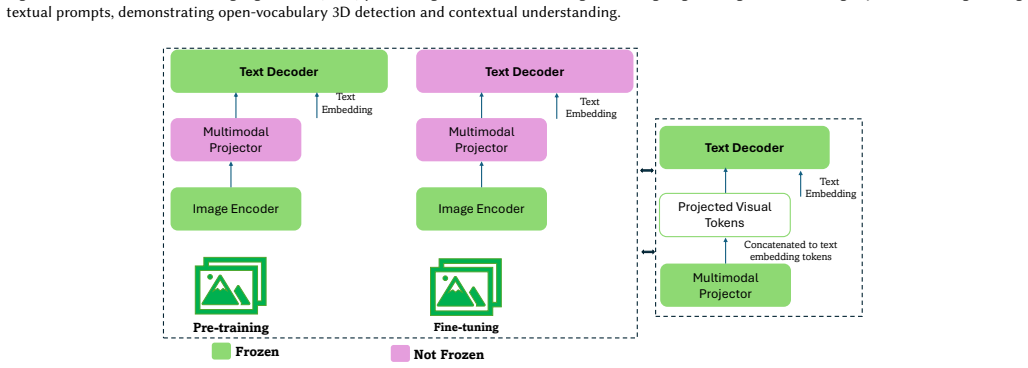
The load-bearing structure is the review's two-axis taxonomy plus the generic VLM architecture it describes. The taxonomy separates traditional 3D detectors (point clouds, voxel grids, frustum proposals) from VLM-based detectors (CLIP-style alignment, 3D-LLM injection, instruction tuning) and then compares them across data efficiency, generalization, explainability, compute, and use cases. The architectural machinery is the three-stage VLM pipeline—image encoder, multimodal projector, text decoder—extended to 3D by projecting 2D language-grounded proposals into 3D frustums and refining them with cross-modal attention. The curated corpus of 105 papers, filtered from 459 through three screening rounds, is what carries the claim that this is a representative map rather than a sample of convenience.
What would settle it
Compile the full list of the 105 included papers, rerun the same search queries on the twelve platforms with dated logs, and verify each row of Tables 1 and 2 against its cited source; a material number of missing or misattributed entries would show that the corpus is not the representative map the review claims.
Extended reading notes
Core claim
On its own terms, the paper's discovery is organizational: a systematic account of how 3D object detection is moving from geometry-only neural networks to vision-language models. It classifies traditional methods (voxel-wise, point-wise, ROI-wise, attention-based) against VLM-based systems (CLIP-aligned, instruction-tuned, LLM-injected, open-vocabulary), and identifies a recurring pipeline in which a VLM produces 2D proposals, projects them into 3D frustums with depth or LiDAR, aligns hierarchical features cross-modally, and refines the boxes with language feedback. The review reports that VLM methods excel at zero-shot and open-vocabulary detection and semantic grounding, while traditional methods retain advantages in latency and geometric precision, and it flags spatial misalignment, occlusion sensitivity, and limited real-time viability as the pressing open problems.
Load-bearing premise
The conclusions stand on the assumption that the 105 selected papers form a representative, correctly attributed corpus of the field, yet the paper does not list the included papers, give search dates, or provide a reproducible protocol.
Editorial extensions
If this is right
- If the review's map is correct, new researchers get a structured entry point: the field splits cleanly into 43 traditional-network papers and 62 VLM-based papers, with the latter organized by architecture and task.
- VLM-based 3D detection becomes the default answer for open-vocabulary and instruction-driven robotics, AR, and embodied AI, where users query objects in natural language rather than fixed class labels.
- Traditional voxel- and point-based detectors remain the safer choice for latency-critical, closed-set deployments, since the review reports VLM systems run at roughly 8-15 FPS versus 50+ FPS for optimized conventional detectors.
- The identified bottlenecks—3D-language data scarcity, cross-modal misalignment, semantic hallucination, and compute—define a concrete agenda: synthetic captioning, 3D scene graphs, and multimodal reinforcement learning are the paper's proposed next steps.
- Benchmarks such as OMNI3D, ScanRefer, SUN RGB-D, and ScanNet will likely be the proving grounds, and the review implies that no standard benchmark yet exists specifically for VLM-based 3D detection.
Reading between the lines
- If the taxonomy holds, one testable extension is a living benchmark that scores VLM-based 3D detectors on open-vocabulary queries across indoor, outdoor, and agricultural scenes, since the review's own apple-orchard example suggests deployment targets beyond autonomous driving.
- The recurring 2D-to-3D frustum pipeline implies that progress in 2D open-vocabulary detection could transfer almost directly into 3D, so advances in 2D VLMs may compound into 3D gains without new 3D-specific methods.
- A reproducible version of the search protocol—with dated queries, inclusion lists, and inter-annotator agreement—would let the community verify whether the 105-paper corpus is genuinely representative, and would turn the review's map into a repeatable methodology.
- The review's framing suggests that hybrid architectures combining voxel efficiency with language grounding, rather than pure VLM end-to-end systems, may be the fastest route to real-time open-vocabulary 3D detection; this is an inference, since the paper only notes hybrids as an emerging direction.
Signed reviews
Editorial analysis
A structured set of objections, weighed in public.
Referee Report
Summary. The paper claims to be the first comprehensive review of 3D object detection with vision-language models (VLMs). It reports a hybrid search strategy combining academic databases and AI engines that reduced 459 candidate papers to 105 selected works, and it organizes the field into traditional point-cloud/voxel methods versus VLM-based approaches, with comparison tables, architecture overviews, benchmark discussions, and a list of challenges and future directions. The core value proposition is a reliable, curated map of this emerging area, together with a comparative trade-off analysis.
Significance. If the corpus were accurate and representative, a systematic survey of VLM-based 3D object detection would be timely and useful to researchers in robotics, autonomous driving, and embodied AI. The paper does assemble a broad set of references and organizes them into useful categories, and the accompanying GitHub project is a potentially helpful resource. The authors also correctly identify real open problems such as spatial grounding, annotation cost, and real-time latency. However, the scientific value of a review stands or falls on the correctness and completeness of its curation and attribution, and the manuscript's pervasive citation errors, unverifiable corpus, and failure to engage prior surveys undermine that value in its current form.
major comments (5)
- [Section 2.1, Figures 3-4] The central claim of a 'comprehensive' review rests on the 105-paper corpus, but the manuscript never provides the list of included papers, the search dates, the query strings, or the inclusion/exclusion decisions for the filtering cascade (459 to 208 to 134 to 105). The protocol as described is not reproducible: the role of AI engines such as ChatGPT, Perplexity, Grok, and DeepSeek in retrieving and screening papers is not specified, and no validation of the AI-generated outputs is given. Without a verifiable corpus, every aggregate comparison and trend claim in the review is unsupported.
- [Table 1 and Section 3.1.1 (Objective)] Several foundational papers are misattributed in ways that corrupt the baseline of the review. PointNet++ is attributed to Sheshappanavar and Kambhamettu 2020, which is a different workshop paper, instead of Qi et al. 2017; VoxelNet is cited in Section 1 (Objective) as [Chen et al. 2023b; Sindagi et al. 2019], both of which are different works (VoxelNeXt and MVX-Net respectively), although Table 1 correctly cites Zhou and Tuzel 2018; and MV3D appears twice in Table 1. These errors are not typographical, because they misassign foundational contributions and appear in the paper's own structured comparison tables.
- [Table 2 and Section 3.3.1] The VLM-based comparison table includes models that are not 3D object detectors and citations that point to unrelated papers. For example, 'OmniVLM3D' is cited as [Chen et al. 2024a], but the reference list entry for Chen et al. 2024a is 'OmniVLM: A Token-Compressed, Sub-Billion-Parameter Vision-Language Model for Efficient On-Device Inference,' a 2D efficient VLM with no 3D detection component. Similarly, 'Cube R-CNN' is attributed to Brazil et al. 2023 (the OMNI3D dataset paper) rather than to Piekenbrinck et al. 2024, which is the actual source of the Cube R-CNN architecture and is also in the reference list. These misattributions mean the paper's map of the VLM-based 3D detection field is unreliable at the level of individual models.
- [Introduction (first paragraph) and Section 2.2] The paper repeatedly calls itself 'the first of its kind' focused on 3D object detection with VLMs, but this claim is contradicted by the authors' own reference list: Ma et al. 2024 surveys 3D tasks via multi-modal LLMs, and Sapkotaa and Karkeea 2025 is an in-depth review of object detection with multimodal large vision-language models. The 'first' claim is therefore either inaccurate or requires a specific delimitation of scope that the manuscript does not provide; the lack of any discussion of these prior surveys weakens the novelty assertion that is central to the paper's framing.
- [Sections 3.2, 3.3, and Tables 3-4] The review's scope is broader than its title, and this dilutes the claimed focus on 3D object detection. The VLM section discusses general-purpose models (LLaVA-1.5, BLIP-2, Qwen2-VL, InternVL) and non-detection tasks such as segmentation, captioning, and VQA, while the trade-off analysis in Section 3.3.2 makes quantitative claims such as '2–5x more GPU resources' and '8 FPS' versus '50 FPS' without providing a source or a derivation, and Section 5 cites '15–20% lower FPS' without a citation. These generic and unsupported comparisons do not constitute a rigorous comparative analysis of VLM-based 3D object detection specifically.
minor comments (5)
- [Table 1] The entry 'FusionTransformer citefent2024dpft' contains a raw LaTeX citation token that should be replaced with the proper citation to Fent et al. 2024.
- [Table 2] The entry 'OWL-ViT Link to paper' contains a placeholder URL text, not a proper citation, and no year or author information is given.
- [Figure 9 caption and Section 3.2.2] There are typographical errors such as 'bby' in the Figure 9 caption and 'Likwise' in Section 3.2.2; these should be corrected.
- [Section 4.0.1-4.0.2] The subsection numbering '4.0.1' and '4.0.2' is nonstandard; these should be numbered 4.1 and 4.2, and the references to 'Table 4' appear before the table is introduced and are not clearly tied to the enumerated tradeoffs.
- [Section 3.1.3] The text in the 'Voxelization Bottlenecks' bullet cites VoxelNet as [Sindagi et al. 2019] while Table 1 correctly cites [Zhou and Tuzel 2018]; these internal inconsistencies should be systematically fixed across the manuscript.
Circularity Check
No circular derivation: this is a literature review with no fitting, prediction, or equation chain, and its self-citations are framing only.
full rationale
The manuscript is a survey, not a derivation. It contains no fitted parameters, no predictive equations, and no construction in which an output is defined in terms of an input. The claimed contribution is a curated synthesis of 105 papers, and that claim is supported by a described search protocol; whether that protocol is reproducible or the corpus correctly attributed is a correctness and reliability concern, not a circularity concern. The self-citations (e.g., Sapkota and Karkee 2024; Sapkota et al. 2024c; Sapkotaa and Karkeea 2025) appear in framing sentences about YOLO models, data augmentation, and object detection reviews, and they are not used to justify any derived result or to import a uniqueness theorem. The 'first of its kind' assertion is a novelty claim that is contradicted by other cited surveys, but an overstated novelty claim is not an argument that reduces to its own inputs. Under the hard rules requiring a quotable equation-level or definition-level reduction, no circular step can be exhibited, so the appropriate finding is no significant circularity with score 0.
Assumptions & free parameters
assumptions (3)
- domain assumption The 105 selected papers constitute a representative and correctly described body of work for VLM-based 3D object detection.
- ad hoc to paper AI-powered search engines (ChatGPT, Perplexity, Grok, DeepSeek) retrieve relevant and trustworthy literature comparable to academic databases.
- domain assumption Model descriptions in Tables 1 and 2 accurately reflect the cited papers.
Cite this review
Pith. "Pith review of A Review of 3D Object Detection with Vision-Language Models." pith.science (2026). https://pith.science/paper/3UDPTEDT
@misc{pith2026250418738,
  author       = {Pith},
  title        = {Pith review of: A Review of 3D Object Detection with Vision-Language Models},
  year         = {2026},
  howpublished = {\url{https://pith.science/paper/3UDPTEDT}},
  note         = {Machine review of arXiv:2504.18738}
}
read the original abstract
This review provides a systematic analysis of comprehensive survey of 3D object detection with vision-language models(VLMs) , a rapidly advancing area at the intersection of 3D vision and multimodal AI. By examining over 100 research papers, we provide the first systematic analysis dedicated to 3D object detection with vision-language models. We begin by outlining the unique challenges of 3D object detection with vision-language models, emphasizing differences from 2D detection in spatial reasoning and data complexity. Traditional approaches using point clouds and voxel grids are compared to modern vision-language frameworks like CLIP and 3D LLMs, which enable open-vocabulary detection and zero-shot generalization. We review key architectures, pretraining strategies, and prompt engineering methods that align textual and 3D features for effective 3D object detection with vision-language models. Visualization examples and evaluation benchmarks are discussed to illustrate performance and behavior. Finally, we highlight current challenges, such as limited 3D-language datasets and computational demands, and propose future research directions to advance 3D object detection with vision-language models. >Object Detection, Vision-Language Models, Agents, VLMs, LLMs, AI
Figures


Figures from the paper (6 more)




Forward citations
Cited by 1 Pith paper
-
Plant Disease Detection through Multimodal Large Language Models and Convolutional Neural Networks
Fine-tuned GPT-4o slightly outperforms ResNet-50 on PlantVillage apple and corn disease classification (98.12% vs 96.88% at 256px) at much higher compute cost.
Reference graph
Works this paper leans on
-
[4]
Leveraging VLM-Based Pipelines to Annotate 3D Objects
Cross-modal learning for domain adaptation in 3d semantic segmentation. IEEE Transactions on Pattern Analysis and Machine Intelligence 45, 2 (2022), 1533– 1544. Pengkun Jiao, Na Zhao, Jingjing Chen, and Yu-Gang Jiang. 2024. Unlocking textual and visual wisdom: Open-vocabulary 3d object detection enhanced by comprehensive guidance from text and image. In E...
work page Pith review arXiv 2022
-
[6]
SparseVoxFormer: Sparse Voxel-based Transformer for Multi-modal 3D Object Detection
SparseVoxFormer: Sparse Voxel-based Transformer for Multi-modal 3D Object Detection. arXiv preprint arXiv:2503.08092 (2025). Shezheng Song, Xiaopeng Li, Shasha Li, Shan Zhao, Jie Yu, Jun Ma, Xiaoguang Mao, Weimin Zhang, and Meng Wang. 2025. How to Bridge the Gap between Modalities: Survey on Multimodal Large Language Model. IEEE Transactions on Knowledge ...
work page Pith review arXiv 2025
-
[7]
Computers & Graphics 119 (2024), 103885
A survey of efficient fine-tuning methods for vision-language models—prompt and adapter. Computers & Graphics 119 (2024), 103885. Wenpeng Xing, Minghao Li, Mohan Li, and Meng Han. 2025. Towards Robust and Secure Embodied AI: A Survey on Vulnerabilities and Attacks. arXiv preprint arXiv:2502.13175 (2025). ACM Trans. Graph., Vol. 37, No. 4, Article 111. Pub...
arXiv 2024
-
[2022]
A unified sequence interface for vision tasks. Advances in Neural Information Processing Systems 35 (2022), 31333–31346. Wei Chen, Yan Li, Zijian Tian, and Fan Zhang. 2023a. 2D and 3D object detection algorithms from images: A Survey. Array 19 (2023), 100305. Wei Chen, Zhiyuan Li, and Shuo Xin. 2024a. OmniVLM: A Token-Compressed, Sub- Billion-Parameter Vi...
work page Pith review arXiv 2022
-
[2023]
arXiv preprint arXiv:2303.15780 (2023)
Instruct 3d-to-3d: Text instruction guided 3d-to-3d conversion. arXiv preprint arXiv:2303.15780 (2023). Junjie Ke, Lihuo He, Bo Han, Jie Li, Di Wang, and Xinbo Gao. 2024. VLDadaptor: Domain Adaptive Object Detection With Vision-Language Model Distillation. IEEE Transactions on Multimedia (2024). Salman Khan, Muzammal Naseer, Munawar Hayat, Syed Waqas Zami...
arXiv 2023
-
[2024]
In Proceedings of the IEEE/CVF Conference on Computer Vision and Pattern Recognition
Leveraging vision-language models for improving domain generalization in image classification. In Proceedings of the IEEE/CVF Conference on Computer Vision and Pattern Recognition. 23922–23932. Shivani Agarwal and Dan Roth. 2002. Learning a sparse representation for object detection. In Computer Vision—ECCV 2002: 7th European Conference on Computer ACM Tr...
arXiv 2022
-
[2025]
arXiv preprint arXiv:2503.06435 (2025)
OV-SCAN: Semantically Consistent Alignment for Novel Object Discovery in Open-Vocabulary 3D Object Detection. arXiv preprint arXiv:2503.06435 (2025). Shengheng Deng, Zhihao Liang, Lin Sun, and Kui Jia. 2022. Vista: Boosting 3d ob- ject detection via dual cross-view spatial attention. In Proceedings of the IEEE/CVF conference on computer vision and pattern...
arXiv 2025
Reviewed August 16, 2026 · model on record in the stance chip above.
Discussion (0). Continue with ORCID to comment.