REVIEW 3 major objections 5 minor 4 references
TransparentGS: Fast Inverse Rendering of Transparent Objects with Gaussians
T0 review · 3 major / 5 minor · reviewed 2026-08-16 · deepseek-v4-flash
Pith's one-line read The paper claims that transparent objects with sharp refraction and reflection can be inverse-rendered from ordinary multi-view photos in under an hour, then re-rendered in real time.
desk verdict TransparentGS deserves serious refereeing: a strong systems contribution with a real but acknowledged convergence gap in IterQuery. read the letter →
The pith
A machine-rendered reading of the paper's core claim, the machinery that carries it, and where it could break.
The reading
What carries the argument
The mechanism is transparent Gaussian primitives paired with baked Gaussian light field probes. Each primitive adds surface material attributes to the usual Gaussian geometry, and deferred shading aggregates the normal, hitting point, and material into a G-buffer before a single secondary ray is cast. Each probe stores a 360-degree color-and-depth panorama of the environment as seen from its position, encoding both distant ambient light and nearby objects; the IterQuery algorithm then uses the depth panoramas to iteratively correct each probe's query direction, driving the probe hit points along the scene surface until they coincide with the first intersection of the queried ray. The fixed-point argument is supplied for one probe, while the paper reports $K=8$ or $K=64$ probes with five iterations in practice.
What would settle it
Reconstruct a scene with a thin, high-contrast rod placed behind a transparent object, then render a view where the rod should appear refracted through the glass. If the manifold assumption gives way, the rod will appear at the wrong position, blurred, or doubled near silhouettes, and inspecting the probe depth panoramas along those rays will show more than one depth value in a single direction.
Extended reading notes
Core claim
The central claim is that fast inverse rendering of transparent objects becomes possible when appearance is split into physical surface parameters rather than view-dependent color. Each transparent Gaussian primitive carries normal, roughness, metalness, transparency, index of refraction, and base color, and these are $\alpha$-blended into G-buffers before shading, so refraction is sampled once with an aggregated normal and hitting point instead of being averaged per primitive. Incident light is supplied by Gaussian light field probes: sparse caches that store color and depth panoramas of the surrounding scene. The IterQuery algorithm repeatedly re-aims each probe along a refracted or reflected ray until the probes' stored depths indicate the same first intersection with the environment, which removes the parallax blur that naively averaging probes would introduce. On a synthetic dataset with ground truth, the paper reports a mean angular error of $5.53^\circ$ for reconstructed normals, substantially lower than the compared baselines, together with higher PSNR for reflection, refraction, and base-color components, while training in under an hour and rendering at 31–51 frames per second.
Load-bearing premise
Each probe's panorama stores only the nearest surface in every direction, so the iterative alignment assumes a refracted or reflected ray hits exactly one scene point per direction; at sharp silhouettes and gaps this is violated, and probes can converge to the wrong background location, bending the reflected or refracted light incorrectly.
Editorial extensions
If this is right
- Transparent-scene capture becomes an hour-scale operation with real-time playback, since training cost is dominated by efficient Gaussian rasterization rather than dense network sampling.
- Material editing and relighting become practical: normal, roughness, transparency, index of refraction, and base color are decoupled and can be changed independently before re-rendering.
- Reconstructed assets can be composed into larger scenes where mirrors, glass, and glossy objects produce secondary ray effects through the same probe query path.
- Colored transparent objects can have absorption decoupled from refraction, so an object's inherent color and the background seen through it are separated rather than entangled.
- Non-pinhole cameras, including fisheye and panoramic views, can be rendered through the same probe-based pipeline without changing the representation.
Reading between the lines
- If the single-valued depth assumption behind IterQuery were replaced by multilayer depth or multiple candidate depths per ray, the same probe architecture could plausibly handle self-occluding, hollow, and nested transparent geometries, which the paper names as its main failure mode.
- The probe baking stage separates environment reconstruction from transparent-object optimization, so a dynamic scene could be handled by re-baking probes periodically rather than retraining the whole pipeline.
- The iterative depth alignment is essentially a coordinate-descent solver for light-path intersection, and the same trick may transfer to other probe-based light field representations, such as radiance caches for glossy indirect illumination, wherever a single first intersection per direction is a good approximation.
- Because the convergence proof is only given for one probe, the practical $K=8$ and $K=64$ settings likely rely on ensemble averaging to stabilize silhouettes; a testable extension would measure how often individual probes oscillate or lock onto the wrong background point near depth discontinuities.
Signed reviews
Editorial analysis
A structured set of objections, weighed in public.
Referee Report
Summary. The paper presents TransparentGS, a 3D Gaussian Splatting-based inverse rendering pipeline for transparent objects. The method introduces transparent Gaussian primitives with explicit material attributes, a deferred refraction shading strategy, and baked Gaussian light field probes (GaussProbe) that encode both ambient light and nearby indirect light. To query these probes for reflected and refracted rays, the paper proposes IterQuery, a depth-based iterative algorithm intended to compensate for parallax among multiple probes. The authors claim training within one hour, real-time rendering, and state-of-the-art results for novel view synthesis and inverse rendering on synthetic and real-captured datasets, including support for material editing and composition with secondary ray effects.
Significance. If the claims hold, this is a substantial practical advance: it brings transparent-object inverse rendering into the speed regime of 3D-GS while recovering editable materials and secondary ray effects. Strengths include the explicit physically-based deferred shading pipeline, the synthetic ground-truth evaluation of decoupled reflection, refraction, and base color in Table 5, careful ablations of the deferred strategy and GaussProbe in Table 6, and a reproducible experimental setup with real-captured data. The main concern is that the central IterQuery component lacks a persuasive convergence analysis, and the paper's own limitations section documents failure cases that directly affect the claimed high-fidelity secondary rays.
major comments (3)
- [3.3, Eqs. 16-21 and Listing 1] The fixed-point derivation for K=1 (Eqs. 19-21) shows only that a stationary point satisfies o+t_hat d = p_i + t_i d_i; it does not prove that the iteration converges from the initialization of Eq. 15, nor that the fixed point is the first scene intersection along the query ray. For the used configurations K=8 and K=64 no convergence argument is supplied, and Eq. 17's trilinear interpolation implicitly assumes the probe depth maps agree on a single surface point. Section 4.5 and Fig. 18 concede that at depth discontinuities 'not all probes converge to the first intersection,' yielding incorrect results. Because the same converged directions d_i are used to sample the color panorama Phi, this gap is load-bearing for the headline refraction/reflection fidelity claim. Please provide a convergence proof for finite K under defined manifold conditions, or empirically bound the frequency and magnitude of the failure cases on the reported scenes, or restrict the claim accordingly.
- [3.3, Listing 1 line 13] The stopping criterion compares the probe depth re-queried with the updated direction against the previous depth. This is a self-consistency check: a wrong fixed point that is not the first intersection is accepted as converged. In particular, the algorithm cannot detect that the query ray crosses a depth discontinuity of the baked environment. The paper should either devise a termination test that verifies the first-intersection property or state this limitation explicitly alongside the convergence claim.
- [3.2, Eq. 11] The Beer-Lambert transmittance exp(-sigma(lambda)d) is approximated by the alpha-weighted base color sum T_i alpha_i b_i, which is an unconstrained optimizable parameter rather than a physically derived absorption coefficient. While Table 5 reports base-color PSNR on synthetic scenes, the claim that this design 'effectively decouples the refraction term from the object's inherent color' would be strengthened by an ablation showing that the learned transmittance does not absorb errors from other components of the pipeline, for example by fixing b_i to 1 and observing the effect on the decoupled refraction map.
minor comments (5)
- [Section 1] The phrase 'baked and updated fastly' should read 'quickly' or 'rapidly'.
- [Section 4.3 heading] The heading 'Ablation studies on inserse rendering' contains a typo: 'inserse' should be 'inverse'.
- [Figure 5 caption] The caption entry 'Naïve (Initial)IterQuery' is missing a space before 'IterQuery'.
- [Section 4.2] The reported frame rate of 31-51 FPS is not directly comparable to the per-query times given (0.002-0.005 s); clarifying the relationship, for example by amortizing probe baking or including the full deferred shading cost, would aid reproducibility.
- [Table 3] For the Glass scene, the PSNR of Ours (27.12) is slightly lower than that of Eikonal (27.15); the text says 'we surpass other methods in most scenes,' which is accurate but should be phrased to avoid overstating the PSNR results on this dataset.
Circularity Check
No significant circularity: the headline results are independently benchmarked, and the IterQuery convergence gap is a robustness limitation, not a circular step.
full rationale
TransparentGS's central claim—fast inverse rendering of transparent objects with secondary ray effects—is validated against external, non-circular evidence: held-out novel views on real-captured scenes, and a synthetic Blender dataset with ground-truth normal, reflection, refraction, and base-color maps (Sec. 4.1–4.2, Tables 3–5). The material attributes (roughness, metalness, transparency, IOR, base color) are optimized as inverse-rendering unknowns against input photographs; this is the standard use of data, not a hidden prediction, and the synthetic ground truth is not derived from the method. The GaussProbe environment is baked from the segmented environment via vanilla 3D-GS and the optimal projection strategy [Huang et al. 2024]; that citation is a peer-reviewed, externally checkable mathematical result and is not used to force the paper's conclusions. The IterQuery algorithm is a fixed-point procedure whose purpose is to reduce parallax in probe queries; its K=1 derivation (Eqs. 19–21) merely characterizes a fixed point and does not prove convergence, and Sec. 4.5 openly acknowledges failure cases at depth discontinuities. This is an unresolved correctness/robustness gap, not a circular reduction of the output to the input. No fitted quantity is renamed as a prediction, no load-bearing argument reduces to a self-citation, and no known result is merely renamed. Therefore the paper exhibits no significant circularity.
Assumptions & free parameters
free parameters (7)
- roughness rho
- metallic m
- transparency t
- index of refraction eta
- base color b_i
- number of probes K and IterQuery iteration count =
K=8 or 64, iterations=5
- loss weights lambda1, lambda2, lambda3 =
0.2, 0.2, 1
assumptions (6)
- domain assumption The scene can be separated into an opaque environment and transparent foreground using SAM2 and GroundingDINO segmentation.
- domain assumption Each GaussProbe depth panorama is a single-valued 2D manifold of first intersections.
- domain assumption A single alpha-weighted normal and alpha-weighted hit point per pixel determines the correct refracted and reflected ray.
- domain assumption Light paths inside transparent objects consist of exactly two refractions with at most one total internal reflection.
- ad hoc to paper Beer-Lambert absorption can be approximated by the alpha-weighted learned base color.
- standard math The Cook-Torrance BRDF with Schlick Fresnel and perfect specular transmission is adequate for transparent Gaussian primitives.
invented entities (2)
-
Transparent Gaussian primitives
-
GaussProbe
Cite this review
Pith. "Pith review of TransparentGS: Fast Inverse Rendering of Transparent Objects with Gaussians." pith.science (2026). https://pith.science/paper/CK3NN2VJ
@misc{pith2026250418768,
  author       = {Pith},
  title        = {Pith review of: TransparentGS: Fast Inverse Rendering of Transparent Objects with Gaussians},
  year         = {2026},
  howpublished = {\url{https://pith.science/paper/CK3NN2VJ}},
  note         = {Machine review of arXiv:2504.18768}
}
read the original abstract
The emergence of neural and Gaussian-based radiance field methods has led to considerable advancements in novel view synthesis and 3D object reconstruction. Nonetheless, specular reflection and refraction continue to pose significant challenges due to the instability and incorrect overfitting of radiance fields to high-frequency light variations. Currently, even 3D Gaussian Splatting (3D-GS), as a powerful and efficient tool, falls short in recovering transparent objects with nearby contents due to the existence of apparent secondary ray effects. To address this issue, we propose TransparentGS, a fast inverse rendering pipeline for transparent objects based on 3D-GS. The main contributions are three-fold. Firstly, an efficient representation of transparent objects, transparent Gaussian primitives, is designed to enable specular refraction through a deferred refraction strategy. Secondly, we leverage Gaussian light field probes (GaussProbe) to encode both ambient light and nearby contents in a unified framework. Thirdly, a depth-based iterative probes query (IterQuery) algorithm is proposed to reduce the parallax errors in our probe-based framework. Experiments demonstrate the speed and accuracy of our approach in recovering transparent objects from complex environments, as well as several applications in computer graphics and vision.
Figures


Figures from the paper (16 more)


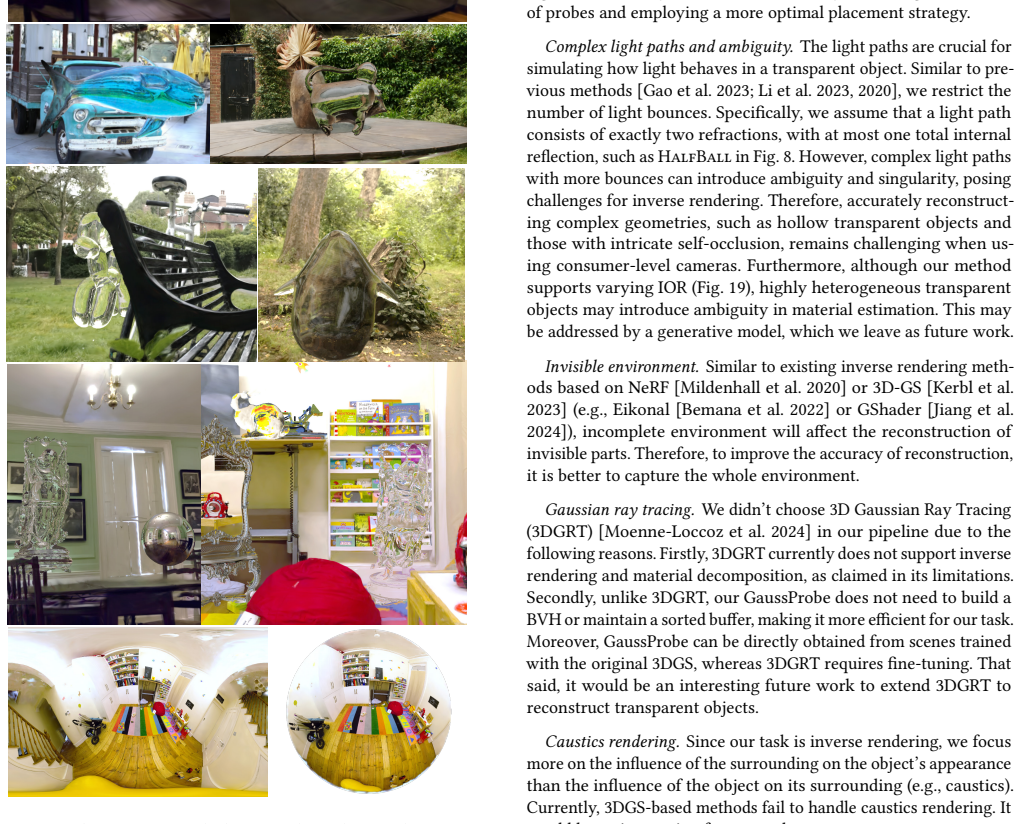


Reference graph
Works this paper leans on
-
[3]
In Computer Graphics Forum, Vol
TraM-NeRF: Tracing Mirror and Near-Perfect Specular Reflections Through Neural Radiance Fields. In Computer Graphics Forum, Vol. 43. Wiley Online Library, e15163. Letian Huang, Jiayang Bai, Jie Guo, Yuanqi Li, and Yanwen Guo. 2024. On the Error Analysis of 3D Gaussian Splatting and an Optimal Projection Strategy. In European Conference on Computer Vision ...
arXiv 1986
-
[2022]
In Proceedings of the IEEE/CVF conference on computer vision and pattern recognition
Mip-nerf 360: Unbounded anti-aliased neural radiance fields. In Proceedings of the IEEE/CVF conference on computer vision and pattern recognition . 5470–5479. Frederick O Bartell, Eustace L Dereniak, and William L Wolfe. 1981. The theory and measurement of bidirectional reflectance distribution function (BRDF) and bidirectional transmittance distribution ...
work page 1981
-
[2023]
In Proceedings of the IEEE/CVF International Conference on Computer Vision
Segment anything. In Proceedings of the IEEE/CVF International Conference on Computer Vision. 4015–4026. Arno Knapitsch, Jaesik Park, Qian-Yi Zhou, and Vladlen Koltun. 2017. Tanks and temples: Benchmarking large-scale scene reconstruction. ACM Transactions on Graphics (ToG) 36, 4 (2017), 1–13. Kiriakos N Kutulakos and Eron Steger. 2008. A theory of refrac...
arXiv 2017
-
[2024]
In European Conference on Computer Vision
Relightable 3D Gaussians: Realistic Point Cloud Relighting with BRDF De- composition and Ray Tracing. In European Conference on Computer Vision . Springer, 73–89. Wenhang Ge, Tao Hu, Haoyu Zhao, Shu Liu, and Ying-Cong Chen. 2023. Ref-neus: Ambiguity-reduced neural implicit surface learning for multi-view reconstruction with reflection. In Proceedings of t...
work page 2018
Reviewed August 16, 2026 · model on record in the stance chip above.
Discussion (0). Continue with ORCID to comment.