REVIEW 5 major objections 6 minor 90 references
CAMeL: Cross-modality Adaptive Meta-Learning for Text-based Person Retrieval
T0 review · 5 major / 6 minor · reviewed 2026-08-16 · deepseek-v4-flash
Pith's one-line read This paper claims that a meta-learning pretraining recipe, CAMeL, lets models trained on synthetic person images and captions transfer better to real text-based person retrieval benchmarks, beating prior published results.
desk verdict CAMeL is a solid but modest pretraining recipe; the gains are consistent, though the meta-learning attribution is only partially disentangled from extra compute. read the letter →
The pith
A machine-rendered reading of the paper's core claim, the machinery that carries it, and where it could break.
The reading
What carries the argument
The load-bearing mechanism is the cross-modality meta-learning loop combined with adaptive dual-speed updates. During pretraining, the model is trained on several stylized cross-modality tasks, and for each task its parameters are moved by gradient descent on that task's loss; after all tasks, the fast parameter copy steps toward the average of these task-specific updates, and every k meta-epochs a slow parameter copy is interpolated with the fast copy. This two-speed loop is what the paper credits with learning domain-invariant image-text associations from synthetic data, while the dynamic error sample memory unit supplies the hard negatives that make the tasks challenging.
What would settle it
Generate a new synthetic person dataset with a different generative model or captioning pipeline, run the same CAMeL pretraining recipe on it, and fine-tune on CUHK-PEDES; if the Recall@1 gain over the plain pretrained baseline vanishes or reverses, the method is tied to MALS's specific biases rather than being domain-agnostic.
Extended reading notes
Core claim
The central claim is that applying cross-modality meta-learning during pretraining on synthesized image-text pairs yields features that transfer better to real person-retrieval benchmarks than ordinary pretraining does. Concretely, after fine-tuning, CAMeL reports Recall@1 of 77.24 on CUHK-PEDES, 68.50 on RSTPReid, and 68.70 on ICFG-PEDES, each above the previous best published numbers, and a zero-shot Recall@1 of 25.26 on CUHK-PEDES against 15.97 for the same architecture pretrained without CAMeL. The mechanism is a set of stylized pretraining tasks, built from dynamic illumination, Gaussian blur, and a mixup-based adaptive memory of hard negatives, whose per-task gradient updates are aggregated with a fast update while a slow parameter copy preserves long-term knowledge. The authors attribute the improvements to handling biased synthetic images and noisy text annotations, not to scale: CAMeL uses about 145 million parameters, fewer than most strong baselines.
Load-bearing premise
The load-bearing premise is that the artificial distortions used in pretraining (lighting changes, blurring, and mixed-up image-text pairs) capture the same kind of difference that separates real person photos and captions from synthetic ones, so that learning to handle them prepares the model for real benchmarks.
Editorial extensions
If this is right
- Pretraining with CAMeL on synthetic data should reduce the amount of manually annotated real data needed to deploy a text-based person retrieval system, because the same pretrained weights transfer to several real benchmarks.
- The zero-shot results imply that a CAMeL-pretrained model can be applied to a new dataset without fine-tuning and still retain a large fraction of its retrieval accuracy.
- The word-masking experiments suggest that retrieval systems built on CAMeL will degrade more gracefully when users issue incomplete or noisy text queries.
- The domain migration results indicate that a model fine-tuned on one dataset can be reused on a related dataset with modest extra tuning, which matters for deployments across camera networks.
Reading between the lines
- If the gains come from the meta-learning loop rather than from augmentation alone, the same pretraining recipe should transfer to other synthetic-to-real retrieval problems, such as text-based vehicle or product search; this is a testable extension the paper does not run.
- An ablation that separates the memory unit from the meta-updates would clarify how much of the improvement comes from replaying hard negatives and how much from the two-speed optimization.
- The dual-speed update resembles a form of weight averaging, so it may generalize to other cross-modal pretraining pipelines where a slow parameter copy stabilizes long-term learning.
- Because the paper shows stable attention and retrieval under word deletion, the learned representations may be less dependent on any single attribute word; probing attention after removing keywords could test this directly.
Signed reviews
Editorial analysis
A structured set of objections, weighed in public.
Referee Report
Summary. The manuscript proposes CAMeL, a pretraining framework for text-based person retrieval that trains on the synthetic MALS dataset using three stylized tasks (dynamic illumination, Gaussian blur, and mixup-based adaptive memory), followed by Reptile-style cross-modality meta-learning with an adaptive dual-speed update. The authors evaluate the pretrained and fine-tuned models on CUHK-PEDES, ICFG-PEDES, and RSTPReid, reporting state-of-the-art or competitive Recall@K and mAP, and additionally present zero-shot, domain-migration, word-masking robustness, and geo-localization experiments. The central claim is that CAMeL yields domain-agnostic representations that transfer better to real benchmarks than existing pretraining recipes.
Significance. If the claimed effects are real, CAMeL is a useful and simple domain-agnostic pretraining recipe that improves over strong baselines on three public benchmarks, and the paper benefits from clear algorithm pseudocode, external benchmark evaluation, component ablations, and a robustness analysis under masked-word queries. The code release is a practical strength. However, the significance is currently limited by the absence of a control that separates the meta-learning mechanism from the increased diversity of augmented data, by missing variance estimates on the main tables, and by several internal inconsistencies; these issues must be resolved before the central claim is supported.
major comments (5)
- [Section IV-C, Table IV] The ablations do not isolate cross-modality meta-learning from data augmentation. In Table IV, Row 2 (+ST) adds all stylized views and mixed hard negatives to the baseline, Row 3 adds ADSU, Row 4 adds CMML, and Row 5 adds both; there is no control that receives the same stylized views, mixup samples, and memory replay as ordinary pooled minibatch data under the same ITC/ITM losses and the same number of optimizer steps but without the per-task inner loop of Algorithm 1. Consequently, the fine-tuned R1 gains of roughly 1.0 to 2.7 points over the baseline cannot yet be attributed to cross-modality adaptive meta-learning or to the dual-speed update; they may simply reflect training on more augmented data. This control is load-bearing because the title and central claim are about the meta-learning adaptation mechanism.
- [Tables I, II, III, IV] The main tables do not support significance claims. Tables I-III report single runs with no error bars, and Table IV says results are averaged over ten trials but reports only means. The improvements over APTM on the three benchmarks are 0.71, 1.00, and 0.19 Recall@1 points, and several component differences in Table IV are of similar magnitude; without standard deviations, per-trial values, or a significance test, these differences are within plausible seed noise. I request error bars or per-trial values for all main results, or a clear statement of which numbers are single runs.
- [Table II vs. Table IV] The RSTPReid baseline is internally inconsistent. Table II reports Baseline (Finetuned) with R5=86.80 and R10=91.95, while Table IV, row 1, reports the same Baseline with R5=85.80 and R10=91.25, with the same mAP of 52.93. Since Table IV is presented as a ten-trial average and Table II as the comparison baseline, this discrepancy needs an explanation or correction; as it stands, the fine-tuned gains in Table IV and the comparison in Table II cannot both be reproduced from the described protocol.
- [Table V] The claim that task order has negligible impact is not supported by the reported numbers. In Table V, random ordering changes RSTPReid R5 by -0.45 and mAP by -0.34, and CUHK-PEDES R5 by -0.26, with mixed signs across datasets; without error bars or multiple trials, differences of this size are consistent with ordinary optimization noise. Please provide variance estimates for the order comparison or soften the claim.
- [Table VII] The domain-migration table contains an unexplained outlier. For I->C, Ours achieves 70.66 R1 versus APTM*'s 46.52, a 24.14-point jump, while all other source-target pairs in the same table show gains between 0.61 and 5.40 points. This result is far larger than any other reported improvement in the paper and suggests a protocol mismatch, a different evaluation split, or an unreported detail; it must be verified and explained before the domain-migration claims can be accepted.
minor comments (6)
- [Section III-A, Eq. (1)] The symbol \odot is used for convolution in the text, but \odot usually denotes elementwise multiplication; please use a standard convolution symbol or clarify the operation.
- [Section IV-C, geo-localization experiments] The ADSU results on University-1652, SUES-200, and CVUSA are reported only in prose with no table of the protocol, splits, or baseline numbers; please provide full experimental details or move these results to supplementary material.
- [Section III-B] The memory unit is described as a queue of embeddings, but the paper does not specify how replayed hard negatives are combined with the ITM loss or whether the memory stores image embeddings, text embeddings, or both.
- [Figure 6 and Section IV-C] The figure legend uses 'APTM*' while the prose uses 'APTM'; please standardize the notation.
- [Table IV caption] Table IV says results are averaged over ten trials, but Tables I-III do not state whether the reported numbers are single runs or averages; please state this uniformly across all tables.
- [Section III-B and References] There is a typo 'Albiet' in Section III-B, and references [44] and [59] both point to the same Nichol et al. Reptile work; please consolidate them.
Circularity Check
No circular derivation: pretraining tasks and meta-updates are evaluated on external benchmarks; the only burden is a minor self-citation to the authors' APTM baseline, which is not load-bearing.
full rationale
The paper's derivation chain is empirical: MALS stylization tasks (dynamic illumination, Gaussian blur, mixup hard negatives) feed a Reptile-style inner/outer meta-update with an EMA slow loop, followed by fine-tuning on benchmark training splits and evaluation on held-out test splits. None of Eq. (1)-(5) defines a target benchmark metric in terms of the pretraining loss by construction; Recall@1/mAP are measured on CUHK-PEDES, ICFG-PEDES, and RSTPReid test sets that are external to the pretraining data. The ablation table adds components (ST, ADSU, CMML) one at a time against the same benchmark protocol, so the gains are not a fitted quantity renamed as a prediction. The hyperparameter k is tuned on RSTPReid and then fixed, which is a model-selection choice rather than a circular fit. The only self-citation burden is APTM [14], a prior work sharing co-author Zhedong Zheng, re-implemented as APTM* in Table VII and Fig. 6; however, the main SOTA tables include many independent external baselines (IRRA, RDE, RaSa, WoRA, TBPS-CLIP, etc.), and the central generalization claim does not reduce to the APTM comparison. The reviewer concern that no control isolates the meta-loop from simply training on more augmented data is a possible attribution confound, but it is an experimental-design issue, not a definitional reduction, and therefore does not meet the standard for flagging a circular step.
Assumptions & free parameters
free parameters (5)
- epsilon_fast (fast meta-learning rate) =
not reported
- epsilon_slow (slow update smoothing factor) =
0.5
- update cycle k =
6
- memory capacity =
50% of sample batch
- mixup parameter delta =
1
assumptions (4)
- domain assumption MALS synthetic image-text pairs, with caption regeneration, approximate the distribution of real person images and descriptions.
- domain assumption Hand-designed stylized tasks (illumination, blur, memory/mixup) span the domain shift between synthetic and real data.
- domain assumption Meta-update directions computed on these tasks during pretraining improve fine-tuning on real benchmarks.
- standard math Standard stochastic optimization (AdamW, SGD) converges for the proposed objective.
Cite this review
Pith. "Pith review of CAMeL: Cross-modality Adaptive Meta-Learning for Text-based Person Retrieval." pith.science (2026). https://pith.science/paper/GMDGPZLG
@misc{pith2026250418782,
  author       = {Pith},
  title        = {Pith review of: CAMeL: Cross-modality Adaptive Meta-Learning for Text-based Person Retrieval},
  year         = {2026},
  howpublished = {\url{https://pith.science/paper/GMDGPZLG}},
  note         = {Machine review of arXiv:2504.18782}
}
read the original abstract
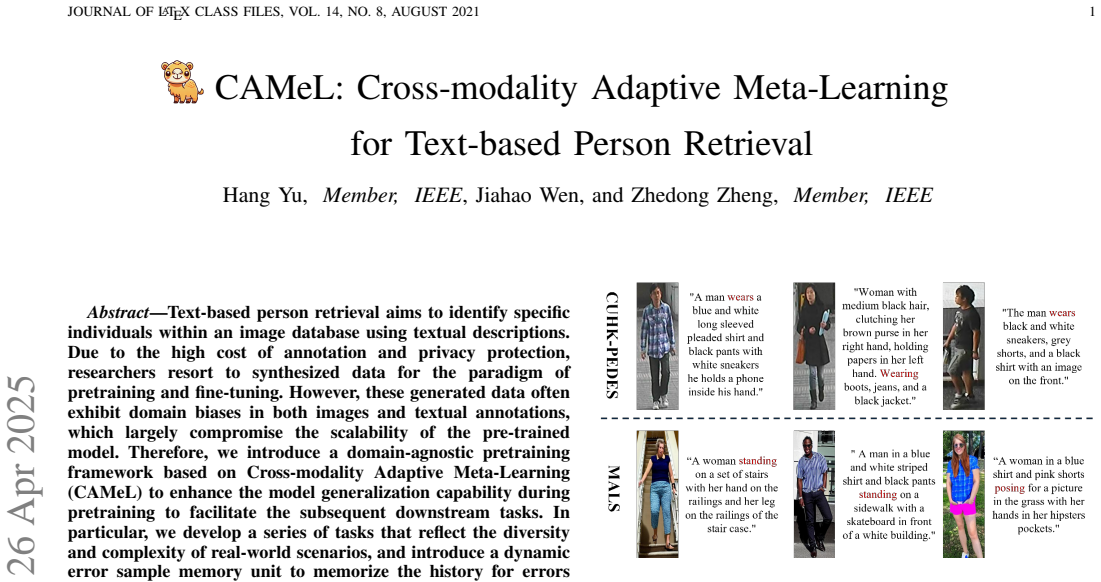
Text-based person retrieval aims to identify specific individuals within an image database using textual descriptions. Due to the high cost of annotation and privacy protection, researchers resort to synthesized data for the paradigm of pretraining and fine-tuning. However, these generated data often exhibit domain biases in both images and textual annotations, which largely compromise the scalability of the pre-trained model. Therefore, we introduce a domain-agnostic pretraining framework based on Cross-modality Adaptive Meta-Learning (CAMeL) to enhance the model generalization capability during pretraining to facilitate the subsequent downstream tasks. In particular, we develop a series of tasks that reflect the diversity and complexity of real-world scenarios, and introduce a dynamic error sample memory unit to memorize the history for errors encountered within multiple tasks. To further ensure multi-task adaptation, we also adopt an adaptive dual-speed update strategy, balancing fast adaptation to new tasks and slow weight updates for historical tasks. Albeit simple, our proposed model not only surpasses existing state-of-the-art methods on real-world benchmarks, including CUHK-PEDES, ICFG-PEDES, and RSTPReid, but also showcases robustness and scalability in handling biased synthetic images and noisy text annotations. Our code is available at https://github.com/Jahawn-Wen/CAMeL-reID.
Figures


Figures from the paper (4 more)


Reference graph
Works this paper leans on
-
[1]
Zheng, L
Z. Zheng, L. Zheng, Object re-identification: Problems, algorithms and responsible research practice, in: The Boundaries of Data, Amsterdam University Press, 2024
2024
-
[2]
T. Xiao, S. Li, B. Wang, L. Lin, X. Wang, End-to-end deep learning for person search, arXiv preprint arXiv:1604.01850 2 (2) (2016) 4
arXiv 2016
-
[3]
Jiang, M
D. Jiang, M. Ye, Cross-modal implicit relation reasoning and aligning for text-to-image person retrieval, in: Proceedings of the IEEE/CVF Conference on Computer Vision and Pattern Recognition (CVPR), 2023, pp. 2787–2797
2023
-
[4]
H. Shan, Q. Zhang, Z. Liu, G. Zhang, C. Li, Beyond two-tower: Attribute guided representation learning for candidate retrieval, in: Proceedings of the ACM Web Conference 2023 (WWW), 2023, pp. 3173–3181
2023
-
[5]
S. Li, T. Xiao, H. Li, B. Zhou, D. Yue, X. Wang, Person search with natural language description, in: Proceedings of the IEEE Conference on Computer Vision and Pattern Recognition (CVPR), 2017, pp. 1970– 1979
2017
- [6]
- [7]
-
[8]
A. Lu, C. Li, T. Zha, X. Wang, J. Tang, B. Luo, Nighttime person re- identification via collaborative enhancement network with multi-domain learning, IEEE Transactions on Information Forensics and Security (TIFS)Doi:10.1109/TIFS.2025.3527335 (2025)
arXiv 2025
Show all 90 references
-
[9]
Y . Liu, M. Qi, Y . Zhang, Q. Wu, J. Wu, S. Zhuang, Improving con- sistency of proxy-level contrastive learning for unsupervised person re- identification, IEEE Transactions on Information Forensics and Security (TIFS)Doi:10.1109/TIFS.2024.3426351 (2024)
2024
-
[10]
M. Ye, W. Shen, J. Zhang, Y . Yang, B. Du, Securereid: Privacy-preserving anonymization for person re-identification, IEEE Transactions on Information Forensics and Security (TIFS)Doi:10.1109/TIFS.2024.3356233 (2024)
2024
-
[11]
D. Li, Z. Zhang, X. Chen, K. Huang, A richly annotated pedes- trian dataset for person retrieval in real surveillance scenarios, IEEE Transactions on Image Processing (TIP) 28 (4) (2018) 1575–1590, doi:10.1109/TIP.2018.2878349
2018
-
[12]
Zheng, L
Z. Zheng, L. Zheng, Y . Yang, Unlabeled samples generated by gan improve the person re-identification baseline in vitro, in: Proceedings of the IEEE International Conference on Computer Vision (ICCV), 2017, pp. 3754–3762
2017
-
[13]
G. C. Bertocco, F. Andal ´o, A. Rocha, Unsupervised and self-adaptative techniques for cross-domain person re-identification, IEEE Transactions on Information Forensics and Security (TIFS) 16 (2021) 4419–4434, doi:10.1109/TIFS.2021.3107157
2021
-
[14]
S. Yang, Y . Zhou, Z. Zheng, Y . Wang, L. Zhu, Y . Wu, Towards unified text-based person retrieval: A large-scale multi-attribute and language search benchmark, in: Proceedings of the 31st ACM International Conference on Multimedia (ACMM), 2023, pp. 4492–4501
2023
-
[15]
M. Chu, Z. Zheng, W. Ji, T. Wang, T.-S. Chua, Towards natural language-guided drones: Geotext-1652 benchmark with spatial relation matching, in: Proceedings of the European Conference on Computer Vision (ECCV), 2024
2024
-
[16]
L. Yao, W. Chen, Q. Jin, Capenrich: Enriching caption semantics for web images via cross-modal pre-trained knowledge, in: Proceedings of the ACM Web Conference 2023 (WWW), 2023, pp. 2392–2401
2023
-
[17]
Rombach, A
R. Rombach, A. Blattmann, D. Lorenz, P. Esser, B. Ommer, High- resolution image synthesis with latent diffusion models, in: Proceedings of the IEEE/CVF Conference on Computer Vision and Pattern Recog- nition (CVPR), 2022, pp. 10684–10695
2022
-
[18]
Hertz, R
A. Hertz, R. Mokady, J. Tenenbaum, K. Aberman, Y . Pritch, D. Cohen- Or, Prompt-to-prompt image editing with cross attention control, arXiv preprint arXiv:2208.01626 (2022)
2022 arXiv
-
[19]
Karras, Progressive growing of gans for improved quality, stability, and variation, arXiv preprint arXiv:1710.10196 (2017)
T. Karras, Progressive growing of gans for improved quality, stability, and variation, arXiv preprint arXiv:1710.10196 (2017)
2017 arXiv
-
[20]
Z. Ding, C. Ding, Z. Shao, D. Tao, Semantically self-aligned network for text-to-image part-aware person re-identification, arXiv preprint arXiv:2107.12666 (2021)
2021 arXiv
-
[21]
A. Zhu, Z. Wang, Y . Li, X. Wan, J. Jin, T. Wang, F. Hu, G. Hua, Dssl: Deep surroundings-person separation learning for text-based person retrieval, in: Proceedings of the 29th ACM International Conference on Multimedia (ACMM), 2021, pp. 209–217
2021
-
[22]
Z. Shao, X. Zhang, M. Fang, Z. Lin, J. Wang, C. Ding, Learn- ing granularity-unified representations for text-to-image person re- identification, in: Proceedings of the 30th ACM International Conference on Multimedia (ACMM), 2022, pp. 5566–5574
2022
-
[23]
Y . Bai, M. Cao, D. Gao, Z. Cao, C. Chen, Z. Fan, L. Nie, M. Zhang, Rasa: Relation and sensitivity aware representation learning for text- based person search, arXiv preprint arXiv:2305.13653 (2023)
2023 arXiv
-
[24]
Fujii, S
T. Fujii, S. Tarashima, Bilma: Bidirectional local-matching for text-based person re-identification, in: Proceedings of the IEEE/CVF International Conference on Computer Vision (ICCV), 2023, pp. 2786–2790
2023
-
[25]
S. Wang, H. Li, Z. Wang, W. Ouyang, Dynamic position-aware network for fine-grained image recognition, in: Proceedings of the AAAI Con- ference on Artificial Intelligence (AAAI), V ol. 35, 2021, pp. 2791–2799
2021
-
[26]
X. Wang, Z. Zheng, Y . He, F. Yan, Z. Zeng, Y . Yang, Progressive local filter pruning for image retrieval acceleration, IEEE Transactions on Multimedia 25 (2023) 9597–9607, doi:10.1109/TMM.2023.3256092
2023
-
[27]
K. Niu, Y . Huang, W. Ouyang, L. Wang, Improving description-based person re-identification by multi-granularity image-text alignments, IEEE Transactions on Image Processing (TIP) 29 (2020) 5542–5556, doi:10.1109/TIP.2020.2984883
2020
-
[28]
Sarafianos, X
N. Sarafianos, X. Xu, I. A. Kakadiaris, Adversarial representation learning for text-to-image matching, in: Proceedings of the IEEE/CVF International Conference on Computer Vision (ICCV), 2019, pp. 5814– 5824
2019
-
[29]
S. He, H. Luo, W. Jiang, X. Jiang, H. Ding, Vgsg: Vision- guided semantic-group network for text-based person search, IEEE Transactions on Image Processing (TIP) 33 (2023) 163–176, doi:10.1109/TIP.2023.3337653
2023
-
[30]
Ergasti, T
A. Ergasti, T. Fontanini, C. Ferrari, M. Bertozzi, A. Prati, Mars: Paying more attention to visual attributes for text-based person search, arXiv preprint arXiv:2407.04287 (2024)
2024 arXiv
-
[31]
L. Tan, J. Xia, W. Liu, P. Dai, Y . Wu, L. Cao, Occluded person re- identification via saliency-guided patch transfer, in: Proceedings of the AAAI Conference on Artificial Intelligence (AAAI), V ol. 38, 2024, pp. 5070–5078
2024
-
[32]
Zhang, Y
Y . Zhang, Y . Yan, Y . Lu, H. Wang, Adaptive middle modality align- ment learning for visible-infrared person re-identification, International JOURNAL OF LATEX CLASS FILES, VOL. 14, NO. 8, AUGUST 2021 12 Journal of Computer Vision (IJCV) (2024) 1–21Doi:10.1007/s11263- 024-02276-4
2024 doi
-
[33]
L. Tan, Y . Zhang, K. Han, P. Dai, Y . Zhang, Y . Wu, R. Ji, Rle: A unified perspective of data augmentation for cross-spectral re-identification, arXiv preprint arXiv:2411.01225 (2024)
2024 arXiv
-
[34]
Verma, T
V . Verma, T. Luong, K. Kawaguchi, H. Pham, Q. Le, Towards domain- agnostic contrastive learning, in: International Conference on Machine Learning (ICML), PMLR, 2021, pp. 10530–10541
2021
-
[35]
Tamkin, V
A. Tamkin, V . Liu, R. Lu, D. Fein, C. Schultz, N. Goodman, Dabs: A domain-agnostic benchmark for self-supervised learning, arXiv preprint arXiv:2111.12062 (2021)
2021 arXiv
-
[36]
K. Lee, Y . Zhu, K. Sohn, C.-L. Li, J. Shin, H. Lee, I-mix: A domain- agnostic strategy for contrastive representation learning, arXiv preprint arXiv:2010.08887 (2020)
2020 arXiv
-
[37]
Mishra, R
S. Mishra, R. Panda, C. P. Phoo, C.-F. R. Chen, L. Karlinsky, K. Saenko, V . Saligrama, R. S. Feris, Task2sim: Towards effective pre-training and transfer from synthetic data, in: Proceedings of the IEEE/CVF Conference on Computer Vision and Pattern Recognition (CVPR), 2022, p...
2022
-
[38]
Y . Zhu, H. Shi, Z. Zhang, S. Tang, Mario: Model agnostic recipe for improving ood generalization of graph contrastive learning, in: Proceedings of the ACM on Web Conference 2024 (WWW), 2024, pp. 300–311
2024
-
[39]
X. Huo, L. Xie, H. Hu, W. Zhou, H. Li, Q. Tian, Domain-agnostic prior for transfer semantic segmentation, in: Proceedings of the IEEE/CVF Conference on Computer Vision and Pattern Recognition (CVPR), 2022, pp. 7075–7085
2022
-
[40]
Z. Du, X. Li, F. Li, K. Lu, L. Zhu, J. Li, Domain-agnostic mu- tual prompting for unsupervised domain adaptation, arXiv preprint arXiv:2403.02899 (2024)
2024 arXiv
-
[41]
J. Hu, Y . Yao, C. Wang, S. Wang, Y . Pan, Q. Chen, T. Yu, H. Wu, Y . Zhao, H. Zhang, et al., Large multilingual models pivot zero-shot multimodal learning across languages, arXiv preprint arXiv:2308.12038 (2023)
2023 arXiv
-
[42]
F. Lv, C. Nie, J. Zhang, G. Yang, G. Lin, X. Wu, T. Li, Rethinking the effect of uninformative class name in prompt learning, in: Proceedings of the 32nd ACM International Conference on Multimedia (ACMM), 2024, pp. 8345–8354
2024
-
[43]
C. Finn, P. Abbeel, S. Levine, Model-agnostic meta-learning for fast adaptation of deep networks, in: International Conference on Machine Learning (ICML), PMLR, 2017, pp. 1126–1135
2017
-
[45]
Zhang, Q
Z. Zhang, Q. Liu, Z. Hu, Y . Zhan, Z. Huang, W. Gao, Q. Mao, Enhancing fairness in meta-learned user modeling via adaptive sampling, in: Proceedings of the ACM Web Conference 2024 (WWW), 2024, pp. 3241–3252
2024
-
[46]
S. Li, C. He, X. Xu, F. Shen, Y . Yang, H. T. Shen, Adaptive uncertainty- based learning for text-based person retrieval, in: Proceedings of the AAAI Conference on Artificial Intelligence (AAAI), V ol. 38, 2024, pp. 3172–3180
2024
-
[47]
Y . Ma, S. Zhao, W. Wang, Y . Li, I. King, Multimodality in meta- learning: A comprehensive survey, Knowledge-Based Systems 250 (2022) 108976, doi:10.1016/j.knosys.2022.108976
2022
-
[48]
Z. Tian, Z. Xie, F. Lin, Y . Song, A multi-view meta-learning approach for multi-modal response generation, in: Proceedings of the ACM Web Conference 2023 (WWW), 2023, pp. 1938–1947
2023
-
[49]
X. Wang, L. Cao, H. Zhang, L. Feng, Y . Ding, N. Li, A meta- learning based stress category detection framework on social media, in: Proceedings of the ACM Web Conference 2022 (WWW), 2022, pp. 2925–2935
2022
-
[50]
Q. Sun, Y . Liu, T.-S. Chua, B. Schiele, Meta-transfer learning for few-shot learning, in: Proceedings of the IEEE/CVF Conference on Computer Vision and Pattern Recognition (CVPR), 2019, pp. 403–412
2019
-
[51]
M. Tran, R. Shah, Z. Gong, 3fm: Multi-modal meta-learning for feder- ated tasks, arXiv preprint arXiv:2312.10179 (2023)
2023 arXiv
-
[52]
Z. Wang, A. Zhu, J. Xue, X. Wan, C. Liu, T. Wang, Y . Li, Look before you leap: Improving text-based person retrieval by learning a consistent cross-modal common manifold, in: Proceedings of the 30th ACM International Conference on Multimedia (ACMM), 2022, pp. 1984–1992
2022
-
[53]
Vettoruzzo, M.-R
A. Vettoruzzo, M.-R. Bouguelia, J. Vanschoren, T. Rognvaldsson, K. Santosh, Advances and challenges in meta-learning: A technical review, IEEE Transactions on Pattern Analysis and Machine Intelligence (TPAMI)Doi:10.1109/TPAMI.2024.3357847 (2024)
2024
-
[54]
J. Wei, K. Zou, Eda: Easy data augmentation techniques for boosting performance on text classification tasks, in: Proceedings of the 2019 Conference on Empirical Methods in Natural Language Processing and the 9th International Joint Conference on Natural Language Processing (E...
2019
-
[55]
E. D. Cubuk, B. Zoph, J. Shlens, Q. V . Le, Randaugment: Practical automated data augmentation with a reduced search space, in: 2020 IEEE/CVF Conference on Computer Vision and Pattern Recognition Workshops (CVPRW), 2020
2020
-
[56]
X. Han, Z. Jiang, N. Liu, X. Hu, G-mixup: Graph data augmentation for graph classification, in: International Conference on Machine Learning (ICML), PMLR, 2022, pp. 8230–8248
2022
-
[57]
Zhong, L
W. Zhong, L. Guo, Q. Gao, H. Ye, Y . Wang, Memorybank: Enhancing large language models with long-term memory, in: Proceedings of the AAAI Conference on Artificial Intelligence (AAAI), V ol. 38, 2024, pp. 19724–19731
2024
-
[58]
Z. Wang, Z. Gao, X. Xu, Y . Luo, Y . Yang, H. T. Shen, Point to rectangle matching for image text retrieval, in: Proceedings of the 30th ACM International Conference on Multimedia (ACMM), 2022, pp. 4977– 4986
2022
-
[59]
Nichol, J
A. Nichol, J. Achiam, J. Schulman, On first-order meta-learning algo- rithms, arXiv preprint arXiv:1803.02999 (2018)
2018 arXiv
-
[60]
S. Ravi, H. Larochelle, Optimization as a model for few-shot learning, in: International Conference on Learning Representations (ICLR), 2016
2016
-
[61]
Z. Wu, X. Wang, J. E. Gonzalez, T. Goldstein, L. S. Davis, Ace: Adapting to changing environments for semantic segmentation, in: Proceedings of the IEEE/CVF International Conference on Computer Vision (ICCV), 2019, pp. 2121–2130
2019
-
[62]
Robbins, S
H. Robbins, S. Monro, A stochastic approximation method, The Annals of Mathematical Statistics (1951) 400–407
1951
-
[63]
L. Wei, S. Zhang, W. Gao, Q. Tian, Person transfer gan to bridge domain gap for person re-identification, in: Proceedings of the IEEE Conference on Computer Vision and Pattern Recognition (CVPR), 2018, pp. 79–88
2018
-
[64]
Zheng, L
Z. Zheng, L. Zheng, M. Garrett, Y . Yang, M. Xu, Y .-D. Shen, Dual-path convolutional image-text embeddings with instance loss, ACM Trans- actions on Multimedia Computing, Communications, and Applications (TOMM) 16 (2) (2020) 1–23, doi:10.1145/3383184
2020 doi
-
[65]
Zhang, H
Y . Zhang, H. Lu, Deep cross-modal projection learning for image-text matching, in: Proceedings of the European Conference on Computer Vision (ECCV), 2018, pp. 686–701
2018
-
[66]
Liu, Z.-J
J. Liu, Z.-J. Zha, R. Hong, M. Wang, Y . Zhang, Deep adversarial graph attention convolution network for text-based person search, in: Proceedings of the 27th ACM International Conference on Multimedia (ACMM), 2019, pp. 665–673
2019
-
[67]
Z. Wang, Z. Fang, J. Wang, Y . Yang, Vitaa: Visual-textual attributes alignment in person search by natural language, in: Proceedings of the European Conference on Computer Vision (ECCV), Springer, 2020, pp. 402–420
2020
-
[68]
Z. Wang, A. Zhu, Z. Zheng, J. Jin, Z. Xue, G. Hua, Img-net: Inner-cross- modal attentional multigranular network for description-based person re-identification, Journal of Electronic Imaging 29 (4) (2020) 043028– 043028, doi:10.1117/1.JEI.29.4.043028
2020 doi
-
[69]
Aggarwal, V
S. Aggarwal, V . B. Radhakrishnan, A. Chakraborty, Text-based person search via attribute-aided matching, in: Proceedings of the IEEE/CVF Winter Conference on Applications of Computer Vision (W ACV), 2020, pp. 2617–2625
2020
-
[70]
Zheng, W
K. Zheng, W. Liu, J. Liu, Z.-J. Zha, T. Mei, Hierarchical gumbel attention network for text-based person search, in: Proceedings of the 28th ACM International Conference on Multimedia (ACMM), 2020, pp. 3441–3449
2020
-
[71]
C. Gao, G. Cai, X. Jiang, F. Zheng, J. Zhang, Y . Gong, P. Peng, X. Guo, X. Sun, Contextual non-local alignment over full-scale representation for text-based person search, arXiv preprint arXiv:2101.03036 (2021)
2021 arXiv
-
[72]
C. Wang, Z. Luo, Y . Lin, S. Li, Text-based person search via multi- granularity embedding learning, in: International Joint Conference on Artificial Intelligence (IJCAI), 2021, pp. 1068–1074
2021
-
[73]
X. Han, S. He, L. Zhang, T. Xiang, Text-based person search with limited data, arXiv preprint arXiv:2110.10807 (2021)
2021 arXiv
-
[74]
Y . Chen, G. Zhang, Y . Lu, Z. Wang, Y . Zheng, Tipcb: A simple but effec- tive part-based convolutional baseline for text-based person search, Neu- rocomputing 494 (2022) 171–181, doi:10.1016/j.neucom.2022.04.081
2022 doi
-
[75]
Z. Wang, A. Zhu, J. Xue, X. Wan, C. Liu, T. Wang, Y . Li, Caibc: Capturing all-round information beyond color for text-based person retrieval, in: Proceedings of the 30th ACM International Conference on Multimedia (ACMM), 2022, pp. 5314–5322
2022
-
[76]
Farooq, M
A. Farooq, M. Awais, J. Kittler, S. S. Khalid, Axm-net: Implicit cross- modal feature alignment for person re-identification, in: Proceedings of the AAAI Conference on Artificial Intelligence (AAAI), V ol. 36, 2022, pp. 4477–4485. JOURNAL OF LATEX CLASS FILES, VOL. 14, NO. 8, ...
2022
-
[77]
W. Suo, M. Sun, K. Niu, Y . Gao, P. Wang, Y . Zhang, Q. Wu, A simple and robust correlation filtering method for text-based person search, in: Proceedings of the European Conference on Computer Vision (ECCV), Springer, 2022, pp. 726–742
2022
-
[78]
S. Yan, N. Dong, L. Zhang, J. Tang, Clip-driven fine-grained text- image person re-identification, IEEE Transactions on Image Processing (TIP)Doi:10.1109/TIP.2023.3327924 (2023)
2023
-
[79]
J. Zuo, C. Yu, N. Sang, C. Gao, Plip: Language-image pre-training for person representation learning, arXiv preprint arXiv:2305.08386 (2023)
2023 arXiv
-
[80]
M. Cao, Y . Bai, Z. Zeng, M. Ye, M. Zhang, An empirical study of clip for text-based person search, in: Proceedings of the AAAI Conference on Artificial Intelligence (AAAI), V ol. 38, 2024, pp. 465–473
2024
-
[81]
Y . Qin, Y . Chen, D. Peng, X. Peng, J. T. Zhou, P. Hu, Noisy- correspondence learning for text-to-image person re-identification, arXiv preprint arXiv:2308.09911 (2023)
2023 arXiv
-
[82]
J. Sun, Z. Zheng, G. Ding, From data deluge to data curation: A filtering- wora paradigm for efficient text-based person search, Proceedings of the ACM on Web Conference (WWW) (2025)
2025
-
[83]
S. Ren, X. Yang, S. Liu, X. Wang, Sg-former: Self-guided transformer with evolving token reallocation, in: Proceedings of the IEEE/CVF International Conference on Computer Vision (ICCV), 2023, pp. 6003– 6014
2023
-
[84]
Devlin, M.-W
J. Devlin, M.-W. Chang, K. Lee, K. Toutanova, Bert: Pre-training of deep bidirectional transformers for language understanding, arXiv preprint arXiv:1810.04805 (2018)
2018 arXiv
-
[85]
Loshchilov, F
I. Loshchilov, F. Hutter, Decoupled weight decay regularization, arXiv preprint arXiv:1711.05101 (2017)
2017 arXiv
-
[86]
Izmailov, D
P. Izmailov, D. Podoprikhin, T. Garipov, D. Vetrov, A. G. Wilson, Averaging weights leads to wider optima and better generalization, arXiv preprint arXiv:1803.05407 (2018)
2018 arXiv
-
[87]
X. Shu, W. Wen, H. Wu, K. Chen, Y . Song, R. Qiao, B. Ren, X. Wang, See finer, see more: Implicit modality alignment for text-based person retrieval, in: Proceedings of the European Conference on Computer Vision (ECCV), Springer, 2022, pp. 624–641
2022
-
[88]
Zheng, Y
Z. Zheng, Y . Wei, Y . Yang, University-1652: A multi-view multi-source benchmark for drone-based geo-localization, in: Proceedings of the 28th ACM International Conference on Multimedia (ACMM), 2020, pp. 1395–1403
2020
-
[89]
R. Zhu, L. Yin, M. Yang, F. Wu, Y . Yang, W. Hu, Sues-200: A multi- height multi-scene cross-view image benchmark across drone and satel- lite, IEEE Transactions on Circuits and Systems for Video Technology (TCSVT) 33 (9) (2023) 4825–4839, doi:10.1109/TCSVT.2023.3249204
2023
-
[90]
M. Zhai, Z. Bessinger, S. Workman, N. Jacobs, Predicting ground- level scene layout from aerial imagery, in: 2017 IEEE Conference on Computer Vision and Pattern Recognition (CVPR), 2017
2017
-
[91]
Gildenblat, contributors, Pytorch library for cam methods, https: //github.com/jacobgil/pytorch-grad-cam (2021)
J. Gildenblat, contributors, Pytorch library for cam methods, https: //github.com/jacobgil/pytorch-grad-cam (2021)
2021
Reviewed August 16, 2026 · model on record in the stance chip above.
Discussion (0). Continue with ORCID to comment.