REVIEW 5 major objections 7 minor 49 references
Frequency-Integrated Transformer for Arbitrary-Scale Super-Resolution
T0 review · 5 major / 7 minor · reviewed 2026-08-16 · deepseek-v4-flash
Pith's one-line read FIT claims best PSNR in arbitrary-scale super-resolution
desk verdict FIT reports consistent small PSNR gains in arbitrary-scale super-resolution, but the key FIM equation is domain-incoherent as written and no code is released, so the empirical claim is not yet reproducible. read the letter →
The pith
A machine-rendered reading of the paper's core claim, the machinery that carries it, and where it could break.
The reading
What carries the argument
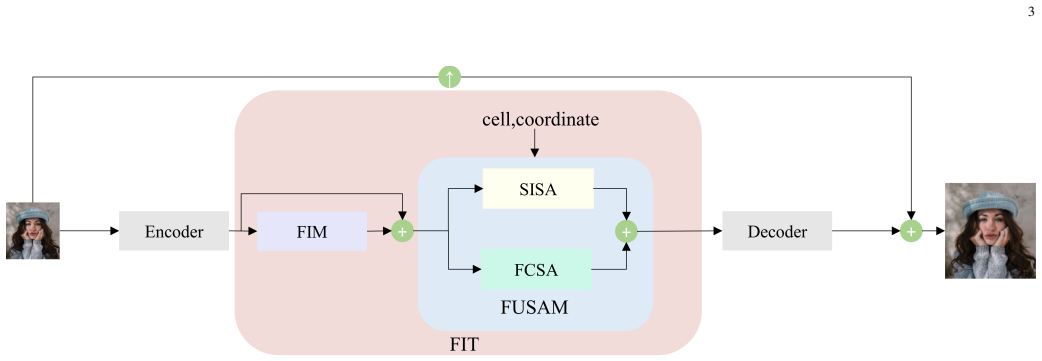
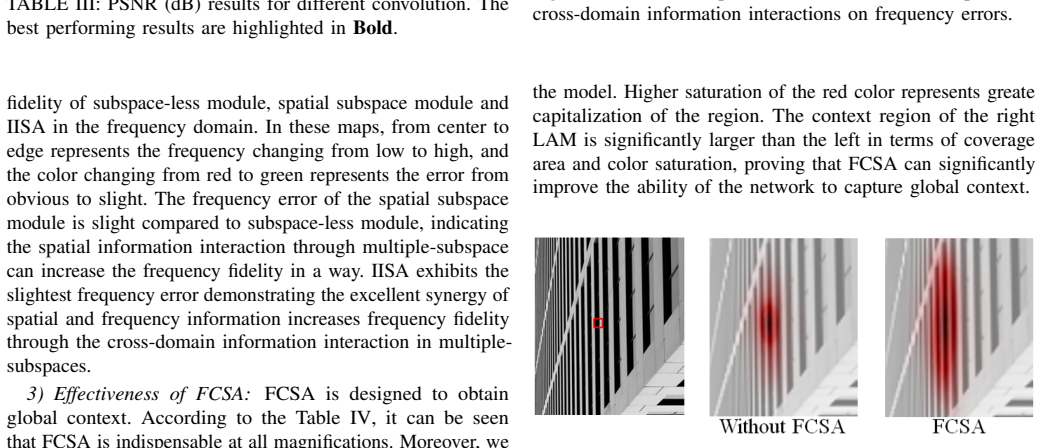
The load-bearing components are the Frequency Incorporation Module (FIM) and the Frequency Utilization Self-Attention module (FUSAM). FIM uses Fast Fourier Transform plus real-imaginary mapping so that complex frequency values are kept intact rather than collapsed into channels or polar coordinates, and a skip connection merges the modulated frequency feature with the spatial feature. Inside FUSAM, Interaction Implicit Self-Attention (IISA) alternately projects the same mixed feature through spatial-labelled and frequency-labelled matrices into multiple subspaces to enable cross-domain interaction, while Frequency Correlation Self-Attention (FCSA) transforms query and key with FFT, computes their correlation in the frequency domain, and uses that correlation as the attention weight. The combination is what carries the claim: lossless frequency entry plus two distinct ways of using frequency information.
What would settle it
Replace the frequency-labelled projection matrices in IISA with random matrices of the same shape, keeping all other weights and training unchanged, and compare PSNR on DIV2K validation; if the scores stay within noise, frequency-specific interaction is not what drives FIT's gains.
Extended reading notes
Core claim
The central claim is that frequency information can be added to an implicit-neural-representation super-resolution pipeline without the usual information loss, and that the resulting network achieves higher PSNR than previous methods on every tested benchmark and scale. FIM achieves lossless incorporation by converting the complex Fourier tensor into separate real and imaginary components, processing each with convolution, recombining them, and applying the inverse transform alongside a skip connection. IISA then projects the mixed feature into alternating spatial and frequency subspaces before multi-head attention, while FCSA computes attention weights from a frequency-domain correlation of query and key. With both EDSR and RDN as encoders, FIT reports the best PSNR at every magnification tested, with gains of roughly 0.05 to 0.3 dB over the previous best methods.
Load-bearing premise
The paper's gain over previous methods is attributed to mixing spatial and frequency information, but it never identifies which parts of its features are spatial and which are frequency, so the improvement could just come from adding parameters.
Editorial extensions
If this is right
- If FIT's benchmark results hold, arbitrary-scale super-resolution can be improved by treating frequency as a first-class input rather than as auxiliary detail.
- The real-imaginary mapping trick gives a reusable recipe for inserting complex-valued Fourier information into convolutional networks without amplitude-phase or channel-collapse loss.
- FCSA's frequency-correlation attention offers a global-context mechanism that could transfer to other image restoration tasks.
- Because FIT works at non-integer scales with the same training setup as prior implicit-representation methods, the reported gains do not require new datasets or scale-specific training.
- The paper's own limitations section points to adaptive frequency weighting by magnification and frequency-aware position coding as immediate next targets.
Reading between the lines
- A fair test of IISA's claimed cross-domain synergy would be to relabel which subspaces are called spatial and which frequency, or to replace the frequency-labelled projections with equally sized random projections; if PSNR does not move, the mechanism reduces to extra capacity.
- The losslessness claim for FIM is likely approximate under limited precision and learned weights, so one could quantify how much information is actually preserved by comparing FIT's frequency response with and without the module.
- The same FIM-plus-FCSA design could be applied to image denoising or deblurring, where frequency fidelity is also known to matter, and that would test whether the benefit is specific to super-resolution.
Signed reviews
Editorial analysis
A structured set of objections, weighed in public.
Referee Report
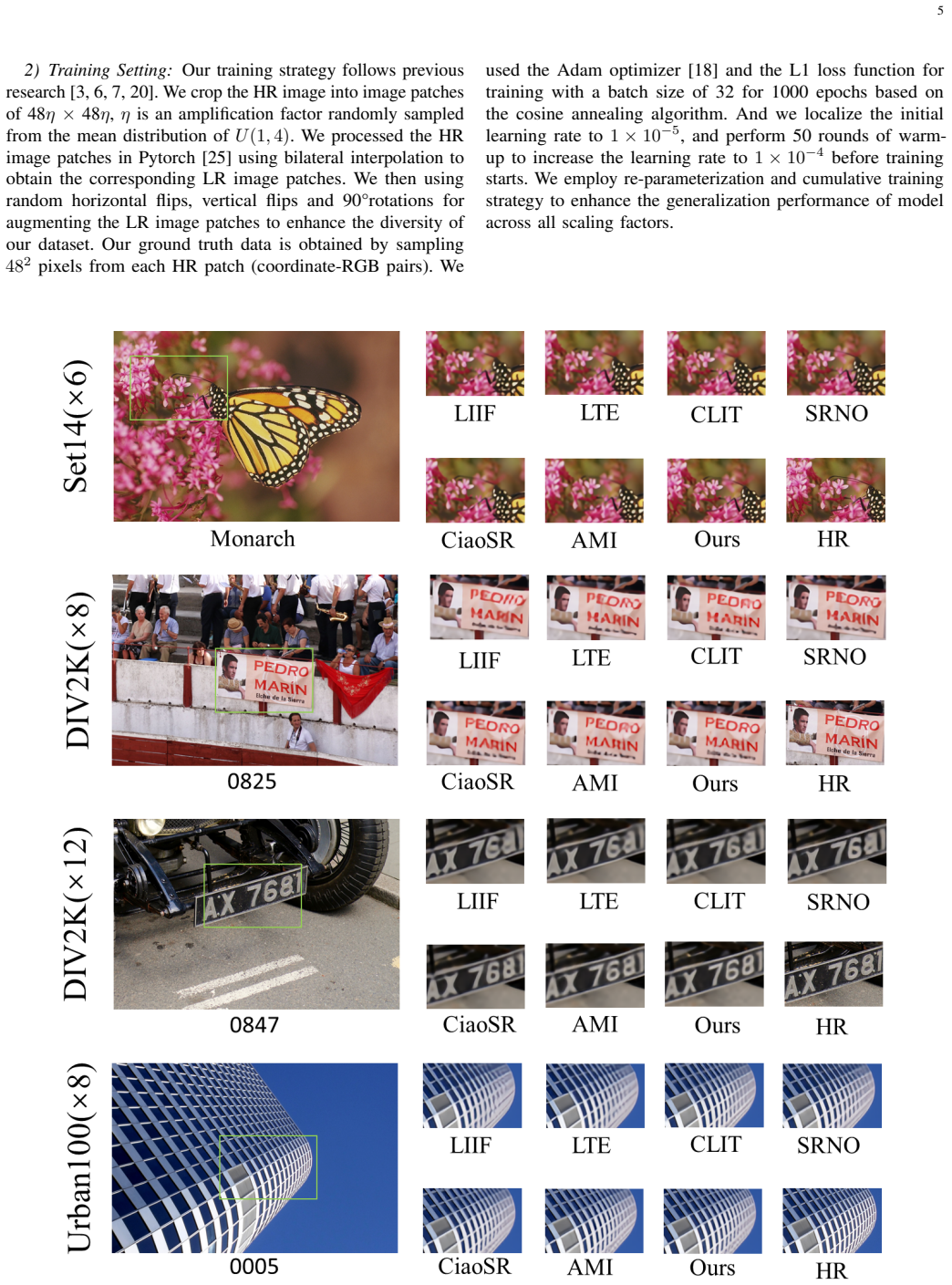
Summary. The paper proposes Frequency-Integrated Transformer (FIT) for arbitrary-scale super-resolution. FIT consists of a Frequency Incorporation Module (FIM), which inserts frequency-domain information via FFT and a real-imaginary mapping, and a Frequency Utilization Self-Attention Module (FUSAM) containing Interaction Implicit Self-Attention (IISA) and Frequency Correlation Self-Attention (FCSA). The authors report PSNR comparisons on DIV2K validation, Set5, Set14, Urban100, and BSD100 across integer and non-integer scales, claiming consistent improvements over prior arbitrary-scale SR methods. Ablation studies examine the roles of FIM, IISA, and FCSA, and qualitative visualizations are provided.
Significance. If the empirical claims hold, FIT would give a modest but consistent improvement over the current state of the art for arbitrary-scale super-resolution on several standard benchmarks, with gains of roughly 0.05 to 0.3 dB depending on dataset and scale. The paper includes a broad set of comparisons, multiple scale factors, and targeted ablations, which are strengths. However, the central architectural equation (Eq. (3)) is not a well-defined operation as written, and the reported gains are not accompanied by variance estimates or code, so the reproducibility and the attribution of gains to the proposed frequency-integration mechanism are not yet established. The 'lossless' claim is also unsupported because the module contains learned convolutions that can discard information.
major comments (5)
- [Section III-B, Eq. (3)] Equation (3) is domain-incoherent as written. Z'_FFT is a complex-valued frequency-domain tensor produced by the FFT and real-imaginary processing in Eq. (2), while Zin is the real-valued spatial feature map. Adding Z'_FFT + Zin before applying the inverse FFT treats the spatial tensor as if it were a frequency spectrum, which is not a defined operation. If the implementation actually computes PConv(F^{-1}(Z'_FFT) + Zin), then Eq. (3) misdescribes the model; if it literally follows Eq. (3), the pointwise convolution must consume complex-valued activations, which is not supported by standard PyTorch convolutions. This ambiguity is load-bearing because FIM is the core contribution that the empirical gains are attributed to. Please provide a corrected equation and, ideally, release code to resolve the discrepancy.
- [Section III-B, 'lossless' claim] The statement that FIM introduces frequency information 'in a lossless manner' is not justified. Although the real-imaginary mapping is a constant map, Eq. (2) applies learned convolutions to Zreal and Zimag, and Eq. (3) applies a pointwise convolution; these are arbitrary learned linear maps that are not shown to be invertible. Information can therefore be discarded before the IFFT. The 'lossless' claim should either be proven (e.g., by showing invertibility of each learned operation) or replaced by a more modest claim about preserving the real and imaginary components up to learned transformations.
- [Section III-C2, Eq. (6) and Table IV] The claimed cross-domain synergy of IISA is not operationalized in the paper. In Eq. (6), all projections receive the same input Z'_FIM, and the distinction between 'spatial' (W_n) and 'frequency' (W_m) matrices is only an index difference; no entry or statistical property identifies which subspace encodes spatial versus frequency information. The improvement attributed to cross-domain interaction could therefore be due to additional linear parameters or to the particular random initialization. The paper should include a control experiment, such as permuting the subspace indices or matching total parameter count while using only spatial projections, to demonstrate that the synergy mechanism, rather than extra capacity, drives the gains in Table IV.
- [Tables I-IV] All quantitative results report a single PSNR value per configuration, with no standard deviation, repeated runs, or significance testing. This is particularly concerning for the ablation tables: in Table III, differences of 0.01-0.02 dB between FDF, FRB, and the spatial module are likely within run-to-run variation, yet they are interpreted as rankable differences. The empirical claim of state-of-the-art performance also rests on gains as small as 0.02-0.05 dB in some cells of Tables I and II. Please report mean and standard deviation over at least three runs, or provide a significance analysis, for the main comparisons and ablations.
- [Section III-C3, Eq. (11)] Equation (11) as written does not compute a correlation. For real-valued signals, the cross-correlation in the frequency domain requires the conjugate transpose (or complex conjugate) of one spectrum, i.e., F^{-1}(F(\tilde Q) \cdot \overline{F(\tilde K)}). The expression uses F^T(\tilde K), which is a transpose without conjugation, so the operation is not a standard correlation and its interpretation as 'frequency correlation' is unclear. Please clarify the notation and the exact operation, and show that it is consistent with the claimed global-context behavior of FCSA.
minor comments (7)
- [Abstract and Section I] The sentence 'We proposes a novel network' contains a subject-verb agreement error; it should be 'We propose'.
- [Section III-B] The sentence 'Where the Comp denotes the the F denotes the FFT and the F^{-1} denotes the IFFT' is garbled and missing words; it should be rewritten for clarity.
- [Table II] The row label 'RDM-FIT(Ours)' appears to be a typo for 'RDN-FIT(Ours)'.
- [Section III-A] The phrase 'jump connection' is used where the standard term in super-resolution literature is 'skip connection'.
- [Section III-C3 and Fig. 2] The caption of Fig. 2 calls the third panel '(c) Overview of IISA structure', but the text refers to Fig. 2(c) as FCSA; please align the caption with the text.
- [Section IV-B2] Phrases such as 'DIV2K validation set 0825' and 'DIV2K validation set 0847' are missing the word 'image'; they should read 'image 0825' and 'image 0847'.
- [General] No statement of code availability is provided. Given the specification ambiguity in Eq. (3), releasing source code would substantially improve reproducibility.
Circularity Check
No significant circularity: the central claim is an external PSNR comparison against published methods, not a derivation from fitted constants.
full rationale
The paper's central claim is that FIT achieves higher PSNR than existing arbitrary-scale super-resolution methods on DIV2K validation, Set5, Set14, Urban100, and BSD100 (Tables I-II). Those results are compared against independently published baselines; no fitted parameter derived from the test sets is renamed as a prediction, and no equation in the paper forces the reported gains by construction. The FIM 'lossless' statement (Eqs. 2-3) raises technical-validity concerns because the learned convolutions are not shown invertible before the IFFT, and Eq. (3) mixes a complex frequency-domain tensor with a real spatial tensor; however, this is an architectural under-specification or correctness issue, not a circular derivation. Likewise, labeling the projection matrices in Eq. (6) as 'spatial' versus 'frequency' while both act on the same Z'_FIM is an interpretive weakness, but the performance claim does not depend on that label. The only overlapping-author citation ([47]) appears as background for applications and is not load-bearing. Hyperparameters selected on the DIV2K validation split are standard model selection, not a circular fit to the reported test sets. Therefore no circular step is exhibited.
Assumptions & free parameters
free parameters (8)
- p =
10
- H =
8
- n_subspaces =
4
- initial_learning_rate =
1e-4
- warmup_steps =
50
- training_epochs =
1000
- batch_size =
32
- hr_patch_size =
48η (η ~ U(1,4))
assumptions (4)
- standard math FFT and IFFT are exact inverses for finite signals.
- standard math Convolution is distributive over addition, so separate processing of real and imaginary parts can be recombined.
- domain assumption Frequency-domain correlation captures global context useful for super-resolution.
- ad hoc to paper Hyperparameters (p=10, H=8, 4 subspaces) chosen on DIV2K validation generalize to other datasets.
Cite this review
Pith. "Pith review of Frequency-Integrated Transformer for Arbitrary-Scale Super-Resolution." pith.science (2026). https://pith.science/paper/OT5NIC6W
@misc{pith2026250418818,
  author       = {Pith},
  title        = {Pith review of: Frequency-Integrated Transformer for Arbitrary-Scale Super-Resolution},
  year         = {2026},
  howpublished = {\url{https://pith.science/paper/OT5NIC6W}},
  note         = {Machine review of arXiv:2504.18818}
}
read the original abstract
Methods based on implicit neural representation have demonstrated remarkable capabilities in arbitrary-scale super-resolution (ASSR) tasks, but they neglect the potential value of the frequency domain, leading to sub-optimal performance. We proposes a novel network called Frequency-Integrated Transformer (FIT) to incorporate and utilize frequency information to enhance ASSR performance. FIT employs Frequency Incorporation Module (FIM) to introduce frequency information in a lossless manner and Frequency Utilization Self-Attention module (FUSAM) to efficiently leverage frequency information by exploiting spatial-frequency interrelationship and global nature of frequency. FIM enriches detail characterization by incorporating frequency information through a combination of Fast Fourier Transform (FFT) with real-imaginary mapping. In FUSAM, Interaction Implicit Self-Attention (IISA) achieves cross-domain information synergy by interacting spatial and frequency information in subspace, while Frequency Correlation Self-attention (FCSA) captures the global context by computing correlation in frequency. Experimental results demonstrate FIT yields superior performance compared to existing methods across multiple benchmark datasets. Visual feature map proves the superiority of FIM in enriching detail characterization. Frequency error map validates IISA productively improve the frequency fidelity. Local attribution map validates FCSA effectively captures global context.
Figures


Figures from the paper (5 more)


Reference graph
Works this paper leans on
-
[1]
Ntire 2017 challenge on single image super-resolution: Dataset and study
Eirikur Agustsson and Radu Timofte. Ntire 2017 challenge on single image super-resolution: Dataset and study. In Proceedings of the IEEE conference on computer vision and pattern recognition workshops , pages 126–135, 2017
work page 2017
-
[2]
M. Bevilacqua, A. Roumy, C. Guillemot, and A. Morel. Low- complexity single image super-resolution based on nonnegative neighbor embedding. In British Machine Vision Conference , 2012
work page 2012
-
[3]
Refconv: Re-parameterized refocusing convolution for powerful convnets
Zhicheng Cai, Xiaohan Ding, Qiu Shen, and Xun Cao. Refconv: Re-parameterized refocusing convolution for powerful convnets. arXiv preprint arXiv:2310.10563 , 2023
arXiv 2023
-
[4]
Jiezhang Cao, Qin Wang, Yongqin Xian, Yawei Li, Bingbing Ni, Zhiming Pi, Kai Zhang, Yulun Zhang, Radu Timofte, and Luc Van Gool. Ciaosr: Continuous implicit attention-in- attention network for arbitrary-scale image super-resolution. In Proceedings of the IEEE/CVF Conference on Computer Vision and Pattern Recognition, pages 1796–1807, 2023
work page 2023
-
[5]
Deep local shapes: Learning local sdf priors for detailed 3d reconstruction
Rohan Chabra, Jan E Lenssen, Eddy Ilg, Tanner Schmidt, Julian Straub, Steven Lovegrove, and Richard Newcombe. Deep local shapes: Learning local sdf priors for detailed 3d reconstruction. In Computer Vision–ECCV 2020: 16th European Conference, Glasgow, UK, August 23–28, 2020, Proceedings, Part XXIX 16 , pages 608–625. Springer, 2020
work page 2020
-
[6]
Cascaded local implicit transformer for arbitrary-scale super-resolution
Hao-Wei Chen, Yu-Syuan Xu, Min-Fong Hong, Yi-Min Tsai, Hsien-Kai Kuo, and Chun-Yi Lee. Cascaded local implicit transformer for arbitrary-scale super-resolution. In Proceedings of the IEEE/CVF Conference on Computer Vision and Pattern Recognition, pages 18257–18267, 2023
work page 2023
-
[7]
Learning continuous image representation with local implicit image function
Yinbo Chen, Sifei Liu, and Xiaolong Wang. Learning continuous image representation with local implicit image function. In Proceedings of the IEEE/CVF conference on computer vision and pattern recognition , pages 8628–8638, 2021
work page 2021
-
[8]
Lu Chi, Borui Jiang, and Yadong Mu. Fast fourier convolution. Advances in Neural Information Processing Systems , 33:4479– 4488, 2020
work page 2020
Show all 49 references
-
[9]
Omni-kernel network for image restoration
Yuning Cui, Wenqi Ren, and Alois Knoll. Omni-kernel network for image restoration. In Proceedings of the AAAI conference on artificial intelligence , volume 38, pages 1426–1434, 2024
2024
-
[10]
Image super-resolution using deep convolutional networks
Chao Dong, Chen Change Loy, Kaiming He, and Xiaoou Tang. Image super-resolution using deep convolutional networks. IEEE transactions on pattern analysis and machine intelligence , 38 (2):295–307, 2015
2015
-
[11]
Efficient frequency-domain image deraining with contrastive regulariza- tion
Ning Gao, Xingyu Jiang, Xiuhui Zhang, and Yue Deng. Efficient frequency-domain image deraining with contrastive regulariza- tion. In European Conference on Computer Vision , pages 240–
-
[12]
Interpreting super-resolution networks with local attribution maps
Jinjin Gu and Chao Dong. Interpreting super-resolution networks with local attribution maps. In Proceedings of the IEEE/CVF 10 Conference on Computer Vision and Pattern Recognition , pages 9199–9208, 2021
2021
-
[13]
Meta-sr: A magnification-arbitrary network for super-resolution
Xuecai Hu, Haoyuan Mu, Xiangyu Zhang, Zilei Wang, Tieniu Tan, and Jian Sun. Meta-sr: A magnification-arbitrary network for super-resolution. In 2019 IEEE/CVF Conference on Computer Vision and Pattern Recognition (CVPR) , 2020
2019
-
[14]
Single image super-resolution from transformed self-exemplars
Jia-Bin Huang, Abhishek Singh, and Narendra Ahuja. Single image super-resolution from transformed self-exemplars. In Proceedings of the IEEE conference on computer vision and pattern recognition, pages 5197–5206, 2015
2015
-
[15]
Adaptive frequency filters as efficient global token mixers
Zhipeng Huang, Zhizheng Zhang, Cuiling Lan, Zheng-Jun Zha, Yan Lu, and Baining Guo. Adaptive frequency filters as efficient global token mixers. In Proceedings of the IEEE/CVF International Conference on Computer Vision, pages 6049–6059, 2023
2023
-
[16]
Local implicit grid representations for 3d scenes
Chiyu Jiang, Avneesh Sud, Ameesh Makadia, Jingwei Huang, Matthias Nießner, Thomas Funkhouser, et al. Local implicit grid representations for 3d scenes. In Proceedings of the IEEE/CVF Conference on Computer Vision and Pattern Recognition , pages 6001–6010, 2020
2020
-
[17]
Fabnet: Frequency- aware binarized network for single image super-resolution
Xinrui Jiang, Nannan Wang, Jingwei Xin, Keyu Li, Xi Yang, Jie Li, Xiaoyu Wang, and Xinbo Gao. Fabnet: Frequency- aware binarized network for single image super-resolution. IEEE Transactions on Image Processing , 32:6234–6247, 2023
2023
-
[18]
Adam: A method for stochastic optimization
Diederik P Kingma and Jimmy Ba. Adam: A method for stochastic optimization. arXiv preprint arXiv:1412.6980 , 2014
2014 arXiv
-
[19]
Efficient frequency domain-based transformers for high-quality image deblurring
Lingshun Kong, Jiangxin Dong, Jianjun Ge, Mingqiang Li, and Jinshan Pan. Efficient frequency domain-based transformers for high-quality image deblurring. In Proceedings of the IEEE/CVF Conference on Computer Vision and Pattern Recognition , pages 5886–5895, 2023
2023
-
[20]
Local texture estimator for implicit representation function
Jaewon Lee and Kyong Hwan Jin. Local texture estimator for implicit representation function. In Proceedings of the IEEE/CVF conference on computer vision and pattern recognition , pages 1929–1938, 2022
1929
-
[21]
Feature modulation transformer: Cross-refinement of global representation via high- frequency prior for image super-resolution
Ao Li, Le Zhang, Yun Liu, and Ce Zhu. Feature modulation transformer: Cross-refinement of global representation via high- frequency prior for image super-resolution. In Proceedings of the IEEE/CVF International Conference on Computer Vision , pages 12514–12524, 2023
2023
-
[22]
Swinir: Image restoration using swin transformer
Jingyun Liang, Jiezhang Cao, Guolei Sun, Kai Zhang, Luc Van Gool, and Radu Timofte. Swinir: Image restoration using swin transformer. In Proceedings of the IEEE/CVF international conference on computer vision , pages 1833–1844, 2021
2021
-
[23]
Enhanced deep residual networks for single image super-resolution
Bee Lim, Sanghyun Son, Heewon Kim, Seungjun Nah, and Kyoung Mu Lee. Enhanced deep residual networks for single image super-resolution. In Proceedings of the IEEE conference on computer vision and pattern recognition workshops , pages 136–144, 2017
2017
-
[24]
A database of human segmented natural images and its application to evaluating segmentation algorithms and measuring ecological statistics
David Martin, Charless Fowlkes, Doron Tal, and Jitendra Malik. A database of human segmented natural images and its application to evaluating segmentation algorithms and measuring ecological statistics. In Proceedings Eighth IEEE International Conference on Computer Vision. IC...
2001
-
[25]
Pytorch: An imperative style, high-performance deep learning library
Adam Paszke, Sam Gross, Francisco Massa, Adam Lerer, James Bradbury, Gregory Chanan, Trevor Killeen, Zeming Lin, Natalia Gimelshein, Luca Antiga, et al. Pytorch: An imperative style, high-performance deep learning library. Advances in neural information processing systems , 32, 2019
2019
-
[26]
Digital image processing algorithms and applications
I Pitas. Digital image processing algorithms and applications. John Wiley & Sons Inc google schola , 2:133–138, 2000
2000
-
[27]
Leveraging frequency analysis for image denoising network pruning
Dongdong Ren, Wenbin Li, Jing Huo, Lei Wang, Hongbing Pan, and Yang Gao. Leveraging frequency analysis for image denoising network pruning. IEEE Transactions on Image Processing, 34:1660–1671, 2025
2025
-
[28]
Spectral representations for convolutional neural networks
Oren Rippel, Jasper Snoek, and Ryan P Adams. Spectral representations for convolutional neural networks. Advances in neural information processing systems , 28, 2015
2015
-
[29]
Graf: Generative radiance fields for 3d-aware image synthesis
Katja Schwarz, Yiyi Liao, Michael Niemeyer, and Andreas Geiger. Graf: Generative radiance fields for 3d-aware image synthesis. Advances in Neural Information Processing Systems , 33:20154–20166, 2020
2020
-
[30]
Scene representation networks: Continuous 3d-structure-aware neural scene representations
Vincent Sitzmann, Michael Zollhöfer, and Gordon Wetzstein. Scene representation networks: Continuous 3d-structure-aware neural scene representations. Advances in Neural Information Processing Systems, 32, 2019
2019
-
[31]
Ntire 2017 challenge on single image super-resolution: Methods and results
Radu Timofte, Eirikur Agustsson, Luc Van Gool, Ming-Hsuan Yang, and Lei Zhang. Ntire 2017 challenge on single image super-resolution: Methods and results. In Proceedings of the IEEE conference on computer vision and pattern recognition workshops, pages 114–125, 2017
2017
-
[32]
Attention is all you need
Ashish Vaswani, Noam Shazeer, Niki Parmar, Jakob Uszkoreit, Llion Jones, Aidan N Gomez, Łukasz Kaiser, and Illia Polo- sukhin. Attention is all you need. Advances in neural information processing systems, 30, 2017
2017
-
[33]
Spatial-frequency mutual learning for face super-resolution
Chenyang Wang, Junjun Jiang, Zhiwei Zhong, and Xianming Liu. Spatial-frequency mutual learning for face super-resolution. In Proceedings of the IEEE/CVF Conference on Computer Vision and Pattern Recognition, pages 22356–22366, 2023
2023
-
[34]
High-frequency component helps explain the generalization of convolutional neural networks
Haohan Wang, Xindi Wu, Zeyi Huang, and Eric P Xing. High-frequency component helps explain the generalization of convolutional neural networks. In Proceedings of the IEEE/CVF conference on computer vision and pattern recognition , pages 8684–8694, 2020
2020
-
[35]
Group shuffle and spectral-spatial fusion for hyperspectral image super-resolution
Xinya Wang, Yingsong Cheng, Xiaoguang Mei, Junjun Jiang, and Jiayi Ma. Group shuffle and spectral-spatial fusion for hyperspectral image super-resolution. IEEE Transactions on Computational Imaging, 8:1223–1236, 2022
2022
-
[36]
attention
Yan Wang, Yi Liu, Shijie Zhao, Junlin Li, and Li Zhang. Camixersr: Only details need more" attention". In Proceedings of the IEEE/CVF Conference on Computer Vision and Pattern Recognition, pages 25837–25846, 2024
2024
-
[37]
Super-resolution neural operator
Min Wei and Xuesong Zhang. Super-resolution neural operator. In Proceedings of the IEEE/CVF Conference on Computer Vision and Pattern Recognition, pages 18247–18256, 2023
2023
-
[38]
Metalearning-based alternating minimization algorithm for nonconvex optimization
Jing-Yuan Xia, Shengxi Li, Jun-Jie Huang, Zhixiong Yang, Imad M Jaimoukha, and Deniz Gündüz. Metalearning-based alternating minimization algorithm for nonconvex optimization. IEEE Transactions on Neural Networks and Learning Systems , 34(9):5366–5380, 2022
2022
-
[39]
Blind super-resolution via meta-learning and markov chain monte carlo simulation
Jingyuan Xia, Zhixiong Yang, Shengxi Li, Shuanghui Zhang, Yaowen Fu, Deniz Gündüz, and Xiang Li. Blind super-resolution via meta-learning and markov chain monte carlo simulation. IEEE Transactions on Pattern Analysis and Machine Intelligence, 46(12):8139–8156, 2024
2024
-
[40]
Residual quo- tient learning for zero-reference low-light image enhancement
Chao Xie, Linfeng Fei, Huanjie Tao, Yaocong Hu, Wei Zhou, Jiun Tian Hoe, Weipeng Hu, and Yap-Peng Tan. Residual quo- tient learning for zero-reference low-light image enhancement. IEEE Transactions on Image Processing , 34:365–378, 2025
2025
-
[41]
A dynamic kernel prior model for unsupervised blind image super-resolution
Zhixiong Yang, Jingyuan Xia, Shengxi Li, Xinghua Huang, Shuanghui Zhang, Zhen Liu, Yaowen Fu, and Yongxiang Liu. A dynamic kernel prior model for unsupervised blind image super-resolution. In Proceedings of the IEEE/CVF Conference on Computer Vision and Pattern Recognition , p...
2024
-
[42]
A fourier perspective on model robustness in computer vision
Dong Yin, Raphael Gontijo Lopes, Jon Shlens, Ekin Dogus Cubuk, and Justin Gilmer. A fourier perspective on model robustness in computer vision. Advances in Neural Information Processing Systems, 32, 2019
2019
-
[43]
On single image scale-up using sparse-representations
Roman Zeyde, Michael Elad, and Matan Protter. On single image scale-up using sparse-representations. In Curves and Surfaces: 7th International Conference, Avignon, France, June 24-30, 2010, Revised Selected Papers 7 , pages 711–730. Springer, 2012
2010
-
[44]
Anysr: Realizing image super-resolution as any-scale, any- resource
Wengyi Zhan, Mingbao Lin, Chia-Wen Lin, and Rongrong Ji. Anysr: Realizing image super-resolution as any-scale, any- resource. IEEE Transactions on Image Processing , 33:6564– 6578, 2024. 11
2024
-
[45]
Residual dense network for image super-resolution
Yulun Zhang, Yapeng Tian, Yu Kong, Bineng Zhong, and Yun Fu. Residual dense network for image super-resolution. In Proceedings of the IEEE conference on computer vision and pattern recognition, pages 2472–2481, 2018
2018
-
[46]
Activating more information in arbitrary-scale image super-resolution
Yaoqian Zhao, Qizhi Teng, Honggang Chen, Shujiang Zhang, Xiaohai He, Yi Li, and Ray E Sheriff. Activating more information in arbitrary-scale image super-resolution. IEEE Transactions on Multimedia , 26:7946–7961, 2024
2024
-
[47]
Efficient mixed transformer for single image super-resolution
Ling Zheng, Jinchen Zhu, Jinpeng Shi, and Shizhuang Weng. Efficient mixed transformer for single image super-resolution. Engineering Applications of Artificial Intelligence , 133:108035, 2024
2024
-
[48]
Srformer: Permuted self-attention for single image super-resolution
Yupeng Zhou, Zhen Li, Chun-Le Guo, Song Bai, Ming-Ming Cheng, and Qibin Hou. Srformer: Permuted self-attention for single image super-resolution. In Proceedings of the IEEE/CVF International Conference on Computer Vision , pages 12780– 12791, 2023
2023
-
[49]
Image super-resolution via efficient transformer embedding frequency decomposition with restart
Yifan Zuo, Wenhao Yao, Yuqi Hu, Yuming Fang, Wei Liu, and Yuxin Peng. Image super-resolution via efficient transformer embedding frequency decomposition with restart. IEEE Trans- actions on Image Processing , 33:4670–4685. Xufei Wang received the B. S. degree from QingDao Univ...
2022
Reviewed August 16, 2026 · model on record in the stance chip above.
Discussion (0). Continue with ORCID to comment.