REVIEW 5 major objections 5 minor 115 references
A Langevin sampling algorithm inspired by the Adam optimizer
T0 review · 5 major / 5 minor · reviewed 2026-08-16 · deepseek-v4-flash
Pith's one-line read This paper claims that adaptive-stepsize Langevin sampling with an Adam-style moving average of gradient norms can run at mean stepsizes far above the fixed-step stability limit while preserving canonical averages through reweighting.
desk verdict A genuinely new adaptive-stepsize Langevin scheme whose experiments are more convincing than its theory; worth a serious referee, but the authors need to close the gap between the proved result and the implemented algorithm. read the letter →
The pith
A machine-rendered reading of the paper's core claim, the machinery that carries it, and where it could break.
The reading
What carries the argument
The load-bearing object is the Sundman time-rescaled underdamped Langevin SDE in augmented phase space, $$dx=\psi(\zeta)p\,d\tau,\quad dp=-\psi(\zeta)\nabla U\,d\tau-\gamma\psi(\zeta)p\,d\tau+\sqrt{2\gamma\$beta^{{-1}}$\psi(\zeta)}\,dW,\quad d\zeta=(-\$\alpha$\zeta+g(x,p))\,d\tau,$$ with $dt=\psi(\zeta)d\tau$. The monitor $g=\|\nabla U\|^s$ (typically $s=1$ or $2$, scaled by $\Omega$) drives the moving average, and the bounded filter $\psi(\zeta)= (m\zeta^r+M)/(\zeta^r+m)$ keeps $\Delta t$ inside $[m\Delta\tau,M\Delta\tau]$. The integrator ZBAOABZ wraps the standard BAOAB splitting with half-steps of the $\zeta$-flow, and the reweighting identity $\mathbb{E}_{\pi_\beta}(\phi)=\mathbb{E}_{\Pi_\tau}(\phi\psi)/\mathbb{E}_{\Pi_\tau}(\psi)$ is what converts rescaled-time samples into canonical averages.
What would settle it
On a target with exactly known marginals and unbounded gradient norm—for example a high-dimensional Neal funnel with heavier tails—measure the stationary bias of reweighted observables under ZBAOABZ at decreasing $\Delta\tau$: if the bias fails to shrink at order $\Delta\tau^2$, or if the mean-step advantage over BAOAB disappears when the monitor is replaced by a globally Lipschitz smoothed version, the central efficiency claim is refuted.
Extended reading notes
Core claim
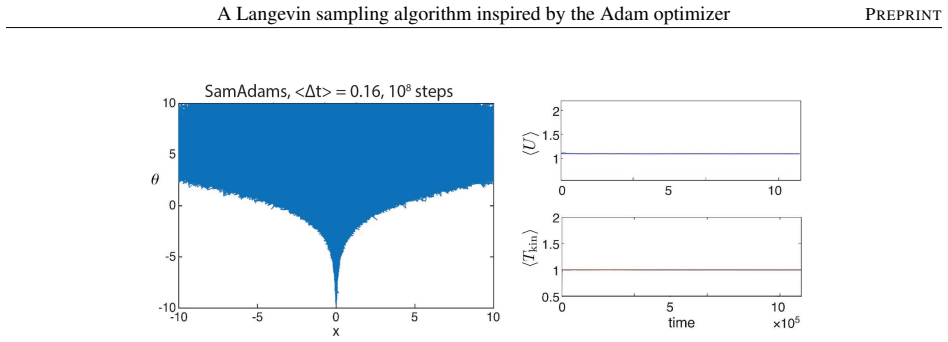
On its own terms, the central claim is that a time-rescaled Langevin process with an Adam-style monitor is a practical, provably second-order sampling method whose adaptive step size is automatically reduced in regions of steep change of the log posterior and increased on plateaus. The invariant measure of the rescaled dynamics is not the Boltzmann measure, but the paper proves the reweighting identity $\mathbb{E}_{\pi_\beta}(\phi) = \mathbb{E}_{\Pi_\tau}(\phi\,\psi)/\mathbb{E}_{\Pi_\tau}(\psi)$ and uses it to compute canonical averages. The numerical heart is the claim that ZBAOABZ remains stable and accurate at mean step sizes $\langle\Delta t\rangle$ that would make BAOAB unstable, because small step sizes are needed only in rare steep regions. The paper supports this with a weak-order-two convergence theorem and experiments on the star potential, asymmetric double well, entropic barrier, Beale potential, Neal's funnel, and Bayesian neural networks on MNIST.
Load-bearing premise
The efficiency claim rests on the assumption that one scalar moving average of the gradient norm, combined with a bounded filter, keeps the implemented integrator stable and nearly unbiased in high dimensions; the paper's convergence theorem requires smoother monitors than the $\|\nabla U\|^2$ actually used.
Editorial extensions
If this is right
- ZBAOABZ can be run at mean step sizes above the stability threshold of fixed-step BAOAB; stability is governed by local, not global, curvature.
- On the 9D Neal funnel the method yields about 400% more effective samples per unit cost at equal accuracy to the best fixed-step run.
- On the MNIST MLP and CNN, the adaptive step prevents early-training loss spikes, and posterior-averaged test accuracies are higher and have far smaller variance than BAOAB at comparable cost.
- Any fixed-stepsize Langevin integrator can be wrapped in the two Z half-steps, and the same reweighting identity then provides canonical expectations without Metropolis correction.
Reading between the lines
- A monitor based on minibatch gradient variance rather than the gradient norm would make the step size track the injected noise; the paper's logistic-regression appendix suggests this could automatically adjust for changing batch size, replacing hand-tuned learning-rate schedules.
- The scalar $\zeta$ discards Adam's per-coordinate step sizes; a vector-valued $\zeta$ could add anisotropy and help ill-conditioned targets, but the paper gives no implementation or bias analysis for that variant.
- Because the step size reacts to the gradient norm, the method should transfer to molecular dynamics with repulsive cores or other force fields with rare large forces, where fixed-step integrators are throttled by the worst-case force.
Signed reviews
Editorial analysis
A structured set of objections, weighed in public.
Referee Report
Summary. This paper develops an adaptive-stepsize Langevin sampling framework called SamAdams. It augments the phase space with an auxiliary variable ζ that evolves by a relaxation equation driven by a monitor function g(x,p), typically a power of the gradient norm, and uses a bounded Sundman kernel ψ(ζ) to rescale time by dt=ψ(ζ)dτ. The authors show that in continuous time the (x,p) process in real time is ordinary underdamped Langevin dynamics, so canonical averages can be recovered by reweighting samples with ψ(ζ). A symmetric splitting integrator ZBAOABZ is introduced and a finite-time weak second-order error bound is stated in Theorem 1 under strong regularity assumptions. Numerical experiments on toy potentials, a 9D funnel, and MNIST MLP/CNN classifiers report improved stability and larger mean stepsizes than fixed-step BAOAB.
Significance. If the theoretical gap can be closed, this is a genuinely useful contribution: the reweighting construction is simple and does not require modifying the drift, the moving-average mechanism is a principled bridge to Adam, and the numerical study is extensive, with striking stability improvements on the 9D funnel and the CNN. The paper is also honest in Remark 3 that the implemented monitor violates the assumptions of Theorem 1. However, the central claim that SamAdams samples the canonical distribution is currently supported only for the continuous-time dynamics and for the finite-time weak error of a regularized version of the algorithm; no stationary-bias guarantee is provided for the implemented method. This gap is load-bearing and should be addressed before the headline claims are accepted.
major comments (5)
- [Section 3.2, Remark 3, Eq. (26), Section 5] Theorem 1 requires ψ, √ψ, ∇U, and g to be C^6 with all partial derivatives bounded and r<ψ<M. The monitor used in every experiment is g=Ω^{-1}||∇U||^s with s=1 or 2 (Eq. (26)); for s=2 this is not globally Lipschitz, and for s=1 it is not differentiable at ∇U=0. The funnel, Beale, and ReLU neural-network potentials also have unbounded or non-smooth derivatives. Remark 3 acknowledges this and proposes a smoothed variant, but no experiment uses that smoothed variant. Thus Theorem 1 cannot be invoked for any of the reported numerical claims.
- [Section 3.2 and Section 2.1] The paper proves only a finite-time weak-error bound for the reweighted ratio (Eq. (18)); the constant C depends on T and the bound does not control the limit n→∞ with fixed ∆τ. Section 2.1 gives the exact continuous-time reweighting identity, but the asymptotic bias of ergodic averages computed by the discrete ZBAOABZ is not analyzed; the text explicitly defers this to future work. Since the abstract and conclusion claim that the method samples the canonical distribution after reweighting, a stationary-bias theorem for the implemented algorithm is required, or the claims must be weakened.
- [Eq. (25), Section 4, and Section 5 initialization] For the displayed kernels ψ(1) and ψ(2), one has ψ(0)=M/m and ψ(∞)=m, not ψ(0)=M as stated in Section 4. Consequently the claimed stepsize bounds ∆t∈[m∆τ,M∆τ] do not follow from the formulas, and the repeated assertion that ζ0=0 gives ∆t0=M∆τ (e.g., Section 5 and Fig. 5) is algebraically inconsistent for m<1. Either the kernels or the bound statements are misprinted; as written, all reported values of ∆tmax and the initialization argument need to be revised.
- [Section 5.2.4, Fig. 11] Fig. 11 shows strong dependence of the stability threshold on α and Ω, with a 'highly unstable' region and an optimal zone near α≈1, Ω≈100. This is in tension with the statement in Section 5 that detailed hyperparameter tuning is usually unnecessary. The authors should provide guidance on how to choose (α,Ω) for a new problem, or explicitly state the admissible region and its dependence on the force scale.
- [Section 5.3.1, Table 1 and Fig. 14] The claimed 400% efficiency improvement in the 9D funnel rests on ESS estimates computed from non-uniformly spaced samples after an interpolation step that is not described. Table 1 also shows non-negligible variation in mean log posterior across stepsizes (−10.55 to −10.42), so the accuracy comparison is not fully quantified. Please report the ESS estimation procedure and provide effective sample size per gradient evaluation for both samplers.
minor comments (5)
- [Section 2.1] The uniform lower bound r<ψ<M is used to justify division by E(ψ), but it is only introduced later in Theorem 1; state it when the reweighting formula is first presented.
- [Algorithm 1] The pseudocode does not define burn-in or how nmeas interacts with the reported averages; specify that the first n_burn iterations are discarded and that 'collect' means storing (x_n,p_n,µ_n) for reweighting.
- [Section 5.3.2] The sentence 'using the mean adaptive stepsize for BAOAB gives the benefit of the doubt to the fixed-stepsize method' needs a caveat, because the mean uses future information from the full trajectory that would not be available when selecting a fixed stepsize in practice; the direction of the resulting bias should be stated explicitly.
- [Section 5, Eq. (27)] The notation q(n∆t) is ambiguous for the adaptive scheme; clarify whether n∆t refers to real time for the fixed-step scheme and to the corresponding rescaled time for ZBAOABZ.
- [General] The paper does not state whether code is available; for a methods paper with extensive experiments, a reproducibility statement or code release would be helpful.
Circularity Check
No circular derivation: the reweighting identity and weak-order theorem are independent of the Adam analogy, and all speedups are benchmarked against fixed-step BAOAB.
full rationale
I find no circular step in the derivation chain. The central reweighting formula in Section 2.1, EΠτ(ϕψ)/EΠτ(ψ)=Eπβ(ϕ), follows from the definition dt=ψ(ζ)dτ plus an ergodicity assumption, so the canonical-average claim is a mathematical identity of the construction rather than a fitted output. Theorem 1's weak-order bound is obtained by applying Vilmart's external result [103] to the Strang-type splitting; it does not presuppose the accuracy of the SamAdams algorithm. The Adam connection is explicitly a source of inspiration, not a derivation: the paper states that the choices (22)-(23) 'mimic the Adam ODE' and then immediately lists structural differences from Adam, and no numerical claim is justified by Adam's convergence behavior. The efficiency claims are benchmarked externally against fixed-step BAOAB at matched mean stepsizes or work-normalized settings (Sections 5.1-5.3), so they are not comparing the method to its own fitted predictions. The self-citations to [62] and [88] are contextual or are backed by the external Lyapunov framework of [64]; neither is used as a uniqueness theorem to forbid alternatives. The paper itself flags the important limitations that matter for correctness but not circularity: Remark 3 admits the implemented monitor g=||∇U||^2 does not satisfy Theorem 1's Lipschitz/C^6 hypotheses, and Section 3.2 says stationary-bias convergence 'will be explored in future work.' These are theory-practice gaps, not reductions of the claimed result to its inputs.
Assumptions & free parameters
free parameters (7)
- alpha (zeta relaxation rate) =
varies: 0.1 (Neal funnel), 1 (double well, Beale), 50 (MNIST MLP), 500 (MNIST CNN)
- Omega (monitor normalization) =
1 for low-dimensional problems, around 100 for the star potential optimum, N_D for MNIST
- m, M (Sundman kernel bounds) =
typically 0.1 and 10; 0.01 and 1.0 in the 9D funnel
- r (kernel exponent) =
0.25, 0.5, or 1 depending on experiment
- s (monitor exponent) =
1 or 2 in the experiments
- Delta tau (virtual stepsize) =
varied per experiment, e.g., 0.0002 for MNIST MLP and 0.002 for MNIST CNN
- zeta_0 (initial auxiliary variable) =
0 or g(x0, p0) depending on the experiment
assumptions (6)
- domain assumption Target density has the form pi proportional to exp(-beta U) with U in C^2 and sufficient growth at infinity.
- domain assumption The Sundman factor psi is uniformly bounded away from zero and infinity.
- domain assumption For ergodicity, the potential is convex outside a ball and psi is uniformly bounded.
- standard math Vilmart's weak second-order composition result applies to the ZBAOABZ splitting.
- ad hoc to paper The implemented monitor g = ||grad U||^2 satisfies the regularity assumptions of Theorem 1.
- domain assumption The discrete reweighted averages approximate continuous-time ergodic averages with negligible bias.
invented entities (1)
-
Auxiliary control variable zeta
Cite this review
Pith. "Pith review of A Langevin sampling algorithm inspired by the Adam optimizer." pith.science (2026). https://pith.science/paper/WEDNS5PU
@misc{pith2026250418911,
  author       = {Pith},
  title        = {Pith review of: A Langevin sampling algorithm inspired by the Adam optimizer},
  year         = {2026},
  howpublished = {\url{https://pith.science/paper/WEDNS5PU}},
  note         = {Machine review of arXiv:2504.18911}
}
read the original abstract
We present a framework for adaptive-stepsize MCMC sampling based on time-rescaled Langevin dynamics, in which the stepsize variation is dynamically driven by an additional degree of freedom. Our approach augments the phase space by an additional variable which in turn defines a time reparameterization. The use of an auxiliary relaxation equation allows accumulation of a moving average of a local monitor function and provides for precise control of the timestep while circumventing the need to modify the drift term in the physical system. Our algorithm is straightforward to implement and can be readily combined with any off-the-peg fixed-stepsize Langevin integrator. As a particular example, we consider control of the stepsize by monitoring the norm of the log-posterior gradient, which takes inspiration from the Adam optimizer, the stepsize being automatically reduced in regions of steep change of the log posterior and increased on plateaus, improving numerical stability and convergence speed. As in Adam, the stepsize variation depends on the recent history of the gradient norm, which enhances stability and improves accuracy compared to more immediate control approaches. We demonstrate the potential benefit of this method--both in accuracy and in stability--in numerical experiments including Neal's funnel and a Bayesian neural network for classification of MNIST data.
Figures


Figures from the paper (24 more)



Reference graph
Works this paper leans on
-
[62]
Alix Leroy, Benedict Leimkuhler, Jonas Latz, and Desmond J. Higham. Adaptive stepsize algorithms for Langevin dynamics. SIAM J. Sci. Comput., 46(6):A3574–A3598, 2024
work page 2024
-
[1]
TensorFlow: Large-scale machine learning on heterogeneous systems, 2015
Martín et al Abadi. TensorFlow: Large-scale machine learning on heterogeneous systems, 2015. Software available from tensorflow.org
2015
-
[2]
Adaptive batch sizes for active learning: a probabilistic numerics approach
Masaki Adachi, Satoshi Hayakawa, Martin Jorgensen, Xingchen Wan, Vu Nguyen, Harald Oberhauser, and Michael Osborne. Adaptive batch sizes for active learning: a probabilistic numerics approach. PMLR: Proceed- ings of the 27th International Conference on Artificial Intelligence and Statistics (AISTATS), 238, 2024
2024
-
[3]
Christoph Andrieu, Nando De Freitas, Arnaud Doucet, and Michael I. Jordan. An introduction to MCMC for machine learning, 2003
2003
-
[4]
Benefits of learning rate annealing for tuning-robustness in stochastic optimization
Amit Attia and Tomer Koren. Benefits of learning rate annealing for tuning-robustness in stochastic optimization. arXiv preprint arXiv:2503.09411, 2025
-
[5]
Sampling with time-changed Markov processes
Andrea Bertazzi and Giorgos Vasdekis. Sampling with time-changed Markov processes. arXiv preprint arXiv:2501.15155, 2025
arXiv 2025
-
[6]
The fundamental incompatibility of scalable Hamiltonian Monte Carlo and naive data subsampling
Michael Betancourt. The fundamental incompatibility of scalable Hamiltonian Monte Carlo and naive data subsampling. In Francis Bach and David Blei, editors, Proceedings of the 32nd International Conference on Machine Learning, volume 37 of Proceedings of Machine Learning Research, pages 533–540, Lille, France, 07–09 Jul 2015. PMLR
2015
-
[7]
AdamMCMC: combining Metropolis-adjusted Langevin with momentum-based optimization, 2025
Sebastian Bieringer, Gregor Kasieczka, Maximillian Steffen, and Mathias Trabs. AdamMCMC: combining Metropolis-adjusted Langevin with momentum-based optimization, 2025
2025
Show all 115 references
-
[8]
Covertype
Jock Blackard. Covertype. UCI Machine Learning Repository, 1998. DOI: https://doi.org/10.24432/C50K5N
1998 doi
-
[9]
Incorporating local step-size adaptivity into the No-U-Turn Sampler using Gibbs self tuning
Nawaf Bou-Rabee, Bob Carpenter, Tore Selland Kleppe, and Milo Marsden. Incorporating local step-size adaptivity into the No-U-Turn Sampler using Gibbs self tuning. arXiv preprint arXiv:2408.08259, 2024
2024 arXiv
-
[10]
GIST: Gibbs self-tuning for locally adaptive Hamiltonian Monte Carlo
Nawaf Bou-Rabee, Bob Carpenter, and Milo Marsden. GIST: Gibbs self-tuning for locally adaptive Hamiltonian Monte Carlo. arXiv preprint arXiv:2404.15253, 2024
2024 arXiv
-
[11]
Long-run accuracy of variational integrators in the stochastic context
Nawaf Bou-Rabee and Houman Owhadi. Long-run accuracy of variational integrators in the stochastic context. SIAM Journal on Numerical Analysis, 48(1):278–297, 2010
2010
-
[12]
Randomized Hamiltonian Monte Carlo
Nawaf Bou-Rabee and Jesús María Sanz-Serna. Randomized Hamiltonian Monte Carlo. The Annals of Applied Probability, 27(4):2159 – 2194, 2017
2017
-
[13]
Handbook of Markov chain Monte Carlo
Steve Brooks, Andrew Gelman, Galin Jones, and Xiao-Li Meng. Handbook of Markov chain Monte Carlo. Chapter 5 (Author: Radford M. Neal). Chapman and Hall/CRC, May 2011
2011
-
[14]
Tom B. Brown, Benjamin Mann, Nick Ryder, Melanie Subbiah, Jared Kaplan, Prafulla Dhariwal, Arvind Neelakantan, Pranav Shyam, Girish Sastry, Amanda Askell, Sandhini Agarwal, Ariel Herbert-V oss, Gretchen Krueger, Tom Henighan, Rewon Child, Aditya Ramesh, Daniel M. Ziegler, Jeff...
2020
-
[15]
Stochastic boundary conditions for molecular dynamics simulations of ST2 water
Axel Brünger, III Brooks, Charles L., and Martin Karplus. Stochastic boundary conditions for molecular dynamics simulations of ST2 water. Chemical Physics Letters, 105(5):495–500, March 1984
1984
-
[16]
Accurate sampling using Langevin dynamics
Giovanni Bussi and Michele Parrinello. Accurate sampling using Langevin dynamics. Physical Review E—Statistical, Nonlinear, and Soft Matter Physics, 75(5):056707, 2007
2007
-
[17]
Cariñena, Eduardo Martínez, and Miguel C
José F. Cariñena, Eduardo Martínez, and Miguel C. Muñoz-Lecanda. Infinitesimal time reparametrisation and its applications. Journal of Nonlinear Mathematical Physics, 29(3):523–555, February 2022
2022
-
[18]
Statistical practice: Markov chain Monte Carlo in practice
Brad Carlin, Andrew Gelman, and Radford Neal. Statistical practice: Markov chain Monte Carlo in practice. The American Statistician, 52, 1998. panel discussion, moderator:Kass, Robert
1998
-
[19]
Unbiased kinetic Langevin Monte Carlo with inexact gradients
Neil K Chada, Benedict Leimkuhler, Daniel Paulin, and Peter A Whalley. Unbiased kinetic Langevin Monte Carlo with inexact gradients. arXiv preprint arXiv:2311.05025, 2023
2023
-
[20]
Fox, and Carlos Guestrin
Tianqi Chen, Emily B. Fox, and Carlos Guestrin. Stochastic gradient hamiltonian monte carlo, 2014
2014
-
[21]
On the convergence of a class of adam-type algorithms for non-convex optimization, 2019
Xiangyi Chen, Sijia Liu, Ruoyu Sun, and Mingyi Hong. On the convergence of a class of adam-type algorithms for non-convex optimization, 2019
2019
-
[22]
Towards practical PDMP sampling: Metropolis adjust- ments, locally adaptive step-sizes, and NUTS-based time lengths
Augustin Chevallier, Sam Power, and Matthew Sutton. Towards practical PDMP sampling: Metropolis adjust- ments, locally adaptive step-sizes, and NUTS-based time lengths. arXiv preprint arXiv:2503.11479, 2025
2025 arXiv
-
[23]
A general system of differential equations to model first-order adaptive algorithms
André Belotto Da Silva and Maxime Gazeau. A general system of differential equations to model first-order adaptive algorithms. The Journal of Machine Learning Research, 21(1):5072–5113, 2020
2020
-
[24]
On sampling from a log-concave density using kinetic langevin diffusions
Arnak Dalalyan and Lionel Riou-Durand. On sampling from a log-concave density using kinetic langevin diffusions. Bernoulli, 26:1956–1988, 2020
1956
-
[25]
Note on learning rate schedules for stochastic optimization
Christian Darken and John Moody. Note on learning rate schedules for stochastic optimization. In Advances in Neural Information Processing Systems, 1990
1990
-
[26]
Role of molecular dynamics and related methods in drug discovery
Marco De Vivo, Matteo Masetti, Giovanni Bottegoni, and Andrea Cavalli. Role of molecular dynamics and related methods in drug discovery. Journal of Medicinal Chemistry, 59(9):4035–4061, May 2016
2016
-
[27]
Optimal linear decay learning rate schedules and further refinements, 2024
Aaron Defazio, Ashok Cutkosky, Harsh Mehta, and Konstantin Mishchenko. Optimal linear decay learning rate schedules and further refinements, 2024
2024
-
[28]
A simple convergence proof of Adam and Adagrad
Alexandre Défossez, Leon Bottou, Francis Bach, and Nicolas Usunier. A simple convergence proof of Adam and Adagrad. Transactions on Machine Learning Research, 2022
2022
-
[29]
The mnist database of handwritten digit images for machine learning research
Li Deng. The mnist database of handwritten digit images for machine learning research. IEEE Signal Processing Magazine, 29(6):141–142, 2012
2012
-
[30]
Bert: Pre-training of deep bidirectional transformers for language understanding, 2019
Jacob Devlin, Ming-Wei Chang, Kenton Lee, and Kristina Toutanova. Bert: Pre-training of deep bidirectional transformers for language understanding, 2019
2019
-
[31]
Bayesian sam- pling using stochastic gradient thermostats
Nan Ding, Youhan Fang, Ryan Babbush, Changyou Chen, Robert D Skeel, and Hartmut Neven. Bayesian sam- pling using stochastic gradient thermostats. In Advances in Neural Information Processing Systems, volume 27. Curran Associates, Inc., 2014
2014
-
[32]
Incorporating Nesterov Momentum into Adam
Timothy Dozat. Incorporating Nesterov Momentum into Adam. In Proceedings of the 4th International Conference on Learning Representations, pages 1–4, 2016
2016
-
[33]
Simon Duane, A. D. Kennedy, Brian J. Pendleton, and Duncan Roweth. Hybrid Monte Carlo. Physics Letters B, 195(2):216–222, September 1987
1987
-
[34]
Adaptive subgradient methods for online learning and stochastic optimization
John Duchi, Elad Hazan, and Yoram Singer. Adaptive subgradient methods for online learning and stochastic optimization. Journal of Machine Learning Research, 12(61):2121–2159, 2011
2011
-
[35]
Uniform minorization condition and convergence bounds for discretizations of kinetic Langevin dynamics
Alain Durmus, Aurélien Enfroy, Éric Moulines, and Gabriel Stoltz. Uniform minorization condition and convergence bounds for discretizations of kinetic Langevin dynamics. arXiv preprint arXiv:2107.14542, 2021
2021 arXiv
-
[36]
Peláez, Charlles R
Peter Eastman, Raimondas Galvelis, Raúl P. Peláez, Charlles R. A. Abreu, Stephen E. Farr, Emilio Gallicchio, Anton Gorenko, Michael M. Henry, Frank Hu, Jing Huang, Andreas Krämer, Julien Michel, Joshua A. Mitchell, Vijay S. Pande, João PGLM Rodrigues, Jaime Rodriguez-Guerra, A...
2024
-
[37]
New high-order runge-kutta formulas with step size control for systems of first and second-order differential equations
Erwin Fehlberg. New high-order runge-kutta formulas with step size control for systems of first and second-order differential equations. Zeitschrift für Angewandte Mathematik und Mechanik, 44:T17–T29, 1964. 27 A Langevin sampling algorithm inspired by the Adam optimizer PREPRINT
1964
-
[38]
On the convergence of adaptive approximations for stochastic differential equations
James Foster and Andraž Jelinˇciˇc. On the convergence of adaptive approximations for stochastic differential equations. arXiv preprint arXiv:2311.14201, 2023
2023
-
[39]
Riemann manifold langevin and hamiltonian monte carlo methods
Mark Girolami and Ben Calderhead. Riemann manifold langevin and hamiltonian monte carlo methods. Journal of the Royal Statistical Society: Series B (Statistical Methodology), 73(2):123–214, 2011
2011
-
[40]
Velocity jumps for molecular dynamics
Nicolai Gouraud, Louis Lagardère, Olivier Adjoua, Thomas Plé, Pierre Monmarché, and Jean-Philip Piquemal. Velocity jumps for molecular dynamics. J. Chem. Theory Comput., 21:2854–2866, 2025
2025
-
[41]
W. Keith. Hastings. Monte Carlo Sampling Methods using Markov Chains and their Applications. Biometrika, 57(1):97–109, April 1970
1970
-
[42]
Hopkins, Scott Le Grand, Ross C
Chad W. Hopkins, Scott Le Grand, Ross C. Walker, and Adrian E. Roitberg. Long time-step molecular dynamics through hydrogen mass repartitioning. Journal of chemical theory and computation, 11 4:1864–74, 2015
2015
-
[43]
Horowitz
Alan M. Horowitz. A generalized guided Monte Carlo algorithm. Physics Letters B, 268(2):247–252, 1991
1991
-
[44]
The adaptive verlet method
Weizhang Huang and Benedict Leimkuhler. The adaptive verlet method. SIAM Journal on Scientific Computing, 18(1):239–256, 1997
1997
-
[45]
Binarized neural networks
Itay Hubara, Matthieu Courbariaux, Daniel Soudry, Ran El-Yaniv, and Yoshua Bengio. Binarized neural networks. In Advances in Neural Information Processing Systems, volume 29. Curran Associates, Inc., 2016
2016
-
[46]
Phillip Isola, Jun-Yan Zhu, Tinghui Zhou, and Alexei A. Efros. Image-to-image translation with conditional adversarial networks, 2018
2018
-
[47]
Pavel Izmailov, Sharad Vikram, Matthew D Hoffman, and Andrew Gordon Gordon Wilson. What are bayesian neural network posteriors really like? In Marina Meila and Tong Zhang, editors, Proceedings of the 38th International Conference on Machine Learning, volume 139 of Proceedings ...
2021
-
[48]
Single-seed generation of Brownian paths and integrals for adaptive and high order SDE solvers
Andraž Jelinˇciˇc, James Foster, and Patrick Kidger. Single-seed generation of Brownian paths and integrals for adaptive and high order SDE solvers. arXiv preprint arXiv:2405.06464, 2024
2024
-
[49]
Adaptive stochastic methods for sampling driven molecular systems
Andrew Jones and Benedict Leimkuhler. Adaptive stochastic methods for sampling driven molecular systems. The Journal of Chemical Physics, 135(8):084125, 08 2011
2011
-
[50]
Hands-on Bayesian neural networks—a tutorial for deep learning users
Laurent Valentin Jospin, Hamid Laga, Farid Boussaid, Wray Buntine, and Mohammed Bennamoun. Hands-on Bayesian neural networks—a tutorial for deep learning users. IEEE Computational Intelligence Magazine , 17(2):29–48, May 2022
2022
-
[51]
Higher-order damping mechanisms with applications in optimisation and machine learning
Aikaterini Karoni. Higher-order damping mechanisms with applications in optimisation and machine learning. PhD thesis, The University of Edinburgh, 2024
2024
-
[52]
Analyzing and improving the training dynamics of diffusion models
Tero Karras, Miika Aittala, Jaako Lehtinen, Janne Hellsten, Timo Aila, and Simuli Laines. Analyzing and improving the training dynamics of diffusion models. Proceedings of the IEEE/CVF Conference on Computer Vision and Pattern Recognition (CVPR), pages 24174–24184, 2024
2024
-
[53]
A style-based generator architecture for generative adversarial networks, 2019
Tero Karras, Samuli Laine, and Timo Aila. A style-based generator architecture for generative adversarial networks, 2019
2019
-
[54]
Kingma and Jimmy Ba
Diederik P. Kingma and Jimmy Ba. Adam: A method for stochastic optimization, 2017
2017
-
[55]
Computational methods in ordinary differential equations
John Lambert. Computational methods in ordinary differential equations. Introductory mathematics for scientists and engineers. Wiley, London, 1973
1973
-
[56]
Rational construction of stochastic numerical methods for molecular sampling
Benedict Leimkuhler and Charles Matthews. Rational construction of stochastic numerical methods for molecular sampling. Applied Mathematics Research eXpress, June 2012
2012
-
[57]
Efficient molecular dynamics using geodesic integration and solvent–solute splitting
Benedict Leimkuhler and Charles Matthews. Efficient molecular dynamics using geodesic integration and solvent–solute splitting. Proceedings of the Royal Society A: Mathematical, Physical and Engineering Sciences, 472(2189):20160138, 2016
2016
-
[58]
The computation of averages from equilibrium and nonequilibrium Langevin molecular dynamics
Benedict Leimkuhler, Charles Matthews, and Gabriel Stoltz. The computation of averages from equilibrium and nonequilibrium Langevin molecular dynamics. IMA Journal of Numerical Analysis, 36(1):13–79, 2016
2016
-
[59]
Ensemble preconditioning for Markov chain Monte Carlo simulation
Benedict Leimkuhler, Charles Matthews, and Jonathan Weare. Ensemble preconditioning for Markov chain Monte Carlo simulation. Statistics and Computing, 28(2):277–290, 2018
2018
-
[60]
Molecular Dynamics: With Deterministic and Stochastic Numerical Methods
Benedict Leimkuhler and Charlie Matthews. Molecular Dynamics: With Deterministic and Stochastic Numerical Methods. Springer, 2015
2015
-
[61]
Benedict Leimkuhler, Daniel Paulin, and Peter A. Whalley. Contraction and convergence rates for discretized kinetic Langevin dynamics. SIAM J. Numer. Anal., 62(3):1226–1258, 2024. 28 A Langevin sampling algorithm inspired by the Adam optimizer PREPRINT
2024
-
[63]
How do adam and training strategies help bnns optimization
Zechun Liu, Zhiqiang Shen, Shichao Li, Koen Helwegen, Dong Huang, and Kwang-Ting Cheng. How do adam and training strategies help bnns optimization. In Marina Meila and Tong Zhang, editors, Proceedings of the 38th International Conference on Machine Learning, volume 139 of Proc...
2021
-
[64]
Ergodicity for SDEs and approximations: locally Lipschitz vector fields and degenerate noise
Jonathan C Mattingly, Andrew M Stuart, and Desmond J Higham. Ergodicity for SDEs and approximations: locally Lipschitz vector fields and degenerate noise. Stochastic processes and their applications, 101(2):185–232, 2002
2002
-
[65]
An empirical model of large-batch training
Sam McCandlish, Jared Kaplan, Dario Amodei, and OpenAI Dota Team. An empirical model of large-batch training. CoRR, abs/1812.06162, 2018
2018 arXiv
-
[66]
Adaptive bound optimization for online convex optimization, 2010
Hugh Brendan McMahan and Matthew Streeter. Adaptive bound optimization for online convex optimization, 2010
2010
-
[67]
Design of quasisymplectic propagators for langevin dynamics
Simone Melchionna. Design of quasisymplectic propagators for langevin dynamics. The Journal of Chemical Physics, 127(4):044108, 07 2007
2007
-
[68]
Rosenbluth, Marshall N
Nicholas Metropolis, Arianna W. Rosenbluth, Marshall N. Rosenbluth, Augusta H. Teller, and Edward Teller. Equation of State Calculations by Fast Computing Machines.The Journal of Chemical Physics, 21(6):1087–1092, June 1953
1953
-
[69]
Numerical integration of stochastic differential equations with nonglobally lipschitz coefficients
Grigory Milstein and Michael Tretyakov. Numerical integration of stochastic differential equations with nonglobally lipschitz coefficients. SIAM J. Num. Anal., 43(3):1139–1154, 2005
2005
-
[70]
High-dimensional MCMC with a standard splitting scheme for the underdamped Langevin diffusion
Pierre Monmarché. High-dimensional MCMC with a standard splitting scheme for the underdamped Langevin diffusion. Electron. J. Stat., 15(2):4117–4166, 2021
2021
-
[71]
Monnahan, James T
Cole C. Monnahan, James T. Thorson, and Trevor A. Branch. Faster estimation of Bayesian models in ecology using Hamiltonian Monte Carlo. Methods in Ecology and Evolution, 8(3):339–348, 2017
2017
-
[72]
Bayesian neural networks, 2018
Vikram Mullachery, Aniruddh Khera, and Amir Husain. Bayesian neural networks, 2018
2018
-
[73]
Radford M. Neal. Bayesian Learning for Neural Networks. Springer-Verlag, Berlin, Heidelberg, 1996
1996
-
[74]
Radford M. Neal. Annealed importance sampling. Statistics and Computing, 11(2):125–139, 2001
2001
-
[75]
PyTorch: An imperative style, high-performance deep learning library
Adam Paszke, Sam Gross, Francisco Massa, Adam Lerer, James Bradbury, Gregory Chanan, Trevor Killeen, Zeming Lin, Natalia Gimelshein, Luca Antiga, Alban Desmaison, Andreas Kopf, Edward Yang, Zachary DeVito, Martin Raison, Alykhan Tejani, Sasank Chilamkurthy, Benoit Steiner, Lu ...
2019
-
[76]
Sampling from Bayesian neural network posteriors with symmetric minibatch splitting Langevin dynamics
Daniel Paulin, Peter A Whalley, Neil K Chada, and Benedict J Leimkuhler. Sampling from Bayesian neural network posteriors with symmetric minibatch splitting Langevin dynamics. In The 28th International Conference on Artificial Intelligence and Statistics, 2025
2025
-
[77]
Stochastic processes and applications: diffusion processes, the Fokker-Planck and Langevin equations
Grigorios A Pavliotis. Stochastic processes and applications: diffusion processes, the Fokker-Planck and Langevin equations. Springer, 2014
2014
-
[78]
Numerics with coordinate transforms for efficient Brownian dynamics simulations
Dominic Phillips, Benedict Leimkuhler, and Charles Matthews. Numerics with coordinate transforms for efficient Brownian dynamics simulations. Molecular Physics, page e2347546, 2024
2024
-
[79]
Unsupervised representation learning with deep convolutional generative adversarial networks, 2016
Alec Radford, Luke Metz, and Soumith Chintala. Unsupervised representation learning with deep convolutional generative adversarial networks, 2016
2016
-
[80]
Improving language understanding by generative pre-training [openai blog]., 2018
Alec Radford, Karthik Narasimhan, Tim Salimans, and Ilya Sutskever. Improving language understanding by generative pre-training [openai blog]., 2018
2018
-
[81]
Reddi, Satyen Kale, and Sanjiv Kumar
Sashank J. Reddi, Satyen Kale, and Sanjiv Kumar. On the convergence of adam and beyond. In International Conference on Learning Representations, 2018
2018
-
[82]
Sarhan, and M
Mohamed Reyad, Amany M. Sarhan, and M. Arafa. A modified adam algorithm for deep neural network optimization. Neural Computing and Applications, 35(23):17095–17112, 2023
2023
-
[83]
Metropolis adjusted Langevin trajectories: a robust alternative to Hamiltonian Monte Carlo, 2023
Lionel Riou-Durand and Jure V ogrinc. Metropolis adjusted Langevin trajectories: a robust alternative to Hamiltonian Monte Carlo, 2023
2023
-
[84]
A Stochastic Approximation Method
Herbert Robbins and Sutton Monro. A Stochastic Approximation Method. The Annals of Mathematical Statistics, 22(3):400 – 407, 1951. 29 A Langevin sampling algorithm inspired by the Adam optimizer PREPRINT
1951
-
[85]
Optimal scaling of discrete approximations to Langevin diffusions
Gareth O Roberts and Jeffrey S Rosenthal. Optimal scaling of discrete approximations to Langevin diffusions. Journal of the Royal Statistical Society: Series B (Statistical Methodology), 60(1):255–268, 1998
1998
-
[86]
Roberts and Richard L
Gareth O. Roberts and Richard L. Tweedie. Exponential convergence of Langevin distributions and their discrete approximations. Bernoulli, 2(4):341 – 363, 1996
1996
-
[87]
An adaptive discretization algorithm for the weak approximation of stochastic differential equations
Andreas Rössler. An adaptive discretization algorithm for the weak approximation of stochastic differential equations. Proc. Appl. Math. Mech., 19(4):19–22, 2004
2004
-
[88]
Langevin dynamics with variable coefficients and nonconservative forces: from stationary states to numerical methods
Matthias Sachs, Benedict Leimkuhler, and Vincent Danos. Langevin dynamics with variable coefficients and nonconservative forces: from stationary states to numerical methods. Entropy, 19(12):647, 2017
2017
-
[89]
Biomolecular dynamics at long timesteps
Tamar Schlick, Eric Barth, and Margaret Mandziuk. Biomolecular dynamics at long timesteps. Annual Review of Biophysics, 26(V olume 26, 1997):181–222, 1997
1997
-
[90]
Covariance-controlled adaptive langevin thermostat for large-scale bayesian sampling
Xiaocheng Shang, Zhanxing Zhu, Benedict Leimkuhler, and Amos J Storkey. Covariance-controlled adaptive langevin thermostat for large-scale bayesian sampling. In C. Cortes, N. Lawrence, D. Lee, M. Sugiyama, and R. Garnett, editors, Advances in Neural Information Processing Syst...
2015
-
[91]
Random reshuffling for stochastic gradient Langevin dynamics
Luke Shaw and Peter A Whalley. Random reshuffling for stochastic gradient Langevin dynamics. arXiv preprint arXiv:2501.16055, 2025
2025
-
[92]
Randomised splitting methods and stochastic gradient descent
Luke Shaw and Peter A Whalley. Randomised splitting methods and stochastic gradient descent. arXiv preprint arXiv:2504.04274, 2025
2025 arXiv
-
[93]
Integration schemes for molecular dynamics and related applications
Robert Skeel. Integration schemes for molecular dynamics and related applications. In The Graduate Student’s Guide to Numerical Analysis 98. Springer, 1999
1999
-
[94]
An impulse integrator for Langevin dynamics
Robert Skeel and Jesus Izaguirre. An impulse integrator for Langevin dynamics. Molecular physics , 100(24):3885–3891, 2002
2002
-
[95]
Smith, Pieter-Jan Kindermans, and Quoc V
Samuel L. Smith, Pieter-Jan Kindermans, and Quoc V . Le. Don’t decay the learning rate, increase the batch size. CoRR, abs/1711.00489, 2017
2017 arXiv
-
[96]
Variable steps for reversible integration methods
Daniel Stoffer. Variable steps for reversible integration methods. Computing, 55(1):1–22, 1995
1995
-
[97]
Mémoire sur le problème des trois corps
Karl Sundman. Mémoire sur le problème des trois corps. Acta Mathematica., 36:105–179, 1912
1912
-
[98]
Adaptive weak approximation of stochastic differential equations
Anders Szepessy, Raul Tempone, and Georgios Zouraris. Adaptive weak approximation of stochastic differential equations. Comm. Pure Appl. Math., 54:1051–1070, 2001
2001
-
[99]
Stochastic hamiltonian systems: exponential convergence to the invariant measure, and discretization by the implicit euler scheme
Denis Talay. Stochastic hamiltonian systems: exponential convergence to the invariant measure, and discretization by the implicit euler scheme. Markov Processes Relat. Fields, 8:1–36, 2002
2002
-
[100]
Lecture 6.5 - rmsprop, coursera: Neural networks for machine learning., 2012
Tijmen Tieleman and Geoffrey Hinton. Lecture 6.5 - rmsprop, coursera: Neural networks for machine learning., 2012
2012
-
[101]
A variable step-size control algorithm for the weak approximation of stochastic differential equations
Ali Valinejad and Seyed Mohammad Hosseini. A variable step-size control algorithm for the weak approximation of stochastic differential equations. Numerical Algorithms, 55(4):429–446, 2001
2001
-
[102]
Gomez, Łukasz Kaiser, and Illia Polosukhin
Ashish Vaswani, Noam Shazeer, Niki Parmar, Jakob Uszkoreit, Llion Jones, Aidan N. Gomez, Łukasz Kaiser, and Illia Polosukhin. Attention is all you need. In Proceedings of the 31st International Conference on Neural Information Processing Systems, NIPS’17, page 6000–6010, Red H...
2017
-
[103]
Weak second order multirevolution composition methods for highly oscillatory stochastic differential equations with additive or multiplicative noise
Gilles Vilmart. Weak second order multirevolution composition methods for highly oscillatory stochastic differential equations with additive or multiplicative noise. SIAM J. Sci. Comput., 36(4):A1770–A1796, 2014
2014
-
[104]
Bayesian learning via stochastic gradient langevin dynamics
Max Welling and Yee Whye Teh. Bayesian learning via stochastic gradient langevin dynamics. InProceedings of the 28th International Conference on International Conference on Machine Learning, ICML’11, page 681–688, Madison, WI, USA, 2011. Omnipress
2011
-
[105]
Florian Wenzel, Kevin Roth, Bastiaan Veeling, Jakub Swiatkowski, Linh Tran, Stephan Mandt, Jasper Snoek, Tim Salimans, Rodolphe Jenatton, and Sebastian Nowozin. How good is the Bayes posterior in deep neural networks really? In Hal Daumé III and Aarti Singh, editors, Proceedin...
2020
-
[106]
Minimax mixing time of the Metropolis-adjusted Langevin algorithm for log-concave sampling
Keru Wu, Scott Schmidler, and Yuansi Chen. Minimax mixing time of the Metropolis-adjusted Langevin algorithm for log-concave sampling. Journal of Machine Learning Research, 23(270):1–63, 2022. 30 A Langevin sampling algorithm inspired by the Adam optimizer PREPRINT
2022
-
[107]
Dynamically adjusting transformer batch size by monitoring gradient direction change
Hongfei Xu, Josef van Genabith, Deyi Xiong, and Qiuhui Liu. Dynamically adjusting transformer batch size by monitoring gradient direction change. In Dan Jurafsky, Joyce Chai, Natalie Schluter, and Joel Tetreault, editors, Proceedings of the 58th Annual Meeting of the Associati...
2020
-
[108]
Matthew D. Zeiler. Adadelta: An adaptive learning rate method, 2012
2012
-
[109]
Feder Cooper, and Christopher De Sa
Ruqi Zhang, A. Feder Cooper, and Christopher De Sa. AMAGOLD: Amortized Metropolis adjustment for efficient stochastic gradient MCMC. In Silvia Chiappa and Roberto Calandra, editors, Proceedings of the Twenty Third International Conference on Artificial Intelligence and Statist...
2020
-
[110]
Feder Cooper, and Christopher De Sa
Ruqi Zhang, A. Feder Cooper, and Christopher De Sa. Asymptotically optimal exact minibatch metropolis- hastings. In Advances in Neural Information Processing Systems, 2020
2020
-
[111]
Cyclical stochastic gradient MCMC for Bayesian deep learning, 2020
Ruqi Zhang, Chunyuan Li, Jianyi Zhang, Changyou Chen, and Andrew Gordon Wilson. Cyclical stochastic gradient MCMC for Bayesian deep learning, 2020
2020
-
[112]
On Cold Posteriors of Probabilistic Neural Networks Understanding the Cold Posterior Effect and A New Way to Learn Cold Posteriors with Tight Generalization Guarantees
Yijie Zhang. On Cold Posteriors of Probabilistic Neural Networks Understanding the Cold Posterior Effect and A New Way to Learn Cold Posteriors with Tight Generalization Guarantees . PhD thesis, University of Copenhagen, 2024. A General Form of the SamAdams Algorithm It is pos...
2024
-
[113]
For fixed α, smaller values of Ω lead to largerζ and hence smaller ∆t
-
[114]
For fixed Ω, larger values ofα lead to smallerζ and hence larger ∆t, and also to less memory inζ
-
[115]
Larger values of α with Ω scaled according to (62) leads to less memory inζ while keeping E(∆t) fixed. In Fig. 21, we demonstrate the effects of changingα and Ω on the obtained stepsizes on the 2-dimensional star potential (see Fig. 1 in the main text). In the left-hand plot, ...
Reviewed August 16, 2026 · model on record in the stance chip above.
Discussion (0). Continue with ORCID to comment.