REVIEW 4 major objections 6 minor 70 references
3DPyranet Features Fusion for Spatio-temporal Feature Learning
T0 review · 4 major / 6 minor · reviewed 2026-08-16 · deepseek-v4-flash
Pith's one-line read A four-layer 3D pyramidal network with position-oriented, partially shared weights is claimed to learn video features that rival or beat far larger 3D convolutional networks, reaching 94.83% on Maryland and 98.99% on Weizmann with only…
desk verdict A legitimate compact 3D pyramidal architecture, but the reported state-of-the-art results are undercut by conflicting baseline numbers and non-equivalent evaluation protocols. read the letter →
The pith
A machine-rendered reading of the paper's core claim, the machinery that carries it, and where it could break.
The reading
What carries the argument
The load-bearing object is the 3D partially shared weight matrix: for every output neuron, three weight slices and three consecutive input frames are correlated through a receptive field of size RF, with the weight matrix the same size as the input so that the kernel is position-specific and locally shared only to the degree set by an overlap O. This weighting scheme does the work of learning spatial layout and temporal correspondence at once; 3D temporal max pooling then selects maxima across three fields, and the final normalized feature maps are concatenated into one vector that a linear SVM classifies.
What would settle it
Run 3DPyraNet-F on KTH and Weizmann under the exact standard protocols used by the cited baselines, using fixed public splits, multiple runs, and per-class standard deviations. If the mean accuracy falls below the reported 93.42% on KTH or 98.99% on Weizmann by more than a couple of points, the state-of-the-art comparison is not robust to split choice.
Extended reading notes
Core claim
On the paper's own terms, the central discovery is that replacing the sliding convolutional kernel with a 3D, partially shared, position-oriented weight matrix—each output neuron gets a unique local 3D kernel assembled from three consecutive frames—lets a four-layer network learn discriminative spatio-temporal features from raw or lightly preprocessed frames. Training that base model and then extracting and fusing the final normalized feature maps into a single vector for a linear SVM yields 3DPyraNet-F. The paper reports that this fusion step raises accuracy on Weizmann from 90.9% to 98.99%, and on Maryland from 67% to 94.83%, overtaking C3D by 7.17 percentage points there; on KTH and YUPENN it reports results comparable or close to recent deep baselines while keeping parameters below one million.
Load-bearing premise
The headline numbers rest on the assumption that the paper's loosely described training and evaluation splits match the baselines it is compared with, so the reported margins are not an artifact of easier or harder test sets.
Editorial extensions
If this is right
- A shallow 3D pyramidal model can match or beat much deeper 3D convolutional networks on small action and scene datasets, so depth is not the only route to discriminative video features.
- Fusing the highest-layer learned features and classifying with a linear SVM is itself a performance lever: the paper reports Weizmann rising from 90.9% to 98.99% with this addition.
- The roughly 0.83M-parameter model, compared with C3D's 17.5M, implies video recognition models can run in embedded or memory-constrained settings if the accuracy carries over.
- The strong Maryland result suggests position-oriented temporal correlation is especially suited to camera-induced motion, where the scene content shifts between frames.
Reading between the lines
- If the protocol issue were resolved, a natural extension would be to train 3DPyraNet-F on a large-scale video corpus; the paper itself suggests this only as future work, and the outcome is not known.
- The gap between global fusion (3DPyraNet-F) and local mean fusion (3DPyraNet-F_M) on Weizmann and KTH hints that fusion granularity is a tunable axis; sweeping fusion over intermediate layers rather than only the top layer could lift YUPENN, where the model lags the best baseline by 5.33%.
- The position-oriented weight matrix may be interpretable by construction: visualizing the trained weight matrices, as the paper reports for the first layer, could provide a direct test of which spatial positions and temporal offsets the model relies on for each class.
Signed reviews
Editorial analysis
A structured set of objections, weighed in public.
Referee Report
Summary. The manuscript proposes 3DPyraNet, a three-hidden-layer 3D pyramidal neural network whose partially shared position-oriented weight scheme is intended to learn spatio-temporal features from video, and 3DPyraNet-F, which fuses the last-layer features and classifies them with a linear SVM. Experiments are reported on Weizmann, KTH, YUPENN, and Maryland for action and dynamic scene recognition. The paper reports 98.99% on Weizmann, 93.42% on KTH, 93.67% on YUPENN, and 94.83% on Maryland for 3DPyraNet-F, with 0.83M parameters versus 17.5M for C3D, and claims state-of-the-art performance on three of the four datasets. Back-propagation equations for the 3D pyramidal, pooling, and fully connected layers are given in Section 3.3.
Significance. The architectural idea of a biologically motivated pyramidal 3D weight-sharing scheme is coherent, and the parameter budget (0.83M) relative to C3D is attractive if the accuracies can be reproduced. The derivation of the back-propagation equations in Section 3.3 is one of the more concrete parts of the paper. However, the empirical contribution is the main selling point, and it is currently underdetermined by the evaluation protocol: split definitions, sampling procedures, standard deviations, and clip-level versus video-level metrics are missing, and several baseline numbers in Tables 2-4 conflict. The SOTA margins are therefore not reproducible as stated.
major comments (4)
- [Section 5.2, Table 4 (KTH)] The KTH evaluation is not protocol-equivalent to the cited baselines. The text states that the model was tested on a 'random set of samples from full KTH datasets' with only background subtraction, whereas Baccouche et al.'s 3D-ConvNet baseline is evaluated on the KTH1/KTH2 complexity split with a voting scheme, and Ji et al.'s 3DCNN uses ROI sequences extracted by a tracker. The reported 93.42% for 3DPyraNet-F and the 89.40%/90.2% baseline values therefore do not measure the same quantity. Please specify the exact split, class-wise composition, number of runs, standard deviations, and whether results are clip-level or video-level; without these details the KTH rows of Table 4 are not comparable.
- [Section 5.3.2 and Tables 2/4 (Maryland)] The Maryland state-of-the-art claim is internally inconsistent. The text says 3DPyraNet-F reaches 94.83% and outperforms C3D by 7.17%; that margin is computed from the 87.7% C3D figure in Table 4, but Table 2 reports C3D's Maryland overall accuracy as 78 and 3DPyraNet-F's as 95. The same inconsistency occurs for YUPENN, where Table 3 gives C3D overall 97 and Table 4 gives 98.1. Please reconcile the baseline values and recompute all claimed gains, or state explicitly which C3D configuration each table refers to.
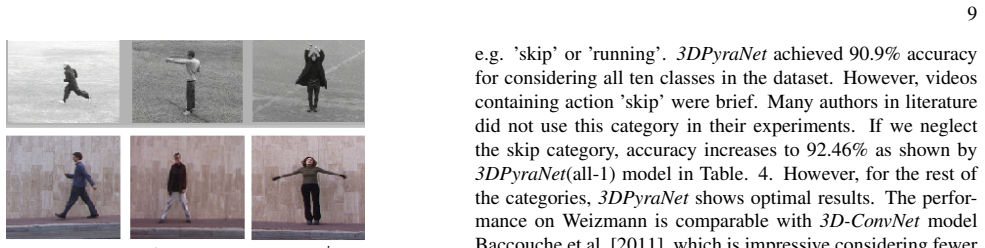
- [Section 5.2 and Table 4 (Weizmann)] The Weizmann protocol is not specified. The paper reports a mean accuracy over five splits but does not define the splits, the number of training/testing sequences per class, or the standard deviation. It also states that the 92.46% 'all-1' result is shown as 3DPyraNet(all-1) in Table 4, but Table 4 contains no such entry. Please provide the split definition, per-split results, and a corrected table or reference.
- [Section 5.3.2 (YUPENN comparisons)] The margin statements for YUPENN are mutually inconsistent. The text says the model falls short of state-of-the-art by 5.33% and later says Feichtenhofer et al. (2014) is better by 1.5%, while Table 4 lists 99 and 96.2 for the two Feichtenhofer entries and 93.67 for 3DPyraNet-F, corresponding to differences of 5.33 and 2.53 percentage points. Please correct the text and table so that the claimed margins are reproducible.
minor comments (6)
- [Section 3.2] The notation table is referred to as 'Table. ??' in two places, but no notation table appears; please add it or remove the references.
- [Section 5.1] The abbreviations 'AR' and 'SR' are used, with 'SR' presumably meaning dynamic scene recognition (DSR); this abbreviation is never defined.
- [Table 4 and Section 4.2] The model name appears as '3DPyraNet-FM' in Table 4 and as '3DPyraNet-F M' in the text; please use one consistent name throughout.
- [Section 5.2] The sentence 'it overcame reported best result by 3DConvNet model, i.e. 88.26% with an average of 91.07% from ten tests' is ambiguous about which model produced the 91.07% average; please rewrite for clarity.
- [Equations 1-2] The symbol 'D' is used both for temporal depth and as the upper limit in summations; a consistent table of symbols would help the reader.
- [General] There are typographical errors such as 'becuase', 'hihg', and inconsistent capitalization; a careful proofread is needed.
Circularity Check
No circularity: the empirical claims rest on held-out SVM evaluation, not on inputs defined in terms of outputs.
full rationale
The paper's central contribution is an architecture plus a fusion/SVM pipeline. The accuracy numbers are obtained by training 3DPyraNet, extracting Norm6 features, training a linear SVM on those features, and classifying test-set feature vectors; Section 4.1 states 'SVM trains over these fused features. Finally, the trained SVM model is used to classify the feature vectors extracted from the testing set using 3DPyraNet.' This is an external held-out evaluation, not a quantity defined by the fitted parameters themselves. The architecture derivation is explicit: Eq. (1) defines the 3D correlation output, Eq. (2) defines the receptive field, Eq. (3) defines pooling, and Eqs. (5)-(26) give backpropagation updates; none of these equations contains the target accuracies as inputs. The only self-citations are to prior pyramidal-network work (Cantoni and Petrosino 2002; Ullah and Petrosino 2016) as architectural inspiration and as a general remark about parameter reduction; no load-bearing uniqueness theorem or ansatz is imported from those citations, and no benchmark number is derived from them. Concerns raised by the reader about non-equivalent evaluation protocols and inconsistent baseline numbers across Tables 2-4 are verifiability/correctness issues, not circularity: they affect whether the reported comparisons are meaningful, but they do not make the reported accuracies equal to the inputs of the method by construction.
Assumptions & free parameters
free parameters (5)
- RF (receptive field size) =
4 or 3 depending on layer and dataset
- O (overlap value) =
3, 2, or 0 depending on layer and dataset
- Temporal depth D =
3
- Number of weight matrices per layer =
3
- Learning rate schedules =
0.00015 with decay for AR; 0.000015 with decay for DSR
assumptions (3)
- domain assumption The proposed 3D correlation weighting scheme improves feature learning for video recognition compared to standard convolutions.
- domain assumption Accuracy numbers from the paper's experimental runs are representative and were obtained without test-set peeking or cherry-picking.
- domain assumption The compared baselines used equivalent evaluation protocols.
Cite this review
Pith. "Pith review of 3DPyranet Features Fusion for Spatio-temporal Feature Learning." pith.science (2026). https://pith.science/paper/ZLWDHQDW
@misc{pith2026250418977,
  author       = {Pith},
  title        = {Pith review of: 3DPyranet Features Fusion for Spatio-temporal Feature Learning},
  year         = {2026},
  howpublished = {\url{https://pith.science/paper/ZLWDHQDW}},
  note         = {Machine review of arXiv:2504.18977}
}
read the original abstract
Convolutional neural network (CNN) slides a kernel over the whole image to produce an output map. This kernel scheme reduces the number of parameters with respect to a fully connected neural network (NN). While CNN has proven to be an effective model in recognition of handwritten characters and traffic signal sign boards, etc. recently, its deep variants have proven to be effective in similar as well as more challenging applications like object, scene and action recognition. Deep CNN add more layers and kernels to the classical CNN, increasing the number of parameters, and partly reducing the main advantage of CNN which is less parameters. In this paper, a 3D pyramidal neural network called 3DPyraNet and a discriminative approach for spatio-temporal feature learning based on it, called 3DPyraNet-F, are proposed. 3DPyraNet introduces a new weighting scheme which learns features from both spatial and temporal dimensions analyzing multiple adjacent frames and keeping a biological plausible structure. It keeps the spatial topology of the input image and presents fewer parameters and lower computational and memory costs compared to both fully connected NNs and recent deep CNNs. 3DPyraNet-F extract the features maps of the highest layer of the learned network, fuse them in a single vector, and provide it as input in such a way to a linear-SVM classifier that enhances the recognition of human actions and dynamic scenes from the videos. Encouraging results are reported with 3DPyraNet in real-world environments, especially in the presence of camera induced motion. Further, 3DPyraNet-F clearly outperforms the state-of-the-art on three benchmark datasets and shows comparable result for the fourth.
Figures


Figures from the paper (2 more)

Reference graph
Works this paper leans on
-
[1]
M. Baccouche, F. Mamalet, C. Wolf, C. Garcia, and A. Baskurt. Sequential deep learning for human action recognition. In Proceedings of the Second International Conference on Human Behavior Unterstanding, HBU'11, pages 29--39, Berlin, Heidelberg, 2011. Springer-Verlag
work page 2011
-
[2]
L. Ballan, M. Bertini, A. Del Bimbo , L. Seidenari, and G. Serra. Effective codebooks for human action representation and classification in unconstrained videos . IEEE Transactions on Multimedia, 14 0 (4 PART 2): 0 1234--1245, 2012. ISSN 15209210. doi:10.1109/TMM.2012.2191268
-
[3]
W. Beil. Volume image processing (vip'93) steerable filters and invariance theory. Pattern Recognition Letters, 15 0 (5): 0 453 -- 460, 1994. ISSN 0167-8655. doi:http://dx.doi.org/10.1016/0167-8655(94)90136-8
-
[4]
Y. Bengio. Practical recommendations for gradient-based training of deep architectures. In Neural Networks: Tricks of the Trade, pages 437--478. Springer, 2012
work page 2012
- [5]
-
[6]
P. Burt and E. Adelson. The laplacian pyramid as a compact image code. IEEE Transactions on Communications, 31 0 (4): 0 532--540, Apr 1983. ISSN 0090-6778. doi:10.1109/TCOM.1983.1095851
arXiv 1983
-
[7]
V. Cantoni and A. Petrosino. Neural recognition in a pyramidal structure . IEEE Transactions on Neural Networks, 13 0 (2): 0 472--480, 2002. doi:1045-9277(02)01806-4
work page 2002
-
[8]
L.-C. Chen, G. Papandreou, I. Kokkinos, K. Murphy, and A. L. Yuille. Semantic image segmentation with deep convolutional nets and fully connected crfs. ICLR, 2015
work page 2015
Show all 70 references
-
[9]
K. G. Derpanis, M. Lecce, K. Daniilidis, and R. P. Wildes. Dynamic scene understanding: The role of orientation features in space and time in scene classification . IEEE Conference on CVPR, pages 1306--1313, 2012. ISSN 1063-6919
2012
-
[10]
Doll\' a r, V
P. Doll\' a r, V. Rabaud, G. Cottrell, and S. Belongie. Behavior recognition via sparse spatio-temporal features . Proceedings - 2nd Joint IEEE International Workshop on Visual Surveillance and Performance Evaluation of Tracking and Surveillance, VS-PETS, 2005: 0 65--72, 2005
2005
-
[11]
A. A. Efros, A. C. Berg, G. Mori, and J. Malik. Recognizing action at a distance . IEEE International Conference on Computer Vision, 2003. ISSN 1478-7814. doi:10.1109/ICCV.2003.1238420
2003 arXiv
-
[12]
Feichtenhofer, A
C. Feichtenhofer, A. Pinz, and R. P. Wildes. Spacetime forests with complementary features for dynamic scene recognition. In BMVC, page 6. Citeseer, 2013
2013
-
[13]
Feichtenhofer, A
C. Feichtenhofer, A. Pinz, and R. Wildes. Bags of spacetime energies for dynamic scene recognition. In Proceedings of the IEEE Conference on CVPR, pages 2681--2688, 2014
2014
-
[14]
Feichtenhofer, A
C. Feichtenhofer, A. Pinz, and R. Wildes. Dynamic Scene Recognition with Complementary Spatiotemporal Features . IEEE Transactions on PAMI, PP 0 (99): 0 1, 2016. ISSN 0162-8828. doi:10.1109/TPAMI.2016.2526008
2016
-
[15]
B. J. Fernandes, G. D. Cavalcanti, and T. I. Ren. A receptive field based approach for face detection. In 2009 International Joint Conference on Neural Networks, pages 803--810. IEEE, 2009 a
2009
-
[16]
B. J. T. Fernandes, G. D. C. Cavalcanti, and T. I. Ren. Nonclassical Receptive Field Inhibition Applied to Image Segmentation Receptive and Inhibitory Fields . Neural Network World, 19 0 (1): 0 21--37, 2009 b
2009
-
[17]
B. J. T. Fernandes, G. D. C. Cavalcanti, and T. I. Ren. Lateral inhibition pyramidal neural network for image classification. IEEE transactions on cybernetics, 43 0 (6): 0 2082--91, dec 2013. ISSN 2168-2275. doi:10.1109/TCYB.2013.2240295
2013
-
[18]
N. D. Freitas. Deep learning of invariant spatio-temporal features from video. In Workshop on Deep Learning and Unsupervised Feature Learning in NIPS, pages 1--9, 2010
2010
-
[19]
Fukushima
K. Fukushima. Neocognitron: A hierarchical neural network capable of visual pattern recognition . Neural Networks, 1 0 (2): 0 119--130, Jan. 1988. ISSN 08936080
1988
-
[20]
Glorot and Y
X. Glorot and Y. Bengio. Understanding the difficulty of training deep feedforward neural networks. In Proceedings of the thirteenth international conference on artificial intelligence and statistics, pages 249--256. JMLR Workshop and Conference Proceedings, 2010
2010
-
[21]
Goodfellow, Y
I. Goodfellow, Y. Bengio, and A. Courville. Deep learning. Book in preparation for MIT Press, 2016. URL http://www.deeplearningbook.org
2016
-
[22]
B. Graham. Fractional max-pooling. CoRR, abs/1412.6071, 2014
2014 arXiv
-
[23]
S. Han, H. Mao, and W. J. Dally. A deep neural network compression pipeline: Pruning, quantization, huffman encoding. arXiv preprint arXiv:1510.00149, 10, 2015 a
2015 arXiv
-
[24]
S. Han, J. Pool, J. Tran, and W. J. Dally. Learning both weights and connections for efficient neural networks. CoRR, abs/1506.02626, 2015 b
2015 arXiv
-
[25]
K. He, X. Zhang, S. Ren, and J. Sun. Delving deep into rectifiers: Surpassing human-level performance on imagenet classification. In IEEE International Conference on Computer Vision, pages 1026--1034, 2015
2015
-
[26]
K. He, X. Zhang, S. Ren, and J. Sun. Deep residual learning for image recognition. In Proceedings of the IEEE conference on computer vision and pattern recognition, pages 770--778, 2016
2016
-
[27]
Huang, Z
G. Huang, Z. Liu, L. Van Der Maaten, and K. Q. Weinberger. Densely connected convolutional networks. In Proceedings of the IEEE conference on computer vision and pattern recognition, pages 4700--4708, 2017
2017
-
[28]
S. Ji, M. Yang, and K. Yu. 3D convolutional neural networks for human action recognition. IEEE transactions on PAMI, 35 0 (1): 0 221--31, 2013. ISSN 1939-3539
2013
-
[29]
Karpathy and T
A. Karpathy and T. Leung. Large-scale Video Classification with Convolutional Neural Networks . Proceedings of 2014 IEEE Conference on CVPR, pages 1725--1732, 2014
2014
-
[30]
Krizhevsky, I
A. Krizhevsky, I. Sutskever, and G. E. Hinton. ImageNet Classification with Deep Convolutional Neural Networks . In Advances in Neural Information Processing Systems, pages 1097--1105, 2012
2012
-
[31]
Laptev, B
I. Laptev, B. Caputo, C. Sch\" u ldt, and T. Lindeberg. Local velocity-adapted motion events for spatio-temporal recognition. Comput. Vis. Image Underst., 108 0 (3): 0 207--229, Dec. 2007. ISSN 1077-3142
2007
-
[32]
Lazebnik and C
S. Lazebnik and C. Schmid. Beyond Bags of Features : Spatial Pyramid Matching for Recognizing Natural Scene Categories . Proceedings of the IEEE Computer Society Conference on CVPR, 2: 0 2169--2178, 2006. doi:10.1109/CVPR.2006.68
2006 doi
-
[33]
Q. V. Le, W. Y. Zou, S. Y. Yeung, and A. Y. Ng. Learning hierarchical invariant spatio-temporal features for action recognition with independent subspace analysis . Proceedings of the IEEE Computer Society Conference on CVPR, pages 3361--3368, 2011
2011
-
[34]
Lecun, L
Y. Lecun, L. Bottou, Y. Bengio, and P. Haffner. Gradient-based learning applied to document recognition . Proceedings of the IEEE, 86 0 (11): 0 2278--2324, 1998
1998
-
[35]
C.-Y. Lee, S. Xie, P. Gallagher, Z. Zhang, and Z. Tu. Deeply-supervised nets. In Artificial intelligence and statistics, pages 562--570. Pmlr, 2015
2015
-
[36]
M. Lin, Q. Chen, and S. Yan. Network in network. CoRR, abs/1312.4400, 2013
2013 arXiv
-
[37]
W. Liu, Z. Wang, D. Tao, and J. Yu. Hessian Regularized Sparse Coding for Human Action Recognition . In 21st International Conference on MMM, pages 502--511, 2015
2015
-
[38]
J. Long, E. Shelhamer, and T. Darrell. Fully convolutional networks for semantic segmentation . Cvpr 2015, 2015
2015
-
[39]
D. G. Lowe. Distinctive image features from scale-invariant keypoints. International Journal of Computer Vision, 60 0 (2): 0 91--110, 2004. ISSN 1573-1405. doi:10.1023/B:VISI.0000029664.99615.94
2004
-
[40]
A. L. Maas, A. Y. Hannun, A. Y. Ng, et al. Rectifier nonlinearities improve neural network acoustic models. In Proc. icml, volume 30, page 3. Atlanta, GA, 2013
2013
-
[41]
Maddalena and A
L. Maddalena and A. Petrosino. The 3dsobs+ algorithm for moving object detection. Computer Vision and Image Understanding, 122: 0 65 -- 73, 2014
2014
-
[42]
Maninis, P
K. Maninis, P. Koutras, and P. Maragos. Advances on action recognition in videos using an interest point detector based on multiband spatio-temporal energies. In 2014 IEEE International Conference on Image Processing (ICIP), pages 1490--1494, 2014. doi:10.1109/ICIP.2014.7025298
2014
-
[43]
Melfi, S
R. Melfi, S. Kondra, and A. Petrosino. Human activity modeling by spatio temporal textural appearance . Pattern Recognition Letters, 34 0 (15): 0 1990--1994, Nov. 2013
1990
-
[44]
G. B. Orr and K.-R. M \"u ller. Neural networks: tricks of the trade. Springer, 2003
2003
-
[45]
Y. Pang, M. Sun, X. Jiang, and X. Li. Convolution in convolution for network in network. IEEE transactions on neural networks and learning systems, 29 0 (5): 0 1587--1597, 2017
2017
-
[46]
S. L. Phung and A. Bouzerdoum. A pyramidal neural network for visual pattern recognition. IEEE transactions on neural networks / a publication of the IEEE Neural Networks Council, 18 0 (2): 0 329--43, Mar. 2007
2007
-
[47]
Schindler and L
K. Schindler and L. Van Gool . Action Snippets: How many frames does human action recognition require? 26th IEEE Conference on CVPR, 2008
2008
-
[48]
Sch\" u ldt, I
C. Sch\" u ldt, I. Laptev, and B. Caputo. Recognizing human actions: A local SVM approach . Proceedings - International Conference on Pattern Recognition, 3: 0 32--36, 2004. ISSN 10514651. doi:10.1109/ICPR.2004.1334462
2004 arXiv
-
[49]
Scovanner, S
P. Scovanner, S. Ali, and M. Shah. A 3-dimensional sift descriptor and its application to action recognition . Proceedings of the ACM International Conference on Multimedia (MM 2007), page 357, 2007. doi:10.1145/1291233.1291311
2007
-
[50]
Simonyan and A
K. Simonyan and A. Zisserman. Very deep convolutional networks for large-scale image recognition. CoRR, abs/1409.1556, 2014
2014 arXiv
-
[51]
A. F. Smeaton, P. Over, and W. Kraaij. High- L evel F eature D etection from V ideo in TRECV id: a 5- Y ear R etrospective of A chievements. In A. Divakaran, editor, Multimedia Content Analysis, Theory and Applications, pages 151--174. Springer Verlag, Berlin, 2009. ISBN 978-0...
2009
-
[52]
Szegedy, W
C. Szegedy, W. Liu, Y. Jia, P. Sermanet, S. Reed, D. Anguelov, D. Erhan, V. Vanhoucke, and A. Rabinovich. Going deeper with convolutions. In CVPR , USA, June 7-12 , pages 1--9, 2015
2015
-
[53]
Taigman, M
Y. Taigman, M. Yang, M. Ranzato, and L. Wolf. DeepFace: Closing the Gap to Human-Level Performance in Face Verification . In IEEE Conference on CVPR, pages 1701--1708. IEEE, jun 2014. ISBN 978-1-4799-5118-5. doi:10.1109/CVPR.2014.220
2014 doi
-
[54]
G. W. Taylor, R. Fergus, Y. LeCun, and C. Bregler. Convolutional learning of spatio-temporal features . Lecture Notes in Computer Science, 6316 LNCS 0 (PART 6): 0 140--153, 2010. ISSN 03029743
2010
-
[55]
Theriault, N
C. Theriault, N. Thome, and M. Cord. Dynamic scene classification: Learning motion descriptors with slow features analysis. In IEEE Conference on CVPR, pages 2603--2610, June 2013 a
2013
-
[56]
Theriault, N
C. Theriault, N. Thome, and M. Cord. Dynamic scene classification: Learning motion descriptors with slow features analysis . Proceedings of the IEEE Computer Society Conference on Computer Vision and Pattern Recognition, pages 2603--2610, 2013 b . ISSN 10636919
2013
-
[57]
D. Tran, L. Bourdev, R. Fergus, L. Torresani, and M. Paluri. Learning Spatiotemporal Features with 3D Convolutional Networks . International Conference on Computer Vision, 2015
2015
-
[58]
Uetz and S
R. Uetz and S. Behnke. Locally-connected hierarchical neural networks for gpu-accelerated object recognition. In NIPS 2009 Workshop on Large-Scale Machine Learning: Parallelism and Massive Datasets, volume 10, page 13, 2009
2009
-
[59]
Ullah and A
I. Ullah and A. Petrosino. About pyramid structure in convolutional neural networks. In International Joint Conference on Neural Networks (IJCNN), pages 1318--1324, 2016. doi:10.1109/IJCNN.2016.7727350
2016
-
[60]
H. Wang, M. M. Ullah, A. Klaser, I. Laptev, and C. Schmid. Evaluation of local spatio-temporal features for action recognition . British Machine Vision Conference, pages 124.1--124.11, 2009
2009
-
[61]
H. Wang, A. Kläser, C. Schmid, and C.-L. Liu. Action recognition by dense trajectories. In CVPR 2011, pages 3169--3176, 2011. doi:10.1109/CVPR.2011.5995407
2011
-
[62]
P. Wang, Y. Cao, C. Shen, L. Liu, and H. Shen. Temporal pyramid pooling based convolutional neural network for action recognition. IEEE Transactions on Circuits and Systems for Video Technology, 2016
2016
-
[63]
Weinland, M
D. Weinland, M. \" O zuysal, and P. Fua. Making action recognition robust to occlusions and viewpoint changes . Lecture Notes in Computer Science, 6313 LNCS 0 (PART 3): 0 635--648, 2010
2010
-
[64]
Yang and Y
X. Yang and Y. Tian. Action Recognition Using Super Sparse Coding Vector with Spatio-temporal Awareness . In ECCV, volume 8690, pages 727--741, 2014. ISBN 978-3-319-10604-5
2014
-
[65]
Yangqing Jia , Chang Huang , and T. Darrell. Beyond spatial pyramids: Receptive field learning for pooled image features . In IEEE Conference on CVPR, pages 3370--3377. IEEE, jun 2012. ISBN 978-1-4673-1228-8. doi:10.1109/CVPR.2012.6248076
2012
-
[66]
M. D. Zeiler and R. Fergus. Stochastic pooling for regularization of deep convolutional neural networks. arXiv preprint arXiv:1301.3557, 2013
2013 arXiv
-
[67]
M. D. Zeiler and R. Fergus. Visualizing and understanding convolutional networks. In 13th European Conference on Computer Vision, Zurich, Switzerland, September 6-12, pages 818--833, 2014
2014
-
[68]
write newline
" write newline "" before.all 'output.state := FUNCTION n.dashify 't := "" t empty not t #1 #1 substring "-" = t #1 #2 substring "--" = not "--" * t #2 global.max substring 't := t #1 #1 substring "-" = "-" * t #2 global.max substring 't := while if t #1 #1 substring * t #2 gl...
-
[69]
write newline
" write newline "" before.all 'output.state := FUNCTION n.dashify 't := "" t empty not t #1 #1 substring "-" = t #1 #2 substring "--" = not "--" * t #2 global.max substring 't := t #1 #1 substring "-" = "-" * t #2 global.max substring 't := while if t #1 #1 substring * t #2 gl...
-
[70]
write newline
" write newline "" before.all 'output.state := FUNCTION n.dashify 't := "" t empty not t #1 #1 substring "-" = t #1 #2 substring "--" = not "--" * t #2 global.max substring 't := t #1 #1 substring "-" = "-" * t #2 global.max substring 't := while if t #1 #1 substring * t #2 gl...
Reviewed August 16, 2026 · model on record in the stance chip above.
Discussion (0). Continue with ORCID to comment.