REVIEW 2 major objections 4 minor 49 references
A biconvex method for minimum-time motion planning through sequences of convex sets
T0 review · 2 major / 4 minor · reviewed 2026-08-16 · deepseek-v4-flash
Pith's one-line read A biconvex alternating scheme solves minimum-time motion planning through convex sets, returning complete, anytime, near-optimal trajectories without tuning.
desk verdict SCS is a genuinely useful biconvex planner with transparent math and honest limitations; the strict-positivity assumption is real but disclosed, and the paper deserves a serious referee. read the letter →
The pith
A machine-rendered reading of the paper's core claim, the machinery that carries it, and where it could break.
The reading
What carries the argument
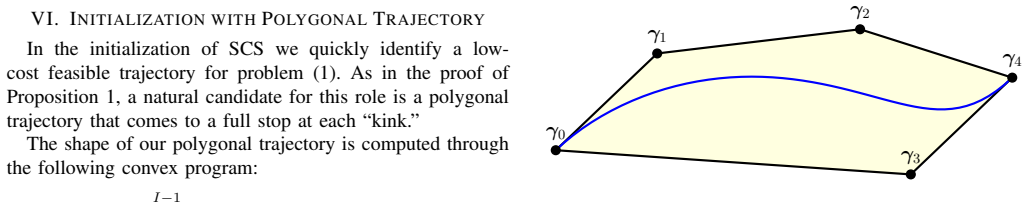
The carrying mechanism is a pair of convex restrictions of one nonconvex program. In the fixed-transition-velocity subproblem, velocity continuity becomes linear and the acceleration set $T_i^2\mathcal{A}$ is replaced by the tangent underestimate $\bar T_i(2T_i-\bar T_i)\mathcal{A}$ around the nominal traversal time. In the fixed-transition-point subproblem, the trajectory inside each set is reparameterized by reciprocals $S_i=1/T_i$ and scaled position functions $r_i=q_i/T_i$, which makes velocity constraints convex and leaves the acceleration constraint as the only nonconvexity; it is then relaxed by the analogous underestimate $\bar T_i(2-\bar T_i S_i)\mathcal{A}$. Each subproblem is feasible whenever the current trajectory is feasible and yields a trajectory of no greater duration, which is what makes full-step alternation, monotone convergence, completeness, and the anytime property possible. Bézier curves with their convex-hull property supply the finite-dimensional implementation.
What would settle it
Take a one-dimensional or two-dimensional corridor satisfying Assumption 1 whose true time-optimal trajectory is known from dynamic programming or bang-bang analysis; run SCS with high Bézier degree and a tight tolerance (for example $\varepsilon=10^{-4}$) and measure the duration gap and whether every early-stopped iterate satisfies all constraints, since a gap clearly above the few percent reported, a non-monotone cost sequence, or an infeasible early iterate would contradict the central claims.
Extended reading notes
Core claim
The paper's central claim is that the minimum-time problem can be solved by biconvex alternation in a way that is complete and anytime, even though the full problem is nonconvex. The key fact is that fixing either the transition points $q(t_i)$ or the transition velocities $\dot q(t_i)$ makes the remaining problem convex, up to a conservative linearization of the acceleration constraint that underestimates $T_i^2$ (or $1/S_i$) at the current traversal times. Because each convex subproblem is a restriction rather than an approximation that can leave feasibility, SCS can take full steps toward their optima without a line search or trust region; the duration decreases monotonically and any intermediate iterate is feasible. The authors report worst-case duration gaps of about 3.2% against nonconvex solvers on their test battery, with typical gaps near 0.1–1.2% when the stopping tolerance is tightened, and they show that the same package-transfer task completes 28% faster than the trust-region baseline and 50% faster than a waypoint planner.
Load-bearing premise
The whole guarantee rests on every traversal time $T_i$ being strictly positive; Assumption 1 ensures this geometrically, and when an optimal trajectory merely grazes one set, the $S_i=1/T_i$ transformation used in the fixed-transition-point subproblem breaks down.
Editorial extensions
If this is right
- SCS can be used as an online motion planner for robots operating in convex corridors: planning completes in milliseconds and any interruption yields a usable trajectory.
- Because no line-search or trust-region parameters are involved, deploying the method in production avoids algorithm-specific tuning; only the Bézier degree and stopping tolerance remain.
- On the reported benchmark family, SCS scales nearly linearly with the number of safe sets, facets, space dimension, and trajectory degree, so the method should remain practical for large corridors and high-dimensional arms.
- The small duration gap to nonconvex optimizers (0.1–3.2%) means SCS is appropriate where near-optimal, reliable, fast plans matter more than certified global optimality.
Reading between the lines
- The same convex-restriction pattern should carry over to fixed-final-time costs that penalize velocity and acceleration, as the paper hints; the reciprocal-time change of variables is not specific to minimizing total time.
- A natural test of the completeness-versus-optimality distinction is to benchmark SCS against a certified global method in low dimensions; the paper only compares against local nonconvex solvers and heuristic baselines.
- Because only convex geometry and convex derivative constraints are used, SCS should compose with any convex-corridor generator, including GPU-inflated sets; the package-transfer experiments suggest but do not establish this at scale.
- The method could also be extended to jerk or higher-order derivative constraints by raising the Bézier degree, but convexity of the resulting constraints would need to be rechecked.
Signed reviews
Editorial analysis
A structured set of objections, weighed in public.
Referee Report
Summary. This paper proposes SCS, an alternating convex-optimization algorithm for the minimum-time motion-planning problem of traversing an ordered sequence of convex sets while respecting convex velocity and acceleration constraints. The authors reformulate the nonconvex infinite-dimensional problem using per-set time scaling, derive two convex subproblems by fixing either transition velocities or transition points and underestimating the time-dependent terms with tangent lines, and initialize the method with a polygonal trajectory. The paper claims monotone convergence, anytime feasibility, no line-search or trust-region parameters, and empirically reports faster runtimes than SNOPT and IPOPT and lower-duration trajectories than trust-region and waypoint baselines, including a two-robot package-transfer benchmark.
Significance. The manuscript is a solid, clearly written contribution to a practical problem. Its strengths include a transparent derivation from elementary convex analysis, where every iterate is feasible by construction and no step-size tuning is required; a fully specified finite-dimensional Bezier implementation in Appendix A; reproducible code; and systematic experiments across problem size, facet count, dimension, and polynomial degree. If the claims hold, the method offers a parameter-light, anytime alternative to nonconvex trajectory optimization within its scope. The principal caveat is that the formal guarantees rely on Assumption 1, which rules out zero traversal times; this is acknowledged in the body but not in the abstract.
major comments (2)
- [§II-B, §IX, abstract] The completeness and anytime guarantees are proven only under Assumption 1, which ensures strictly positive traversal times T_i. The reformulation in (15) uses S_i = 1/T_i, so it is not well posed when some optimal traversal time is zero. The abstract states 'guaranteed to converge, returns a feasible trajectory even if stopped early' without this qualification, and the limitations paragraph in §IX proposes an artificial lower bound on traversal times without a proof that the modified method remains complete or anytime, or a bound on the induced suboptimality. I recommend qualifying the abstract (e.g., 'under a mild nondegeneracy assumption') and either analyzing the lower-bound variant or explicitly labeling it as a heuristic.
- [§VIII-A] The statement 'SCS is guaranteed to converge monotonically' is used to support the abstract's 'guaranteed to converge.' The proof in §VIII-A shows only that the objective values are nonincreasing and bounded below; it does not establish convergence of the trajectory iterates to a limit or to a stationary point. Since the stopping criterion is a relative-decrease tolerance, the sense of 'converge' should be stated precisely to avoid overstating the theoretical result.
minor comments (4)
- [§X-B] The phrases 'runtimes increase by 3060', 'grows by 210', 'by 17.6', and 'by 9.9' are ambiguous; they should be written as 'by a factor of 30–60', 'by a factor of 2–10', etc.
- [§V] The variable r_i is used in (12) but defined only indirectly as ˙r_i = ˙q_i/T_i; please state explicitly that r_i = q_i/T_i before (12).
- [§VIII-A] The anytime claim should specify that feasibility is guaranteed at iteration boundaries, not during the solve of a convex subproblem, since stopping mid-solve does not necessarily provide a feasible trajectory.
- [§II-B] The phrase 'forces our trajectory to cover a nonzero distance within each safe set' is imprecise; Assumption 1 actually guarantees a positive traversal time, which is the property used in the change of variables.
Circularity Check
No significant circularity: the convex restrictions, initialization, and monotone-improvement argument are derived from explicit inequalities and an independently constructed feasible trajectory; self-citations are contextual or baseline only.
full rationale
The paper's central derivation chain is self-contained. The nonconvex reformulation (7) is obtained by the algebraic change of variables T_i and q_i, with velocity and acceleration expressed as dot(q_i)/T_i and ddot(q_i)/T_i^2. The two convex subproblems are genuine convex restrictions: equation (10) replaces T_i^2 A with the smaller set bar(T_i)(2T_i - bar(T_i))A, justified by the inequality T_i^2 >= bar(T_i)(2T_i - bar(T_i)) and by 0 in A, so any solution of (11) is feasible for (7); similarly, (14) replaces (1/S_i)A with bar(T_i)(2 - bar(T_i)S_i)A, using 1/S_i >= bar(T_i)(2 - bar(T_i)S_i) under 2 >= bar(T_i)S_i. Feasibility of the initialization is proved in Proposition 1 by an explicit polygonal construction, and the relaxation T_i >= 1/S_i in (17) is shown to be lossless by an explicit rescaling. Completeness and the anytime property follow directly from these facts: the initialization produces a feasible trajectory and the convex restrictions never leave the feasible set, so every iterate is feasible. The self-citations to [28] appear as a baseline, as a reproducibility note for Proposition 1, and for standard Bezier-curve facts, none of which is load-bearing for the method's guarantees. The comparison results against SNOPT and IPOPT are external benchmarks, not fitted predictions. The only significant caveat, Assumption 1 and the treatment of zero traversal times, is explicitly acknowledged in Section IX as a limitation rather than being disguised as a result; it does not make the derivation circular.
Assumptions & free parameters
assumptions (5)
- domain assumption Each safe set Qi is closed, convex, and intersects the next (Qi ∩ Q_{i+1} ≠ ∅).
- domain assumption The velocity set V and acceleration set A are closed, convex, and contain the origin in their interior.
- domain assumption Assumption 1: qinit ∉ Q2, qterm ∉ Q_{I-1}, and Qi ∩ Q_{i+1} ∩ Q_{i+2} = ∅ for i ≤ I-2.
- standard math For a convex set S, the set {(x,λ): λ ≥ 0, x ∈ λS} is convex, and the tangent linearization of a convex function is a global underestimator.
- domain assumption Bézier curves of degree K ≥ 3 can represent straight-line segments with zero endpoint velocity.
Cite this review
Pith. "Pith review of A biconvex method for minimum-time motion planning through sequences of convex sets." pith.science (2026). https://pith.science/paper/UQ5B65WR
@misc{pith2026250418978,
  author       = {Pith},
  title        = {Pith review of: A biconvex method for minimum-time motion planning through sequences of convex sets},
  year         = {2026},
  howpublished = {\url{https://pith.science/paper/UQ5B65WR}},
  note         = {Machine review of arXiv:2504.18978}
}
read the original abstract
We consider the problem of designing a smooth trajectory that traverses a sequence of convex sets in minimum time, while satisfying given velocity and acceleration constraints. This problem is naturally formulated as a nonconvex program. To solve it, we propose a biconvex method that quickly produces an initial trajectory and iteratively refines it by solving two convex subproblems in alternation. This method is guaranteed to converge, returns a feasible trajectory even if stopped early, and does not require the selection of any line-search or trust-region parameter. Exhaustive experiments show that our method finds high-quality trajectories in a fraction of the time of state-of-the-art solvers for nonconvex optimization. In addition, it achieves runtimes comparable to industry-standard waypoint-based motion planners, while consistently designing lower-duration trajectories than existing optimization-based planners.
Figures


Figures from the paper (4 more)


Reference graph
Works this paper leans on
-
[28]
Fast path planning through large collections of safe boxes
Tobia Marcucci, Parth Nobel, Russ Tedrake, and Stephen Boyd. Fast path planning through large collections of safe boxes. IEEE Transactions on Robotics , 40:3795–3811, 2024
work page 2024
-
[1]
Practical methods for optimal control and estimation using nonlinear programming
John T Betts. Practical methods for optimal control and estimation using nonlinear programming . SIAM, 2010
2010
-
[2]
Massively parallelizing the RRT and the RRT*
Joshua Bialkowski, Sertac Karaman, and Emilio Frazzoli. Massively parallelizing the RRT and the RRT*. In IEEE/RSJ International Conference on Intelligent Robots and Systems, pages 3513–3518. IEEE, 2011
work page 2011
-
[3]
Stephen Boyd and Lieven Vandenberghe. Convex opti- mization. Cambridge University Press, 2004
work page 2004
-
[4]
Jing Chen, Tianbo Liu, and Shaojie Shen. Online gener- ation of collision-free trajectories for quadrotor flight in unknown cluttered environments. In IEEE International Conference on Robotics and Automation , pages 1476–
-
[5]
GCS*: Forward heuristic search on implicit graphs of convex sets
Shao Yuan Chew Chia, Rebecca H Jiang, Bernhard Paus Graesdal, Leslie Pack Kaelbling, and Russ Tedrake. GCS*: Forward heuristic search on implicit graphs of convex sets. arXiv preprint arXiv:2407.08848 , 2024
arXiv 2024
-
[6]
Certified polyhedral de- compositions of collision-free configuration space
Hongkai Dai, Alexandre Amice, Peter Werner, Annan Zhang, and Russ Tedrake. Certified polyhedral de- compositions of collision-free configuration space. The International Journal of Robotics Research , 43(9):1322– 1341, 2024
work page 2024
-
[7]
Computing large con- vex regions of obstacle-free space through semidefinite programming
Robin Deits and Russ Tedrake. Computing large con- vex regions of obstacle-free space through semidefinite programming. In Algorithmic Foundations of Robotics XI: Selected Contributions of the Eleventh International Workshop on the Algorithmic Foundations of Robotics , pages 109–124. Springer, 2015
2015
Show all 49 references
-
[8]
Efficient mixed-integer planning for UA Vs in cluttered environments
Robin Deits and Russ Tedrake. Efficient mixed-integer planning for UA Vs in cluttered environments. In IEEE International Conference on Robotics and Automation , pages 42–49. IEEE, 2015
2015
-
[9]
A general system for heuristic minimization of convex functions over non-convex sets
Steven Diamond, Reza Takapoui, and Stephen Boyd. A general system for heuristic minimization of convex functions over non-convex sets. Optimization Methods and Software, 33(1):165–193, 2018
2018
-
[10]
Algorithms for polynomials in Bernstein form
Rida Farouki and V Rajan. Algorithms for polynomials in Bernstein form. Computer Aided Geometric Design , 5(1):1–26, 1988
1988
-
[11]
SNOPT: An SQP algorithm for large-scale constrained optimization
Philip E Gill, Walter Murray, and Michael A Saunders. SNOPT: An SQP algorithm for large-scale constrained optimization. SIAM Review, 47(1):99–131, 2005
2005
-
[12]
Clarabel: An interior- point solver for conic programs with quadratic objectives
Paul J Goulart and Yuwen Chen. Clarabel: An interior- point solver for conic programs with quadratic objectives. arXiv preprint arXiv:2405.12762 , 2024
2024 arXiv
-
[13]
ALTRO: A fast solver for constrained trajectory optimization
Taylor A Howell, Brian E Jackson, and Zachary Manch- ester. ALTRO: A fast solver for constrained trajectory optimization. In IEEE/RSJ International Conference on Intelligent Robots and Systems (IROS), pages 7674–7679. IEEE, 2019
2019
-
[14]
Gomp: Grasp- optimized motion planning for bin picking
Jeffrey Ichnowski, Michael Danielczuk, Jingyi Xu, Vishal Satish, and Ken Goldberg. Gomp: Grasp- optimized motion planning for bin picking. In IEEE International Conference on Robotics and Automation , pages 5270–5277. IEEE, 2020
2020
-
[15]
STOMP: Stochastic trajectory optimization for motion planning
Mrinal Kalakrishnan, Sachin Chitta, Evangelos Theodorou, Peter Pastor, and Stefan Schaal. STOMP: Stochastic trajectory optimization for motion planning. In IEEE International Conference on Robotics and Automation, pages 4569–4574. IEEE, 2011
2011
-
[16]
Optimal kino- dynamic motion planning using incremental sampling- based methods
Sertac Karaman and Emilio Frazzoli. Optimal kino- dynamic motion planning using incremental sampling- based methods. In 49th IEEE Conference on Decision and Control, pages 7681–7687. IEEE, 2010
2010
-
[17]
Sampling-based al- gorithms for optimal motion planning
Sertac Karaman and Emilio Frazzoli. Sampling-based al- gorithms for optimal motion planning. The International Journal of Robotics Research , 30(7):846–894, 2011
2011
-
[18]
Probabilistic roadmaps for path planning in high-dimensional configuration spaces
Lydia Kavraki, Petr Svestka, J-C Latombe, and Mark Overmars. Probabilistic roadmaps for path planning in high-dimensional configuration spaces. IEEE Transac- tions on Robotics and Automation , 12(4):566–580, 1996
1996
-
[19]
Rapidly-exploring random trees: A new tool for path planning
Steven LaValle. Rapidly-exploring random trees: A new tool for path planning. TR 98-11, Computer Science Department, Iowa State University , 1998
1998
-
[20]
Randomized kinodynamic planning
Steven M LaValle and James J Kuffner Jr. Randomized kinodynamic planning. The International Journal of Robotics Research, 20(5):378–400, 2001
2001
-
[21]
Time-optimal control of a multidimensional in- tegrator chain with applications
Mirko Leomanni, Gabriele Costante, and Francesco Fer- rante. Time-optimal control of a multidimensional in- tegrator chain with applications. IEEE Control Systems Letters, 6:2371–2376, 2022
2022
-
[22]
Asymptotically optimal sampling-based kinodynamic planning
Yanbo Li, Zakary Littlefield, and Kostas E Bekris. Asymptotically optimal sampling-based kinodynamic planning. The International Journal of Robotics Re- search, 35(5):528–564, 2016
2016
-
[23]
Minimum-time speed optimisation over a fixed path
Thomas Lipp and Stephen Boyd. Minimum-time speed optimisation over a fixed path. International Journal of Control, 87(6):1297–1311, 2014
2014
-
[24]
Planning dynamically feasible trajectories for quadrotors using safe flight corridors in 3-D complex environments
Sikang Liu, Michael Watterson, Kartik Mohta, Ke Sun, Subhrajit Bhattacharya, Camillo J Taylor, and Vijay Kumar. Planning dynamically feasible trajectories for quadrotors using safe flight corridors in 3-D complex environments. IEEE Robotics and Automation Letters , 2 (3):1688–...
2017
-
[25]
Convex optimization for trajectory generation: A tutorial on generating dynamically feasible trajectories reliably and efficiently
Danylo Malyuta, Taylor P Reynolds, Michael Szmuk, Thomas Lew, Riccardo Bonalli, Marco Pavone, and Behc ¸et Ac ¸ıkmes ¸e. Convex optimization for trajectory generation: A tutorial on generating dynamically feasible trajectories reliably and efficiently. IEEE Control Systems Mag...
2022
-
[26]
Graphs of Convex Sets with Applications to Optimal Control and Motion Planning
Tobia Marcucci. Graphs of Convex Sets with Applications to Optimal Control and Motion Planning . PhD thesis, Massachusetts Institute of Technology, 2024
2024
-
[27]
Motion planning around obstacles with convex optimization
Tobia Marcucci, Mark Petersen, David von Wrangel, and Russ Tedrake. Motion planning around obstacles with convex optimization. Science robotics , 8(84):eadf7843, 2023
2023
-
[29]
Shortest paths in graphs of convex sets
Tobia Marcucci, Jack Umenberger, Pablo Parrilo, and Russ Tedrake. Shortest paths in graphs of convex sets. SIAM Journal on Optimization , 34(1):507–532, 2024
2024
-
[30]
Multi-query shortest-path problem in graphs of convex sets
Savva Morozov, Tobia Marcucci, Alexandre Amice, Bernhard Paus Graesdal, Rohan Bosworth, Pablo A Parrilo, and Russ Tedrake. Multi-query shortest-path problem in graphs of convex sets. arXiv preprint arXiv:2409.19543, 2024
2024 arXiv
-
[31]
GPU-based parallel colli- sion detection for fast motion planning
Jia Pan and Dinesh Manocha. GPU-based parallel colli- sion detection for fast motion planning. The International Journal of Robotics Research , 31(2):187–200, 2012
2012
-
[32]
Semidefinite programming relaxations for semialgebraic problems
Pablo A Parrilo. Semidefinite programming relaxations for semialgebraic problems. Mathematical programming, 96:293–320, 2003
2003
-
[33]
Motion planning with sequential convex optimization and convex colli- sion checking
John Schulman, Yan Duan, Jonathan Ho, Alex Lee, Ibrahim Awwal, Henry Bradlow, Jia Pan, Sachin Patil, Ken Goldberg, and Pieter Abbeel. Motion planning with sequential convex optimization and convex colli- sion checking. The International Journal of Robotics Research, 33(9):1251...
2014
-
[34]
Disciplined multi-convex programming
Xinyue Shen, Steven Diamond, Madeleine Udell, Yuan- tao Gu, and Stephen Boyd. Disciplined multi-convex programming. In 29th Chinese Control and Decision Conference, pages 895–900. IEEE, 2017
2017
-
[35]
Curobo: Parallelized collision-free robot motion generation
Balakumar Sundaralingam, Siva Kumar Sastry Hari, Adam Fishman, Caelan Garrett, Karl Van Wyk, Valts Blukis, Alexander Millane, Helen Oleynikova, Ankur Handa, Fabio Ramos, et al. Curobo: Parallelized collision-free robot motion generation. In IEEE Inter- national Conference on R...
2023
-
[36]
Drake: Model-based design and verification for robotics, 2019
Russ Tedrake and the Drake Development Team. Drake: Model-based design and verification for robotics, 2019
2019
-
[37]
LQR-trees: Feedback motion planning via sums-of-squares verification
Russ Tedrake, Ian Manchester, Mark Tobenkin, and John Roberts. LQR-trees: Feedback motion planning via sums-of-squares verification. The International Journal of Robotics Research , 29(8):1038–1052, 2010
2010
-
[38]
Motions in microseconds via vectorized sampling-based planning
Wil Thomason, Zachary Kingston, and Lydia E Kavraki. Motions in microseconds via vectorized sampling-based planning. In IEEE International Conference on Robotics and Automation, pages 8749–8756. IEEE, 2024
2024
-
[39]
Newton methods for k-order markov constrained motion problems
Marc Toussaint. Newton methods for k-order markov constrained motion problems. arXiv preprint arXiv:1407.0414, 2014
2014 arXiv
-
[40]
Time-optimal path tracking for robots: A convex optimization approach
Diederik Verscheure, Bram Demeulenaere, Jan Swevers, Joris De Schutter, and Moritz Diehl. Time-optimal path tracking for robots: A convex optimization approach. IEEE Transactions on Automatic Control , 54(10):2318– 2327, 2009
2009
-
[41]
On the imple- mentation of an interior-point filter line-search algorithm for large-scale nonlinear programming
Andreas W ¨achter and Lorenz T Biegler. On the imple- mentation of an interior-point filter line-search algorithm for large-scale nonlinear programming. Mathematical Programming, 106:25–57, 2006
2006
-
[42]
Fast iterative region inflation for computing large 2-D/3-D convex regions of obstacle- free space
Qianhao Wang, Zhepei Wang, Mingyang Wang, Jialin Ji, Zhichao Han, Tianyue Wu, Rui Jin, Yuman Gao, Chao Xu, and Fei Gao. Fast iterative region inflation for computing large 2-D/3-D convex regions of obstacle- free space. arXiv preprint arXiv:2403.02977 , 2024
2024 arXiv
-
[43]
Fast model predictive control using online optimization
Yang Wang and Stephen Boyd. Fast model predictive control using online optimization. IEEE Transactions on Control Systems Technology, 18(2):267–278, 2009
2009
-
[44]
Approximating robot configu- ration spaces with few convex sets using clique covers of visibility graphs
Peter Werner, Alexandre Amice, Tobia Marcucci, Daniela Rus, and Russ Tedrake. Approximating robot configu- ration spaces with few convex sets using clique covers of visibility graphs. In IEEE International Conference on Robotics and Automation, pages 10359–10365. IEEE, 2024
2024
-
[45]
Faster algorithms for growing collision-free convex polytopes in robot configuration space
Peter Werner, Thomas Cohn, Rebecca H Jiang, Tim Seyde, Max Simchowitz, Russ Tedrake, and Daniela Rus. Faster algorithms for growing collision-free convex polytopes in robot configuration space. arXiv preprint arXiv:2410.12649, 2024
-
[46]
Superfast configuration-space convex set computation on GPUs for online motion planning
Peter Werner, Richard Cheng, Tom Stewart, Russ Tedrake, and Daniela Rus. Superfast configuration-space convex set computation on GPUs for online motion planning. arXiv preprint arXiv:2504.10783 , 2025
2025 arXiv
-
[47]
Optimal convex cover as collision-free space approximation for trajectory generation
Yuwei Wu, Igor Spasojevic, Pratik Chaudhari, and Vijay Kumar. Optimal convex cover as collision-free space approximation for trajectory generation. arXiv preprint arXiv:2406.09631, 2024
2024 arXiv
-
[48]
A new semidefinite relaxation for linear and piecewise-affine optimal control with time scaling
Lujie Yang, Tobia Marcucci, Pablo A Parrilo, and Russ Tedrake. A new semidefinite relaxation for linear and piecewise-affine optimal control with time scaling. arXiv preprint arXiv:2504.13170, 2025
2025 arXiv
-
[49]
tangent” and “projection
Matt Zucker, Nathan Ratliff, Anca D Dragan, Mihail Piv- toraiko, Matthew Klingensmith, Christopher M Dellin, J Andrew Bagnell, and Siddhartha S Srinivasa. CHOMP: Covariant hamiltonian optimization for motion planning. The International Journal of Robotics Research , 32(9- 10):...
2013
Reviewed August 16, 2026 · model on record in the stance chip above.
Discussion (0). Continue with ORCID to comment.