REVIEW 4 major objections 6 minor 24 references
Enhancing Cochlear Implant Signal Coding with Scaled Dot-Product Attention
T0 review · 4 major / 6 minor · reviewed 2026-08-16 · deepseek-v4-flash
Pith's one-line read One deep-learning model—a temporal convolutional network plus scaled dot-product attention—can generate cochlear-implant electrodograms whose vocoded speech is nearly as intelligible as the standard ACE strategy.
desk verdict A small, honest empirical paper: TCN+attention can mimic ACE electrodograms nearly enough to match its STOI on 20 files, but the headline 'closely approximating' rests on no statistics and a self-referential training target. read the letter →
The pith
A machine-rendered reading of the paper's core claim, the machinery that carries it, and where it could break.
The reading
What carries the argument
The central machinery is the scaled dot-product attention mechanism, $\mathrm{Attention}(Q,K,V) = \mathrm{softmax}(QK^{\top}/\sqrt{d_k})V$, placed on top of a temporal convolutional network. The TCN's causal dilated convolutions supply long-range temporal context, and the attention layer lets the model weight the most relevant parts of that context when deciding stimulation levels for each electrode band. The training objective couples mean squared error for continuous electrodogram values with binary cross entropy for band-selection decisions, and the whole pipeline is supervised by ACE electrodograms, so the architecture is doing imitation learning of ACE rather than discovering a new coding strategy from first principles.
What would settle it
Compute per-file STOI on the same 20 test clips and report the distribution with a paired confidence interval; if the mean gap of 0.0095 lies within the noise of the measurement, or if removing the attention layer produces the same 0.6031 mean, the claim that this attention-based model approximates ACE is not supported.
Extended reading notes
Core claim
The paper's central claim is that an encoder–decoder network built from a temporal convolutional backbone and a scaled dot-product attention layer can reproduce ACE electrodograms closely enough that a sine-vocoder reconstruction of the predicted patterns reaches a mean STOI of 0.6031, within 0.0095 of the 0.6126 obtained from the ACE strategy on the same 20-file TIMIT test set. The authors present this as evidence that deep learning can serve as a viable alternative to conventional cochlear-implant coding, retaining the essential spectral and temporal cues while offering the flexibility of a learned, adaptable system. The model is trained on 100 TIMIT utterances whose electrodograms were generated by a Matlab implementation of ACE, optimized with a combined mean-squared-error and binary-cross-entropy loss, and evaluated by vocoding its predicted electrodograms back into audio and computing STOI against the original speech.
Load-bearing premise
The central comparison rests on treating the average STOI over 20 test files, with no error bars or significance testing, as enough to show that 0.6031 closely approximates 0.6126; the model's ceiling is also fixed by the ACE electrodograms used as training targets.
Editorial extensions
If this is right
- If the network really matches ACE within 0.0095 STOI, a learned front-end could replace the hand-designed ACE stages without a measurable loss of intelligibility on clean speech.
- Because the model is differentiable, the same architecture could be fine-tuned on individual listeners' feedback or on noisy speech, which is where ACE's fixed mapping is least flexible.
- The reported gap sets a concrete target for further work: an architecture that closes or reverses the 0.0095 gap would have a demonstrable intelligibility advantage over ACE.
- The training recipe—ACE electrodograms as targets, a combined MSE/BCE loss, and STOI evaluation—provides an objective loop for testing other neural cochlear-implant coding strategies.
Reading between the lines
- Because the training target is ACE itself, the model's intelligibility is capped by ACE; training on a perceptual objective such as STOI could in principle push the model past 0.6126, a route the paper does not explore.
- The 0.0095 gap is small enough that it may fall within per-sentence and per-listener variability; a paired listening test or confidence intervals on per-file STOI would show whether the difference is perceptible at all.
- The attention weights could be inspected to identify which electrodes or frequency bands carry intelligibility-critical information, turning the model into an exploratory tool for cochlear-implant coding rather than only an ACE mimic.
- A natural next experiment is to train the same architecture in noisy conditions, since TCNs are known for noise robustness; if attention helps there, the model's advantage over ACE may be larger than the clean-speech numbers suggest.
Signed reviews
Editorial analysis
A structured set of objections, weighed in public.
Referee Report
Summary. The paper proposes a deep learning approach for cochlear implant (CI) signal coding, combining temporal convolutional networks (TCNs) with scaled dot-product attention to generate electrodograms. The model is trained on TIMIT audio files whose target outputs are electrodograms produced by the ACE strategy implemented in Matlab. The predicted electrodograms are vocoded back to audio and evaluated with the short-time objective intelligibility (STOI) metric. The authors report an average STOI of 0.6031 for their model versus 0.6126 for the ACE strategy over a 20-file test set, and conclude that the model closely approximates ACE while offering potential advantages in flexibility and adaptability. The paper includes architecture details, training curves, and a qualitative electrodogram comparison, but provides no statistical analysis of the reported STOI scores.
Significance. If the quantitative claim were properly supported, the work would provide a useful data point on learned alternatives to traditional CI coding strategies: the architecture is simple, the training pipeline is clearly described, and the use of a standard objective metric (STOI) makes the result comparable to prior work. The manuscript also correctly acknowledges that cross-dataset STOI comparisons are confounded. However, the central result rests on a single pair of aggregate STOI means with no variance or significance assessment, and the training objective is to imitate ACE itself, so the 'advanced alternative' framing is not currently supported. The study does not provide reproducible code or sufficiently detailed experimental settings, which limits its immediate value to the community.
major comments (4)
- [Section V (Experimental Results), Abstract] The headline claim that the model's STOI of 0.6031 'closely approximates' the ACE score of 0.6126 is a statistical assertion, but no variance, confidence interval, or significance or equivalence test is reported. With only 20 test files, the standard error of the mean STOI for vocoded speech can easily exceed the observed 0.0095 gap, and the aggregate means could conceal opposite-sign per-file differences. The authors should report per-file STOI scores, the mean and standard deviation for each condition, and a paired analysis appropriate to the matched test set; ideally they should specify a pre-defined equivalence margin. Without this, the central claim is not distinguishable from a chance difference.
- [Section IV-B (Audio material), Section V] The experimental design makes the comparison to ACE partly self-referential: the model is trained to regress ACE-generated electrodograms, and Section V explicitly states that the ACE electrodogram 'serves as the ground truth' when assessing the model's output. Consequently, the model's attainable STOI is bounded by the fidelity of ACE itself, and the observed proximity in STOI is an expected consequence of the imitation objective rather than evidence of an independent improvement. To support the 'advanced alternative' claim, the authors should either compare against a non-ACE target, evaluate with a vocoder or listener test that does not derive its reference from ACE, or explicitly reframe the contribution as 'a learned model that can reproduce ACE-like performance' and discuss what is gained (e.g., computational cost, personalization) beyond imitation.
- [Section IV-B (Audio material)] The dataset description is underspecified. The text says 'The dataset consisted of 100 audio files for both training and validation' — this is ambiguous between 100 files total and 100 per split. There is no mention of the number of speakers, sentence duration, sampling rate, gender balance, or whether the 20 test files are disjoint from the training/validation speakers. These details are necessary for interpreting the intelligibility scores and for any future replication. The authors should provide a precise breakdown of the TIMIT subsets used.
- [Section V (Experimental Results)] The comparison with existing studies (TMHINT-based scores from Refs. [20] and [11]) is presented as contextualization, but the authors themselves note the datasets and vocoders differ. As such, the sentence 'our model demonstrates competitive performance within the context of CI coding strategies' is not supported by the evidence. Since the model and ACE are evaluated on the same TIMIT test set, the only valid comparison is the within-dataset model-vs-ACE contrast, which currently lacks statistical backing. The cross-study numbers should be removed or clearly labeled as non-comparable.
minor comments (6)
- [Section I (Introduction), Section III-B] The phrase 'artificial intelligent (AI)' in the Abstract should be corrected to 'artificial intelligence (AI)'.
- [Section IV-A (DL model), Fig. 4] The architecture diagram is hard to read: the connections between the TCN, attention, and decoder modules are not clearly labeled, and the meaning of the 'M x 1 Conv.' and '1 x L Conv.' annotations is not explained in the text. A short description of tensor shapes would improve reproducibility.
- [Section III-B (Eq. 2)] The notation in Eq. (2) states Q∈ R^{n×dk}, K∈ R^{m×dk}, V∈ R^{m×dv}, but the text and the standard formulation in Ref. [15] require QK^T to be compatible, which implies Q should be R^{n×dk} and K^T is R^{dk×m}; this is correct as written, but the dimensions of V and the output are not specified. Please clarify the output dimensions and the relationship between n and the sequence length.
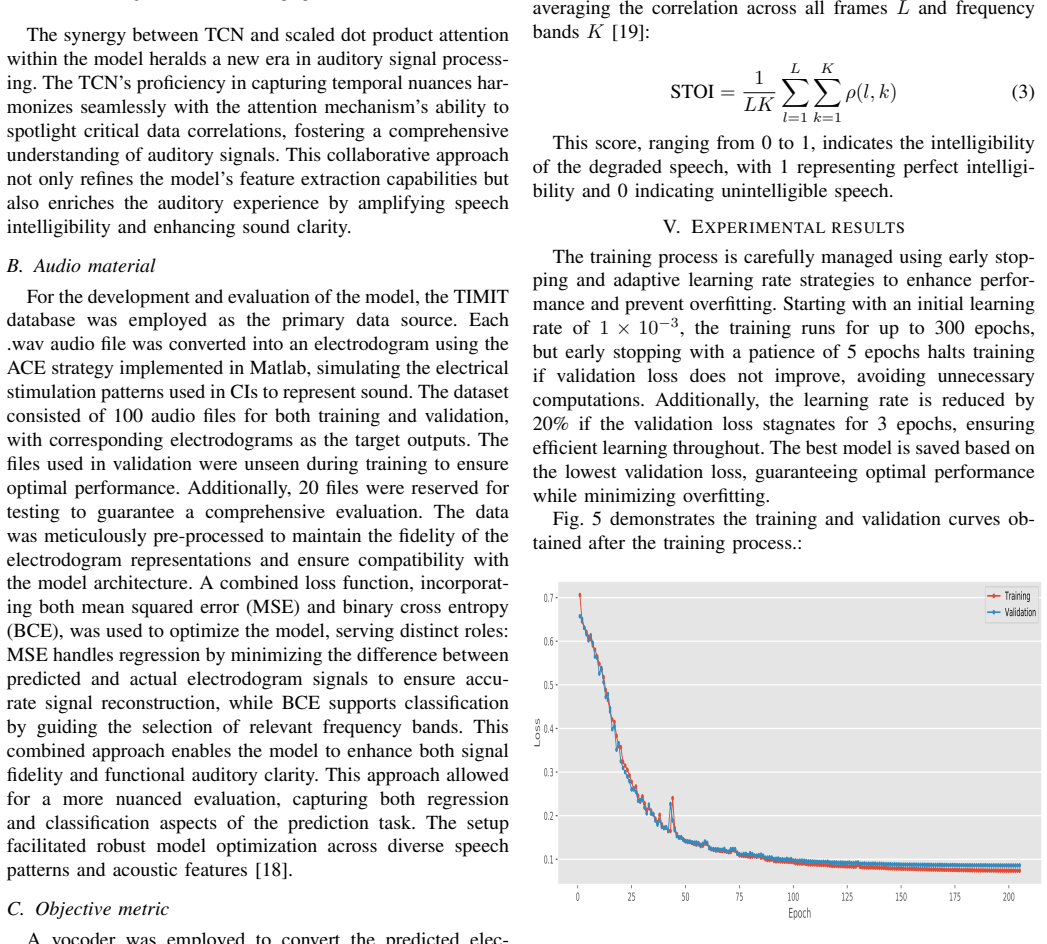
- [Section V (Experimental Results)] The training curves in Fig. 5 appear to be smoothed or downsampled, and the y-axis label 'Loss' is not specific about which loss (MSE, BCE, or combined) is plotted. Please label the curve with the exact loss function and report the final validation loss.
- [Section V (Experimental Results), Fig. 6] The spectrograms in Fig. 6 are mentioned in the text but are not clearly visible or labeled in the figure; please ensure the figure contains both the electrodograms and the spectrograms with distinct captions or subplot labels.
- [General] Several references are incomplete or informally cited; for example, Ref. [15] is listed as 'Attention is all you need' without authors, venue, or year. Please provide complete bibliographic information for all references.
Circularity Check
Headline result reduces to regression to ACE: the model is trained on ACE electrodograms and then evaluated against ACE as ground truth, so the close STOI is by construction.
-
fitted input called prediction
[Section IV-B (Audio material) and Section V (Experimental Results)]
"Each .wav audio file was converted into an electrodogram using the ACE strategy implemented in Matlab ... with corresponding electrodograms as the target outputs. ... To evaluate the model's effectiveness, the predicted electrodogram was compared against the electrodogram generated by the ACE coding strategy, which serves as the ground truth. ... The results showed an average STOI score of 0.6031 for our model and 0.6126 for the ACE strategy."
The model is trained with MSE and BCE losses whose targets are ACE electrodograms, so the predicted electrodogram is a regression to ACE. The evaluation then compares the vocoded output of this regression against the same ACE pipeline called 'ground truth' and reports that the STOI scores are close. The headline result, STOI(model) ≈ STOI(ACE), is therefore the expected consequence of successful fitting to ACE, not an independent discovery about a novel coding strategy. The 'close proximity' is a convergence check on the imitation objective, and the claimed 'advanced alternative' status is asserted from a property that the training procedure was designed to produce.
full rationale
The paper's central quantitative claim is that the proposed TCN-plus-attention model achieves 0.6031 STOI, closely approximating the 0.6126 STOI of ACE. The derivation chain makes this claim self-referential: the ACE electrodograms are both the training targets (Section IV-B) and the 'ground truth' against which predictions are visually and quantitatively compared (Section V). A network trained to reproduce ACE outputs should, if optimization succeeds, produce vocoded audio with STOI near that of ACE; the observed closeness is a measure of regression fidelity, not evidence of an independent mechanism. No per-file variance, confidence intervals, or significance/equivalence tests are reported, so 'closely approximating' is also statistically unsupported, but the circularity concern is distinct: the comparison is to the model's own training target. There is minor self-citation (e.g., references [2] and [13]) but those citations are not load-bearing for the central quantitative result. The rest of the paper, including the STOI metric definition and the TCN/attention equations, is standard material and not circular. Because the main claim reduces to the model's ability to imitate its own training target, a partial circularity score of 6 is appropriate.
Assumptions & free parameters
free parameters (4)
- Trained network weights =
Not disclosed
- MSE/BCE loss weighting =
Not disclosed
- ACE implementation parameters =
Not disclosed
- Architecture hyperparameters =
Not disclosed
assumptions (5)
- standard math Scaled dot-product attention (Eq. 2) and STOI (Eq. 3) are correctly stated standard formulations.
- domain assumption STOI computed on vocoded reconstructed audio is a valid proxy for intelligibility of CI stimulation signals.
- domain assumption ACE electrodograms generated by the authors' Matlab implementation are the correct training labels and evaluation reference.
- domain assumption The 100-file training set and 20-file test set from TIMIT are representative and unbiased for CI coding evaluation.
- domain assumption The sine wave vocoder used for reconstruction introduces no material bias between the two arms.
Cite this review
Pith. "Pith review of Enhancing Cochlear Implant Signal Coding with Scaled Dot-Product Attention." pith.science (2026). https://pith.science/paper/M3TGEFMG
@misc{pith2026250419046,
  author       = {Pith},
  title        = {Pith review of: Enhancing Cochlear Implant Signal Coding with Scaled Dot-Product Attention},
  year         = {2026},
  howpublished = {\url{https://pith.science/paper/M3TGEFMG}},
  note         = {Machine review of arXiv:2504.19046}
}
read the original abstract
Cochlear implants (CIs) play a vital role in restoring hearing for individuals with severe to profound sensorineural hearing loss by directly stimulating the auditory nerve with electrical signals. While traditional coding strategies, such as the advanced combination encoder (ACE), have proven effective, they are constrained by their adaptability and precision. This paper investigates the use of deep learning (DL) techniques to generate electrodograms for CIs, presenting our model as an advanced alternative. We compared the performance of our model with the ACE strategy by evaluating the intelligibility of reconstructed audio signals using the short-time objective intelligibility (STOI) metric. The results indicate that our model achieves a STOI score of 0.6031, closely approximating the 0.6126 score of the ACE strategy, and offers potential advantages in flexibility and adaptability. This study underscores the benefits of incorporating artificial intelligent (AI) into CI technology, such as enhanced personalization and efficiency.
Figures


Figures from the paper (3 more)


Reference graph
Works this paper leans on
-
[20]
E. H.-H. Huang, C.-M. Wu, H.-C. Lin, Combination and comparison of sound coding strategies using cochlear implant simulation with man- darin speech, IEEE Transactions on Neural Systems and Rehabilitation Engineering 29 (2021) 2407–2416
work page 2021
-
[11]
E. H.-H. Huang, R. Chao, Y . Tsao, C.-M. Wu, Electrodenet—a deep- learning-based sound coding strategy for cochlear implants, IEEE Trans- actions on Cognitive and Developmental Systems 16 (1) (2023) 346– 357
work page 2023
- [1]
-
[2]
Essaid, H
B. Essaid, H. Kheddar, N. Batel, M. E. Chowdhury, A. Lakas, Artificial intelligence for cochlear implants: Review of strategies, challenges, and perspectives, IEEE Access (2024)
2024
-
[3]
H. Kheddar, Transformers and large language models for efficient intrusion detection systems: A comprehensive survey, arXiv preprint arXiv:2408.07583 (2024)
arXiv 2024
- [4]
- [5]
- [6]
Show all 24 references
-
[7]
F.-G. Zeng, S. Rebscher, W. Harrison, X. Sun, H. Feng, Cochlear implants: system design, integration, and evaluation, IEEE reviews in biomedical engineering 1 (2008) 115–142
2008
-
[8]
J. H. Hansen, H. Ali, J. N. Saba, M. R. Charan, N. Mamun, R. Ghosh, A. Brueggeman, Cci-mobile: Design and evaluation of a cochlear implant and hearing aid research platform for speech scientists and engineers, in: 2019 IEEE EMBS International Conference on Biomedical & Health ...
2019
-
[9]
Gajecki, W
T. Gajecki, W. Nogueira, An end-to-end deep learning speech coding and denoising strategy for cochlear implants, in: ICASSP 2022-2022 IEEE International Conference on Acoustics, Speech and Signal Processing (ICASSP), IEEE, 2022, pp. 3109–3113
2022
-
[10]
Gajecki, Y
T. Gajecki, Y . Zhang, W. Nogueira, A deep denoising sound coding strategy for cochlear implants, IEEE Transactions on Biomedical Engi- neering 70 (9) (2023) 2700–2709
2023
-
[12]
Nicolson, K
A. Nicolson, K. K. Paliwal, Masked multi-head self-attention for causal speech enhancement, Speech Communication 125 (2020) 80–96
2020
-
[13]
Essaid, H
B. Essaid, H. Kheddar, N. Batel, M. E. Chowdhury, Deep learning- based coding strategy for improved cochlear implant speech perception in noisy environments, IEEE Access (2025)
2025
-
[14]
Djeffal, H
N. Djeffal, H. Kheddar, D. Addou, A. C. Mazari, Y . Himeur, Automatic speech recognition with bert and ctc transformers: A review, in: 2023 2nd International Conference on Electronics, Energy and Measurement (IC2EM), V ol. 1, IEEE, 2023, pp. 1–8
2023
-
[15]
Vaswani, Attention is all you need, Advances in Neural Information Processing Systems (2017)
A. Vaswani, Attention is all you need, Advances in Neural Information Processing Systems (2017)
2017
-
[16]
Kheddar, M
H. Kheddar, M. Hemis, Y . Himeur, Automatic speech recognition using advanced deep learning approaches: A survey, Information Fusion (2024) 102422
2024
-
[17]
Djeffal, H
N. Djeffal, H. Kheddar, D. Addou, S. A. Selouani, Transformer-based multi-head attention for noisy speech recognition, in: 2024 International Conference on Telecommunications and Intelligent Systems (ICTIS), IEEE, 2024, pp. 1–6
2024
-
[18]
Kheddar, Y
H. Kheddar, Y . Himeur, S. Al-Maadeed, A. Amira, F. Bensaali, Deep transfer learning for automatic speech recognition: Towards better gen- eralization, Knowledge-Based Systems 277 (2023) 110851
2023
-
[19]
C. H. Taal, R. C. Hendriks, R. Heusdens, J. Jensen, A short-time ob- jective intelligibility measure for time-frequency weighted noisy speech, in: 2010 IEEE international conference on acoustics, speech and signal processing, IEEE, 2010, pp. 4214–4217
2010
-
[21]
Habchi, H
Y . Habchi, H. Kheddar, Y . Himeur, A. Boukabou, S. Atalla, W. Mansoor, H. Al-Ahmad, Deep transfer learning for kidney cancer diagnosis, arXiv preprint arXiv:2408.04318 (2024)
2024 arXiv
-
[22]
Lachenani, H
S. Lachenani, H. Kheddar, M. Ouldzmirli, Improving pretrained yamnet for enhanced speech command detection via transfer learning, in: 2024 International Conference on Telecommunications and Intelligent Systems (ICTIS), IEEE, 2024, pp. 1–6
2024
-
[23]
Djeffal, D
N. Djeffal, D. Addou, H. Kheddar, S. A. Selouani, Transfer learning- based deep residual learning for speech recognition in clean and noisy environments, in: 2024 International Conference on Telecommunications and Intelligent Systems (ICTIS), IEEE, 2024, pp. 1–5
2024
-
[24]
Himeur, I
Y . Himeur, I. Varlamis, H. Kheddar, A. Amira, S. Atalla, Y . Singh, F. Bensaali, W. Mansoor, Federated learning for computer vision, arXiv preprint arXiv:2308.13558 (2023)
2023 arXiv
Reviewed August 16, 2026 · model on record in the stance chip above.
Discussion (0). Continue with ORCID to comment.