REVIEW 3 major objections 5 minor 54 references
Boosting Single-domain Generalized Object Detection via Vision-Language Knowledge Interaction
T0 review · 3 major / 5 minor · reviewed 2026-08-16 · deepseek-v4-flash
Pith's one-line read A detector trained on one domain can generalize to unseen corruptions by aligning each region with fine-grained text prompts from CLIP, gaining 8.8 mPC on Cityscapes-C and 7.9 mPC on DWD.
desk verdict Plausible region-level CLIP alignment for S-DGOD, but the central loss is underspecified as written and the numbers need code or errata before they can be trusted. read the letter →
The pith
A machine-rendered reading of the paper's core claim, the machinery that carries it, and where it could break.
The reading
What carries the argument
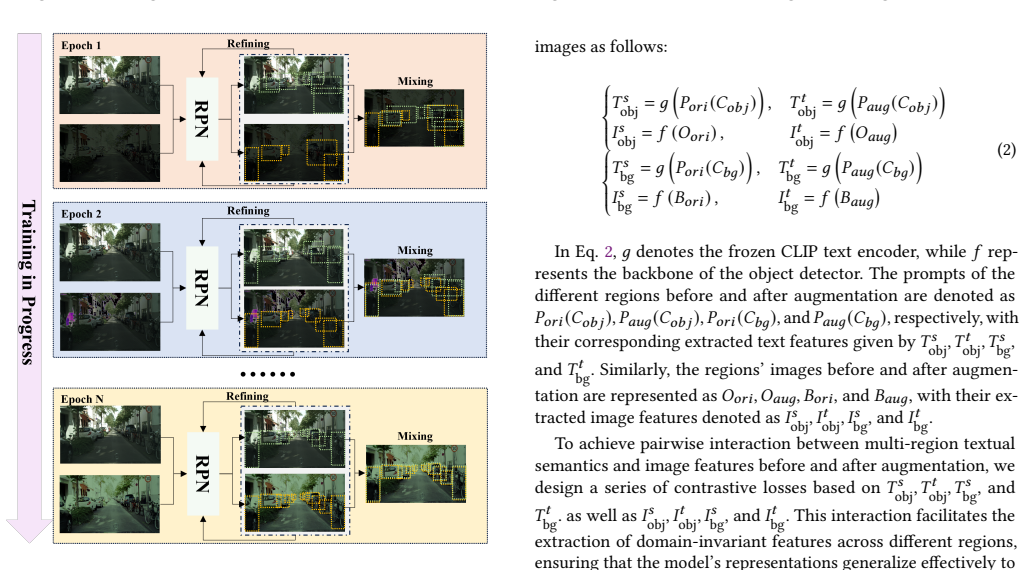
The central object is the Cross-modal and Region-aware Feature Interaction (CRFI) loss, an InfoNCE-based contrastive objective over object and background regions paired with class-aware text prompts. It is complemented by Cross-domain Proposal Refining and Mixing (CPRM), which averages RPN losses on clean and augmented images and concatenates their proposals. Together they make the text encoder's region-level semantics the training anchor for domain invariance.
What would settle it
Train the same pipeline replacing the CLIP text encoder with a fixed random projection of class labels (or with image-free one-hot vectors), keeping all other components. If the mPC gains on Cityscapes-C mostly survive, the claimed role of vision-language knowledge is wrong; if they collapse, the claim is supported. A second check: evaluate on a corruption type not represented in the color and frequency augmentations, such as severe JPEG compression or elastic distortion at high severity, and see whether the robustness margin over the baseline persists.
Extended reading notes
Core claim
The paper claims that simultaneously enforcing two kinds of invariance — between clean and augmented image regions, and between image regions and their textual descriptions — yields a detector that transfers to unseen domains. The CRFI loss uses InfoNCE to pull together region visual features and frozen CLIP text embeddings of prompts like 'a pedestrian on a sunny day' while separating different categories, and to align the same region before and after color and frequency augmentation. CPRM refines RPN proposals on both clean and augmented views and mixes them so the RPN learns consistent localization. The combined objective L = L_roi + L_CPRM + alpha * L_CRFI is what the experiments credit for the gains.
Load-bearing premise
The method assumes that frozen CLIP text embeddings for class labels and scenes remain a reliable, domain-invariant target for region features even when the visual appearance is heavily corrupted or augmented; if that text–image alignment breaks under the target shifts, the contrastive loss pulls features toward an unreliable anchor and the gains should shrink.
Editorial extensions
If this is right
- Region-level text alignment can be plugged into any region-based detector, not just Faster R-CNN, without changing inference cost.
- The gain pattern (largest on noise and weather) suggests the mechanism is most effective for appearance-level, global shifts.
- CRFI and CPRM are complementary: the ablation shows CRFI supplies most of the gain and CPRM adds localization robustness.
- The mPC metric, averaging mAP over corruptions and severities, is the evaluation protocol that determines the method's ranking.
Reading between the lines
- If CLIP embeddings are the bottleneck, scaling the text encoder or using per-category attribute prompts could further improve generalization without new target data.
- The proposal-mixing idea may transfer to semi-supervised or test-time adaptation settings where a teacher and student see different augmentations.
- One could test CPRM alone on vision-only baselines such as PhysAug to isolate whether localization alignment helps when feature invariance is already strong.
Signed reviews
Editorial analysis
A structured set of objections, weighed in public.
Referee Report
Summary. The paper proposes a method for Single-Domain Generalized Object Detection (S-DGOD) that combines two components: Cross-modal and Region-aware Feature Interaction (CRFI) and Cross-domain Proposal Refining and Mixing (CPRM). CRFI uses a frozen CLIP text encoder to compute contrastive losses between detector region-of-interest features and text-prompt embeddings for both object and background regions, across clean and augmented images. CPRM refines and mixes region proposals from clean and augmented views to improve localization. The method is evaluated on Cityscapes-C and DWD, reporting state-of-the-art mPC improvements of +8.8% over the baseline and +1.6% over the previous best on Cityscapes-C, and +7.9% over baseline and +0.6% over previous best on DWD. Ablations on Cityscapes-C attribute large gains to CRFI (+8.5 mPC) and additional gains to CPRM.
Significance. If the claims hold, the paper makes a useful contribution by showing that region-level vision-language knowledge interaction can improve single-domain generalized object detection beyond scene-level prompt guidance. The core ideas—using frozen CLIP text embeddings as anchors for RoI features and adding proposal mixing across augmented domains—are well motivated and the ablations indicate substantial effect sizes. The manuscript also clearly identifies the limitation of prior VLM-based methods that only use coarse scene-level text. However, the significance is currently tempered by reproducibility gaps: no code is released, the augmentation details are in an unavailable supplementary, no error bars are reported, and the central CRFI loss is underspecified as written. The paper's central claim therefore rests on details that the reader cannot verify from the manuscript alone.
major comments (3)
- [Section 3.3, Eqs. (5)–(6)] The InfoNCE loss in Eqs. (5)–(6) is applied directly between region visual features I_obj, I_bg (extracted by the detector backbone f) and text features T_obj, T_bg (from the frozen CLIP text encoder g). The paper specifies no projection layer, no normalization, and no dimension matching between these two feature spaces. Faster R-CNN/FPN RoI features are not in CLIP's shared image–text embedding space, so the cosine-similarity or dot-product used by InfoNCE is not well defined as written. Because the ablation in Table 3 attributes +8.5 mPC to CRFI, this is a load-bearing technical detail: either a trainable projection is applied and omitted from the text, or the loss cannot be computed. Please specify the projection architecture, normalization, and how the InfoNCE similarity is computed, and ideally release code to confirm.
- [Table 2] There is an internal inconsistency in the DWD results. For the Baseline row, the four non-Daytime columns (Sunny 37.5, Night Sunny 29.2, Dusk Rainy 14.6, Night Rainy 33.1) have a mean of 28.6, not the reported mPC of 30.2. All other rows in Table 2 match the mean of their four non-Daytime columns. This suggests a transcription error in the baseline mPC. If the corrected baseline is 28.6, the reported +7.9 improvement over baseline changes. Please provide an erratum or corrected table, and ideally release exact per-corruption scores.
- [Section 4.1.3 / Section 4.2] The hyperparameter alpha is set to 0.01 on Cityscapes-C and 0.03 on DWD, but the paper does not state the validation procedure used to select these values, nor does it report sensitivity to alpha. Similarly, the random color and frequency augmentation parameters used in CRFI are said to be detailed 'in the supplementary material,' which is not available in the arXiv v1. Without this information, the reported improvements could reflect dataset-specific tuning. Please include the supplementary details, a sensitivity analysis for alpha, and ideally per-seed error bars or at least multiple-run standard deviations for the main tables.
minor comments (5)
- [Section 1, contributions list] The fourth bullet says CPRM 'signs and diversifies region proposals'; this appears to be a typo for 'aligns and diversifies.'
- [Algorithm 1 and Eq. (2)] The notation is inconsistent: Algorithm 1 returns P(C_obj) and P(C_bg), but Eq. (2) uses P_ori(C_obj), P_aug(C_obj), etc. Please define how the prompt template is split into original and augmented variants, and make the notation uniform (e.g., C_obj vs. C_O in the algorithm).
- [Section 3.4, Eq. (7)] It is unclear whether L_CPRM = L_refine exactly equals the standard RPN loss computed on clean and augmented images, or whether it is a modified loss. Please clarify the definition of L_aug_rpn and L_ori_rpn, and state how this replacement interacts with L_roi in Eq. (9).
- [Section 5.2 and Figure 6] The cosine similarity analysis is described only briefly. Please specify which features are compared, how the source and target features are pooled, and whether the plot shows per-corruption or averaged values.
- [General] The manuscript uses the 'Conference'17' LaTeX template, which leaves placeholder headers (e.g., 'Conference’17, July 2017') and causes some equations to be unreadably small. Please reformat to the target venue's style and ensure all equations are legible.
Circularity Check
No circularity: the central loss uses frozen CLIP text knowledge and external benchmarks; the only self-citation (PhysAug) is a baseline comparison, not a load-bearing premise.
full rationale
The derivation chain is self-contained. CRFI aligns detector ROI features to frozen CLIP text embeddings (Eqs. 2-6), where the text encoder is an external, fixed knowledge source; CPRM combines RPN losses and proposal concatenation (Eqs. 7-8) without using target-domain labels; the total loss in Eq. 9 is a training objective only. The SOTA claims rest on Cityscapes-C and DWD benchmark comparisons, which are external evaluations and are not used to fit the method's parameters. The only self-citation, PhysAug [42], appears as a comparative baseline and as a configuration reference, not as a load-bearing premise, uniqueness theorem, or forced-choice argument. No quoted equation reduces to its own input: Eq. 4 aligns augmented and clean visual features, Eqs. 5-6 align those with CLIP text features, and the reported alpha constants are not shown to be selected by target-domain performance. The noted dimensionality or projection issue in Eqs. 5-6 is a reproducibility/correctness concern, not a circularity one. Therefore no circular step is established.
Assumptions & free parameters
free parameters (2)
- alpha (loss weight for L_CRFI) =
0.01 (Cityscapes-C), 0.03 (DWD)
- number of selected regions per image =
1 per unique category + 1 background
assumptions (3)
- domain assumption Frozen CLIP text embeddings of class-label prompts provide a domain-invariant target for region-level visual features.
- domain assumption Random color and frequency transformations create pseudo-target images that are representative of the corruptions in Cityscapes-C and DWD.
- domain assumption The single selected region per category is a representative positive sample for that category.
Cite this review
Pith. "Pith review of Boosting Single-domain Generalized Object Detection via Vision-Language Knowledge Interaction." pith.science (2026). https://pith.science/paper/IJW5S37D
@misc{pith2026250419086,
  author       = {Pith},
  title        = {Pith review of: Boosting Single-domain Generalized Object Detection via Vision-Language Knowledge Interaction},
  year         = {2026},
  howpublished = {\url{https://pith.science/paper/IJW5S37D}},
  note         = {Machine review of arXiv:2504.19086}
}
read the original abstract
Single-Domain Generalized Object Detection~(S-DGOD) aims to train an object detector on a single source domain while generalizing well to diverse unseen target domains, making it suitable for multimedia applications that involve various domain shifts, such as intelligent video surveillance and VR/AR technologies. With the success of large-scale Vision-Language Models, recent S-DGOD approaches exploit pre-trained vision-language knowledge to guide invariant feature learning across visual domains. However, the utilized knowledge remains at a coarse-grained level~(e.g., the textual description of adverse weather paired with the image) and serves as an implicit regularization for guidance, struggling to learn accurate region- and object-level features in varying domains. In this work, we propose a new cross-modal feature learning method, which can capture generalized and discriminative regional features for S-DGOD tasks. The core of our method is the mechanism of Cross-modal and Region-aware Feature Interaction, which simultaneously learns both inter-modal and intra-modal regional invariance through dynamic interactions between fine-grained textual and visual features. Moreover, we design a simple but effective strategy called Cross-domain Proposal Refining and Mixing, which aligns the position of region proposals across multiple domains and diversifies them, enhancing the localization ability of detectors in unseen scenarios. Our method achieves new state-of-the-art results on S-DGOD benchmark datasets, with improvements of +8.8\%~mPC on Cityscapes-C and +7.9\%~mPC on DWD over baselines, demonstrating its efficacy.
Figures


Figures from the paper (3 more)


Reference graph
Works this paper leans on
-
[1]
Sungha Choi, Sanghun Jung, Huiwon Yun, Joanne T Kim, Seungryong Kim, and Jaegul Choo. 2021. Robustnet: Improving domain generalization in urban-scene segmentation via instance selective whitening. In Proceedings of the IEEE/CVF conference on computer vision and pattern recognition. 11580–11590
work page 2021
-
[2]
Ekin D Cubuk, Barret Zoph, Jonathon Shlens, and Quoc V Le. 2020. Randaug- ment: Practical automated data augmentation with a reduced search space. In Proceedings of the IEEE/CVF conference on computer vision and pattern recognition workshops. 702–703
work page 2020
-
[3]
Muhammad Sohail Danish, Muhammad Haris Khan, Muhammad Akhtar Munir, M Saquib Sarfraz, and Mohsen Ali. 2024. Improving Single Domain-Generalized Object Detection: A Focus on Diversification and Alignment. InProceedings of the IEEE/CVF Conference on Computer Vision and Pattern Recognition. 17732–17742
work page 2024
-
[4]
Karan Desai and Justin Johnson. 2021. Virtex: Learning visual representations from textual annotations. In Proceedings of the IEEE/CVF conference on computer vision and pattern recognition. 11162–11173
work page 2021
-
[5]
Terrance DeVries and Graham W Taylor. 2017. Improved regularization of convolutional neural networks with cutout. arXiv preprint arXiv:1708.04552 (2017)
arXiv 2017
-
[6]
Jeffrey Donahue, Lisa Anne Hendricks, Sergio Guadarrama, Marcus Rohrbach, Subhashini Venugopalan, Kate Saenko, and Trevor Darrell. 2015. Long-term recurrent convolutional networks for visual recognition and description. In Proceedings of the IEEE conference on computer vision and pattern recognition . 2625–2634
work page 2015
-
[7]
Mohammad Fahes, Tuan-Hung Vu, Andrei Bursuc, Patrick Pérez, and Raoul De Charette. 2023. Poda: Prompt-driven zero-shot domain adaptation. InProceed- ings of the IEEE/CVF International Conference on Computer Vision. 18623–18633. Boosting Single-Domain Generalized Object Detection via Vision-Language Knowledge Interaction Conference’17, July 2017, Washingto...
work page 2023
-
[8]
Christoph Feichtenhofer, Axel Pinz, and Andrew Zisserman. 2017. Detect to track and track to detect. In Proceedings of the IEEE international conference on computer vision. 3038–3046
work page 2017
Show all 54 references
-
[9]
Robert Geirhos, Patricia Rubisch, Claudio Michaelis, Matthias Bethge, Felix A Wichmann, and Wieland Brendel. 2018. ImageNet-trained CNNs are biased towards texture; increasing shape bias improves accuracy and robustness. arXiv preprint arXiv:1811.12231 (2018)
2018 arXiv
-
[10]
Mahmoud Hassaballah, Mourad A Kenk, Khan Muhammad, and Shervin Minaee
-
[11]
Kaiming He, Xiangyu Zhang, Shaoqing Ren, and Jian Sun. 2016. Deep residual learning for image recognition. In Proceedings of the IEEE conference on computer vision and pattern recognition. 770–778
2016
-
[12]
Dan Hendrycks and Thomas Dietterich. 2019. Benchmarking neural net- work robustness to common corruptions and perturbations. arXiv preprint arXiv:1903.12261 (2019)
2019 arXiv
-
[13]
Dan Hendrycks and Thomas G Dietterich. 2018. Benchmarking neural net- work robustness to common corruptions and surface variations. arXiv preprint arXiv:1807.01697 (2018)
2018 arXiv
-
[14]
Dan Hendrycks, Norman Mu, Ekin D Cubuk, Barret Zoph, Justin Gilmer, and Balaji Lakshminarayanan. 2019. Augmix: A simple data processing method to improve robustness and uncertainty. arXiv preprint arXiv:1912.02781 (2019)
2019 arXiv
-
[15]
Lei Huang, Yi Zhou, Fan Zhu, Li Liu, and Ling Shao. 2019. Iterative normaliza- tion: Beyond standardization towards efficient whitening. In Proceedings of the IEEE/CVF conference on computer vision and pattern recognition. 4874–4883
2019
-
[16]
Christoph Hümmer, Manuel Schwonberg, Liangwei Zhou, Hu Cao, Alois Knoll, and Hanno Gottschalk. 2024. Strong but Simple: A Baseline for Domain General- ized Dense Perception by CLIP-Based Transfer Learning. In Proceedings of the Asian Conference on Computer Vision. 4223–4244
2024
-
[17]
Andrej Karpathy and Li Fei-Fei. 2015. Deep visual-semantic alignments for generating image descriptions. In Proceedings of the IEEE conference on computer vision and pattern recognition. 3128–3137
2015
-
[18]
Prannay Khosla, Piotr Teterwak, Chen Wang, Aaron Sarna, Yonglong Tian, Phillip Isola, Aaron Maschinot, Ce Liu, and Dilip Krishnan. 2020. Supervised contrastive learning. Advances in neural information processing systems 33 (2020), 18661– 18673
2020
-
[19]
Wooju Lee, Dasol Hong, Hyungtae Lim, and Hyun Myung. 2024. Object-Aware Domain Generalization for Object Detection. In Proceedings of the AAAI Confer- ence on Artificial Intelligence, Vol. 38. 2947–2955
2024
-
[20]
Deng Li, Aming Wu, Yaowei Wang, and Yahong Han. 2024. Prompt-driven dynamic object-centric learning for single domain generalization. In Proceedings of the IEEE/CVF Conference on Computer Vision and Pattern Recognition. 17606– 17615
2024
-
[21]
Tsung-Yi Lin, Piotr Dollár, Ross Girshick, Kaiming He, Bharath Hariharan, and Serge Belongie. 2017. Feature pyramid networks for object detection. In Proceed- ings of the IEEE conference on computer vision and pattern recognition. 2117–2125
2017
-
[22]
Yajing Liu, Shijun Zhou, Xiyao Liu, Chunhui Hao, Baojie Fan, and Jiandong Tian
-
[23]
Claudio Michaelis, Benjamin Mitzkus, Robert Geirhos, Evgenia Rusak, Oliver Bringmann, Alexander S Ecker, Matthias Bethge, and Wieland Brendel. 2019. Benchmarking robustness in object detection: Autonomous driving when winter is coming. arXiv preprint arXiv:1907.07484 (2019)
2019 arXiv
-
[24]
Apostolos Modas, Rahul Rade, Guillermo Ortiz-Jiménez, Seyed-Mohsen Moosavi- Dezfooli, and Pascal Frossard. 2022. Prime: A few primitives can boost robustness to common corruptions. In European Conference on Computer Vision. Springer, 623–640
2022
-
[25]
Richard A Newcombe, Shahram Izadi, Otmar Hilliges, David Molyneaux, David Kim, Andrew J Davison, Pushmeet Kohi, Jamie Shotton, Steve Hodges, and Andrew Fitzgibbon. 2011. Kinectfusion: Real-time dense surface mapping and tracking. In 2011 10th IEEE international symposium on mi...
2011
-
[26]
Xingang Pan, Xiaohang Zhan, Jianping Shi, Xiaoou Tang, and Ping Luo. 2019. Switchable whitening for deep representation learning. In Proceedings of the IEEE/CVF international conference on computer vision. 1863–1871
2019
-
[27]
Alec Radford, Jong Wook Kim, Chris Hallacy, Aditya Ramesh, Gabriel Goh, Sandhini Agarwal, Girish Sastry, Amanda Askell, Pamela Mishkin, Jack Clark, et al. 2021. Learning transferable visual models from natural language supervision. In International conference on machine learni...
2021
-
[28]
Yongming Rao, Wenliang Zhao, Guangyi Chen, Yansong Tang, Zheng Zhu, Guan Huang, Jie Zhou, and Jiwen Lu. 2022. Denseclip: Language-guided dense predic- tion with context-aware prompting. In Proceedings of the IEEE/CVF conference on computer vision and pattern recognition. 18082–18091
2022
-
[29]
Sylvestre-Alvise Rebuffi, Sven Gowal, Dan Andrei Calian, Florian Stimberg, Olivia Wiles, and Timothy A Mann. 2021. Data augmentation can improve robustness. Advances in Neural Information Processing Systems 34 (2021), 29935–29948
2021
-
[30]
Joseph Redmon and Ali Farhadi. 2018. Yolov3: An incremental improvement. arXiv preprint arXiv:1804.02767 (2018)
2018 arXiv
-
[31]
Shaoqing Ren, Kaiming He, Ross Girshick, and Jian Sun. 2015. Faster r-cnn: Towards real-time object detection with region proposal networks. Advances in neural information processing systems 28 (2015)
2015
-
[32]
Christos Sakaridis, Dengxin Dai, and Luc Van Gool. 2018. Semantic foggy scene understanding with synthetic data. International Journal of Computer Vision 126 (2018), 973–992
2018
-
[33]
Shuai Shen, Wanhua Li, Xiaobing Wang, Dafeng Zhang, Zhezhu Jin, Jie Zhou, and Jiwen Lu. 2023. Clip-cluster: Clip-guided attribute hallucination for face clustering. In Proceedings of the IEEE/CVF international conference on computer vision. 20786–20795
2023
-
[34]
Connor Shorten and Taghi M Khoshgoftaar. 2019. A survey on image data augmentation for deep learning. Journal of big data 6, 1 (2019), 1–48
2019
-
[35]
Bo Sun, Banghuai Li, Shengcai Cai, Ye Yuan, and Chi Zhang. 2021. Fsce: Few-shot object detection via contrastive proposal encoding. InProceedings of the IEEE/CVF conference on computer vision and pattern recognition. 7352–7362. Conference’17, July 2017, Washington, DC, USA Xu et al
2021
-
[36]
Puru Vaish, Shunxin Wang, and Nicola Strisciuglio. 2024. Fourier-basis func- tions to bridge augmentation gap: Rethinking frequency augmentation in image classification. In Proceedings of the IEEE/CVF Conference on Computer Vision and Pattern Recognition. 17763–17772
2024
-
[37]
Vidit Vidit, Martin Engilberge, and Mathieu Salzmann. 2023. Clip the gap: A single domain generalization approach for object detection. In Proceedings of the IEEE/CVF conference on computer vision and pattern recognition. 3219–3229
2023
-
[38]
Xin Wang, Thomas E Huang, Benlin Liu, Fisher Yu, Xiaolong Wang, Joseph E Gonzalez, and Trevor Darrell. 2021. Robust object detection via instance-level temporal cycle confusion. In Proceedings of the IEEE/CVF International Conference on Computer Vision. 9143–9152
2021
-
[39]
Thomas Whelan, Renato F Salas-Moreno, Ben Glocker, Andrew J Davison, and Stefan Leutenegger. 2016. ElasticFusion: Real-time dense SLAM and light source estimation. The International Journal of Robotics Research35, 14 (2016), 1697–1716
2016
-
[40]
Aming Wu and Cheng Deng. 2022. Single-domain generalized object detection in urban scene via cyclic-disentangled self-distillation. In Proceedings of the IEEE/CVF Conference on computer vision and pattern recognition. 847–856
2022
-
[41]
Fan Wu, Jinling Gao, Lanqing Hong, Xinbing Wang, Chenghu Zhou, and Nanyang Ye. 2024. G-NAS: Generalizable Neural Architecture Search for Single Domain Generalization Object Detection. In Proceedings of the AAAI Conference on Artifi- cial Intelligence, Vol. 38. 5958–5966
2024
-
[42]
Xiaoran Xu, Jiangang Yang, Wenhui Shi, Siyuan Ding, Luqing Luo, and Jian Liu
-
[43]
Lewei Yao, Jianhua Han, Youpeng Wen, Xiaodan Liang, Dan Xu, Wei Zhang, Zhenguo Li, Chunjing Xu, and Hang Xu. 2022. Detclip: Dictionary-enriched visual-concept paralleled pre-training for open-world detection. Advances in Neural Information Processing Systems 35 (2022), 9125–9138
2022
-
[44]
Fisher Yu, Haofeng Chen, Xin Wang, Wenqi Xian, Yingying Chen, Fangchen Liu, Vashisht Madhavan, and Trevor Darrell. 2020. Bdd100k: A diverse driving dataset for heterogeneous multitask learning. In Proceedings of the IEEE/CVF conference on computer vision and pattern recognitio...
2020
-
[45]
arXiv preprint arXiv:2412.11807 (2024)
PhysAug: A Physical-guided and Frequency-based Data Augmentation for Single-Domain Generalized Object Detection. arXiv preprint arXiv:2412.11807 (2024)
2024 arXiv
-
[46]
Long Zhao, Ting Liu, Xi Peng, and Dimitris Metaxas. 2020. Maximum-entropy adversarial data augmentation for improved generalization and robustness. Ad- vances in Neural Information Processing Systems 33 (2020), 14435–14447
2020
-
[47]
Yuyang Zhao, Zhun Zhong, Na Zhao, Nicu Sebe, and Gim Hee Lee. 2022. Style- hallucinated dual consistency learning for domain generalized semantic segmen- tation. In European conference on computer vision. Springer, 535–552
2022
-
[48]
Hongyi Zhang, Moustapha Cisse, Yann N Dauphin, and David Lopez-Paz. 2017. mixup: Beyond empirical risk minimization. arXiv preprint arXiv:1710.09412 (2017)
2017 arXiv
-
[49]
Kaiyang Zhou, Jingkang Yang, Chen Change Loy, and Ziwei Liu. 2022. Conditional prompt learning for vision-language models. In Proceedings of the IEEE/CVF conference on computer vision and pattern recognition. 16816–16825
2022
-
[50]
Kaiyang Zhou, Jingkang Yang, Chen Change Loy, and Ziwei Liu. 2022. Learning to prompt for vision-language models. International Journal of Computer Vision 130, 9 (2022), 2337–2348
2022
-
[51]
Kaiyang Zhou, Ziwei Liu, Yu Qiao, Tao Xiang, and Chen Change Loy. 2022. Domain generalization: A survey. IEEE Transactions on Pattern Analysis and Machine Intelligence 45, 4 (2022), 4396–4415
2022
-
[54]
Barret Zoph, Ekin D Cubuk, Golnaz Ghiasi, Tsung-Yi Lin, Jonathon Shlens, and Quoc V Le. 2020. Learning data augmentation strategies for object detection. In Computer Vision–ECCV 2020: 16th European Conference, Glasgow, UK, August 23–28, 2020, Proceedings, Part XXVII 16. Spring...
2020
-
[2020]
IEEE transactions on intelligent transportation systems 22, 7 (2020), 4230–4242
Vehicle detection and tracking in adverse weather using a deep learning framework. IEEE transactions on intelligent transportation systems 22, 7 (2020), 4230–4242
2020
-
[2024]
In Proceedings of the IEEE/CVF Conference on Computer Vision and Pattern Recognition
Unbiased Faster R-CNN for Single-source Domain Generalized Object Detection. In Proceedings of the IEEE/CVF Conference on Computer Vision and Pattern Recognition. 28838–28847
Reviewed August 16, 2026 · model on record in the stance chip above.
Discussion (0). Continue with ORCID to comment.