REVIEW 4 major objections 5 minor 48 references
Adaptive Dual-domain Learning for Underwater Image Enhancement
T0 review · 4 major / 5 minor · reviewed 2026-08-16 · deepseek-v4-flash
Pith's one-line read SS-UIE claims state-of-the-art underwater image enhancement by adapting to degradation in both space and frequency, at lower computational cost.
desk verdict Solid new architecture for underwater enhancement with a real SOTA result, but the 'linear complexity' claim contradicts its own appendix and the experimental reporting lacks statistical rigor. read the letter →
The pith
A machine-rendered reading of the paper's core claim, the machinery that carries it, and where it could break.
The reading
What carries the argument
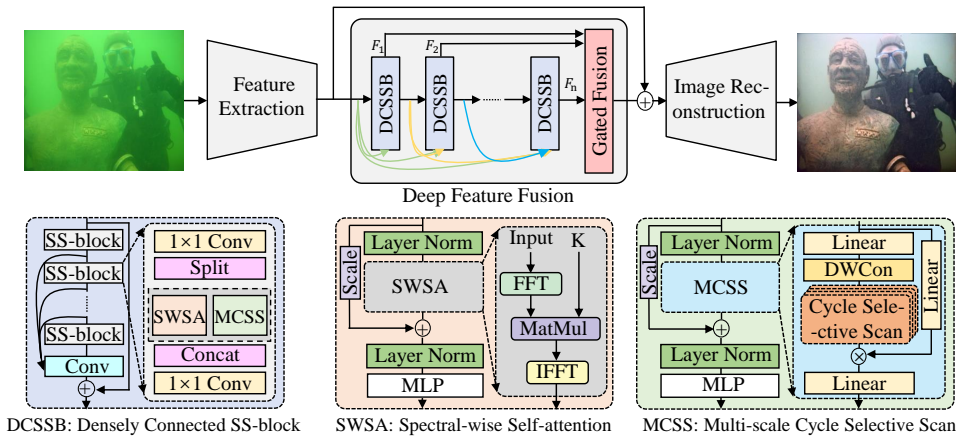
The load-bearing object is the SS-block: a parallel combination of a Multi-scale Cycle Selective Scan (MCSS) module and a Spectral-Wise Self-Attention (SWSA) module, followed by a $1\times1$ convolution residual. MCSS unfolds input features into patch sequences along several cyclic traversal paths and passes each sequence through an S6 state-space block, giving a global spatial receptive field. SWSA applies a 2D FFT, multiplies the spectrum by a learnable filter $K$ of the same shape, and transforms back with IFFT, giving global inter-spectral mixing. The paper argues that running these two branches in parallel lets the network capture severe-attenuation regions and bands simultaneously. The Frequency-Wise Loss (FWL) computes a per-channel spectral distance $d_k(u,v)$, reweights it by a factor $\theta_k(u,v)$ that grows with reconstruction error at that frequency, and adds it to an $L_1$ term, which is what directs extra capacity to hard high-frequency content.
What would settle it
A reader could settle the claim by rerunning all eight comparison methods from official code on the same UIEB and LSUI splits with several seeds and checking whether SS-UIE's PSNR, SSIM, LPIPS, and FID margins persist. Separately, timing SS-UIE at 256, 512, and 1024 pixel inputs would show whether the FFT branch's $O(N \log N)$ growth undercuts the linear-complexity claim.
Extended reading notes
Core claim
The paper's central claim is that underwater image enhancement improves when the network allocates its capacity according to degradation level, rather than treating all pixels and color bands equally. SS-UIE pairs a Multi-scale Cycle Selective Scan (MCSS), which gives a global spatial receptive field at claimed linear cost, with a Spectral-Wise Self-Attention (SWSA) module that multiplies the FFT of features by a learnable global filter, running both in parallel inside an SS-block. The block is designed to model, for each spatial region and each spectral band, how strongly the water has attenuated the signal, and to strengthen the network's response where attenuation is severe. A Frequency-Wise Loss (FWL) then reweights residual errors by how far the predicted spectrum is from the ground truth, pushing the model to recover high-frequency detail. The paper reports that this architecture surpasses eight prior enhancement methods on UIEB, LSUI, and U45 while requiring cheaper computational and memory costs.
Load-bearing premise
The headline result rests on the eight comparison methods being run fairly with their official code and identical settings on the same splits; if any baseline was under-tuned, the reported margins could shrink. Relatedly, counting the FFT-based branch as linear is not exact, since a 2D FFT costs $O(N \log N)$, so the efficiency claim depends on treating that growth as negligible.
Editorial extensions
If this is right
- If the reported margins hold, underwater image enhancement can be performed at lower computational and memory cost than current transformer and diffusion baselines, making on-device or real-time deployment plausible.
- The parallel MCSS/SWSA block gives a reusable template for restoration tasks with non-uniform degradation, such as haze, low light, or turbid-medium imaging, where region-specific and frequency-specific adaptation should help.
- FWL can be added to any existing underwater enhancement network as a plug-in training loss with no added inference cost; it should improve high-frequency fidelity whenever the model underfits texture.
- A degradation-level-adaptive design may reduce the need for explicit physical parameter estimation, such as depth or transmission maps, in underwater enhancement pipelines.
Reading between the lines
- A strong test of the paper's mechanism would be to visualize the learned filter $K$ and the MCSS scan weighting per region: if the network truly adapts to degradation levels, these should concentrate on the haziest patches and the most attenuated color channels. The paper does not show such maps.
- The same dual-domain design may generalize to other inverse problems with wavelength-dependent attenuation, such as dehazing or imaging through scattering media, but the paper only evaluates underwater benchmarks.
- Because FWL's weight $\theta$ is tied to absolute frequency error, it could function as a generic finishing loss for any image restoration model; a cheap experiment is to swap FWL into a Swin-based baseline and measure PSNR on LSUI.
- The reported 'linear complexity' of the spectral branch is an idealization: a strict scaling analysis would count FFT cost as $O(N \log N)$, so the efficiency advantage should be verified by wall-clock tests at larger resolutions.
Signed reviews
Editorial analysis
A structured set of objections, weighed in public.
Referee Report
Summary. The paper proposes SS-UIE, an underwater image enhancement network built from Spatial-Spectral blocks (SS-blocks). Each SS-block combines a Multi-scale Cycle Selective Scan (MCSS) module for spatial modeling and a Spectral-Wise Self-Attention (SWSA) module based on FFT for spectral modeling, connected in parallel. A Frequency-Wise Loss (FWL) is added to emphasize high-frequency reconstruction. The authors report state-of-the-art results on UIEB, LSUI, and U45 datasets while claiming lower parameter and FLOP counts than eight compared methods. The method section includes architectural details, the ablation study supports each component, and code is made available.
Significance. If the reported results hold, the paper contributes a practically useful dual-domain architecture for underwater image enhancement, with a frequency-domain loss that improves high-frequency detail recovery. The efficiency comparison is a valuable part of the contribution: the proposed network reportedly achieves competitive quality with lower parameter and FLOP counts. However, the paper's central efficiency claim is weakened by an internal inconsistency about the complexity of the FFT-based SWSA module, and the state-of-the-art claim rests on single-run comparisons without statistical verification. These issues are fixable and do not by themselves invalidate the proposed method.
major comments (4)
- [Abstract, §1, §2, Method (Eqs. 5–7), Appendix C] The paper repeatedly claims that SWSA has 'linear complexity' (Abstract, §1, §2, Method), but SWSA uses 2D FFT and IFFT as defined in Eqs. 5–7, and Appendix C explicitly derives that FFT reduces DFT complexity to O(N log N). The SWSA branch therefore has O(N log N) complexity, not O(N). This is a load-bearing inconsistency because 'linear complexity' is presented as a central advantage of the design. The claim should be corrected throughout to 'quasi-linear' or 'O(N log N)' for SWSA, with MCSS's O(N) complexity stated separately.
- [Experiments, Table 1, §Experiment Setup] The state-of-the-art claim is supported only by single-run comparisons against eight baselines. The paper states that provided source codes and identical settings were used, but does not report random seeds, number of runs, confidence intervals, or statistical significance. Some differences are small (e.g., +0.33 dB PSNR over WF-Diff on UIEB), so without variance estimates a third party cannot determine whether the reported gains are due to the method or to accidental training/selection differences. Please provide mean±std over multiple runs or release the full evaluation scripts and per-baseline configurations for verification.
- [Ablation Study, Table 2] The ablation results are presented as single numbers for each configuration, and the checkmark-based table does not unambiguously identify which row corresponds to 'BL+SS2D', 'Serial', and 'Parallel' as described in the text. The conclusion that the parallel design outperforms the serial design rests on this table, so the configuration labels must be made explicit and, ideally, supported by multiple runs to rule out optimization noise.
- [Method, Frequency-Wise Loss (Eqs. 12–13)] The definition of the dynamic weight θ is vague: the text states it is 'linearly related to the distance d(u,v)' and then says it 'changes linearly with the absolute value of the kth channel frequency distance sqrt(|d|)'. The functional form of θ is not written explicitly, and it is unclear whether θ is normalized or how it affects the gradient. Please give the exact formula for θ and explain how it adapts across channels and frequencies.
minor comments (5)
- [References to tables in full text] The text refers to 'Tab. 3' and 'Tab. 4' when discussing the quantitative comparison and the ablation study, but those tables are actually labeled Table 1 and Table 2 in the manuscript. Please renumber or fix the cross-references.
- [Appendix A and Table 3/4] The input size in Table 4 says 'Conv(16,1,3,1,1)' produces 'Output Size (256,256,3)', but the final convolution output has 3 channels; please confirm whether the reconstruction module outputs 3 channels directly and whether the preceding upsample and conv blocks are correctly described.
- [Appendix C] The proof is a standard derivation of DFT/FFT, and the text contains 'our SF-block' which appears to be a typo for 'SS-block'. Consider condensing this proof or moving it to supplementary material.
- [Typos throughout] There are several typos: 'Enhancemnet' in the Related Work heading, 'dual domian loss' in Eq. 15, 'SS-Blcok' in the Ablation Study, and inconsistent punctuation (e.g., 'Mamba' vs. 'Mamba,'). These should be corrected.
- [Code release and reproducibility] The code link is provided, but no commit hash or version is given, and the evaluation scripts for the baseline comparisons are not included. To support reproducibility, please provide a specific release or commit and document the exact commands used to produce Table 1.
Circularity Check
No significant circularity: SS-UIE is an empirical learning method evaluated on public benchmarks against independent baselines; the efficiency claim is internally inconsistent but not circular.
full rationale
The paper's central claim is an empirical performance comparison on public datasets (UIEB, LSUI, U45) against eight baseline methods using standard metrics (PSNR, SSIM, LPIPS, FID, UIQM, UCIQE). The network is a learned architecture whose components (MCSS, SWSA, FWL) are defined directly from inputs and ground-truth supervision; no physical quantity is derived from fitted parameters, and no prediction is equivalent to an input by construction. The only self-citations (U-Shape and the LSUI dataset) are used as a baseline and benchmark, not as justification for the core method, so they are not load-bearing. The LFD ablation metric is closely related to the FWL objective, but the paper also validates FWL via independent PSNR/SSIM gains, so this is not a circular reduction. The repeated 'linear complexity' claim for SWSA conflicts with the paper's own Appendix C (FFT is O(N log N)), but that is an internal correctness inconsistency, not circularity.
Assumptions & free parameters
free parameters (2)
- frequency loss weight λ =
not stated numerically
- MCSS channel expansion factor λ =
not stated
assumptions (2)
- domain assumption Underwater images have inconsistent degradation levels across spatial regions and spectral bands.
- domain assumption Deep networks fit low frequencies first (F-Principle), so a frequency-weighted loss improves high-frequency reconstruction.
Cite this review
Pith. "Pith review of Adaptive Dual-domain Learning for Underwater Image Enhancement." pith.science (2026). https://pith.science/paper/BBW6NPFU
@misc{pith2026250419198,
  author       = {Pith},
  title        = {Pith review of: Adaptive Dual-domain Learning for Underwater Image Enhancement},
  year         = {2026},
  howpublished = {\url{https://pith.science/paper/BBW6NPFU}},
  note         = {Machine review of arXiv:2504.19198}
}
read the original abstract
Recently, learning-based Underwater Image Enhancement (UIE) methods have demonstrated promising performance. However, existing learning-based methods still face two challenges. 1) They rarely consider the inconsistent degradation levels in different spatial regions and spectral bands simultaneously. 2) They treat all regions equally, ignoring that the regions with high-frequency details are more difficult to reconstruct. To address these challenges, we propose a novel UIE method based on spatial-spectral dual-domain adaptive learning, termed SS-UIE. Specifically, we first introduce a spatial-wise Multi-scale Cycle Selective Scan (MCSS) module and a Spectral-Wise Self-Attention (SWSA) module, both with linear complexity, and combine them in parallel to form a basic Spatial-Spectral block (SS-block). Benefiting from the global receptive field of MCSS and SWSA, SS-block can effectively model the degradation levels of different spatial regions and spectral bands, thereby enabling degradation level-based dual-domain adaptive UIE. By stacking multiple SS-blocks, we build our SS-UIE network. Additionally, a Frequency-Wise Loss (FWL) is introduced to narrow the frequency-wise discrepancy and reinforce the model's attention on the regions with high-frequency details. Extensive experiments validate that the SS-UIE technique outperforms state-of-the-art UIE methods while requiring cheaper computational and memory costs.
Figures


Figures from the paper (5 more)


Reference graph
Works this paper leans on
-
[1]
, " * write output.state after.block = add.period write newline
ENTRY address archivePrefix author booktitle chapter edition editor eid eprint howpublished institution isbn journal key month note number organization pages publisher school series title type volume year label extra.label sort.label short.list INTEGERS output.state before.all mid.sentence after.sentence after.block FUNCTION init.state.consts #0 'before.a...
-
[2]
write newline
" write newline "" before.all 'output.state := FUNCTION n.dashify 't := "" t empty not t #1 #1 substring "-" = t #1 #2 substring "--" = not "--" * t #2 global.max substring 't := t #1 #1 substring "-" = "-" * t #2 global.max substring 't := while if t #1 #1 substring * t #2 global.max substring 't := if while FUNCTION word.in bbl.in capitalize " " * FUNCT...
-
[3]
Akkaynak, D.; and Treibitz, T. 2019. Sea-Thru: A Method for Removing Water From Underwater Images. In CVPR, 1682--1691
work page 2019
-
[4]
Ancuti, C.; Ancuti, C. O.; Haber, T.; and Bekaert, P. 2012. Enhancing Underwater Images and Videos by Fusion. In CVPR, 81--88
work page 2012
-
[5]
Chiang, J. Y.; and Chen, Y.-C. 2012. Underwater Image Enhancement by Wavelength Compensation and Dehazing. IEEE T. Image Process., 21(4): 1756--1769
work page 2012
-
[6]
Dosovitskiy, A.; Beyer, L.; Kolesnikov, A.; Weissenborn, D.; Zhai, X.; Unterthiner, T.; Dehghani, M.; Minderer, M.; Heigold, G.; Gelly, S.; et al. 2020. An Image is Worth 16x16 Words: Transformers for Image Recognition at Scale. In ICLR
2020
-
[7]
Drews Jr, P.; do Nascimento, E.; Moraes, F.; Botelho, S.; and Campos, M. 2013. Transmission Estimation in Underwater Single Images. In ICCV workshops, 825--830
work page 2013
-
[8]
Fabbri, C.; Islam, M. J.; and Sattar, J. 2018. Enhancing Underwater Imagery Using Generative Adversarial Networks. ICRA, 7159--7165
work page 2018
Show all 48 references
-
[9]
Goodfellow, I.; Pouget-Abadie, J.; Mirza, M.; Xu, B.; Warde-Farley, D.; Ozair, S.; Courville, A.; and Bengio, Y. 2020. Generative adversarial networks. Commun. ACM, 63(11): 139--144
2020
-
[10]
Gu, A.; and Dao, T. 2023. Mamba: Linear-time sequence modeling with selective state spaces. arXiv preprint arXiv:2312.00752
2023 arXiv
-
[11]
Gu, A.; Goel, K.; and R \'e , C. 2021. Efficiently modeling long sequences with structured state spaces. arXiv preprint arXiv:2111.00396
2021 arXiv
-
[12]
Han, D.; Wang, Z.; Xia, Z.; Han, Y.; Pu, Y.; Ge, C.; Song, J.; Song, S.; Zheng, B.; and Huang, G. 2024. Demystify Mamba in Vision: A Linear Attention Perspective. arXiv preprint arXiv:2405.16605
2024 arXiv
-
[13]
Han, Q.; Fan, Z.; Dai, Q.; Liu, J.; and Wang, J. 2023. ON THE CONNECTION BETWEEN LOCAL ATTENTION AND DYNAMIC DEPTH-WISE CONVOLUTION. IEEE TPAMI, 45(6): 29
2023
-
[14]
Heusel, M.; Ramsauer, H.; Unterthiner, T.; Nessler, B.; and Hochreiter, S. 2017. GANs trained by a two time-scale update rule converge to a local nash equilibrium. In NIPS, 6629–6640. ISBN 9781510860964
2017
-
[15]
Huang, T.; Pei, X.; You, S.; Wang, F.; Qian, C.; and Xu, C. 2024. LocalMamba: Visual State Space Model with Windowed Selective Scan. arXiv preprint arXiv:2403.09338
2024 arXiv
-
[16]
J.; Xia, Y.; and Sattar, J
Islam, M. J.; Xia, Y.; and Sattar, J. 2020. Fast Underwater Image Enhancement for Improved Visual Perception. IEEE Robot. Autom. Lett., 5(2): 3227--3234
2020
-
[17]
R.; Mishra, P.; Mehta, N.; Phutke, S
Khan, M. R.; Mishra, P.; Mehta, N.; Phutke, S. S.; Vipparthi, S. K.; Nandi, S.; and Murala, S. 2024. Spectroformer: Multi-Domain Query Cascaded Transformer Network For Underwater Image Enhancement. In WACV, 1443--1452
2024
-
[18]
Li, C.; Anwar, S.; Hou, J.; Cong, R.; Guo, C.; and Ren, W. 2021. Underwater Image Enhancement via Medium Transmission-Guided Multi-Color Space Embedding. IEEE T. Image Process., 30: 4985--5000
2021
-
[19]
Li, C.; Guo, C.; Ren, W.; Cong, R.; Hou, J.; Kwong, S.; and Tao, D. 2020. An Underwater Image Enhancement Benchmark Dataset and Beyond. IEEE T. Image Process., 29: 4376--4389
2020
-
[20]
Li, C.; Guo, J.; Chen, S.; Tang, Y.; Pang, Y.; and Wang, J. 2016 a . Underwater Image Restoration Based on Minimum Information Loss Principle and Optical Properties of Underwater Imaging. In ICIP, 1993--1997
2016
-
[21]
Li, C.; Guo, J.; and Guo, C. 2018. Emerging From Water: Underwater Image Color Correction Based on Weakly Supervised Color Transfer. IEEE Signal. Process. Lett., 25(3): 323--327
2018
-
[22]
Li, C.-Y.; Guo, J.-C.; Cong, R.-M.; Pang, Y.-W.; and Wang, B. 2016 b . Underwater Image Enhancement by Dehazing With Minimum Information Loss and Histogram Distribution Prior. IEEE T. Image Process., 25(12): 5664--5677
2016
-
[23]
Li, H.; Li, J.; and Wang, W. 2019. A fusion adversarial underwater image enhancement network with a public test dataset. arXiv preprint arXiv:1906.06819
2019 arXiv
-
[24]
A.; Eustice, R
Li, J.; Skinner, K. A.; Eustice, R. M.; and Johnson-Roberson, M. 2017. WaterGAN: Unsupervised Generative Network to Enable Real-Time Color Correction of Monocular Underwater Images. IEEE Robot. Autom. Lett., 3(1): 387--394
2017
-
[25]
Liu, Y.; Tian, Y.; Zhao, Y.; Yu, H.; Xie, L.; Wang, Y.; Ye, Q.; and Liu, Y. 2024. VMamba: Visual State Space Model. arXiv preprint arXiv:2401.10166
2024 arXiv
-
[26]
Liu, Z.; Lin, Y.; Cao, Y.; Hu, H.; Wei, Y.; Zhang, Z.; Lin, S.; and Guo, B. 2021. Swin transformer: Hierarchical vision transformer using shifted windows. In ICCV, 10012--10022
2021
-
[27]
J.; and Nussbaumer, H
Nussbaumer, H. J.; and Nussbaumer, H. J. 1982. The fast Fourier transform. Springer
1982
-
[28]
Panetta, K.; Gao, C.; and Agaian, S. 2016. Human-Visual-System-Inspired Underwater Image Quality Measures. IEEE J. Ocean. Eng., 41(3): 541--551
2016
-
[29]
Pei, X.; Huang, T.; and Xu, C. 2024. EfficientVMamba: Atrous Selective Scan for Light Weight Visual Mamba. arXiv preprint arXiv:2403.09977
2024 arXiv
-
[30]
Peng, L.; Zhu, C.; and Bian, L. 2023. U-Shape Transformer for Underwater Image Enhancement. IEEE T. Image Process., 32: 3066--3079
2023
-
[31]
Pitas, I. 2000. Digital image processing algorithms and applications. John Wiley & Sons
2000
-
[32]
Sahu, P.; Gupta, N.; and Sharma, N. 2014. A survey on underwater image enhancement techniques. IJCA, 87(13)
2014
-
[33]
Schettini, R.; and Corchs, S. 2010. Underwater Image Processing: State of the Art of Restoration and Image Enhancement Methods. EURASIP. J. Adv. Signal Process., 2010: 1--14
2010
-
[34]
Tang, Y.; Kawasaki, H.; and Iwaguchi, T. 2023. Underwater image enhancement by transformer-based diffusion model with non-uniform sampling for skip strategy. In ACM MM, 5419--5427
2023
-
[35]
M.; Wu, Z.; and Wang, Z
Uplavikar, P. M.; Wu, Z.; and Wang, Z. 2019. All-in-One Underwater Image Enhancement Using Domain-Adversarial Learning. In CVPR Workshops, 1--8
2019
-
[36]
N.; Kaiser, .; and Polosukhin, I
Vaswani, A.; Shazeer, N.; Parmar, N.; Uszkoreit, J.; Jones, L.; Gomez, A. N.; Kaiser, .; and Polosukhin, I. 2017. Attention is All You Need. In NIPS, 5998--6008
2017
-
[37]
Wang, S.-Y.; Wang, O.; Zhang, R.; Owens, A.; and Efros, A. A. 2020. CNN-generated images are surprisingly easy to spot...for now. In CVPR
2020
-
[38]
Wang, Y.; Liu, H.; and Chau, L.-P. 2018. Single Underwater Image Restoration Using Adaptive Attenuation-Curve Prior. IEEE Trans. Circuits. Syst. I. Regul. Pap., 65(3): 992--1002
2018
-
[39]
Wang, Z.; Bovik, A.; Sheikh, H.; and Simoncelli, E. 2004. Image quality assessment: from error visibility to structural similarity. IEEE TIP, 13(4): 600--612
2004
-
[40]
Xu, R.; Yang, S.; Wang, Y.; Du, B.; and Chen, H. 2024. A survey on vision mamba: Models, applications and challenges. arXiv preprint arXiv:2404.18861
2024 arXiv
-
[41]
J.; Zhang, Y.; and Xiao, Y
Xu, Z.-Q. J.; Zhang, Y.; and Xiao, Y. 2019. Training behavior of deep neural network in frequency domain. In ICONIP, 264--274. Springer
2019
-
[42]
Yang, M.; Hu, J.; Li, C.; Rohde, G.; Du, Y.; and Hu, K. 2019. An In-Depth survey of underwater image enhancement and restoration. IEEE Access., 7: 123638--123657
2019
-
[43]
Yang, M.; and Sowmya, A. 2015. An Underwater Color Image Quality Evaluation Metric. IEEE T. Image Process., 24(12): 6062--6071
2015
-
[44]
D.; and Fergus, R
Zeiler, M. D.; and Fergus, R. 2014. Visualizing and understanding convolutional networks. In ECCV, 818--833. Springer
2014
-
[45]
A.; Shechtman, E.; and Wang, O
Zhang, R.; Isola, P.; Efros, A. A.; Shechtman, E.; and Wang, O. 2018. The Unreasonable Effectiveness of Deep Features as a Perceptual Metric. In CVPR, 586--595
2018
-
[46]
Zhang, W.; Zhuang, P.; Sun, H.-H.; Li, G.; Kwong, S.; and Li, C. 2022. Underwater Image Enhancement via Minimal Color Loss and Locally Adaptive Contrast Enhancement. IEEE T. Image Process., 31: 3997--4010
2022
-
[47]
Zhang, X.; Karaman, S.; and Chang, S.-F. 2019. Detecting and Simulating Artifacts in GAN Fake Images. In WIFS, 1--6
2019
-
[48]
Zhao, C.; Cai, W.; Dong, C.; and Hu, C. 2024. Wavelet-based fourier information interaction with frequency diffusion adjustment for underwater image restoration. In CVPR, 8281--8291
2024
Reviewed August 16, 2026 · model on record in the stance chip above.
Discussion (0). Continue with ORCID to comment.