REVIEW 3 major objections 4 minor 38 references
Full analysis of CP violation induced by the decay angular correlations in four-body cascade decays of heavy hadrons
T0 review · 3 major / 4 minor · reviewed 2026-08-16 · deepseek-v4-flash
Pith's one-line read This paper claims that a full angular-correlation analysis of $B^0\to p\bar p K^+\pi^-$ uncovers CP asymmetries near 10% with $>5\sigma$ significance, hidden in previously published data.
desk verdict The angular-correlation formalism is worth reading; the claimed 5-sigma CP violation is not—it rests on an unreproducible yield inversion. read the letter →
The pith
A machine-rendered reading of the paper's core claim, the machinery that carries it, and where it could break.
The reading
What carries the argument
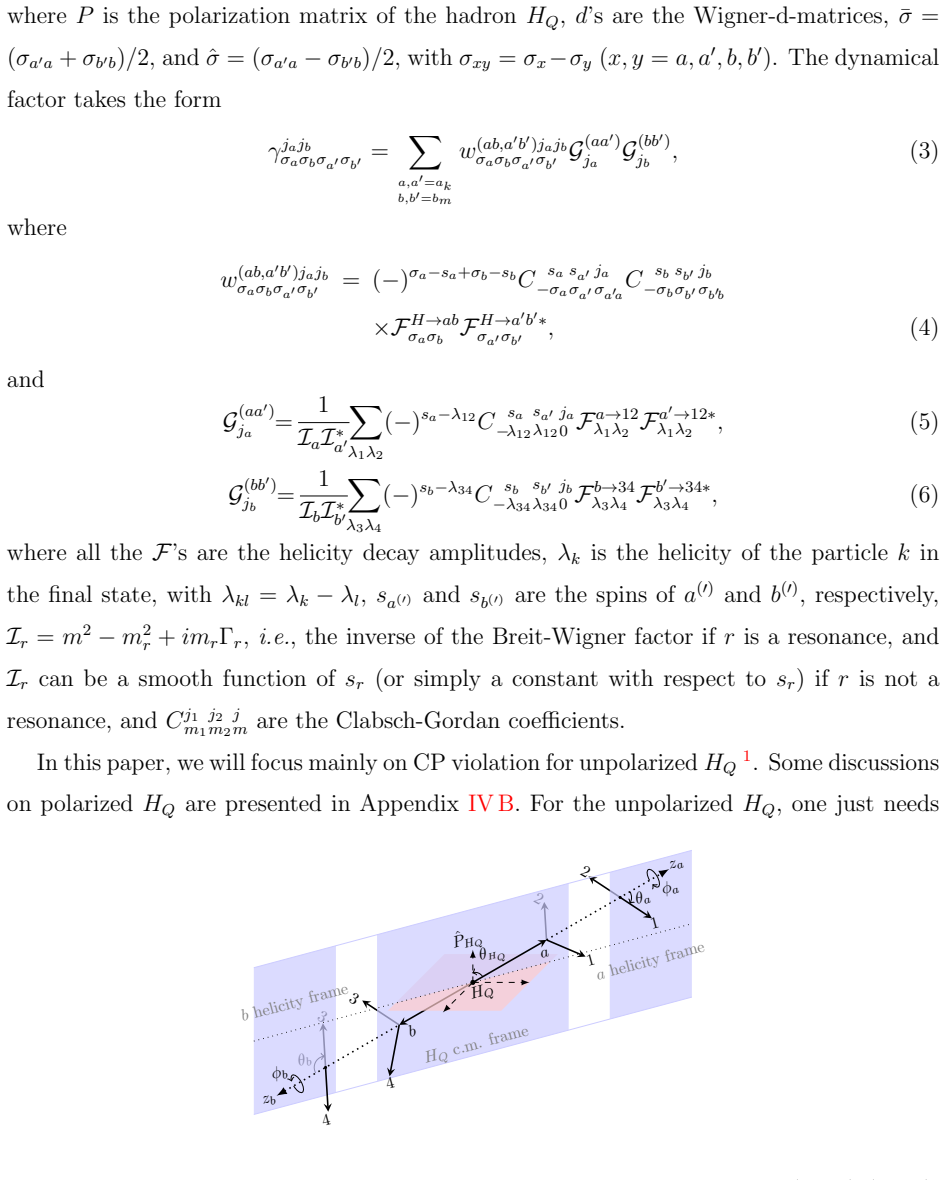
The central object is the expansion of the decay amplitude squared into dynamical factors $\gamma^{j_aj_b}_\sigma$ multiplying kinematical correlations $\Psi^{j_aj_b}_\sigma=d^{j_a}_{\sigma,0}(\theta_a)d^{j_b}_{\sigma,0}(\theta_b)\cos\sigma\varphi$ and $\Phi^{j_aj_b}_\sigma=d^{j_a}_{\sigma,0}(\theta_a)d^{j_b}_{\sigma,0}(\theta_b)\sin\sigma\varphi$, where $d$ are Wigner $d$-functions and $\varphi$ is the angle between the two decay planes. The integer indices $j_a,j_b$ are fixed by the spins and parities of the resonances, and $\sigma$ ranges over both. This machinery lists exhaustively which angular correlations can carry CP violation and separates the real and imaginary parts of the interference terms between resonances. Because integrating over the $K^+\pi^-$ mass window around $K^*(892)$ kills the real part of one class of interferences, the paper introduces a sign factor $\mathrm{sgn}(m^2_{34}-m^2_{K^*})$ inside the asymmetry definition, producing the tilde observables that recover the lost term.
What would settle it
Re-fit the unbinned $B^0\to p\bar pK^+\pi^-$ data with the full amplitude-squared expansion and evaluate $\tilde{A}^{\Psi^{01}_0}_{CP}$, $\tilde{A}^{\Psi^{11}_0}_{CP}$, and $A^{\Psi^{12}_1}_{CP}$ directly; if the fitted values are consistent with zero (or below about 6%), the inverse-yield extraction was biased. A second check: compare the extracted per-region event yields in the appendix tables with the true recorded yields; any systematic mismatch beyond the quoted uncertainties would remove the $5\sigma$ claim.
Extended reading notes
Core claim
The central claim is that for an unpolarized heavy hadron $H_Q\to a(\to12)\,b(\to34)$, the full amplitude squared can be organized as $\sum_{j_a,j_b,\sigma}\,\big[\mathrm{Re}(\gamma^{j_aj_b}_\sigma)\,\Psi^{j_aj_b}_\sigma - \mathrm{Im}(\gamma^{j_aj_b}_\sigma)\,\Phi^{j_aj_b}_\sigma\big]$, where $\Psi$ and $\Phi$ are products of Wigner $d$-functions times $\cos\sigma\varphi$ and $\sin\sigma\varphi$, and the $\gamma$ factors encode the resonance helicity amplitudes and their interferences. Each term defines a CP observable as the half-difference of the angular-correlation asymmetry in the decay and its CP conjugate. Applied to $B^0\to p\bar{p}K^+\pi^-$ with event yields extracted inversely from the published data, three observables come out non-zero at about $10\%$: $\tilde{A}^{\Psi^{01}_0}_{CP}=(10.8\pm2.05)\%$, $\tilde{A}^{\Psi^{11}_0}_{CP}=(10.6\pm2.05)\%$, and $A^{\Psi^{12}_1}_{CP}=(9.5\pm2.07)\%$, corresponding to $5.3\sigma$, $5.2\sigma$, and $4.6\sigma$. The paper concludes that this CP violation was hidden in the available data and would have been found earlier by a full angular analysis.
Load-bearing premise
The claim stands or falls on whether the event yields reconstructed inversely from the published triple-product asymmetries reproduce the true per-region yields with Gaussian statistical errors, including the decision to double two quoted uncertainties as typos.
Editorial extensions
If this is right
- If the $5\sigma$ CP asymmetries are real, CP violation exists in meson-to-baryon-antibaryon decays at the 10% level, considerably larger than the CP asymmetry seen in $\Lambda_b^0\to pK^-\pi^+\pi^-$.
- Triple-product asymmetries alone are insufficient; searches that only test $\sin\varphi$ correlations can miss CP violation carried by $\cos\varphi$ and helicity-angle correlations.
- The three nonzero observables imply non-zero helicity-$\pm1$ amplitudes in $K^*(892)$ production and interference between $0^\pm$ and $1^\mp$ contributions in the $p\bar p$ system.
- The remaining six angular correlations (such as $\Psi^{02}_0$, $\Psi^{20}_0$, and $\Psi^{22}_2$) define additional CP observables that a full experimental analysis should measure.
- The same formalism, applied step by step from the lowest angular correlations upward, works even if the resonance content is not known in advance.
Reading between the lines
- The sign-factor reconstruction could be carried over to other cascade channels with a narrow intermediate resonance whose mass cut suppresses the real part of an interference term, potentially converting published null triple-product results into non-zero angular CP asymmetries.
- If the 10% scale is confirmed, the effect points toward the baryon-antibaryon threshold region as the dynamical source, making these angular asymmetries a probe of strong-interaction threshold amplitudes rather than necessarily new physics.
- A direct experimental test would redo the full unbinned fit on the original $B^0\to p\bar pK^+\pi^-$ sample; a zero result there would not disprove the formalism but would indict the inverse-yield reconstruction and the Gaussian-error assumption.
- The two published uncertainties that the paper doubles as typos could be checked against the original measurement; if they were not typos, the quoted significances would change materially.
Signed reviews
Editorial analysis
A structured set of objections, weighed in public.
Referee Report
Summary. The paper develops a general helicity-based formalism for CP-violating observables built from angular correlations in four-body cascade decays of heavy hadrons, including interference terms between intermediate resonances. The formalism is then applied to B0 -> p pbar K+ pi- using published LHCb triple-product-asymmetry (TPA) data. By 'extracting inversely' per-region event yields from those TPAs, the authors obtain three large CP asymmetries, ~10%, at 4.6-5.3 sigma, and conclude that CP violation was already hidden in existing LHCb data and would have been observed earlier if the full angular-correlation analysis had been performed.
Significance. If the numerical claim were established, it would be a striking result: the first CP violation in a meson-to-baryon-antibaryon four-body decay, with unexpectedly large angular-correlation asymmetries. The formal framework in Eqs. (1)-(14) is a plausible, internally consistent generalisation of the helicity formalism and is model-independent; it also makes the connection between CP-violating observables and interference dynamics transparent. The derivation of the angular-correlation basis and the counting of independent observables in Sec. II and Appendix C is a genuine contribution. However, the central numerical claim is not yet established: it rests on an undocumented inverse extraction of event yields from published TPA values, on an unvalidated correction of two published uncertainties, and on a statistical treatment that ignores reconstruction uncertainty and trials factors. The paper itself concedes in Appendix A that the extracted yields are not the original data and that the Scheme-B subregion sums do not exactly match the Scheme-A yields.
major comments (3)
- [Sec. III and Appendix A] The headline CPAs in Table I are computed from event yields that are 'extracted inversely' from the published TPAs, but the inversion formula and the original per-region total yields are not given. The paper states in Appendix A that the yields are not the original data and that the sum of the two Scheme-B yields does not exactly equal the Scheme-A yield; nevertheless every asymmetry in Table I is a weighted sum of these reconstructed N_+ and N_- values. Without the explicit inversion relation and a demonstration that the reconstruction is unbiased, the three quoted asymmetries cannot be reproduced or checked. This is the load-bearing point of the numerical application, and it is currently unsupported.
- [Appendix A, Tables II and III] The authors correct two published uncertainties in Region 9 by multiplying them by 2, describing them as 'obvious typos', without any external confirmation from the LHCb collaboration or a sensitivity study. The quoted 4.6-5.3 sigma significances depend directly on the size of these errors; if the correction is wrong, the significance of the central claim changes materially. The authors should either provide independent justification for the correction or treat the published values as-is and assess the impact.
- [Table I and Sec. III] The statistical treatment is incomplete. Only Gaussian statistical errors from the TPA measurements are propagated, while the uncertainties introduced by the inverse reconstruction and by the mismatch between Scheme-A and Scheme-B yields are not included. In addition, Table I lists 12 angular-correlation CPAs and the paper highlights the three largest deviations (5.3, 5.2 and 4.6 sigma); no trials factor or look-elsewhere correction is applied over the 18 (or 12) observables. The effective significance of the claim that 'CPV was already hidden behind the data' is therefore overstated as it stands.
minor comments (4)
- [Table I] The row labeled 'Psi22_1' appears twice, with different values; from Table IV one of these rows should presumably be 'Phi22_1'. This makes Table I ambiguous and should be fixed.
- [Eq. (14)] The notation for the CP-conjugate angular function Ybar and the sign factor delta_Y is hard to parse. Please spell out the transformation of theta_a, theta_b and phi under CP and define delta_Y explicitly in the text rather than only in the equation.
- [Sec. II] There are minor grammatical and typographical issues, e.g. 'their could also be some smooth contributions' in the first paragraph of Sec. II. A careful proofreading pass is needed.
- [References] Reference [27] is missing the publication year; please supply the full citation information.
Circularity Check
No significant circularity: the angular-correlation CPAs are computed from external LHCb yields, not fitted to the claimed values; self-citations define observables but do not force the numerical result.
full rationale
The paper's central numerical claim (tilde A^{Psi01_0}_CP ~ 10.8%, etc.) is obtained by re-binning event yields that are extracted inversely from the published LHCb TPA tables, not by fitting any parameter to reproduce those CPAs. The formalism in Eqs. (1)-(14) is self-contained: it defines angular-correlation observables and CPV estimators from helicity amplitudes and Wigner-d functions, with no step in which an input is redefined as the output. The self-citations to Refs. [36,37] are used to name or motivate the sgn34-weighted observables, but the definitions are given explicitly in the paper itself, so the cited results are not load-bearing in the sense of supplying an unverified premise that forces the conclusion. The inversion from measured TPAs to per-bin yields is undocumented and may be questionable, and the Gaussian-error and typo-correction assumptions are potentially fragile, but these are reproducibility and statistical-validity concerns, not circularity: the headline CPAs are not identical to the TPA inputs by construction, since the Psi-type asymmetries depend on total per-bin yields rather than on the TPA values themselves. No uniqueness theorem is imported from the authors' prior work, and no known result is merely renamed. Under the stated hard rules, no specific reduction of the claimed prediction to its own inputs can be exhibited, so the appropriate finding is no significant circularity.
Assumptions & free parameters
assumptions (4)
- standard math The decay amplitude can be decomposed into helicity amplitudes, and the generalized Cabibbo-Maksymowicz variables describe the full phase space.
- domain assumption The observed forward-backward and left-right asymmetries in Ref. [32] are caused mainly by the angular correlations Psi_0^10, Psi_0^01, and Phi_1^11, implying spin-parity content 0+/-, 1-/+ in the ppbar and Kpi systems.
- ad hoc to paper The statistical uncertainties on the published triple-product asymmetries are Gaussian and can be propagated, and two published errors in Region 9 are typos needing a factor-of-two increase.
- domain assumption The phase-space region selected (low ppbar mass, Kpi around K*(892)) contains all relevant resonance contributions, and the yields reconstructed from measured TPAs are accurate.
Cite this review
Pith. "Pith review of Full analysis of CP violation induced by the decay angular correlations in four-body cascade decays of heavy hadrons." pith.science (2026). https://pith.science/paper/VATP3MAI
@misc{pith2026250419228,
  author       = {Pith},
  title        = {Pith review of: Full analysis of CP violation induced by the decay angular correlations in four-body cascade decays of heavy hadrons},
  year         = {2026},
  howpublished = {\url{https://pith.science/paper/VATP3MAI}},
  note         = {Machine review of arXiv:2504.19228}
}
abstract
The violation of the charge-parity (CP) transformation symmetry, which although has been observed in plenty of pure meson decay processes, was only confirmed just very recently by the LHCb collaboration in the four-body decay of the heavy baryon $\Lambda_b^0$, $\Lambda_b^0\to p K^- \pi^+ \pi ^-$, through a comparison of the decay branching ratio with that of the CP-conjugate process. However, the detailed dynamics behind this CP asymmetry is obviously far from clear. In this paper, we propose a formalism for the full analysis of the decay angular correlations in four-body cascade decays of heavy hadrons which can provide more information about the CP violation in these decays. To illustrate this, we apply the decay angular correlation analysis of CP violation to another four-body decay channel that involve baryons, $B^0\to p\bar{p}K^+\pi^-$, which has also been investigated by the LHCb collaboration with no evidence of CP violation being found. Surprisingly, based on a simple assumption on the statistical errors, and with the event yield extracted inversely from the published data of LHCb, we obtain non-zero CP asymmetries of about $10\%$ corresponding to the decay angular correlations, which are considerably larger than the CPA asymmetries observed in the $\Lambda_b^0\to p K^- \pi^+ \pi ^-$ channel. We suggest our experimental colleagues to perform full decay angular correlation analyses of CP violation in four-body decays of heavy hadrons, including the above two decay channels.
Figures
Reference graph
Works this paper leans on
-
[32]
R. Aaij et al. (LHCb), Search for CP violation using Tˆ-odd correlations in B0 →pp¯K+π- decays, Phys. Rev. D 108, 032007 (2023), arXiv:2205.08973 [hep-ex]
work page Pith review arXiv 2023
-
[1]
M. Kobayashi and T. Maskawa, CP Violation in the Renormalizable Theory of Weak Inter- action, Prog. Theor. Phys. 49, 652 (1973)
work page 1973
-
[2]
Cabibbo, Unitary Symmetry and Leptonic Decays, Phys
N. Cabibbo, Unitary Symmetry and Leptonic Decays, Phys. Rev. Lett. 10, 531 (1963)
1963
-
[3]
A. D. Sakharov, Violation of CP Invariance, C asymmetry, and baryon asymmetry of the universe, Pisma Zh. Eksp. Teor. Fiz. 5, 32 (1967)
1967
-
[4]
Trodden, Electroweak baryogenesis, Rev
M. Trodden, Electroweak baryogenesis, Rev. Mod. Phys. 71, 1463 (1999), arXiv:hep- ph/9803479
-
[5]
A. Riotto and M. Trodden, Recent progress in baryogenesis, Ann. Rev. Nucl. Part. Sci. 49, 35 (1999), arXiv:hep-ph/9901362
arXiv 1999
-
[6]
D. E. Morrissey and M. J. Ramsey-Musolf, Electroweak baryogenesis, New J. Phys.14, 125003 (2012), arXiv:1206.2942 [hep-ph]
arXiv 2012
-
[7]
N. Aghanim et al. (Planck), Planck 2018 results. VI. Cosmological parameters, Astron. As- trophys. 641, A6 (2020), [Erratum: Astron.Astrophys. 652, C4 (2021)], arXiv:1807.06209 [astro-ph.CO]. 16
arXiv 2020
Show all 38 references
-
[8]
J. H. Christenson, J. W. Cronin, V. L. Fitch, and R. Turlay, Evidence for the 2 π Decay of the K0 2 Meson, Phys. Rev. Lett. 13, 138 (1964)
1964
-
[9]
Aaij et al
R. Aaij et al. (LHCb), Observation of CP Violation in Charm Decays, Phys. Rev. Lett. 122, 211803 (2019), arXiv:1903.08726 [hep-ex]
2019 arXiv
-
[10]
Aubert et al
B. Aubert et al. (BaBar), Measurement of CP violating asymmetries in B0 decays to CP eigenstates, Phys. Rev. Lett. 86, 2515 (2001), arXiv:hep-ex/0102030
2001 arXiv
-
[11]
Abe et al
K. Abe et al. (Belle), Observation of large CP violation in the neutral B meson system, Phys. Rev. Lett. 87, 091802 (2001), arXiv:hep-ex/0107061
2001 arXiv
-
[12]
Aaij et al
R. Aaij et al. (LHCb), First observation of CP violation in the decays of B0 s mesons, Phys. Rev. Lett. 110, 221601 (2013), arXiv:1304.6173 [hep-ex]
2013 arXiv
-
[13]
R. L. Workman (Particle Data Group), Review of Particle Physics, PTEP 2022, 083C01 (2022)
2022
-
[14]
Aaij et al
R. Aaij et al. (LHCb), Observation of charge-parity symmetry breaking in baryon decays, (2025), arXiv:2503.16954 [hep-ex]
2025
-
[15]
Aaij et al
R. Aaij et al. (LHCb), Evidence for CP Violation in B+→ ppK+ Decays, Phys. Rev. Lett. 113, 141801 (2014), arXiv:1407.5907 [hep-ex]
2014
-
[16]
Hou and A
W.-S. Hou and A. Soni, Pathways to rare baryonic B decays, Phys. Rev. Lett. 86, 4247 (2001), arXiv:hep-ph/0008079
2001 arXiv
-
[17]
J. F. Donoghue, B. R. Holstein, and G. Valencia, Survey of Present and Future Tests of CP Violation, Int. J. Mod. Phys. A 2, 319 (1987)
1987
-
[18]
Valencia, Angular Correlations in the Decay B→ VV and CP Violation, Phys
G. Valencia, Angular Correlations in the Decay B→ VV and CP Violation, Phys. Rev. D 39, 3339 (1989)
1989
-
[19]
Dunietz, H
I. Dunietz, H. R. Quinn, A. Snyder, W. Toki, and H. J. Lipkin, How to extract CP violating asymmetries from angular correlations, Phys. Rev. D 43, 2193 (1991)
1991
-
[20]
Golowich and G
E. Golowich and G. Valencia, Triple Product Correlations in Semileptonic B± Decays, Phys. Rev. D 40, 112 (1989)
1989
-
[21]
Kayser, Kinematically Nontrivial CP Violation in Beauty Decay, Nucl
B. Kayser, Kinematically Nontrivial CP Violation in Beauty Decay, Nucl. Phys. B Proc. Suppl. 13, 487 (1990)
1990
-
[22]
Bensalem and D
W. Bensalem and D. London, T odd triple product correlations in hadronic b decays, Phys. Rev. D 64, 116003 (2001), arXiv:hep-ph/0005018. 17
2001 arXiv
-
[23]
Bensalem, A
W. Bensalem, A. Datta, and D. London, T violating triple product correlations in charmless Lambda(b) decays, Phys. Lett. B 538, 309 (2002), arXiv:hep-ph/0205009
2002 arXiv
-
[24]
Bensalem, A
W. Bensalem, A. Datta, and D. London, New physics effects on triple product correlations in Lambda(b) decays, Phys. Rev. D 66, 094004 (2002), arXiv:hep-ph/0208054
2002 arXiv
-
[25]
Durieux and Y
G. Durieux and Y. Grossman, Probing CP violation systematically in differential distributions, Phys. Rev. D 92, 076013 (2015), arXiv:1508.03054 [hep-ph]
2015 arXiv
-
[26]
Gronau and J
M. Gronau and J. L. Rosner, Triple product asymmmetries in Λ b and Ξb decays, Phys. Lett. B 749, 104 (2015), arXiv:1506.01346 [hep-ph]
2015 arXiv
-
[27]
Durieux, CP violation in multibody decays of beauty baryons, JHEP 10, 005, arXiv:1608.03288 [hep-ph]
G. Durieux, CP violation in multibody decays of beauty baryons, JHEP 10, 005, arXiv:1608.03288 [hep-ph]
-
[28]
Shi, X.-W
X.-D. Shi, X.-W. Kang, I. Bigi, W.-P. Wang, and H.-P. Peng, Prospects for CP and P violation in Λ+ c decays at Super Tau Charm Facility, Phys. Rev. D100, 113002 (2019), arXiv:1904.12415 [hep-ph]
2019 arXiv
-
[29]
J.-P. Wang, Q. Qin, and F.-S. Yu, CP violation induced by T-odd correlations and its baryonic application, (2022), arXiv:2211.07332 [hep-ph]
2022 arXiv
-
[30]
Cabibbo and A
N. Cabibbo and A. Maksymowicz, Angular Correlations in Ke-4 Decays and Determination of Low-Energy pi-pi Phase Shifts, Phys. Rev. 137, B438 (1965), [Erratum: Phys.Rev. 168, 1926 (1968)]
1965
-
[31]
Aaij et al
R. Aaij et al. (LHCb), Measurements of the Λ 0 b→ J/ψΛ decay amplitudes and the Λ 0 b po- larisation in pp collisions at √s = 7 TeV, Phys. Lett. B 724, 27 (2013), arXiv:1302.5578 [hep-ex]
2013 arXiv
-
[33]
M. Z. Wang et al. (Belle), Observation of B+ —> p anti-p pi+, B0 —> p anti-p K0, and B+ —> p anti-p K*+, Phys. Rev. Lett. 92, 131801 (2004), arXiv:hep-ex/0310018
2004 arXiv
-
[34]
Suzuki, Partial waves of baryon-antibaryon in three-body B meson decay, J
M. Suzuki, Partial waves of baryon-antibaryon in three-body B meson decay, J. Phys. G 34, 283 (2007), arXiv:hep-ph/0609133
2007 arXiv
-
[35]
C. Q. Geng and Y. K. Hsiao, Angular distributions in three-body baryonic B decays, Phys. Rev. D 74, 094023 (2006), arXiv:hep-ph/0606141
2006 arXiv
-
[36]
Qi, J.-Y
J.-J. Qi, J.-Y. Yang, and Z.-H. Zhang, CP asymmetries corresponding to the imaginary parts of the interference terms in cascade decays of heavy hadrons, Phys. Rev. D 110, L111301 18 (2024), arXiv:2407.20586 [hep-ph]
2024 arXiv
-
[37]
Zhang, Searching for CP violation through two-dimensional angular distributions in four-body decays of bottom and charmed baryons, Phys
Z.-H. Zhang, Searching for CP violation through two-dimensional angular distributions in four-body decays of bottom and charmed baryons, Phys. Rev. D 107, L011301 (2023), arXiv:2209.13196 [hep-ph]
2023 arXiv
-
[38]
J. H. Chen et al. (Belle), Observation of B0 —> p anti-p K*0 with a large K*0 polarization, Phys. Rev. Lett. 100, 251801 (2008), arXiv:0802.0336 [hep-ex]. 19
2008 arXiv
Reviewed August 16, 2026 · model on record in the stance chip above.
Discussion (0). Continue with ORCID to comment.