REVIEW 3 major objections 5 minor 65 references
ODExAI: A Comprehensive Object Detection Explainable AI Evaluation
T0 review · 3 major / 5 minor · reviewed 2026-08-16 · deepseek-v4-flash
Pith's one-line read The paper proposes ODExAI, a three-axis benchmark for explainable AI in object detection, and uses it to show that D-CLOSE is the most faithful explainer, G-CAME the best localized and fastest, and D-RISE moderate on every axis.
desk verdict A useful integration of existing XAI-for-detection metrics, shipped as a tool and a small benchmark, but the empirical support for the 'reliably measures' claim is thin and partly undercut by the paper's own limitations section. read the letter →
The pith
A machine-rendered reading of the paper's core claim, the machinery that carries it, and where it could break.
The reading
What carries the argument
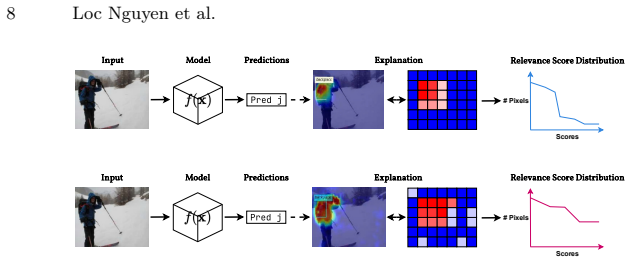
The central object is the metric grid: five quantitative scores grouped into three dimensions—Pointing Game and Energy-based Pointing Game for localization, Deletion, Insertion and Over-All for faithfulness, and Sparsity plus runtime for complexity. Each saliency map is scored on every axis, producing a table that exposes the trade-offs. The load-bearing identities are the formulas themselves: $\mathrm{PG}$ counts whether the maximum-saliency point lands inside the annotated bounding box, $\mathrm{EBPG}$ is the fraction of saliency energy inside the box, $\mathrm{OA} = \mathrm{AUC}(\text{Insertion}) - \mathrm{AUC}(\text{Deletion})$ combines the two perturbation curves, and Sparsity is the ratio $S_{\max}/S_{\mathrm{mean}}$ of the normalized map. The framework's argument runs by assembling these scores into a single comparison table and reading method selection off the resulting trade-offs.
What would settle it
Recompute the same benchmark with multiple random seeds and per-image distributions: if the gaps reported in the paper, such as D-CLOSE's OA of 0.881 versus G-CAME's 0.644 on MS-COCO/YOLOX or G-CAME's PG of 94.31% versus D-CLOSE's 87.86%, overlap under resampling, the claimed trade-offs would not be established.
Extended reading notes
Core claim
On the paper's own terms, ODExAI reliably measures explanation quality and informs method selection for specific detection tasks. Concretely, the benchmark shows a structured trade-off: D-CLOSE achieves the highest faithfulness, with Over-All (OA) values such as 0.881 on MS-COCO with YOLOX and 0.863 with Faster R-CNN, at the cost of runtimes around 70 seconds; G-CAME achieves the best localization, with Pointing Game scores up to 96.13% and Energy-based Pointing Game scores up to 70.11%, and the lowest runtime (0.54s), but lower faithfulness (OA 0.549 in the same Faster R-CNN setting) and more diffuse saliency maps; D-RISE stays moderate across all dimensions without leading on the main higher-is-better metrics. The paper interprets these results as evidence that region-based methods are better suited to auditing and debugging, while CAM-based methods fit real-time, localization-focused deployments.
Load-bearing premise
The whole comparison rests on the assumption that the five selected metrics, each computed once per setting, accurately capture whether an explanation is localized, faithful, and simple, and that the bounding box is the correct spatial target for explanation quality.
Editorial extensions
If this is right
- If the central claim is right, a real-time object detection pipeline should prefer a CAM-based explainer like G-CAME when localization is the priority, accepting lower faithfulness.
- For auditing or debugging, where the explanation must track the model's actual reasoning, a region-based method like D-CLOSE is the defensible choice despite its high runtime.
- Reporting a single evaluation metric, such as faithfulness alone, would mislead: the three dimensions must be reported together to see the trade-off profile.
- ODExAI provides a repeatable protocol: any new explainer can be inserted and scored on the same five metrics across the same detectors and datasets, making comparisons standardizable.
- A method that is moderate on every axis, such as D-RISE, remains useful as a fallback when the target dimension is unspecified or when explanation diversity is valued.
Reading between the lines
- Editorial inference: re-running the same evaluation with segmentation masks or human-annotated regions of interest instead of bounding boxes could shift the localization rankings, especially G-CAME's lead, and this is directly testable with the paper's released benchmark.
- Editorial inference: because each cell in the benchmark is a single number, resampling across images and random seeds and reporting confidence intervals would show which of the advertised gaps are stable; I would expect some gaps to shrink substantially.
- Editorial inference: applying ODExAI to transformer-based detectors, where attention maps play a different role than convolutional feature maps, would test whether the low faithfulness of CAM-based methods is a general property or an artifact of the two detectors benchmarked here.
Signed reviews
Editorial analysis
A structured set of objections, weighed in public.
Referee Report
Summary. The paper introduces ODExAI, a framework for evaluating explainable AI (XAI) methods for object detection along three dimensions: localization accuracy (PG, EBPG), faithfulness to the model (Deletion/Insertion, OA), and computational complexity (Sparsity, runtime). The framework is demonstrated in a 'toy experiment' comparing D-CLOSE, G-CAME, and D-RISE on YOLOX and Faster R-CNN using MS-COCO and PASCAL VOC, with results reported in Table 1 and visualized as spider plots in Figure 5. The central empirical claim, stated in Section 4.3, is that ODExAI 'reliably measures explanation quality and informs method selection,' leading to conclusions that D-CLOSE is most faithful but slow, G-CAME is best localized and fastest but less faithful, and D-RISE is moderate across all dimensions.
Significance. If the central claim were fully supported, ODExAI would be a useful standardized benchmark for comparing XAI methods in object detection, a domain where no such consensus framework exists. The paper's strengths are the use of standard, correctly cited metrics (PG, EBPG, Deletion/Insertion, OA, Sparsity) and the public release of code at the provided GitHub URL. However, as it stands, the paper delivers a demonstration rather than a validated evaluation standard: the empirical evidence consists of single point estimates from a self-described toy experiment, with no error bars, sample sizes, statistical tests, or seed variance reported, and Section 5.2 concedes that the framework lacks a proper normalization scheme, which can be misleading when metrics differ in scale or unit. These issues directly affect the load-bearing claim that ODExAI reliably measures explanation quality, so the contribution is currently a framework proposal with illustrative results rather than a fully supported empirical benchmark.
major comments (3)
- [Section 4.3, Table 1] The central claim that ODExAI 'reliably measures explanation quality and informs method selection' is not supported by the reported evidence. Each cell of Table 1 is a single point estimate with no variance, sample size, or statistical test; D-CLOSE and D-RISE are stochastic methods using 2000 random perturbation masks, so seed variance should be reported to establish that the observed differences are not noise. The paper itself labels the study a 'toy experiment' in the contribution list, which further weakens the basis for the reliability claim.
- [Section 5.2, Figure 5] The framework's own stated limitation undermines the trade-off analysis. Section 5.2 admits that the framework 'lacks a proper normalization scheme, which can be misleading when metrics differ in scale or unit' and that metrics mix higher-better and lower-better directions. Since Table 1 and Figure 5 plot raw OA (an AUC difference), PG/EBPG percentages, Sparsity (a ratio with unbounded upper range), and runtime in seconds on the same spider plot, the visual shape and the resulting trade-off narrative (e.g., D-CLOSE faithful but slow, G-CAME localized but less faithful) may be artifacts of scale rather than of method quality. The skill-score baseline cited as reference [5] is mentioned only as future work, so no random or reference baseline is used to put the raw values in context.
- [Section 3.2] The localization metrics PG and EBPG assume that the ground-truth bounding box is the correct region of interest for an explanation, but this assumption is not validated. Object-detection explanations may reasonably include contextual or surrounding pixels that contribute to the model's decision, so restricting localization to the bounding box could systematically disadvantage methods that capture context. Since localization is one of the three headline dimensions, the choice should be justified empirically, for example by a sensitivity analysis using different ROI definitions, or explicitly discussed as a limitation with a concrete test.
minor comments (5)
- [Table 1] The PG row contains concatenated values without delimiters, such as '94.3186.55' and '96.1384.12', making the table difficult to read; the values should be separated clearly.
- [Section 2.1] DETR is cited as reference [57], but [57] is the FCOS paper; DETR corresponds to the Carion et al. reference currently numbered [9], and Deformable DETR should have its own distinct citation.
- [References] References [4] and [5] are identical (both Bommer et al., 'Finding the right XAI method'), which creates a duplicate entry; the duplicate should be merged and the in-text citation for the skill score corrected accordingly.
- [Section 5.2] The proposed solution of 'assign weights' to handle higher-better versus lower-better metrics is only a sentence; the paper should specify how the weights would be determined so that they do not introduce a new arbitrary degree of freedom.
- [Figure 5] The spider plot axes are not labeled with units or any normalization information; without such labels, the visualization cannot be interpreted across metrics with different physical dimensions.
Circularity Check
No significant circularity: ODExAI is an empirical benchmark built on externally published metrics and independent XAI implementations, with no equation reducing to its own inputs.
full rationale
The paper's central claim is that ODExAI reliably measures explanation quality, supported by a toy experiment comparing D-CLOSE, G-CAME, and D-RISE. The metrics (PG, EBPG, Deletion/Insertion, OA, Sparsity, runtime) are standard externally published measures, and the XAI methods are cited external implementations, not derived from the framework. No parameter is fitted to a subset of data and then renamed a prediction; no uniqueness theorem from the authors is invoked; and no equation such as Eq. (1), (2), or (3) reduces to the conclusions about method ranking. The Section 5.2 caveat about missing normalization and mixed higher/lower-better metrics is a validity concern about comparing raw scales, not a circularity issue. Accordingly, the score is 0, and no circular steps are listed.
Assumptions & free parameters
free parameters (2)
- Number of perturbed masks (D-CLOSE and D-RISE) =
2000
- Test image subset size =
not reported
assumptions (4)
- domain assumption The bounding box of the target object is the correct region of interest for evaluating localization
- domain assumption The chosen metrics (PG, EBPG, Del/Ins, OA, Sparsity) are valid and sufficient for measuring the three intended dimensions
- domain assumption YOLOX and Faster R-CNN are representative detectors and MS-COCO and PASCAL VOC are representative datasets
- ad hoc to paper The implementation correctly computes the saliency maps and metrics
Cite this review
Pith. "Pith review of ODExAI: A Comprehensive Object Detection Explainable AI Evaluation." pith.science (2026). https://pith.science/paper/7XNDWT2X
@misc{pith2026250419249,
  author       = {Pith},
  title        = {Pith review of: ODExAI: A Comprehensive Object Detection Explainable AI Evaluation},
  year         = {2026},
  howpublished = {\url{https://pith.science/paper/7XNDWT2X}},
  note         = {Machine review of arXiv:2504.19249}
}
read the original abstract
Explainable Artificial Intelligence (XAI) techniques for interpreting object detection models remain in an early stage, with no established standards for systematic evaluation. This absence of consensus hinders both the comparative analysis of methods and the informed selection of suitable approaches. To address this gap, we introduce the Object Detection Explainable AI Evaluation (ODExAI), a comprehensive framework designed to assess XAI methods in object detection based on three core dimensions: localization accuracy, faithfulness to model behavior, and computational complexity. We benchmark a set of XAI methods across two widely used object detectors (YOLOX and Faster R-CNN) and standard datasets (MS-COCO and PASCAL VOC). Empirical results demonstrate that region-based methods (e.g., D-CLOSE) achieve strong localization (PG = 88.49%) and high model faithfulness (OA = 0.863), though with substantial computational overhead (Time = 71.42s). On the other hand, CAM-based methods (e.g., G-CAME) achieve superior localization (PG = 96.13%) and significantly lower runtime (Time = 0.54s), but at the expense of reduced faithfulness (OA = 0.549). These findings demonstrate critical trade-offs among existing XAI approaches and reinforce the need for task-specific evaluation when deploying them in object detection pipelines. Our implementation and evaluation benchmarks are publicly available at: https://github.com/Analytics-Everywhere-Lab/odexai.
Figures


Figures from the paper (2 more)

Reference graph
Works this paper leans on
-
[5]
Artificial Intelligence for the Earth Systems 3(3), e230074 (2024)
Bommer, P.L., et al.: Finding the right xai method—a guide for the evaluation and ranking of explainable ai methods in climate science. Artificial Intelligence for the Earth Systems 3(3), e230074 (2024)
work page 2024
-
[1]
Information Fusion81, 14–40 (2022)
Arras, L., et al.: Clevr-xai: A benchmark dataset for the ground truth evaluation of neural network explanations. Information Fusion81, 14–40 (2022)
work page 2022
-
[2]
Arya, V., et al.: One explanation does not fit all: A toolkit and taxonomy of ai explainability techniques (2019)
work page 2019
-
[3]
Bochkovskiy, A., et al.: Yolov4: Optimal speed and accuracy of object detection (2020)
work page 2020
-
[6]
Forest Ecology and Management551, 121530 (2024)
Buchelt, A., et al.: Exploring artificial intelligence for applications of drones in forest ecology and management. Forest Ecology and Management551, 121530 (2024)
work page 2024
-
[7]
C, B., et al.: A novel approach for jute pest detection using improved vgg-19 and xai. In: 2024 15th International Conference on Computing Communication and Networking Technologies (ICCCNT). pp. 1–5 (2024)
work page 2024
-
[8]
In: 2018 IEEE/CVF Conference on Computer Vision and Pattern Recognition
Cai, Z., Vasconcelos, N.: Cascade r-cnn: Delving into high quality object detection. In: 2018 IEEE/CVF Conference on Computer Vision and Pattern Recognition. pp. 6154–6162 (2018)
work page 2018
-
[9]
Carion, N., et al.: End-to-end object detection with transformers (2020)
work page 2020
Show all 65 references
-
[10]
In: 2019 IEEE/CVF International Conference on Computer Vision (ICCV)
Duan, K., et al.: Centernet: Keypoint triplets for object detection. In: 2019 IEEE/CVF International Conference on Computer Vision (ICCV). pp. 6568–6577 (2019)
2019
-
[11]
Frontiers in Robotics and AI11 (2024)
Ennab, M., Mcheick, H.: Enhancing interpretability and accuracy of ai models in healthcare: a comprehensive review on challenges and future directions. Frontiers in Robotics and AI11 (2024)
2024
-
[12]
Journal of Personalized Medicine11(11) (2021)
Esmaeili, M., et al.: Explainable artificial intelligence for human-machine interaction in brain tumor localization. Journal of Personalized Medicine11(11) (2021)
2021
-
[13]
Everingham, M., et al.: The PASCAL Visual Object Classes Challenge 2012 (VOC2012) Results
2012
-
[14]
Computers in biology and medicine 170, 108042 (2024)
Famiglini, L., et al.: Evidence-based xai: An empirical approach to design more effective and explainable decision support systems. Computers in biology and medicine 170, 108042 (2024)
2024
-
[15]
Ge, Z., et al.: Yolox: Exceeding yolo series in 2021 (2021)
2021
-
[16]
In: Pattern Recognition and Artificial Intelligence
Gomez, T., et al.: Metrics for saliency map evaluation of deep learning explanation methods. In: Pattern Recognition and Artificial Intelligence. pp. 84–95. Springer International Publishing, Cham (2022)
2022
-
[17]
201–238 (2019)
Grami, A.: The Gaussian Distribution, pp. 201–238 (2019)
2019
-
[18]
AI Magazine 40(2), 44–58 (Jun 2019)
Gunning, D., Aha, D.: Darpa’s explainable artificial intelligence (xai) program. AI Magazine 40(2), 44–58 (Jun 2019)
2019
-
[19]
In: 2017 IEEE International Conference on Computer Vision (ICCV)
He, K., et al.: Mask r-cnn. In: 2017 IEEE International Conference on Computer Vision (ICCV). pp. 2980–2988 (2017)
2017
-
[20]
Journal of Machine Learning Research 24(34), 1–11 (2023) 14 Loc Nguyen et al
Hedström, A., et al.: Quantus: An explainable ai toolkit for responsible evaluation of neural network explanations and beyond. Journal of Machine Learning Research 24(34), 1–11 (2023) 14 Loc Nguyen et al
2023
-
[21]
Information & Communications Technology Law 28(1), 65–98 (2019)
Hoofnagle, C.J., et al.: The european union general data protection regulation: what it is and what it means. Information & Communications Technology Law 28(1), 65–98 (2019)
2019
-
[22]
In: 2023 IEEE 27th International Conference on Intelligent Engineering Systems (INES)
Kadir, M.A., et al.: Evaluation metrics for xai: A review, taxonomy, and practical applications. In: 2023 IEEE 27th International Conference on Intelligent Engineering Systems (INES). pp. 000111–000124 (2023)
2023
-
[23]
Inter- national Journal of Applied Earth Observation and Geoinformation103, 102520 (2021)
Kakogeorgiou, I., Karantzalos, K.: Evaluating explainable artificial intelligence methods for multi-label deep learning classification tasks in remote sensing. Inter- national Journal of Applied Earth Observation and Geoinformation103, 102520 (2021)
2021
-
[24]
Law, H., Deng, J.: Cornernet: Detecting objects as paired keypoints (2019)
2019
-
[25]
In: Elkind, E
Le, P.Q., et al.: Benchmarking explainable ai - a survey on available toolkits and open challenges. In: Elkind, E. (ed.) Proceedings of the Thirty-Second International Joint Conference on Artificial Intelligence, IJCAI-23. pp. 6665–6673. International Joint Conferences on Arti...
2023
-
[26]
In: Fleet, D., Pajdla, T., Schiele, B., Tuytelaars, T
Lin, T.Y., et al.: Microsoft coco: Common objects in context. In: Fleet, D., Pajdla, T., Schiele, B., Tuytelaars, T. (eds.) Computer Vision – ECCV 2014. pp. 740–755. Springer International Publishing, Cham (2014)
2014
-
[27]
Liu, W., et al.: SSD: Single Shot MultiBox Detector, p. 21–37. Springer International Publishing (2016)
2016
-
[28]
In: 2021 IEEE/CVF International Conference on Computer Vision (ICCV)
Liu, Z., et al.: Swin transformer: Hierarchical vision transformer using shifted windows. In: 2021 IEEE/CVF International Conference on Computer Vision (ICCV). pp. 9992–10002 (2021)
2021
-
[29]
Applied Sciences12(19) (2022)
Lopes, P., et al.: Xai systems evaluation: A review of human and computer-centred methods. Applied Sciences12(19) (2022)
2022
-
[30]
ACM Trans
Mohseni, S., et al.: A multidisciplinary survey and framework for design and evaluation of explainable ai systems. ACM Trans. Interact. Intell. Syst.11(3–4) (Sep 2021)
2021
-
[31]
Molnar, C., et al.: General Pitfalls of Model-Agnostic Interpretation Methods for Machine Learning Models, pp. 39–68. Springer International Publishing, Cham (2022)
2022
-
[32]
Engineering Applications of Artificial Intelligence137, 109183 (2024)
Moradi, M., et al.: Model-agnostic explainable artificial intelligence for object detection in image data. Engineering Applications of Artificial Intelligence137, 109183 (2024)
2024
-
[33]
Mumuni, F., Mumuni, A.: Explainable artificial intelligence (xai): from inherent explainability to large language models (2025)
2025
-
[34]
Scientific Reports14(1), 13695 (Jun 2024)
Natarajan, S., et al.: Robust diagnosis and meta visualizations of plant diseases through deep neural architecture with explainable ai. Scientific Reports14(1), 13695 (Jun 2024)
2024
-
[35]
ACM Comput
Nauta, M., et al.: From anecdotal evidence to quantitative evaluation methods: A systematic review on evaluating explainable ai. ACM Comput. Surv.55(13s) (Jul 2023)
2023
-
[36]
The EU Artificial Intelligence Act 106 (2022)
Neuwirth, R.: The eu artificial intelligence act. The EU Artificial Intelligence Act 106 (2022)
2022
-
[37]
Nguyen, H., et al.: Human-centered explainable psychiatric disorder diagnosis system using wearable ecg monitors
-
[38]
In: Proceedings of the Thirty-Third International Joint Conference on Artificial Intelligence, IJCAI-24
Nguyen, H., et al.: Langxai: Integrating large vision models for generating textual explanations to enhance explainability in visual perception tasks. In: Proceedings of the Thirty-Third International Joint Conference on Artificial Intelligence, IJCAI-24. pp. 8754–8758 (8 2024...
2024
-
[39]
Information Fusion116, 102782 (2025)
Nguyen, H.T.T., et al.: Xedgeai: A human-centered industrial inspection framework with data-centric explainable edge ai approach. Information Fusion116, 102782 (2025)
2025
-
[40]
Proceedings of the Canadian Con- ference on Artificial Intelligence (2024)
Nguyen, K., et al.: Efficient and Concise Explanations for Object Detection with Gaussian-Class Activation Mapping Explainer. Proceedings of the Canadian Con- ference on Artificial Intelligence (2024)
2024
-
[41]
In: International Workshop on Health Intelligence
Nguyen, T.T.H., et al.: Towards trust of explainable ai in thyroid nodule diagnosis. In: International Workshop on Health Intelligence. pp. 11–26. Springer (2023)
2023
-
[42]
In: 2024 IEEE International Conference on Consumer Electronics (ICCE)
Nguyen, T.T.H., et al.: Enhancing the fairness and performance of edge cameras with explainable ai. In: 2024 IEEE International Conference on Consumer Electronics (ICCE). pp. 1–4 (2024)
2024
-
[43]
Padmanabhan,D.C.,etal.:Dext:Detectorexplanationtoolkit.In:WorldConference on Explainable Artificial Intelligence. pp. 433–456. Springer (2023)
2023
-
[44]
In: Proceedings of the British Machine Vision Conference (BMVC) (2018)
Petsiuk, V., Das, A., Saenko, K.: Rise: Randomized input sampling for explanation of black-box models. In: Proceedings of the British Machine Vision Conference (BMVC) (2018)
2018
-
[45]
In: Proceedings of the IEEE/CVF Conference on Computer Vision and Pattern Recognition (CVPR)
Petsiuk, V., et al.: Black-box explanation of object detectors via saliency maps. In: Proceedings of the IEEE/CVF Conference on Computer Vision and Pattern Recognition (CVPR). pp. 11443–11452 (June 2021)
2021
-
[46]
Redmon, J., Farhadi, A.: Yolov3: An incremental improvement (2018)
2018
-
[47]
Redmon, J., et al.: You only look once: Unified, real-time object detection (2016)
2016
-
[48]
In: Cortes, C., et al
Ren, S., et al.: Faster r-cnn: Towards real-time object detection with region proposal networks. In: Cortes, C., et al. (eds.) Advances in Neural Information Processing Systems. vol. 28. Curran Associates, Inc. (2015)
2015
-
[49]
Ren, S., et al.: Faster r-cnn: Towards real-time object detection with region proposal networks (2016)
2016
-
[50]
why should i trust you?
Ribeiro, M.T., et al.: "why should i trust you?": Explaining the predictions of any classifier. In: Proceedings of the 22nd ACM SIGKDD International Conference on Knowledge Discovery and Data Mining. p. 1135–1144. KDD ’16, Association for Computing Machinery, New York, NY, USA (2016)
2016
-
[51]
Machine Learning and Knowledge Extraction3(3), 662–671 (2021)
Sejr, J.H., et al.: Surrogate object detection explainer (sodex) with yolov4 and lime. Machine Learning and Knowledge Extraction3(3), 662–671 (2021)
2021
-
[52]
In: Proceedings of the IEEE International Conference on Computer Vision (ICCV) (Oct 2017)
Selvaraju, R.R., et al.: Grad-cam: Visual explanations from deep networks via gradient-based localization. In: Proceedings of the IEEE International Conference on Computer Vision (ICCV) (Oct 2017)
2017
-
[53]
Song, L., et al.: Explainable artificial intelligence to interpret spatially-explicit impacts of future climate change on species distribution (01 2024)
2024
-
[54]
Sensors24(21) (2024)
Tahir, H.A., et al.: A novel hybrid xai solution for autonomous vehicles: Real-time interpretability through lime–shap integration. Sensors24(21) (2024)
2024
-
[55]
AIMS Mathematics9(12), 35678–35701 (2024)
Tarmissi, K., et al.: Explainable artificial intelligence with fusion-based transfer learning on adverse weather conditions detection using complex data for autonomous vehicles. AIMS Mathematics9(12), 35678–35701 (2024)
2024
-
[56]
Multimedia Systems28(6), 2335–2355 (Dec 2022)
Teng, Q., et al.: A survey on the interpretability of deep learning in medical diagnosis. Multimedia Systems28(6), 2335–2355 (Dec 2022)
2022
-
[57]
In: 2019 IEEE/CVF International Conference on Computer Vision (ICCV)
Tian, Z., et al.: Fcos: Fully convolutional one-stage object detection. In: 2019 IEEE/CVF International Conference on Computer Vision (ICCV). pp. 9626–9635 (2019)
2019
-
[58]
In: Yanıkoğlu, B., Buntine, W
Truong, V.B., et al.: Towards better explanations for object detection. In: Yanıkoğlu, B., Buntine, W. (eds.) Proceedings of the 15th Asian Conference on Machine Learning. Proceedings of Machine Learning Research, vol. 222, pp. 1385–1400. PMLR (11–14 Nov 2024) 16 Loc Nguyen et al
2024
-
[59]
In: Proceedings of the IEEE/CVF conference on computer vision and pattern recognition workshops
Wang, H., et al.: Score-cam: Score-weighted visual explanations for convolutional neural networks. In: Proceedings of the IEEE/CVF conference on computer vision and pattern recognition workshops. pp. 24–25 (2020)
2020
-
[60]
Medical Image Analysis78, 102391 (2022)
Wood, D.A., et al.: Deep learning models for triaging hospital head mri examinations. Medical Image Analysis78, 102391 (2022)
2022
-
[61]
In: Proceedings of the IEEE/CVF Conference on Computer Vision and Pattern Recognition (CVPR) Workshops
Yamauchi, T.: Spatial sensitive grad-cam++: Improved visual explanation for object detectors via weighted combination of gradient map. In: Proceedings of the IEEE/CVF Conference on Computer Vision and Pattern Recognition (CVPR) Workshops. pp. 8164–8168 (June 2024)
2024
-
[62]
In: 2022 IEEE International Conference on Image Processing (ICIP)
Yamauchi, T., Ishikawa, M.: Spatial sensitive grad-cam: Visual explanations for object detection by incorporating spatial sensitivity. In: 2022 IEEE International Conference on Image Processing (ICIP). pp. 256–260 (2022)
2022
-
[63]
Information Fusion 77, 29–52 (2022)
Yang, G., et al.: Unbox the black-box for the medical explainable ai via multi-modal and multi-centre data fusion: A mini-review, two showcases and beyond. Information Fusion 77, 29–52 (2022)
2022
-
[64]
International Journal of Computer Vision126(10), 1084–1102 (2018)
Zhang, J., et al.: Top-down neural attention by excitation backprop. International Journal of Computer Vision126(10), 1084–1102 (2018)
2018
-
[65]
arXiv preprint arXiv:2103.13859 (2021)
Zhang, Q., et al.: Group-cam: Group score-weighted visual explanations for deep convolutional networks. arXiv preprint arXiv:2103.13859 (2021)
2021 arXiv
-
[66]
IEEE Transactions on Pattern Analysis & Machine Intelligence46(09), 5967–5985 (Sep 2024)
Zhao, C., et al.: Gradient-Based Instance-Specific Visual Explanations for Object Specification and Object Discrimination . IEEE Transactions on Pattern Analysis & Machine Intelligence46(09), 5967–5985 (Sep 2024)
2024
Reviewed August 16, 2026 · model on record in the stance chip above.
Discussion (0). Continue with ORCID to comment.