REVIEW 4 major objections 4 minor 1 cited by
GRADE: Grover-based Benchmarking Toolkit for Assessing Quantum Hardware
T0 review · 4 major / 4 minor · reviewed 2026-08-16 · deepseek-v4-flash
Pith's one-line read A generalized Grover search, scored by target probability minus penalties, is a portable reliability benchmark for quantum hardware.
desk verdict A useful-looking benchmark idea that is currently undercut by an unspecified Grover iteration count and missing code. read the letter →
The pith
A machine-rendered reading of the paper's core claim, the machinery that carries it, and where it could break.
The reading
What carries the argument
The load-bearing object is the generalized Grover circuit paired with a three-term scoring function. The oracle marks each target by flipping the bits that are 0 in that target, applying an $H$ gate followed by a multi-controlled-$X$ gate, then undoing the bit flips, which inverts the phase of each marked state before the usual Grover diffusion step amplifies them. The score $S = P_T - \lambda \sigma_T - \mu P_N$ turns the measured probability distribution into one number: $P_T$ is the mean probability over targets, $\sigma_T$ the standard deviation among targets, and $P_N$ the total probability assigned to non-targets. The hyperparameters $\lambda$ and $\mu$ are the dials that let a user decide whether a benchmark should punish uneven target amplification or leakage into non-target states.
What would settle it
Run GRADE on a set of devices alongside randomized-benchmarking fidelities and coherence measurements, then compare rank orderings; if a device with a poor GRADE score has high gate fidelity or vice versa, or if an eight-state score fails to predict a 16- or 32-state score on the same device, the claim that GRADE measures generalizable reliability is falsified.
Extended reading notes
Core claim
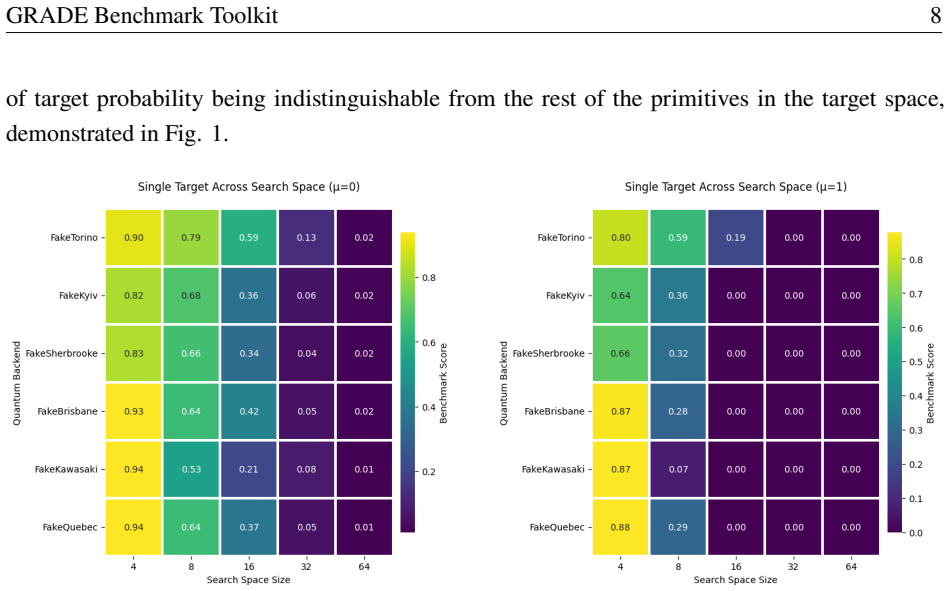
On its own terms, the paper establishes a method rather than a hardware result: the reliability of a quantum device can be quantified by executing a generalized Grover search and scoring the output distribution. The score is $S = \bar{P}_T - \lambda \sigma_T - \mu P_N$, where $\bar{P}_T$ is the mean probability of the marked target states, $\sigma_T$ is their standard deviation, and $P_N = 1 - P_T$ is the total non-target probability; the hyperparameters $\lambda$ and $\mu$ let the user weight how strongly uneven amplification and leakage are penalized. GRADE also provides a way to build multi-target oracles that mark all requested states. The authors report that every tested processor scored above 0.75 on an eight-state single-target search, and that scores fall as the search space grows on noisy emulators while a noiseless simulator stays flat; they explicitly refrain from ranking vendors.
Load-bearing premise
The load-bearing premise is that the GRADE score—target probability minus penalties for unevenness and leakage—is a valid measure of hardware reliability, and the paper never checks this score against independent error metrics such as gate fidelity, coherence time, or an established benchmark suite.
Editorial extensions
If this is right
- A single GRADE run gives a comparable number for any device that accepts transpiled circuits, so hardware from different providers can be compared on the same algorithmic task without per-vendor tuning.
- GRADE detects the expected noise signature: scores decline as search space grows on noisy backends, while a noiseless simulator retains a full score, so the metric tracks circuit-level sensitivity to device errors.
- Multi-target benchmarks with nonzero $\lambda$ and $\mu$ quantify not just success probability but how evenly the algorithm amplifies all marked states and how much probability leaks to unmarked states, which is useful for evaluating oracle implementations.
- Because GRADE intentionally avoids hardware-specific optimizations, its scores reflect the default behavior of the algorithm rather than a vendor's best possible performance; any optimization would have to be reported separately.
- The same toolkit can be extended to error-mitigation studies and to other algorithm families such as variational or optimization circuits, giving a uniform scoring standard across algorithm types.
Reading between the lines
- Editorial inference: if the GRADE score is validated against independent error metrics, it could serve as a lightweight acceptance test during device provisioning, since one small circuit and a few score components are far cheaper to run than full application benchmarks.
- Editorial inference: the decomposition into $\bar{P}_T$, $\sigma_T$, and $P_N$ gives a diagnostic signature—rising $P_N$ points toward depolarizing or measurement errors, while rising $\sigma_T$ points toward coherent errors that affect marked states unevenly—though the paper does not make this mapping.
- Editorial inference: the single-target, eight-state demonstrations are too small to establish scalability; a natural next experiment is to test whether scores at three qubits predict scores at four to ten qubits on the same device class, which would turn GRADE into a predictive benchmark.
- Editorial inference: because the authors do not compare GRADE with other benchmark suites or error metrics, the score currently measures Grover success on a tiny search more directly than it measures general reliability; users should treat it as a relative probe until external cross-validation appears.
Signed reviews
Editorial analysis
A structured set of objections, weighed in public.
Referee Report
Summary. The paper introduces GRADE, a proposed open-source benchmarking toolkit that runs a generalized Grover's algorithm on quantum hardware and computes a scalar 'reliability' score from the output probability distribution. The user specifies a search space and a set of one or more target states; Algorithm 3 builds a multi-target phase-flip oracle, and Algorithm 4 computes Score = P_T - lambda * sigma_T - mu * P_N, intended to reward high target probability, uniform amplification across targets, and suppression of non-target leakage. The authors report scores on Qiskit fake backends (Figs. 2 and 3) and on IonQ, Rigetti, Quantinuum, and IBM hardware (Fig. 4), claiming that the approach can adapt to multiple quantum platforms and provide a reliability assessment. The paper also sketches future extensions to other algorithms such as QAOA and VQE.
Significance. If the central claim were established, GRADE would offer a useful, provider-agnostic, algorithm-level benchmark: the score is defined directly from measured probabilities with no fitted parameters, and the multi-target oracle in Algorithm 3 is a standard, easily reproducible construction. That said, the manuscript does not yet establish that the GRADE score measures hardware reliability. The missing Grover iteration count makes the score underdetermined (a noiseless 3-qubit single-target search can yield ideal scores ranging from 0 to 0.89 depending on the iteration count), and the hardware results lack shot counts, error bars, and any comparison with independent error metrics. These issues are fixable, but they are load-bearing rather than cosmetic.
major comments (4)
- [Section 2.3 and Algorithms 1-4] The number of Grover iterations is never specified. The text only says that the oracle is 'sent to the original implementation of Grover's diffusion for state amplification' (Section 2.3), and no iteration count appears in the algorithms or figure captions. Because Grover's success probability is periodic in the iteration count, Eq. (1) is not a well-defined function of hardware behavior: for the 3-qubit, single-target search used in Fig. 4, the ideal target probability is about 0.945 with 2 iterations, about 0.78 with 1 iteration, and about 0.33 with 3 iterations, which for lambda=mu=1 gives GRADE scores of about 0.89, 0.56, and 0 (if clamped), respectively. The reported hardware scores above 0.75 in Fig. 4 are therefore uninterpretable without knowing the iteration schedule. Please specify the Grover iteration count (or an adaptive schedule, e.g., floor(pi/4 * sqrt(N/M))) and report it for each experiment, together with the corresponding noiseless baseline for the same schedule.
- [Section 2.4, Eq. (1)-(3) and Algorithm 4] The definition of P_T is inconsistent. Eq. (1) says P_T is the cumulative probability of the target states, while Eq. (2) says P_T is the mean target probability, and Algorithm 4 first accumulates P_T and then normalizes by |T| before computing the score. For two equal targets on noiseless hardware, the cumulative definition gives Score=1 while the mean definition gives Score=0.5 (for lambda=mu=1). Moreover, the text states that when mu*P_N > P_T the score 'returns 0,' but Algorithm 4 contains no such clamp and can return a negative score. Because the score is the core output of the benchmark, this ambiguity must be resolved and the algorithm must match Eq. (1) exactly, including any floor at zero.
- [Section 3.2 and Fig. 4] The hardware results are reported without shot counts, without repeated runs, and without error bars, and no comparison is made to independent error metrics such as gate fidelities, coherence times, or established benchmark suites. As a result, the abstract's claim that GRADE 'evaluate[s] the reliability of quantum hardware' is not supported: the score is simply defined as reliability, not shown to track it. Please report statistical details and validate GRADE against at least one independent metric on the same devices, ideally comparing GRADE with a known benchmark such as QED-C or QUARK discussed in Section 1.3.
- [Reproducibility and Data Availability] The abstract and introduction describe GRADE as an open-source toolkit, but no repository URL, package name, or code listing is given, and the Data Availability Statement only says that 'further inquiries can be directed to the corresponding author.' For a benchmarking paper whose central contribution is a toolkit, the code must be accessible, versioned, and linked (e.g., via a DOI or repository), and the exact circuit construction and scoring implementation must be specified. Please provide this or state clearly why it is omitted.
minor comments (4)
- [Algorithms 1 and 2] The expression for n appears to rely on a ceiling function that is not rendered in the text; as printed, n = log2(num_targets) need not be an integer. Please ensure the formulas read n = ceil(log2(num_targets)) (and similarly for Algorithm 2) so that the search-space size is always a valid power of two.
- [Section 2.4] The phrase 'modeled after the scoring function for machine learning' is vague; please cite the specific scoring function being adapted (e.g., F1 score or R^2) and explain the analogy.
- [Figure 1] Figure 1 is a heatmap, but the caption does not describe the axes, the color scale, or the value ranges; please expand the caption so the figure is interpretable without the main text.
- [Section 3.2] The word 'publically' should be 'publicly' in the sentence describing access through Microsoft Azure.
Circularity Check
No circularity found: GRADE defines an operational score directly from measured output probabilities and makes no fitted-input or self-citation-dependent prediction.
full rationale
The paper's derivation chain consists of constructing a Grover circuit, measuring a probability distribution, and applying the explicit scoring function in Eq. (1). The score is a direct function of measured probabilities; no parameter is fitted to the results and then reported as a prediction. The paper does not invoke uniqueness theorems or rely on self-citations: references [8]-[11] are external prior benchmark frameworks and tooling, and none is used to justify the scoring rule. The claim that the score evaluates the reliability of quantum hardware is an operational definition of a benchmark metric rather than a derivation of an independent quantity from the score; this is a validation gap, since GRADE is not compared with external error metrics, but it is not circularity. Therefore no load-bearing step reduces to its own inputs.
Assumptions & free parameters
free parameters (2)
- lambda =
0 and 1 in experiments (user-selected)
- mu =
0 and 1 in experiments (user-selected)
assumptions (4)
- standard math Grover's algorithm and the multi-target oracle construction behave as described in standard references.
- domain assumption The measured probability distribution over output states reflects hardware reliability rather than implementation artifacts.
- domain assumption Qiskit fake backends approximate the real hardware they emulate.
- domain assumption Running without hardware-specific optimizations yields comparable and unbiased measurements across providers.
Cite this review
Pith. "Pith review of GRADE: Grover-based Benchmarking Toolkit for Assessing Quantum Hardware." pith.science (2026). https://pith.science/paper/CJWEDDL7
@misc{pith2026250419387,
  author       = {Pith},
  title        = {Pith review of: GRADE: Grover-based Benchmarking Toolkit for Assessing Quantum Hardware},
  year         = {2026},
  howpublished = {\url{https://pith.science/paper/CJWEDDL7}},
  note         = {Machine review of arXiv:2504.19387}
}
read the original abstract
Quantum computing holds the potential to provide speedups in solving complex problems that are currently difficult for classical computers. However, the realization of this potential is hindered by the issue of current hardware reliability, primarily due to noise and architectural imperfections. As quantum computing systems rapidly advance, there exists a need to create a generalizable benchmarking tool that can assess reliability across different hardware platforms. In this paper, we introduce GRADE (Grover-based Reliability Assessment for Device Evaluation), an open-source benchmarking toolkit to evaluate the reliability of quantum hardware using a generalized form of Grover's algorithm. GRADE operates by implementing Grover's algorithm to search through a variety of primitive collections that are customizable by the user, analyzing the probability distribution of the results to assess accuracy and stability. This approach aims to evaluate the hardware performance of Grover's algorithm, which is fundamental in unordered search problems, making it an ideal candidate for benchmarking purposes, as it is one of the few generalizable quantum algorithms that provide a direct speedup. Importantly, GRADE can adapt to a wide range of quantum computing platforms, ensuring it can be applied across different hardware architectures. Additionally, our work provides a scoring function for evaluating the hardware performance for multi-target Grover's implementation. Our work validates this approach across a multitude of simulators and hardware platforms from varying providers, demonstrating its adaptability to differing backend providers.
Figures


Figures from the paper (1 more)

Forward citations
Cited by 1 Pith paper
-
GroverFigureOfMerit: An Agnostic Figure of Merit for Quantum Backend Characterization in the NISQ Era
A Grover-algorithm-based figure of merit with uniformity and leakage penalties distinguishes quantum backend performance across heterogeneous architectures under simulated noise models.
Reference graph
Works this paper leans on
-
[1]
The Development of the Number Field Sieve, volume 1554
ArjenK.Lenstra,HendrikW.Lenstra,MarkS.Manasse,andJohnM.Pollard. The Development of the Number Field Sieve, volume 1554. Springer-Verlag, Berlin, Heidelberg, 1993
work page 1993
-
[2]
Polynomial-time algorithms for prime factorization and discrete logarithms on a quantum computer.SIAM review, 41(2):303–332, 1999
Peter W Shor. Polynomial-time algorithms for prime factorization and discrete logarithms on a quantum computer.SIAM review, 41(2):303–332, 1999
1999
-
[3]
Rapid solution of problems by quantum computation
David Deutsch and Richard Jozsa. Rapid solution of problems by quantum computation. Proceedings of the Royal Society of London. Series A: Mathematical and Physical Sciences , 439(1907):553–558, 1992
work page 1907
-
[4]
A fast quantum mechanical algorithm for database search
Lov K Grover. A fast quantum mechanical algorithm for database search. InProceedings of the twenty-eighth annual ACM symposium on Theory of computing , pages 212–219, 1996
work page 1996
-
[5]
Cambridge university press, 2010
Michael A Nielsen and Isaac L Chuang.Quantum computation and quantum information . Cambridge university press, 2010. GRADE Benchmark Toolkit 13
work page 2010
-
[6]
Supercomputing leverages quantummachinelearningandgrover’salgorithm
Bikram Khanal, Javier Orduz, Pablo Rivas, and Erich Baker. Supercomputing leverages quantummachinelearningandgrover’salgorithm. The Journal of Supercomputing,79(6):6918– 6940, 2023
work page 2023
-
[7]
Applying grover’s algorithm to hash functions: a software perspective
Richard H Preston. Applying grover’s algorithm to hash functions: a software perspective. IEEE Transactions on Quantum Engineering, 3:1–10, 2022
work page 2022
-
[8]
Application-oriented performance benchmarks for quantum computing.IEEE Transactions on Quantum Engineering, 4:1–32, 2023
Thomas Lubinski, Sonika Johri, Paul Varosy, Jeremiah Coleman, Luning Zhao, Jason Necaise, Charles H Baldwin, Karl Mayer, and Timothy Proctor. Application-oriented performance benchmarks for quantum computing.IEEE Transactions on Quantum Engineering, 4:1–32, 2023
2023
Show all 11 references
-
[9]
Quark: A framework for quantum computing application benchmarking
Jernej Rudi Finžgar, Philipp Ross, Leonhard Hölscher, Johannes Klepsch, and Andre Luckow. Quark: A framework for quantum computing application benchmarking. In2022 IEEE international conference on quantum computing and engineering (QCE) , pages 226–237. IEEE, 2022
2022
-
[10]
Wood, Jake Lishman, Julien Gacon, Simon Martiel, Paul D
Ali Javadi-Abhari, Matthew Treinish, Kevin Krsulich, Christopher J. Wood, Jake Lishman, Julien Gacon, Simon Martiel, Paul D. Nation, Lev S. Bishop, Andrew W. Cross, Blake R. Johnson, and Jay M. Gambetta. Quantum computing with Qiskit, 2024
2024
-
[11]
Quantum computinginthecloud: Analyzingjobandmachinecharacteristics
GokulSubramanianRavi,KaitlinN.Smith,PranavGokhale,andFredericT.Chong. Quantum computinginthecloud: Analyzingjobandmachinecharacteristics. In 2021 IEEE International Symposium on Workload Characterization (IISWC), pages 39–50, 2021
2021
Reviewed August 16, 2026 · model on record in the stance chip above.
Discussion (0). Continue with ORCID to comment.