REVIEW 3 major objections 5 minor 41 references
Rapid and efficient wavefront correction for spatially entangled photons using symmetrized optimization
T0 review · 3 major / 5 minor · reviewed 2026-08-16 · deepseek-v4-flash
Pith's one-line read This paper shows that restricting wavefront corrections to the even-parity component of the phase distortion makes adaptive correction of spatially entangled photons four times faster and 38% more effective in a fixed number of generations.
desk verdict A useful experimental demonstration that enforcing even-parity symmetry in a genetic algorithm speeds up wavefront correction for entangled photons, though a contradictory contrast number in the text needs to be reconciled before the secondary claim is clean. read the letter →
The pith
A machine-rendered reading of the paper's core claim, the machinery that carries it, and where it could break.
The reading
What carries the argument
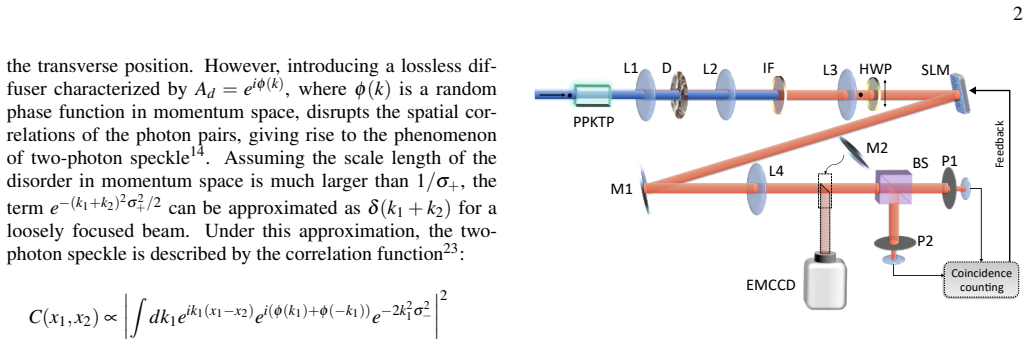
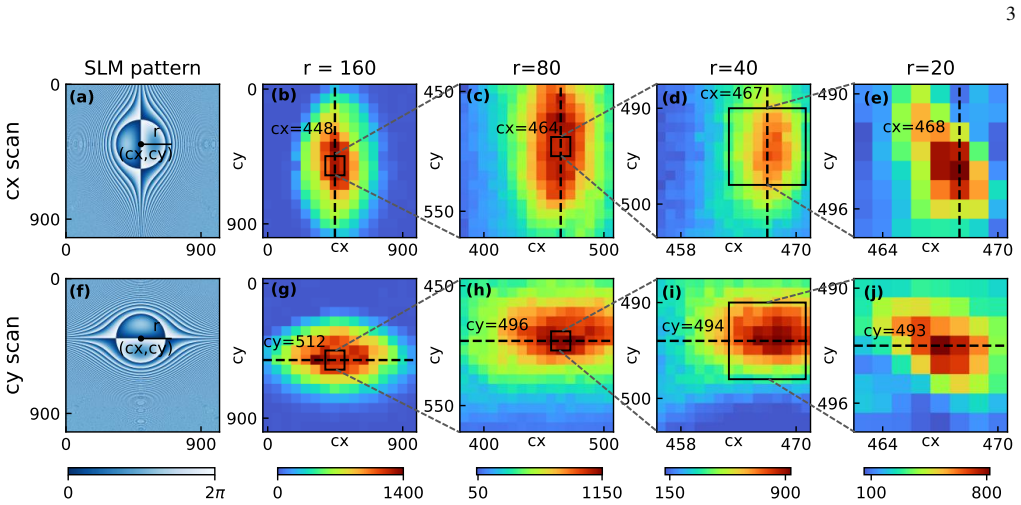
The load-bearing object is the even-parity phase φ(k) + φ(−k) that appears in the two-photon correlation integral, together with the enforced 180°-rotational symmetry of the SLM phase mask that makes it the only degree of freedom. The identity that carries the argument is that the two-photon correlation C(x1,x2) depends on the diffuser only through the symmetrized combination, so an odd-parity phase mask is invisible to the feedback signal; this is what allows halving the parameter space. The mechanical enforcer is the sGA, a genetic algorithm in which the lower half of the super-pixel phase pattern is set by rotating the independently optimized upper half, plus a Zernike-based beam-centering scan that locates the symmetry center on the SLM.
What would settle it
Measure the two-photon coincidence enhancement while applying a phase pattern that is purely odd under 180° rotation, centered on the beam; the theory says it should leave the correlation completely unchanged, so any measurable change would refute the premise behind the symmetrized algorithm.
Extended reading notes
Core claim
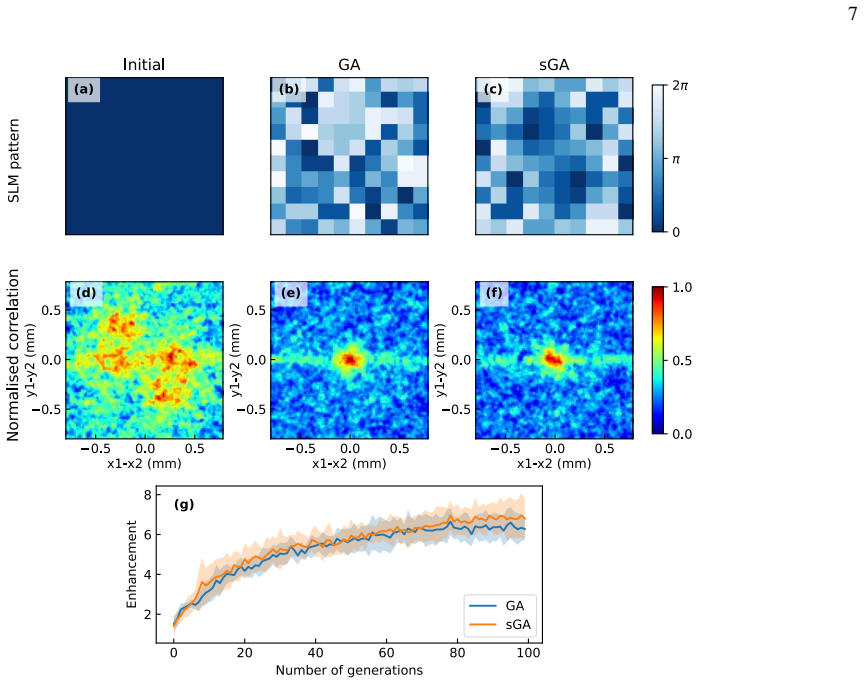
The central discovery is that the two-photon correlation function in the far field of a crystal is sensitive only to the even-parity component of a phase diffuser placed in the momentum plane, because the odd-parity component cancels in the advanced-wave picture. Starting from the SPDC two-photon wavefunction and the advanced-wave model, the authors show that the coincidence rate is governed by a correlation function into which the diffuser phase enters only through φ(k) + φ(−k). They exploit this by running a genetic algorithm on the SLM with the constraint that the phase mask be symmetric under 180° rotation about the beam center, so only half the super-pixels are independent. Experimentally, sGA achieves a fourfold speedup: an enhancement of 5.9 that takes the standard GA 100 generations is reached in 25 generations, and at 100 generations sGA exceeds GA by 38% in enhancement, with higher contrast in the restored two-photon correlation. The paper also establishes that the achievable enhancement rises with the signal-to-noise ratio of the coincidence feedback, which is set by the detector integration time.
Load-bearing premise
The speed and enhancement gains of the symmetrized algorithm depend on the correction pattern being centered on the exactly right spot of the light beam; if that center is off by about half the size of the random variations, the improvement drops by roughly 40%.
Editorial extensions
If this is right
- Wavefront correction for spatially entangled photons can be performed with direct feedback from the quantum signal itself, without an auxiliary classical beam or pump-beam alignment, at up to four times lower overhead.
- For a fixed optimization time, correcting only the even-parity component yields up to 38% higher enhancement of two-photon correlations than correcting the full wavefront.
- The speed advantage depends on accurate localization of the beam center on the SLM: a center offset of 20 pixels (about half the disorder scale length) reduces sGA's final enhancement by about 40%, while GA is unaffected by such shifts.
- Because the odd-parity component does not contribute, detectors must be positioned at the beam center; placing them off-center removes sGA's advantage, since sGA cannot add the beam tilt that GA uses to improve feedback.
- Longer detector integration times raise the signal-to-noise ratio of the coincidence feedback and increase the final enhancement for both algorithms, at the cost of longer total runtime.
Reading between the lines
- A testable extension: restricting any wavefront-shaping optimizer (particle swarm, simulated annealing, or neural feedback) to phase masks with 180° rotational symmetry should yield a similar speedup, since the even/odd immunity is a property of the two-photon correlation, not of the genetic algorithm itself.
- A consequence the paper does not draw: sGA's advantage over GA should grow with disorder strength, because stronger disorder makes the even-parity contribution more dominant and simultaneously sharpens the center-alignment sensitivity reported in Appendix A.
- The Zernike-based beam-centering procedure exploits the same immunity and could serve as a general in situ alignment diagnostic for biphoton wavefront-shaping setups when no diffuser is present.
- Because the 38% figure is measured with a single diffuser realization, averaging over many disorder realizations would likely reduce the margin; the paper's fixed-realization comparison is fair but may overstate the practical gain for arbitrary disorder.
Signed reviews
Editorial analysis
A structured set of objections, weighed in public.
Referee Report
Summary. The paper demonstrates adaptive wavefront correction for spatially entangled photons using a genetic algorithm that enforces even-parity (180-degree rotational) symmetry on the SLM correction phase, based on the theoretical result that only the even-parity component of far-field diffuser phase affects two-photon correlations. The authors compare this symmetrized GA (sGA) with a standard GA using SPAD coincidence counts as feedback, reporting that sGA achieves the same enhancement in 25 generations that GA reaches in 100 generations, a claimed 4x speedup, and a 38% higher final enhancement at 100 generations. They also study the dependence of enhancement on detector integration time and include appendices on the sensitivity of sGA to center misalignment and detector displacement. The manuscript contains a direct internal inconsistency in the reported EMCCD contrast values, which the authors use as an independent verification of correction quality.
Significance. If the central claims survive scrutiny, the work is a useful practical advance: it uses direct quantum feedback rather than a classical probe beam, exploits a symmetry-based reduction of the optimization space, and includes robustness checks (center alignment, detector placement, integration time) that are often absent in wavefront-shaping papers. The theoretical motivation is clearly derived from Eq. (2) and the advanced-wave picture. However, the paper's own independent EMCCD contrast measurement currently contradicts the claimed sGA superiority, and the stated speedup factors are presented without the supporting numerical values and error bars. These issues must be resolved before the claims can be accepted.
major comments (3)
- [Section IV, after Eq. (3)] The manuscript states that the contrast values for Fig. 3(e) and Fig. 3(f) are 7.6 and 5.5, respectively, and then concludes that Fig. 3(f) exhibits higher contrast. Since Fig. 3(e) is identified two paragraphs earlier as the result after standard GA and Fig. 3(f) as the result after sGA, the reported numbers imply that the GA image has higher contrast, directly contradicting the claim that sGA achieves superior performance. Because the EMCCD correlation measurement is the only independent, post-hoc check of correction quality (the enhancement curves in Fig. 3(g) use the same SPAD coincidence signal that drives the optimization), this inconsistency is load-bearing. The authors must either correct the transposed numbers or figure labeling, or provide the raw correlation images and recomputed contrast values that support the claimed ordering.
- [Appendix A and Section III (beam center determination)] The sGA advantage relies on the optimization center (cx,cy) coinciding with the beam center (X,Y) on the SLM, yet the paper does not report the uncertainty of the beam-center measurement described in Fig. 2. The final scan in panels (e) and (j) uses r=20 and a cropped region, but no step size or repeated-measurement statistics are given. Given that Appendix A shows a 20-pixel shift (about half the disorder scale length of ~32 pixels) reduces the final sGA enhancement by roughly 40%, the authors should quantify the precision of their center-finding procedure and demonstrate that the Fig. 3 comparison is not degraded by a systematic center offset. Without this, the claim that sGA is four times faster is conditional on an unquantified alignment accuracy.
- [Section IV, Fig. 3(g)] The quantitative claims that sGA outperforms GA by 38% at the end of 100 generations and that sGA reaches GA's final enhancement of 5.9 in 25 generations are stated in the text without the corresponding numerical values or standard deviations from the five independent runs. The shaded error regions in Fig. 3(g) provide some information, but the 38% and 4x figures should be reported explicitly as mean ± standard deviation over the five runs, along with the actual enhancement values at generation 100 for both algorithms, to allow readers to assess the statistical significance of the claimed advantage.
minor comments (5)
- [Section IV, paragraph on EMCCD processing] The sentence 'calculated using data recoded by EMCCD' contains a typo: 'recoded' should be 'recorded'.
- [Section II, Eq. (2)] The exponential term is rendered as 'e−2k2 1σ 2−' and appears to have a formatting error; it should read e^{-2 k_1^2 \sigma_-^2}, with the subscript 1 on the first k and the subscript - on sigma.
- [Throughout] Capitalization of 'Fig.' is inconsistent; both 'Fig. 3' and 'fig. 3(e),(f)' appear in the same paragraph. Please standardize.
- [References] References 14 and 15 are identical (both are Peeters, Moerman, and Van Exter, 'Observation of two-photon speckle patterns,' PRL 104, 173601 (2010)). One should be replaced with the correct citation if a different work was intended.
- [Section II, sentence after Eq. (2)] The expression 'ei(φ (k1)+φ (−k1))' has an extra closing parenthesis; the intended argument is φ(k1)+φ(-k1).
Circularity Check
No significant circularity: the even-parity insight is derived in-text and the performance claims are measured empirically.
full rationale
The paper's central claims are not circular. The even-parity-only contribution to two-photon correlations is derived explicitly in Eq. (2) from the SPDC two-photon wavefunction, with the odd-parity cancellation further explained via the advanced-wave picture. The sGA speedup and enhancement advantage are measured directly from coincidence-count feedback and EMCCD correlation data, not fitted from the model. No fitted parameter encodes the claimed 38% improvement or 4x speedup; the reduction in search space follows structurally from enforcing inversion symmetry, and the convergence comparison is empirical. Self-citations to the authors' prior work (Refs. 23, 24) support but do not carry the derivation, since the relevant mathematics is reproduced in the text. The paper's internal inconsistency in the reported EMCCD contrast values (7.6 and 5.5 for Figs. 3(e) and 3(f), stated as supporting higher contrast in 3(f)) is a data-reporting or labeling discrepancy, not a circular derivation, and does not affect the circularity score.
Assumptions & free parameters
free parameters (7)
- GA population size =
15
- mutation rate =
0.1
- number of elites =
3
- phase quantization levels =
16
- super-pixel size =
8x8 pixels
- number of generations =
100
- detector integration time per pattern =
1 s
assumptions (5)
- domain assumption Two-photon wavefunction has Gaussian momentum correlations with sigma+ >> sigma-, so the term e^{-(k1+k2)^2 sigma+^2/2} approximates a delta function.
- domain assumption The diffuser is lossless and phase-only, with transfer function A_d = e^{i phi(k)}.
- domain assumption Only the even-parity component of the far-field phase affects two-photon correlation; the odd-parity component cancels.
- domain assumption The SLM is phase-only and lossless, and the imaging system correctly maps the crystal far field onto the SLM and back to the near field.
- domain assumption Coincidence counts at two correlated pinholes placed at the beam center provide a monotonic feedback signal for correlation enhancement.
Cite this review
Pith. "Pith review of Rapid and efficient wavefront correction for spatially entangled photons using symmetrized optimization." pith.science (2026). https://pith.science/paper/4MNL2PFQ
@misc{pith2026250419490,
  author       = {Pith},
  title        = {Pith review of: Rapid and efficient wavefront correction for spatially entangled photons using symmetrized optimization},
  year         = {2026},
  howpublished = {\url{https://pith.science/paper/4MNL2PFQ}},
  note         = {Machine review of arXiv:2504.19490}
}
read the original abstract
Spatial entanglement is a key resource in quantum technologies, enabling applications in quantum communication, imaging, and computation. However, propagation through complex media distorts spatial correlations, posing a challenge for practical implementations. We introduce a symmetrized genetic algorithm (sGA) for adaptive wavefront correction of spatially entangled photons, leveraging the insight that only the even-parity component of wavefront distortions affects two-photon correlations. By enforcing symmetry constraints, sGA reduces the optimization parameter space by half, leading to faster convergence and improved enhancement within finite number of generations compared to standard genetic algorithms (GA). Additionally, we establish the dependence of enhancement on the signal-to-noise ratio of the feedback signal, which is controlled by detector integration time. This technique enables correction of entanglement degradation, enhancing quantum imaging, secure quantum communication, and quantum sensing in complex environments.
Figures

Figures from the paper (3 more)


Reference graph
Works this paper leans on
-
[1]
merlin.mbs aapmrev4-1.bst 2010-07-25 4.21a (PWD, AO, DPC) hacked
FUNCTION id.bst "merlin.mbs aapmrev4-1.bst 2010-07-25 4.21a (PWD, AO, DPC) hacked" ENTRY address archive archivePrefix author bookaddress booktitle chapter collaboration doi edition editor eid eprint howpublished institution isbn issn journal key language month note number organization pages primaryClass publisher school SLACcitation series title translat...
2010
-
[2]
merlin.mbs aipauth4-1.bst 2010-07-25 4.21a (PWD, AO, DPC) hacked
FUNCTION id.bst "merlin.mbs aipauth4-1.bst 2010-07-25 4.21a (PWD, AO, DPC) hacked" ENTRY address archive archivePrefix author bookaddress booktitle chapter collaboration doi edition editor eid eprint howpublished institution isbn issn journal key language month note number organization pages primaryClass publisher school SLACcitation series title translat...
2010
-
[3]
merlin.mbs aipnum4-1.bst 2010-07-25 4.21a (PWD, AO, DPC) hacked
FUNCTION id.bst "merlin.mbs aipnum4-1.bst 2010-07-25 4.21a (PWD, AO, DPC) hacked" ENTRY address archive archivePrefix author bookaddress booktitle chapter collaboration doi edition editor eid eprint howpublished institution isbn issn journal key language month note number organization pages primaryClass publisher school SLACcitation series title translati...
2010
-
[4]
merlin.mbs apsrev4-1.bst 2010-07-25 4.21a (PWD, AO, DPC) hacked
FUNCTION id.bst "merlin.mbs apsrev4-1.bst 2010-07-25 4.21a (PWD, AO, DPC) hacked" ENTRY address archive archivePrefix author bookaddress booktitle chapter collaboration doi edition editor eid eprint howpublished institution isbn issn journal key language month note number organization pages primaryClass publisher school SLACcitation series title translati...
2010
-
[5]
merlin.mbs apsrmp4-1.bst 2010-07-25 4.21a (PWD, AO, DPC) hacked
FUNCTION id.bst "merlin.mbs apsrmp4-1.bst 2010-07-25 4.21a (PWD, AO, DPC) hacked" ENTRY address archive archivePrefix author bookaddress booktitle chapter collaboration doi edition editor eid eprint howpublished institution isbn issn journal key language month note number organization pages primaryClass publisher school SLACcitation series title translati...
2010
-
[6]
author author J. Schneeloch \ and\ author J. C. \ Howell ,\ title title Introduction to the transverse spatial correlations in spontaneous parametric down-conversion through the biphoton birth zone , \ 10.1088/2040-8978/18/5/053501 journal journal Journal of Optics (United Kingdom) \ volume 18 ( year 2016 ),\ 10.1088/2040-8978/18/5/053501 ,\ http://arxiv....
-
[7]
author author C. K. \ Law \ and\ author J. H. \ Eberly ,\ title title Analysis and interpretation of high transverse entanglement in optical parametric down conversion , \ 10.1103/PhysRevLett.92.127903 journal journal Physical Review Letters \ volume 92 ( year 2004 ),\ 10.1103/PhysRevLett.92.127903 ,\ http://arxiv.org/abs/0312088 arXiv:0312088 [quant-ph] NoStop
-
[8]
author author Z. Sun , author Y. Li , \ and\ author H. Ma ,\ title title Experimental high-dimensional quantum key distribution with orbital angular momentum , \ 10.1364/josab.507195 journal journal Journal of the Optical Society of America B \ volume 41 ,\ pages 351 ( year 2024 ) NoStop
Show all 41 references
-
[9]
Lib , author K
author author O. Lib , author K. Sulimany , author M. Ara \' u jo , author M. Ben-Or , \ and\ author Y. Bromberg ,\ title title High-dimensional quantum key distribution using a multi-plane light converter , \ http://arxiv.org/abs/2403.04210 \ ( year 2024 ) ,\ http://arxiv.org...
2024 arXiv
-
[10]
Erhard , author M
author author M. Erhard , author M. Krenn , \ and\ author A. Zeilinger ,\ 10.1038/s42254-020-0193-5 title Advances in high-dimensional quantum entanglement , \ ( year 2020 a ),\ http://arxiv.org/abs/1911.10006 arXiv:1911.10006 NoStop
2020 arXiv
-
[11]
He , author Y
author author Z. He , author Y. Zhang , author X. Tong , author L. Li , \ and\ author L. V. \ Wang ,\ title title Quantum microscopy of cells at the Heisenberg limit , \ 10.1038/s41467-023-38191-4 journal journal Nature Communications \ volume 14 ( year 2023 ),\ 10.1038/s41467...
-
[12]
Untern \" a hrer , author B
author author M. Untern \" a hrer , author B. Bessire , author L. Gasparini , author M. Perenzoni , \ and\ author A. Stefanov ,\ title title Super-resolution quantum imaging at the Heisenberg limit , \ 10.1364/optica.5.001150 journal journal Optica \ volume 5 ,\ pages 1150 ( y...
-
[13]
author author N. J. \ Cerf , author M. Bourennane , author A. Karlsson , \ and\ author N. Gisin ,\ title title Security of quantum key distribution using d-level systems , \ 10.1103/physrevlett.88.127902 journal journal Physical Review Letters \ volume 88 ( year 2002 ),\ 10.11...
-
[14]
Erhard , author M
author author M. Erhard , author M. Krenn , \ and\ author A. Zeilinger ,\ title title Advances in high-dimensional quantum entanglement , \ 10.1038/s42254-020-0193-5 journal journal Nature Reviews Physics \ volume 2 ,\ pages 365–381 ( year 2020 b ) NoStop
-
[15]
author author A. N. \ Boto , author P. Kok , author D. S. \ Abrams , author S. L. \ Braunstein , author C. P. \ Williams , \ and\ author J. P. \ Dowling ,\ title title Quantum interferometric optical lithography: Exploiting entanglement to beat the diffraction limit , \ 10.110...
-
[16]
author author C. Couteau ,\ title title Spontaneous parametric down-conversion , \ 10.1080/00107514.2018.1488463/ASSET/40D680C4-32CA-435D-A876-364396CE0768/ASSETS/IMAGES/TCPH_A_1488463_F0010_C.JPG journal journal Contemporary Physics \ volume 59 ,\ pages 291--304 ( year 2018 )...
2018
-
[17]
Karan , author S
author author S. Karan , author S. Aarav , author H. Bharadhwaj , author L. Taneja , author A. De , author G. Kulkarni , author N. Meher , \ and\ author A. K. \ Jha ,\ title title Phase matching in -barium borate crystals for spontaneous parametric down-conversion , \ 10.1088/...
-
[18]
Defienne , author M
author author H. Defienne , author M. Barbieri , author I. A. \ Walmsley , author B. J. \ Smith , \ and\ author S. Gigan ,\ title title Two-photon quantum walk in a multimode fiber , \ 10.1126/SCIADV.1501054 journal journal Science Advances \ volume 2 ( year 2016 ),\ 10.1126/S...
-
[20]
author author W. H. \ Peeters , author J. J. \ Moerman , \ and\ author M. P. \ Van Exter ,\ title title Observation of two-photon speckle patterns , \ 10.1103/PhysRevLett.104.173601 journal journal Physical Review Letters \ volume 104 ( year 2010 b ),\ 10.1103/PhysRevLett.104....
-
[21]
Lib \ and\ author Y
author author O. Lib \ and\ author Y. Bromberg ,\ title title Quantum light in complex media and its applications , \ 10.1038/s41567-022-01692-y journal journal Nature Physics \ ( year 2022 ),\ 10.1038/s41567-022-01692-y NoStop
2022 doi
-
[22]
author author C. W. \ Beenakker , author J. W. \ Venderbos , \ and\ author M. P. \ Van Exter ,\ title title Two-Photon speckle as a probe of Multi-Dimensional entanglement , \ 10.1103/PhysRevLett.102.193601 journal journal Physical Review Letters \ volume 102 ( year 2009 ),\ 1...
-
[23]
author author N. H. \ Valencia , author S. Goel , author W. McCutcheon , author H. Defienne , \ and\ author M. Malik ,\ title title Unscrambling entanglement through a complex medium , \ 10.1038/s41567-020-0970-1 journal journal Nature Physics \ volume 16 ,\ pages 1112–1116 ( ...
-
[24]
Devaux , author A
author author F. Devaux , author A. Mosset , author S. M. \ Popoff , \ and\ author E. Lantz ,\ title title Restoring and tailoring very high dimensional spatial entanglement of a biphoton state transmitted through a scattering medium , \ 10.1088/2040-8986/acc2ce journal journa...
-
[25]
Courme , author P
author author B. Courme , author P. Cameron , author D. Faccio , author S. Gigan , \ and\ author H. Defienne ,\ title title Manipulation and Certification of High-Dimensional Entanglement through a Scattering Medium , \ 10.1103/PRXQuantum.4.010308 journal journal PRX Quantum \...
-
[26]
Lib , author G
author author O. Lib , author G. Hasson , \ and\ author Y. Bromberg ,\ title title Real-time shaping of entangled photons by classical control and feedback , \ 10.1126/sciadv.abb6298 journal journal Science Advances \ volume 6 ( year 2020 ),\ 10.1126/sciadv.abb6298 ,\ http://a...
-
[27]
Shekel , author O
author author R. Shekel , author O. Lib , author A. Sardas , \ and\ author Y. Bromberg ,\ title title Shaping entangled photons through emulated turbulent atmosphere , \ 10.1364/osac.431200 journal journal OSA Continuum \ volume 4 ,\ pages 2339 ( year 2021 ) NoStop
-
[28]
Bajar , author R
author author K. Bajar , author R. Chatterjee , author V. S. \ Bhat , \ and\ author S. Mujumdar ,\ title title Partial immunity of two-photon correlation against wavefront distortion for spatially entangled photons , \ 10.1063/5.0238937 journal journal APL Quantum \ volume 2 (...
-
[29]
author author A. N. \ Black , author E. Giese , author B. Braverman , author N. Zollo , author S. M. \ Barnett , \ and\ author R. W. \ Boyd ,\ title title Quantum nonlocal aberration cancellation , \ 10.1103/physrevlett.123.143603 journal journal Physical Review Letters \ volu...
-
[30]
Zheng , author J.-S
author author Y. Zheng , author J.-S. \ Xu , author C.-F. \ Li , \ and\ author G.-C. \ Guo ,\ title title Theory of the monochromatic advanced-wave picture and applications in biphoton optics , \ 10.1103/physreva.110.063710 journal journal Physical Review A \ volume 110 ( year...
-
[31]
Shekel , author O
author author R. Shekel , author O. Lib , \ and\ author Y. Bromberg ,\ title title Shaping entangled photons through arbitrary scattering media using an advanced wave beacon , \ 10.1364/opticaq.525445 journal journal Optica Quantum \ volume 2 ,\ pages 303 ( year 2024 ) NoStop
-
[32]
author author V. S. \ Bhat , author K. Bajar , author R. Chatterjee , \ and\ author S. Mujumdar ,\ title title Facile dual-shot measurement of schmidt number in type-0 and type-2 downconversion , \ 10.1103/physrevresearch.6.033151 journal journal Physical Review Research \ vol...
-
[33]
author author V. S. \ Bhat , author R. Chatterjee , author K. Bajar , \ and\ author S. Mujumdar ,\ title title Controlling the degree of entanglement in downconversion by targeted birth zone activation , \ 10.1364/oe.542537 journal journal Optics Express \ volume 33 ,\ pages 9...
-
[34]
Edgar , author D
author author M. Edgar , author D. Tasca , author F. Izdebski , author R. Warburton , author J. Leach , author M. Agnew , author G. Buller , author R. Boyd , \ and\ author M. Padgett ,\ title title Imaging high-dimensional spatial entanglement with a camera , \ 10.1038/ncomms1...
-
[35]
Defienne , author M
author author H. Defienne , author M. Reichert , author J. W. \ Fleischer , \ and\ author P. G. \ Kwiat ,\ title title General Model of Photon-Pair Detection with an Image Sensor , \ 10.1103/PhysRevLett.120.203604 journal journal Physical Review Letters \ volume 120 ( year 201...
-
[36]
Chatterjee , author V
author author R. Chatterjee , author V. S. \ Bhat , author K. Bajar , \ and\ author S. Mujumdar ,\ title title Multifold enhancement of quantum snr by using an emccd as a photon number resolving device , \ 10.1364/opticaq.518037 journal journal Optica Quantum \ volume 2 ,\ pag...
-
[37]
Samanta \ and\ author S
author author R. Samanta \ and\ author S. Mujumdar ,\ title title Controlling the transmission of broadband light through scattering media using a digital micromirror device , \ 10.1364/ol.495297 journal journal Optics Letters \ volume 48 ,\ pages 4241 ( year 2023 ) NoStop
-
[38]
Fayyaz , author N
author author Z. Fayyaz , author N. Mohammadian , author M. Reza Rahimi Tabar , author R. Manwar , \ and\ author K. Avanaki ,\ title title A comparative study of optimization algorithms for wavefront shaping , \ 10.1142/S1793545819420021 journal journal Journal of Innovative O...
-
[39]
author author D. B. \ Conkey , author A. N. \ Brown , author A. M. \ Caravaca-Aguirre , \ and\ author R. Piestun ,\ title title Genetic algorithm optimization for focusing through turbid media in noisy environments , \ 10.1364/oe.20.004840 journal journal Optics Express \ volu...
-
[40]
author author I. M. \ Vellekoop ,\ title title Feedback-based wavefront shaping , \ 10.1364/oe.23.012189 journal journal Optics Express \ volume 23 ,\ pages 12189 ( year 2015 ) NoStop
2015 doi
-
[41]
Alfaraj ,\ 10.13140/RG.2.2.10971.77608 title A review of charge-coupled device image sensors , \ ( year 2017 ) NoStop
author author N. Alfaraj ,\ 10.13140/RG.2.2.10971.77608 title A review of charge-coupled device image sensors , \ ( year 2017 ) NoStop
2017
-
[42]
Courme , author C
author author B. Courme , author C. Vernière , author M. Joly , author D. Faccio , author S. Gigan , \ and\ author H. Defienne ,\ https://arxiv.org/abs/2503.24283 title Non-classical optimization through complex media , \ ( year 2025 ),\ http://arxiv.org/abs/2503.24283 arXiv:2...
2025 arXiv
Reviewed August 16, 2026 · model on record in the stance chip above.
Discussion (0). Continue with ORCID to comment.