REVIEW 3 major objections 5 minor 51 references
Towards Faster and More Compact Foundation Models for Molecular Property Prediction
T0 review · 3 major / 5 minor · reviewed 2026-08-16 · deepseek-v4-flash
Pith's one-line read Removing two interaction blocks shrinks JMP-L by 32% with minimal accuracy loss.
desk verdict Useful compression study with a real confound: fixed wall-clock budget makes the 'over-parameterized' conclusion unproven. read the letter →
The pith
A machine-rendered reading of the paper's core claim, the machinery that carries it, and where it could break.
The reading
What carries the argument
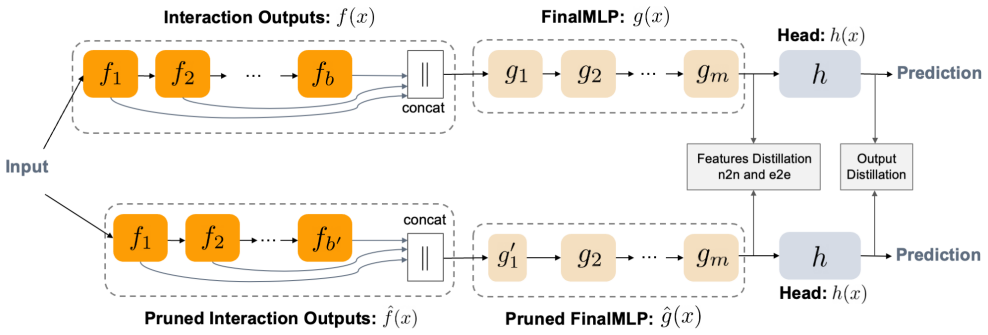
The load-bearing mechanism is a GradCAM-style relevance score: features from each interaction block are weighted by their gradient with respect to the loss, passed through a ReLU, and averaged to give an importance rank per block. The paper uses this ranking to prune blocks sequentially from the deepest end, then adjusts the first FinalMLP layer either by slicing its weights or by random initialization. A short knowledge-distillation phase aligns the pruned model's output and intermediate node and edge representations with the teacher model.
What would settle it
Run the paper's layer-wise ablation on rMD17 and at least one more dataset, removing each interaction block individually; if removing a block with higher GradCAM relevance consistently causes no larger a performance drop than removing a lower-ranked block, the ranking that selects the blocks to prune is not doing the work.
Extended reading notes
Core claim
The central claim is that structured block reduction of a pre-trained GemNet-OC backbone preserves most of JMP-L's accuracy while materially improving efficiency. Using GradCAM relevance scores, the authors rank the six interaction blocks and find diminishing returns in deeper blocks. Removing the last two blocks cuts parameters from 160M to 108M and raises inference throughput from 19.1 to 25.6 samples/s on QMOF, while the pruned model matches the full model on rMD17, SPICE, and QMOF and even outperforms it on QM9. Pre-training distillation with node-to-node and edge-to-edge losses can reduce the remaining gap, though it helps only in some settings.
Load-bearing premise
The load-bearing premise is that the gradient-based importance scores (GradCAM) correctly rank which interaction blocks are least useful, so removing the lowest-scoring blocks preserves accuracy.
Editorial extensions
If this is right
- A 4-interaction-block JMP-L (108M parameters) can replace the 160M model on many tasks with negligible accuracy change.
- Fine-tuning the smaller model converges as fast as or faster than the full model on tasks like QM9 within a fixed 1 GPU-day budget.
- Resource-constrained workflows and high-throughput screening can use a 1.3x faster inference model with 32% fewer parameters.
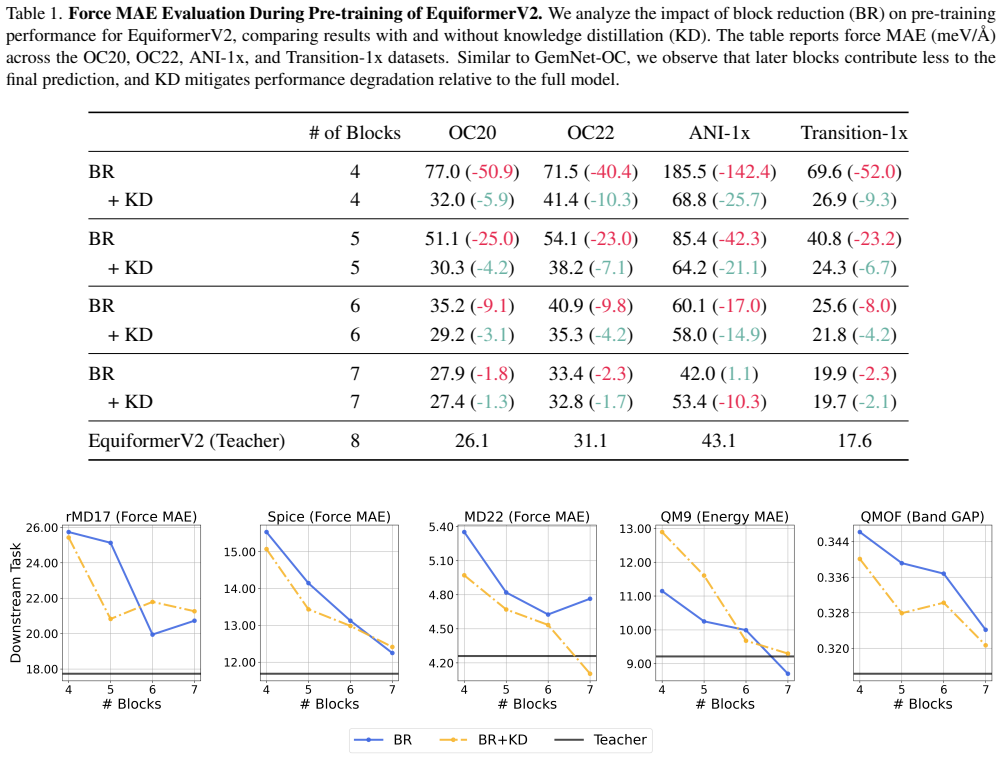
- Block reduction transfers to another architecture, EquiformerV2, but the gains shrink when the teacher model is already compact at 31M parameters.
- Pre-training distillation is not uniformly beneficial downstream; it helps most for heavily pruned models and can hurt when only one or two blocks are removed.
Reading between the lines
- The paper's own layer-wise ablation suggests the GradCAM ordering is imperfect, so a simpler rule such as 'always remove the deepest blocks' might work as well without computing relevance scores.
- Because the 4-block model beats the full model on QM9, block reduction may act as a regularizer; this could be tested by comparing fine-tuning variance across multiple random seeds.
- The diminishing-returns pattern mirrors observations in large language models, raising the question of whether block reduction is a general property of deep pre-trained networks rather than specific to GemNet-OC.
- A testable extension is to apply the same pipeline to other molecular backbones with publicly available pre-trained checkpoints, predicting that the benefit scales with the teacher's parameter count.
Signed reviews
Editorial analysis
A structured set of objections, weighed in public.
Referee Report
Summary. This paper studies the layer efficiency of JMP-L, the 160M-parameter GemNet-OC-based foundation model for molecular property prediction, and proposes block reduction as a compression strategy. The authors compute GradCAM relevance scores for the concatenated per-block features on the JMP pre-training distribution, find that the later interaction blocks receive the lowest scores, and construct reduced models by removing the last interaction blocks and truncating the first FinalMLP layer accordingly (with either a 'sliced' weight initialization or a randomly re-initialized alternative). Optionally, a brief knowledge-distillation phase is run before fine-tuning, transferring output, node, and edge features from the teacher. The headline result is that removing two of six interaction blocks reduces parameters by 32% (160M to 108M) and improves inference throughput by 1.3x while incurring only a minimal accuracy drop when pruned and full models are fine-tuned under the same wall-clock budget (1 GPU-day on a V100; 2 GPU-days for QM9) and evaluated on five targets: Aspirin (rMD17), U0 (QM9), solvated amino acids (SPICE), Ac-Ala3-NHMe (MD22), and band gap (QMOF). Additional experiments cover pre-training-time MAE on the four JMP upstream datasets (with and without KD), convergence curves within the fixed budget, inference benchmarks, a layer-wise ablation on rMD17 (Appendix C), a comparison with training from scratch, and an extension to EquiformerV2 in the appendix.
Significance. If the main claim holds, the paper delivers a practically useful result: a 108M-parameter JMP variant that is 32% smaller and 1.3x faster at inference with accuracy comparable to the full model, which is valuable for high-throughput screening and resource-constrained settings. The work is one of the first layer-redundancy analyses of a large atomistic foundation model, and its conclusion is consistent with the broader observation that later transformer/GNN blocks give diminishing returns. The manuscript is transparent in several important ways: code is released; the JMP-L baseline is reproduced rather than taken from the original paper on faith; the GradCAM-based block ordering is checked against a layer-wise ablation; the EquiformerV2 study honestly reports only partial transfer; and the mixed KD results are acknowledged in Section 4.3. These strengths make the empirical core credible. The significance is nevertheless conditional: the over-parameterization conclusion rests on a fixed-wall-clock comparison that does not separate model capacity from optimization budget, on single-run results without error bars, and on an evaluation of only five of the 40 JMP tasks.
major comments (3)
- [§4.3, Figures 3-4; Abstract] The claim that removing two interaction blocks yields a 'minimal performance drop' is confounded by the fixed wall-clock fine-tuning budget. The authors fine-tune every configuration for 1 GPU-day on a V100 (2 GPU-days for QM9); since the 4- and 5-block models have fewer FLOPs per step, they receive proportionally more optimizer steps within that window. Equality of test MAE under this protocol therefore demonstrates efficiency per unit of wall-clock time, not that the removed blocks are superfluous at convergence. This is not a pedantic distinction: Section 4.4 (Figure 4) shows the 6-block model retaining a clear advantage on MD22 at the 1-GPU-day cutoff, and Section 2.1 states that JMP-L fine-tuning requires over 275 GPU hours to converge, so the baseline is likely far from plateau. The manuscript discloses the fixed-budget constraint ('constrained by a fixed computational budget') but does not discuss how the constraint interacts with the over-parameterization conclusion. The abstract's conclusion that 'JMP-L is over-parameterized' requires a comparison in which the 6-block model has either converged or demonstrably ceased to improve; the current protocol cannot distinguish the pruning hypothesis from the undertrained-baseline hypothesis. I ask the authors to add training curves extending past the budget cutoff (or converged fine-tuning runs) for the 6-block and 4-block models, or to reframe the central claim as fixed-budget efficiency.
- [Figures 3-4; Tables 1-2] All reported results are single runs with no error bars, multiple seeds, or significance tests. The differences that carry the paper's conclusion are small (e.g., in Figure 3, the 4-block and 5-block BR curves are within a few meV/Angstrom of the 6-block baseline on rMD17 and SPICE), and the KD comparisons change sign across block counts on rMD17. Without variance estimates, 'minimal performance drop' and 'comparable accuracy' are not quantitatively supported, and the reader cannot tell whether the 4-block-versus-6-block gap is real or within run-to-run noise. Please report mean and standard deviation over at least three seeds for the headline fine-tuning comparisons, and preferably for the pre-training MAE table as well.
- [§4.3; Abstract; §1] The downstream evaluation covers five targets (Aspirin from rMD17, U0 from QM9, solvated amino acids from SPICE, Ac-Ala3-NHMe from MD22, and band gap from QMOF) out of the 40 tasks used in [38], yet the abstract and introduction generalize to 'many tasks' and to JMP-L as such. The five targets are predominantly molecular force/energy benchmarks plus one MOF property; no OC20/OC22 adsorption or catalysis tasks are included, so the over-parameterization conclusion is not tested where JMP's pre-training capacity may matter most. Either expand the task coverage, or explicitly restrict the over-parameterization and 'comparable performance' claims to the evaluated regime.
minor comments (5)
- [§3.2, Appendix C] Appendix C shows an inversion in the GradCAM ordering: removing f4 hurts more than removing f3, contrary to the importance scores in Figure 2. Since the headline result removes the last two blocks (f6 and f7), this discrepancy does not invalidate the main claim, but the main text presents the scores as the justification for the pruning order without stating that the ablation validates only the global trend; a sentence acknowledging the f3/f4 caveat should appear in Section 3.2.
- [§1, Abstract, §4.3] The introduction's statement that 'pruning and distillation improve JMP-L's efficiency while preserving comparable performance for most tasks' and the abstract's mention of a 'pruned and distilled variant' are stronger than the results in Section 4.3: KD hurts the 4- and 5-block models on rMD17 and helps mainly at the largest reductions. The conclusion's phrasing ('knowledge distillation can help mitigate performance degradation in certain tasks') is accurate and should be used consistently in the abstract and introduction.
- [§3.2] The notation in the GradCAM description is imprecise: the symbol ∇CAM is never defined, and r = ReLU(f ∘ ∇CAM) should specify that the gradient is taken of L0 with respect to the concatenated feature tensor; also, the decomposition of r into per-block partitions should state the dimensions involved, since the interaction blocks and the embedding block do not share identical output shapes.
- [Figure 2 caption; Table 2] Figure 2's caption says 'This table illustrates...' although it is a figure, and Table 2 does not state the measurement conditions for throughput and GFlops (batch size, input graph sizes, warm-up, and whether the batch size is held constant across block counts); please specify these details.
- [§4.3, Figure 3] The text says the 4-block model 'outperforms the original JMP-L on the QM9 target,' but it is ambiguous whether 'original JMP-L' refers to the published converged numbers from [38], which were obtained under a different fine-tuning protocol, or to the authors' own 1-GPU-day reproduction; the comparison is only valid if the protocols are matched, so this should be clarified.
Circularity Check
No significant circularity: block selection is heuristic and independently validated; the central comparison is external, though the fixed fine-tuning budget is a correctness confound, not circular.
full rationale
The paper's derivation chain is not circular. The claim that later interaction blocks contribute less is obtained from GradCAM saliency on the pre-trained JMP-L model (Section 3.2), and the pruning decision is checked by a layer-wise ablation in Appendix C, which explicitly reports a mismatch (removing f4 hurts more than f3). No parameter is fitted to downstream test MAE; the block-reduced models are fine-tuned and evaluated on held-out external benchmarks. The baseline is the reproduced JMP-L, and the original JMP-L numbers from [38] are external, with no author overlap. The only load-bearing assumption that could be challenged is the fixed 1 GPU-day fine-tuning budget (Section 4.3), which gives smaller models more optimizer steps and may understate the 6-block baseline's converged accuracy. This is an experimental confound and a threat to the over-parameterization conclusion, but it is not a circular reduction: the paper does not define the prediction in terms of the budget, nor fit a parameter renamed as a prediction. Under the stated rules, this concern belongs to correctness risk, not circularity.
Assumptions & free parameters
free parameters (2)
- Number of removed interaction blocks =
2
- Knowledge distillation loss weight
assumptions (4)
- domain assumption GradCAM relevance scores accurately reflect the contribution of interaction blocks to downstream performance.
- domain assumption Fine-tuning under a fixed GPU-day budget is a fair comparison across model sizes.
- domain assumption The five downstream tasks (rMD17, QM9, SPICE, MD22, QMOF) are representative of JMP-L's target tasks.
- domain assumption The JMP-L pre-trained checkpoint provides a valid starting point for pruning.
Cite this review
Pith. "Pith review of Towards Faster and More Compact Foundation Models for Molecular Property Prediction." pith.science (2026). https://pith.science/paper/I5PP6G7A
@misc{pith2026250419538,
  author       = {Pith},
  title        = {Pith review of: Towards Faster and More Compact Foundation Models for Molecular Property Prediction},
  year         = {2026},
  howpublished = {\url{https://pith.science/paper/I5PP6G7A}},
  note         = {Machine review of arXiv:2504.19538}
}
read the original abstract
Advancements in machine learning for molecular property prediction have improved accuracy but at the expense of higher computational cost and longer training times. Recently, the Joint Multi-domain Pre-training (JMP) foundation model has demonstrated strong performance across various downstream tasks with reduced training time over previous models. Despite JMP's advantages, fine-tuning it on molecular datasets ranging from small-scale to large-scale requires considerable time and computational resources. In this work, we investigate strategies to enhance efficiency by reducing model size while preserving performance. To better understand the model's efficiency, we analyze the layer contributions of JMP and find that later interaction blocks provide diminishing returns, suggesting an opportunity for model compression. We explore block reduction strategies by pruning the pre-trained model and evaluating its impact on efficiency and accuracy during fine-tuning. Our analysis reveals that removing two interaction blocks results in a minimal performance drop, reducing the model size by 32% while increasing inference throughput by 1.3x. These results suggest that JMP-L is over-parameterized and that a smaller, more efficient variant can achieve comparable performance with lower computational cost. Our study provides insights for developing lighter, faster, and more scalable foundation models for molecular and materials discovery. The code is publicly available at: https://github.com/Yasir-Ghunaim/efficient-jmp.
Figures


Figures from the paper (5 more)




Reference graph
Works this paper leans on
-
[38]
From molecules to materials: Pre-training large generalizable models for atomic property prediction
Nima Shoghi, Adeesh Kolluru, John R Kitchin, Zachary W Ulissi, C Lawrence Zitnick, and Brandon M Wood. From molecules to materials: Pre-training large generalizable models for atomic property prediction. arXiv preprint arXiv:2310.16802, 2023. 1, 2, 5, 6, 8, 11
-
[1]
Ilyes Batatia, Simon Batzner, D ´avid P ´eter Kov ´acs, Albert Musaelian, Gregor N. C. Simm, Ralf Drautz, Christoph Ort- ner, Boris Kozinsky, and G´abor Cs´anyi. The design space of e(3)-equivariant atom-centered interatomic potentials, 2022. 1
work page 2022
-
[2]
Ilyes Batatia, David Peter Kovacs, Gregor N. C. Simm, Christoph Ortner, and Gabor Csanyi. MACE: Higher order equivariant message passing neural networks for fast and ac- curate force fields. In Advances in Neural Information Pro- cessing Systems, 2022. 1
work page 2022
-
[3]
A foundation model for atomistic materials chemistry
Ilyes Batatia, Philipp Benner, Yuan Chiang, Alin M Elena, D´avid P Kov ´acs, Janosh Riebesell, Xavier R Advincula, Mark Asta, William J Baldwin, Noam Bernstein, et al. A foundation model for atomistic materials chemistry. arXiv preprint arXiv:2401.00096, 2023. 1, 2
arXiv 2023
-
[4]
Generalized neural- network representation of high-dimensional potential-energy surfaces
J ¨org Behler and Michele Parrinello. Generalized neural- network representation of high-dimensional potential-energy surfaces. Physical Review Letters, 98(14), 2007. 1
work page 2007
-
[5]
Davis Blalock, Jose Javier Gonzalez Ortiz, Jonathan Fran- kle, and John Guttag. What is the state of neural network pruning? Proceedings of machine learning and systems , 2: 129–146, 2020. 2
work page 2020
-
[6]
Tucker- man, Klaus-Robert M ¨uller, and Kieron Burke
Mihail Bogojeski, Leslie V ogt-Maranto, Mark E. Tucker- man, Klaus-Robert M ¨uller, and Kieron Burke. Quantum chemical accuracy from density functional approximations via machine learning. Nature Communications, 11(1), 2020. 1
work page 2020
-
[7]
Cristian Bucilua, Rich Caruana, and Alexandru Niculescu- Mizil. Model compression. In Proceedings of the 12th ACM SIGKDD International Conference on Knowledge Discov- ery and Data Mining , page 535–541, New York, NY , USA,
Show all 51 references
-
[8]
Open catalyst 2020 (oc20) dataset and community challenges
Lowik Chanussot, Abhishek Das, Siddharth Goyal, Thibaut Lavril, Muhammed Shuaibi, Morgane Riviere, Kevin Tran, Javier Heras-Domingo, Caleb Ho, Weihua Hu, et al. Open catalyst 2020 (oc20) dataset and community challenges. Acs Catalysis, 11(10):6059–6072, 2021. 1, 5, 8
2020
-
[9]
A survey on deep neural network pruning-taxonomy, compari- son, analysis, and recommendations, 2024
Hongrong Cheng, Miao Zhang, and Javen Qinfeng Shi. A survey on deep neural network pruning-taxonomy, compari- son, analysis, and recommendations, 2024. 2
2024
-
[10]
Machine learning of accurate energy-conserving molecular force fields
Stefan Chmiela, Alexandre Tkatchenko, Huziel E Sauceda, Igor Poltavsky, Kristof T Sch ¨utt, and Klaus-Robert M ¨uller. Machine learning of accurate energy-conserving molecular force fields. Science advances, 3(5):e1603015, 2017. 6
2017
-
[11]
Accurate global machine learning force fields for molecules with hundreds of atoms
Stefan Chmiela, Valentin Vassilev-Galindo, Oliver T Unke, Adil Kabylda, Huziel E Sauceda, Alexandre Tkatchenko, and Klaus-Robert M¨uller. Accurate global machine learning force fields for molecules with hundreds of atoms. Science Advances, 9(2):eadf0873, 2023. 6
2023
-
[12]
Imagenet: A large-scale hierarchical image database
Jia Deng, Wei Dong, Richard Socher, Li-Jia Li, Kai Li, and Li Fei-Fei. Imagenet: A large-scale hierarchical image database. In IEEE Conference on Computer Vision and Pat- tern Recognition, pages 248–255, 2009. 2
2009
-
[13]
An image is worth 16x16 words: Transformers for image recognition at scale
Alexey Dosovitskiy, Lucas Beyer, Alexander Kolesnikov, Dirk Weissenborn, Xiaohua Zhai, Thomas Unterthiner, Mostafa Dehghani, Matthias Minderer, Georg Heigold, Syl- vain Gelly, Jakob Uszkoreit, and Neil Houlsby. An image is worth 16x16 words: Transformers for image recognition ...
2021
-
[14]
Benchmarking materials property prediction methods: the matbench test set and automatminer reference algorithm
Alexander Dunn, Qi Wang, Alex Ganose, Daniel Dopp, and Anubhav Jain. Benchmarking materials property prediction methods: the matbench test set and automatminer reference algorithm. npj Computational Materials, 6(1):138, 2020. 1
2020
-
[15]
Spice, a dataset of drug-like molecules and peptides for training machine learning potentials
Peter Eastman, Pavan Kumar Behara, David L Dotson, Rai- mondas Galvelis, John E Herr, Josh T Horton, Yuezhi Mao, John D Chodera, Benjamin P Pritchard, Yuanqing Wang, et al. Spice, a dataset of drug-like molecules and peptides for training machine learning potentials. Scientifi...
2023
-
[16]
Accelerating molecular graph neu- ral networks via knowledge distillation
Filip Ekstr ¨om Kelvinius, Dimitar Georgiev, Artur Toshev, and Johannes Gasteiger. Accelerating molecular graph neu- ral networks via knowledge distillation. Advances in Neural Information Processing Systems, 36, 2024. 2, 3, 5
2024
-
[17]
Gemnet: Universal directional graph neural networks for molecules
Johannes Gasteiger, Florian Becker, and Stephan G¨unnemann. Gemnet: Universal directional graph neural networks for molecules. Advances in Neural Information Processing Systems, 34:6790–6802, 2021. 3
2021
-
[18]
Gemnet-oc: developing graph neural net- works for large and diverse molecular simulation datasets
Johannes Gasteiger, Muhammed Shuaibi, Anuroop Sriram, Stephan G ¨unnemann, Zachary Ulissi, C Lawrence Zitnick, and Abhishek Das. Gemnet-oc: developing graph neural net- works for large and diverse molecular simulation datasets. arXiv preprint arXiv:2204.02782, 2022. 2, 3, 8
2022 arXiv
-
[19]
Andrey Gromov, Kushal Tirumala, Hassan Shapourian, Paolo Glorioso, and Daniel A. Roberts. The unreasonable ineffectiveness of the deeper layers, 2024. 2, 3
2024
-
[20]
Knowl- edge distillation in vision transformers: A critical review,
Gousia Habib, Tausifa Jan Saleem, and Brejesh Lall. Knowl- edge distillation in vision transformers: A critical review,
-
[21]
Deep residual learning for image recognition
Kaiming He, Xiangyu Zhang, Shaoqing Ren, and Jian Sun. Deep residual learning for image recognition. In Proceed- ings of the IEEE conference on computer vision and pattern recognition, pages 770–778, 2016. 2
2016
-
[22]
Distilling the knowledge in a neural net- work
Geoffrey Hinton. Distilling the knowledge in a neural net- work. arXiv preprint arXiv:1503.02531, 2015. 2, 3
2015 arXiv
-
[23]
Lawrence Zit- nick, John R Kitchin, and Zachary W Ulissi
Adeesh Kolluru, Muhammed Shuaibi, Aini Palizhati, Nima Shoghi, Abhishek Das, Brandon Wood, C. Lawrence Zit- nick, John R Kitchin, and Zachary W Ulissi. Open chal- lenges in developing generalizable large scale machine learn- ing models for catalyst discovery, 2022. 1
2022
-
[24]
Mace- off23: Transferable machine learning force fields for organic molecules
D ´avid P ´eter Kov ´acs, J Harry Moore, Nicholas J Brown- ing, Ilyes Batatia, Joshua T Horton, Venkat Kapil, Ioan- Bogdan Magd˘au, Daniel J Cole, and G ´abor Cs´anyi. Mace- off23: Transferable machine learning force fields for organic molecules. arXiv preprint arXiv:2312.1521...
2023 arXiv
-
[25]
Equiformerv2: Improved equivariant transformer for scaling to higher-degree representations
Yi-Lun Liao, Brandon Wood, Abhishek Das, and Tess Smidt. Equiformerv2: Improved equivariant transformer for scaling to higher-degree representations. arXiv preprint arXiv:2306.12059, 2023. 8, 11
2023 arXiv
-
[26]
Comprehen- sive graph gradual pruning for sparse training in graph neural networks, 2022
Chuang Liu, Xueqi Ma, Yibing Zhan, Liang Ding, Dapeng Tao, Bo Du, Wenbin Hu, and Danilo Mandic. Comprehen- sive graph gradual pruning for sparse training in graph neural networks, 2022. 2
2022
-
[27]
LLM- pruner: On the structural pruning of large language mod- els
Xinyin Ma, Gongfan Fang, and Xinchao Wang. LLM- pruner: On the structural pruning of large language mod- els. In Thirty-seventh Conference on Neural Information Processing Systems, 2023. 3
2023
-
[28]
Nørskov, Frank Abild-Pedersen, Felix Studt, and Thomas Bligaard
Jens K. Nørskov, Frank Abild-Pedersen, Felix Studt, and Thomas Bligaard. Density functional theory in surface chemistry and catalysis. Proceedings of the National Academy of Sciences, 108(3):937–943, 2011. 1
2011
-
[29]
Quantum chemistry structures and properties of 134 kilo molecules
Raghunathan Ramakrishnan, Pavlo O Dral, Matthias Rupp, and O Anatole V on Lilienfeld. Quantum chemistry structures and properties of 134 kilo molecules. Scientific data, 1(1): 1–7, 2014. 6
2014
-
[30]
Machine learning the quantum-chemical properties of metal–organic frameworks for accelerated materials discovery.Matter, 4(5):1578–1597,
Andrew S Rosen, Shaelyn M Iyer, Debmalya Ray, Zhen- peng Yao, Alan Aspuru-Guzik, Laura Gagliardi, Justin M Notestein, and Randall Q Snurr. Machine learning the quantum-chemical properties of metal–organic frameworks for accelerated materials discovery.Matter, 4(5):1578–1597,
-
[31]
Rosen, Victor Fung, Patrick Huck, Cody T
Andrew S. Rosen, Victor Fung, Patrick Huck, Cody T. O’Donnell, Matthew K. Horton, Donald G. Truhlar, Kristin A. Persson, Justin M. Notestein, and Randall Q. Snurr. High-throughput predictions of metal–organic frame- work electronic properties: theoretical challenges, graph neu...
2022
-
[32]
Sabe, Thandokuhle Ntombela, Lindiwe A
Victor T. Sabe, Thandokuhle Ntombela, Lindiwe A. Jhamba, Glenn E.M. Maguire, Thavendran Govender, Tricia Naicker, and Hendrik G. Kruger. Current trends in computer aided drug design and a highlight of drugs discovered via computa- tional techniques: A review. European Journal ...
2021
-
[33]
Transition1x - a dataset for building generalizable reactive machine learning potentials
Mathias Schreiner, Arghya Bhowmik, Tejs Vegge, Jonas Busk, and Ole Winther. Transition1x - a dataset for building generalizable reactive machine learning potentials. Scientific Data, 9(1), 2022. 1
2022
-
[34]
Transition1x-a dataset for building generalizable reactive machine learning potentials
Mathias Schreiner, Arghya Bhowmik, Tejs Vegge, Jonas Busk, and Ole Winther. Transition1x-a dataset for building generalizable reactive machine learning potentials. Scientific Data, 9(1):779, 2022. 5
2022
-
[35]
Schnet: A continuous-filter con- volutional neural network for modeling quantum interac- tions
Kristof Sch ¨utt, Pieter-Jan Kindermans, Huziel Enoc Sauceda Felix, Stefan Chmiela, Alexandre Tkatchenko, and Klaus-Robert M ¨uller. Schnet: A continuous-filter con- volutional neural network for modeling quantum interac- tions. Advances in neural information processing system...
2017
-
[36]
Selvaraju, Michael Cogswell, Abhishek Das, Ramakrishna Vedantam, Devi Parikh, and Dhruv Ba- tra
Ramprasaath R. Selvaraju, Michael Cogswell, Abhishek Das, Ramakrishna Vedantam, Devi Parikh, and Dhruv Ba- tra. Grad-cam: Visual explanations from deep networks via gradient-based localization. In 2017 IEEE International Conference on Computer Vision (ICCV) , pages 618–626,
2017
-
[37]
Lorenzini, Rui Ma, Qiang Zhu, Daniel W
Vinit Sharma, Chenchen Wang, Robert G. Lorenzini, Rui Ma, Qiang Zhu, Daniel W. Sinkovits, Ghanshyam Pila- nia, Artem R. Oganov, Sanat Kumar, Gregory A. Sotzing, Steven A. Boggs, and Rampi Ramprasad. Rational design of all organic polymer dielectrics. Nature Communications, 5 (...
2014
-
[39]
Neural net pruning-why and how
Sietsma and Dow. Neural net pruning-why and how. InIEEE 1988 International Conference on Neural Networks , pages 325–333 vol.1, 1988. 2
1988
-
[40]
The ani-1ccx and ani- 1x data sets, coupled-cluster and density functional theory properties for molecules
Justin S Smith, Roman Zubatyuk, Benjamin Nebgen, Nicholas Lubbers, Kipton Barros, Adrian E Roitberg, Olexandr Isayev, and Sergei Tretiak. The ani-1ccx and ani- 1x data sets, coupled-cluster and density functional theory properties for molecules. Scientific data, 7(1):134, 2020. 1, 5
2020
-
[41]
Brab- son, Abhishek Das, Zachary Ulissi, Matt Uyttendaele, An- drew J
Anuroop Sriram, Sihoon Choi, Xiaohan Yu, Logan M. Brab- son, Abhishek Das, Zachary Ulissi, Matt Uyttendaele, An- drew J. Medford, and David S. Sholl. The open dac 2023 dataset and challenges for sorbent discovery in direct air cap- ture, 2023. 1
2023
-
[42]
Zico Kolter
Mingjie Sun, Zhuang Liu, Anna Bair, and J. Zico Kolter. A simple and effective pruning approach for large language models, 2024. 2
2024
-
[43]
Yijun Tian, Shichao Pei, Xiangliang Zhang, Chuxu Zhang, and Nitesh V . Chawla. Knowledge distillation on graphs: A survey, 2023. 2
2023
-
[44]
The open catalyst 2022 (oc22) dataset and challenges for oxide electrocatalysts
Richard Tran, Janice Lan, Muhammed Shuaibi, Bran- don M Wood, Siddharth Goyal, Abhishek Das, Javier Heras- Domingo, Adeesh Kolluru, Ammar Rizvi, Nima Shoghi, et al. The open catalyst 2022 (oc22) dataset and challenges for oxide electrocatalysts. ACS Catalysis, 13(5):3066–3084,
2022
-
[45]
A survey on knowledge distillation of large language models,
Xiaohan Xu, Ming Li, Chongyang Tao, Tao Shen, Reynold Cheng, Jinyang Li, Can Xu, Dacheng Tao, and Tianyi Zhou. A survey on knowledge distillation of large language models,
-
[46]
Width & depth pruning for vision transformers
Fang Yu, Kun Huang, Meng Wang, Yuan Cheng, Wei Chu, and Li Cui. Width & depth pruning for vision transformers. In Proceedings of the AAAI Conference on Artificial Intelli- gence, pages 3143–3151, 2022. 2
2022
-
[47]
Pre- training via denoising for molecular property prediction,
Sheheryar Zaidi, Michael Schaarschmidt, James Martens, Hyunjik Kim, Yee Whye Teh, Alvaro Sanchez-Gonzalez, Pe- ter Battaglia, Razvan Pascanu, and Jonathan Godwin. Pre- training via denoising for molecular property prediction,
-
[48]
Molkd: Distilling cross-modal knowledge in chemical reactions for molecular property prediction, 2023
Liang Zeng, Lanqing Li, and Jian Li. Molkd: Distilling cross-modal knowledge in chemical reactions for molecular property prediction, 2023. 2
2023
-
[49]
Loraprune: Structured pruning meets low-rank parameter-efficient fine- tuning, 2024
Mingyang Zhang, Hao Chen, Chunhua Shen, Zhen Yang, Linlin Ou, Xinyi Yu, and Bohan Zhuang. Loraprune: Structured pruning meets low-rank parameter-efficient fine- tuning, 2024. 2
2024
-
[50]
Uni-mol: A universal 3d molecular representation learning framework
Gengmo Zhou, Zhifeng Gao, Qiankun Ding, Hang Zheng, Hongteng Xu, Zhewei Wei, Linfeng Zhang, and Guolin Ke. Uni-mol: A universal 3d molecular representation learning framework. In The Eleventh International Conference on Learning Representations, 2023. 1 Appendix A. Beyond GemN...
2023
-
[2006]
Association for Computing Machinery. 2
Reviewed August 16, 2026 · model on record in the stance chip above.
Discussion (0). Continue with ORCID to comment.