REVIEW 2 major objections 5 minor 38 references
Joint Optimization of Neural Radiance Fields and Continuous Camera Motion from a Monocular Video
T0 review · 2 major / 5 minor · reviewed 2026-08-16 · deepseek-v4-flash
Pith's one-line read Modeling camera motion as continuous angular velocity and velocity lets a NeRF recover camera poses and scene geometry from a monocular video without depth priors.
desk verdict Genuinely new continuous-motion parameterization for joint pose-NeRF optimization, with solid static-scene results; the unstated rigid-world assumption is the main gap, but the paper deserves serious review. read the letter →
The pith
A machine-rendered reading of the paper's core claim, the machinery that carries it, and where it could break.
The reading
What carries the argument
The load-bearing object is the continuous camera-motion representation: a motion MLP $\phi_v$ that maps time $t$ to angular velocity $\omega(t)\in\mathbb{R}^3$ and velocity $v(t)\in\mathbb{R}^3$, with frame-to-frame transformations $P_{t_1\to t_2}$ obtained by Euler integration of these velocities. The second essential component is a time-dependent SDF-based NeRF, adapted from the NeuS representation, which predicts signed distance $s(x,t)$ and color $c(x,d,t)$ in each local camera coordinate system; training it on neighboring frames gives local geometry sufficient to constrain the motion. The two are coupled by the SDF-flow consistency loss (Eq. 11), which enforces that temporal change in the SDF matches the change expected from rigid camera motion, so scene geometry and camera motion must agree.
What would settle it
Record a monocular video in which the camera moves but a foreground object also moves independently (or the scene contains a large reflective surface), and compare the recovered camera trajectory against a ground-truth trajectory from an inertial measurement unit; if pose error rises sharply or the moving object leaves ghosting artifacts in the reconstructed geometry, the rigidity assumption is what fails.
Extended reading notes
Core claim
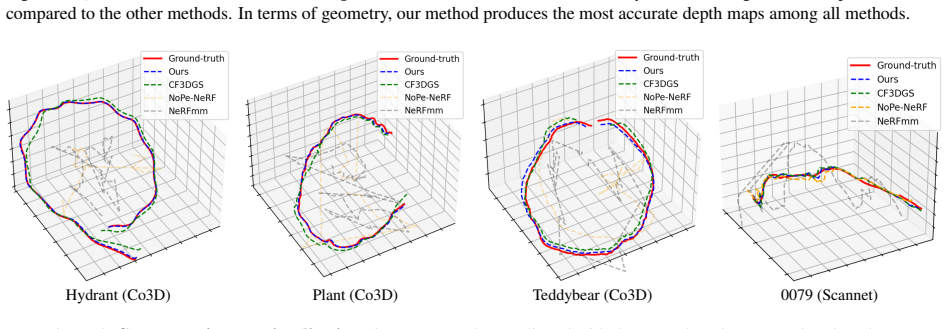
The paper's central claim is that jointly optimizing a continuous-time camera motion and a time-dependent signed-distance-field NeRF, then fine-tuning the NeRF in the world frame with the learned poses held fixed, yields accurate camera poses and scene geometry from monocular video without any geometric priors. The camera motion is represented by an MLP predicting $\omega(t)$ and $v(t)$, and the relative transformation between any two frames is obtained by Euler integration of these velocities; poses are aggregated to a world frame defined at a single middle time step. During joint optimization, the time-dependent NeRF supplies local scene geometry, and three consistency losses tie that geometry to the motion: the SDF-flow loss linking $\partial s/\partial t$ to $(\omega(t)\times x + v(t))^\top n(x)$, a photometric reprojection loss between neighboring frames, and an SDF-consistency loss against the world frame. After the motion is learned, the time-dependent model is fine-tuned as a conventional NeRF at the world time step using all frames. On Co3D and ScanNet, the paper reports that this outperforms prior NeRF-based and 3DGS-based joint-optimization methods in camera pose and depth estimation, with novel-view synthesis comparable to the best baseline.
Load-bearing premise
The load-bearing assumption is that the scene is static and rigid, so every temporal change in the observed images and in the signed distance field is caused only by the camera's own motion.
Editorial extensions
If this is right
- Training a NeRF from monocular video no longer requires COLMAP, a good pose initialization, or a pre-trained depth network.
- Large camera rotations and translations become learnable as accumulated small relative motions rather than as large camera-to-world mappings.
- The time-dependent NeRF stage provides local geometry per time step, which is later merged into a full global scene by fine-tuning with the fixed integrated poses.
- The paper reports that on Co3D and ScanNet the method reduces pose and depth errors compared to NeRFmm, NoPe-NeRF, and CF3DGS, while matching CF3DGS in novel-view synthesis.
Reading between the lines
- The same velocity-integration strategy could be extended to dynamic scenes by explicitly modeling residual non-rigid flow, so independently moving objects would not be absorbed into camera motion.
- The method's sensitivity to low-texture and reflective regions suggests a testable modification: weighting the photometric loss by per-pixel uncertainty or adding a normal-smoothness prior could extend it to such surfaces.
- If the approach scales to longer and more varied videos, it could replace Structure-from-Motion preprocessing in monocular SLAM and dense reconstruction systems, since it outputs both camera trajectories and dense geometry at once.
Signed reviews
Editorial analysis
A structured set of objections, weighed in public.
Referee Report
Summary. The paper proposes a method for jointly optimizing camera poses and a NeRF-based scene representation from a monocular video, without relying on depth priors or SfM initialization. Camera motion is parameterized as continuous angular velocity and velocity functions of time predicted by an MLP; relative poses between frames are obtained by Euler integration of these velocities. A time-dependent SDF-based NeRF is trained with several consistency losses: a flow loss relating the SDF temporal derivative to the camera velocities (Eq. 11), a photometric reprojection loss (Eq. 14), and an SDF consistency loss with a chosen world frame (Eq. 15). After the motion network converges, the poses are fixed and the NeRF is fine-tuned in a conventional way. Experiments on ScanNet and Co3D show consistent improvements over NeRFmm, NoPe-NeRF, and CF3DGS in pose and depth estimation, with competitive novel-view synthesis.
Significance. If the result holds, the method removes the COLMAP and depth-prior requirements for NeRF training on static monocular videos, handles large camera rotations through a continuous motion representation, and provides a principled coupling between scene geometry and camera motion. The paper is clearly written, the ablation study isolates each loss component, and the code is publicly released. The main significance is the demonstration that a continuous-motion parameterization plus a time-dependent NeRF can jointly recover poses and geometry without external priors; however, the claims are currently limited to static scenes and the generality of the method is not tested.
major comments (2)
- [Section 3.3, Eq. (11) and Eq. (14)] The flow loss and the photometric consistency loss enforce that every temporal change in the SDF and every pixel color change between frames is explained by the continuous camera motion (ω(t), v(t)). This is mathematically exact only under a static, rigid scene assumption, since any independently moving object or non-rigid deformation would be absorbed into the estimated camera velocities and corrupt both poses and geometry. The paper never states this assumption in the abstract or introduction, and the Limitation paragraph (Section 5) mentions only low-texture and reflective regions, not dynamic content. The evaluation is restricted to ScanNet and Co3D, which are static scenes; consequently the unqualified claim of a 'prior-free pipeline to jointly optimize camera motion and scene geometry from a monocular video' is not established for dynamic or partially dynamic scenes. The authors should either explicitly scope the method to static scenes or add a dynamic-scene experiment (e.g., a video with a moving object) to test the boundary.
- [Section 4.2, Tables 1-3] All metrics are reported from a single training run with no error bars or multiple seeds. Given the strong claim of 'superior' pose and depth estimation, and the fact that some ScanNet pose margins are modest (e.g., RPEt of 0.401 vs 0.455 for NoPe-NeRF on scene 0418), the reader cannot assess whether the improvements are statistically meaningful. At minimum, the authors should report results over multiple runs (e.g., 3 seeds) or state the variance observed; this is particularly important in a neural optimization setting where results are known to vary with initialization and ray sampling.
minor comments (5)
- [Section 3.1] The heading 'NeRF with SDF Presentation' contains a typo; it should be 'SDF Representation'.
- [Section 3.3] The hyperparameter N (the set of intervals to neighboring frames used in Lphoto, Eq. 14) is not specified in the main text; it is never stated which values are used in the experiments, so readers cannot reproduce the photometric consistency loss setting.
- [Table 4] The ablation study reports results 'on the Co3D dataset' but does not specify which scene(s) the numbers correspond to; if it is an average over all five Co3D scenes, this should be stated, and if it is a single scene, the scene name and the rationale for choosing it should be given.
- [Section 3.2, Eq. (5)-(6)] The frame convention for the angular velocity and velocity (whether they are expressed in the camera frame or the world frame) is not explicitly stated, which makes the integration formulas in Eq. (5)-(6) ambiguous; please clarify the convention.
- [Section 4.1] The paper claims that the method requires no priors, but the ray sampling requires a pre-defined depth range and the camera intrinsics are assumed known; a brief note acknowledging these mild assumptions would be helpful for precision.
Circularity Check
Pose/depth claims are externally validated; the novel-view synthesis metric is partially circular because test poses are fitted to the scored images.
-
fitted input called prediction
[Section 4.2, Novel-view Synthesis paragraph]
"To obtain the camera poses corresponding to the test images, we keep the NeRF model fixed and learn these poses by minimizing the color rendering lossLrgb, as in [2]."
The test pose is the fitted parameter and the test image is both the fitting target (Lrgb) and the evaluation image for PSNR/SSIM/LPIPS. With a free per-view pose optimized on the scored image, photometric error on that image can be driven down even when the fixed NeRF's geometry is imperfect; the reported novel-view synthesis quality therefore measures pose-fitting plus reconstruction, not prediction of an unseen view. This does not affect the pose/depth results, which use the learned motion network without seeing the test poses, but it makes the novel-view synthesis claim partially forced by construction.
full rationale
The central pose and depth contributions are not circular: the continuous camera motion ω(t), v(t) and the time-dependent SDF are optimized only against RGB frames via Lrgb, Lflow, Lphoto, and Lsdf, and the pose/depth evaluations compare the resulting fixed trajectory and rendered depth against external ScanNet/Co3D ground truth. No target pose or depth is used as supervision, so the main claim is independently testable. The constraint in Eq. 11 is attributed to [18], which shares two authors with this paper; however, the SDF-flow identity ∂s/∂t + (ω×x+v)^T∇s = 0 is a standard mathematical relation for a rigidly moving implicit surface and is externally verifiable, so the self-citation is not a circular load-bearing step. The static-scene rigidity premise and the low-texture/reflective limitation are assumptions, not circularity. The one genuinely circular element is the novel-view synthesis evaluation: the paper optimizes each test image's camera pose by minimizing Lrgb on that same test image and then reports PSNR/SSIM/LPIPS for that image (Sec. 4.2). By construction, the reported NVS quality is a best-fit reconstruction rather than a prediction of an unseen view. Because the pose and depth claims are unaffected, the overall circularity is partial, not systemic.
Assumptions & free parameters
free parameters (7)
- lambda_1, lambda_2, lambda_3, lambda_4 (loss weights in Eq. 16)
- U (Euler sub-intervals per frame) =
10
- Neighboring frame interval set N for Lphoto
- Depth range for ray sampling
- First-stage training length
- SDF consistency loss schedule =
lambda_4 = 0 for first 200 epochs, then gradually increased
- gamma (SDF density sharpness in Eq. 1) =
learnable
assumptions (5)
- domain assumption The scene is static and rigid; all temporal changes in the SDF are due to camera motion.
- domain assumption The SDF-flow relation from [18] is valid with the sign convention used in Eq. 11.
- domain assumption Camera intrinsics are known and fixed.
- ad hoc to paper A smooth MLP mapping time to omega and v can represent the true camera trajectory, and Euler integration with U=10 sub-intervals is a sufficiently accurate approximation.
- ad hoc to paper The time-dependent NeRF trained with neighboring frames provides a locally accurate geometry for estimating camera motion.
Cite this review
Pith. "Pith review of Joint Optimization of Neural Radiance Fields and Continuous Camera Motion from a Monocular Video." pith.science (2026). https://pith.science/paper/R64QR63R
@misc{pith2026250419819,
  author       = {Pith},
  title        = {Pith review of: Joint Optimization of Neural Radiance Fields and Continuous Camera Motion from a Monocular Video},
  year         = {2026},
  howpublished = {\url{https://pith.science/paper/R64QR63R}},
  note         = {Machine review of arXiv:2504.19819}
}
read the original abstract
Neural Radiance Fields (NeRF) has demonstrated its superior capability to represent 3D geometry but require accurately precomputed camera poses during training. To mitigate this requirement, existing methods jointly optimize camera poses and NeRF often relying on good pose initialisation or depth priors. However, these approaches struggle in challenging scenarios, such as large rotations, as they map each camera to a world coordinate system. We propose a novel method that eliminates prior dependencies by modeling continuous camera motions as time-dependent angular velocity and velocity. Relative motions between cameras are learned first via velocity integration, while camera poses can be obtained by aggregating such relative motions up to a world coordinate system defined at a single time step within the video. Specifically, accurate continuous camera movements are learned through a time-dependent NeRF, which captures local scene geometry and motion by training from neighboring frames for each time step. The learned motions enable fine-tuning the NeRF to represent the full scene geometry. Experiments on Co3D and Scannet show our approach achieves superior camera pose and depth estimation and comparable novel-view synthesis performance compared to state-of-the-art methods. Our code is available at https://github.com/HoangChuongNguyen/cope-nerf.
Figures


Figures from the paper (1 more)
Reference graph
Works this paper leans on
-
[18]
Neural sdf flow for 3d reconstruction of dynamic scenes
Wei Mao, Richard Hartley, Mathieu Salzmann, and Miaomiao Liu. Neural sdf flow for 3d reconstruction of dynamic scenes. In The Twelfth International Conference on Learning Representations. 2, 3, 5
-
[1]
Surf: Speeded up robust features
Herbert Bay, Tinne Tuytelaars, and Luc Van Gool. Surf: Speeded up robust features. In Computer Vision–ECCV 2006: 9th European Conference on Computer Vision, Graz, Austria, May 7-13, 2006. Proceedings, Part I 9 , pages 404–417. Springer, 2006. 1
work page 2006
-
[2]
Nope-nerf: Optimising neural radiance field with no pose prior
Wenjing Bian, Zirui Wang, Kejie Li, Jia-Wang Bian, and Victor Adrian Prisacariu. Nope-nerf: Optimising neural radiance field with no pose prior. In Proceedings of the IEEE/CVF Conference on Computer Vision and Pattern Recognition, pages 4160–4169, 2023. 1, 2, 3, 4, 5, 6, 7, 8
work page 2023
-
[3]
Tensorf: Tensorial radiance fields
Anpei Chen, Zexiang Xu, Andreas Geiger, Jingyi Yu, and Hao Su. Tensorf: Tensorial radiance fields. In European conference on computer vision, pages 333–350. Springer,
-
[4]
Gaussian activated neural radiance fields for high fidelity reconstruction and pose estima- tion
Shin-Fang Chng, Sameera Ramasinghe, Jamie Sherrah, and Simon Lucey. Gaussian activated neural radiance fields for high fidelity reconstruction and pose estima- tion. In European Conference on Computer Vision, pages 264–280. Springer, 2022. 3
work page 2022
-
[5]
Scannet: Richly-annotated 3d reconstructions of indoor scenes
Angela Dai, Angel X Chang, Manolis Savva, Ma- ciej Halber, Thomas Funkhouser, and Matthias Nießner. Scannet: Richly-annotated 3d reconstructions of indoor scenes. In Proceedings of the IEEE conference on com- puter vision and pattern recognition , pages 5828–5839,
-
[6]
Yang Fu, Sifei Liu, Amey Kulkarni, Jan Kautz, Alexei A. Efros, and Xiaolong Wang. Colmap-free 3d gaussian splatting. 2023. 1, 2, 3, 5, 6, 7, 8
work page 2023
-
[7]
Dynamic view synthesis from dynamic monoc- ular video
Chen Gao, Ayush Saraf, Johannes Kopf, and Jia-Bin Huang. Dynamic view synthesis from dynamic monoc- ular video. In Proceedings of the IEEE/CVF Inter- national Conference on Computer Vision , pages 5712– 5721, 2021. 2, 3
work page 2021
Show all 38 references
-
[8]
Implicit geometric regularization for learning shapes
Amos Gropp, Lior Yariv, Niv Haim, Matan Atzmon, and Yaron Lipman. Implicit geometric regularization for learning shapes. arXiv preprint arXiv:2002.10099, 2020. 5
2002 arXiv
-
[9]
Sugar: Surface- aligned gaussian splatting for efficient 3d mesh recon- struction and high-quality mesh rendering
Antoine Gu ´edon and Vincent Lepetit. Sugar: Surface- aligned gaussian splatting for efficient 3d mesh recon- struction and high-quality mesh rendering. In Proceed- ings of the IEEE/CVF Conference on Computer Vision and Pattern Recognition, pages 5354–5363, 2024. 2
2024
-
[10]
2d gaussian splatting for geometri- cally accurate radiance fields
Binbin Huang, Zehao Yu, Anpei Chen, Andreas Geiger, and Shenghua Gao. 2d gaussian splatting for geometri- cally accurate radiance fields. In ACM SIGGRAPH 2024 Conference Papers, pages 1–11, 2024. 2
2024
-
[11]
Splatam: Splat track & map 3d gaussians for dense rgb-d slam
Nikhil Keetha, Jay Karhade, Krishna Murthy Jataval- labhula, Gengshan Yang, Sebastian Scherer, Deva Ra- manan, and Jonathon Luiten. Splatam: Splat track & map 3d gaussians for dense rgb-d slam. In Proceedings of the IEEE/CVF Conference on Computer Vision and Pattern Recognitio...
2024
-
[12]
3d gaussian splatting for real-time radiance field rendering
Bernhard Kerbl, Georgios Kopanas, Thomas Leimk¨uhler, and George Drettakis. 3d gaussian splatting for real-time radiance field rendering. ACM Transactions on Graphics, 42(4), 2023. 2, 3
2023
-
[13]
3d gaussian splatting as markov chain monte carlo
Shakiba Kheradmand, Daniel Rebain, Gopal Sharma, Weiwei Sun, Jeff Tseng, Hossam Isack, Abhishek Kar, Andrea Tagliasacchi, and Kwang Moo Yi. 3d gaussian splatting as markov chain monte carlo. arXiv preprint arXiv:2404.09591, 2024. 3
2024 arXiv
-
[14]
Kingma and Jimmy Ba
Diederik P. Kingma and Jimmy Ba. Adam: A method for stochastic optimization, 2017. 6
2017
-
[15]
Tanks and temples: Benchmarking large-scale scene reconstruction
Arno Knapitsch, Jaesik Park, Qian-Yi Zhou, and Vladlen Koltun. Tanks and temples: Benchmarking large-scale scene reconstruction. ACM Transactions on Graphics (ToG), 36(4):1–13, 2017. 5
2017
-
[16]
Barf: Bundle-adjusting neural radiance fields
Chen-Hsuan Lin, Wei-Chiu Ma, Antonio Torralba, and Simon Lucey. Barf: Bundle-adjusting neural radiance fields. In Proceedings of the IEEE/CVF international conference on computer vision, pages 5741–5751, 2021. 2, 3, 4
2021
-
[17]
Distinctive image features from scale- invariant keypoints
David G Lowe. Distinctive image features from scale- invariant keypoints. International journal of computer vision, 60:91–110, 2004. 1
2004
-
[19]
Hidenobu Matsuki, Riku Murai, Paul H. J. Kelly, and An- drew J. Davison. Gaussian Splatting SLAM. In Proceed- ings of the IEEE/CVF Conference on Computer Vision and Pattern Recognition, 2024. 2, 3
2024
-
[20]
Nerf: Representing scenes as neural radiance fields for view synthesis
Ben Mildenhall, Pratul P Srinivasan, Matthew Tancik, Jonathan T Barron, Ravi Ramamoorthi, and Ren Ng. Nerf: Representing scenes as neural radiance fields for view synthesis. Communications of the ACM, 65(1):99– 106, 2021. 1, 2, 5, 6
2021
-
[21]
Instant neural graphics primitives with a multiresolution hash encoding
Thomas M ¨uller, Alex Evans, Christoph Schied, and Alexander Keller. Instant neural graphics primitives with a multiresolution hash encoding. ACM transactions on graphics (TOG), 41(4):1–15, 2022. 2
2022
-
[22]
Au- tomatic differentiation in pytorch
Adam Paszke, Sam Gross, Soumith Chintala, Gregory Chanan, Edward Yang, Zachary DeVito, Zeming Lin, Alban Desmaison, Luca Antiga, and Adam Lerer. Au- tomatic differentiation in pytorch. 2017. 3
2017
-
[23]
Vision transformers for dense prediction
Ren ´e Ranftl, Alexey Bochkovskiy, and Vladlen Koltun. Vision transformers for dense prediction. InProceedings of the IEEE/CVF international conference on computer vision, pages 12179–12188, 2021. 3
2021
-
[24]
Common objects in 3d: Large-scale learning and evaluation of real-life 3d category reconstruction
Jeremy Reizenstein, Roman Shapovalov, Philipp Hen- zler, Luca Sbordone, Patrick Labatut, and David Novotny. Common objects in 3d: Large-scale learning and evaluation of real-life 3d category reconstruction. In Proceedings of the IEEE/CVF international conference on computer vi...
2021
-
[25]
Splat-slam: Globally opti- mized rgb-only slam with 3d gaussians
Erik Sandstr ¨om, Keisuke Tateno, Michael Oechsle, Michael Niemeyer, Luc Van Gool, Martin R Oswald, and Federico Tombari. Splat-slam: Globally opti- mized rgb-only slam with 3d gaussians. arXiv preprint arXiv:2405.16544, 2024. 2, 3
2024 arXiv
-
[26]
Structure-from-motion revisited
Johannes L Schonberger and Jan-Michael Frahm. Structure-from-motion revisited. In Proceedings of the IEEE conference on computer vision and pattern recog- nition, pages 4104–4113, 2016. 1, 2
2016
-
[27]
Block- nerf: Scalable large scene neural view synthesis
Matthew Tancik, Vincent Casser, Xinchen Yan, Sabeek Pradhan, Ben Mildenhall, Pratul P Srinivasan, Jonathan T Barron, and Henrik Kretzschmar. Block- nerf: Scalable large scene neural view synthesis. In Proceedings of the IEEE/CVF Conference on Computer Vision and Pattern Recogn...
2022
-
[28]
Least-squares estimation of transfor- mation parameters between two point patterns
Shinji Umeyama. Least-squares estimation of transfor- mation parameters between two point patterns. IEEE Transactions on Pattern Analysis & Machine Intelli- gence, 13(04):376–380, 1991. 6
1991
-
[29]
Neus: Learning neu- ral implicit surfaces by volume rendering for multi-view reconstruction
Peng Wang, Lingjie Liu, Yuan Liu, Christian Theobalt, Taku Komura, and Wenping Wang. Neus: Learning neu- ral implicit surfaces by volume rendering for multi-view reconstruction. arXiv preprint arXiv:2106.10689, 2021. 1, 2, 3, 6, 8
2021 arXiv
-
[30]
Image quality assessment: from error visibil- ity to structural similarity
Zhou Wang, Alan C Bovik, Hamid R Sheikh, and Eero P Simoncelli. Image quality assessment: from error visibil- ity to structural similarity. IEEE transactions on image processing, 13(4):600–612, 2004. 6
2004
-
[31]
Nerf–: Neural radiance fields without known camera parameters
Zirui Wang, Shangzhe Wu, Weidi Xie, Min Chen, and Victor Adrian Prisacariu. Nerf–: Neural radiance fields without known camera parameters. arXiv preprint arXiv:2102.07064, 2021. 2, 3, 6, 7, 8
2021 arXiv
-
[32]
Gs-slam: Dense visual slam with 3d gaussian splatting
Chi Yan, Delin Qu, Dan Xu, Bin Zhao, Zhigang Wang, Dong Wang, and Xuelong Li. Gs-slam: Dense visual slam with 3d gaussian splatting. In Proceedings of the IEEE/CVF Conference on Computer Vision and Pattern Recognition, pages 19595–19604, 2024. 2, 3
2024
-
[33]
V olume rendering of neural implicit surfaces
Lior Yariv, Jiatao Gu, Yoni Kasten, and Yaron Lip- man. V olume rendering of neural implicit surfaces. Ad- vances in Neural Information Processing Systems , 34: 4805–4815, 2021. 1, 2
2021
-
[34]
inerf: Inverting neural radiance fields for pose estimation
Lin Yen-Chen, Pete Florence, Jonathan T Barron, Al- berto Rodriguez, Phillip Isola, and Tsung-Yi Lin. inerf: Inverting neural radiance fields for pose estimation. in 2021 ieee. In RSJ International Conference on Intelli- gent Robots and Systems (IROS), pages 1323–1330. 3
2021
-
[35]
Gaus- sian opacity fields: Efficient and compact surface re- construction in unbounded scenes
Zehao Yu, Torsten Sattler, and Andreas Geiger. Gaus- sian opacity fields: Efficient and compact surface re- construction in unbounded scenes. arXiv preprint arXiv:2404.10772, 2024. 2, 3
2024 arXiv
-
[36]
Rade-gs: Ras- terizing depth in gaussian splatting
Baowen Zhang, Chuan Fang, Rakesh Shrestha, Yixun Liang, Xiaoxiao Long, and Ping Tan. Rade-gs: Ras- terizing depth in gaussian splatting. arXiv preprint arXiv:2406.01467, 2024. 2
2024 arXiv
-
[37]
The unreasonable effectiveness of deep features as a perceptual metric
Richard Zhang, Phillip Isola, Alexei A Efros, Eli Shecht- man, and Oliver Wang. The unreasonable effectiveness of deep features as a perceptual metric. In Proceedings of the IEEE conference on computer vision and pattern recognition, pages 586–595, 2018. 6
2018
-
[38]
Unsupervised learning of depth and ego- motion from video
Tinghui Zhou, Matthew Brown, Noah Snavely, and David G Lowe. Unsupervised learning of depth and ego- motion from video. In Proceedings of the IEEE confer- ence on computer vision and pattern recognition , pages 1851–1858, 2017. 6
2017
Reviewed August 16, 2026 · model on record in the stance chip above.
Discussion (0). Continue with ORCID to comment.