REVIEW 5 major objections 4 minor 30 references
Mesh-Learner: Texturing Mesh with Spherical Harmonics
T0 review · 5 major / 4 minor · reviewed 2026-08-16 · deepseek-v4-flash
Pith's one-line read A mesh whose textures store spherical-harmonic coefficients can be trained end-to-end to render photorealistic novel views, performing on par with or better than state-of-the-art point-based and implicit representations while remaining…
desk verdict Mesh-Learner is a genuinely useful step toward rasterization-native view synthesis, but its SOTA claim is not backed by the paper's own tables. read the letter →
The pith
A machine-rendered reading of the paper's core claim, the machinery that carries it, and where it could break.
The reading
What carries the argument
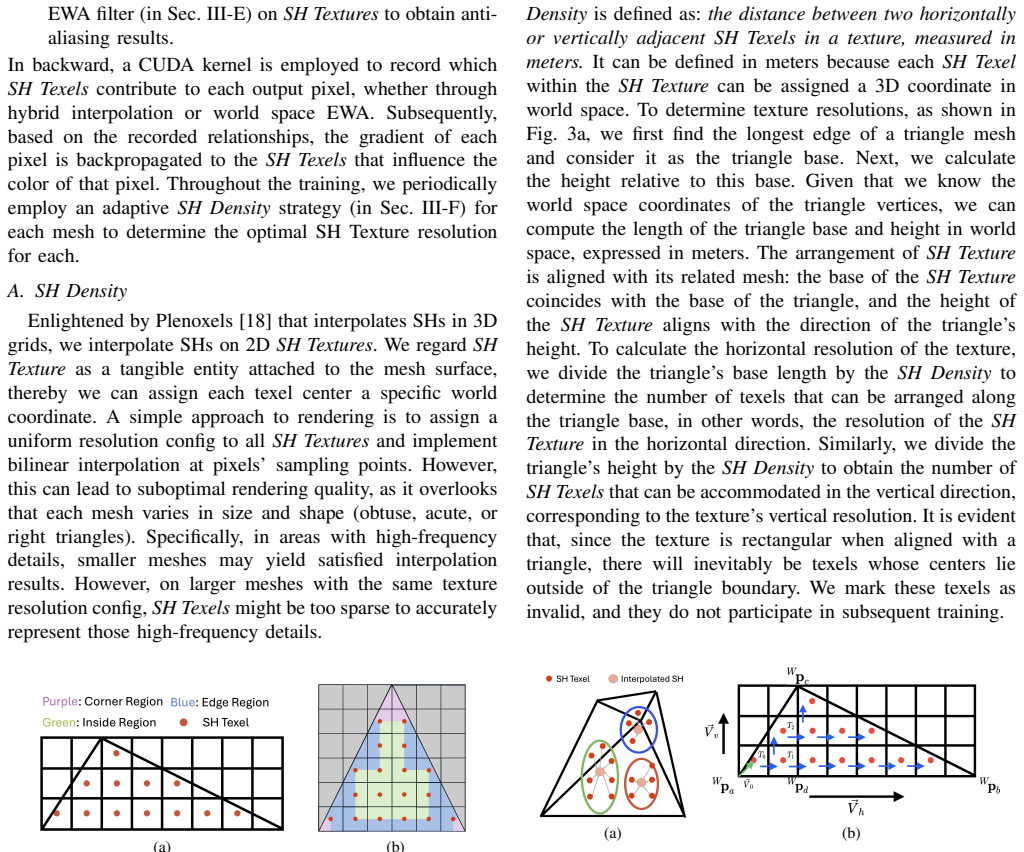
The load-bearing object is the SH Texture — a texture map attached to each triangle mesh in which every texel stores spherical-harmonic coefficients rather than a fixed color, so shading becomes a per-view linear combination of coefficients. The machinery around it is a per-triangle resolution rule ('SH Density', the world-space distance between adjacent texel centers), a hybrid interpolation policy (bilinear inside the triangle; inverse-distance weighting over neighboring meshes' texels on edges and corners), a world-space EWA filter that averages all SH texels falling inside an ellipse around the sampling point, and an adaptive density scheduler that raises a mesh's SH Density while PSNR improves and stops once metrics stop improving.
What would settle it
Take a scene with a foreground object whose mesh has a deliberate hole while the background mesh stays intact, train Mesh-Learner, and render a view behind the object: the paper's limitation statement predicts background surfaces will show foreground colors. A second check: place two adjacent triangles at a dihedral angle just above and just below 15 degrees and render a distant view; the EWA filter should suddenly stop borrowing texels across the boundary, producing a sharp aliasing seam at that threshold.
Extended reading notes
Core claim
The paper's central claim is that view-dependent radiance can be stored, optimized, and rendered directly in SH-valued textures on scene meshes, and that this representation reaches state-of-the-art rendering quality without sacrificing rasterizer compatibility. Each triangle gets a dedicated SH texture, with resolution set by a world-space SH Density; rendering rasters geometry once into offscreen buffers (texture coordinates, view directions, world-space sample positions) and then a CUDA pass looks up and interpolates SH coefficients at every pixel. Interpolation is hybrid: bilinear inside the triangle interior, inverse-distance weighting that pulls in texels from neighboring meshes at edges and corners, and a world-space EWA anisotropic filter for distant pixels that averages all in-range SH texels within an ellipse, up to a 15-degree normal-disparity cutoff between coplanar neighbors. On Replica, the reported averages beat all compared methods on interpolation PSNR and LPIPS and on extrapolation SSIM and LPIPS; on FAST-LIVO2, the reported SSIM and LPIPS averages beat 3DGS and Textured-GS while PSNR is close.
Load-bearing premise
The pipeline takes a good scene mesh as given; if that mesh is incomplete, foreground colors are painted onto background surfaces and appear as artifacts in novel views (the paper states this limitation explicitly), and the world-space EWA filter further assumes adjacent triangles lie within 15 degrees of coplanar.
Editorial extensions
If this is right
- Trained SH textures can be loaded directly into existing rasterization-based renderers (for example Blender) and used for rendering without conversion, because inference is just texture sampling and interpolation.
- Large scenes can be trained with moderate GPU memory, since only the SH textures inside the current camera frustum are resident on the GPU; the rest stay in CPU RAM.
- The same trained representation can feed downstream tasks that already consume rasterized meshes, such as robot simulation and reinforcement learning environments.
- The adaptive density scheduler and world-space EWA filter shift texture memory toward detail-rich regions and suppress aliasing in distant views, so quality does not require a single worst-case texture resolution.
Reading between the lines
- If the quality gap holds at scale, lidar-based mapping systems that already output meshes could output a directly renderable representation, making the mesh itself the final asset rather than an intermediate that must be converted from Gaussians or neural fields.
- A natural extension is to reformulate the adaptive SH-density rule as a constrained optimization that, for a fixed total texture budget, picks per-triangle densities to maximize a perceptual index rather than per-mesh PSNR.
- The 15-degree normal cutoff in the world-space EWA filter is a binary heuristic; a continuous weight that decays with the angle between normals would likely remove visible seams at the cutoff.
- Since the pipeline renders through deferred rasterization, it could be coupled with differentiable rasterizers that jointly optimize mesh vertices and SH textures, directly addressing the incomplete-mesh limitation the paper identifies.
Signed reviews
Editorial analysis
A structured set of objections, weighed in public.
Referee Report
Summary. The paper proposes Mesh-Learner, a view-synthesis framework that learns spherical-harmonic (SH) textures on a given triangle mesh using a rasterization-based training pipeline. The method defines per-triangle SH textures with resolution set by a 'SH Density', renders via deferred shading plus a hybrid interpolation scheme (bilinear in interior regions and inverse-distance weighting at edges/corners), applies a world-space elliptical weighted average filter for distant views, and adaptively adjusts SH density per mesh during training. Experiments on Replica and FAST-LIVO2 compare interpolation and extrapolation rendering against Instant-NGP, 3DGS, Textured-GS, MonoGS, and M2-Mapping. The paper claims state-of-the-art performance and emphasizes compatibility with standard rasterization tools such as OpenGL and Blender.
Significance. The engineering contribution is timely: a mesh-texture representation that trains and renders natively in the rasterization pipeline could reduce conversion overhead for robotics and simulation applications, and the CPU/GPU texture streaming design is a practical response to memory limits. The method description is detailed and the qualitative results, particularly on Replica interpolation, are strong. However, the quantitative evidence does not establish the claimed state-of-the-art status: on FAST-LIVO2 the method is below 3DGS and Textured-GS in PSNR, and on Replica extrapolation it is below M2-Mapping. The comparison also does not isolate the benefit of the supplied high-quality mesh. The strengths are real, but the claims need to be scaled back and the missing experiments added before the paper can be accepted.
major comments (5)
- [IV.C, Table I] On the FAST-LIVO2 interpolation split, the average PSNR of Ours is 25.624 dB, below 3DGS (25.825 dB) and Textured-GS (25.856 dB). Since the abstract explicitly names 3DGS as a comparison and PSNR is a standard fidelity metric, the 'state-of-the-art performance' claim is not supported; the authors must either establish that the PSNR gap is not statistically significant or revise the claim to be metric-specific.
- [IV.B, Table II] On the Replica extrapolation split, Ours achieves average PSNR 37.915 dB, below M2-Mapping's 38.226 dB, and loses to M2-Mapping in five of the eight scenes. The abstract's claim that extrapolation results achieve state-of-the-art performance is therefore not supported by the reported numbers.
- [IV.C and Abstract] The abstract states that interpolation and extrapolation sequences in both Replica and FAST-LIVO2 are evaluated, but Section IV.C reports only interpolation for FAST-LIVO2 and no FAST-LIVO2 extrapolation table is given. The missing experiment is directly relevant to the central claim and should either be added or the abstract revised.
- [III.A and Limitations] Mesh-Learner requires a high-quality mesh a priori, whereas 3DGS, MonoGS, and M2-Mapping reconstruct geometry from RGB or RGB-D input; the reported comparison does not control for this additional input. The Limitations section acknowledges mesh incompleteness as a source of artifacts, but no experiment quantifies the effect of mesh quality on rendering accuracy, so the comparison conflates representation quality with the advantage of a supplied mesh.
- [IV.D] No quantitative ablation is reported for the three proposed components (hybrid interpolation, world-space EWA filter, adaptive SH density); Figures 5 and 6 are qualitative only. Without ablations, the contribution of each component to the final numbers cannot be assessed, and the novelty claims in Section I are not substantiated.
minor comments (4)
- [III-F, Algorithm 1] Algorithm 1 contains typos ('patiance', 'T_patience') and uses ¯Ai, ¯Vi, and ¯ρi without defining their initial values; please clarify the initialization and the exact termination condition.
- [III-D, Eq. (1)] The inverse-distance weighting exponent of 0.9 is introduced without rationale or sensitivity analysis; please add a brief justification or an ablation.
- [III-E] The 15-degree coplanarity threshold for the world-space EWA filter is stated without supporting evidence; please provide a sensitivity study or a citation.
- [IV.A] The baselines are not described as being evaluated under the same protocol (e.g., how training and test frames are selected for each method on FAST-LIVO2); please report the exact split and any filtering of test poses for all methods.
Circularity Check
No significant circularity: SH textures are learned from posed images, the mesh inputs and baselines are external, and the adaptive density scheme is hyperparameter search rather than a prediction.
full rationale
The derivation chain is self-contained: the paper fits per-texel SH coefficients by minimizing a smooth L1 photometric loss (Eqs. 2-3) against posed training images, with the scene mesh supplied as an input from external lidar-mapping systems (ImMesh, FAST-LIVO2, M2-Mapping). No predicted quantity is defined in terms of the target it is supposed to explain, and no equation in Section III reduces to its own input. The adaptive SH Density strategy (Algorithm 1) is a validation-based hyperparameter schedule that increases per-mesh texture resolution when training PSNR improves; it does not rename a fitted parameter as a prediction. The only self-citations ([13], [14], [23]) supply meshes, poses, or baselines, which are inputs or comparison targets rather than load-bearing evidence for the claimed rendering result. The EWA filter and SH representation are standard external tools, and extending EWA from texture space to world space is a technical adaptation rather than a renamed known result. Therefore no circular step can be exhibited with a specific reduction; the fact that the abstract's state-of-the-art claim is not consistently supported by Tables I and II (e.g., average PSNR below 3DGS and Textured-GS on FAST-LIVO2, and below M2-Mapping on Replica extrapolation) is a correctness or claim-precision issue, not circularity.
Assumptions & free parameters
free parameters (8)
- Initial SH Density rho0
- Density update step d
- Patience T_patience
- Termination percentage epsilon_T
- IDW exponent =
0.9
- EWA coplanarity angle threshold =
15 degrees
- LOD threshold for EWA activation =
LOD level > 1
- SH degree/order
assumptions (5)
- domain assumption A high-quality mesh of the scene is available, typically from lidar-based mapping such as ImMesh or FAST-LIVO2.
- standard math Spherical harmonics can represent the view-dependent radiance of scene surfaces.
- domain assumption The rasterization pipeline with depth test provides correct triangle visibility and per-pixel attributes.
- ad hoc to paper Inverse distance weighting with exponent 0.9 is a suitable interpolation strategy for SH texels.
- ad hoc to paper Adjacent triangles are near-coplanar within 15 degrees for the world-space EWA filter to be valid.
Cite this review
Pith. "Pith review of Mesh-Learner: Texturing Mesh with Spherical Harmonics." pith.science (2026). https://pith.science/paper/42MN2QPH
@misc{pith2026250419938,
  author       = {Pith},
  title        = {Pith review of: Mesh-Learner: Texturing Mesh with Spherical Harmonics},
  year         = {2026},
  howpublished = {\url{https://pith.science/paper/42MN2QPH}},
  note         = {Machine review of arXiv:2504.19938}
}
read the original abstract
In this paper, we present a 3D reconstruction and rendering framework termed Mesh-Learner that is natively compatible with traditional rasterization pipelines. It integrates mesh and spherical harmonic (SH) texture (i.e., texture filled with SH coefficients) into the learning process to learn each mesh s view-dependent radiance end-to-end. Images are rendered by interpolating surrounding SH Texels at each pixel s sampling point using a novel interpolation method. Conversely, gradients from each pixel are back-propagated to the related SH Texels in SH textures. Mesh-Learner exploits graphic features of rasterization pipeline (texture sampling, deferred rendering) to render, which makes Mesh-Learner naturally compatible with tools (e.g., Blender) and tasks (e.g., 3D reconstruction, scene rendering, reinforcement learning for robotics) that are based on rasterization pipelines. Our system can train vast, unlimited scenes because we transfer only the SH textures within the frustum to the GPU for training. At other times, the SH textures are stored in CPU RAM, which results in moderate GPU memory usage. The rendering results on interpolation and extrapolation sequences in the Replica and FAST-LIVO2 datasets achieve state-of-the-art performance compared to existing state-of-the-art methods (e.g., 3D Gaussian Splatting and M2-Mapping). To benefit the society, the code will be available at https://github.com/hku-mars/Mesh-Learner.
Figures


Figures from the paper (4 more)


Reference graph
Works this paper leans on
-
[1]
Orbit: A unified simulation framework for interactive robot learning environments,
M. Mittal, C. Yu, Q. Yu, J. Liu, N. Rudin, D. Hoeller, J. L. Yuan, R. Singh, Y . Guo, H. Mazhar, A. Mandlekar, B. Babich, G. State, M. Hutter, and A. Garg, “Orbit: A unified simulation framework for interactive robot learning environments,” IEEE Robotics and Automa- tion Letters, vol. 8, no. 6, pp. 3740–3747, 2023
2023
-
[2]
iMAP: Implicit mapping and positioning in real-time,
E. Sucar, S. Liu, J. Ortiz, and A. Davison, “iMAP: Implicit mapping and positioning in real-time,” in Proceedings of the International Conference on Computer Vision (ICCV) , 2021
2021
-
[3]
meta, “Meta xr all-in-one sdk,” 2025. [Online]. Available: https://developers.meta.com/horizon/downloads/package/ meta-xr-sdk-all-in-one-upm/
work page 2025
-
[4]
Deep multi-view learning methods: A review,
X. Yan, S. Hu, Y . Mao, Y . Ye, and H. Yu, “Deep multi-view learning methods: A review,” Neurocomputing, vol. 448, pp. 106–129, 2021. [Online]. Available: https://www.sciencedirect.com/science/article/pii/ S0925231221004768
work page 2021
-
[5]
Nerf: Representing scenes as neural radiance fields for view synthesis,
B. Mildenhall, P. P. Srinivasan, M. Tancik, J. T. Barron, R. Ramamoor- thi, and R. Ng, “Nerf: Representing scenes as neural radiance fields for view synthesis,” in ECCV, 2020
2020
-
[6]
3d gaussian splatting for real-time radiance field rendering,
B. Kerbl, G. Kopanas, T. Leimk ¨uhler, and G. Drettakis, “3d gaussian splatting for real-time radiance field rendering,” ACM Transactions on Graphics , vol. 42, no. 4, July 2023. [Online]. Available: https://repo-sam.inria.fr/fungraph/3d-gaussian-splatting/
2023
-
[7]
Nerf++: Analyzing and improving neural radiance fields,
K. Zhang, G. Riegler, N. Snavely, and V . Koltun, “Nerf++: Analyzing and improving neural radiance fields,” arXiv:2010.07492, 2020
arXiv 2010
-
[8]
Mip-splatting: Alias-free 3d gaussian splatting,
Z. Yu, A. Chen, B. Huang, T. Sattler, and A. Geiger, “Mip-splatting: Alias-free 3d gaussian splatting,” in Proceedings of the IEEE/CVF Conference on Computer Vision and Pattern Recognition (CVPR), June 2024, pp. 19 447–19 456
work page 2024
Show all 30 references
-
[9]
Reducing the memory footprint of 3d gaussian splatting,
P. Papantonakis, G. Kopanas, B. Kerbl, A. Lanvin, and G. Drettakis, “Reducing the memory footprint of 3d gaussian splatting,” Proceedings of the ACM on Computer Graphics and Interactive Techniques, vol. 7, no. 1, May 2024. [Online]. Available: https://repo-sam.inria.fr/fungrap...
2024
-
[10]
Gaussian splatting playground in unity,
aras p, “Gaussian splatting playground in unity,” 2023. [Online]. Available: https://github.com/aras-p/UnityGaussianSplatting
2023
-
[11]
Rendering artifacts close to the splats,
K. Ellersdorfer, “Rendering artifacts close to the splats,” 2024. [Online]. Available: https://github.com/aras-p/UnityGaussianSplatting/ issues/147/
2024
-
[12]
The objects are not being rendered correctly,
JerryWu6288, “The objects are not being rendered correctly,” 2024. [Online]. Available: https://github.com/aras-p/UnityGaussianSplatting/ issues/99/
2024
-
[13]
Immesh: An immediate lidar localization and meshing framework,
J. Lin, C. Yuan, Y . Cai, H. Li, Y . Zou, X. Hong, and F. Zhang, “Immesh: An immediate lidar localization and meshing framework,” arXiv preprint arXiv:2301.05206 , 2023
2023 arXiv
-
[14]
Fast- livo2: Fast, direct lidar–inertial–visual odometry,
C. Zheng, W. Xu, Z. Zou, T. Hua, C. Yuan, D. He, B. Zhou, Z. Liu, J. Lin, F. Zhu, Y . Ren, R. Wang, F. Meng, and F. Zhang, “Fast- livo2: Fast, direct lidar–inertial–visual odometry,” IEEE Transactions on Robotics, vol. 41, pp. 326–346, 2025
2025
-
[15]
Creating raster omnimax images from multiple perspective views using the elliptical weighted average filter,
N. Greene and P. S. Heckbert, “Creating raster omnimax images from multiple perspective views using the elliptical weighted average filter,” IEEE Computer Graphics and Applications , vol. 6, no. 6, pp. 21–27, 1986
1986
-
[16]
Pytorch: An imperative style, high-performance deep learning library,
A. Paszke, S. Gross, F. Massa, A. Lerer, J. Bradbury, G. Chanan, T. Killeen, Z. Lin, N. Gimelshein, L. Antiga, A. Desmaison, A. Kopf, E. Yang, Z. DeVito, M. Raison, A. Tejani, S. Chilamkurthy, B. Steiner, L. Fang, J. Bai, and S. Chintala, “Pytorch: An imperative style, high-pe...
2019
-
[17]
Cuda, release: 12.4.0,
NVIDIA, P. Vingelmann, and F. H. Fitzek, “Cuda, release: 12.4.0,”
-
[18]
Plenoxels: Radiance fields without neural networks,
Sara Fridovich-Keil and Alex Yu, M. Tancik, Q. Chen, B. Recht, and A. Kanazawa, “Plenoxels: Radiance fields without neural networks,” in CVPR, 2022
2022
-
[19]
Textured gaussians for enhanced 3d scene appearance modeling,
B. Chao, H.-Y . Tseng, L. Porzi, C. Gao, T. Li, Q. Li, A. Saraf, J.-B. Huang, J. Kopf, G. Wetzstein, and C. Kim, “Textured gaussians for enhanced 3d scene appearance modeling,” 2024. [Online]. Available: https://arxiv.org/abs/2411.18625
2024
-
[20]
Hdgs: Textured 2d gaussian splatting for enhanced scene rendering,
Y . Song, H. Lin, J. Lei, L. Liu, and K. Daniilidis, “Hdgs: Textured 2d gaussian splatting for enhanced scene rendering,” 2024. [Online]. Available: https://arxiv.org/abs/2412.01823
2024 arXiv
-
[21]
2d gaussian splatting for geometrically accurate radiance fields,
B. Huang, Z. Yu, A. Chen, A. Geiger, and S. Gao, “2d gaussian splatting for geometrically accurate radiance fields,” in SIGGRAPH 2024 Conference Papers . Association for Computing Machinery, 2024
2024
-
[22]
Mobilenerf: Exploiting the polygon rasterization pipeline for efficient neural field rendering on mobile architectures,
Z. Chen, T. Funkhouser, P. Hedman, and A. Tagliasacchi, “Mobilenerf: Exploiting the polygon rasterization pipeline for efficient neural field rendering on mobile architectures,” in The Conference on Computer Vision and Pattern Recognition (CVPR) , 2023
2023
-
[23]
Neural surface reconstruction and rendering for lidar-visual systems,
J. Liu, C. Zheng, Y . Wan, B. Wang, Y . Cai, and F. Zhang, “Neural surface reconstruction and rendering for lidar-visual systems,” 2024. [Online]. Available: https://arxiv.org/abs/2409.05310
2024 arXiv
-
[24]
Pyramidal parametrics,
L. Williams, “Pyramidal parametrics,” in Proceedings of the 10th Annual Conference on Computer Graphics and Interactive Techniques, ser. SIGGRAPH ’83. New York, NY , USA: Association for Computing Machinery, 1983, p. 1–11. [Online]. Available: https://doi.org/10.1145/800059.801126
1983
-
[25]
Certain topics in telegraph transmission theory,
H. Nyquist, “Certain topics in telegraph transmission theory,” Transac- tions of the American Institute of Electrical Engineers , vol. 47, no. 2, pp. 617–644, 1928
1928
-
[26]
Fast r-cnn,
R. Girshick, “Fast r-cnn,” in 2015 IEEE International Conference on Computer Vision (ICCV) , 2015, pp. 1440–1448
2015
-
[27]
The Replica dataset: A digital replica of indoor spaces,
J. Straub, T. Whelan, L. Ma, Y . Chen, E. Wijmans, S. Green, J. J. Engel, R. Mur-Artal, C. Ren, S. Verma, A. Clarkson, M. Yan, B. Budge, Y . Yan, X. Pan, J. Yon, Y . Zou, K. Leon, N. Carter, J. Briales, T. Gillingham, E. Mueggler, L. Pesqueira, M. Savva, D. Batra, H. M. Strasd...
1906 arXiv
-
[28]
Instant neural graphics primitives with a multiresolution hash encoding,
T. M ¨uller, A. Evans, C. Schied, and A. Keller, “Instant neural graphics primitives with a multiresolution hash encoding,” ACM Trans. Graph., vol. 41, no. 4, pp. 102:1–102:15, Jul. 2022. [Online]. Available: https://doi.org/10.1145/3528223.3530127
2022
-
[29]
Gaussian Splatting SLAM,
H. Matsuki, R. Murai, P. H. J. Kelly, and A. J. Davison, “Gaussian Splatting SLAM,” in Proceedings of the IEEE/CVF Conference on Computer Vision and Pattern Recognition , 2024
2024
-
[2024]
Available: https://developer.nvidia.com/cuda-toolkit
[Online]. Available: https://developer.nvidia.com/cuda-toolkit
Reviewed August 16, 2026 · model on record in the stance chip above.
Discussion (0). Continue with ORCID to comment.