REVIEW 4 major objections 5 minor 32 references
Improving trajectory continuity in drone-based crowd monitoring using a set of minimal-cost techniques and deep discriminative correlation filters
T0 review · 4 major / 5 minor · reviewed 2026-08-16 · deepseek-v4-flash
Pith's one-line read This paper claims that a point-oriented SORT tracker augmented with camera-motion compensation, altitude-aware assignment, classification-based trajectory validation, and correlation filters reusing the localizer's own features reduces…
desk verdict A solid engineering contribution with a new public tracking benchmark, but the headline DDCF gains are under-verified and could partly reflect trajectory stitching rather than true identity preservation. read the letter →
The pith
A machine-rendered reading of the paper's core claim, the machinery that carries it, and where it could break.
The reading
What carries the argument
The load-bearing mechanism is the reuse of the localisation network's decoder features: a 544×940×16 spatial feature map from the second-to-last layer of the head is extracted once per frame, and object-sized crops are fed into an ECO-style Deep Discriminative Correlation Filter that re-localises a confirmed trajectory whenever its detection is missing. Alongside it, association uses a circular gate with altitude-dependent radius $T_r = \max(10, \frac{100}{\text{altitude}}\cdot 10)$ pixels, and a lightweight convolutional classifier must give an average probability above 80% before a candidate track is confirmed. Together these mechanisms decide which points belong to which person and keep that decision alive through detector dropouts.
What would settle it
Take the full pipeline and disable only the DDCF re-localisation, then additionally suppress detections in a random sample of 10–30 frame windows; if the large ID-switch and Tr-nMAE improvements vanish, the filter is the cause, whereas if they survive, the other modules are carrying the gain. A second check is to crop the filter's re-localised positions and have humans or a strong detector judge whether the same person was found.
Extended reading notes
Core claim
The paper's central claim is that a point-oriented tracker can recover long, stable trajectories for sub-ten-pixel people without a new detector or offline optimisation. Replacing IoU-based association with a point-distance circle whose radius is set by flight altitude, compensating drone motion with an affine transform from sparse optical flow, validating unconfirmed tracks with a small classifier, and bridging missed detections with a Deep Discriminative Correlation Filter built on the localisation model's second-to-last-layer features reduces DroneCrowd counting error from 32% to 23% and UP-COUNT-TRACK counting error from 37% to 15%, while dropping identity switches from 6290 to 388 and from 3305 to 287. The method runs online, frame by frame, and the correlation filter adds little compute because it consumes features already computed for detection.
Load-bearing premise
The whole scheme leans on the assumption that the 16-channel feature map from the localisation head's second-to-last layer still distinguishes one few-pixel person from another person and from background during missed-detection intervals; if those features are not identity-discriminative at that scale, the correlation filter can drift and the ID-switch and counting gains would reflect prolonged but wrong trajectories rather than true tracking.
Editorial extensions
If this is right
- Trajectory-counting error falls to 23% on DroneCrowd and 15% on UP-COUNT-TRACK, so counting people by unique trajectories becomes a practical route to crowd-size estimates.
- Identity switches drop from 6290 to 388 on DroneCrowd and from 3305 to 287 on UP-COUNT-TRACK, which would make per-person movement and behaviour analysis feasible instead of just counting.
- Because the enhanced online tracker beats the offline greedy global-optimisation method on UP-COUNT-TRACK and is competitive on DroneCrowd, the paper implies offline processing is not required for good trajectory continuity.
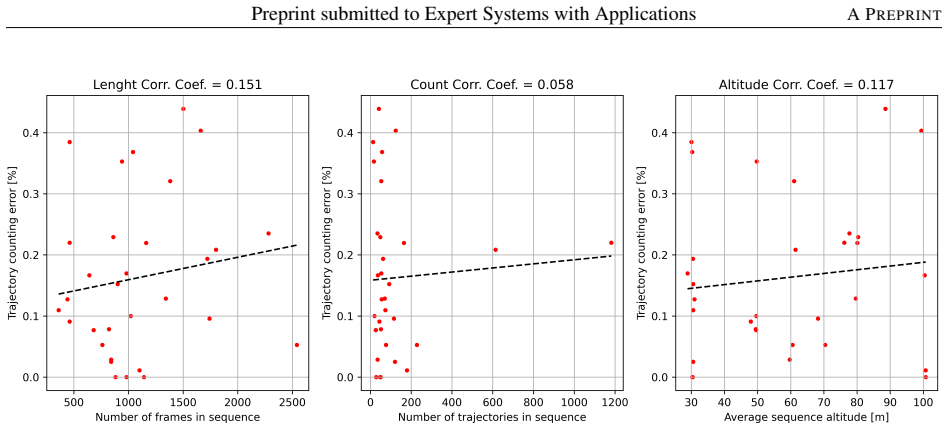
- The altitude-dependent assignment radius lets a single configuration handle flights from roughly 29 m to 100 m above ground, removing a tuning step for different drone heights.
- Reusing localiser features avoids a second feature-extraction network, but the paper notes the overall pipeline remains computationally demanding and is not yet real-time on board a drone.
Reading between the lines
- The reported ID-switch collapse may be partly a consequence of artificially prolonging trajectories through detection gaps; a direct way to test this is to compare tracks produced with and without the DDCF module on sequences where detector outputs are deliberately suppressed.
- If the 16-channel features carry enough identity information for few-pixel objects, the same feature-reuse pattern could extend to other point-based dense prediction tasks, such as vehicle or animal counting, that output spatial feature maps from their heads.
- The altitude rule uses only a scalar radius; incorporating full camera pose from GPS, IMU, and gimbal angles could generalise the assignment gate to non-horizontal cameras and curved flight paths.
- The order-of-magnitude ID-switch reduction suggests many identity switches in drone datasets are artifacts of detection gaps rather than association ambiguities; detector training might benefit from a temporal continuity loss that rewards stable features across frames.
Signed reviews
Editorial analysis
A structured set of objections, weighed in public.
Referee Report
Summary. The paper proposes an online, point-oriented multi-object tracker for drone-based crowd monitoring, built on SORT with a point-distance assignment metric. It adds three minimal-cost techniques: camera motion compensation (CMC), altitude-aware dynamic assignment thresholds, and a classification-based trajectory validation step. It further integrates Deep Discriminative Correlation Filters (DDCF) that reuse spatial feature maps from the Dot Localisation network, aiming to maintain trajectory continuity during missed detections. The method is evaluated on the newly released UP-COUNT-TRACK dataset and on DroneCrowd, reporting reduced identity switches (ID-SW) and trajectory counting errors (Tr-nMAE) relative to a baseline SORT variant and to the offline GOG algorithm.
Significance. If the DDCF module genuinely preserves object identity during missed-detection gaps, the paper offers a practical, computationally efficient online recipe for tracking sub-ten-pixel people in drone footage, with a valuable new benchmark dataset (UP-COUNT-TRACK) and a zero-waste reuse of localisation features. The incremental ablation design is commendable: Tables 2 and 3 show that each added component either improves or holds the reported metrics. However, the central claimed breakthrough—the drastic ID-SW reduction attributed to DDCF—is not supported by direct evidence of per-object re-identification fidelity, and the comparison set lacks established online trackers. The dataset contribution alone is significant for the community.
major comments (4)
- [Section 4.4-4.5 and Tables 2-3] The DDCF module is credited with the dominant improvement: ID-SW drops from 2943 to 287 on UP-COUNT-TRACK and from 6645 to 388 on DroneCrowd, while HOTA remains essentially flat (0.63 to 0.63; 0.52 to 0.54). The paper does not demonstrate that the correlation-filter-based re-detections recover the same physical person; for objects of only a few pixels, the 16-channel feature map from the localisation head may not be identity-discriminative, and the filter could lock onto a neighbor or background. Without a per-track re-identification accuracy, a failure analysis, a comparison against cheaper gap-filling (e.g., Kalman prediction alone), or a HOTA decomposition showing association gains, the ID-SW reduction is equally consistent with trajectory stitching that artificially prolongs tracks. This is load-bearing: the central claim of improved trajectory continuity hinges on the DDCF's identity-preserving behaviour.
- [Section 5.3] The comparison includes only the paper's own baseline with incremental components and the offline GOG algorithm. The abstract and Section 1 claim the method 'outperform[s] baseline online trackers', but no established online multi-object trackers (e.g., DeepSORT, ByteTrack, BoT-SORT, or a standard point-based SORT variant) are evaluated. Since SORT is acknowledged as the base, a comparison against a well-tuned SORT/DeepSORT would be necessary to substantiate the practical improvement claim.
- [Eq. (1) and Section 4.3.2] The altitude-aware threshold for DroneCrowd relies on assuming 100 m for 'small' objects and 50 m for 'large' objects because the dataset lacks altitude metadata. The paper does not justify these specific values or report sensitivity to them. Given that the threshold directly controls assignment radii and thus ID-SW, a sensitivity analysis (e.g., varying the assumed altitudes or the constant in Eq. (1)) is needed to show the reported gains are not artifacts of tuned assumptions.
- [Section 4.3.3 and Section 5.5] The classification-based validation uses an 80% average-probability threshold stated as 'determined experimentally', but no ablation on this threshold is reported, and the training/evaluation protocol for the classifier is underspecified: is the classifier trained on UP-COUNT-TRACK training split and then evaluated on DroneCrowd, or trained separately per dataset? The accuracy figures in Section 5.5 (0.987 and 0.939) do not indicate whether the classifier generalises across domains or whether the threshold was tuned on the test sets.
minor comments (5)
- [Abstract] There is a stray spacing issue: 'drone -based' should be 'drone-based'.
- [Tables 2 and 3] The numeric formatting of '49 .13± 117 .22' and similar entries inserts spaces before decimal points; these should be corrected throughout.
- [Section 4.4.1] The spatial feature map dimensions 544×940×16 are mentioned without stating the input image resolution to which they correspond; adding this context would help readers judge the feature stride relative to object size.
- [Section 5.2] The definitions of Tr-MAE and Tr-nMAE use n for the number of sequences, but it is not explicitly stated that y_i and ŷ_i are the ground-truth and estimated numbers of unique trajectories per sequence; please make this explicit, as the metric is central to the counting claims.
- [References] The BoT-SORT reference is incomplete: it lists 'Aharon, N., Orfaig, R., Bobrovsky, B., .' with no year; the arXiv identifier is given but the citation entry should be completed.
Circularity Check
No circular derivation: the tracking gains are measured against external benchmarks; DDCF is a pipeline component, not a fitted predictor, and self-citations are non-load-bearing.
full rationale
The paper's derivation chain is not circular. Detections come from the authors' previously published Dot Localisation method, which is used as an external input and benchmarked (L-AP@10 on DroneCrowd and UP-COUNT), not as a quantity derived from the tracking metrics. The tracking pipeline applies SORT with point-distance assignment, camera motion compensation, an altitude-dependent threshold (Eq. 1), an early-classification trigger (Eq. 2), an experimentally determined 80% confirmation threshold, and an ECO-style DDCF that reuses dense feature maps from the localisation head. None of the reported metrics (HOTA, T-mAP, ID-SW, Tr-MAE, Tr-nMAE) is algebraically identical to any fitted parameter or to the DDCF feature maps; the reductions in ID-SW and Tr-nMAE are empirical measurements on DroneCrowd and the newly constructed UP-COUNT-TRACK dataset. Eq. (1) is a heuristic mapping from altitude to pixel radius, Eq. (2) is a trajectory-age test, and the 80% threshold is stated as experimentally determined; these are engineering choices, not identities. The DDCF could be under-validated as a per-object re-identification mechanism, but that is a measurement-interpretation or correctness concern, not circular reasoning. The self-citations to Ptak and Kraft (2025) provide the localisation backbone and dataset, but the central tracking claim is independently evaluated against external metrics and an external benchmark, so no load-bearing reduction to the paper's own inputs occurs.
Assumptions & free parameters
free parameters (7)
- Assignment radius default =
10 px
- Dynamic threshold altitude factor =
Tr = max(10, (100 / altitude) * 10)
- Minimum trajectory length (Nthresh) =
30 frames
- Maximum trajectory age =
60 frames
- Classification validation threshold =
80% average probability
- Confirmation trigger offset =
Nthresh - 3
- DroneCrowd assumed altitudes =
100 m for small-object sequences, 50 m for large-object sequences
assumptions (5)
- standard math The Hungarian algorithm yields the optimal one-to-one assignment for the distance cost matrix.
- domain assumption SORT's Kalman filter approximates each person's motion as linear and Gaussian over short intervals.
- domain assumption Inter-frame camera motion is representable by a single affine transformation estimated from sparse Lucas-Kanade corners.
- ad hoc to paper The 16-channel spatial feature map from the localisation head is discriminative enough for DDCF re-detection of individual tiny people.
- domain assumption The trajectory-validation classifier trained on known object positions and random negatives generalizes to test sequences without label leakage.
Cite this review
Pith. "Pith review of Improving trajectory continuity in drone-based crowd monitoring using a set of minimal-cost techniques and deep discriminative correlation filters." pith.science (2026). https://pith.science/paper/KR457BKD
@misc{pith2026250420234,
  author       = {Pith},
  title        = {Pith review of: Improving trajectory continuity in drone-based crowd monitoring using a set of minimal-cost techniques and deep discriminative correlation filters},
  year         = {2026},
  howpublished = {\url{https://pith.science/paper/KR457BKD}},
  note         = {Machine review of arXiv:2504.20234}
}
read the original abstract
Drone-based crowd monitoring is the key technology for applications in surveillance, public safety, and event management. However, maintaining tracking continuity and consistency remains a significant challenge. Traditional detection-assignment tracking methods struggle with false positives, false negatives, and frequent identity switches, leading to degraded counting accuracy and making in-depth analysis impossible. This paper introduces a point-oriented online tracking algorithm that improves trajectory continuity and counting reliability in drone-based crowd monitoring. Our method builds on the Simple Online and Real-time Tracking (SORT) framework, replacing the original bounding-box assignment with a point-distance metric. The algorithm is enhanced with three cost-effective techniques: camera motion compensation, altitude-aware assignment, and classification-based trajectory validation. Further, Deep Discriminative Correlation Filters (DDCF) that re-use spatial feature maps from localisation algorithms for increased computational efficiency through neural network resource sharing are integrated to refine object tracking by reducing noise and handling missed detections. The proposed method is evaluated on the DroneCrowd and newly shared UP-COUNT-TRACK datasets, demonstrating substantial improvements in tracking metrics, reducing counting errors to 23% and 15%, respectively. The results also indicate a significant reduction of identity switches while maintaining high tracking accuracy, outperforming baseline online trackers and even an offline greedy optimisation method.
Figures


Figures from the paper (7 more)




Reference graph
Works this paper leans on
-
[1]
author Aharon, N. , author Orfaig, R. , author Bobrovsky, B. , . title BoT-SORT : Robust associations multi-pedestrian tracking . journal arXiv preprint arXiv:2206.14651
-
[2]
author Asanomi, T. , author Nishimura, K. , author Bise, R. , year 2023 . title Multi-frame attention with feature-level warping for drone crowd tracking , in: booktitle Winter Conf. on Applications of Computer Vision , pp. pages 1664--1673
work page 2023
-
[3]
author Bernardin, K. , author Stiefelhagen, R. , year 2008 . title Evaluating multiple object tracking performance: the clear MOT metrics . journal EURASIP Journal on Image and Video Processing volume 2008 , pages 1--10
work page 2008
-
[4]
author Bewley, A. , author Ge, Z. , author Ott, L. , author Ramos, F. , author Upcroft, B. , year 2016 . title Simple online and realtime tracking , in: booktitle 2016 IEEE international conference on image processing (ICIP) , organization IEEE . pp. pages 3464--3468
work page 2016
-
[5]
author Bouguet, J.Y. , et al., year 2001 . title Pyramidal implementation of the affine lucas kanade feature tracker description of the algorithm . journal Intel corporation volume 5 , pages 4
work page 2001
-
[6]
author Chatfield, K. , year 2014 . title Return of the devil in the details: Delving deep into convolutional nets . journal arXiv preprint arXiv:1405.3531
arXiv 2014
-
[7]
author Danelljan, M. , author Bhat, G. , author Shahbaz Khan, F. , author Felsberg, M. , year 2017 . title ECO : Efficient convolution operators for tracking , in: booktitle Proceedings of the IEEE conference on computer vision and pattern recognition , pp. pages 6638--6646
work page 2017
-
[8]
author Danelljan, M. , author Hager, G. , author Shahbaz Khan, F. , author Felsberg, M. , year 2015 . title Convolutional features for correlation filter based visual tracking , in: booktitle Proceedings of the IEEE international conference on computer vision workshops , pp. pages 58--66
work page 2015
Show all 32 references
-
[9]
, author Robinson, A
author Danelljan, M. , author Robinson, A. , author Shahbaz Khan, F. , author Felsberg, M. , year 2016 . title Beyond correlation filters: Learning continuous convolution operators for visual tracking , in: booktitle Computer Vision--ECCV 2016: 14th European Conference, Amster...
2016
-
[10]
, author Shahbaz Khan, F
author Danelljan, M. , author Shahbaz Khan, F. , author Felsberg, M. , author Van de Weijer, J. , year 2014 . title Adaptive color attributes for real-time visual tracking , in: booktitle Proceedings of the IEEE conference on computer vision and pattern recognition , pp. pages...
2014
-
[11]
, author Khaleel, M
author Emimi, M. , author Khaleel, M. , author Alkrash, A. , year 2023 . title The current opportunities and challenges in drone technology . journal Int. J. Electr. Eng. and Sustain. , pages 74--89
2023
-
[12]
, author Girshick, R.B
author Felzenszwalb, P.F. , author Girshick, R.B. , author McAllester, D. , author Ramanan, D. , year 2009 . title Object detection with discriminatively trained part-based models . journal IEEE transactions on pattern analysis and machine intelligence volume 32 , pages 1627--1645
2009
-
[13]
, author Sim, T
author Galoogahi, H.K. , author Sim, T. , author Lucey, S. , year 2013 . title Multi-channel correlation filters , in: booktitle Proceedings of the IEEE international conference on computer vision , pp. pages 3072--3079
2013
-
[14]
, author Caseiro, R
author Henriques, J.F. , author Caseiro, R. , author Martins, P. , author Batista, J. , year 2014 . title High-speed tracking with kernelized correlation filters . journal IEEE transactions on pattern analysis and machine intelligence volume 37 , pages 583--596
2014
-
[15]
, year 2014
author Kingma, D.P. , year 2014 . title Adam: A method for stochastic optimization . journal arXiv preprint arXiv:1412.6980
2014 arXiv
-
[16]
, author Matas, J
author Kristan, M. , author Matas, J. , author Leonardis, A. , author Felsberg, M. , author Cehovin, L. , author Fernandez, G. , author Vojir, T. , author Hager, G. , author Nebehay, G. , author Pflugfelder, R. , year 2015 . title The visual object tracking VOT2015 challenge r...
2015
-
[17]
, author Huang, C
author Li, Y. , author Huang, C. , author Nevatia, R. , year 2009 . title Learning to associate: Hybridboosted multi-target tracker for crowded scene , in: booktitle 2009 IEEE Conference on Computer Vision and Pattern Recognition , pp. pages 2953--2960 . :10.1109/CVPR.2009.5206735
2009
-
[18]
, author Zhu, J
author Li, Y. , author Zhu, J. , year 2015 . title A scale adaptive kernel correlation filter tracker with feature integration , in: booktitle Computer Vision-ECCV 2014 Workshops: Zurich, Switzerland, September 6-7 and 12, 2014, Proceedings, Part II 13 , organization Springer ...
2015
-
[19]
, author Osep, A
author Luiten, J. , author Osep, A. , author Dendorfer, P. , author Torr, P. , author Geiger, A. , author Leal-Taix \'e , L. , author Leibe, B. , year 2021 . title HOTA : A higher order metric for evaluating multi-object tracking . journal International journal of computer vis...
2021
-
[20]
, author Vojir, T
author Lukezic, A. , author Vojir, T. , author ˇCehovin Zajc, L. , author Matas, J. , author Kristan, M. , year 2017 . title Discriminative correlation filter with channel and spatial reliability , in: booktitle Proceedings of the IEEE conference on computer vision and pattern...
2017
-
[21]
, author Huang, J.B
author Ma, C. , author Huang, J.B. , author Yang, X. , author Yang, M.H. , year 2015 . title Hierarchical convolutional features for visual tracking , in: booktitle Proceedings of the IEEE international conference on computer vision , pp. pages 3074--3082
2015
-
[22]
, author Gen \'e -Mola, J
author Miranda, J.C. , author Gen \'e -Mola, J. , author Zude-Sasse, M. , author Tsoulias, N. , author Escol \`a , A. , author Arn \'o , J. , author Rosell-Polo, J.R. , author Sanz-Cortiella, R. , author Mart \' nez-Casasnovas, J.A. , author Gregorio, E. , year 2023 . title Fr...
2023
-
[23]
, author Nezamabadi-Pour, H
author Mirzaei, B. , author Nezamabadi-Pour, H. , author Raoof, A. , author Derakhshani, R. , year 2023 . title Small object detection and tracking: a comprehensive review . journal Sensors volume 23 , pages 6887
2023
-
[24]
, author Ramanan, D
author Pirsiavash, H. , author Ramanan, D. , author Fowlkes, C.C. , year 2011 . title Globally-optimal greedy algorithms for tracking a variable number of objects , in: booktitle CVPR 2011 , organization IEEE . pp. pages 1201--1208
2011
-
[25]
, author Kraft, M
author Ptak, B. , author Kraft, M. , year 2025 . title Enhancing people localisation in drone imagery for better crowd management by utilising every pixel in high-resolution images . https://arxiv.org/abs/2502.04014, http://arxiv.org/abs/2502.04014 arXiv:2502.04014
2025 arXiv
-
[26]
, author Twardowski, B
author Trzcinski, T. , author Twardowski, B. , author Zieli \'n ski, B. , author Adamczewski, K. , author W \'o jcik, B. , year 2024 . title Zero-waste machine learning , in: booktitle ECAI 2024 . publisher IOS Press , pp. pages 43--49
2024
-
[27]
, author Schmid, C
author Van De Weijer, J. , author Schmid, C. , author Verbeek, J. , author Larlus, D. , year 2009 . title Learning color names for real-world applications . journal IEEE Transactions on Image Processing volume 18 , pages 1512--1523
2009
-
[28]
, author Liu, T
author Wang, L. , author Liu, T. , author Wang, G. , author Chan, K.L. , author Yang, Q. , year 2015 . title Video tracking using learned hierarchical features . journal IEEE Transactions on Image Processing volume 24 , pages 1424--1435
2015
-
[29]
, author Yeung, D.Y
author Wang, N. , author Yeung, D.Y. , year 2013 . title Learning a deep compact image representation for visual tracking . journal Advances in neural information processing systems volume 26
2013
-
[30]
, author Du, D
author Wen, L. , author Du, D. , author Zhu, P. , author Hu, Q. , author Wang, Q. , author Bo, L. , author Lyu, S. , year 2021 . title Detection, tracking, and counting meets drones in crowds: A benchmark , in: booktitle Proceedings of the IEEE/CVF Conference on Computer Visio...
2021
-
[31]
, author Ptak, B
author Wilinski, M. , author Ptak, B. , author Kraft, M. , year 2024 . title Elevating point-based object detection in UAVs : A deep learning method with altitude fusion , in: booktitle Progress in Polish Artificial Intelligence Research 5: Proceedings of the 5th Polish Confer...
2024
-
[32]
, author Lim, J
author Wu, Y. , author Lim, J. , author Yang, M.H. , year 2013 . title Online object tracking: A benchmark , in: booktitle Proceedings of the IEEE conference on computer vision and pattern recognition , pp. pages 2411--2418
2013
Reviewed August 16, 2026 · model on record in the stance chip above.
Discussion (0). Continue with ORCID to comment.