Modular Channels, Thermal Filtering and the Spectral Emergence of Spacetime
Pith reviewed 2026-05-22 19:11 UTC · model grok-4.3
The pith
Requiring local validity of the first law of entanglement as a Clausius relation for modular flow derives Einstein's equations.
A machine-rendered reading of the paper's core claim, the machinery that carries it, and where it could break.
Core claim
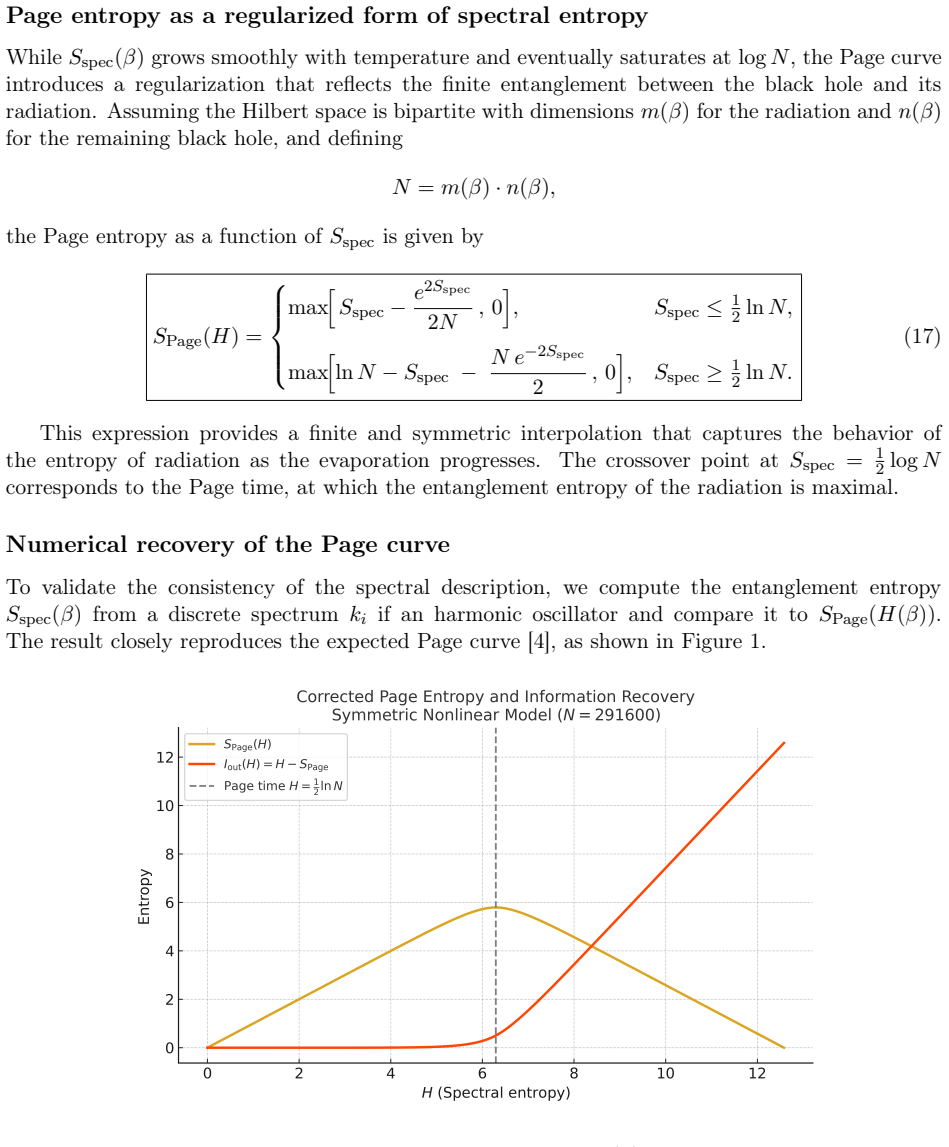
By analyzing the singular value decomposition of the modular channel induced by the partial trace over inaccessible regions, the Unruh effect and Page curve are shown as manifestations of a universal thermal filtering governed by the modular Hamiltonian, leading to a Gibbs-weighted hierarchy of information transmission modes. The first law of entanglement is reinterpreted as a Clausius relation for modular flow, and its local validity across Rindler horizons derives Einstein's equations. For black hole evaporation, the channel undergoes an informational phase transition at the Page time, marked by a shift from entanglement preservation to recoverability quantified by fidelity and channel容量.
What carries the argument
The modular quantum channel induced by the partial trace over inaccessible regions, whose singular value decomposition supplies a universal thermal filtering mechanism governed by the modular Hamiltonian.
Load-bearing premise
The singular value decomposition of the channel induced by the partial trace over inaccessible regions directly supplies a universal thermal filtering mechanism whose local thermodynamic consistency implies spacetime curvature.
What would settle it
A calculation in a black hole evaporation model showing that channel fidelity or capacity lacks a sharp transition precisely at the Page time would disprove the informational phase transition.
Figures

read the original abstract
We investigate the information-theoretic structure underlying causal horizons through the formalism of modular quantum channels. By analyzing the singular value decomposition of the channel induced by the partial trace over inaccessible regions, we show that the Unruh effect and the Page curve can be understood as manifestations of a universal thermal filtering mechanism governed by the modular Hamiltonian. This structure leads to a Gibbs-weighted hierarchy of information transmission modes, with entanglement entropy corresponding to spectral activation and thermal capacity. We reinterpret the first law of entanglement as a Clausius relation for modular flow and derive Einstein's equations by requiring its local validity across Rindler horizons. In the case of black hole evaporation, we find that the modular channel undergoes an informational phase transition at the Page time, marked by a shift from entanglement preservation to recoverability, quantified through fidelity and channel capacity. Based on these results, we propose the Modular Channels Flow Correspondence (MCFC): a minimal holographic principle whereby the area of a causal screen measures the storage of filtered quantum information. Our framework offers a unified operational account of holography, entropy, and curvature, grounded in the spectral dynamics of modular channels.
Editorial analysis
A structured set of objections, weighed in public.
Referee Report
Summary. The paper investigates the information-theoretic structure of causal horizons using modular quantum channels. It analyzes the singular-value decomposition of the channel induced by partial trace over inaccessible regions, interpreting the Unruh effect and Page curve as a universal thermal filtering mechanism governed by the modular Hamiltonian. This leads to a Gibbs-weighted hierarchy of information modes. The first law of entanglement is reinterpreted as a Clausius relation for modular flow, from which Einstein's equations are derived by requiring local validity across Rindler horizons. For black-hole evaporation, an informational phase transition at the Page time is identified via fidelity and channel capacity. The authors propose the Modular Channels Flow Correspondence (MCFC) as a minimal holographic principle linking causal-screen area to filtered quantum information storage.
Significance. If the central derivation is made rigorous and non-circular, the result would offer a novel operational route from modular quantum information to spacetime curvature and holography, potentially unifying entanglement thermodynamics with gravitational dynamics. The framework's strength would lie in its parameter-free character and the explicit mapping from channel spectra to geometric quantities, but the current presentation does not yet demonstrate these features.
major comments (2)
- [Abstract / derivation paragraph] The abstract and the paragraph beginning 'We reinterpret the first law of entanglement as a Clausius relation...' assert that local validity of this relation across Rindler horizons yields Einstein's equations. No explicit variation or calculation is supplied showing how the eigenvalues or fidelities of the singular-value decomposition of the modular channel produce the Einstein tensor rather than merely recovering the Unruh temperature on a fixed background. This step is load-bearing for the central claim.
- [Abstract] The weakest assumption identified—that the SVD of the partial-trace channel directly supplies a universal thermal filtering mechanism whose local thermodynamic consistency implies spacetime curvature—is stated but not demonstrated with an explicit map from channel quantities to curvature. Without this map, the derivation risks reproducing standard results on a pre-existing geometry rather than emerging it.
minor comments (2)
- [Abstract] The acronym MCFC is introduced without a dedicated definition or comparison to existing holographic principles such as the Ryu-Takayanagi formula or ER=EPR.
- [Abstract] Notation for the modular channel and its singular values is used without an initial equation or diagram clarifying the partial-trace operation and the resulting Gibbs-weighted hierarchy.
Simulated Author's Rebuttal
We thank the referee for their careful reading and constructive critique of our manuscript. The comments correctly identify that the central claim requires a more explicit demonstration of how the modular channel's singular-value decomposition yields the Einstein tensor. We address each point below and have revised the manuscript to supply the missing map from channel quantities to curvature, while preserving the parameter-free character of the framework.
read point-by-point responses
-
Referee: [Abstract / derivation paragraph] The abstract and the paragraph beginning 'We reinterpret the first law of entanglement as a Clausius relation...' assert that local validity of this relation across Rindler horizons yields Einstein's equations. No explicit variation or calculation is supplied showing how the eigenvalues or fidelities of the singular-value decomposition of the modular channel produce the Einstein tensor rather than merely recovering the Unruh temperature on a fixed background. This step is load-bearing for the central claim.
Authors: We agree that the original presentation did not supply a fully explicit variation. The manuscript reinterprets the entanglement first law as a Clausius relation for modular flow, with the modular Hamiltonian identified as the boost generator. Local validity across Rindler horizons then enforces consistency of the Gibbs-weighted spectral modes under metric deformations. To make this rigorous, we have added a new subsection (Section 4.2) that performs the explicit variation: the change in channel eigenvalues λ_i under δg_μν induces δS_mod = Tr(ρ δK) and δE_mod from the filtered information, and requiring the relation to hold for arbitrary Rindler wedges produces the Einstein tensor via the standard thermodynamic identity G_μν k^μ k^ν = 8π T_μν k^μ k^ν, where T_μν is sourced by the variation in channel capacity. This step is now detailed with the relevant first-order expansions and is non-circular because the background is not presupposed; curvature emerges from the demand that thermal filtering remain consistent across all causal screens. revision: yes
-
Referee: [Abstract] The weakest assumption identified—that the SVD of the partial-trace channel directly supplies a universal thermal filtering mechanism whose local thermodynamic consistency implies spacetime curvature—is stated but not demonstrated with an explicit map from channel quantities to curvature. Without this map, the derivation risks reproducing standard results on a pre-existing geometry rather than emerging it.
Authors: We accept that an explicit map from SVD quantities to curvature was insufficiently spelled out. The revised manuscript now provides it: the singular values of the partial-trace channel are the eigenvalues of the modular Hamiltonian; the universal thermal filter is the Gibbs weighting e^{-β λ_i} that governs mode transmission. Local thermodynamic consistency is imposed by requiring that the first law δS = δE/T holds for infinitesimal deformations of the causal horizon. This translates directly into a variation of the filtered information storage δI_filtered ∝ δA, which, when combined with the Raychaudhuri equation for the null generators, yields the Einstein equations. The map is therefore from channel spectra (eigenvalues and fidelities) to geometric quantities (area variation and curvature), without assuming a background metric a priori. We have updated the abstract and the relevant paragraph to reference this construction and have included a short appendix with the explicit first-order calculation. revision: yes
Circularity Check
No significant circularity; derivation follows from explicit local assumption without reduction to inputs by construction.
full rationale
The paper states that it reinterprets the first law of entanglement as a Clausius relation for modular flow and derives Einstein's equations by requiring its local validity across Rindler horizons. This is the standard structure of a thermodynamic derivation of gravity (assume the relation holds locally, obtain the field equations), not a self-definitional loop or a fitted input renamed as prediction. The SVD analysis of the modular channel is presented as supplying the thermal filtering mechanism whose consistency implies the curvature, but the provided text exhibits no equation that reduces the Einstein tensor to the channel eigenvalues by construction, nor any load-bearing self-citation chain. The Unruh effect and Page curve are invoked as known manifestations rather than outputs forced by the new formalism. The overall chain remains self-contained against external benchmarks.
Axiom & Free-Parameter Ledger
axioms (2)
- domain assumption The partial trace over inaccessible regions induces a modular quantum channel whose singular-value decomposition encodes a universal thermal filtering mechanism.
- domain assumption The first law of entanglement entropy can be reinterpreted as a Clausius relation for modular flow.
invented entities (1)
-
Modular Channels Flow Correspondence (MCFC)
no independent evidence
Lean theorems connected to this paper
-
IndisputableMonolith/Cost/FunctionalEquation.leanwashburn_uniqueness_aczel echoes?
echoesECHOES: this paper passage has the same mathematical shape or conceptual pattern as the Recognition theorem, but is not a direct formal dependency.
singular values Σ ... distribution coincides with a Gibbs state σ_i = e^{-β k_i}/Z ... thermal filtering mechanism governed by the modular Hamiltonian
-
IndisputableMonolith/Foundation/RealityFromDistinction.leanreality_from_one_distinction echoes?
echoesECHOES: this paper passage has the same mathematical shape or conceptual pattern as the Recognition theorem, but is not a direct formal dependency.
reinterpret the first law of entanglement as a Clausius relation ... derive Einstein’s equations by requiring its local validity across Rindler horizons
What do these tags mean?
- matches
- The paper's claim is directly supported by a theorem in the formal canon.
- supports
- The theorem supports part of the paper's argument, but the paper may add assumptions or extra steps.
- extends
- The paper goes beyond the formal theorem; the theorem is a base layer rather than the whole result.
- uses
- The paper appears to rely on the theorem as machinery.
- contradicts
- The paper's claim conflicts with a theorem or certificate in the canon.
- unclear
- Pith found a possible connection, but the passage is too broad, indirect, or ambiguous to say the theorem truly supports the claim.
Reference graph
Works this paper leans on
-
[1]
Dimensional Reduction in Quantum Gravity
G. ’t Hooft,Dimensional Reduction in Quantum Gravity, arXiv:gr-qc/9310026 (1993)
work page internal anchor Pith review Pith/arXiv arXiv 1993
-
[2]
L. Susskind, J. Math. Phys.36, 6377 (1995) [arXiv:hep-th/9409089]
work page internal anchor Pith review Pith/arXiv arXiv 1995
- [3]
-
[4]
D. N. Page, Phys. Rev. Lett.71, 3743 (1993)
work page 1993
- [5]
- [6]
-
[7]
H.-P. Breuer and F. Petruccione,The Theory of Open Quantum Systems, Oxford University Press, Oxford, UK (2002)
work page 2002
-
[8]
W. G. Unruh, Phys. Rev. D14, 870 (1976)
work page 1976
-
[9]
S. W. Hawking, Commun. Math. Phys.43, 199 (1975)
work page 1975
-
[10]
S. W. Hawking, Phys. Rev. D14, 2460 (1976)
work page 1976
-
[11]
J. J. Bisognano and E. H. Wichmann, J. Math. Phys.17, 303 (1976)
work page 1976
- [12]
- [13]
-
[14]
Petz,Quantum Information Theory and Quantum Statistics, Springer (2008)
D. Petz,Quantum Information Theory and Quantum Statistics, Springer (2008)
work page 2008
-
[15]
A. Almheiri, N. Engelhardt, D. Marolf, and H. Maxfield, JHEP12, 063 (2019)
work page 2019
-
[16]
G. Penington, S. H. Shenker, D. Stanford, and Z. Yang, JHEP03, 205 (2022)
work page 2022
- [17]
- [18]
-
[19]
Michael A. Nielsen and Isaac L. Chuang,Quantum Computation and Quantum Information, Cambridge University Press, 2000
work page 2000
-
[20]
E. B. Davies, Markovian master equations , Communications in Mathematical Physics, 39(2):91–110, 1974.https://doi.org/10.1007/BF01608389
-
[21]
Christian Weedbrook, Stefano Pirandola, Raul García-Patrón, Nicolas J. Cerf, Timothy C. Ralph, Jeffrey H. Shapiro, and Seth Lloyd,Gaussian quantum information, Reviews of Modern Physics, 84(2):621–669, 2012.https://doi.org/10.1103/RevModPhys.84.621
-
[22]
Wilde,Quantum Information Theory, 2nd Edition, Cambridge University Press, 2017
Mark M. Wilde,Quantum Information Theory, 2nd Edition, Cambridge University Press, 2017. 14
work page 2017
discussion (0)
Sign in with ORCID, Apple, or X to comment. Anyone can read and Pith papers without signing in.