REVIEW 4 major objections 6 minor 66 references
Purifying, Labeling, and Utilizing: A High-Quality Pipeline for Small Object Detection
T0 review · 4 major / 6 minor · reviewed 2026-08-16 · deepseek-v4-flash
Pith's one-line read PLUSNet's three modules lift small-object AP to 32.0 on SODA-D and 21.7 on AI-TOD.
desk verdict A plausible, clearly-written small-object detection pipeline whose headline gains are real only if the test-set hyperparameter tuning and missing error bars do not hide them; worth sending to peer review but the numbers should be treated as provisional. read the letter →
The pith
A machine-rendered reading of the paper's core claim, the machinery that carries it, and where it could break.
The reading
What carries the argument
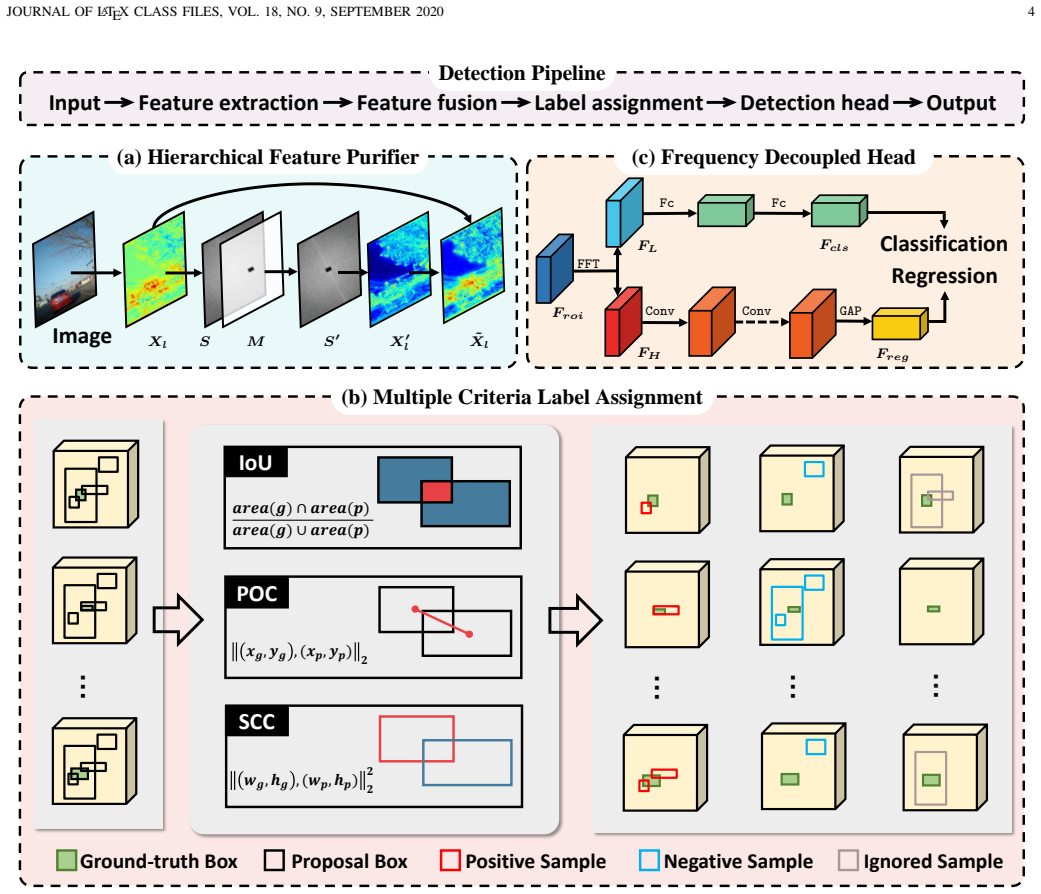
The load-bearing mechanism is the trio of modules PLUSNet inserts at three pipeline stages. HFP filters low levels of the feature pyramid in the Fourier domain, with mask width set by $\mu (r-l)/r$ and the purified map formed as $\tilde{X}_l = \mathrm{IFFT}(M \odot \mathrm{FFT}(X_l)) \cdot \omega + X_l$; this residual highpass filter is what 'purifies' features. MCLA scores each proposal as a normalized weighted sum of IoU, a position offset score $S_{\mathrm{POC}} = (1+\sqrt{20 E_1^{\mathrm{norm}}})^{-1}$, and a shape constraint score $S_{\mathrm{SCC}} = (1+\sqrt{0.25 E_2})^{-1}$, which supplies more positive samples to tiny objects. FDHead splits the region-of-interest feature into low-frequency and high-frequency components, feeding the low-frequency part through fully connected layers for classification and the high-frequency part through convolution blocks with global average pooling for regression. The paper argues these three mechanisms are complementary, and that their combination, not any single module, produces the reported accuracy.
What would settle it
The quickest direct test is to run only HFP, the highpass purification module, on AI-TOD with the settings tuned on SODA-D; the paper's own ablation predicts the tiny-object split will worsen, so an improvement would falsify the purification premise. A second check is to grid-search the filtering strength on AI-TOD and see whether the SODA-D-optimal value still transfers.
Extended reading notes
Core claim
The central claim is that the standard two-stage detection pipeline damages small objects at every stage, so optimizing the whole pipeline works better than optimizing any isolated stage. In the upstream, feature pyramid top-down fusion injects low-frequency semantic noise into the low-level features that small objects need; the Hierarchical Feature Purifier applies an FFT-based highpass mask with a residual to those levels. In the midstream, IoU-only assignment under-supplies tiny objects with positive training samples because the ratio is size-sensitive; the Multiple Criteria Label Assignment adds a position-offset criterion and a shape-constraint criterion to the IoU score. In the downstream, a shared head forces classification and regression to use the same representation; the Frequency Decoupled Head gives classification fully connected layers on low-frequency features and regression convolutions on high-frequency features. The paper's evidence is the full model's gains on SODA-D, AI-TOD, and COCO, plus ablations showing each module contributes and that the final small-object benefit requires their combination.
Load-bearing premise
The whole method depends on the premise that the lowest-level feature maps in the feature pyramid contain harmful low-frequency semantic noise, and that removing it with highpass filtering plus a residual preserves the small-object detail; the ablation table shows this module alone actually hurts the smallest objects, with the 0-to-12-pixel metric APeS falling from 13.8 to 12.6, so the purification benefit appears only after the other two modules are added.
Editorial extensions
If this is right
- On SODA-D, PLUSNet with a ResNet-50 backbone reaches 32.0 AP versus 28.9 for the Faster R-CNN baseline and 30.7 for the previous best method CFINet.
- On AI-TOD, PLUSNet reaches 21.7 AP versus 11.1 for the baseline, and adding the modules to DetectoRS pushes AP to 25.2.
- On the COCO mini-val set, adding the modules to Faster R-CNN, Mask R-CNN, Libra R-CNN, and Guided Anchoring improves overall mAP and the small-object metric, so the claimed benefit is not limited to purpose-built tiny-object datasets.
- In the SODA-D ablation, HFP alone lowers the metric for 0-to-12-pixel objects (APeS) from 13.8 to 12.6; the full gain appears only after MCLA and FDHead are added, eventually reaching 15.4 APeS.
Reading between the lines
- If the frequency-band premise transfers, the HFP mask should be learnable per level and per dataset rather than fixed by $\mu$ and $r$; a testable prediction is that the optimal cutoff tracks the dataset's object-size distribution, with AI-TOD's roughly 12.8-pixel objects needing a different pass band than SODA-D's roughly 20.3-pixel objects.
- The MCLA simulation counts how many positive samples each assigner produces, but not whether those extra samples actually improve localization; measuring regression error on the newly assigned tiny-object samples would show whether the gain comes from more samples or from more balanced training.
- Because the paper reports a large computational cost increase (206.7 to 481.0 GFLOPs) and labels it a limitation, a practical follow-up would replace the explicit FFT/IFFT loops with a learned frequency filter or a distilled model that skips the transform at inference; the paper itself suggests learning to work directly on the transformed features.
Signed reviews
Editorial analysis
A structured set of objections, weighed in public.
Referee Report
Summary. The paper proposes PLUSNet, a small-object detection framework composed of three modules: a Hierarchical Feature Purifier (HFP) that high-pass filters low-level FPN features in the Fourier domain, a Multiple Criteria Label Assignment (MCLA) that augments IoU with position-offset and shape-constraint criteria, and a Frequency Decoupled Head (FDHead) that feeds low-frequency features to classification and high-frequency features to regression. Experiments on SODA-D, AI-TOD, and a COCO subset reportedly show consistent gains over Faster R-CNN and prior state-of-the-art methods, with the largest claimed improvements being 32.0 AP vs. 28.9 AP baseline on SODA-D and 21.7 AP vs. 11.1 AP baseline on AI-TOD. The paper also includes ablations for each module and a simulation experiment showing that MCLA assigns more positive samples to small objects than MaxIoU strategies.
Significance. If the reported results hold, the paper would make a useful empirical contribution: each module is simple, the overall design is clearly motivated by the detection pipeline, and the modules are claimed to be plug-and-play across detectors. The simulation experiment in Section IV-D is a nice sanity check that directly demonstrates the label-imbalance problem MCLA addresses. However, the significance is tempered by the fact that the central empirical claim rests on test-set tuning and single-run comparisons, and the computational overhead of the Fourier transforms is substantial (481.0 GFLOPs vs. 206.7 for the baseline in Table X). The paper is reproducible in principle because the method is described with enough detail to re-implement, but no code is released and no variance estimates are provided.
major comments (4)
- [Section IV-C, Tables IV–VIII] All hyperparameters are selected by comparing AP on the SODA-D test set, and the final comparison in Table I is also on that same test set. Specifically, µ and ω (Table IV), r (Table V), λ2 and λ3 (Table VI), Dl and Dh (Table VII), and the frequency-component choice (Table VIII) are all tuned on the test set. With roughly ten free choices, this constitutes selection on the test set, which can inflate the reported 32.0 AP and make the comparison against CFINet (30.7) and the baseline (28.9) potentially unfair, since the competing methods are not given the same test-set tuning. The authors should instead fix all hyperparameters using a held-out validation split (or cross-validation), report the validation choices, and then evaluate on the test set exactly once. Without this, the headline improvements cannot be trusted as unbiased estimates of generalization.
- [Tables I–III] All reported numbers are single runs with no seeds, error bars, or significance tests. The advantage over CFINet on SODA-D is only 1.3 AP (32.0 vs. 30.7), which may be within run-to-run variance for a 12-epoch schedule on a dataset of this size. The authors should report mean and standard deviation over at least three independent runs for the baseline, the prior state of the art, and PLUSNet, and state whether the differences are statistically meaningful. This is necessary to support the claim of 'significant and consistent improvements' in the abstract.
- [Section IV-C, Table III] The ablation contradicts the stated role of HFP. Adding HFP alone raises overall AP from 28.9 to 30.0 but lowers APeS (the 0–12 pixel objects) from 13.8 to 12.6. The text in Section IV-C acknowledges this ('the detection accuracy for extremely small objects is adversely affected'), which means the paper's claimed mechanism—that HFP purifies low-level features to benefit small objects—is not directly supported by the data. The final APeS of 15.4 is only achieved after MCLA and FDHead are added. The authors should either present evidence that the HFP-induced drop is due to insufficient sample count rather than feature damage, or reframe HFP as a global feature rebalancer whose benefit for small objects is conditional on the downstream modules.
- [Section IV-F, Table X] The computational cost is a major weakness that is underplayed. Table X shows PLUSNet at 481.0 GFLOPs versus 206.7 for the Faster R-CNN baseline and 227.1 for CFINet, i.e., roughly 2.3× the baseline and 2.1× the state of the art on SODA-D. While the paper includes a 'Limitation' paragraph, the abstract and conclusion still present PLUSNet as a straightforward improvement without qualifying the cost. At minimum, the authors should report inference speed (e.g., FPS) and explicitly compare the accuracy-per-FLOP trade-off against CFINet, and should temper the 'plug-and-play' claim to note the computational overhead.
minor comments (6)
- [Section III-C] In the text after Algorithm 1, 'SIoU , SPOC , and SPOC' should read 'SIoU , SPOC , and SSCC'.
- [Section III-B, Eq. (3)] The phrase '⊙ denotes the element-wise production' should be 'element-wise product'.
- [Section IV-B heading] The heading 'Comparision with State-of-the-art Methods' contains a typo; it should be 'Comparison'.
- [Section IV-D, Table IX] The table title says 'COCO mini-val SET'. It is unclear what 'mini-val' denotes; please clarify whether this is a random subset of the COCO val set, and describe its size, to allow reproducibility.
- [Section IV-E] The description of SODA-D masking in the Fig. 5 caption is confusing: 'the SODA-D dataset applies masking to confine the detection objects within a sufficiently small area. This operation directly removes the pixels of larger objects.' Please clarify whether this is part of the dataset's evaluation protocol or a preprocessing step, and whether it affects the quantitative results.
- [Section II-C] The phrase 'The inspiring work [44]' is subjective; please rephrase as 'The work [44]' or 'The influential work [44]'.
Circularity Check
No circularity: PLUSNet is an empirical systems paper with no derivational claims that reduce to their inputs.
full rationale
The paper makes no derivation-chain claims that are equivalent to their inputs by construction. HFP is defined by Eq. (3) as IFFT(M⊙FFT(X_l))*ω + X_l, which is a concrete architectural transformation rather than a restatement of the reported AP gains. MCLA and FDHead are likewise heuristic modules whose contributions are measured empirically in ablations, not derived from the evaluation metric. The generalization experiments on AI-TOD and MS COCO use numbers obtained by transferring the SODA-D-tuned pipeline to separate external benchmarks; those results are not forced by the construction of the modules. The main methodological weakness is that hyperparameters (μ, ω, r, λ2, λ3, Dl, Dh) are selected by comparing AP on the SODA-D test set, which is a statistical validity and reproducibility concern, but it is not circularity: the tuning does not make the reported AI-TOD or COCO numbers true by definition. There are no load-bearing self-citations, no imported uniqueness theorems, and no fitted parameter renamed as a prediction. Accordingly, the circularity score is 0.
Assumptions & free parameters
free parameters (10)
- mu =
0.05
- omega =
0.3
- r =
2
- lambda_1 =
1.0
- lambda_2 =
3.0
- lambda_3 =
1.0
- factor_20 =
20
- factor_0.25 =
0.25
- Dl =
0.85
- Dh =
0.10
assumptions (4)
- standard math FFT and IFFT are invertible transforms that preserve the information content of the feature map.
- domain assumption Low-frequency components of CNN features encode semantic information, and high-frequency components encode contour and detail information.
- domain assumption Providing more positive training samples for small objects improves their detection accuracy.
- domain assumption Classification benefits from low-frequency semantic features, while regression benefits from high-frequency contour features.
Cite this review
Pith. "Pith review of Purifying, Labeling, and Utilizing: A High-Quality Pipeline for Small Object Detection." pith.science (2026). https://pith.science/paper/B4TLLDPR
@misc{pith2026250420602,
  author       = {Pith},
  title        = {Pith review of: Purifying, Labeling, and Utilizing: A High-Quality Pipeline for Small Object Detection},
  year         = {2026},
  howpublished = {\url{https://pith.science/paper/B4TLLDPR}},
  note         = {Machine review of arXiv:2504.20602}
}
read the original abstract
Small object detection is a broadly investigated research task and is commonly conceptualized as a "pipeline-style" engineering process. In the upstream, images serve as raw materials for processing in the detection pipeline, where pre-trained models are employed to generate initial feature maps. In the midstream, an assigner selects training positive and negative samples. Subsequently, these samples and features are fed into the downstream for classification and regression. Previous small object detection methods often focused on improving isolated stages of the pipeline, thereby neglecting holistic optimization and consequently constraining overall performance gains. To address this issue, we have optimized three key aspects, namely Purifying, Labeling, and Utilizing, in this pipeline, proposing a high-quality Small object detection framework termed PLUSNet. Specifically, PLUSNet comprises three sequential components: the Hierarchical Feature Purifier (HFP) for purifying upstream features, the Multiple Criteria Label Assignment (MCLA) for improving the quality of midstream training samples, and the Frequency Decoupled Head (FDHead) for more effectively exploiting information to accomplish downstream tasks. The proposed PLUS modules are readily integrable into various object detectors, thus enhancing their detection capabilities in multi-scale scenarios. Extensive experiments demonstrate the proposed PLUSNet consistently achieves significant and consistent improvements across multiple datasets for small object detection.
Figures


Figures from the paper (3 more)


Reference graph
Works this paper leans on
-
[19]
Rethinking classification and localization for object detection,
Y . Wu, Y . Chen, L. Yuan, Z. Liu, L. Wang, H. Li, and Y . Fu, “Rethinking classification and localization for object detection,” in Proceedings of the IEEE/CVF conference on computer vision and pattern recognition , 2020, pp. 10 186–10 195
work page 2020
-
[1]
Small- object detection in remote sensing images with end-to-end edge- enhanced gan and object detector network,
J. Rabbi, N. Ray, M. Schubert, S. Chowdhury, and D. Chao, “Small- object detection in remote sensing images with end-to-end edge- enhanced gan and object detector network,” Remote Sensing , vol. 12, no. 9, p. 1432, 2020
2020
-
[2]
Cross-layer attention network for small object detection in remote sensing imagery,
Y . Li, Q. Huang, X. Pei, Y . Chen, L. Jiao, and R. Shang, “Cross-layer attention network for small object detection in remote sensing imagery,” IEEE Journal of Selected Topics in Applied Earth Observations and Remote Sensing, vol. 14, pp. 2148–2161, 2020
work page 2020
-
[3]
Small object detection in remote sensing images with residual feature aggregation-based super-resolution and object detector network,
S. M. A. Bashir and Y . Wang, “Small object detection in remote sensing images with residual feature aggregation-based super-resolution and object detector network,” Remote Sensing, vol. 13, no. 9, p. 1854, 2021
2021
-
[4]
Exploring feature compensation and cross-level correlation for infrared small target de- tection,
M. Zhang, K. Yue, J. Zhang, Y . Li, and X. Gao, “Exploring feature compensation and cross-level correlation for infrared small target de- tection,” in Proceedings of the 30th ACM International Conference on Multimedia, 2022, pp. 1857–1865
work page 2022
-
[5]
Y . Pi, N. D. Nath, and A. H. Behzadan, “Convolutional neural networks for object detection in aerial imagery for disaster response and recovery,” Advanced Engineering Informatics , vol. 43, p. 101009, 2020
work page 2020
-
[6]
Self-mimic learning for small-scale pedestrian detection,
J. Wu, C. Zhou, Q. Zhang, M. Yang, and J. Yuan, “Self-mimic learning for small-scale pedestrian detection,” in Proceedings of the 28th ACM International Conference on Multimedia , 2020, pp. 2012–2020
work page 2020
-
[7]
A survey and performance evaluation of deep learning methods for small object detection,
Y . Liu, P. Sun, N. Wergeles, and Y . Shang, “A survey and performance evaluation of deep learning methods for small object detection,” Expert Systems with Applications , vol. 172, p. 114602, 2021
2021
Show all 66 references
-
[8]
A survey of the four pillars for small object detection: Multiscale representation, contextual information, super-resolution, and region proposal,
G. Chen, H. Wang, K. Chen, Z. Li, Z. Song, Y . Liu, W. Chen, and A. Knoll, “A survey of the four pillars for small object detection: Multiscale representation, contextual information, super-resolution, and region proposal,” IEEE Transactions on systems, man, and cybernetics: s...
2020
-
[9]
Small object detection via pixel level balancing with applications to blood cell detection,
B. Hu, Y . Liu, P. Chu, M. Tong, and Q. Kong, “Small object detection via pixel level balancing with applications to blood cell detection,” Frontiers in Physiology, vol. 13, p. 911297, 2022
2022
-
[10]
Imaging based cervical cancer diagnostics using small object detection-generative adversarial networks,
R. Elakkiya, K. S. S. Teja, L. Jegatha Deborah, C. Bisogni, and C. Medaglia, “Imaging based cervical cancer diagnostics using small object detection-generative adversarial networks,” Multimedia Tools and Applications, pp. 1–17, 2022
2022
-
[11]
H. J. Nussbaumer and H. J. Nussbaumer, The fast Fourier transform . Springer, 1982
1982
-
[12]
Feature pyramid networks for object detection,
T.-Y . Lin, P. Doll´ar, R. Girshick, K. He, B. Hariharan, and S. Belongie, “Feature pyramid networks for object detection,” in Proceedings of the IEEE/CVF Conference on Computer Vision and Pattern Recognition , 2017, pp. 2117–2125
2017
-
[13]
Faster r-cnn: Towards real-time object detection with region proposal networks,
S. Ren, K. He, R. Girshick, and J. Sun, “Faster r-cnn: Towards real-time object detection with region proposal networks,” Advances in neural information processing systems , vol. 28, 2015
2015
-
[14]
Focal loss for dense object detection,
T.-Y . Lin, P. Goyal, R. Girshick, K. He, and P. Doll ´ar, “Focal loss for dense object detection,” in Proceedings of the IEEE/CVF International Conference on Computer Vision , 2017, pp. 2980–2988
2017
-
[15]
Fcos: Fully convolutional one- stage object detection,
Z. Tian, C. Shen, H. Chen, and T. He, “Fcos: Fully convolutional one- stage object detection,” in Proceedings of the IEEE/CVF International Conference on Computer Vision , 2019, pp. 9627–9636
2019
-
[16]
End-to-end object detection with transformers,
N. Carion, F. Massa, G. Synnaeve, N. Usunier, A. Kirillov, and S. Zagoruyko, “End-to-end object detection with transformers,” in European conference on computer vision . Springer, 2020, pp. 213– 229
2020
-
[17]
Iou loss for 2d/3d object detection,
D. Zhou, J. Fang, X. Song, C. Guan, J. Yin, Y . Dai, and R. Yang, “Iou loss for 2d/3d object detection,” in 2019 international conference on 3D vision (3DV). IEEE, 2019, pp. 85–94
2019
-
[18]
A jaccard base similarity measure to improve performance of cf based recom- mender systems,
M. Ayub, M. A. Ghazanfar, M. Maqsood, and A. Saleem, “A jaccard base similarity measure to improve performance of cf based recom- mender systems,” in 2018 International Conference on Information Networking (ICOIN). IEEE, 2018, pp. 1–6
2018
-
[20]
Towards large-scale small object detection: Survey and benchmarks,
G. Cheng, X. Yuan, X. Yao, K. Yan, Q. Zeng, X. Xie, and J. Han, “Towards large-scale small object detection: Survey and benchmarks,” IEEE Transactions on Pattern Analysis and Machine Intelligence , 2023
2023
-
[21]
Tiny object detection in aerial images,
J. Wang, W. Yang, H. Guo, R. Zhang, and G.-S. Xia, “Tiny object detection in aerial images,” in 2020 25th international conference on pattern recognition (ICPR) . IEEE, 2021, pp. 3791–3798
2020
-
[22]
Microsoft coco: Common objects in context,
T.-Y . Lin, M. Maire, S. Belongie, J. Hays, P. Perona, D. Ramanan, P. Doll ´ar, and C. L. Zitnick, “Microsoft coco: Common objects in context,” in Proceedings of the European Conference on Computer Vision. Springer, 2014, pp. 740–755
2014
-
[23]
Dynamic head: Unifying object detection heads with attentions,
X. Dai, Y . Chen, B. Xiao, D. Chen, M. Liu, L. Yuan, and L. Zhang, “Dynamic head: Unifying object detection heads with attentions,” in Proceedings of the IEEE/CVF conference on computer vision and pattern recognition, 2021, pp. 7373–7382
2021
-
[24]
Bridging the gap between anchor-based and anchor-free detection via adaptive training sample selection,
S. Zhang, C. Chi, Y . Yao, Z. Lei, and S. Z. Li, “Bridging the gap between anchor-based and anchor-free detection via adaptive training sample selection,” in Proceedings of the IEEE/CVF Conference on Computer Vision and Pattern Recognition , 2020, pp. 9759–9768
2020
-
[25]
Cornernet: Detecting objects as paired keypoints,
H. Law and J. Deng, “Cornernet: Detecting objects as paired keypoints,” in Proceedings of the European conference on computer vision (ECCV) , 2018, pp. 734–750
2018
-
[26]
Objects as points,
X. Zhou, D. Wang, and P. Kr ¨ahenb¨uhl, “Objects as points,” arXiv preprint arXiv:1904.07850, 2019
1904 arXiv
-
[27]
Reppoints: Point set representation for object detection,
Z. Yang, S. Liu, H. Hu, L. Wang, and S. Lin, “Reppoints: Point set representation for object detection,” in Proceedings of the IEEE/CVF International Conference on Computer Vision , 2019, pp. 9657–9666
2019
-
[28]
Deformable detr: Deformable transformers for end-to-end object detection,
X. Zhu, W. Su, L. Lu, B. Li, X. Wang, and J. Dai, “Deformable detr: Deformable transformers for end-to-end object detection,”arXiv preprint arXiv:2010.04159, 2020
2010 arXiv
-
[29]
Aug- mentation for small object detection,
M. Kisantal, Z. Wojna, J. Murawski, J. Naruniec, and K. Cho, “Aug- mentation for small object detection,” arXiv preprint arXiv:1902.07296, 2019
1902 arXiv
-
[30]
Learning data augmentation strategies for object detection,
B. Zoph, E. D. Cubuk, G. Ghiasi, T.-Y . Lin, J. Shlens, and Q. V . Le, “Learning data augmentation strategies for object detection,” in Proceedings of the European Conference on Computer Vision. Springer, 2020, pp. 566–583
2020
-
[31]
Scale match for tiny person detection,
X. Yu, Y . Gong, N. Jiang, Q. Ye, and Z. Han, “Scale match for tiny person detection,” in Proceedings of the IEEE/CVF winter conference on applications of computer vision , 2020, pp. 1257–1265
2020
-
[32]
Sod-mtgan: Small object detection via multi-task generative adversarial network,
Y . Bai, Y . Zhang, M. Ding, and B. Ghanem, “Sod-mtgan: Small object detection via multi-task generative adversarial network,” in Proceedings of the European Conference on Computer Vision (ECCV) , 2018, pp. 206–221
2018
-
[33]
Better to follow, follow to be better: Towards precise supervision of feature super-resolution for small object detection,
J. Noh, W. Bae, W. Lee, J. Seo, and G. Kim, “Better to follow, follow to be better: Towards precise supervision of feature super-resolution for small object detection,” in Proceedings of the IEEE/CVF International Conference on Computer Vision , 2019, pp. 9725–9734
2019
-
[34]
Effective fusion factor in fpn for tiny object detection,
Y . Gong, X. Yu, Y . Ding, X. Peng, J. Zhao, and Z. Han, “Effective fusion factor in fpn for tiny object detection,” in Proceedings of the IEEE/CVF winter conference on applications of computer vision , 2021, pp. 1160–1168
2021
-
[35]
Sspnet: Scale selection pyramid network for tiny person detection from uav images,
M. Hong, S. Li, Y . Yang, F. Zhu, Q. Zhao, and L. Lu, “Sspnet: Scale selection pyramid network for tiny person detection from uav images,” IEEE Geoscience and Remote Sensing Letters , vol. 19, pp. 1–5, 2021
2021
-
[36]
Rethinking rotated object detection with gaussian wasserstein distance loss,
X. Yang, J. Yan, Q. Ming, W. Wang, X. Zhang, and Q. Tian, “Rethinking rotated object detection with gaussian wasserstein distance loss,” in International conference on machine learning . PMLR, 2021, pp. 11 830–11 841
2021
-
[37]
A normalized gaussian wasserstein distance for tiny object detection,
J. Wang, C. Xu, W. Yang, and L. Yu, “A normalized gaussian wasserstein distance for tiny object detection,” arXiv preprint arXiv:2110.13389 , 2021
2021 arXiv
-
[38]
Rfla: Gaussian receptive field based label assignment for tiny object detection,
C. Xu, J. Wang, W. Yang, H. Yu, L. Yu, and G.-S. Xia, “Rfla: Gaussian receptive field based label assignment for tiny object detection,” in European conference on computer vision . Springer, 2022, pp. 526– 543
2022
-
[39]
Dynamic coarse-to-fine learning for oriented tiny object detection,
C. Xu, J. Ding, J. Wang, W. Yang, H. Yu, L. Yu, and G.-S. Xia, “Dynamic coarse-to-fine learning for oriented tiny object detection,” in Proceedings of the IEEE/CVF Conference on Computer Vision and Pattern Recognition, 2023, pp. 7318–7328
2023
-
[40]
Small object detection via coarse-to-fine proposal generation and imitation learning,
X. Yuan, G. Cheng, K. Yan, Q. Zeng, and J. Han, “Small object detection via coarse-to-fine proposal generation and imitation learning,” in Proceedings of the IEEE/CVF international conference on computer vision, 2023, pp. 6317–6327
2023
-
[41]
Feature selective anchor-free module for single-shot object detection,
C. Zhu, Y . He, and M. Savvides, “Feature selective anchor-free module for single-shot object detection,” in Proceedings of the IEEE/CVF Conference on Computer Vision and Pattern Recognition, 2019, pp. 840– 849
2019
-
[42]
Ota: Optimal transport assignment for object detection,
Z. Ge, S. Liu, Z. Li, O. Yoshie, and J. Sun, “Ota: Optimal transport assignment for object detection,” in Proceedings of the IEEE/CVF Conference on Computer Vision and Pattern Recognition, 2021, pp. 303– 312
2021
-
[43]
Freeanchor: Learning to match anchors for visual object detection,
X. Zhang, F. Wan, C. Liu, R. Ji, and Q. Ye, “Freeanchor: Learning to match anchors for visual object detection,” Advances in neural information processing systems , vol. 32, 2019. JOURNAL OF LATEX CLASS FILES, VOL. 18, NO. 9, SEPTEMBER 2020 13
2019
-
[44]
High-frequency component helps explain the generalization of convolutional neural networks,
H. Wang, X. Wu, Z. Huang, and E. P. Xing, “High-frequency component helps explain the generalization of convolutional neural networks,” in Proceedings of the IEEE/CVF conference on computer vision and pattern recognition, 2020, pp. 8684–8694
2020
-
[45]
Learning in the frequency domain,
K. Xu, M. Qin, F. Sun, Y . Wang, Y .-K. Chen, and F. Ren, “Learning in the frequency domain,” in Proceedings of the IEEE/CVF conference on computer vision and pattern recognition , 2020, pp. 1740–1749
2020
-
[46]
Invertible image rescaling,
M. Xiao, S. Zheng, C. Liu, Y . Wang, D. He, G. Ke, J. Bian, Z. Lin, and T.-Y . Liu, “Invertible image rescaling,” in Computer Vision–ECCV 2020: 16th European Conference, Glasgow, UK, August 23–28, 2020, Proceedings, Part I 16 . Springer, 2020, pp. 126–144
2020
-
[47]
Detect- ing camouflaged object in frequency domain,
Y . Zhong, B. Li, L. Tang, S. Kuang, S. Wu, and S. Ding, “Detect- ing camouflaged object in frequency domain,” in Proceedings of the IEEE/CVF Conference on Computer Vision and Pattern Recognition , 2022, pp. 4504–4513
2022
-
[48]
Deep residual learning for image recognition,
K. He, X. Zhang, S. Ren, and J. Sun, “Deep residual learning for image recognition,” in Proceedings of the IEEE/CVF Conference on Computer Vision and Pattern Recognition , 2016, pp. 770–778
2016
-
[49]
Aggregated residual transformations for deep neural networks,
S. Xie, R. Girshick, P. Doll ´ar, Z. Tu, and K. He, “Aggregated residual transformations for deep neural networks,” in Proceedings of the IEEE conference on computer vision and pattern recognition, 2017, pp. 1492– 1500
2017
-
[50]
Sparse r-cnn: End-to-end object detection with learnable proposals,
P. Sun, R. Zhang, Y . Jiang, T. Kong, C. Xu, W. Zhan, M. Tomizuka, L. Li, Z. Yuan, C. Wang et al. , “Sparse r-cnn: End-to-end object detection with learnable proposals,” in Proceedings of the IEEE/CVF conference on computer vision and pattern recognition , 2021, pp. 14 454–14 463
2021
-
[51]
Cascade rpn: Delving into high-quality region proposal network with adaptive convolution,
T. Vu, H. Jang, T. X. Pham, and C. Yoo, “Cascade rpn: Delving into high-quality region proposal network with adaptive convolution,” Advances in neural information processing systems , vol. 32, 2019
2019
-
[52]
Yolox: Exceeding yolo series in 2021,
Z. Ge, S. Liu, F. Wang, Z. Li, and J. Sun, “Yolox: Exceeding yolo series in 2021,” arXiv preprint arXiv:2107.08430 , 2021
2021 arXiv
-
[53]
Autoassign: Differentiable label assignment for dense object detection,
B. Zhu, J. Wang, Z. Jiang, F. Zong, S. Liu, Z. Li, and J. Sun, “Autoassign: Differentiable label assignment for dense object detection,” arXiv preprint arXiv:2007.03496 , 2020
2007 arXiv
-
[54]
Cascade r-cnn: Delving into high quality object detection,
Z. Cai and N. Vasconcelos, “Cascade r-cnn: Delving into high quality object detection,” in Proceedings of the IEEE conference on computer vision and pattern recognition , 2018, pp. 6154–6162
2018
-
[55]
Dot distance for tiny object detection in aerial images,
C. Xu, J. Wang, W. Yang, and L. Yu, “Dot distance for tiny object detection in aerial images,” in Proceedings of the IEEE/CVF Conference on Computer Vision and Pattern Recognition , 2021, pp. 1192–1201
2021
-
[56]
Dab-detr: Dynamic anchor boxes are better queries for detr,
S. Liu, F. Li, H. Zhang, X. Yang, X. Qi, H. Su, J. Zhu, and L. Zhang, “Dab-detr: Dynamic anchor boxes are better queries for detr,” arXiv preprint arXiv:2201.12329, 2022
2022 arXiv
-
[57]
Detectors: Detecting objects with recursive feature pyramid and switchable atrous convolution,
S. Qiao, L.-C. Chen, and A. Yuille, “Detectors: Detecting objects with recursive feature pyramid and switchable atrous convolution,” in Proceedings of the IEEE/CVF conference on computer vision and pattern recognition, 2021, pp. 10 213–10 224
2021
-
[58]
MMDetection: Open mmlab detection toolbox and benchmark,
K. Chen, J. Wang, J. Pang, Y . Cao, Y . Xiong, X. Li, S. Sun, W. Feng, Z. Liu, J. Xu, Z. Zhang, D. Cheng, C. Zhu, T. Cheng, Q. Zhao, B. Li, X. Lu, R. Zhu, Y . Wu, J. Dai, J. Wang, J. Shi, W. Ouyang, C. C. Loy, and D. Lin, “MMDetection: Open mmlab detection toolbox and benchmar...
1906 arXiv
-
[59]
Mask r-cnn,
K. He, G. Gkioxari, P. Dollar, and R. Girshick, “Mask r-cnn,” 2017 IEEE International Conference on Computer Vision (ICCV) , Oct 2017
2017
-
[60]
Libra r-cnn: Towards balanced learning for object detection,
J. Pang, K. Chen, J. Shi, H. Feng, W. Ouyang, and D. Lin, “Libra r-cnn: Towards balanced learning for object detection,” in IEEE Conference on Computer Vision and Pattern Recognition , 2019
2019
-
[61]
Region proposal by guided anchoring,
J. Wang, K. Chen, S. Yang, C. C. Loy, and D. Lin, “Region proposal by guided anchoring,” in IEEE Conference on Computer Vision and Pattern Recognition, 2019
2019
-
[62]
R3det: Refined single-stage detector with feature refinement for rotating object,
X. Yang, J. Yan, Z. Feng, and T. He, “R3det: Refined single-stage detector with feature refinement for rotating object,” in Proceedings of the AAAI conference on artificial intelligence , vol. 35, no. 4, 2021, pp. 3163–3171
2021
-
[63]
Align deep features for oriented object detection,
J. Han, J. Ding, J. Li, and G.-S. Xia, “Align deep features for oriented object detection,” IEEE Transactions on Geoscience and Remote Sens- ing, vol. 60, pp. 1–11, 2021
2021
-
[64]
Redet: A rotation-equivariant detector for aerial object detection,
J. Han, J. Ding, N. Xue, and G.-S. Xia, “Redet: A rotation-equivariant detector for aerial object detection,” in Proceedings of the IEEE/CVF Conference on Computer Vision and Pattern Recognition , 2021, pp. 2786–2795
2021
-
[65]
Gliding vertex on the horizontal bounding box for multi-oriented object detection,
Y . Xu, M. Fu, Q. Wang, Y . Wang, K. Chen, G.-S. Xia, and X. Bai, “Gliding vertex on the horizontal bounding box for multi-oriented object detection,” IEEE transactions on pattern analysis and machine intelligence, vol. 43, no. 4, pp. 1452–1459, 2020
2020
-
[66]
Oriented r-cnn for object detection,
X. Xie, G. Cheng, J. Wang, X. Yao, and J. Han, “Oriented r-cnn for object detection,” in Proceedings of the IEEE/CVF International Conference on Computer Vision , 2021, pp. 3520–3529
2021
Reviewed August 16, 2026 · model on record in the stance chip above.
Discussion (0). Continue with ORCID to comment.