REVIEW 4 major objections 6 minor 35 references
A Generative-AI-Driven Claim Retrieval System Capable of Detecting and Retrieving Claims from Social Media Platforms in Multiple Languages
T0 review · 4 major / 6 minor · reviewed 2026-08-16 · deepseek-v4-flash
Pith's one-line read A multilingual pipeline retrieves past fact-checks, then an LLM filters the irrelevant ones, summarizes the rest, and predicts veracity with retrieved context.
desk verdict A solid multilingual fact-checking pipeline with a genuinely new dataset (AFP-Sum), but the abstract's effort-reduction claim is not directly measured and should be toned down or tested with a baseline-controlled study. read the letter →
The pith
A machine-rendered reading of the paper's core claim, the machinery that carries it, and where it could break.
The reading
What carries the argument
The carrying mechanism is a four-stage pipeline: (1) retrieval, where a multilingual text embedding model (Multilingual E5 Large) ranks the most similar previously fact-checked claims; (2) filtration, where a prompt instructs an LLM to keep only claims implied by the input, with an explanation for each; (3) summarization, where the LLM condenses each relevant fact-checking article into a 3-5 sentence English summary; (4) veracity prediction, where the LLM sees the input plus the kept claims, summaries, and ratings and outputs True/False/Unverifiable with justification. The filtration prompt is the load-bearing novelty: it converts a ranking problem into a relevance-classification problem that the LLM can justify, and its true-negative/false-negative trade-off determines everything downstream.
What would settle it
Measure whether the filtration step actually saves time: in a randomized trial with professional fact-checkers, compare time-to-decision and decision accuracy with the full candidate list versus the LLM-filtered list; if the 90% true-negative filtering does not reduce completion time or improve accuracy, the effort-reduction claim fails.
Extended reading notes
Core claim
The paper's central claim is that an LLM placed after a multilingual text-embedding retriever can serve as a reliable relevance gate for previously fact-checked claims, and that the gated set carries enough signal to summarize articles and predict veracity. Concretely, on a 1,000-post, ten-language subset of the MultiClaim collection, the strongest filter (Mistral Large) raised the true-negative rate from 86.3% to 90.2% while holding missed relevant fact-checks at 15.4%; the best veracity model with retrieved context reached a Macro F1 of 63.05 versus 26.53 without context. The paper also introduces a 23-language fact-check summarization corpus and shows that larger instruction-tuned models produce English summaries that survive ROUGE-L and BERTScore comparison against reference summaries. The intended consequence is that a fact-checker facing a new post can quickly see whether the claim was already debunked, in a language they may not read, and get a suggested verdict with explanation.
Load-bearing premise
The load-bearing premise is that a higher true-negative rate in the filtered list translates into less human effort, but the paper never measures task time, workload, or decision accuracy against a no-tool baseline.
Editorial extensions
If this is right
- With Mistral Large as the filter, the pipeline raises the true-negative rate from 86.3% to 90.2% while keeping the false-negative rate at 15.4%, so fact-checkers see markedly fewer irrelevant near-matches.
- The LLM also produces English summaries and relevance explanations for the kept fact-checks across 23 languages, removing the language barrier for a checker working outside the original language.
- Veracity prediction with retrieved fact-checks and summaries lifts Macro F1 from 26.53 to 63.05 for Mistral Large compared with the no-context baseline, making the suggestion usable as a starting point.
- The whole pipeline runs with open-weight models (Llama3.3 70B) in the deployed tool, so the approach does not depend on a closed API for the core loop.
- Because the LLM explains why each fact-check is relevant, the tool gives fact-checkers a reason to trust (or challenge) the filter rather than a black-box ranking.
Reading between the lines
- A testable extension the paper leaves open is a controlled time-and-accuracy study with professional fact-checkers; the current six-participant satisfaction study cannot confirm that the higher filtration rate shortens real workflow time.
- The error analysis suggests a cheap improvement: because 27% of veracity errors came from missing context in the claim, feeding the LLM the full post text plus entity-level context before filtration could lift the downstream veracity score.
- The same retrieval-plus-filtration pattern could transfer to other evidence-grounded tasks, such as medical misinformation triage or legislative claim tracking, wherever a database of previously vetted statements must be matched to a new utterance.
- The 48.6% missing-fact-check rate for the smallest model is a warning that model choice, not retrieval architecture, may be the binding constraint for low-resource deployment.
Signed reviews
Editorial analysis
A structured set of objections, weighed in public.
Referee Report
Summary. The paper proposes a multilingual pipeline for retrieving previously fact-checked claims from social media posts. The pipeline has four stages: dense retrieval with text embedding models, LLM-based filtration that removes irrelevant fact-checks, LLM summarization of relevant fact-check articles, and LLM veracity prediction based on the selected fact-checks. The authors introduce the AFP-Sum dataset (~19K AFP fact-checking articles with human-written summaries across 23 languages), evaluate a battery of embedding models and LLMs on retrieval, filtration, summarization, and veracity prediction, and report a web-based tool with a small human evaluation. The headline results are that Mistral Large filtration raises the true-negative rate from 86.3% to 90.2% while keeping the false-negative rate at 15.4%, and veracity prediction improves from 26.5 to 63.1 Macro F1 when retrieved fact-checks are supplied.
Significance. If the central claims hold, this is a useful contribution to multilingual fact-checking support: the systematic comparison of TEMs across 20 languages, the new AFP-Sum dataset, the open code, and the transparent error analysis in Appendix E.1 are concrete assets. The paper also makes a practical contribution by shipping a working tool. However, the headline claim that LLM filtration 'reduces effort and streamlines the fact-checking process' is not supported by the measurements actually reported, and part of the evaluation (criteria-based retrieval in §4.2) is self-referential. These issues need to be fixed before the paper's main contribution is reliable as stated.
major comments (4)
- [Abstract, §5.1, §8.2, §F.1] The abstract's causal claim that LLMs 'reduce effort and streamline the fact-checking process' is not supported by the experiments. Section 5.1 reports pairwise TNR/FNR on a candidate set and §8.2 reports satisfaction scores from six non-professional participants, with no measurement of task completion time, decision accuracy, or workload against a no-tool baseline. Moreover, the interface in §F.1 still lists all non-relevant fact-checks (Figure 10), so the LLM relabels information rather than removing it, and the reader cannot infer that effort is reduced. Either add a task-based evaluation that measures human performance or time, or remove the causal effort-reduction wording from the abstract, §9, and §10.
- [§4.2, Table 3] The criteria-based retrieval evaluation is circular. The ground truth is created by using Multilingual E5 Large to rank manually pre-filtered data, and the predicted list is produced by the same model using natural-language instructions. The negative Spearman/Kendall correlations therefore measure self-consistency between two prompt/input formulations of the same model, not the accuracy of criteria-based filtering. The conclusion that TEMs 'struggle' with date-range filtering needs independent relevance judgments or a reference ranking from a different model to be meaningful.
- [§7.1, Table 14, §E.1] Table 14 shows that even for the best filtration model (Mistral Large), 25.5% of posts have no ground-truth relevant fact-check in the LLM-filtered context, and the authors acknowledge in §E.1 that retrieval quality is a bottleneck. This means the claimed reduction in fact-checker effort coexists with a substantial risk of presenting incomplete evidence. The unconditional claims in the abstract and §10 should be conditioned on this failure rate, and the discussion in §9 should explicitly state how a fact-checker using the tool should handle the missing-fact-check cases.
- [§5.1] The filtration experiments compare LLMs only against the Multilingual E5 Large baseline. Since §2 reviews prior LLM-based claim-matching and re-ranking approaches (e.g., Choi and Ferrara 2024a,b; Shliselberg and Dori-Hacohen 2022), at least one such method should be included as a comparative baseline. Without it, the claim that the proposed pipeline improves on existing claim-retrieval and filtration approaches is not established.
minor comments (6)
- [§6.1] The sentence 'providing the article before the instruction significantly improved performance (p < 0.05), yielding better results when the article was provided after the instruction' is self-contradictory; the final phrase should presumably read 'before the instruction.'
- [§3.1] 'We scrapped fact-checking articles' should be 'scraped.'
- [§E.1] 'The analysis reseals variations' should be 'reveals variations.'
- [§4.2] The similarity threshold of 0.8 is introduced without justification; please state how this threshold was chosen and whether the results are sensitive to it.
- [§5.1] The paper mentions selecting an optimal threshold using Youden's Index for the binary classification framing but does not report the threshold value or how it was computed; please provide this detail for reproducibility.
- [Table 3] The column header 'Avg. Common FCs' is unclear; specify that it shows the mean proportion of fact-checks shared between the predicted and reference lists.
Circularity Check
Only a partial self-referential evaluation in criteria-based retrieval; the central filtration, summarization, and veracity results are externally benchmarked and non-circular.
-
self definitional
[Section 4.2, Criteria-based Retrieval (ground truth definition and Table 3)]
"As ground truth, we used the results obtained by using Multilingual E5 Large to rank a subset of the data already filtered based on a given condition using the manually-designed filter (e.g., only Spanish fact-checks were ranked)."
The reference list used as 'ground truth' is itself produced by Multilingual E5 Large, the very model whose criteria-following retrieval is being evaluated. The predicted pipeline also uses Multilingual E5 Large for both the criteria-query retrieval (similarity threshold 0.8) and the post-content ranking. Therefore, the Spearman/Kendall correlations and common-fact-check overlap in Table 3 measure how consistently two prompt formulations of the same embedding model agree with each other, not whether the model satisfies the language/date/domain/entity criteria against an external standard. The conclusion that 'filtering based on the named entities yielded the highest overlap between the predicted and ground truth fact-check lists' is consequently partly self-definitional.
full rationale
The paper's central claims are supported by external benchmarks rather than by construction. Filtration experiments (Section 5) build pairs from the top-50 candidates retrieved by Multilingual E5 Large but assign relevance labels from MultiClaim's human-derived post-fact-check links, so the reported TNR/FNR improvements of Mistral Large are measured against externally annotated relevance. Summarization (Section 6) compares LLM outputs against AFP fact-checker summaries, and veracity prediction (Section 7) uses MultiClaim's veracity ratings, which the authors state were manually checked. The abstract's causal claim that filtration 'reduce[s] effort and streamline[s] the fact-checking process' is not directly measured by the six-participant satisfaction study, but under- measurement is a correctness/evidence concern, not circularity. The self-citation to Vykopal et al. (2025) for the idea of using LLMs to assess relevance is not load-bearing because this paper independently evaluates that idea. The one genuine circularity-adjacent element is Section 4.2, where the 'ground truth' ranked list for criteria-based retrieval is generated by the same Multilingual E5 Large model under test; this makes the criteria-retrieval evaluation a self-consistency check rather than an external validation. Because this affects only a secondary experiment and does not feed into the main filtration, summarization, or veracity conclusions, the overall circularity is low.
Assumptions & free parameters
free parameters (3)
- Youden's Index threshold =
not reported
- Similarity threshold for criteria-based retrieval =
0.8
- Retrieval depth K =
50
assumptions (4)
- domain assumption MultiClaim's post-to-fact-check relevance links are accurate and complete.
- domain assumption Google Translate provides adequate English reference summaries for ROUGE-L and BERTScore evaluation.
- domain assumption Journalism students are a reasonable proxy for professional fact-checkers.
- domain assumption Fact-check ratings normalize cleanly into True/False/Unverifiable.
Cite this review
Pith. "Pith review of A Generative-AI-Driven Claim Retrieval System Capable of Detecting and Retrieving Claims from Social Media Platforms in Multiple Languages." pith.science (2026). https://pith.science/paper/R3BLQYPY
@misc{pith2026250420668,
  author       = {Pith},
  title        = {Pith review of: A Generative-AI-Driven Claim Retrieval System Capable of Detecting and Retrieving Claims from Social Media Platforms in Multiple Languages},
  year         = {2026},
  howpublished = {\url{https://pith.science/paper/R3BLQYPY}},
  note         = {Machine review of arXiv:2504.20668}
}
read the original abstract
Online disinformation poses a global challenge, placing significant demands on fact-checkers who must verify claims efficiently to prevent the spread of false information. A major issue in this process is the redundant verification of already fact-checked claims, which increases workload and delays responses to newly emerging claims. This research introduces an approach that retrieves previously fact-checked claims, evaluates their relevance to a given input, and provides supplementary information to support fact-checkers. Our method employs large language models (LLMs) to filter irrelevant fact-checks and generate concise summaries and explanations, enabling fact-checkers to faster assess whether a claim has been verified before. In addition, we evaluate our approach through both automatic and human assessments, where humans interact with the developed tool to review its effectiveness. Our results demonstrate that LLMs are able to filter out many irrelevant fact-checks and, therefore, reduce effort and streamline the fact-checking process.
Figures


Figures from the paper (8 more)


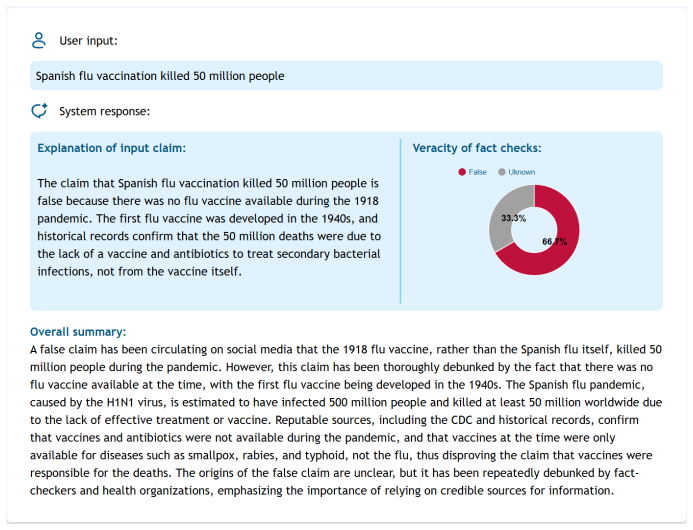
Reference graph
Works this paper leans on
-
[1]
Roee Aharoni, Shashi Narayan, Joshua Maynez, Jonathan Herzig, Elizabeth Clark, and Mirella Lapata. 2023. https://doi.org/10.18653/v1/2023.findings-acl.220 Multilingual summarization with factual consistency evaluation . In Findings of the Association for Computational Linguistics: ACL 2023, pages 3562--3591, Toronto, Canada. Association for Computational ...
-
[2]
Saud Althabiti, Mohammad Ammar Alsalka, and Eric Atwell. 2024. https://arxiv.org/abs/2401.14067 Ta'keed: The first generative fact-checking system for arabic claims . Preprint, arXiv:2401.14067
work page Pith review arXiv 2024
-
[3]
Alberto Barr \'o n-Cede \ n o, Tamer Elsayed, Preslav Nakov, Giovanni Da San Martino, Maram Hasanain, Reem Suwaileh, Fatima Haouari, Nikolay Babulkov, Bayan Hamdan, Alex Nikolov, Shaden Shaar, and Zien Sheikh Ali. 2020. Overview of checkthat! 2020: Automatic identification and verification of claims in social media. In Experimental IR Meets Multilingualit...
work page 2020
-
[4]
Abhik Bhattacharjee, Tahmid Hasan, Wasi Uddin Ahmad, Yuan-Fang Li, Yong-Bin Kang, and Rifat Shahriyar. 2023. https://doi.org/10.18653/v1/2023.acl-long.143 C ross S um: Beyond E nglish-centric cross-lingual summarization for 1,500+ language pairs . In Proceedings of the 61st Annual Meeting of the Association for Computational Linguistics (Volume 1: Long Pa...
-
[5]
Bjarte Botnevik, Eirik Sakariassen, and Vinay Setty. 2020. https://doi.org/10.1145/3397271.3401396 Brenda: Browser extension for fake news detection . In Proceedings of the 43rd International ACM SIGIR Conference on Research and Development in Information Retrieval, SIGIR '20, page 2117–2120, New York, NY, USA. Association for Computing Machinery
arXiv 2020
-
[6]
Eun Cheol Choi and Emilio Ferrara. 2024 a . https://doi.org/10.1145/3589335.3651910 Automated claim matching with large language models: Empowering fact-checkers in the fight against misinformation . In Companion Proceedings of the ACM Web Conference 2024, WWW '24, page 1441–1449, New York, NY, USA. Association for Computing Machinery
arXiv 2024
-
[7]
Eun Cheol Choi and Emilio Ferrara. 2024 b . https://doi.org/10.1145/3589335.3651504 Fact-gpt: Fact-checking augmentation via claim matching with llms . In Companion Proceedings of the ACM Web Conference 2024, WWW '24, page 883–886, New York, NY, USA. Association for Computing Machinery
arXiv 2024
-
[8]
Cohere For AI . 2024. https://doi.org/10.57967/hf/3136 c4ai-command-r-plus-08-2024 (revision dfda5ab)
Show all 35 references
-
[9]
Aaron Grattafiori, Abhimanyu Dubey, Abhinav Jauhri, Abhinav Pandey, Abhishek Kadian, Ahmad Al-Dahle, Aiesha Letman, Akhil Mathur, Alan Schelten, Alex Vaughan, Amy Yang, Angela Fan, Anirudh Goyal, Anthony Hartshorn, Aobo Yang, Archi Mitra, Archie Sravankumar, Artem Korenev, Art...
2024 arXiv
-
[10]
Momchil Hardalov, Anton Chernyavskiy, Ivan Koychev, Dmitry Ilvovsky, and Preslav Nakov. 2022. https://doi.org/10.18653/v1/2022.aacl-main.22 C rowd C hecked: Detecting previously fact-checked claims in social media . In Proceedings of the 2nd Conference of the Asia-Pacific Chap...
2022 doi
-
[11]
Saiful Islam, Kazi Mubasshir, Yuan-Fang Li, Yong-Bin Kang, M
Tahmid Hasan, Abhik Bhattacharjee, Md. Saiful Islam, Kazi Mubasshir, Yuan-Fang Li, Yong-Bin Kang, M. Sohel Rahman, and Rifat Shahriyar. 2021. https://doi.org/10.18653/v1/2021.findings-acl.413 XL -sum: Large-scale multilingual abstractive summarization for 44 languages . In Fin...
2021 doi
-
[12]
Naeemul Hassan, Gensheng Zhang, Fatma Arslan, Josue Caraballo, Damian Jimenez, Siddhant Gawsane, Shohedul Hasan, Minumol Joseph, Aaditya Kulkarni, Anil Kumar Nayak, Vikas Sable, Chengkai Li, and Mark Tremayne. 2017. https://doi.org/10.14778/3137765.3137815 Claimbuster: the fir...
2017
-
[13]
Andrea Hrckova, Robert Moro, Ivan Srba, Jakub Simko, and Maria Bielikova. 2024. https://arxiv.org/abs/2211.12143 Autonomation, not automation: Activities and needs of fact-checkers as a basis for designing human-centered ai systems . Preprint, arXiv:2211.12143
2024 arXiv
-
[14]
Israa Jaradat, Pepa Gencheva, Alberto Barr \'o n-Cede \ n o, Llu \'i s M \`a rquez, and Preslav Nakov. 2018. https://doi.org/10.18653/v1/N18-5006 C laim R ank: Detecting check-worthy claims in A rabic and E nglish . In Proceedings of the 2018 Conference of the North A merican ...
2018 doi
-
[15]
Ashkan Kazemi, Kiran Garimella, Devin Gaffney, and Scott A. Hale. 2021. https://doi.org/10.18653/v1/2021.acl-long.347 Claim matching beyond E nglish to scale global fact-checking . In Proceedings of the 59th Annual Meeting of the Association for Computational Linguistics and t...
2021 doi
-
[16]
Miaoran Li, Baolin Peng, Michel Galley, Jianfeng Gao, and Zhu Zhang. 2024. https://doi.org/10.18653/v1/2024.findings-naacl.12 Self-checker: Plug-and-play modules for fact-checking with large language models . In Findings of the Association for Computational Linguistics: NAACL ...
2024 doi
-
[17]
Mistral AI Team . 2024. https://mistral.ai/news/mistral-large-2407/ Large enough
2024
-
[18]
Anna Neumann, Dorothea Kolossa, and Robert M Nickel. 2023. https://aclanthology.org/2023.icnlsp-1.13 Deep learning-based claim matching with multiple negatives training . In Proceedings of the 6th International Conference on Natural Language and Speech Processing (ICNLSP 2023)...
2023
-
[19]
Mat \'u s Pikuliak, Ivan Srba, Robert Moro, Timo Hromadka, Timotej Smole n , Martin Meli s ek, Ivan Vykopal, Jakub Simko, Juraj Podrou z ek, and Maria Bielikova. 2023. https://doi.org/10.18653/v1/2023.emnlp-main.1027 Multilingual previously fact-checked claim retrieval . In Pr...
2023 doi
-
[20]
Vipula Rawte, Amit Sheth, and Amitava Das. 2023. https://arxiv.org/abs/2309.05922 A survey of hallucination in large foundation models . Preprint, arXiv:2309.05922
2023 arXiv
-
[21]
Thomas Scialom, Paul-Alexis Dray, Sylvain Lamprier, Benjamin Piwowarski, and Jacopo Staiano. 2020. https://doi.org/10.18653/v1/2020.emnlp-main.647 MLSUM : The multilingual summarization corpus . In Proceedings of the 2020 Conference on Empirical Methods in Natural Language Pro...
2020 doi
-
[22]
Shaden Shaar, Nikolay Babulkov, Giovanni Da San Martino, and Preslav Nakov. 2020. https://doi.org/10.18653/v1/2020.acl-main.332 That is a known lie: Detecting previously fact-checked claims . In Proceedings of the 58th Annual Meeting of the Association for Computational Lingui...
2020 doi
-
[23]
Shaden Shaar, Nikola Georgiev, Firoj Alam, Giovanni Da San Martino, Aisha Mohamed, and Preslav Nakov. 2022. https://doi.org/10.18653/v1/2022.findings-emnlp.151 Assisting the human fact-checkers: Detecting all previously fact-checked claims in a document . In Findings of the As...
2022 doi
-
[24]
Zien Sheikh Ali, Watheq Mansour, Fatima Haouari, Maram Hasanain, Tamer Elsayed, and Abdulaziz Al-Ali. 2023. https://doi.org/10.1145/3539618.3591815 Tahaqqaq: A real-time system for assisting twitter users in arabic claim verification . In Proceedings of the 46th International ...
2023
-
[25]
Michael Shliselberg and Shiri Dori-Hacohen. 2022. Riet lab at checkthat!-2022: Improving decoder based re-ranking for claim matching. In CLEF (Working Notes), pages 671--678
2022
-
[26]
Kai Shu, Limeng Cui, Suhang Wang, Dongwon Lee, and Huan Liu. 2019. https://doi.org/10.1145/3292500.3330935 defend: Explainable fake news detection . In Proceedings of the 25th ACM SIGKDD International Conference on Knowledge Discovery & Data Mining, KDD '19, page 395–405, New ...
2019
-
[27]
Gemma Team, Aishwarya Kamath, Johan Ferret, Shreya Pathak, Nino Vieillard, Ramona Merhej, Sarah Perrin, Tatiana Matejovicova, Alexandre Ramé, Morgane Rivière, Louis Rouillard, Thomas Mesnard, Geoffrey Cideron, Jean bastien Grill, Sabela Ramos, Edouard Yvinec, Michelle Casbon, ...
2025 arXiv
-
[28]
Ivan Vykopal, Matúš Pikuliak, Simon Ostermann, Tatiana Anikina, Michal Gregor, and Marián Šimko. 2025. https://arxiv.org/abs/2503.02737 Large language models for multilingual previously fact-checked claim detection . Preprint, arXiv:2503.02737
2025
-
[29]
Ivan Vykopal, Matúš Pikuliak, Simon Ostermann, and Marián Šimko. 2024. https://arxiv.org/abs/2407.02351 Generative large language models in automated fact-checking: A survey . Preprint, arXiv:2407.02351
2024 arXiv
-
[30]
Jiaan Wang, Yunlong Liang, Fandong Meng, Beiqi Zou, Zhixu Li, Jianfeng Qu, and Jie Zhou. 2023. https://doi.org/10.18653/v1/2023.newsum-1.2 Zero-shot cross-lingual summarization via large language models . In Proceedings of the 4th New Frontiers in Summarization Workshop, pages...
2023 doi
-
[31]
Linting Xue, Noah Constant, Adam Roberts, Mihir Kale, Rami Al-Rfou, Aditya Siddhant, Aditya Barua, and Colin Raffel. 2021. https://doi.org/10.18653/v1/2021.naacl-main.41 m T 5: A massively multilingual pre-trained text-to-text transformer . In Proceedings of the 2021 Conferenc...
2021 doi
-
[32]
An Yang, Baosong Yang, Binyuan Hui, Bo Zheng, Bowen Yu, Chang Zhou, Chengpeng Li, Chengyuan Li, Dayiheng Liu, Fei Huang, Guanting Dong, Haoran Wei, Huan Lin, Jialong Tang, Jialin Wang, Jian Yang, Jianhong Tu, Jianwei Zhang, Jianxin Ma, Jianxin Yang, Jin Xu, Jingren Zhou, Jinze...
2024 arXiv
-
[33]
Arkaitz Zubiaga, Ahmet Aker, Kalina Bontcheva, Maria Liakata, and Rob Procter. 2018. https://doi.org/10.1145/3161603 Detection and resolution of rumours in social media: A survey . ACM Comput. Surv., 51(2)
2018 doi
-
[34]
online" 'onlinestring :=
ENTRY address archivePrefix author booktitle chapter edition editor eid eprint eprinttype howpublished institution journal key month note number organization pages publisher school series title type volume year doi pubmed url lastchecked label extra.label sort.label short.list...
-
[35]
write newline
" write newline "" before.all 'output.state := FUNCTION n.dashify 't := "" t empty not t #1 #1 substring "-" = t #1 #2 substring "--" = not "--" * t #2 global.max substring 't := t #1 #1 substring "-" = "-" * t #2 global.max substring 't := while if t #1 #1 substring * t #2 gl...
Reviewed August 16, 2026 · model on record in the stance chip above.
Discussion (0). Continue with ORCID to comment.