REVIEW 4 major objections 4 minor 22 references
Building Trust in Healthcare with Privacy Techniques: Blockchain in the Cloud
T0 review · 4 major / 4 minor · reviewed 2026-08-16 · deepseek-v4-flash
Pith's one-line read The paper proposes an Ethereum-based consent system for the NewbornTime project that records only encrypted consent metadata on-chain while keeping personal data off-chain, aiming to make consent management transparent, tamper-proof, and…
desk verdict Internal contradiction between the code and the central privacy claim makes this a major-revision paper, but the architecture and measurements are worth a serious referee. read the letter →
The pith
A machine-rendered reading of the paper's core claim, the machinery that carries it, and where it could break.
The reading
What carries the argument
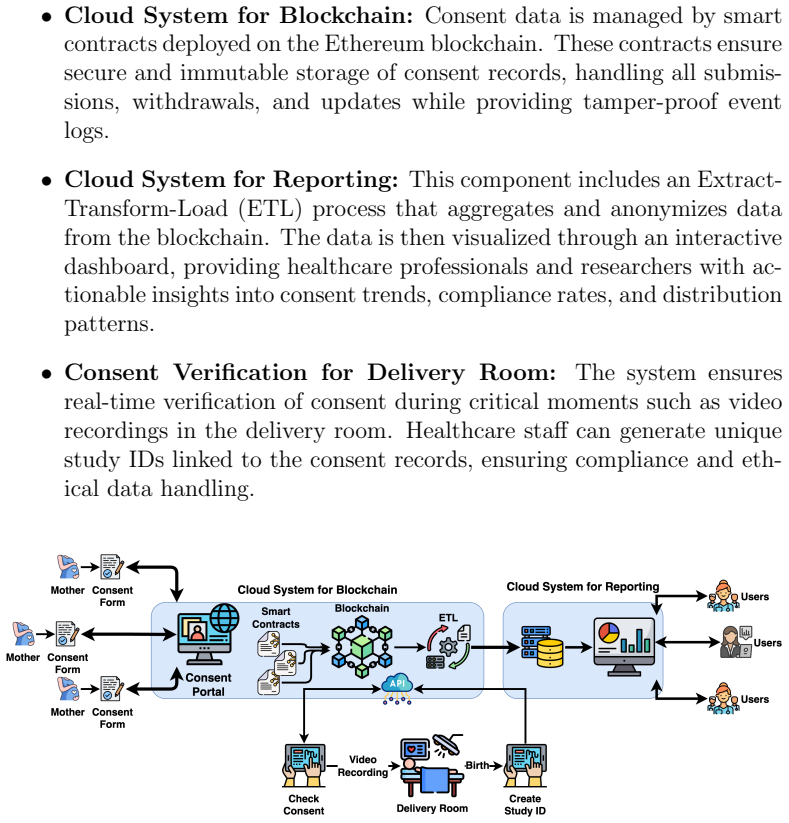
The load-bearing mechanism is the HealthcareConsent.sol Solidity smart contract, which maintains a mapping of patient Ethereum addresses to arrays of Consent structs, each holding patient address, provider address, consent status, mother's name, national ID, phone number, and timestamp. The contract exposes functions for submitting, querying, and revoking consent, enforces access control via an onlyOwner modifier, and emits ConsentChanged events to produce an audit trail. The paper pairs this with a cloud layer that performs ETL and an interactive dashboard, but the on-chain contract is what carries the transparency, immutability, and automation claims.
What would settle it
A GDPR-oriented audit could settle the central claim: request a copy of all on-chain records for a test subject after withdrawing consent and check whether the encrypted fields containing the mother's name, national ID, and phone number are still present and decryptable. If they remain accessible to any authorized party with the private key, the claim that 'PII is not stored on the blockchain' and that withdrawal ensures GDPR compliance is false.
Extended reading notes
Core claim
The central claim is that a healthcare consent record can be managed securely and immutably on the Ethereum blockchain while the underlying personal data never appears on-chain: the smart contract HealthcareConsent.sol stores only encrypted consent-related metadata (status, timestamps, and encrypted identifiers such as name, national ID, and phone number), and the paper states that 'PII is not stored on the blockchain; instead, the blockchain records only consent-related metadata, ensuring privacy while maintaining transparency.' Consent withdrawal is handled by recording a new transaction and deleting associated personal data from off-chain storage, which the paper argues satisfies GDPR obligations. The system links this to the NewbornTime project by requiring valid consent before video data is uploaded to Azure cloud storage, with study IDs generated only after consent is confirmed.
Load-bearing premise
The system assumes that deleting personal data from off-chain storage upon consent withdrawal is enough to satisfy GDPR, even though the blockchain permanently retains encrypted consent records that still include a mother's name, national ID, and phone number; if regulators treat those encrypted fields as personal data subject to erasure, the central privacy claim collapses.
Editorial extensions
If this is right
- If the system works as claimed, consent verification becomes a real-time, auditable step before any sensitive video is uploaded, reducing the risk of collecting data without valid consent.
- Patients gain a transparent, self-service way to give, edit, and withdraw consent, with every change permanently logged, which could strengthen trust in research participation.
- The measured gas costs show that storing minimal consent data roughly halves on-chain cost compared to full records, suggesting that a data-minimizing design is also the economically efficient one.
- The architecture is modular enough that the same consent portal and smart contract could be reused in other clinical research projects, not just newborn care, once regulatory and usability assessments are done.
Reading between the lines
- The paper does not demonstrate that on-chain encrypted fields (name, national ID, phone number) are truly hidden from all authorized parties; if any party holds the decryption key, those fields are personal data, and GDPR's right to erasure may apply to the blockchain itself, not just off-chain storage.
- A likely testable extension is to compare the system against a zero-knowledge or hash-based consent design where no encrypted personal fields are stored on-chain, to see whether the audit trail can be preserved without any personal data residue.
- The real-time consent check before upload could be generalized into a policy engine that gates any data transfer to a research archive, which the paper only sketches for the delivery-room scenario.
Signed reviews
Editorial analysis
A structured set of objections, weighed in public.
Referee Report
Summary. The manuscript describes a blockchain-based patient consent management system developed for the NewbornTime project. The system uses an Ethereum smart contract (HealthcareConsent.sol) to record consent events, a web portal for mothers to submit and withdraw consent, cloud storage for video data, and a statistics dashboard. The paper claims that PII such as names and national IDs are never stored on-chain because consent records are encrypted before submission, and that consent revocation immediately deletes off-chain personal data, yielding GDPR compliance. The experimental section reports gas costs, transaction throughput, and scalability tests, including a comparison of full vs. minimal consent records.
Significance. The main value of the manuscript is its end-to-end architectural description of an applied blockchain-based e-consent workflow and its straightforward gas-cost measurements for consent operations. However, the central privacy contribution rests on a claim—'PII is not stored on the blockchain'—that is directly contradicted by the smart contract code and formal record definitions provided in the paper. Because the privacy guarantee is the paper's headline contribution and is also the basis for the claimed regulatory compliance, the manuscript in its current form cannot be considered sound. No machine-checked proofs or reproducible artifact is provided beyond a partial contract listing, and the experimental setup is not described in enough detail to verify the performance claims.
major comments (4)
- [Sections 4.3, 4.4, 4.6.1; Listing 1] The smart contract stores motherName, nationalID, and phoneNumber as plaintext struct fields and contains no encryption or decryption operations; therefore the statement in Section 4.6 that 'PII is not stored on the blockchain; instead, the blockchain records only consent-related metadata' is false relative to the provided implementation. Algorithm 1's 'Encrypt consent record and send to smart contract' step has no counterpart in the contract code shown in Listing 1.
- [Section 4.2, Algorithm 1, QueryConsent] The query procedure takes the mother's personal number as the key parameter to retrieve consent records. This requires the personal number to be stored in a searchable on-chain form (e.g., as a mapping key or indexed event parameter), which conflicts with the claim that only encrypted metadata is stored. The ConsentChanged event additionally exposes indexed patient and healthcareProvider addresses on a public ledger, further contradicting the broad privacy statement.
- [Sections 4.6, 6.1, and 7] The GDPR compliance claim is unsupported. The paper states that revoking consent deletes associated data from off-chain storage, but the on-chain consent records and consent-change events remain permanently. The manuscript does not analyze whether these on-chain artifacts—especially the consent record containing motherName, nationalID, and phoneNumber—are personal data subject to erasure, nor does it reconcile immutable ledger storage with the right to erasure under GDPR.
- [Section 5, Tables 3–6] The experimental measurements lack essential reproducibility information: no Ethereum client or network type, no compiler version, no optimizer settings, and no number of repetitions or error bars. Table 3 lists repeated identical gas values for Add Consent without explanation. Listing 1 is incomplete (it ends at the onlyOwner modifier), so the full contract under test is not available. These omissions prevent independent verification of the quantitative performance claims.
minor comments (4)
- [Section 5.3, Table 4] The gas cost for 10 records is exactly 10 times the single-record cost, but the execution time does not scale proportionally; the text should clarify how batches are submitted and whether execution times are measured serially or in parallel.
- [Sections 1 and 4.1] The terms 'BitUnitor' and 'BitYoga' appear without explanation or references; the relationship between these systems and the proposed architecture should be clarified.
- [Throughout] Several sentences are grammatically incomplete or awkward, for example 'These measures are critical and maintaining compliance with healthcare data protection regulations' in Section 4.6, and 'building data integrity, and patient confidence' in Section 4.6.3; the manuscript would benefit from a careful language edit.
- [Metadata] The Keywords field is empty; the authors should add appropriate keywords describing the system, such as blockchain, smart contracts, consent management, healthcare privacy, and GDPR.
Circularity Check
No circularity found: the paper reports implemented system behavior and direct measurements; the internal privacy contradiction is a correctness issue, not a circular derivation.
full rationale
I walked the paper's claimed derivation chain. The paper does not derive a prediction from an input; it describes an implemented Ethereum smart contract, a web portal, and experimental measurements. Gas costs in Tables 3 and 4, throughput in Figure 7, and the minimal-versus-full data comparison in Table 5 are direct observations of the deployed contract, not fitted parameters renamed as predictions. The data-minimization claim that storing fewer fields lowers gas is indeed a near-tautological consequence of byte size, but the paper presents it as a measured benchmark supporting a design principle, not as evidence for a separate theoretical conclusion, so it is not the kind of by-construction reduction the circularity pass targets. The paper's self-citations, e.g., [5] for the NewbornTime project and [8]-[10] for video analysis, are contextual background and are not load-bearing for the consent-system claims. There is no imported uniqueness theorem, no ansatz smuggled in via citation, and no renaming of a known result as a new derivation. The most serious issue in the paper is an internal inconsistency, not circularity: Section 4.6 states that 'PII is not stored on the blockchain; instead, the blockchain records only consent-related metadata,' while Listing 1's Consent struct stores motherName, nationalID, and phoneNumber as plaintext fields, and Section 5 formalizes each consent record as c = (p, h, g, m, n, ph, t) with m, n, and ph being the mother's name, national ID, and phone number. Algorithm 1 also says to encrypt the consent record before sending it to the smart contract, but the shown contract code contains no encryption. These contradictions undermine the paper's central privacy claim, but they are correctness/validity problems, not circular reasoning. Similarly, the GDPR erasure concern about retaining an immutable on-chain audit trail is a legal and architectural risk, not a circularity step. Accordingly, no circular step meeting the evidentiary standard of this review is present, and the appropriate score is 0.
Assumptions & free parameters
assumptions (4)
- domain assumption GDPR compliance can be achieved by deleting off-chain personal data upon consent withdrawal while the blockchain retains a permanent consent audit trail.
- domain assumption Encrypting consent data before storage on Ethereum keeps personal information confidential even though the blockchain is public.
- domain assumption Phone-number verification is sufficient to authenticate the consent giver.
- domain assumption The Ethereum blockchain is tamper-proof and immutable in the deployment context used.
Cite this review
Pith. "Pith review of Building Trust in Healthcare with Privacy Techniques: Blockchain in the Cloud." pith.science (2026). https://pith.science/paper/MEPFZO76
@misc{pith2026250420700,
  author       = {Pith},
  title        = {Pith review of: Building Trust in Healthcare with Privacy Techniques: Blockchain in the Cloud},
  year         = {2026},
  howpublished = {\url{https://pith.science/paper/MEPFZO76}},
  note         = {Machine review of arXiv:2504.20700}
}
read the original abstract
This study introduces a cutting-edge architecture developed for the NewbornTime project, which uses advanced AI to analyze video data at birth and during newborn resuscitation, with the aim of improving newborn care. The proposed architecture addresses the crucial issues of patient consent, data security, and investing trust in healthcare by integrating Ethereum blockchain with cloud computing. Our blockchain-based consent application simplifies patient consent's secure and transparent management. We explain the smart contract mechanisms and privacy measures employed, ensuring data protection while permitting controlled data sharing among authorized parties. This work demonstrates the potential of combining blockchain and cloud technologies in healthcare, emphasizing their role in maintaining data integrity, with implications for computer science and healthcare innovation.
Figures


Figures from the paper (4 more)



Reference graph
Works this paper leans on
-
[1]
K. N. Griggs, O. Ossipova, C. P. Kohlios, A. N. Baccarini, E. A. Howson, T. Hayajneh, Healthcare blockchain system using smart contracts for secure automated remote patient monitoring, Journal of medical systems 42 (2018) 1–7
work page 2018
-
[2]
P. Shah, I. Thornton, D. Turrin, et al., Informed consent, StatPearls (2024)
work page 2024
- [3]
- [4]
- [5]
-
[6]
P. A. Bjorland, K. Øymar, H. L. Ersdal, S. I. Rettedal, Incidence of newborn resuscitative interventions at birth and short-term outcomes: a regional population-based study, BMJ paediatrics open 3 (2019)
work page 2019
-
[7]
M. H. Wyckoff, J. Wyllie, K. Aziz, M. F. de Almeida, J. Fabres, J. Fawke, R. Guinsburg, S. Hosono, T. Isayama, V. S. Kapadia, et al., Neonatal life support: 2020 international consensus on cardiopulmonary resuscitation and emergency cardiovascular care science with treatment recommendations, Circulation 142 (2020) S185–S221
work page 2020
-
[8]
J. Garc´ ıa-Torres, Ø. Meinich-Bache, S. Brunner, A. Johannessen, S. Ret- tedal, K. Engan, Towards using thermal cameras in birth detection, in: 2022 IEEE 14th Image, Video, and Multidimensional Signal Processing Workshop (IVMSP), IEEE, 2022, pp. 1–5
work page 2022
Show all 22 references
-
[9]
Garc´ ıa-Torres, Ø
J. Garc´ ıa-Torres, Ø. Meinich-Bache, S. I. Rettedal, A. Kibsgaard, S. Brunner, K. Engan, Comparative analysis of binary and multiclass activity recognition in high-quality newborn resuscitation videos, in: Northern Lights Deep Learning Conference 2024, 2024. 25
2024
-
[10]
Kolstad, J
V. Kolstad, J. Garc´ ıa-Torres, S. Brunner, A. Johannessen, E. Foglia, H. Ersdal, Ø. Meinich-Bache, S. Rettedal, Detection of time of birth and cord clamping using thermal video in the delivery room, Frontiers in Pediatrics 12 (2024) 1342415
2024
-
[11]
Szabo, Formalizing and securing relationships on public networks, First monday (1997)
N. Szabo, Formalizing and securing relationships on public networks, First monday (1997)
1997
-
[12]
Buterin, et al., A next-generation smart contract and decentralized application platform, white paper 3 (2014) 2–1
V. Buterin, et al., A next-generation smart contract and decentralized application platform, white paper 3 (2014) 2–1
2014
-
[13]
Albanese, J.-P
G. Albanese, J.-P. Calbimonte, M. Schumacher, D. Calvaresi, Dynamic consent management for clinical trials via private blockchain technology, Journal of ambient intelligence and humanized computing 11 (2020) 4909–4926
2020
-
[14]
Cheng, B
C. Cheng, B. Yan, G. Wang, The blockchain based access control scheme for the internet of things, Procedia Computer Science 202 (2022) 342–347. URL: https://www.sciencedirect.com/science/ article/pii/S1877050922005804. doi:https://doi.org/10.1016/j. procs.2022.04.046, internat...
2022 doi
-
[15]
Albalwy, A
F. Albalwy, A. Brass, A. Davies, et al., A blockchain-based dynamic consent architecture to support clinical genomic data sharing (con- sentchain): Proof-of-concept study, JMIR medical informatics 9 (2021) e27816
2021
-
[16]
Q. Xia, E. B. Sifah, K. O. Asamoah, J. Gao, X. Du, M. Guizani, Med- share: Trust-less medical data sharing among cloud service providers via blockchain, IEEE Access 5 (2017) 14757–14767. doi: 10.1109/ACCESS. 2017.2730843
2017
-
[17]
Pongnumkul, C
S. Pongnumkul, C. Siripanpornchana, S. Thajchayapong, Performance analysis of private blockchain platforms in varying workloads, in: 2017 26th International Conference on Computer Communication and Net- works (ICCCN), 2017, pp. 1–6. doi: 10.1109/ICCCN.2017.8038517
2017
-
[18]
A. E. Gencer, S. Basu, I. Eyal, R. van Renesse, E. G. Sirer, De- centralization in bitcoin and ethereum networks, in: Financial Cryp- tography and Data Security: 22nd International Conference, FC 26 2018, Nieuwpoort, Cura¸ cao, February 26 – March 2, 2018, Re- vised Selected P...
2018 doi
-
[19]
Zamani, M
M. Zamani, M. Movahedi, M. Raykova, Rapidchain: Scaling blockchain via full sharding, in: Proceedings of the 2018 ACM SIGSAC Conference on Computer and Communications Security, CCS ’18, Association for Computing Machinery, New York, NY, USA, 2018, p. 931–948. URL: https://doi....
2018
-
[20]
W. M. Charles, M. B. van der Waal, J. Flach, A. Bisschop, R. X. van der Waal, H. Es-Sbai, C. J. McLeod, Blockchain-based dynamic consent and its applications for patient-centric research and health information sharing: Protocol for an integrative review, JMIR Res Protoc 13 (20...
2024 doi
-
[21]
Khatoon, A blockchain-based smart contract system for health- care management, Electronics 9 (2020)
A. Khatoon, A blockchain-based smart contract system for health- care management, Electronics 9 (2020). URL: https://www.mdpi.com/ 2079-9292/9/1/94. doi:10.3390/electronics9010094
2020 doi
-
[22]
P. E. Velmovitsky, P. A. D. S. E. S. Miranda, H. Vaillancourt, T. Donovska, J. Teague, P. P. Morita, A blockchain-based consent plat- form for active assisted living: modeling study and conceptual frame- work, Journal of medical Internet research 22 (2020) e20832. 27
2020
Reviewed August 16, 2026 · model on record in the stance chip above.
Discussion (0). Continue with ORCID to comment.