REVIEW 3 major objections 5 minor 1 cited by
Gravitational Form Factors and the QCD Dilaton at Large Momentum Transfer
T0 review · 3 major / 5 minor · reviewed 2026-08-16 · deepseek-v4-flash
Pith's one-line read This paper claims that the QCD trace anomaly manifests as a massless dilaton pole in the $TJJ$ correlator, with residue equal to the one-loop beta function, and that this pole enters pion and proton gravitational form factors at large…
desk verdict A clean conference summary of the group's anomaly-pole programme, but the load-bearing derivation and the hadron-level insertion are not in this manuscript. read the letter →
The pith
A machine-rendered reading of the paper's core claim, the machinery that carries it, and where it could break.
The reading
What carries the argument
The load-bearing object is the non-Abelian $TJJ$ three-point function, expanded off shell through a sector decomposition into longitudinal, transverse-traceless, and trace components. The trace sector carries the central identity: a $1/q^2$ pole multiplying $A^{\alpha\beta}_{ab}+B^{\alpha\beta}_{g}$, where $A$ is the anomaly form factor with residue equal to the one-loop $\beta$ function and $B_g$ is a separate gluon-equation-of-motion term. The decomposition also reveals new gluon-sector longitudinal pieces that are allowed because the gluon currents obey Slavnov-Taylor identities (the gauge-fixing analogues of the ordinary Ward identities) rather than ordinary Ward identities. The same object is inserted into the hard-scattering convolution through a modified gluon propagator, which is how the dilaton pole enters the hadronic gravitational form factors at large $-t$.
What would settle it
Evaluate the complete one-loop $\langle TJJ\rangle$ correlator with external gluons projected onto physical transverse polarizations and vary the gauge-fixing parameter; if the coefficient of $1/q^2$ multiplying $u^{\alpha\beta}$ changes with the gauge parameter, the massless pole is an artifact rather than a physical dilaton exchange.
Extended reading notes
Core claim
The paper's central claim is that the trace anomaly of QCD is not only a constraint on the vacuum but a propagating degree of freedom inside a specific correlator: the off-shell $\langle TJJ\rangle$ vertex, built from one energy-momentum tensor $T_{\mu\nu}$ and two color currents $J^a_\alpha$, $J^b_\beta$. In its trace sector, the vertex contains an explicit $1/q^2$ pole. The coefficient of that pole is the anomaly form factor $A^{\alpha\beta}_{ab} = \frac{1}{3}\,\frac{g_s^2}{16\pi^2}\,(11\,C_A - 2\,n_f)\,\delta_{ab}\,u^{\alpha\beta}$, whose prefactor is exactly the one-loop QCD $\beta$ function; the paper states this as 'the anomaly form factor contains a massless pole whose residue equals $\beta$.' It identifies the pole as a $t$-channel dilaton exchange and claims that inserting the vertex into the hard scattering of the pion (order $\alpha_s^2$) and proton (order $\alpha_s^3$) produces an anomaly contribution to the gravitational form factors. A second, non-anomalous gluon term sits alongside the anomaly in the trace sector, and the anomaly form factor obeys a sum rule that persists when quark masses convert the pole into a cut.
Load-bearing premise
The load-bearing premise is that the massless pole found in the off-shell vertex survives the convolution with hadron wave functions and is not cancelled by other longitudinal or gauge-fixing terms in the full hadronic amplitude.
Editorial extensions
If this is right
- The pion gravitational form factor receives a calculable anomaly contribution at order $\alpha_s^2$, and the proton form factor at order $\alpha_s^3$, so the dilaton pole is a specific subleading correction to the hard-scattering result.
- Because the residue of the anomaly pole is the one-loop beta-function coefficient, the size of the dilaton contribution is predicted rather than fitted.
- The sector decomposition gives a parameterization of the TJJ vertex that can be folded into deeply virtual Compton scattering analyses, separating the anomaly channel from ordinary radiative corrections.
- When quark masses are included, the pole becomes a branch cut but the anomaly form factor still satisfies the sum rule, so the dilaton signal should survive as a broader spectral shape rather than disappearing.
Reading between the lines
- A direct test of the paper's central claim would be to carry out the full convolution of the modified gluon propagator of Eq. (31) with pion distribution amplitudes; the paper leaves this step schematic.
- If the pole survives the convolution, the quark and gluon pieces of the proton gravitational form factor at large $-t$ should differ by a term proportional to $\beta(g)/(-t)$, which future extractions from deeply virtual Compton scattering and heavy-quark photoproduction could in principle isolate.
- The same trace-sector mechanism would be expected in gravitational form factors of other hadrons built from the same valence Fock states, making the dilaton contribution a universal hadronic feature rather than a pion- or proton-specific effect.
- A nonperturbative check could come from a lattice calculation of the trace of the energy-momentum tensor in a hadron, where the sum-rule-protected branch cut should appear in the spectral density.
Signed reviews
Editorial analysis
A structured set of objections, weighed in public.
Referee Report
Summary. This proceedings-style paper investigates the non-Abelian TJJ three-point function (stress-tensor with two gluon currents) using a CFT-inspired sector decomposition into transverse-traceless, longitudinal, and trace components. The central claim is that the trace sector, Eq. (18), contains a 1/q^2 pole whose residue, Eq. (23), is proportional to the one-loop QCD beta function, and that this pole should be interpreted as an anomaly-induced dilaton exchanged in the t-channel. The paper further proposes, in Sec. 5, that this dilaton contribution enters pion and proton gravitational form factors at large momentum transfer through a modified gluon propagator, Eq. (31), and advertises a sum rule for the anomaly form factor, Eq. (28). Most of the technical derivation, including the decomposition (16), the explicit form of the gluon equation-of-motion term B_g, and the sum rule, is deferred to the companion references [28,29,30].
Significance. If the central claim is correct, the paper identifies a parameter-free, non-fitted residue: the anomaly form factor in Eq. (23) reduces to the standard one-loop QCD beta function, and its interpretation as a dilaton exchange would give a concrete perturbative mechanism connecting the QCD conformal anomaly to hadronic gravitational form factors, with potential relevance for DVCS and EIC phenomenology. The proposal to extend CFT_p decomposition methods to gauge-fixed QCD via Slavnov-Taylor identities is also of methodological interest. However, the significance is strongly conditional on two unproved points: the gauge-invariant survival of the trace-sector pole in physical amplitudes, and the validity of the schematic insertion into the hard-scattering factorization. Neither is established in this manuscript.
major comments (3)
- [Sec. 4, Eqs. (16)-(23)] The paper does not demonstrate that the 1/q^2 pole isolated in the trace sector survives in a gauge-invariant physical amplitude. The residue tensor u^{alpha beta}(p1,p2) in Eq. (23) is not transverse in the gluon indices: contracting with p1_alpha gives (p1.p2) p1^beta for on-shell p1^2=0, which is nonzero. Since the full correlator satisfies Slavnov-Taylor identities rather than ordinary Ward identities, the non-transverse and longitudinal parts of the trace sector can receive cancellations from the other sectors in Eqs. (16)-(17), from ghost contributions, or from gauge-fixing terms. The manuscript asserts the decomposition and the pole interpretation but does not show that the complete, contracted TJJ amplitude has the same 1/q^2 pole with residue proportional to beta. This is a load-bearing gap for the central claim.
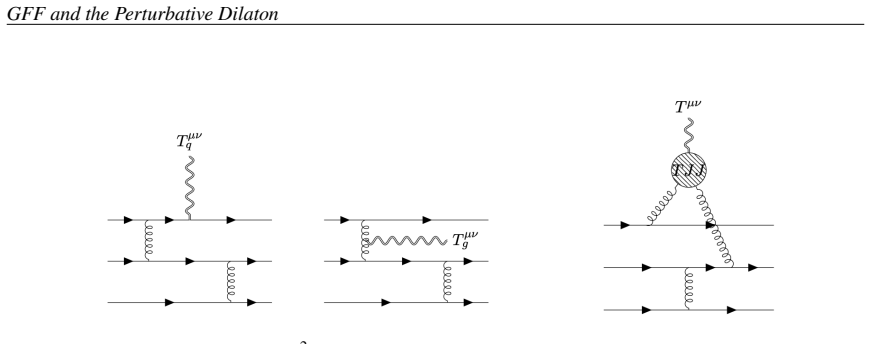
- [Sec. 5, Eqs. (30)-(32)] The insertion of the TJJ vertex into the hadronic hard-scattering amplitude is only schematic. The modified gluon propagator in Eq. (31) is introduced without specifying how the off-shell vertex is contracted with the surrounding hard-scattering kernel, and the convolution with the distribution amplitudes in Eq. (30) is not performed. As a result, the paper does not show that the 1/q^2 pole in the off-shell correlator survives loop integration and projection onto the hadronic helicity amplitude. The 'distillation' of the dilaton contribution declared after Eq. (31) is therefore an ansatz rather than a derived consequence of the factorization framework.
- [Secs. 3.1 and 4, Eq. (28)] The key technical statements are deferred to self-cited companion papers and are not verifiable from the manuscript. In particular, the decomposition (16), the explicit expression for B_g, the identification of the pole in Eq. (27), and the sum rule for Phi_an introduced in Eq. (28) are all asserted with phrases such as 'A dedicated analysis shows' (after Eq. (28)) or 'Details are given in [29,30]'. Since these companion references are not part of the present submission and the central claims rest on them, the manuscript is not self-contained enough for the claimed results to be checked. The authors should either include the derivations or clearly state that the paper is a summary of results established elsewhere and restrict the claims accordingly.
minor comments (5)
- [Sec. 4, Eqs. (24)-(25)] Eq. (24) is a dangling fragment: the right-hand side is presented without a displayed variable or an explicit defining relation, and Eq. (25) is empty. This makes the definition of the F^2 structure unusable as written.
- [Sec. 4, Eq. (28)] The quantity Phi_an is defined but the advertised sum rule is never written down in the manuscript; the reader is only told that 'a dedicated analysis shows' its existence. Please state the sum rule explicitly or remove the claim.
- [Throughout] The text has numerous missing spaces and typographical errors (e.g., 'Wewillbefocusing', 'inziativa specifica', 'the the grant'), which considerably impede readability; the manuscript should undergo a careful editing and formatting pass.
- [Fig. 2 caption] The caption says 'Examples of leading O(alpha_s^2) contributions to the GFF of the proton', while the text around Eq. (32) states that the anomaly contribution appears at O(alpha_s^3); the caption should distinguish the different orders shown in the three panels.
- [References [28]-[30]] The companion references [28], [29], and [30], which carry the central derivations, are listed without titles or journal information; they should be completed so that readers can locate the derivations.
Circularity Check
The claimed massless pole with beta residue is a read-off of a projector-built trace-sector decomposition whose key coefficient is imported from self-cited companion papers, so the central result is not independently derived in this manuscript.
-
self definitional
[Sec. 4, Eqs. (18)-(19) and (27)]
"The 1/q2 pole in the equation above is the signature of a dilaton exchanged in the t channel. It is extracted from the longitudinal projector πμν by defining πμν = 1/q2 π̂μν ... Therefore the anomaly form factor contains a massless pole whose residue equals beta β/q2 δab ⊂ ⟨Tμν(q)Jaα(p1)Jbβ(p2)⟩."
The 1/q² pole is introduced by the longitudinal projector itself: Eq. (19) defines π = π̂/q², and Eq. (18) writes the trace sector with an explicit factor 1/(3q²)π̂. Substituting the coefficient A from Eq. (23) into Eq. (18) then reproduces Eq. (27) by algebraic substitution. Thus, as presented in this manuscript, the 'massless pole whose residue equals beta' is a property of the chosen tensor parameterization rather than a dynamical pole derived here. The nontrivial content would be an independent computation of the nonzero residue A, but that computation is not shown in the paper; it is only cited, which is the separate issue below.
-
self citation load bearing
[Secs. 1 and 4, Eqs. (23) and (28), text after Eq. (16)]
"The trace contribution includes both the anomaly term Aαβ ab=Aαβδab, which encodes the conformal anomaly and a second term Bαβ,g ab, originating from the gluon equations of motion, whose explicit expression is given in [28,29] ... A dedicated analysis shows the presence of a nontrivial sum rule [29]."
The explicit form of the load-bearing coefficient A in Eq. (23), the companion term B_g, and the sum-rule constraint on Φan≡A/q² are not derived in this manuscript; they are assigned to the self-authored companion papers [28-30], which are not independently verified here. Without those references, Eqs. (16)-(23) are unsupported assertions inside the present text. The central claim that the TJJ trace sector contains a pole with residue beta therefore reduces, within this paper, to a self-citation chain. The check against the standard one-loop beta function is an external consistency anchor, which prevents the circularity from being complete, but the residue itself is taken from the authors' own previous work.
full rationale
The trace-sector algebra in Eqs. (18)-(23) is explicit, and no parameter is fitted: the residue is not tuned to data, and it is checked against the standard one-loop QCD beta function, so the 'fitted input called prediction' pattern does not apply. The circularity burden is two-fold. First, the 1/q² pole is placed into the trace sector by the longitudinal projector itself (Eq. 19); Eq. (18) is written with an explicit 1/q², so Eq. (27) is a read-off of the parameterization rather than a dynamical derivation shown in this paper. Second, the residue A and the sum rule are not computed here; they are explicitly referred to the self-authored companion papers [28-30]. If those papers contain a genuine one-loop Feynman-integral evaluation of A, the underlying physics would not be circular, but the present manuscript itself reduces the central claim to a self-citation chain and to the projector-built pole. The skeptic's concern that the non-transverse residue u^{αβ} may be canceled upon contraction with physical polarizations is a correctness/gauge-invariance risk, not circularity, and does not by itself raise the score. Overall score 4: substantial self-citation load-bearing and a partially definitional pole, but with independent content in the beta-function matching.
Assumptions & free parameters
assumptions (4)
- domain assumption QCD collinear factorization applies to gravitational form factors at large momentum transfer with dominance of the leading Fock state and a twist-three distribution amplitude.
- domain assumption The momentum-space conformal decomposition of three-point functions from CFT_p [53] remains applicable to gauge-fixed QCD after replacing Ward identities with Slavnov-Taylor identities.
- domain assumption In the conformal limit with on-shell gluons, the spectral density of the anomaly form factor collapses to a pole; with off-shell or massive kinematics it becomes a cut but remains constrained by a one-loop sum rule.
- ad hoc to paper The 1/q^2 pole in the trace sector is a physical, gauge-invariant t-channel dilaton exchange that survives insertion into the hadronic amplitude.
invented entities (1)
-
Anomaly-induced dilaton (effective t-channel state)
Cite this review
Pith. "Pith review of Gravitational Form Factors and the QCD Dilaton at Large Momentum Transfer." pith.science (2026). https://pith.science/paper/EYDWZZ7B
@misc{pith2026250420884,
  author       = {Pith},
  title        = {Pith review of: Gravitational Form Factors and the QCD Dilaton at Large Momentum Transfer},
  year         = {2026},
  howpublished = {\url{https://pith.science/paper/EYDWZZ7B}},
  note         = {Machine review of arXiv:2504.20884}
}
abstract
We investigate the hard scatterings of hadronic matrix elements corresponding to hadronic gravitational form factors (GFFs) of the pion and proton using QCD factorization, applying conformal field theory (CFT) tools. These GFFs are key to understanding quark and gluon angular momentum via their connection to DVCS moments. The core object is the non-Abelian \( TJJ \) 3-point function, which shows an anomaly-induced dilaton exchange in the \( t \)-channel. We analyze quark, ghost, and gauge-fixing effects through a CFT-based decomposition and propose a parameterization useful for future DVCS studies at the Electron-Ion Collider. The dilaton interaction is interpolated by a conformal anomaly form factor, defined in the nonconformal case, which is constrained by a (dilaton) sum rule.
Figures


Forward citations
Cited by 1 Pith paper
-
Gravitational form factors of the nucleon in the Skyrme model based on scale-invariant chiral perturbation theory
A Skyrme model with a dilaton field attributes the proton's negative internal pressure and confining force to the gluonic scale anomaly, and reproduces the lattice QCD D(t) form factor.
Reference graph
Works this paper leans on
-
[1]
M. V. Polyakov and P. Schweitzer.Int. J. Mod. Phys. A 33(2018) 1830025 [1805.06596]
arXiv 2018
-
[2]
O. V. Teryaev.Front. Phys. (Beijing) 11(2016) 111207
work page 2016
-
[3]
V. D. Burkert, L. Elouadrhiri, F. X. Girod, C. Lorcé, P. Schweitzer and P. E. Shanahan.Rev. Mod. Phys. 95(2023) 041002 [2303.08347]
arXiv 2023
- [4]
-
[5]
K. Tanaka. JPS Conf. Proc. 37(2022) 020405 [2209.14367]
work page Pith review arXiv 2022
- [6]
-
[7]
J. Horejsi. Czech. J. Phys. 42(1992) 241
work page 1992
-
[8]
X.-D. Ji. J. Phys. G24(1998) 1181 [hep-ph/9807358]
arXiv 1998
Show all 54 references
-
[9]
A. V. Radyushkin.Phys. Rev. D 56(1997) 5524 [hep-ph/9704207]
1997 arXiv
- [10]
- [11]
-
[12]
Bhattacharya, Y
S. Bhattacharya, Y. Hatta and W. Vogelsang.Phys. Rev. D 108 (2023) 014029 [2305.09431]
2023 arXiv
-
[13]
Bhattacharya, Y
S. Bhattacharya, Y. Hatta and W. Vogelsang.Phys. Rev. D 107 (2023) 014026 [2210.13419]
2023 arXiv
-
[14]
Castelli, A
I. Castelli, A. Freese, C. Lorcé, A. Metz, B. Pasquini and S. Rodini.Phys. Lett. B 857(2024) 138999 [2408.00554]
2024 arXiv
-
[15]
X.-D. Ji. Phys. Rev. Lett. 78(1997) 610 [hep-ph/9603249]
1997 arXiv
-
[16]
A. V. Radyushkin.Phys. Lett. B 385 (1996) 333 [hep-ph/9604317]
1996 arXiv
-
[17]
A. V. Radyushkin.Phys. Lett. B 380 (1996) 417 [hep-ph/9605431]
1996 arXiv
-
[18]
X. Ji. Phys. Rev. D 55(1997) 7114 [hep-ph/9609381]
1997 arXiv
-
[19]
J. C. Collins and A. Freund.Phys. Rev. D 59 (1999) 074009 [hep-ph/9611369]
1999 arXiv
-
[20]
Vanderhaeghen, P
M. Vanderhaeghen, P. A. M. Guichon and M. Guidal.Phys. Rev. Lett. 80 (1998) 5064 [hep-ph/9806305]
1998 arXiv
-
[21]
I. Y. Kobzarev and L. B. Okun.Zh. Eksp. Teor. Fiz. 43 (1962) 1904
1962
-
[22]
H. Pagels. Phys. Rev. 144 (1966) 1250
1966
-
[23]
A. V. Radyushkin. .hep-ph/0101225
-
[24]
Goeke, M
K. Goeke, M. V. Polyakov and M. Vanderhaeghen.Prog. Part. Nucl. Phys. 47(2001) 401 [hep-ph/0106012]
2001 arXiv
-
[25]
M. Diehl. Phys. Rept. 388 (2003) 41 [hep-ph/0307382]
2003 arXiv
-
[26]
A. V. Belitsky and A. V. Radyushkin.Phys. Rept. 418 (2005) 1 [hep-ph/0504030]
2005 arXiv
-
[27]
M. V. Polyakov and C. Weiss.Phys. Rev. D 60(1999) 114017 [hep-ph/9902451]
1999 arXiv
- [28]
- [29]
-
[30]
Corianò, S
C. Corianò, S. Lionetti and D. Melle. .2502.03182. 11 GFF and the Perturbative Dilaton
- [31]
-
[32]
Corianò, A
C. Corianò, A. Radyushkin and G. F. Sterman.Nucl. Phys. B 405 (1993) 481 [hep-ph/9301274]
1993 arXiv
- [33]
-
[34]
G. F. Sterman and P. Stoler.Ann. Rev. Nucl. Part. Sci. 47 (1997) 193 [hep-ph/9708370]
1997 arXiv
-
[35]
V. D. Burkert, L. Elouadrhiri and F. X. Girod.Nature 557 (2018) 396
2018
-
[36]
Duran et al.Nature 615 (2023) 813 [2207.05212]
B. Duran et al.Nature 615 (2023) 813 [2207.05212]
2023 arXiv
-
[37]
Belle collaboration. Phys. Rev. D 93(2016) 032003 [1508.06757]
2016 arXiv
-
[38]
Belle collaboration. Nucl. Phys. B Proc. Suppl. 234(2013) 287
2013
-
[39]
Kumano, Q.-T
S. Kumano, Q.-T. Song and O. V. Teryaev.Phys. Rev. D 97(2018) 014020 [1711.08088]
2018 arXiv
-
[40]
Jefferson Lab Hall A collaboration. Phys. Rev. Lett. 128 (2022) 252002 [2201.03714]
2022 arXiv
-
[41]
CLAS collaboration. Phys. Rev. Lett. 130 (2023) 211902 [2211.11274]
2023 arXiv
-
[42]
Abdul Khalek et al.Nucl
R. Abdul Khalek et al.Nucl. Phys. A 1026(2022) 122447 [2103.05419]
2022 arXiv
-
[43]
Li and G
H.-n. Li and G. F. Sterman.Nucl. Phys. B 381 (1992) 129
1992
-
[44]
S. J. Brodsky, H.-C. Pauli and S. S. Pinsky.Phys. Rept. 301(1998) 299 [hep-ph/9705477]
1998 arXiv
-
[45]
V. A. Matveev, R. M. Muradian and A. N. Tavkhelidze.Lett. Nuovo Cim. 7(1973) 719
1973
-
[46]
S. J. Brodsky and G. R. Farrar.Phys. Rev. Lett. 31 (1973) 1153
1973
-
[47]
Ji, J.-P
X.-d. Ji, J.-P. Ma and F. Yuan.Phys. Rev. Lett. 90(2003) 241601 [hep-ph/0301141]
2003 arXiv
- [48]
- [49]
-
[50]
G. P. Lepage and S. J. Brodsky.Phys. Rev. D 22(1980) 2157
1980
-
[51]
A. V. Efremov and A. V. Radyushkin.Phys. Lett. B 94(1980) 245
1980
- [52]
- [53]
- [54]
Reviewed August 16, 2026 · model on record in the stance chip above.
Discussion (0). Continue with ORCID to comment.