REVIEW 3 major objections 4 minor 38 references
Inelastic Antideutron Interaction with Nuclei
T0 review · 3 major / 4 minor · reviewed 2026-08-16 · deepseek-v4-flash
Pith's one-line read An intranuclear cascade model that treats the antideuteron as a dumb-bell of two antinucleons reproduces measured inelastic antideuteron-nucleus cross sections without additional parameters.
desk verdict A plausible INC extension to antideuteron–nucleus scattering, but the cross-section normalization depends on an unreported radius and the generator is not released, so the headline agreement claim is not reproducible. read the letter →
The pith
A machine-rendered reading of the paper's core claim, the machinery that carries it, and where it could break.
The reading
What carries the argument
The machinery is the intranuclear cascade (INC) model: a quasi-classical statistical simulation of successive hadron-nucleon collisions inside the target nucleus, with the target treated as a Fermi gas in a potential well, followed by evaporation or explosive disintegration of the residual nucleus and a local decrease of nuclear density as the cascade develops. The antideuteron is modelled as a dumb-bell of an antiproton and an antineutron at a fixed separation $l = 2R_d = 4.32\times10^{-13}$ cm with an isotropically distributed axis; the internal momentum distribution is the square of the Fourier transform of an approximate deuteron wavefunction. The load-bearing formula is $\sigma_{in} = \pi(r_{\mathrm{nucl}}+R_d+\lambda/2)^2 N_{\mathrm{in}}/N_{\mathrm{tot}}$, where $r_{\mathrm{nucl}} = r_0 A^{1/3}$ is the target radius, $\lambda$ the de Broglie wavelength, and $N_{\mathrm{in}}/N_{\mathrm{tot}}$ the simulated probability of an inelastic interaction. Stripping is treated as a special case of the inelastic channel: when one antinucleon misses the nucleus the event remains in $\sigma_{in}$, but it is subtracted when comparing with experiments that rejected spectator-antiproton events.
What would settle it
A precise measurement of the inelastic antideuteron cross section on a light nucleus at momenta between about 0.65 and 4 GeV/c, with explicit identification of spectator antiprotons, would settle the claim: if the model's $\sigma_{in}-\sigma_{\bar p}^{\mathrm{st}}$ misses those data beyond the quoted simulation statistics, the geometric normalization or the stripping subtraction is wrong.
Extended reading notes
Core claim
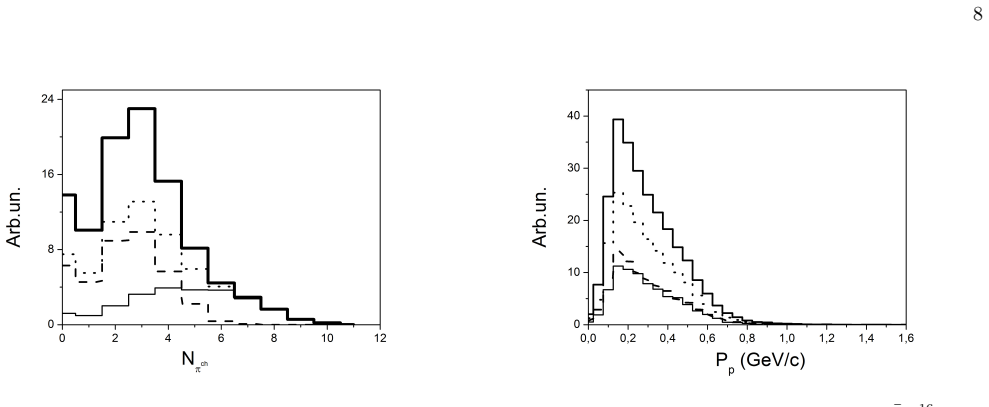
The central claim is that the inelastic antideuteron-nucleus interaction can be simulated as two coupled intranuclear cascades initiated by the antideuteron's constituent antinucleons, and that this reproduces the measured cross sections. Taking the antideuteron as a dumb-bell with fixed separation $l = 2R_d$, the model computes the inelastic cross section from the geometric area $\pi(r_{\mathrm{nucl}}+R_d+\lambda/2)^2$ times the simulated ratio of inelastic to total encounters. After subtracting the calculated antiproton-stripping cross section $\sigma_{\bar p}^{\mathrm{st}}$, the channel in which one antinucleon passes through without interacting, the predicted $\sigma_{in}$ matches the low-energy detector data except at the two lowest momentum bins, and matches the older high-momentum measurements for carbon, aluminium, copper and lead at 13.3 and 25 GeV/c, and for tantalum at 12.2 GeV/c. The paper also reports a structural result: peripheral interaction of only one antinucleon dominates, with about 72% of inelastic events on $^{16}\mathrm{O}$ at 2 GeV/c involving a single antinucleon, while both antinucleons annihilate in only about 20% of events.
Load-bearing premise
The load-bearing premise is that the single geometric interaction radius, whose numerical value is never stated, can be fixed once and reused for all target nuclei and energies, and that the experimental rejection of spectator-antiproton events corresponds to the model's stripping subtraction.
Editorial extensions
If this is right
- For target nuclei and energies where no data exist, the model supplies explicit $\sigma_{in}$ predictions covering $100\ \mathrm{MeV/n} \le T_{\mathrm{kin}} \le 25$–$30\ \mathrm{GeV/n}$ and nuclei from $^{12}\mathrm{C}$ upward.
- The delivered Monte Carlo generator can be used to simulate antideuteron interactions in the detector material of cosmic-ray search experiments, including the multiplicity and spectra of secondary particles.
- Any comparison between model and experiment must subtract the stripping channel when the experiment rejects spectator-antiproton events; the paper shows that this subtraction is essential for agreement.
- Peripheral interaction of a single antinucleon is the dominant channel at the energies studied, so antideuteron interactions cannot be approximated as simple twofold annihilation; the model predicts about 72% of inelastic events on $^{16}\mathrm{O}$ at 2 GeV/c involve only one antinucleon.
Reading between the lines
- The same dumb-bell cascade construction could be extended to anti-$^3\mathrm{He}$ and anti-$^4\mathrm{He}$, which the paper notes are observed cosmic-ray species; treating them as rigid clusters of antinucleons would produce cross-section predictions that cosmic-ray antinuclei searches could use.
- Because the paper never states the numerical value of the interaction radius $r_{\mathrm{int}}$, a reader's first reproducibility check would be to fit $r_{\mathrm{int}}$ on the deuteron-nucleus data shown in the paper and see whether the antideuteron predictions move into or out of agreement.
- The low-momentum excess at 0.3–0.65 GeV/c is plausibly the signature of the Coulomb polarization and diffraction-splitting contributions that the paper lists but does not implement; adding those mechanisms to the cascade would be a concrete, testable next step.
Signed reviews
Editorial analysis
A structured set of objections, weighed in public.
Referee Report
Summary. The paper proposes an intranuclear cascade (INC) model for inelastic antideuteron-nucleus interactions, treating the antideuteron as a loosely bound dumb-bell of an antiproton and an antineutron. The inelastic cross section is written in Eq. (3) as a geometric prefactor times the simulated ratio Nin/Ntot, and the model is compared with IHEP antideuteron data at 13.3 and 25 GeV/c, with the old Ta multiplicity data, and with ALICE low-momentum data. The authors report satisfactory agreement and state that the model works 'without any additional parameters', proposing a Monte Carlo generator for dark-matter searches.
Significance. If the central claim is established, the model would provide a physically motivated alternative to Glauber-based parameterizations for antideuteron propagation in dark-matter search experiments, and the treatment of peripheral one-antinucleon interactions and stripping channels is a useful contribution. The reproduction of the old Ta multiplicities after applying the experimental cuts (Table III) is a genuine success of the model and gives this work independent value beyond the cross-section comparisons. However, as presented, the validation is not complete: the radius parameter controlling the normalization is not reported, the ALICE agreement relies on excluding the two lowest momentum bins and on a model-dependent stripping subtraction, and the IHEP comparison is partly circular because the same model stripping cross section is used to correct the data and then subtracted from the model. These issues are load-bearing for the main claim, though they are potentially fixable in revision.
major comments (3)
- [II, Eq. (3); III] The normalization of the reported cross sections is not reproducible. Equation (3) is sigma_in = pi (r_nucl + R_d + lambda/2)^2 (Nin/Ntot), and Section II states that r_int = r_nucl + lambda/2, with r_nucl = r0 A^(1/3), is 'the only parameter of the model.' No numerical value of r0 or r_int is given anywhere in the paper. Because this prefactor multiplies every quoted cross section, the values in Tables I-II and the curves in Figs. 6-9 scale with this unspecified radius. Please report the value(s) used, state whether r0 was fitted to the (anti)proton/deuteron data shown in Figs. 1-5 before the antideuteron calculation, and provide an uncertainty estimate. Without this, the claim in Section V of agreement 'without any additional parameters' cannot be checked.
- [III, Figs. 8-9] The ALICE comparison is presented as the main validation for the low-momentum region, but the agreement is obtained only after excluding the first two momentum bins and subtracting the model's own spectator-antiproton stripping cross section. The paper itself notes that the experimental event selection is reproduced only 'fairly approximately' in the discussion near Fig. 4. The two excluded bins correspond to antideuteron kinetic energies of roughly 20 and 40 MeV/nucleon, below the declared validity range of 100 MeV/n, so the exclusion may be justified, but this should be stated explicitly and the comparison should be shown with all bins present. Please quantify the sensitivity of the stripping subtraction and of the normalization to model assumptions, and plot model bands rather than single curves.
- [III, Tables I-II, Figs. 6-7] The IHEP comparison is partly circular. The text states that the experimental sigma_in values in Tables I and II 'include the calculated corrections sigma_st^barp [3]', and the plotted model quantity is sigma_in_calc - sigma_st^barp, i.e., the same model stripping cross section is used to correct the data and then subtracted from the model. For 12C at 13.3 GeV/c the tabulated experimental value equals the model value sigma_in - sigma_st by construction. The comparison should instead be made directly with the measured quantity sigma'_in = sigma_in - sigma_st^barp, with the model's stripping cross section reported separately, so that the stripping channel is tested independently.
minor comments (4)
- [Throughout] The heading of Section V is misspelled as 'CONCLUTION', and 'antideutron'/'deutron' are used in several places where 'antideuteron'/'deuteron' is intended.
- [II, Eqs. (2)-(3)] Equations (2) and (3) contain unbalanced parentheses, and 'Rd = 2 , 16 fm' should read 2.16 fm.
- [III, Figs. 8-9] The model curves in Figs. 8-9 are shown without uncertainty bands; the text gives only a 2% statistical error for the Monte Carlo, not the systematic uncertainty from the averaged-nucleus approximation or from the stripping subtraction.
- [III, Fig. 3] The paper acknowledges that diffraction and Coulomb splitting of the deuteron are not included at low energies; this limitation should be stated in the abstract or conclusions where the claimed energy range is quoted.
Circularity Check
No circularity found: Eq. (3) uses an independent cascade ratio and the antideuteron comparison is external; the unreported r_int is a reproducibility issue, not a circular step.
full rationale
The paper's derivation chain is: an existing intranuclear cascade model (refs. [29,31]), a deuteron 'dumb-bell' ansatz (ref. [4]), Eq. (3) for sigma_in, and comparisons to external IHEP and ALICE data. None of these steps reduces by construction to its inputs. Eq. (3) is not a tautology: N_in/N_tot is an independent dynamical output of the Monte Carlo cascade, and the data are external measurements not used in the formula itself. The paper calls r_int 'the only parameter of the model' and notes it 'can be refined' using hadron-nucleus or deuteron inelastic cross-section data, but it never states the value nor shows that the antideuteron predictions were fitted to the same antideuteron data used for validation. That is an unstated-parameter/reproducibility concern, not a circularity, because the quoted text exposes no equation in which the predicted quantity is identical to the input by construction. The ALICE comparisons are further qualified by excluding the two lowest-momentum bins and by subtracting the model's own spectator-antiproton stripping cross section; these caveats weaken the agreement claim but do not make the prediction equal to the fitted input. The self-citations to refs. [4,29,31] are ordinary model references; the central quantitative claim is checked against external data rather than being asserted solely through those citations.
Assumptions & free parameters
free parameters (2)
- interaction radius r_int =
not stated in text
- nuclear radius parameter r0 =
not stated
assumptions (7)
- domain assumption Intranuclear cascade is a valid quasi-classical description of inelastic nuclear reactions in the 100 MeV/n to 25-30 GeV/n range.
- domain assumption The target nucleus can be treated as a degenerate Fermi gas in a spherical diffuse potential well.
- domain assumption Elementary NN, piN and anti-NN interactions in the nucleus are approximated by measured vacuum cross sections.
- ad hoc to paper The antideuteron is a dumb-bell of an antiproton and antineutron at fixed distance 2Rd with isotropic, fixed orientation.
- ad hoc to paper The local density reduction effect can be combined with a continuous density profile for the first interaction.
- domain assumption Inelastic cross sections follow the geometric form σ_in = π r_int^2 * N_in/N_tot.
- domain assumption Stripping events can be identified by the non-interacting spectator antinucleon and subtracted to match experimental event selection.
Cite this review
Pith. "Pith review of Inelastic Antideutron Interaction with Nuclei." pith.science (2026). https://pith.science/paper/J6NJT2PI
@misc{pith2026250420920,
  author       = {Pith},
  title        = {Pith review of: Inelastic Antideutron Interaction with Nuclei},
  year         = {2026},
  howpublished = {\url{https://pith.science/paper/J6NJT2PI}},
  note         = {Machine review of arXiv:2504.20920}
}
abstract
We suggest to use the intranuclear cascade model (INC) for simulation of antideutron-nucleus inelastic interaction in the region of antideutron energies of $100$ MeV/n $\le T_{kin}\le 25-30$ GeV/n for a wide range of target nuclei. With the help of the model we obtain the cross-section $\sigma_{in}$ for inelastic antideutron-nucleus interaction and compare it with the ALICE experimental data. The model is in good agreement with the available experimental data on the inelastic interaction of antideutrons with tantalum nucleus. We have created a Monte Carlo generator for simulation of inelastic interaction of antideutrons with nuclei. This generator can be useful in the preparation and analysis of experiments to search for antideutrons near the Earth.
Figures


Figures from the paper (6 more)




Reference graph
Works this paper leans on
-
[3]
F. G. Binon et al. , Absorption cross-sections of 25 gev/c antideuterons in li, c, al, cu and pb, Phys. Lett. B 31, 230 (1970)
work page 1970
-
[1]
Nucleon-antinucleon interaction
J.-M. Richard, Nucleon-Antinucleon Interaction, in Handbook of Nuclear Physics , edited by I. Tanihata, H. Toki, and T. Kajino (2023) pp. 1–22, arXiv:2205.02529 [nucl-th]
work page Pith review arXiv 2023
-
[2]
S. P. Denisov, S. V. Donskov, Y. P. Gorin, V. A. Kachanov, V. M. Kutjin, A. I. Petrukhin, Y. D. Prokoshkin, E. A. Razuvaev, R. S. Shuvalov, and D. A. Stojanova, Measurements of anti-deuteron absorption and stripping cross sections at the momentum 13.3 gev/c, Nucl. Phys. B 31, 253 (1971)
work page 1971
-
[4]
V. F. Andreev, P. S. Baranov, E. S. Golubeva, A. S. Ilinov, S. V. Levonian, Y. S. Pol, and L. V. Filkov, Mul- tiplicities and correlations of secondary charged particles in the interactions of anti-neutrons and anti-deuterons with a momentum of 6.1-GeV/c per nucleon with tan- talum nuclei. (In Russian), Sov. J. Nucl. Phys. 51, 88 (1990)
work page 1990
-
[5]
T. A. Armstrong et al. (E864), Anti-deuteron yield at the AGS and coalescence implications, Phys. Rev. Lett. 85, 2685 (2000), arXiv:nucl-ex/0005001
work page Pith review arXiv 2000
-
[6]
C. Adler et al. (STAR), Anti-deuteron and anti-He-3 production in s(NN)**(1/2) = 130-GeV Au+Au col- lisions, Phys. Rev. Lett. 87, 262301 (2001), [Erra- tum: Phys.Rev.Lett. 87, 279902 (2001)], arXiv:nucl- ex/0108022
-
[7]
S. S. Adler et al. (PHENIX), Deuteron and antideuteron production in Au + Au collisions at s(NN)**(1/2) = 200- GeV, Phys. Rev. Lett. 94, 122302 (2005), arXiv:nucl- ex/0406004
arXiv 2005
-
[8]
Antideuteron and deuteron production in mid-central Pb+Pb collisions at 158$A$ GeV
T. Anticic et al. (NA49), Antideuteron and deuteron pro- duction in mid-central Pb+Pb collisions at 158 A GeV, Phys. Rev. C 85, 044913 (2012), arXiv:1111.2588 [nucl- ex]
work page Pith review arXiv 2012
Show all 38 references
-
[9]
Adam et al
J. Adam et al. (STAR), Beam energy dependence of (anti-)deuteron production in Au + Au collisions at the BNL Relativistic Heavy Ion Collider, Phys. Rev. C 99, 064905 (2019), arXiv:1903.11778 [nucl-ex]
2019 arXiv
-
[10]
Acharya et al
S. Acharya et al. (ALICE), Measurement of deuteron spectra and elliptic flow in Pb–Pb collisions at √sNN = 2.76 TeV at the LHC, Eur. Phys. J. C 77, 658 (2017), arXiv:1707.07304 [nucl-ex]
2017 arXiv
-
[11]
Acharya et al
S. Acharya et al. (ALICE), Measurement of the (anti- )3He elliptic flow in Pb–Pb collisions at sNN=5.02TeV, Phys. Lett. B 805, 135414 (2020), arXiv:1910.09718 [nucl-ex]
2020 arXiv
-
[12]
Acharya et al
S. Acharya et al. (ALICE), Elliptic and triangular flow of (anti)deuterons in Pb-Pb collisions at √sNN = 5.02 TeV, Phys. Rev. C 102, 055203 (2020), arXiv:2005.14639 [nucl-ex]
2020 arXiv
-
[13]
Acharya et al
S. Acharya et al. (ALICE), First Measurement of An- tideuteron Number Fluctuations at Energies Available at the Large Hadron Collider, Phys. Rev. Lett. 131, 041901 (2023), arXiv:2204.10166 [nucl-ex]
2023 arXiv
-
[14]
Acharya et al
S. Acharya et al. (ALICE), Measurement of the low- energy antideuteron inelastic cross section, Phys. Rev. Lett. 125, 162001 (2020), arXiv:2005.11122 [nucl-ex]
2020 arXiv
-
[15]
Aramaki et al
T. Aramaki et al. , Review of the theoretical and ex- perimental status of dark matter identification with cosmic-ray antideuterons, Phys. Rept. 618, 1 (2016), arXiv:1505.07785 [hep-ph]
2016 arXiv
-
[16]
Donato, N
F. Donato, N. Fornengo, and D. Maurin, Antideuteron fluxes from dark matter annihilation in diffusion models, Phys. Rev. D 78, 043506 (2008), arXiv:0803.2640 [hep- ph]
2008 arXiv
-
[17]
Baer and S
H. Baer and S. Profumo, Low energy antideuterons: shedding light on dark matter, Journal of Cosmology and Astroparticle Physics 2005 (12), 008–008
2005
-
[18]
Silk et al., Particle Dark Matter: Observations, Models and Searches , edited by G
J. Silk et al., Particle Dark Matter: Observations, Models and Searches , edited by G. Bertone (Cambridge Univ. Press, Cambridge, 2010)
2010
-
[19]
Ibarra and S
A. Ibarra and S. Wild, Prospects of antideuteron detec- 10 tion from dark matter annihilations or decays at AMS-02 and GAPS, JCAP 02, 021, arXiv:1209.5539 [hep-ph]
-
[20]
Donato, N
F. Donato, N. Fornengo, and P. Salati, Anti-deuterons as a signature of supersymmetric dark matter, Phys. Rev. D 62, 043003 (2000), arXiv:hep-ph/9904481
2000 arXiv
-
[21]
Kounine, The Alpha Magnetic Spectrometer on the International Space Station, Int
A. Kounine, The Alpha Magnetic Spectrometer on the International Space Station, Int. J. Mod. Phys. E 21, 1230005 (2012)
2012
-
[22]
C. J. Hailey, An indirect search for dark matter using antideuterons: the GAPS experiment, New J. Phys. 11, 105022 (2009)
2009
-
[23]
Fornengo, L
N. Fornengo, L. Maccione, and A. Vittino, Dark matter searches with cosmic antideuterons: status and perspec- tives, JCAP 09, 031, arXiv:1306.4171 [hep-ph]
-
[24]
P. D. L. T. Luque, M. W. Winkler, and T. Linden, Cosmic-ray propagation models elucidate the prospects for antinuclei detection (2024), arXiv:2404.13114 [astro- ph.HE]
2024 arXiv
-
[25]
Uzhinsky, J
V. Uzhinsky, J. Apostolakis, A. Galoyan, G. Fol- ger, V. M. Grichine, V. N. Ivanchenko, and D. H. Wright, Antinucleus-nucleus cross sections implemented in Geant4, Phys. Lett. B 705, 235 (2011)
2011
-
[26]
Galoyan, A
A. Galoyan, A. Ribon, and V. Uzhinsky, Dynamics of Anti-Proton–Protons and Anti-Proton–Nucleus Re- actions, Nucl. Theor. 35, 194 (2016), arXiv:1610.08341 [nucl-th]
2016 arXiv
-
[27]
Allison et al
J. Allison et al. , Recent developments in Geant4, Nucl. Instrum. Meth. A 835, 186 (2016)
2016
-
[28]
V. S. Barashenkov and V. D. Toneev, Interaction of High Energy Particles and Atomic Nuclei with Nuclei (Atom- izadt, Moscow, 1972)
1972
-
[29]
E. S. Golubeva, A. S. Ilinov, A. S. Botvina, and N. M. Sobolevsky, Inelastic Interactions of Intermediate-energy Anti-nucleons With Nuclei, Nucl. Phys. A 483, 539 (1988)
1988
-
[30]
V. S. Barashenkov, A. S. Ilinov, and V. D. Toneev, Fur- ther development of the intranuclear cascade model, Yad. Fiz. 13, 743 (1971)
1971
-
[31]
E. S. Golubeva, J. L. Barrow, and C. G. Ladd, Model of ¯n annihilation in experimental searches for ¯n transforma- tions, Phys. Rev. D 99, 035002 (2019), arXiv:1804.10270 [hep-ex]
2019 arXiv
-
[32]
V. S. Barashenkov, A. S. Ilinov, and V. D. Toneev, Inter- action of relativistic deuterium and tritium nuclei with emulsion nuclei, Acta Phys. Polon. B 4, 219 (1973)
1973
-
[33]
V. S. Barashenkov, Cross Sections of Interaction of Par- ticles and Nuclei with Nuclei (JINR, Dubna, 1993)
1993
-
[34]
V. E. Paphomov and V. E. Sergeev, Application of the three-body model to describe the inelastic interaction of deuterons with nuclei, Brief Reports on Physics of the FIAN (2005)
2005
-
[35]
Minomo, K
K. Minomo, K. Washiyama, and K. Ogata, Deuteron–nucleus total reaction cross sections up to 1 GeV, J. Nucl. Sci. Tech.54, 127 (2017), arXiv:1608.05503 [nucl-th]
2017 arXiv
-
[36]
Kharzeev and A
D. Kharzeev and A. A. Khrapov, Coulomb break-up of an antideuteron atom, Moscow University Physics Bulletin 4, 27 (1986)
1986
-
[37]
V. E. Paphomov and V. E. Sergeev, The contribution of diffraction splitting of deuterons to the total cross sections of reactions with light nuclei, Brief Reports on Physics of the FIAN (2002)
2002
-
[38]
Maurin, L
D. Maurin, L. Audouin, E. Berti, P. Coppin, M. D. Mauro, P. von Doetinchem, F. Donato, C. Evoli, Y. G´ enolini, P. Ghosh, I. Leya, M. J. Losekamm, S. Mar- iani, J. W. Norbury, L. Orusa, M. Paniccia, T. Poeschl, P. D. Serpico, A. Tykhonov, M. Unger, M. Vanstalle, M. J. Zhao, D....
2025
Reviewed August 16, 2026 · model on record in the stance chip above.
Discussion (0). Continue with ORCID to comment.