REVIEW 4 major objections 6 minor 29 references
NavEX: A Multi-Agent Coverage in Non-Convex and Uneven Environments via Exemplar-Clustering
T0 review · 4 major / 6 minor · reviewed 2026-08-16 · deepseek-v4-flash
Pith's one-line read NavEX reframes multi-agent coverage in cluttered and rugged spaces as submodular maximization, giving greedy placement a (1−1/e) optimality guarantee for a single authority and a 1/2 guarantee for multiple authorities.
desk verdict The central utility equation is indexed incorrectly, making the objective independent of the chosen deployment set, so the paper's main claim falls apart as written. read the letter →
The pith
A machine-rendered reading of the paper's core claim, the machinery that carries it, and where it could break.
The reading
What carries the argument
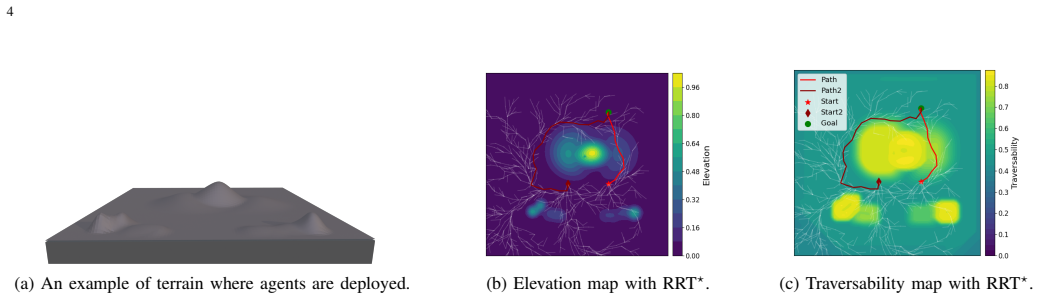
The load-bearing object is the exemplar-clustering utility $f(R)=L(\{d_0\})-L(R\cup\{d_0\})$, where $L(S)$ is the average distance from the points being served to their nearest chosen representative and $d_0$ is a phantom placement. The key fact that carries the argument is that this utility is monotone and submodular for any nonnegative distance function, which is what lets NavEX drop the metric axioms. The distance oracle does the environmental work: a visibility graph supplies exact shortest paths around polygonal obstacles in 2D (roadmap efficiency 1), while traversability-aware RRT* builds a map from slope, flatness, and step-height thresholds and accepts tree edges only within navigable regions, producing finite-sample shortest-path estimates in rugged terrain. For hotspot deployment the distance is passed through a capped logarithmic map, preserving concavity and hence submodularity. The greedy Algorithms 1 and 2 consume this oracle and are what turn the submodularity into the $(1-1/e)$ and $1/2$ performance certificates.
What would settle it
Run NavEX with a visibility graph on a small polygonal workspace where the optimal deployment can be found by exhaustive search, and verify that the greedy utility reaches at least $(1-1/e)$ of the optimum; then repeat on a small rugged terrain, computing true traversal costs on a fine grid and comparing them with traversability-aware RRT* estimates for a fixed low sample budget—if greedy on the estimates yields a deployment whose true-cost utility falls below $(1-1/e)$ of the true optimum, the practical guarantee for uneven terrain fails.
Extended reading notes
Core claim
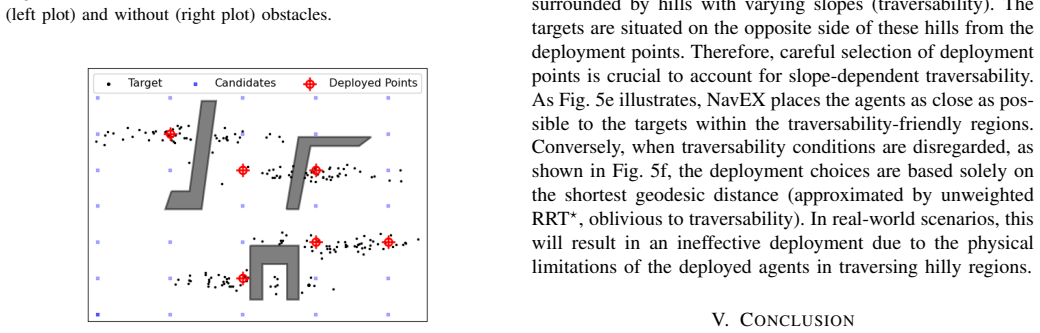
The paper claims that multi-agent dispatch coverage in non-convex and uneven environments is an instance of submodular maximization, provided the utility function is built from exemplar clustering rather than from direct geometric coverage integrals. Define the loss $L(S)$ as the average, over target points, of the distance to the nearest selected deployment point, and let $f(R)=L(\{d_0\})-L(R\cup\{d_0\})$ with $d_0$ a phantom site; maximizing $f$ is equivalent to minimizing $L$. This $f$ is monotone and submodular for any nonnegative—even non-symmetric, triangle-inequality-violating—distance, so the NP-hard placement problem can be attacked by Algorithm 1 or 2 in polynomial time with worst-case ratios $(1-1/e)$ and $1/2$. NavEX then instantiates the distance oracle as exact visibility-graph shortest paths in planar obstacle fields and as traversability-aware RRT* in rugged terrain, with a truncated logarithmic transform for hotspot deployment. The paper's claim is that this single framework preserves the classical submodular guarantees while accommodating realistic, non-Euclidean movement costs.
Load-bearing premise
The load-bearing premise is that the distance values fed into the greedy algorithm faithfully represent true navigation costs—exact for visibility graphs, but only asymptotically exact for traversability-aware RRT*, whose finite-sample estimates are what the performance certificate actually applies to.
Editorial extensions
If this is right
- A single authority with any prespecified set of candidate sites can, in polynomial time, obtain a deployment whose exemplar-clustering utility is at least $(1-1/e)$ of the optimum, regardless of obstacles or terrain, as long as all pairwise distances are nonnegative.
- In planar polygonal environments the visibility-graph oracle is exact, so the certificate applies to true navigational cost; in rugged terrain the same guarantee applies to the sampled RRT*-based distances.
- The identical utility structure serves both fairness (equitable access) and hotspot (demand-weighted) objectives, with only the distance transform differing, so the two tasks share a single solver.
- When multiple authorities independently control disjoint candidate regions, greedy selection still yields a $1/2$ optimality gap, giving a principled way to divide deployment responsibility without centralized computation.
- The independence of per-pair RRT* trees means distance computation can be parallelized, which moderates the per-tree cost of the terrain oracle at scale.
Reading between the lines
- The submodularity property is so permissive that any nonnegative learned cost oracle—for instance, a neural traversability cost map—could be dropped into NavEX and inherit the same greedy guarantees; the paper demonstrates this only for visibility graphs and RRT*.
- Because the utility measures reduction in summed distance, NavEX is effectively a submodular surrogate for the k-median objective; comparing greedy placements against local-search k-median on identical maps would quantify how much is gained or lost by the submodular route.
- A natural stress test is to coarsen or refine the prespecified candidate set: since the paper fixes the candidate locations in advance, deployment quality is bounded above by how well that discrete set samples the traversable region, and an adaptive candidate-generation scheme could close that gap.
Signed reviews
Editorial analysis
A structured set of objections, weighed in public.
Referee Report
Summary. The paper proposes NavEX, a framework for multi-agent deployment on discrete candidate sets in non-convex and uneven environments. NavEX combines an exemplar-clustering-based utility with obstacle-aware distances from visibility graphs and traversability-aware RRT* paths, and casts single-authority and multi-authority deployment as monotone submodular maximization under cardinality or partition-matroid constraints, claiming (1 - 1/e) and 1/2 greedy optimality gaps, respectively. The manuscript presents qualitative simulation examples in 2D obstacle fields and 3D hilly terrains.
Significance. If the definitional issues are corrected, the framework is a useful synthesis: it correctly identifies the facility-location form of exemplar clustering, recognizes that submodularity can be preserved for non-Euclidean and non-metric distance measures, and provides a unified treatment of single- and multi-authority constraints. The authors also state that code is available, which supports reproducibility. However, as submitted, the central utility definition makes the objective independent of the chosen deployment set, and the stated fair-access objective is not represented by the proposed utility. These issues must be resolved before the theoretical claims can be assessed.
major comments (4)
- [Section III-B, Eq. (4)] The loss is written as L(S) = (1/|S|) * sum_{p in X} min_{d in T} dist(p,d), so the selected set S appears only in the normalization 1/|S|. As a result, L(S) is identical for all subsets of the same cardinality, f(R) in Eq. (5) depends on R only through |R|, and the greedy argmax in Algorithm 1 is indifferent among all candidates. The claimed monotone submodularity and the (1 - 1/e) and 1/2 optimality gaps are therefore vacuous as stated. Please replace the loss with the standard exemplar-clustering form, e.g., L(S) = (1/|T|) * sum_{d in T} min_{p in S} dist(p,d) (or an equivalent sum over targets), and re-derive Eqs. (4)-(5) and the submodularity argument under that definition.
- [Sections I and III-B] The fair-access deployment problem is stated as minimizing the maximum distance between any target and its nearest agent (a min-max objective), but the utility in Eq. (4) minimizes an average distance (a k-median-type objective). These objectives differ materially; a deployment minimizing average distance can leave some targets arbitrarily far. The manuscript should either adopt the average-distance objective consistently throughout or propose a submodular surrogate with an explicit formal connection to the min-max goal.
- [Section III-A and Section IV] For uneven terrains, distances are computed by traversability-aware RRT*, which is asymptotically optimal but not exact for finite samples. The stated greedy guarantee applies to the utility function evaluated on the realized approximate distance matrix, not necessarily to the true navigational coverage objective. Please state this limitation explicitly and provide either a convergence analysis or an empirical sensitivity study showing how the reported deployments change across random RRT* runs.
- [Section IV] The demonstrative examples contain no quantitative performance metrics, baselines, or statistical repetitions; claims of effectiveness are supported only by qualitative figures. Please report at least the achieved utility values relative to an upper bound or a baseline, and include variance across randomized target and RRT* realizations.
minor comments (6)
- [Section III-B] The text refers to 'S subset P' while the sum in Eq. (4) runs over p in X; the sets P and X are not defined consistently, and this notation should be unified.
- [Section III-B, Eq. (6)] The symbol L is reused for the truncation cap in Eq. (6) and for the loss function L(S) in Eq. (4); please rename one of them to avoid confusion.
- [Algorithm 2] The constraint is written as |S ∩ X_i| <= kappa_i in the output line, but the surrounding text and problem statement use inconsistent notation for the subset relation; please make the notation uniform.
- [Section III-A] The stated Dijkstra complexity O(E + V log V) is the Fibonacci-heap form; with a binary heap it should be O((E + V) log V). Please specify the implementation or correct the expression.
- [Algorithm 1] The input line says 'number of choices k' while the output and Eq. (1) use K; please align k and K.
- [References] Reference [1] contains an extra comma in the author list ('S. S. Kia, , and S. Martinez'), and the phrase 'roadmap efficiency of 1' in Section III-A should be defined or replaced by a direct statement that visibility graphs yield exact shortest paths.
Circularity Check
Eq. (4)-(5) define the utility independently of the selected set; the greedy/submodular claims are vacuous by construction.
-
self definitional
[Section III-B, Eqs. (4)-(5)]
"L(S) = 1/|S| \sum_{p∈X} min_{d∈T} dist(p,d), (4) ... f(R) = L({d0})−L(R∪{d0}), (5)"
By Eq. (4), the inner minimization is over d∈T (targets), not over the selected exemplars S; therefore L(S) depends on S only through the prefactor 1/|S|, i.e. L(S)=C/|S| with C=\sum_{p∈X}min_{d∈T}dist(p,d). Substituting into Eq. (5) gives f(R)=C−C/(|R|+1), a function of the cardinality of R alone. Consequently every feasible set of a given size has identical utility, Algorithm 1's argmax is indifferent among all candidate deployment points, and the claimed (1−1/e) or 1/2 optimality gap is a guarantee about a constant objective. The coverage utility is thus independent of the decision variables by construction, so the central submodular-maximization claim is vacuous as written.
full rationale
The only load-bearing reduction I can exhibit is Eqs. (4)-(5), where the selected set disappears from the objective; this is a definitional self-removal of the decision variable, so it is counted as self_definitional. No fitted parameters are renamed as predictions; Mτ uses external thresholds and RRT* is asymptotically optimal from standard references. The citation [16] is an author's own survey, but the greedy optimality theorem it summarizes is a standard, externally verifiable result (also available in [15], [17]-[20], [29]), so it is not load-bearing self-citation. The paper's fair-access/hotspot discussion conflates min-max with average-distance minimization, and RRT* distances are finite-sample approximations, but these are correctness/soundness concerns, not circularity. Thus the circularity score is driven by the Eq. (4) index error, which makes the central claim vacuous by definition.
Assumptions & free parameters
free parameters (2)
- hotspot truncation threshold ℓ and cap L
- traversability weights ω1, ω2, ω3 and critical thresholds s_crit, f_crit, ζ_crit
assumptions (5)
- standard math Sequential greedy maximization of a monotone submodular function under a cardinality constraint achieves a (1 - 1/e) approximation; under a partition matroid it achieves 1/2.
- standard math The exemplar-clustering utility in Eq. (5) is monotone and submodular when derived from the loss in Eq. (4), even for distances violating symmetry or the triangle inequality.
- standard math Visibility graphs give exact shortest paths in planar environments with polygonal obstacles.
- domain assumption Traversability-aware RRT* is probabilistically complete and asymptotically optimal.
- domain assumption The topological map and traversability map of W are given from prior surveys and are accurate enough for planning.
invented entities (1)
-
auxiliary phantom deployment point d0
Cite this review
Pith. "Pith review of NavEX: A Multi-Agent Coverage in Non-Convex and Uneven Environments via Exemplar-Clustering." pith.science (2026). https://pith.science/paper/CBDAEFHY
@misc{pith2026250421113,
  author       = {Pith},
  title        = {Pith review of: NavEX: A Multi-Agent Coverage in Non-Convex and Uneven Environments via Exemplar-Clustering},
  year         = {2026},
  howpublished = {\url{https://pith.science/paper/CBDAEFHY}},
  note         = {Machine review of arXiv:2504.21113}
}
read the original abstract
This paper addresses multi-agent deployment in non-convex and uneven environments. To overcome the limitations of traditional approaches, we introduce Navigable Exemplar-Based Dispatch Coverage (NavEX), a novel dispatch coverage framework that combines exemplar-clustering with obstacle-aware and traversability-aware shortest distances, offering a deployment framework based on submodular optimization. NavEX provides a unified approach to solve two critical coverage tasks: (a) fair-access deployment, aiming to provide equitable service by minimizing agent-target distances, and (b) hotspot deployment, prioritizing high-density target regions. A key feature of NavEX is the use of exemplar-clustering for the coverage utility measure, which provides the flexibility to employ non-Euclidean distance metrics that do not necessarily conform to the triangle inequality. This allows NavEX to incorporate visibility graphs for shortest-path computation in environments with planar obstacles, and traversability-aware RRT* for complex, rugged terrains. By leveraging submodular optimization, the NavEX framework enables efficient, near-optimal solutions with provable performance guarantees for multi-agent deployment in realistic and complex settings, as demonstrated by our simulations.
Figures


Figures from the paper (2 more)

Reference graph
Works this paper leans on
-
[1]
S. S. Kia, , and S. Martinez, “Multi-agent coverage control: From discrete assignments to continuous multi-agent distribution matching,” ASME Dynamic Systems & Control Division Newsletter , 2024. Avaiable at arXiv:2407.13890
work page Pith review arXiv 2024
-
[2]
M. V . Espina, R. Grech, D. De Jager, P. Remagnino, L. Iocchi, L. Marchetti, D. Nardi, D. Monekosso, M. Nicolescu, and C. King, Multi-robot Teams for Environmental Monitoring , pp. 183–209. Berlin, Heidelberg: Springer Berlin Heidelberg, 2011
work page 2011
-
[3]
Coverage control for mobile sensing networks,
J. Cortes, S. Martinez, T. Karatas, and F. Bullo, “Coverage control for mobile sensing networks,” IEEE Transactions on Robotics and Automation, vol. 20, no. 2, pp. 243–255, 2004
2004
-
[4]
Statistical coverage control of mobile sensor networks,
O. Arslan, “Statistical coverage control of mobile sensor networks,” IEEE Transactions on Robotics , vol. 35, no. 4, pp. 889–908, 2019
work page 2019
-
[5]
Decentralized, adaptive cover- age control for networked robots,
M. Schwager, D. Rus, and J.-J. Slotine, “Decentralized, adaptive cover- age control for networked robots,” The International Journal of Robotics Research, vol. 28, no. 3, pp. 357–375, 2009
work page 2009
-
[6]
A coverage algorithm for a class of non-convex regions,
C. H. Caicedo-Nunez and M. Zefran, “A coverage algorithm for a class of non-convex regions,” in IEEE Int. Conf. on Decision and Control , pp. 4244–4249, 2008. 6 (a) Terrain Model one. (b) Fair-access deployment using traversability-aware RRT⋆ distance metric. (c) Fair-access deployment using un- weighted RRT ⋆ distance metric oblivious to traversability. ...
work page 2008
-
[7]
Distributed collaborative coverage-control schemes for non-convex domains,
Y . Stergiopoulos, M. Thanou, and A. Tzes, “Distributed collaborative coverage-control schemes for non-convex domains,” IEEE Transactions on Automatic Control , vol. 60, no. 9, pp. 2422–2427, 2015
work page 2015
-
[8]
Multi-robot coverage and ex- ploration on riemannian manifolds with boundaries,
S. Bhattacharya, R. Ghrist, and V . Kumar, “Multi-robot coverage and ex- ploration on riemannian manifolds with boundaries,” The International Journal of Robotics Research , vol. 33, no. 1, pp. 113–137, 2014
work page 2014
Show all 29 references
-
[9]
V oronoi-based multi-robot autonomous exploration in unknown environments via deep reinforcement learning,
J. Hu, H. Niu, J. Carrasco, B. Lennox, and F. Arvin, “V oronoi-based multi-robot autonomous exploration in unknown environments via deep reinforcement learning,” IEEE Transactions on V ehicular Technology , vol. 69, no. 12, pp. 14413–14423, 2020
2020
-
[10]
Distributed multirobot coverage control of nonconvex environments with guarantees,
A. S. Yengejeh, A. B. Asghar, and S. L. Smith, “Distributed multirobot coverage control of nonconvex environments with guarantees,” IEEE Transactions on Control of Network Systems , vol. 10, no. 2, pp. 796– 808, 2023
2023
-
[11]
Adaptive centroidal voronoi tessellation with agent dropout and reinsertion for multi-agent non-convex area coverage,
K. Lee and K. Lee, “Adaptive centroidal voronoi tessellation with agent dropout and reinsertion for multi-agent non-convex area coverage,”IEEE Access, vol. 12, pp. 5503–5516, 2024
2024
-
[12]
Approximating k-median via pseudo- approximation,
S. Li and O. Svensson, “Approximating k-median via pseudo- approximation,” SIAM Journal on Computing , vol. 45, no. 2, pp. 530– 547, 2016
2016
-
[13]
Re- silient coverage: Exploring the local-to-global trade-off,
R. K. Ramachandran, L. Zhou, J. A. Preiss, and G. S. Sukhatme, “Re- silient coverage: Exploring the local-to-global trade-off,” in IEEE/RSJ Int. Conf. on Intelligent Robots & Systems , pp. 11740–11747, 2020
2020
-
[14]
Exploiting submodularity to quantify near-optimality in multi-agent coverage problems,
X. Sun, C. G. Cassandras, and X. Meng, “Exploiting submodularity to quantify near-optimality in multi-agent coverage problems,” Automatica, vol. 100, pp. 349–359, 2019
2019
-
[15]
Near-optimal sensor placements in Gaussian processes: Theory, efficient algorithms and empirical stud- ies,
A. Krause, A. Singh, and C. Guestrin, “Near-optimal sensor placements in Gaussian processes: Theory, efficient algorithms and empirical stud- ies,” J. Mach. Learn. Res. , vol. 9, p. 235–284, jun 2008
2008
-
[16]
Submodular maximization subject to uniform and partition matroids: From theory to practical applications and distributed solu- tions,
S. S. Kia, “Submodular maximization subject to uniform and partition matroids: From theory to practical applications and distributed solu- tions,” arXiv preprint arXiv:2501.01071 , 2025
2025 arXiv
-
[17]
Submodular optimization for coupled task allocation and intermittent deployment problems,
J. Liu and R. K. Williams, “Submodular optimization for coupled task allocation and intermittent deployment problems,” IEEE Robotics and Automation Letters, vol. 4, no. 4, pp. 3169–3176, 2019
2019
-
[18]
Resource-aware distributed submodular max- imization: A paradigm for multi-robot decision-making,
Z. Xu and V . Tzoumas, “Resource-aware distributed submodular max- imization: A paradigm for multi-robot decision-making,” in IEEE Int. Conf. on Decision and Control , pp. 5959–5966, 2022
2022
-
[19]
Distributed strategy selection: A sub- modular set function maximization approach,
N. Rezazadeh and S. S. Kia, “Distributed strategy selection: A sub- modular set function maximization approach,” Automatica, vol. 153, p. 111000, 2023
2023
-
[20]
Inverse submodular maximization with application to human-in-the-loop multi-robot multi-objective coverage control,
G. Shi and G. S. Sukhatme, “Inverse submodular maximization with application to human-in-the-loop multi-robot multi-objective coverage control,” arXiv preprint arXiv:2403.10991 , 2024
2024
-
[21]
Kaufman and P
L. Kaufman and P. Rousseeuw, Finding Groups in Data: An Introduction To Cluster Analysis . Wiley, 01 1990
1990
-
[22]
Streaming submodular maximization: Massive data summarization on the fly,
A. Badanidiyuru, B. Mirzasoleiman, A. Karbasi, and A. Krause, “Streaming submodular maximization: Massive data summarization on the fly,” in ACM SIGKDD international conference on Knowledge discovery and data mining , pp. 671–680, 2014
2014
-
[23]
De Berg, Computational geometry: algorithms and applications
M. De Berg, Computational geometry: algorithms and applications . Springer Science & Business Media, 2000
2000
-
[24]
Informed rrt*: Optimal sampling-based path planning focused via direct sampling of an admissible ellipsoidal heuristic,
J. D. Gammell, S. S. Srinivasa, and T. D. Barfoot, “Informed rrt*: Optimal sampling-based path planning focused via direct sampling of an admissible ellipsoidal heuristic,” in IEEE/RSJ Int. Conf. on Intelligent Robots & Systems , pp. 2997–3004, 2014
2014
-
[25]
An algorithm for planning collision- free paths among polyhedral obstacles,
T. Lozano-Pérez and M. A. Wesley, “An algorithm for planning collision- free paths among polyhedral obstacles,” Commun. ACM , vol. 22, p. 560–570, Oct. 1979
1979
-
[26]
S. K. Ghosh, Visibility Graphs, p. 136–170. Cambridge University Press, 2007
2007
-
[27]
Sampling-based algorithms for optimal motion planning,
S. Karaman and E. Frazzoli, “Sampling-based algorithms for optimal motion planning,” The International Journal of Robotics Research , vol. 30, pp. 846 – 894, 2011
2011
-
[28]
Gaussian process-based traversability analysis for terrain mapless navigation,
A. Leininger, M. Ali, H. Jardali, and L. Liu, “Gaussian process-based traversability analysis for terrain mapless navigation,” in IEEE Int. Conf. on Robotics and Automation , pp. 10925–10931, 2024
2024
-
[29]
Budgeted nonparametric learning from data streams,
R. Gomes and A. Krause, “Budgeted nonparametric learning from data streams,” in International Conference on Machine Learning , (Haifa, Israel), 2010
2010
Reviewed August 16, 2026 · model on record in the stance chip above.
Discussion (0). Continue with ORCID to comment.