REVIEW 2 major objections 5 minor 1 cited by
Determining the Nature of Magnetism in Altermagnetic Candidate RuO$_2$
T0 review · 2 major / 5 minor · reviewed 2026-08-16 · deepseek-v4-flash
Pith's one-line read The authors show that high-quality RuO2 single crystals are itinerant paramagnets with no long-range magnetic order, and therefore not altermagnets.
desk verdict Solid torque and quantum-oscillation evidence that bulk RuO2 is paramagnetic, but the paper overclaims how definitively it rules out the 0.05 μB altermagnetic state. read the letter →
The pith
A machine-rendered reading of the paper's core claim, the machinery that carries it, and where it could break.
The reading
What carries the argument
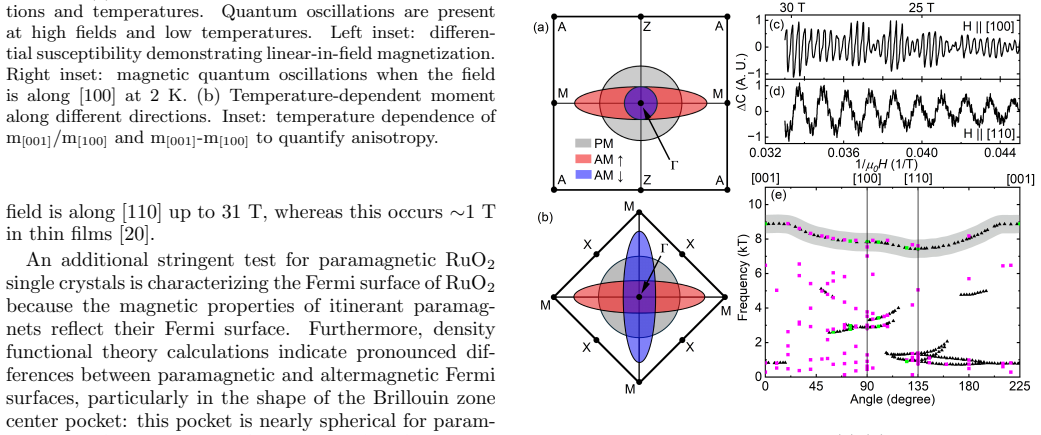
The argument is carried by the magnetic susceptibility tensor as constrained jointly by crystal symmetry and possible magnetic point groups, and measured directly with torque magnetometry. Torque detects the angular derivative of magnetization; the observed $\sin(2\theta)$ response with identical amplitude and periodicity in the $(0\bar{1}0)$ and $(1\bar{1}0)$ planes, together with zero torque in the $(001)$ plane, fixes uniaxial anisotropy with $\chi_a = \chi_b \neq \chi_c$. The second load-bearing element is the textbook result that in a collinear antiferromagnet the susceptibility parallel to the Néel vector (the axis of antiparallel spin alignment) approaches zero at $T \to 0$, while the perpendicular susceptibility remains finite; the authors use the observed $\chi_c > \chi_a$ with $\chi_c$ not tending to zero to eliminate $c$-axis Néel order. The third element is the Fermi-surface shape: paramagnetic and altermagnetic density-functional calculations predict measurably different forms for the Brillouin-zone-center pocket, nearly spherical versus d-wave-distorted, and the quantum-oscillation radius ratios match the paramagnetic predictions.
What would settle it
A decisive test would be a direct zero-field structure determination on the same high-quality crystals, for example neutron or resonant X-ray diffraction with sensitivity to ordered moments below $0.05\ \mu_B$, looking for a Bragg peak at the altermagnetic propagation vector. A second test is to extend torque and magnetization measurements to lower temperatures and check whether $\chi_c$ extrapolates to zero as $T \to 0$, which the collinear-order scenario requires and the present data show it does not. Null results in both would settle the paramagnetic ground state; positive results would overturn the paper's conclusion.
Extended reading notes
Core claim
The paper's central claim is that bulk $\mathrm{RuO_2}$ single crystals do not exhibit the collinear antiferromagnetic order required for altermagnetism. Symmetry-based torque measurements fix the magnetic susceptibility tensor as uniaxial with isotropic response within the $ab$-plane and a larger response along the $c$-axis, a form compatible with either a paramagnet or a $c$-axis Néel vector but incompatible with any in-plane Néel vector, with magnetic domains, or with field-induced Néel-vector reorientation. The measured sign of the torque and the magnetization data show $\chi_c > \chi_a$ with no tendency for $\chi_c$ to vanish as $T \to 0$, which the authors use to exclude the remaining $c$-axis altermagnetic case on the grounds that a collinear antiferromagnet's susceptibility parallel to its Néel vector should approach zero at low temperature. Quantum oscillations reveal a nearly spherical Fermi-surface pocket at the Brillouin-zone center with radius ratios $\Gamma M/\Gamma Z \approx 1.13$ and $\Gamma X/\Gamma M \approx 1.06$, quantitatively matching paramagnetic band-structure calculations rather than the distorted four-fold pocket predicted for altermagnetic order. Taken together, the authors conclude that high-quality $\mathrm{RuO_2}$ single crystals are itinerant paramagnets without long-range magnetic order and, by extension, are not altermagnets.
Load-bearing premise
The argument rests on the textbook premise that a collinear antiferromagnet's susceptibility parallel to its ordered moment approaches zero at absolute zero, so the observed $\chi_c > \chi_a$ with $\chi_c$ not vanishing is taken as proof against $c$-axis order; that premise may fail for very small itinerant moments, and the paper gives no independent calibration showing the torque sensitivity is below the anisotropy that a $0.05\ \mu_B$ moment would produce.
Editorial extensions
If this is right
- Bulk $\mathrm{RuO_2}$ should no longer be treated as a confirmed altermagnet; theoretical altermagnetic predictions for this material would apply at most to thin films or defect-engineered specimens, not to the intrinsic bulk ground state.
- The reported neutron and X-ray signatures of roughly $0.05\ \mu_B$ order in $\mathrm{RuO_2}$ need re-examination, since the thermodynamic and Fermi-surface data presented here are inconsistent with robust long-range order in high-quality crystals.
- Combining torque-determined susceptibility symmetry with quantum-oscillation Fermi-surface shapes offers a practical two-step fingerprint for vetting other candidate altermagnets before pursuing spintronic applications.
- The sharp contrast between bulk crystals and thin films shifts the search for altermagnetism in rutile oxides toward strain, thickness, and point defects as the controlling variables.
Reading between the lines
- The symmetry-based exclusion of in-plane Néel vectors holds regardless of moment size, whereas the exclusion of a weak $c$-axis moment depends on the susceptibility rule; a cautious reading is 'no order above roughly the torque noise floor.'
- The Fermi-surface radius ratios could be used as a quick predictive screen for other candidate altermagnets: a measured $\Gamma M/\Gamma Z$ near unity indicates a paramagnetic-like pocket, while a large ratio would flag a distorted pocket worth pursuing.
- If bulk $\mathrm{RuO_2}$ is truly paramagnetic, then reported altermagnetic transport and spin-split band features in $\mathrm{RuO_2}$ films most plausibly originate from epitaxial strain, interfacial effects, or defects rather than from the intrinsic bulk electronic structure—an interpretation the authors gesture toward but do not test.
- The absence of any phase transition up to 31 T and 0.5 K opens the possibility of probing field-induced or quantum-critical magnetic order at even lower temperatures, where a small ordered moment might finally appear.
Signed reviews
Editorial analysis
A structured set of objections, weighed in public.
Referee Report
Summary. The manuscript reports torque magnetometry, magnetization, and magnetic quantum oscillation measurements on RuO2 single crystals at fields up to 31 T and temperatures down to 0.5 K. The authors show that the torque in the (001) plane is zero, that the torque responses in the (0-10) and (1-10) planes are identical with H^2 scaling, and that the magnetization anisotropy satisfies χc > χa with no tendency of χ toward zero at low temperature. Quantum oscillations reveal a nearly spherical Fermi surface pocket at the Brillouin zone center. From these observations they argue that the magnetic susceptibility tensor is uniaxial, that the commonly assumed c-axis collinear (altermagnetic) state is inconsistent with experiment, and that the Fermi surface matches paramagnetic DFT calculations. They conclude that high-quality RuO2 single crystals are itinerant paramagnets with no detectable long-range magnetic order and, by extension, are not altermagnets.
Significance. If the conclusions hold, this is an important resolution of a long-running controversy about a canonical altermagnetic candidate, with direct consequences for the interpretation of thin-film work and for the altermagnetism literature more broadly. The experimental program is strong: the torque and magnetization data are internally consistent, the anisotropies obtained by the two techniques agree quantitatively, the results are reproduced on multiple samples and instruments, and the Fermi-surface comparison uses independent DFT benchmarks rather than fitted parameters. The near-spherical Γ pocket is a particularly clean and falsifiable diagnostic. The main weakness is that the quantitative exclusion of a weak-moment (≈0.05 μB) antiferromagnetic state is not fully established, because the sensitivity of the measurements to the small anisotropy produced by such a moment is not demonstrated.
major comments (2)
- [Case II exclusion (paragraph beginning 'It is well-established...')] The exclusion of the c-axis altermagnetic Case II rests on the premise that χ parallel to the Néel vector approaches zero at 0 K. This premise is a local-moment Heisenberg result and is not established for the weak itinerant antiferromagnetic regime relevant to the reported ~0.05 μB ordered moments in RuO2 (refs. 26, 39). In an itinerant spin-density-wave picture the uniform susceptibility along the staggered moment can remain Pauli-like, and the measured total susceptibility also contains anisotropic orbital (Van Vleck/Landau) contributions, so the observed χc > χa with finite low-temperature χc does not by itself rule out a small-moment c-axis antiferromagnetic state. The authors should either provide a quantitative estimate of the susceptibility anisotropy expected for a 0.05 μB moment and demonstrate that the torque and magnetization noise floors are below it, or restrict the claim to "no detectable order at the achieved sensitivity."
- [Table I and Fig. 4] The Fermi-surface comparison also has a small-moment sensitivity gap. The altermagnetic DFT calculations cited in Table I assume ordered moments large enough to produce substantial d-wave spin splitting, whereas a 0.05 μB moment would produce a much smaller splitting and a nearly spherical Γ pocket. The measured ratios ΓM/ΓZ = 1.13(1) and ΓX/ΓM = 1.06(1) are therefore consistent not only with paramagnetism but also with a weak-moment altermagnetic state. The authors should either compute the Γ-pocket anisotropy for a small-moment magnetic state or explicitly state, in the discussion of Table I, that the quantum-oscillation data cannot exclude small-moment altermagnetism.
minor comments (5)
- [Abstract] There is a typo in "non-relativisitic" and the accents in "Néel" are used inconsistently.
- [Fig. 2 caption] The plane labels in panels (g)-(i) omit the overbar in one "(110)" label, which is inconsistent with the text's "(1¯10)" notation; also, "Data for the (d) (001) configuration are not periodic" should be rephrased to indicate that no periodic torque signal is observed.
- [Introduction] The space group should be typeset as P42/mnm with appropriate subscripts.
- [After Fig. 4] The phrase "smaller, non-spherical pocket(s)" should be checked for singular/plural agreement, and the assignment of the low frequencies could be clarified by naming the DFT bands or pockets they correspond to.
- [Supplemental Material reference] Reference [49] is a placeholder URL; it should be replaced with the actual Supplemental Material link in the published version.
Circularity Check
No circularity: measured anisotropy and Fermi-surface ratios are compared against external textbook predictions and independent DFT calculations.
full rationale
The paper's derivation chain is self-contained and empirically driven. The torque and magnetization data are measured quantities; the susceptibility tensor form for each magnetic case is derived from the symmetry of the rutile structure, and the expected chi_parallel to 0 behavior for collinear antiferromagnets is taken from standard textbooks (refs. 52-53), not from the present authors' prior work or from the data being predicted. The Fermi-surface test compares experimental quantum-oscillation frequencies with independent paramagnetic and altermagnetic DFT calculations (refs. 57-61), with no fitted parameter tuned to force agreement. The only overlapping-authorship citation is ref. [26] (which includes coauthor H.-D. Zhou), the neutron-diffraction report of small-moment order that the present measurements challenge; that citation is the target of the experiment, not a load-bearing premise. The reviewer's concern about the sensitivity of the chi_parallel to 0 criterion to a 0.05 mu_B itinerant moment is a possible correctness risk about the strength of the exclusion, but it does not make any step circular: the authors do not define the predicted susceptibility in terms of their measured anisotropy, nor do they fit a parameter and rename it a prediction. Accordingly, no step reduces by construction to its own input, and the circularity score is 0.
Assumptions & free parameters
assumptions (3)
- domain assumption The magnetic susceptibility tensor forms for paramagnetic and altermagnetic rutile RuO2 (Cases I-III in Fig. 1) are correctly derived from symmetry.
- domain assumption In collinear antiferromagnets, susceptibility parallel to the Neel vector approaches zero as T approaches 0 and perpendicular susceptibility is roughly constant.
- domain assumption The literature DFT band structures used for paramagnetic and altermagnetic RuO2 are accurate enough to distinguish the Gamma-pocket shape.
Cite this review
Pith. "Pith review of Determining the Nature of Magnetism in Altermagnetic Candidate RuO$_2$." pith.science (2026). https://pith.science/paper/74N7YZHB
@misc{pith2026250421138,
  author       = {Pith},
  title        = {Pith review of: Determining the Nature of Magnetism in Altermagnetic Candidate RuO$_2$},
  year         = {2026},
  howpublished = {\url{https://pith.science/paper/74N7YZHB}},
  note         = {Machine review of arXiv:2504.21138}
}
abstract
The terminology "altermagnetism" has recently been adopted to describe collinear magnetic order with no net magnetization and non-relativisitic, momentum-dependent spin-splitting. The archetypal material used to theoretically explore altermagnetism is RuO$_2$, but there has been significant debate as to whether RuO$_2$ possesses magnetic, let alone altermagnetic, order. To address questions surrounding the nature of magnetism in RuO$_2$, we combine symmetry-sensitive torque magnetometry and magnetization measurements in single crystals. The data are inconsistent with collinear magnetic order possessing a N\'eel vector along the $c-$axis. Torque magnetometry further demonstrates an isotropic magnetic susceptibility within the $ab-$plane, indicative of neither a N\'eel vector within the $ab-$plane nor a field-induced N\'eel vector reorientation. Magnetic quantum oscillations from both techniques reveal a nearly spherical Fermi surface pocket at the Brillouin zone center, in agreement with paramagnetic electronic structure calculations. Taken together, these data indicate no detectable long-range magnetic order and, by extension, suggest no altermagnetism in high-quality RuO$_2$ single crystals.
Figures


Figures from the paper (1 more)
Forward citations
Cited by 1 Pith paper
-
Observation of mirror-odd and mirror-even spin texture in ultrathin epitaxially strained RuO2 films
Spin-resolved ARPES of 2.7 nm epitaxial RuO2 reveals coexisting mirror-even and mirror-odd momentum-dependent spin polarization, consistent with an emergent in-plane magnetic order (m'm2') stabilized by epitaxial strain.
Reference graph
Works this paper leans on
-
[1]
A. S. Borovik-Romanov, H. Grimmer, and M. Kenzel- mann, “Magnetic properties,” in International Tables for Crystallography (John Wiley & Sons, Ltd, 2013) Chap. 1.5, pp. 106–152
work page 2013
-
[2]
Hirohata, K
A. Hirohata, K. Yamada, Y. Nakatani, I.-L. Prejbeanu, B. Di´ eny, P. Pirro, and B. Hillebrands, Journal of Mag- netism and Magnetic Materials 509, 166711 (2020)
2020
-
[3]
M. X. W. P. Jungwirth, T. and J. Wunderlich, Nature Nanotechnology 11, 231 (2016)
work page 2016
-
[4]
ˇSmejkal, J
L. ˇSmejkal, J. Sinova, and T. Jungwirth, Physical Re- view X 12, 031042 (2022)
2022
-
[5]
ˇSmejkal, J
L. ˇSmejkal, J. Sinova, and T. Jungwirth, Physical Re- view X 12, 040501 (2022)
2022
-
[6]
Litvin and W
D. Litvin and W. Opechowski, Physica 76, 538 (1974)
1974
-
[7]
Bhowal and N
S. Bhowal and N. A. Spaldin, Physical Review X 14, 011019 (2024)
2024
-
[8]
P. A. McClarty and J. G. Rau, Physical Review Letters 132, 176702 (2024)
2024
Show all 72 references
-
[9]
Hayami, Y
S. Hayami, Y. Yanagi, and H. Kusunose, Journal of the Physical Society of Japan 88, 123702 (2019)
2019
-
[10]
L.-D. Yuan, Z. Wang, J.-W. Luo, E. I. Rashba, and A. Zunger, Physical Review B 102, 014422 (2020)
2020
-
[11]
Altermagnets and beyond: Nodal magnetically- ordered phases,
T. Jungwirth, R. M. Fernandes, J. Sinova, and L. Sme- jkal, “Altermagnets and beyond: Nodal magnetically- ordered phases,” (2024), arXiv:2409.10034 [cond- mat.mtrl-sci]
2024 arXiv
-
[12]
Altermagnetism: an unconventional spin-ordered phase of matter,
T. Jungwirth, R. M. Fernandes, E. Fradkin, A. H. Mac- Donald, J. Sinova, and L. Smejkal, “Altermagnetism: an unconventional spin-ordered phase of matter,” (2025), 6 arXiv:2411.00717 [cond-mat.mtrl-sci]
2025 arXiv
-
[13]
P-wave magnets,
A. B. Hellenes, T. Jungwirth, R. Jaeschke-Ubiergo, A. Chakraborty, J. Sinova, and L. ˇSmejkal, “P-wave magnets,” (2024), arXiv:2309.01607 [cond-mat.mes- hall]
2024 arXiv
-
[14]
Cheong and F.-T
S.-W. Cheong and F.-T. Huang, npj Quantum Materials 9, 13 (2024)
2024
-
[15]
L.-D. Yuan, A. B. Georgescu, and J. M. Rondinelli, Physical Review Letters 133, 216701 (2024)
2024
-
[16]
C. Xu, S. Wu, G.-X. Zhi, G. Cao, J. Dai, C. Cao, X. Wang, and H.-Q. Lin, Nature Communications 16 (2025), 10.1038/s41467-025-58446-6
2025 doi
-
[17]
Reimers, L
S. Reimers, L. Odenbreit, L. ˇSmejkal, V. N. Strocov, P. Constantinou, A. B. Hellenes, R. Jaeschke Ubiergo, W. H. Campos, V. K. Bharadwaj, A. Chakraborty, et al., Nature Communications 15, 2116 (2024)
2024
-
[18]
Aoyama and K
T. Aoyama and K. Ohgushi, Physical Review Materials 8, L041402 (2024)
2024
-
[19]
S. Lee, S. Lee, S. Jung, J. Jung, D. Kim, Y. Lee, B. Seok, J. Kim, B. G. Park, L. ˇSmejkal, et al. , Physical Review Letters 132, 036702 (2024)
2024
-
[20]
Z. Feng, X. Zhou, L. ˇSmejkal, L. Wu, Z. Zhu, H. Guo, R. Gonz´ alez-Hern´ andez, X. Wang, H. Yan, P. Qin,et al., Nature Electronics 5, 735 (2022)
2022
-
[21]
Leivisk¨ a, J
M. Leivisk¨ a, J. Rial, A. Bad’ura, R. L. Seeger, I. Kounta, S. Beckert, D. Kriegner, I. Joumard, E. Schmoranzerov´ a, J. Sinova, et al. , Physical Review B 109, 224430 (2024)
2024
-
[22]
Sch¨ afer, G
H. Sch¨ afer, G. Schneidereit, and W. Gerhardt, Zeitschrift F¨ ur Anorganische und Allgemeine Chemie 319, 327 (1963)
1963
-
[23]
Kameyama, K
K. Kameyama, K. Tsukada, K. Yahikozawa, and Y. Takasu, Journal of the Electrochemical Society 141, 643 (1994)
1994
-
[24]
Bat’ko, K
I. Bat’ko, K. Flachbart, M. Somora, and D. Vanick` y, Cryogenics 35, 105 (1995)
1995
-
[25]
H. Over, Y. D. Kim, A. Seitsonen, S. Wendt, E. Lund- gren, M. Schmid, P. Varga, A. Morgante, and G. Ertl, Science 287, 1474 (2000)
2000
-
[26]
The latter stems from its relatively simple crystal struc- ture (rutile with crystallographic space groupP 42/mnm) and predictions of large spin-splitting [4, 5]
and its status as the archetypal altermagnet [4, 5]. The latter stems from its relatively simple crystal struc- ture (rutile with crystallographic space groupP 42/mnm) and predictions of large spin-splitting [4, 5]. Despite serving as the prevalent theoretical model for illust...
2025 arXiv
-
[27]
Berlijn, P
T. Berlijn, P. C. Snijders, O. Delaire, H.-D. Zhou, T. A. Maier, H.-B. Cao, S.-X. Chi, M. Matsuda, Y. Wang, M. R. Koehler, et al. , Physical Review Letters 118, 077201 (2017)
2017
-
[28]
Cordfunke, R
E. Cordfunke, R. Konings, E. F. Westrum Jr, and R. Shaviv, Journal of Physics and Chemistry of Solids 50, 429 (1989)
1989
-
[29]
H. S. C. O’Neill and H. Nell, Johan, Geochimica et Cos- mochimica Acta 61, 5279 (1997)
1997
-
[30]
Ryden and A
W. Ryden and A. Lawson, The Journal of Chemical Physics 52, 6058 (1970)
1970
-
[31]
Fletcher, W
J. Fletcher, W. Gardner, B. Greenfield, M. Holdoway, and M. Rand, Journal of the Chemical Society A: Inor- ganic, Physical, Theoretical , 653 (1968)
1968
-
[32]
J.-J. Lin, S. Huang, Y. Lin, T. Lee, H. Liu, X. Zhang, R. Chen, and Y. Huang, Journal of Physics: Condensed Matter 16, 8035 (2004)
2004
-
[33]
K. M. Glassford and J. R. Chelikowsky, Physical Review B 49, 7107 (1994)
1994
-
[34]
Touloukian, R
Y. Touloukian, R. Kirby, E. Taylor, and T. Y. Lee, Thermophysical properties of matter-the TPRC data series. Volume 13. Thermal expansion-nonmetallic solids.(Reannouncement). Data book , Tech. Rep. (Pur- due Univ., Lafayette, IN (United States). Thermophysi- cal and Electronic...
1977
-
[35]
Hiraishi, H
M. Hiraishi, H. Okabe, A. Koda, R. Kadono, T. Muroi, D. Hirai, and Z. Hiroi, Physical Review Letters 132, 166702 (2024)
2024
-
[36]
Keßler, L
P. Keßler, L. Garcia-Gassull, A. Suter, T. Prokscha, Z. Salman, D. Khalyavin, P. Manuel, F. Orlandi, I. I. Mazin, R. Valent´ ı,et al. , npj Spintronics 2, 50 (2024)
2024
-
[37]
Pawula, A
F. Pawula, A. Fakih, R. Daou, S. H´ ebert, N. Mordvinova, O. Lebedev, D. Pelloquin, and A. Maignan, Physical Review B 110, 064432 (2024)
2024
-
[38]
J. Liu, J. Zhan, T. Li, J. Liu, S. Cheng, Y. Shi, L. Deng, M. Zhang, C. Li, J. Ding, et al., Physical Review Letters 133, 176401 (2024)
2024
-
[39]
Wenzel, E
M. Wenzel, E. Uykur, S. R¨ oßler, M. Schmidt, O. Jan- son, A. Tiwari, M. Dressel, and A. A. Tsirlin, Physical Review B 111, L041115 (2025)
2025
-
[40]
Z. Zhu, J. Strempfer, R. Rao, C. Occhialini, J. Pelliciari, Y. Choi, T. Kawaguchi, H. You, J. Mitchell, Y. Shao- Horn, et al., Physical Review Letters 122, 017202 (2019)
2019
-
[41]
Tschirner, P
T. Tschirner, P. Keßler, R. D. Gonzalez Betancourt, T. Kotte, D. Kriegner, B. B¨ uchner, J. Dufouleur, M. Kamp, V. Jovic, L. Smejkal, et al. , APL Materials 11 (2023)
2023
-
[42]
S. G. Jeong, S. Lee, B. Lin, Z. Yang, I. H. Choi, J. Y. Oh, S. Song, S. Nair, R. Choudhary, J. Parikh, et al. , arXiv preprint arXiv:2501.11204 (2025)
2025 arXiv
-
[43]
Karube, T
S. Karube, T. Tanaka, D. Sugawara, N. Kadoguchi, M. Kohda, and J. Nitta, Physical Review Letters 129, 137201 (2022)
2022
-
[44]
H. Bai, Y. Zhang, Y. Zhou, P. Chen, C. Wan, L. Han, W. Zhu, S. Liang, Y. Su, X. Han, et al., Physical Review Letters 130, 216701 (2023)
2023
-
[45]
X. Feng, H. Bai, X. Fan, M. Guo, Z. Zhang, G. Chai, T. Wang, D. Xue, C. Song, and X. Fan, Physical Review Letters 132, 086701 (2024)
2024
-
[46]
Weber, S
M. Weber, S. Wust, L. Haag, A. Akashdeep, K. Leckron, C. Schmitt, R. Ramos, T. Kikkawa, E. Saitoh, M. Kl¨ aui, et al. , arXiv preprint arXiv:2408.05187 (2024)
2024 arXiv
-
[47]
Altermagnetic polar metallic phase in ultra-thin epitaxially-strained ruo2 films,
S. G. Jeong, I. H. Choi, S. Nair, L. Buiarelli, B. Pour- bahari, J. Y. Oh, N. Bassim, D. Hirai, A. Seo, W. S. Choi, R. M. Fernandes, T. Birol, L. Zhao, J. S. Lee, and B. Jalan, “Altermagnetic polar metallic phase in ultra-thin epitaxially-strained ruo2 films,” (2025), arXiv:24...
2025 arXiv
-
[48]
P´ erez-Mato, S
J. P´ erez-Mato, S. Gallego, E. Tasci, L. Elcoro, G. de la Flor, and M. Aroyo, Annual Review of Materials Re- search 45, 217 (2015)
2015
-
[49]
Bazhan and C
A. Bazhan and C. Bazan, Journal of Experimental and Theoretical Physics 42 (1975)
1975
-
[50]
See Supplemental Material at [URL will be inserted by publisher] for additional experimental details and mea- surements on multiple samples
-
[51]
Perfetti, Coordination Chemistry Reviews 348, 171 (2017)
M. Perfetti, Coordination Chemistry Reviews 348, 171 (2017)
2017
-
[52]
Komatsubara, M
T. Komatsubara, M. Murakami, and E. Hirahara, Jour- nal of the Physical Society of Japan 18, 356 (1963)
1963
-
[53]
Blundell, Magnetism in condensed matter (OUP Ox- ford, 2001)
S. Blundell, Magnetism in condensed matter (OUP Ox- ford, 2001)
2001
-
[54]
Lidiard, Proceedings of the Royal Society A 224, 161 (1953)
A. Lidiard, Proceedings of the Royal Society A 224, 161 (1953)
1953
-
[55]
Kiefer, F
L. Kiefer, F. Wirth, A. Bertin, P. Becker, L. Bohat´ y, K. Schmalzl, A. Stunault, J. A. Rodr´ ıguez-Velamazan, O. Fabelo, and M. Braden, Journal of Physics: Con- densed Matter 37, 135801 (2025). 7
2025
-
[56]
Graebner, E
J. Graebner, E. Greiner, and W. Ryden, Physical Review B 13, 2426 (1976)
1976
-
[57]
Shoenberg, Magnetic Oscillations in Metals (Cam- bridge University Press, 1984)
D. Shoenberg, Magnetic Oscillations in Metals (Cam- bridge University Press, 1984)
1984
-
[58]
K.-H. Ahn, A. Hariki, K.-W. Lee, and J. Kuneˇ s, Physical Review B 99, 184432 (2019)
2019
-
[59]
Huang, J
Y. Huang, J. Lai, J. Zhan, T. Yu, R. Chen, P. Liu, X.- Q. Chen, and Y. Sun, Physical Review B 110, 144410 (2024)
2024
-
[60]
Marcus and S
S. Marcus and S. Butler, Physics Letters A 26, 518 (1968)
1968
-
[61]
Samanta, Y.-Y
K. Samanta, Y.-Y. Jiang, T. R. Paudel, D.-F. Shao, and E. Y. Tsymbal, Physical Review B 109, 174407 (2024)
2024
-
[62]
Fedchenko, J
O. Fedchenko, J. Min´ ar, A. Akashdeep, S. W. D’Souza, D. Vasilyev, O. Tkach, L. Odenbreit, Q. Nguyen, D. Kut- nyakhov, N. Wind, et al., Science Advances 10, eadj4883 (2024)
2024
-
[63]
G.-H. R. J. T. ˇSmejkal, Libor and J. Sinova, Science Ad- vances 6, eaaz8809 (2020)
2020
-
[64]
K. M. Glassford and J. R. Chelikowsky, Physical Review B 47, 1732 (1993)
1993
-
[65]
E. C. Stoner, Proceedings of the Royal Society A 154, 656 (1936)
1936
-
[66]
Kriessman and H
C. Kriessman and H. Callen, Physical Review 94, 837 (1954)
1954
-
[67]
P. Cox, J. Goodenough, P. Tavener, D. Telles, and R. Egdell, Journal of Solid State Chemistry 62, 360 (1986)
1986
-
[68]
Shimizu and T
M. Shimizu and T. Takahashi, Journal of the Physical Society of Japan 15, 2236 (1960)
1960
-
[69]
L. F. Mattheiss, Physical Review B 13, 2433 (1976)
1976
-
[70]
E. V. Galoshina, Soviet Physics Uspekhi 17, 345 (1974)
1974
-
[71]
Shimizu, Reports on Progress in Physics 44, 331 (1981)
M. Shimizu, Reports on Progress in Physics 44, 331 (1981)
1981
-
[72]
Smolyanyuk, I
A. Smolyanyuk, I. I. Mazin, L. Garcia-Gassull, and R. Valent´ ı, Physical Review B109, 134424 (2024)
2024
Reviewed August 16, 2026 · model on record in the stance chip above.
Discussion (0). Continue with ORCID to comment.