REVIEW 2 major objections 6 minor 48 references
Redundancy Analysis and Mitigation for Machine Learning-Based Process Monitoring of Additive Manufacturing
T0 review · 2 major / 6 minor · reviewed 2026-08-16 · deepseek-v4-flash
Pith's one-line read This paper argues that redundancy in ML-based process monitoring can be defined, measured, and largely removed, cutting defect-detection latency from 14.2 ms to 1.33 ms per sample and marking the microphone as fully redundant.
desk verdict Useful integration of redundancy-mitigation methods, but the headline sensor-removal claim is built on a confounded comparison and needs a controlled ablation. read the letter →
The pith
A machine-rendered reading of the paper's core claim, the machinery that carries it, and where it could break.
The reading
What carries the argument
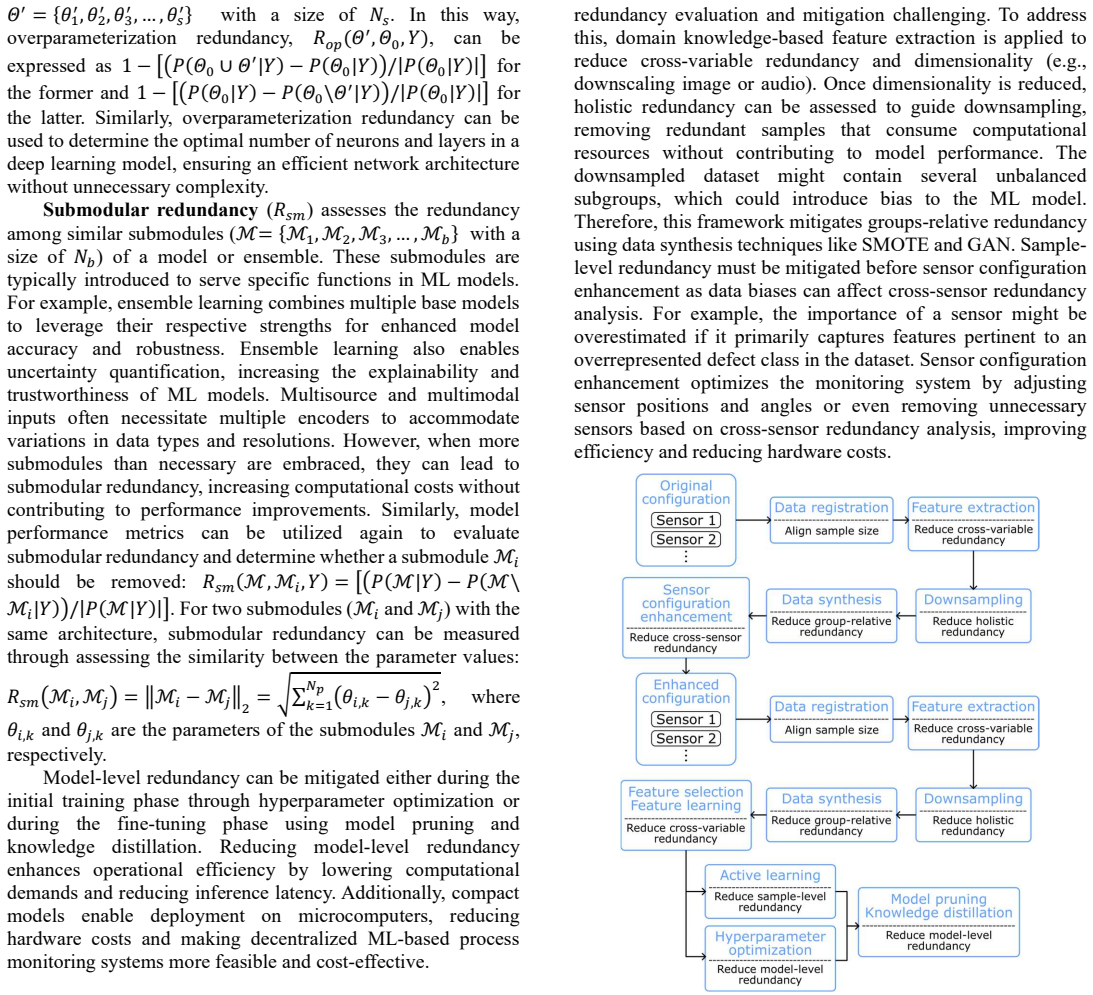
The machinery has three load-bearing pieces. First is the redundancy measure $R(C,K)=1-[(P(K\cup C)-P(K))/|P(K)|]$, a task-relative score that treats a component as redundant when adding it fails to improve—or worsens—a chosen performance, similarity, or information metric. Second is cross-modality knowledge transfer (CMKT), a shared-encoder architecture with contrastive semantic alignment that aligns latent representations of visual and audio inputs so one modality can predict from the other; this is what makes the microphone removable. Third is iterative $\ell^1$-norm-based model pruning, which removes the smallest-magnitude parameters until performance drops, turning earlier qualitative observations of overparameterization into a measured redundancy value.
What would settle it
Retrain the visual-only CMKT and the multimodal fusion classifier many times with different random seeds on the same dataset and compute confidence intervals for balanced accuracy; if the intervals overlap, the measured gap that produces $R=1.0082$ can be training noise, and removing the microphone is not supported by the evidence as stated.
Extended reading notes
Core claim
The central discovery is that redundancy is not merely harmless waste in ML-based AM monitoring; it actively degrades performance, and a systematic audit across sample, feature, and model levels can produce simultaneous gains in speed, accuracy, and compactness. Using the redundancy measure $R(C,K)=1-[(P(K\cup C)-P(K))/|P(K)|]$, the authors quantify when adding a component helps or hurts: $R<1$ means it contributes, $R=1$ means it is fully redundant but neutral, and $R>1$ means it is fully redundant and damaging. Applied to the audio-visual DED dataset, visual-only cross-modality knowledge transfer reaches 98.1% balanced accuracy versus 97.3% for multimodal fusion, giving $R=1.0082$ for the microphone, and pruning removes 92.9% and 99.7% of parameters from the two networks with $R=1$, i.e., zero measured accuracy loss. Together these steps cut error rate by 47% and latency by an order of magnitude, establishing redundancy mitigation as a way to build cheaper, faster, and more accurate monitoring systems.
Load-bearing premise
The load-bearing premise is that the 0.8 percentage-point difference between visual-only CMKT (98.1%) and multimodal fusion (97.3%) is a real, reproducible performance gap; on that difference hinge $R=1.0082$ and the verdict that the microphone is fully redundant.
Editorial extensions
If this is right
- A monitoring system built through the MLRM pipeline can run at 1.33 ms per sample, well below the 33.3 ms camera sampling interval, so inference no longer limits real-time control.
- Removing the audio channel halves the sensor bill in the case study, from $10,000 to $5,000, and deletes the associated transmission, storage, and maintenance overhead.
- Storage falls by 99.4%, from 4633.1 MB to 28.58 MB, making edge and embedded deployment realistic.
- Redundancy removal is not a trade-off against accuracy: in the case study the error rate drops by 47% while the model shrinks, so overparameterization and redundant data actively hurt performance.
- The same audit can be applied to other multimodal monitoring systems because the framework is not specific to DED or to audio-visual data.
Reading between the lines
- Because the redundancy measure is relative to the chosen metric $P$ and task $Y$, the label 'fully redundant' is conditional: the same audio features could be informative for a different monitoring target, such as melt-pool size regression or uncertainty estimation.
- An immediate testable extension is to run the same MLRM audit on thermal-plus-camera or structure-borne-sound monitoring data; if the microphone result generalizes, many production sensor suites carry fully removable channels.
- Since the authors explicitly leave redundancy's positive uses for future work, a natural next step is designing systems that deliberately keep a small, controlled amount of redundancy in safety-critical monitoring paths while still pruning the rest.
- The pruning results suggest that model capacity was not the limiting factor in this dataset; if that holds elsewhere, collecting more data or building larger architectures may matter less than cleaning and aligning the data already being collected.
Signed reviews
Editorial analysis
A structured set of objections, weighed in public.
Referee Report
Summary. The paper proposes a formal definition of redundancy in ML-based AM process monitoring, categorizes redundancy into sample-, feature-, and model-level subtypes, and introduces a multi-level redundancy mitigation (MLRM) framework that combines data registration, downscaling, cross-modality knowledge transfer, and model pruning. The framework is validated on a DED defect-detection case study using a public audio-visual dataset. The authors report a 91% latency reduction, a 47% error-rate decrease, and a 99.4% storage reduction, and conclude that the audio microphone is fully redundant (R=1.0082) and can be removed from the operation phase.
Significance. The paper addresses a real gap: most prior work addresses redundancy types in isolation, and there is no unified framework. The taxonomy and the step-by-step pipeline are useful for practitioners. The latency and storage measurements are direct and internally consistent. The entropy-based downscaling analysis is a nice touch. However, the central cross-sensor redundancy result is not established by the current comparison, and the error-rate reduction claim lacks a stated baseline. If the authors supply a controlled ablation with confidence intervals, the framework's claims could be substantiated; as it stands, the microphone-removal conclusion is not supported.
major comments (2)
- [§4.2, Eq. (3); §5, Fig. 5] The cross-sensor redundancy calculation in Eq. (3) uses balanced accuracies of 97.3% (multimodal fusion) and 98.1% (visual-only CMKT) taken from prior work [46]. However, the two systems differ in input resolution (320×320 vs 80×80), architecture (separate encoders vs. shared encoder), and training objective (standard fusion vs. contrastive semantic alignment). Section 5 explicitly states that downscaling itself improved balanced accuracy by mitigating overfitting. Therefore the 0.8 percentage-point gap cannot be attributed to removing the audio modality, and R=1.0082 does not establish cross-sensor redundancy. This is load-bearing because it grounds the microphone-removal and the 50% sensor-cost reduction claims. Please provide a controlled ablation in which the same architecture, resolution, and training procedure are used with and without the audio input, reporting mean and standard deviation of balanced accuracy over multiple random seeds.
- [§5, 'decreased the error rate by 47%'; Abstract] The manuscript claims a 47% decrease in error rate relative to the original system, but the balanced accuracy of the original system is never stated. Using the numbers in Eq. (3), the relative error-rate reduction from 97.3% to 98.1% is (2.7%−1.9%)/2.7% ≈ 29.6%, not 47%. The 47% figure apparently also includes the downscaling gain, but the intermediate balanced accuracy after downscaling and before CMKT is not reported. Please report the balanced accuracy after each MLRM step so the error-rate reduction can be verified.
minor comments (6)
- [§3.1.2] The formula for cross-sensor redundancy uses the subscript 'cv' (R_{cv}) where it should be 'cs' (R_{cs}) in the displayed equation for R(F_A, F_V, Y).
- [§5] The storage reduction numbers are hard to reconcile: the text gives 4633.1 MB initial total (dataset + model), then 226.06 MB for the downscaled dataset, then 28.49 MB after audio removal. Clarify whether 4633.1 MB is the original dataset alone or includes the original model, and how the ~18-fold reduction follows from 16× downscaling.
- [§4.2, Table 2] The redundancy calculation for downscaling (R_cv=0.833) uses the minimum entropy rather than the mean; justify this choice, since the mean and maximum entropy are barely changed.
- [§5] The statement 'sensor costs were reduced from $10,000 to $5000' is presented as fact; label this as an illustrative estimate or provide a source.
- [Throughout] There are several presentation issues: 'groups-relative' should be 'group-relative'; the abstract contains a duplicated 'However'; and Table 2 has a formatting artifact in the 'NA *' entry.
- [General] The paper does not include a data/code availability statement; since the case study relies on an open dataset and prior work [46], it would be helpful to state whether the trained models and metrics are available.
Circularity Check
Cross-sensor redundancy claim is an arithmetic restatement of self-cited accuracies; core latency/storage results remain independent.
-
self citation load bearing
[Section 4.2, Eq. (3)]
"As indicated in [46], the CMKT method achieved a balanced accuracy (𝐴𝑐𝑐തതതതത(•)) of 98.1%, which was higher than multimodal fusion that requires both modalities for predictions (97.3%). ... Therefore, the microphone is considered redundant during the operation and can be removed without performance compromise using CMKT."
Eq. (3) is the paper's own redundancy definition Eq. (1) with P set to balanced accuracy, so R=1.0082 is just 1 − (0.973 − 0.981)/0.981. The conclusion that audio is 'fully redundant' and that the microphone can be removed is an arithmetic restatement of the two accuracy numbers quoted from [46], the authors' own prior work. The paper does not reproduce those numbers in a new controlled experiment or isolate the audio modality by ablation; the sensor-removal claim is imported from a self-citation rather than derived from independent evidence in this paper.
full rationale
The redundancy definition in Eq. (1) is a convention, and applying it to measured accuracies is not itself circular. The majority of the reported gains—latency from 14.2 to 1.33 ms per sample, storage from 4633.1 to 28.58 MB, and pruning of 92.9%/99.7% of parameters without balanced-accuracy loss—are direct measurements made in this paper and do not depend on prior work. The circularity concern is isolated to the cross-sensor redundancy claim. Eq. (3) computes R=1.0082 by substituting two balanced accuracies from the authors' own prior publication [46] into the paper's own definition, so the conclusion that audio is fully redundant and the microphone can be removed is an arithmetic restatement of those two self-cited numbers. The comparison is additionally confounded: the original multimodal system uses 320×320 inputs and separate overparameterized encoders, while the CMKT system uses downscaled 80×80 inputs, a shared encoder, and a contrastive semantic alignment loss, and the text states that downscaling itself already changed the balanced accuracy. Thus the 0.8-point gap in Eq. (3) cannot be cleanly attributed to removing the audio modality alone. Because the latency, storage, and pruning results are independent and the redundancy definition is an accounting formula rather than a derived physical law, the overall circularity score is 4 rather than higher.
Assumptions & free parameters
free parameters (2)
- Image and spectrogram downscaling size =
80 x 80 pixels
- Pruning fractions =
92.9% of the shared encoder and 99.7% of the task classifier
assumptions (3)
- domain assumption Information entropy of raw pixels and spectrograms is a valid proxy for task-relevant information preserved by downscaling.
- domain assumption The balanced-accuracy numbers from the authors' prior CMKT work [46] are reliable and transferable to this replication.
- domain assumption Removing the microphone does not change the marginal distribution of the visual stream or the trained model's operating conditions.
Cite this review
Pith. "Pith review of Redundancy Analysis and Mitigation for Machine Learning-Based Process Monitoring of Additive Manufacturing." pith.science (2026). https://pith.science/paper/UEM5RCTX
@misc{pith2026250421317,
  author       = {Pith},
  title        = {Pith review of: Redundancy Analysis and Mitigation for Machine Learning-Based Process Monitoring of Additive Manufacturing},
  year         = {2026},
  howpublished = {\url{https://pith.science/paper/UEM5RCTX}},
  note         = {Machine review of arXiv:2504.21317}
}
read the original abstract
The deployment of machine learning (ML)-based process monitoring systems has significantly advanced additive manufacturing (AM) by enabling real-time defect detection, quality assessment, and process optimization. However, redundancy is a critical yet often overlooked challenge in the deployment and operation of ML-based AM process monitoring systems. Excessive redundancy leads to increased equipment costs, compromised model performance, and high computational requirements, posing barriers to industrial adoption. However, existing research lacks a unified definition of redundancy and a systematic framework for its evaluation and mitigation. This paper defines redundancy in ML-based AM process monitoring and categorizes it into sample-level, feature-level, and model-level redundancy. A comprehensive multi-level redundancy mitigation (MLRM) framework is proposed, incorporating advanced methods such as data registration, downscaling, cross-modality knowledge transfer, and model pruning to systematically reduce redundancy while improving model performance. The framework is validated through an ML-based in-situ defect detection case study for directed energy deposition (DED), demonstrating a 91% reduction in latency, a 47% decrease in error rate, and a 99.4% reduction in storage requirements. Additionally, the proposed approach lowers sensor costs and energy consumption, enabling a lightweight, cost-effective, and scalable monitoring system. By defining redundancy and introducing a structured mitigation framework, this study establishes redundancy analysis and mitigation as a key enabler of efficient ML-based process monitoring in production environments.
Figures


Figures from the paper (2 more)


Reference graph
Works this paper leans on
-
[46]
Xie, Jiarui, Safdar, Mutahar, Chen, Lequn, Moon, Seung Ki, and Zhao, Yaoyao Fiona. "Audio-visual cross-modality knowledge transfer for machine learning-based in-situ monitoring in laser additive manufacturing." Additive Manufacturing (2025): pp. 104692
work page 2025
-
[1]
Machine learning in additive manufacturing: State-of- the-art and perspectives
Wang, Chengcheng, Tan, XP, Tor, SB, and Lim, CS. "Machine learning in additive manufacturing: State-of- the-art and perspectives." Additive Manufacturing V ol. 36 (2020): pp. 101538
work page 2020
-
[2]
Additive manufacturing technologies
Gibson, Ian, Rosen, David W, Stucker, Brent, Khorasani, Mahyar, Rosen, David, Stucker, Brent, and Khorasani, Mahyar. Additive manufacturing technologies. Springer, (2021)
work page 2021
-
[3]
Yang, Mingzhang, Rezaei, Ali, and Vlasea, Mihaela. "Process Screening in Additive Manufacturing: Detection of Keyhole Mode using Surface Topography and Machine Learning." Additive Manufacturing Letters (2025): pp. 100275
work page 2025
-
[4]
Yang, Zhuo, Hong, Gi Suk, Lu, Yan, Hu, Chun-Chun, Yang, Haw-Ching, and Lane, Brandon. "Surface Roughness Repeatability Analysis for Multi-Build Overhang Parts in Powder Bed Fusion Additive Manufacturing." International Design Engineering Technical Conferences and Computers and Information in Engineering Conference. pp. V02AT02A039. 2024
work page 2024
-
[5]
Chen, Lequn, Bi, Guijun, Yao, Xiling, Su, Jinlong, Tan, Chaolin, Feng, Wenhe, Benakis, Michalis, Chew, Youxiang, and Moon, Seung Ki. "In-situ process monitoring and adaptive quality enhancement in laser additive manufacturing: a critical review." Journal of Manufacturing Systems V ol. 74 (2024): pp. 527-574
work page 2024
-
[6]
Zhu, Kunpeng, Fuh, Jerry Ying Hsi, and Lin, Xin. "Metal-based additive manufacturing condition monitoring: A review on machine learning based approaches." IEEE/ASME Transactions on Mechatronics V ol. 27 No. 5 (2021): pp. 2495-2510. *Corresponding author 12
work page 2021
-
[7]
Zhang, Ying, Safdar, Mutahar, Xie, Jiarui, Li, Jinghao, Sage, Manuel, and Zhao, Yaoyao Fiona. "A systematic review on data of additive manufacturing for machine learning applications: the data quality, type, preprocessing, and management." Journal of Intelligent Manufacturing V ol. 34 No. 8 (2023): pp. 3305-3340
work page 2023
Show all 48 references
-
[8]
Leveraging small-scale datasets for additive manufacturing process modeling and part certification: Current practice and remaining gaps
Fullington, Durant, Yangue, Emmanuel, Bappy, Mahathir Mohammad, Liu, Chenang, and Tian, Wenmeng. "Leveraging small-scale datasets for additive manufacturing process modeling and part certification: Current practice and remaining gaps." Journal of Manufacturing Systems (2024)
2024
-
[9]
Accurate Inverse Process Optimization Framework in Laser Directed Energy Deposition
Shang, Xiao, Li, Evelyn, Talbot, Ajay, Wen, Haitao, Lyu, Tianyi, Zhang, Jiahui, and Zou, Yu. "Accurate Inverse Process Optimization Framework in Laser Directed Energy Deposition." arXiv preprint arXiv:2407.17338 (2024)
2024 arXiv
-
[10]
Machine learning techniques in additive manufacturing: a state of the art review on design, processes and production control
Kumar, Sachin, Gopi, T, Harikeerthana, N, Gupta, Munish Kumar, Gaur, Vidit, Krolczyk, Grzegorz M, and Wu, ChuanSong. "Machine learning techniques in additive manufacturing: a state of the art review on design, processes and production control." Journal of Intelligent Manufactu...
2023
-
[11]
Current Applications of Machine Learning in Additive Manufacturing: A Review on Challenges and Future Trends
Vashishtha, Govind, Chauhan, Sumika, Zimroz, Radoslaw, Yadav, Nitin, Kumar, Rajesh, and Gupta, Munish Kumar. "Current Applications of Machine Learning in Additive Manufacturing: A Review on Challenges and Future Trends." Archives of Computational Methods in Engineering (2024):...
2024
-
[12]
Audio-visual cross-modality knowledge transfer for machine learning-based in-situ monitoring in laser additive manufacturing
Xie, Jiarui, Safdar, Mutahar, Chen, Lequn, Moon, Seung Ki, and Zhao, Yaoyao Fiona. "Audio-visual cross-modality knowledge transfer for machine learning-based in-situ monitoring in laser additive manufacturing." arXiv preprint arXiv:2408.05307 (2024)
2024 arXiv
-
[13]
Inference of Melt Pool Visual Characteristics in Laser Additive Manufacturing Using Acoustic Signal Features and Robotic Motion Data
Chen, Lequn, Chew, Youxiang, Feng, Wenhe, and Moon, Seung Ki. "Inference of Melt Pool Visual Characteristics in Laser Additive Manufacturing Using Acoustic Signal Features and Robotic Motion Data." 2024 10th International Conference on Control, Automation and Robotics (ICCAR)....
2024
-
[14]
Liu, Haolin, Gobert, Christian, Ferguson, Kevin, Abranovic, Brandon, Chen, Hongrui, Beuth, Jack L, Rollett, Anthony D, and Kara, Levent Burak. "Inference of highly time-resolved melt pool visual characteristics and spatially-dependent lack-of-fusion defects in laser powder bed...
2024
-
[15]
On the data quality and imbalance in machine learning- based design and manufacturing—A systematic review
Zhao, Yaoyao Fiona, Xie, Jiarui, and Sun, Lijun. "On the data quality and imbalance in machine learning- based design and manufacturing—A systematic review." Engineering (2024)
2024
-
[16]
A hybrid model compression approach via knowledge distillation for predicting energy consumption in additive manufacturing
Li, Yixin, Hu, Fu, Liu, Ying, Ryan, Michael, and Wang, Ray. "A hybrid model compression approach via knowledge distillation for predicting energy consumption in additive manufacturing." International Journal of Production Research V ol. 61 No. 13 (2023): pp. 4525-4547
2023
-
[17]
Distilling the knowledge in a neural network
Hinton, Geoffrey, Vinyals, Oriol, and Dean, Jeff. "Distilling the knowledge in a neural network." arXiv preprint arXiv:1503.02531 (2015)
2015 arXiv
-
[18]
Information theory: a tutorial introduction
Stone, James V . "Information theory: a tutorial introduction." (2015)
2015
-
[19]
The elements of statistical learning: data mining, inference, and prediction
Hastie, Trevor, Tibshirani, Robert, Friedman, Jerome H, and Friedman, Jerome H. The elements of statistical learning: data mining, inference, and prediction. Springer, (2009)
2009
-
[20]
Feature engineering in additive manufacturing
Safdar, Mutahar, Lamouche, Guy, Paul, Padma Polash, Wood, Gentry, and Zhao, Yaoyao Fiona. "Feature engineering in additive manufacturing." Engineering of Additive Manufacturing Features for Data-Driven Solutions: Sources, Techniques, Pipelines, and Applications. Springer (2023...
2023
-
[21]
Feature selection and feature learning in machine learning applications for gas turbines: A review
Xie, Jiarui, Sage, Manuel, and Zhao, Yaoyao Fiona. "Feature selection and feature learning in machine learning applications for gas turbines: A review." Engineering Applications of Artificial Intelligence V ol. 117 (2023): pp. 105591
2023
-
[22]
Multisensor fusion-based digital twin for localized quality prediction in robotic laser-directed energy deposition
Chen, Lequn, Bi, Guijun, Yao, Xiling, Tan, Chaolin, Su, Jinlong, Ng, Nicholas Poh Huat, Chew, Youxiang, Liu, Kui, and Moon, Seung Ki. "Multisensor fusion-based digital twin for localized quality prediction in robotic laser-directed energy deposition." Robotics and Computer-Int...
2023
-
[23]
Active learning via adaptive weighted uncertainty sampling applied to additive manufacturing
van Houtum, Gijs JJ and Vlasea, Mihaela L. "Active learning via adaptive weighted uncertainty sampling applied to additive manufacturing." Additive Manufacturing V ol. 48 (2021): pp. 102411
2021
-
[24]
MeltpoolGAN: Melt pool prediction from path- level thermal history
Chen, Hongrui, Liu, Xin, Liu, Xingchen, and Witherell, Paul. "MeltpoolGAN: Melt pool prediction from path- level thermal history." Additive Manufacturing V ol. 84 (2024): pp. 104095
2024
-
[25]
Selecting subsets of source data for transfer learning with applications in metal additive manufacturing
Tang, Yifan, Rahmani Dehaghani, Mostafa, Sajadi, Pouyan, and Wang, G Gary. "Selecting subsets of source data for transfer learning with applications in metal additive manufacturing." Journal of Intelligent Manufacturing (2024): pp. 1-22
2024
-
[26]
Knowledge distillation-based information sharing for online process monitoring in decentralized manufacturing system
Shi, Zhangyue, Li, Yuxuan, and Liu, Chenang. "Knowledge distillation-based information sharing for online process monitoring in decentralized manufacturing system." Journal of Intelligent Manufacturing (2024): pp. 1-16
2024
-
[27]
In-situ monitoring additive manufacturing process with AI edge computing
Zhu, Wenkang, Li, Hui, Shen, Shengnan, Wang, Yingjie, Hou, Yuqing, Zhang, Yikai, and Chen, Liwei. "In-situ monitoring additive manufacturing process with AI edge computing." Optics & Laser Technology V ol. 171 (2024): pp. 110423. *Corresponding author 13
2024
-
[28]
Acoustic anomaly detection in additive manufacturing with long short-term memory neural networks
Becker, Pascal, Roth, Christian, Roennau, Arne, and Dillmann, Ruediger. "Acoustic anomaly detection in additive manufacturing with long short-term memory neural networks." 2020 IEEE 7th International Conference on Industrial Engineering and Applications (ICIEA). pp. 921-926. 2020
2020
-
[29]
Segmentation of Additive Manufacturing Defects Using U-Net
Wong, Vivian Wen Hui, Ferguson, Max, Law, Kincho H, Lee, Yung-Tsun Tina, and Witherell, Paul. "Segmentation of Additive Manufacturing Defects Using U-Net." Journal of Computing and Information Science in Engineering V ol. 22 No. 3 (2022)
2022
-
[30]
Augmented time regularized generative adversarial network (atr-gan) for data augmentation in online process anomaly detection
Li, Yuxuan, Shi, Zhangyue, Liu, Chenang, Tian, Wenmeng, Kong, Zhenyu, and Williams, Christopher B. "Augmented time regularized generative adversarial network (atr-gan) for data augmentation in online process anomaly detection." IEEE Transactions on Automation Science and Engin...
2021
-
[31]
Effective variational-autoencoder-based generative models for highly imbalanced fault detection data in semiconductor manufacturing
Fan, Shu-Kai S, Tsai, Du-Ming, and Yeh, Pei-Chi. "Effective variational-autoencoder-based generative models for highly imbalanced fault detection data in semiconductor manufacturing." IEEE Transactions on Semiconductor Manufacturing V ol. 36 No. 2 (2023): pp. 205-214
2023
-
[32]
Diffusion generative model-based learning for smart layer-wise monitoring of additive manufacturing
Yangue, Emmanuel, Fullington, Durant, Smith, Owen, Tian, Wenmeng, and Liu, Chenang. "Diffusion generative model-based learning for smart layer-wise monitoring of additive manufacturing." Journal of Computing and Information Science in Engineering V ol. 24 No. 6 (2024): pp. 060903
2024
-
[33]
Engineering of Additive Manufacturing Features for Data-Driven Solutions: Sources, Techniques, Pipelines, and Applications
Safdar, Mutahar, Lamouche, Guy, Paul, Padma Polash, Wood, Gentry, and Zhao, Yaoyao Fiona. Engineering of Additive Manufacturing Features for Data-Driven Solutions: Sources, Techniques, Pipelines, and Applications. Springer, (2023)
2023
-
[34]
Porosity prediction: Supervised- learning of thermal history for direct laser deposition
Khanzadeh, Mojtaba, Chowdhury, Sudipta, Marufuzzaman, Mohammad, Tschopp, Mark A, and Bian, Linkan. "Porosity prediction: Supervised- learning of thermal history for direct laser deposition." Journal of manufacturing systems V ol. 47 (2018): pp. 69-82
2018
-
[35]
Defect classification of laser metal deposition using logistic regression and artificial neural networks for pattern recognition
Gaja, Haythem and Liou, Frank. "Defect classification of laser metal deposition using logistic regression and artificial neural networks for pattern recognition." The International Journal of Advanced Manufacturing Technology V ol. 94 (2018): pp. 315-326
2018
-
[36]
Physics- guided long short-term memory networks for emission prediction in laser powder bed fusion
Lei, Rong, Guo, YB, and Guo, Weihong. "Physics- guided long short-term memory networks for emission prediction in laser powder bed fusion." Journal of Manufacturing Science and Engineering V ol. 146 No. 1 (2024)
2024
-
[37]
A hybrid deep learning model of process-build interactions in additive manufacturing
Yazdi, Reza Mojahed, Imani, Farhad, and Yang, Hui. "A hybrid deep learning model of process-build interactions in additive manufacturing." Journal of Manufacturing Systems V ol. 57 (2020): pp. 460-468
2020
-
[38]
Machine learning in additive manufacturing: State-of-the-art and perspectives
Wang, Chengcheng, Tan, Xipeng P, Tor, Shu Beng, and Lim, CS. "Machine learning in additive manufacturing: State-of-the-art and perspectives." Additive Manufacturing V ol. 36 (2020): pp. 101538
2020
-
[39]
Evaluation of design information disclosure through thermal feature extraction in metal based additive manufacturing
Bappy, Mahathir Mohammad, Fullington, Durant, Bian, Linkan, and Tian, Wenmeng. "Evaluation of design information disclosure through thermal feature extraction in metal based additive manufacturing." Manufacturing Letters V ol. 36 (2023): pp. 86-90
2023
-
[40]
Real-time FDM machine condition monitoring and diagnosis based on acoustic emission and hidden semi-Markov model
Wu, Haixi, Yu, Zhonghua, and Wang, Yan. "Real-time FDM machine condition monitoring and diagnosis based on acoustic emission and hidden semi-Markov model." The International Journal of Advanced Manufacturing Technology V ol. 90 (2017): pp. 2027- 2036
2017
-
[41]
Automated anomaly detection of laser-based additive manufacturing using melt pool sparse representation and unsupervised learning
Zhao, Xiyue, Imandoust, Aidin, Khanzadeh, Mojtaba, Imani, Farhad, and Bian, Linkan. "Automated anomaly detection of laser-based additive manufacturing using melt pool sparse representation and unsupervised learning." (2021)
2021
-
[42]
An LSTM-autoencoder based online side channel monitoring approach for cyber-physical attack detection in additive manufacturing
Shi, Zhangyue, Mamun, Abdullah Al, Kan, Chen, Tian, Wenmeng, and Liu, Chenang. "An LSTM-autoencoder based online side channel monitoring approach for cyber-physical attack detection in additive manufacturing." Journal of Intelligent Manufacturing (2023): pp. 1-17
2023
-
[43]
A farewell to the bias-variance tradeoff? an overview of the theory of overparameterized machine learning
Dar, Yehuda, Muthukumar, Vidya, and Baraniuk, Richard G. "A farewell to the bias-variance tradeoff? an overview of the theory of overparameterized machine learning." arXiv preprint arXiv:2109.02355 (2021)
2021 arXiv
-
[44]
Reconciling modern machine-learning practice and the classical bias–variance trade-off
Belkin, Mikhail, Hsu, Daniel, Ma, Siyuan, and Mandal, Soumik. "Reconciling modern machine-learning practice and the classical bias–variance trade-off." Proceedings of the National Academy of Sciences V ol. 116 No. 32 (2019): pp. 15849-15854
2019
-
[45]
Deep learning-based data registration of melt-pool-monitoring images for laser powder bed fusion additive manufacturing
Kim, Jaehyuk, Yang, Zhuo, Ko, Hyunwoong, Cho, Hyunbo, and Lu, Yan. "Deep learning-based data registration of melt-pool-monitoring images for laser powder bed fusion additive manufacturing." Journal of Manufacturing Systems V ol. 68 (2023): pp. 117-129
2023
-
[47]
Optimal placement of non-redundant sensors for structural health monitoring under model uncertainty and measurement noise
An, Haichao, Youn, Byeng D, and Kim, Heung Soo. "Optimal placement of non-redundant sensors for structural health monitoring under model uncertainty and measurement noise." Measurement V ol. 204 (2022): pp. 112102
2022
-
[48]
Classification of specimen density in laser powder bed fusion (L-PBF) using in-process structure-borne acoustic process emissions
Eschner, N, Weiser, L, Häfner, B, and Lanza, G. "Classification of specimen density in laser powder bed fusion (L-PBF) using in-process structure-borne acoustic process emissions." Additive Manufacturing V ol. 34 (2020): pp. 101324
2020
Reviewed August 16, 2026 · model on record in the stance chip above.
Discussion (0). Continue with ORCID to comment.