REVIEW 5 major objections 4 minor 61 references
Multi-level datasets training method in Physics-Informed Neural Networks
T0 review · 5 major / 4 minor · reviewed 2026-08-16 · deepseek-v4-flash
Pith's one-line read Multi-level dataset cycling cuts PINN errors by 30–60 percent and reaches Re=5000.
desk verdict A simple, plausible dataset-switching schedule for PINNs with real but modest epoch-matched gains; the larger 30–60% claims are not yet causally attributed to the method. read the letter →
The pith
A machine-rendered reading of the paper's core claim, the machinery that carries it, and where it could break.
The reading
What carries the argument
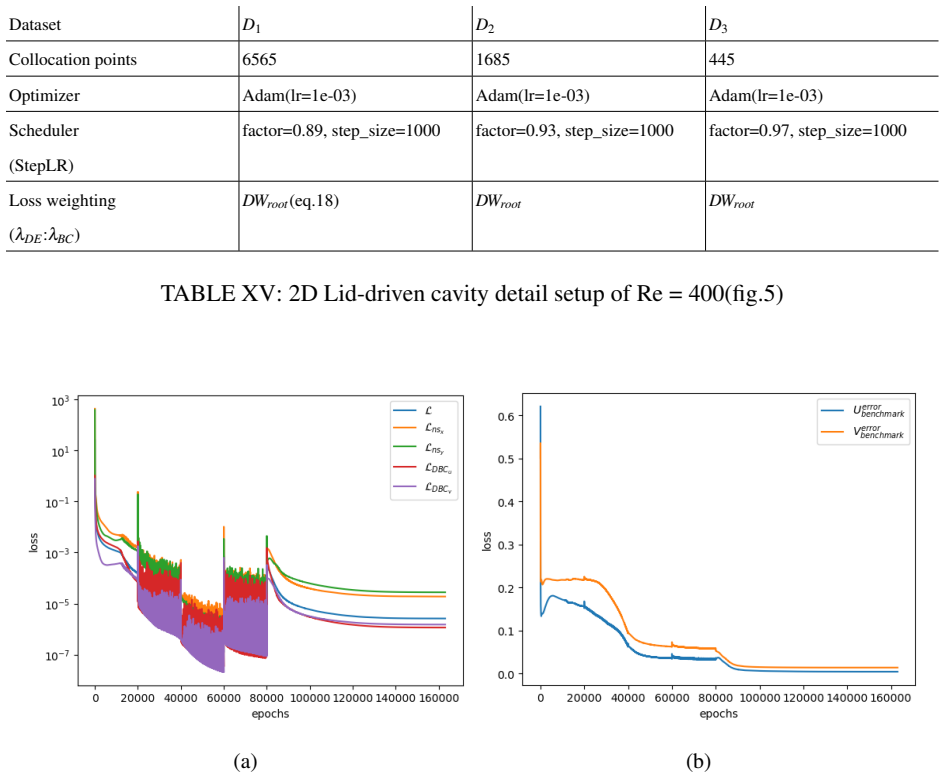
The central object is a multi-level dataset training schedule: a fixed set of collocation datasets $D_1, D_2, D_3$ with decreasing numbers of points (e.g., 6670, 1770, 435 for the convection-diffusion case; 6565, 1685, 445 for the cavity at $Re=400$), cycled in sequences such as V-cycle ($D_1\to D_2\to D_3\to D_2\to D_1$) or W-cycle. The mechanism is that each level is trained with its own Adam optimizer and learning-rate scheduler and then connected to the next level through transfer learning, so that the network sees the same architecture but different collocation densities. For the cavity problem, the composite loss weights are fixed by the dimensional-analysis DWroot rule rather than by adaptive weighting. The intended function of the schedule is multigrid-like frequency separation: small datasets are supposed to teach low-frequency error components and large datasets high-frequency ones, so that alternation removes both kinds of error.
What would settle it
Hold total epochs and the sequence of learning-rate schedules fixed but replace the multi-dataset V-cycle with a single collocation set; if accuracy matches the multi-dataset run, dataset switching is not the cause. Then check the network's prediction spectrum after each level: the mechanism predicts low frequencies dominate on the smallest set and high frequencies appear on the largest.
Extended reading notes
Core claim
The paper's central claim is that spectral bias in PINN training can be counteracted by cycling through collocation datasets of different sizes, treating each switch as a transfer-learning step with its own optimizer and learning-rate scheduler. On the 1D equation $f(x)=\sin(10x)$ in $[0,2\pi]$, a two-level schedule (64 points, then 32, then 64) lowers the relative $L^2$ test error from $1.15\times10^{-1}$ to $4.16\times10^{-2}$ in the same 30,000 epochs. On the 2D convection-diffusion benchmark, a three-level V-cycle (6670, 1770, 435, 1770, 6670 points) improves the relative $L^2$ error from $2.54\times10^{-3}$ to $2.10\times10^{-3}$ at fixed 50,000-epoch cost. For the steady lid-driven cavity at $Re=400$, random V-cycling over three collocation sets reduces the best mean absolute error by 64 percent versus a single random dataset, and with curriculum training through $Re=400,1000,2000,3200,5000$ the model reaches about $7\times10^{-2}$ mean absolute error at $Re=5000$. All runs keep the same MLP with a sine first layer and Swish hidden layers; only the dataset sequence and per-level schedules change.
Load-bearing premise
The load-bearing premise is that training on a smaller collocation set exposes the network to lower-frequency components and that switching dataset sizes—rather than the extra training time, the per-level schedulers, or transfer-learning warm starts—is what produces the 30–60 percent gains.
Editorial extensions
If this is right
- Because the method only changes the collocation schedule, it can be added to any existing PINN architecture without new layers, loss terms, or feature engineering.
- Layered onto curriculum training, it extends PINN solvability to Reynolds numbers like $Re=5000$ where single-dataset training does not converge, and with fewer parameter updates than the published comparison methods.
- The reported 30–60 percent error reductions suggest the scheme can help on any PDE with multiple frequency scales, including sharp-front transport problems and oscillatory solutions.
- Per-level learning-rate schedulers become the main tuning knob, giving practitioners a concrete substitute for hand-tuning a single global schedule.
Reading between the lines
- A control that replays the same per-level optimizer and scheduler steps on a single dataset would determine whether dataset switching, rather than the added optimization structure, causes the gains; the paper does not report such a control.
- If the multigrid analogy is exact, the optimal number of levels and the collocation ratios could be derived from the problem's frequency content or from the network's NTK spectrum, turning the schedule into an automatic design.
- The approach should combine with residual-based adaptive sampling—using the coarse levels to locate regions needing refinement—though the paper does not test this combination.
- The reported improvement is relative to single-dataset baselines with hand-picked schedulers, so in other applications the practical gain may depend on how well the baseline is already tuned.
Signed reviews
Editorial analysis
A structured set of objections, weighed in public.
Referee Report
Summary. The paper proposes a multi-level dataset training procedure for Physics-Informed Neural Networks (PINNs), inspired by multigrid ideas. Instead of training on a single collocation dataset, the method alternates between datasets of different collocation densities, each equipped with its own optimizer and learning-rate scheduler, using a transfer-learning-style handoff. The authors report accuracy gains on a 1D high-frequency ODE, the Smith-Hutton convection-diffusion problem, and steady lid-driven cavity flows at Re=400, 1000, and 5000, claiming 30--60% accuracy improvements and attributing the gains to mitigating spectral bias through exposure to different frequency scales. The paper also combines the approach with curriculum training for the higher-Reynolds-number cavity cases and compares against published PINN results and CFD references.
Significance. If the claimed gains are causal, the method is attractive because it is a training-level modification that leaves the network architecture and loss formulation unchanged, and it is compatible with transfer and curriculum learning. The paper's use of external benchmarks (Ghia et al., Smith-Hutton) and the detailed per-level training tables in the appendix are positive features. However, the current evidence does not establish the mechanism or the headline improvement magnitude: the central cavity comparison is confounded with total epoch count and schedule changes, the ODE benchmark contains an incorrect derivative that invalidates the experiment as written, run-to-run variability is not reported, and the spectral-bias mechanism is asserted rather than measured. The Smith-Hutton experiment provides some controlled evidence (equal total epochs, equal per-level optimizers and schedulers), but it is a single run and shows a modest improvement. With corrected benchmarks and controlled ablation experiments, the contribution would be of genuine interest to the PINN community.
major comments (5)
- [§III.B, Eq. (9)] The derivative in Eq. (9) is incorrect: d/dx sin(10x) = 10 cos(10x), not 10 sin(10x). As written, the residual equation is inconsistent with the stated exact solution f(x)=sin(10x), and the boundary conditions f(0)=f(2π)=0 do not determine the stated solution. The 64% test-error improvement in Table IV is therefore not a valid validation of the method until Eq. (9), the corresponding loss definition, and the reported experiment are corrected and rerun.
- [§III.D, Table IX] The headline Re=400 comparison is not controlled. The 'Random, 1 level' baseline runs 104,000 epochs, while 'Random, V-cycle' runs 163,000 epochs and the other variants run 162,000--184,000 epochs; additionally, the per-level schedulers in Table XV differ across levels. The claimed 64.1% error decrease could therefore be due to extra training, learning-rate cycling, or the combined schedule rather than to dataset switching. An epoch-matched baseline with the same optimizer/scheduler trajectory, or at least a matched total number of parameter updates, is required to attribute the gain to the proposed mechanism.
- [§II.A and §IV] The mechanistic premise that smaller collocation sets expose the network to lower-frequency components is never tested. Section II.A asserts this spectral relationship, but Section IV explicitly defers 'numerical analyses on training frequencies' to future work. Without frequency-content measurements or a mechanism-based ablation, the analogy to multigrid remains a hypothesis rather than a demonstrated explanation of the observed accuracy gains.
- [Abstract and §II.A] The abstract claims the method avoids time spent 'fine-tuning of neural network structures, loss weights as well as hyperparameters,' but the experiments hand-select per-level optimizers, learning rates, scheduler factors, stopping criteria, and network widths (Tables XIII--XVII), and different architectures are used for different problems. This overstates the turnkey character of the proposed approach.
- [§III.D, Table XII] The Re=5000 result is not evidence for the multi-dataset procedure: it compares the proposed pipeline against other published methods, but it does not include a same-architecture, same-epoch ablation trained without the V-cycle/curriculum schedule. The contribution of dataset switching at high Reynolds number is therefore untested.
minor comments (4)
- [§III.C, Eq. (11)] Eq. (11a) appears to contain a typo in the diffusion term: '∂²φ/∂xy' should be '∂²φ/∂x² + ∂²φ/∂y²'. Also, 'Pelect number' should be 'Péclet number'.
- [§III.C, Table VI] The text says the proposed method improves accuracy by 20%, but the relative L2 reduction in Table VI is (2.54e-3 - 2.10e-3)/2.54e-3 ≈ 17%; the reported percentage should be reconciled.
- [§III.D, Table IX] The column 'Error decrease' is reported with negative percentages, which is confusing because a decrease should be a positive number; the formula also averages the relative reductions of u and v without justification. Please clarify the sign convention and the aggregation.
- [§III.B--D] All experiments appear to be single runs without seed variability. Reporting mean and standard deviation over at least three seeds, particularly for the ODE and Smith-Hutton cases, would calibrate the magnitude of the reported gains.
Circularity Check
No circularity: benchmark comparisons are external, and the self-cited DWroot weighting is an input, not a fitted prediction.
full rationale
The paper's central accuracy claims are validated against external references, not against quantities produced by the method itself. The 1D ODE and Smith-Hutton cases are compared with ground-truth/CFD reference solutions, the lid-driven cavity results are compared with Ghia et al.'s reference data, and Table XII compares the proposed model with independently published PINN results. No fitted parameter is renamed as a prediction: the dimensional-analysis weighting DWroot is adopted from a prior same-group thesis, but it is fully specified in Eqs. (17)-(18) of this paper and used as a fixed input for the cavity experiments; it is not inferred from the benchmark outputs, and the reported accuracy gains are not explained by that weighting alone. The multilevel dataset sequences (V-cycle, W-cycle) are design choices inspired by multigrid and MscaleDNN, not derived from the target results. The spectral-bias premise in Section II.A is an unmeasured design assumption, and the paper itself defers numerical analyses of training frequencies to future work; this is a rigor or attribution concern, not circularity, because no claim reduces by construction to its own input. The absence of epoch-matched controls means the 30-60% improvement may be confounded by longer training or per-level scheduler settings, but that is an alternative explanation for a benchmark result, not an equivalence between input and output. Accordingly, no circular step meeting the required evidentiary standard is present.
Assumptions & free parameters
free parameters (5)
- h length scale in DWroot =
1/81 for 6565 collocations; varies as 1/Round(sqrt(N))
- Dataset sizes per level =
(16,64) ODE; (435,1770,6670) SH; (445,1685,6565) Re=400/1000; (965,3725,14645) Re=5000
- Training epochs per level =
e.g., 5000/10000/15000 for ODE; 10000 per level for SH V-cycle; 20000 per level for cavity
- Per-level scheduler hyperparameters =
e.g., factor=0.65/0.8, patience=100 for ODE; factor=0.73/0.80/0.88 for cavity curriculum
- Initial learning rates per level =
1e-3 ODE/cavity; 5e-3 SH; 1e-4/4e-5 in Re=5000 curriculum
assumptions (3)
- domain assumption Minimizing the MSE-based PINN loss (Eq. 4-6) with Adam yields an approximate strong solution of the PDE on the training collocation points.
- ad hoc to paper Smaller collocation datasets expose the network to different (lower) frequency components, and switching between datasets during training alleviates spectral bias.
- ad hoc to paper The derivative of sin(10x) is 10 sin(10x) as written in Eq. 9.
Cite this review
Pith. "Pith review of Multi-level datasets training method in Physics-Informed Neural Networks." pith.science (2026). https://pith.science/paper/PEMGSP6W
@misc{pith2026250421328,
  author       = {Pith},
  title        = {Pith review of: Multi-level datasets training method in Physics-Informed Neural Networks},
  year         = {2026},
  howpublished = {\url{https://pith.science/paper/PEMGSP6W}},
  note         = {Machine review of arXiv:2504.21328}
}
read the original abstract
Physics-Informed Neural Networks have emerged as a promising methodology for solving PDEs, gaining significant attention in computer science and various physics-related fields. Despite being demonstrated the ability to incorporate the physics of laws for versatile applications, PINNs still struggle with the challenging problems which are stiff to be solved and/or have high-frequency components in the solutions, resulting in accuracy and convergence issues. It may not only increase computational costs, but also lead to accuracy loss or solution divergence. In this study, an alternative approach is proposed to mitigate the above-mentioned problems. Inspired by the multi-grid method in CFD community, the underlying idea of the current approach is to efficiently remove different frequency errors via training with different levels of training samples, resulting in a simpler way to improve the training accuracy without spending time in fine-tuning of neural network structures, loss weights as well as hyperparameters. To demonstrate the efficacy of current approach, we first investigate canonical 1D ODE with high-frequency component and 2D convection-diffusion equation with V-cycle training strategy. Finally, the current method is employed for the classical benchmark problem of steady Lid-driven cavity flows at different Reynolds numbers, to investigate the applicability and efficacy for the problem involved multiple modes of high and low frequency. By virtue of various training sequence modes, improvement through predictions lead to 30% to 60% accuracy improvement. We also investigate the synergies between current method and transfer learning techniques for more challenging problems (i.e., higher Re). From the present results, it also revealed that the current framework can produce good predictions even for the case of Re=5000, demonstrating the ability to solve complex high-frequency PDEs.
Figures


Figures from the paper (9 more)



Reference graph
Works this paper leans on
-
[1]
author author H. Lee \ and\ author I. S. \ Kang ,\ title title Neural algorithm for solving differential equations , \ https://doi.org/https://doi.org/10.1016/0021-9991(90)90007-N journal journal Journal of Computational Physics \ volume 91 ,\ pages 110--131 ( year 1990 ) NoStop
-
[2]
author author A. Meade \ and\ author A. Fernandez ,\ title title Solution of nonlinear ordinary differential equations by feedforward neural networks , \ https://doi.org/https://doi.org/10.1016/0895-7177(94)00160-X journal journal Mathematical and Computer Modelling \ volume 20 ,\ pages 19--44 ( year 1994 ) NoStop
-
[3]
author author M. Perdikaris P. Karniadakis G. E. Raissi ,\ title title Physics-informed neural networks: A deep learning framework for solving forward and inverse problems involving nonlinear partial differential equations. \ @noop journal journal Journal of Computational physics. \ volume 378 ,\ pages 686--707 ( year 2019 ) NoStop
work page 2019
-
[4]
author author M. Raissi , author P. Perdikaris ,\ and\ author G. E. \ Karniadakis ,\ title title Physics informed deep learning (part I): data-driven solutions of nonlinear partial differential equations , \ http://arxiv.org/abs/1711.10561 journal journal CoRR \ volume abs/1711.10561 ( year 2017 a ) ,\ https://arxiv.org/abs/1711.10561 1711.10561 NoStop
arXiv 2017
-
[5]
author author M. Raissi , author P. Perdikaris ,\ and\ author G. E. \ Karniadakis ,\ title title Physics informed deep learning (part II): data-driven discovery of nonlinear partial differential equations , \ http://arxiv.org/abs/1711.10566 journal journal CoRR \ volume abs/1711.10566 ( year 2017 b ) ,\ https://arxiv.org/abs/1711.10566 1711.10566 NoStop
arXiv 2017
-
[6]
author author A. G. \ Baydin , author B. A. \ Pearlmutter , author A. A. \ Radul ,\ and\ author J. M. \ Siskind ,\ title title Automatic differentiation in machine learning: a survey , \ http://jmlr.org/papers/v18/17-468.html journal journal Journal of Machine Learning Research \ volume 18 ,\ pages 1--43 ( year 2018 ) NoStop
work page 2018
-
[7]
author author S. J. W. \ Suvrit Sra , Sebastian Nowozin ,\ @noop title Optimization for Machine Learning \ ( publisher The MIT Press ,\ year 2011 ) NoStop
work page 2011
-
[8]
author author Y. B. \ Ian Goodfellow \ and\ author A. Courville ,\ @noop title Deep Learning \ ( publisher The MIT Press ,\ year 2016 ) NoStop
work page 2016
Show all 61 references
-
[9]
Jeong , author J
author author H. Jeong , author J. Bai , author C. Batuwatta-Gamage , author C. Rathnayaka , author Y. Zhou ,\ and\ author Y. Gu ,\ title title A physics-informed neural network-based topology optimization (pinnto) framework for structural optimization , \ https://doi.org/http...
-
[10]
Kervadec , author J
author author H. Kervadec , author J. Bouchtiba , author C. Desrosiers , author E. Granger , author J. Dolz ,\ and\ author I. Ben Ayed ,\ title title Boundary loss for highly unbalanced segmentation , \ https://doi.org/https://doi.org/10.1016/j.media.2020.101851 journal journa...
-
[11]
\ Chiu , author J
author author P.-H. \ Chiu , author J. C. \ Wong , author C. Ooi , author M. H. \ Dao ,\ and\ author Y.-S. \ Ong ,\ title title Can-pinn: A fast physics-informed neural network based on coupled-automatic–numerical differentiation method , \ https://doi.org/10.1016/j.cma.2022.1...
-
[12]
Zhang , author Y
author author P. Zhang , author Y. Hu , author Y. Jin , author S. Deng , author X. Wu ,\ and\ author J. Chen ,\ title title A maxwell's equations based deep learning method for time domain electromagnetic simulations , \ https://doi.org/https://doi.org/10.1109/JMMCT.2021.30577...
-
[13]
Sharma , author W
author author P. Sharma , author W. T. \ Chung , author B. Akoush ,\ and\ author M. Ihme ,\ title title A review of physics-informed machine learning in fluid mechanics , \ https://doi.org/10.3390/en16052343 journal journal Energies \ volume 16 ( year 2023 ),\ 10.3390/en160523...
-
[14]
Pang , author L
author author G. Pang , author L. Lu ,\ and\ author G. E. \ Karniadakis ,\ title title fpinns: Fractional physics-informed neural networks , \ https://doi.org/10.1137/18M1229845 journal journal SIAM Journal on Scientific Computing \ volume 41 ,\ pages A2603--A2626 ( year 2019 ...
-
[15]
\ Liao \ and\ author C.-A
author author Y.-T. \ Liao \ and\ author C.-A. \ Lin ,\ title title Accelerating fractional step simulation with autoencoder , \ @noop journal journal Master thesis, Department of Power Mechanical Engineering, National Tsing Hua University \ ( year 2021 ) NoStop
2021
-
[16]
author author A. D. \ Jagtap , author E. Kharazmi ,\ and\ author G. E. \ Karniadakis ,\ title title Conservative physics-informed neural networks on discrete domains for conservation laws: Applications to forward and inverse problems , \ https://doi.org/https://doi.org/10.1016...
-
[17]
author author A. D. \ Jagtap \ and\ author G. E. \ Karniadakis ,\ title title Extended physics-informed neural networks (xpinns): A generalized space-time domain decomposition based deep learning framework for nonlinear partial differential equations , \ @noop journal journal ...
2020
-
[18]
Sirignano , author J
author author J. Sirignano , author J. F. \ MacArt ,\ and\ author J. B. \ Freund ,\ title title Dpm: A deep learning pde augmentation method with application to large-eddy simulation , \ https://doi.org/https://doi.org/10.1016/j.jcp.2020.109811 journal journal Journal of Compu...
-
[19]
Kochkov , author J
author author D. Kochkov , author J. A. \ Smith , author A. Alieva , author Q. Wang , author M. P. \ Brenner ,\ and\ author S. Hoyer ,\ title title Machine learning–accelerated computational fluid dynamics , \ https://doi.org/10.1073/pnas.2101784118 journal journal Proceedings...
-
[20]
Maulik , author O
author author R. Maulik , author O. San , author A. Rasheed ,\ and\ author P. Vedula ,\ title title Subgrid modelling for two-dimensional turbulence using neural networks , \ https://doi.org/10.1017/jfm.2018.770 journal journal Journal of Fluid Mechanics \ volume 858 ,\ pages ...
2018 doi
-
[21]
Shi , author N
author author Z. Shi , author N. S. \ Gulgec , author A. S. \ Berahas , author S. N. \ Pakzad ,\ and\ author M. Takáč ,\ title title Finite difference neural networks: Fast prediction of partial differential equations , \ @noop \ ( year 2020 ) ,\ https://arxiv.org/abs/2006.018...
2020 arXiv
-
[22]
Sukumar \ and\ author A
author author N. Sukumar \ and\ author A. Srivastava ,\ title title Exact imposition of boundary conditions with distance functions in physics-informed deep neural networks , \ https://doi.org/https://doi.org/10.1016/j.cma.2021.114333 journal journal Computer Methods in Applie...
-
[23]
Wang , author Y
author author J. Wang , author Y. Mo , author B. Izzuddin ,\ and\ author C.-W. \ Kim ,\ title title Exact dirichlet boundary physics-informed neural network epinn for solid mechanics , \ https://doi.org/https://doi.org/10.1016/j.cma.2023.116184 journal journal Computer Methods...
-
[24]
author author J. C. \ Wong , author P.-H. \ Chiu , author C. Ooi , author M. H. \ Dao ,\ and\ author Y.-S. \ Ong ,\ title title Lsa-pinn: Linear boundary connectivity loss for solving pdes on complex geometry , \ booktitle booktitle 2023 International Joint Conference on Neura...
2023
-
[25]
Goswami , author C
author author S. Goswami , author C. Anitescu , author S. Chakraborty ,\ and\ author T. Rabczuk ,\ title title Transfer learning enhanced physics informed neural network for phase-field modeling of fracture , \ https://doi.org/https://doi.org/10.1016/j.tafmec.2019.102447 journ...
-
[26]
author author S. Chakraborty ,\ title title Transfer learning based multi-fidelity physics informed deep neural network , \ https://doi.org/https://doi.org/10.1016/j.jcp.2020.109942 journal journal Journal of Computational Physics \ volume 426 ,\ pages 109942 ( year 2021 ) NoStop
2020
-
[27]
Penwarden , author S
author author M. Penwarden , author S. Zhe , author A. Narayan ,\ and\ author R. M. \ Kirby ,\ title title A metalearning approach for physics-informed neural networks (pinns): Application to parameterized pdes , \ https://doi.org/https://doi.org/10.1016/j.jcp.2023.111912 jour...
-
[28]
Krishnapriyan , author A
author author A. Krishnapriyan , author A. Gholami , author S. Zhe , author R. Kirby ,\ and\ author M. W. \ Mahoney ,\ title title Characterizing possible failure modes in physics-informed neural networks , \ @noop journal journal Advances in Neural Information Processing Syst...
2021
-
[29]
Wang , author S
author author S. Wang , author S. Sankaran , author H. Wang ,\ and\ author P. Perdikaris ,\ title title An expert's guide to training physics-informed neural networks , \ @noop \ ( year 2023 b ) ,\ https://arxiv.org/abs/2308.08468 arXiv:2308.08468 NoStop
2023 arXiv
-
[30]
Wang , author Y
author author S. Wang , author Y. Teng ,\ and\ author P. Perdikaris ,\ title title Understanding and mitigating gradient flow pathologies in physics-informed neural networks , \ https://doi.org/10.1137/20M1318043 journal journal SIAM Journal on Scientific Computing \ volume 43...
-
[31]
Rahaman , author A
author author N. Rahaman , author A. Baratin , author D. Arpit , author F. Draxler , author M. Lin , author F. Hamprecht , author Y. Bengio ,\ and\ author A. Courville ,\ title title On the spectral bias of neural networks , \ @noop journal journal Proceedings of the 36th Inte...
2019
-
[32]
Wang , author X
author author S. Wang , author X. Yu ,\ and\ author P. Perdikaris ,\ title title When and why pinns fail to train: A neural tangent kernel perspective , \ https://doi.org/https://doi.org/10.1016/j.jcp.2021.110768 journal journal Journal of Computational Physics \ volume 449 ,\...
2021
-
[33]
Kendall , author Y
author author A. Kendall , author Y. Gal ,\ and\ author R. Cipolla ,\ title title Multi-task learning using uncertainty to weigh losses for scene geometry and semantics , \ @noop \ ( year 2018 ) ,\ https://arxiv.org/abs/1705.07115 arXiv:1705.07115 [cs.CV] NoStop
2018 arXiv
-
[34]
Xiang , author W
author author Z. Xiang , author W. Peng , author X. Liu ,\ and\ author W. Yao ,\ title title Self-adaptive loss balanced physics-informed neural networks , \ https://doi.org/https://doi.org/10.1016/j.neucom.2022.05.015 journal journal Neurocomputing \ volume 496 ,\ pages 11--3...
2022 doi
-
[35]
Tancik , author P
author author M. Tancik , author P. Srinivasan , author B. Mildenhall , author S. Fridovich-Keil , author N. Raghavan , author U. Singhal , author R. Ramamoorthi , author J. Barron ,\ and\ author R. Ng ,\ title title Fourier features let networks learn high frequency functions...
2020
-
[36]
Wang , author H
author author S. Wang , author H. Wang ,\ and\ author P. Perdikaris ,\ title title On the eigenvector bias of fourier feature networks: From regression to solving multi-scale pdes with physics-informed neural networks , \ https://doi.org/https://doi.org/10.1016/j.cma.2021.1139...
-
[37]
Jacot , author F
author author A. Jacot , author F. Gabriel ,\ and\ author C. Hongler ,\ title title Neural tangent kernel: Convergence and generalization in neural networks , \ @noop journal journal Advances in neural information processing systems \ volume 31 ( year 2018 ) NoStop
2018
-
[38]
Mojgani , author M
author author R. Mojgani , author M. Balajewicz ,\ and\ author P. Hassanzadeh ,\ title title Kolmogorov n–width and lagrangian physics-informed neural networks: A causality-conforming manifold for convection-dominated pdes , \ https://doi.org/10.1016/j.cma.2022.115810 journal ...
-
[39]
author author Z. Liu ,\ title title Multi-scale deep neural network (mscalednn) for solving poisson-boltzmann equation in complex domains , \ https://doi.org/10.4208/cicp.OA-2020-0179 journal journal Communications in Computational Physics \ volume 28 ,\ pages 1970--2001 ( yea...
2020 doi
-
[40]
Wienands \ and\ author W
author author R. Wienands \ and\ author W. Joppich ,\ https://books.google.com.tw/books?id=IOSux5GxacsC title Practical Fourier Analysis for Multigrid Methods ,\ Numerical Insights\ ( publisher Taylor & Francis ,\ year 2005 ) NoStop
2005
-
[41]
Margenberg , author D
author author N. Margenberg , author D. Hartmann , author C. Lessig ,\ and\ author T. Richter ,\ title title A neural network multigrid solver for the navier-stokes equations , \ https://doi.org/https://doi.org/10.1016/j.jcp.2022.110983 journal journal Journal of Computational...
-
[42]
Margenberg , author R
author author N. Margenberg , author R. Jendersie , author C. Lessig ,\ and\ author T. Richter ,\ title title Dnn-mg: A hybrid neural network/finite element method with applications to 3d simulations of the navier–stokes equations , \ https://doi.org/https://doi.org/10.1016/j....
-
[43]
author author M. A. \ Nabian , author R. J. \ Gladstone ,\ and\ author H. Meidani ,\ title title Efficient training of physics-informed neural networks via importance sampling , \ https://doi.org/https://doi.org/10.1111/mice.12685 journal journal Computer-Aided Civil and Infra...
-
[44]
Wu , author M
author author C. Wu , author M. Zhu , author Q. Tan , author Y. Kartha ,\ and\ author L. Lu ,\ title title A comprehensive study of non-adaptive and residual-based adaptive sampling for physics-informed neural networks , \ https://doi.org/https://doi.org/10.1016/j.cma.2022.115...
-
[45]
Riccietti , author V
author author E. Riccietti , author V. Mercier , author S. Gratton ,\ and\ author P. Boudier ,\ https://openreview.net/forum?id=g5odb-gVVZY title Multilevel physics informed neural networks ( MPINN s) , \ ( year 2022 ) NoStop
2022
-
[46]
author author S. J. \ Pan \ and\ author Q. Yang ,\ title title A survey on transfer learning , \ https://doi.org/10.1109/TKDE.2009.191 journal journal IEEE Transactions on Knowledge and Data Engineering \ volume 22 ,\ pages 1345--1359 ( year 2010 ) NoStop
2009 doi
-
[47]
Torrey \ and\ author J
author author L. Torrey \ and\ author J. Shavlik ,\ title title Transfer learning , \ booktitle booktitle Handbook of research on machine learning applications and trends: algorithms, methods, and techniques ,\ @noop \ ,\ pages 242--264 ( year 2010 ) NoStop
2010
-
[48]
Cheng Wong , author C
author author J. Cheng Wong , author C. Ooi , author A. Gupta ,\ and\ author Y.-S. \ Ong ,\ title title Learning in sinusoidal spaces with physics-informed neural networks , \ https://doi.org/10.1109/TAI.2022.3192362 journal journal IEEE Transactions on Artificial Intelligence...
2022
-
[49]
Ramachandran , author B
author author P. Ramachandran , author B. Zoph ,\ and\ author Q. V. \ Le ,\ title title Searching for activation functions , \ @noop journal journal arXiv preprint arXiv:1710.05941 \ ( year 2017 ) NoStop
2017 arXiv
-
[50]
He , author X
author author K. He , author X. Zhang , author S. Ren ,\ and\ author J. Sun ,\ title title Delving deep into rectifiers: Surpassing human-level performance on imagenet classification , \ booktitle booktitle 2015 IEEE International Conference on Computer Vision (ICCV) ,\ https:...
2015 doi
-
[51]
Sitzmann , author J
author author V. Sitzmann , author J. Martel , author A. Bergman , author D. Lindell ,\ and\ author G. Wetzstein ,\ title title Implicit neural representations with periodic activation functions , \ booktitle booktitle Advances in Neural Information Processing Systems ,\ https...
2020
-
[52]
Paszke , author S
author author A. Paszke , author S. Gross , author S. Chintala , author G. Chanan , author E. Yang , author Z. DeVito , author Z. Lin , author A. Desmaison ,\ and\ author L. Antiga ,\ title title Automatic differentiation in pytorch. \ @noop journal journal In NIPS 2017 Autodi...
2017
-
[53]
author author D. P. \ Kingma \ and\ author J. Ba ,\ title title Adam: A method for stochastic optimization , \ @noop \ ( year 2017 ) ,\ https://arxiv.org/abs/1412.6980 arXiv:1412.6980 [cs.LG] NoStop
2017 arXiv
-
[54]
\ Chou \ and\ author C.-A
author author Y.-E. \ Chou \ and\ author C.-A. \ Lin ,\ title title Impact of loss weight and model complexity on physics-informed neural networks for computational fluid dynamics , \ @noop journal journal Master thesis, Department of Power Mechanical Engineering, National Tsi...
2023
-
[55]
Smith \ and\ author A
author author R. Smith \ and\ author A. Hutton ,\ title title The numerical treatment of advection: A performance comparison , \ https://doi.org/https://doi.org/10.1080/10407788208913458 journal journal Numerical Heat Transfer \ volume 5 ,\ pages 439--46 ( year 1982 ) NoStop
-
[56]
Ghia , author K
author author U. Ghia , author K. Ghia ,\ and\ author C. Shin ,\ title title High-re solutions for incompressible flow using the navier-stokes equations and a multigrid method , \ https://doi.org/https://doi.org/10.1016/0021-9991(82)90058-4 journal journal Journal of Computati...
-
[57]
Li \ and\ author X
author author S. Li \ and\ author X. Feng ,\ title title Dynamic weight strategy of physics-informed neural networks for the 2d navier--stokes equations , \ @noop journal journal Entropy \ volume 24 ,\ pages 1254 ( year 2022 ) NoStop
2022
-
[58]
Karniadakis , author Z
author author G. Karniadakis , author Z. Wang ,\ and\ author X. Meng ,\ title title Solution multiplicity and effects of data and eddy viscosity on navier-stokes solutions inferred by physics-informed neural networks , \ @noop journal journal Bulletin of the American Physical ...
2023
-
[59]
Jiang , author C
author author Q. Jiang , author C. Shu , author L. Zhu , author L. Yang , author Y. Liu ,\ and\ author Z. Zhang ,\ title title Applications of finite difference-based physics-informed neural networks to steady incompressible isothermal and thermal flows , \ @noop journal journ...
2023
-
[60]
Chen , author R
author author X. Chen , author R. Chen , author Q. Wan , author R. Xu ,\ and\ author J. Liu ,\ title title An improved data-free surrogate model for solving partial differential equations using deep neural networks , \ @noop journal journal Scientific reports \ volume 11 ,\ pa...
2021
-
[61]
Jin , author S
author author X. Jin , author S. Cai , author H. Li ,\ and\ author G. E. \ Karniadakis ,\ title title Nsfnets (navier-stokes flow nets): Physics-informed neural networks for the incompressible navier-stokes equations , \ https://doi.org/https://doi.org/10.1016/j.jcp.2020.10995...
Reviewed August 16, 2026 · model on record in the stance chip above.
Discussion (0). Continue with ORCID to comment.