REVIEW 4 major objections 6 minor 46 references
Semantic-aided Parallel Image Transmission Compatible with Practical System
T0 review · 4 major / 6 minor · reviewed 2026-08-16 · deepseek-v4-flash
Pith's one-line read The paper claims that adding a lightweight learned semantic stream to a conventional JPEG/LDPC/QPSK image pipeline yields better reconstruction than either approach alone, while keeping the extra bandwidth small.
desk verdict A practical parallel-stream SSCC+JSCC image transmission framework with a promising architecture, but one load-bearing training detail (the training SNR) is missing and the simulations are not reproducible as written. read the letter →
The pith
A machine-rendered reading of the paper's core claim, the machinery that carries it, and where it could break.
The reading
What carries the argument
The carrying mechanism is the residual-conditioned semantic path. The encoder computes the compression residual $x_r = x - x_c$ and treats it as an attention signal that highlights high-frequency content JPEG discarded; the same residual is quantized into a hyperprior that conditions a Gaussian entropy model, so each semantic patch is assigned the minimum number of bits implied by its conditional entropy. At the receiver, PAGNet—a per-pixel, per-scale weighting network—takes the received SNR as an embedding and learns to suppress corrupted regions of the JPEG-decoded image while letting the semantic stream dominate at low SNR. The rate-distortion objective is derived as a conditional variational-autoencoder ELBO whose two optimizable terms are reconstruction distortion and semantic rate.
What would settle it
Run a controlled experiment in which the model is trained at a single SNR (say 6 dB) and tested at 2 and 12 dB on the same datasets and metrics; if PSNR/MS-SSIM/LPIPS gains over the best single-stream baseline disappear or reverse at the off-training SNRs, the claimed large-range superiority would fail. Alternatively, compare against an oracle that picks the best baseline per SNR; if the oracle matches or beats ParaSC everywhere, the parallel stream is not strictly necessary.
Extended reading notes
Core claim
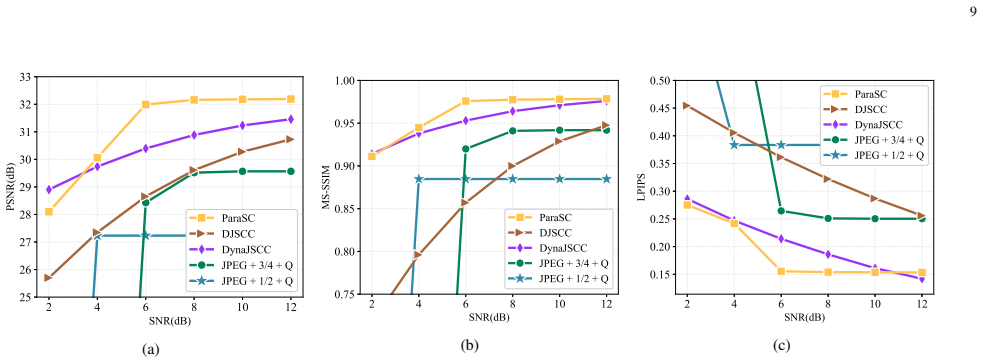
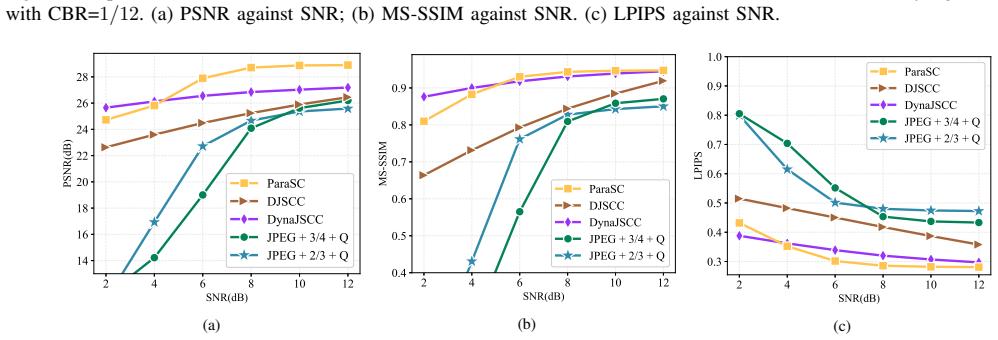
On the paper's own terms, the discovery is that classical separation-based coding and deep JSCC are complementary rather than competing: the conventional stream supplies the bulk of the image at moderate SNR, while a learned semantic stream that is conditioned on the residual $x - x_c$ compensates for compression loss and carries the reconstruction when the channel is poor. The paper develops ParaSC to make this concrete: a residual-enhanced attention encoder produces semantic features and a residual hyperprior; a conditional entropy model allocates a variable code length to each semantic patch; and the PAGNet decoder fuses the two streams with pixel-level, SNR-conditioned weights. Numerical results across CVRG-Pano and Kodak24, on AWGN and Rayleigh fading channels, are reported to show that ParaSC surpasses the JPEG-based SSCC baselines and the learned JSCC baselines over most of the tested SNR and CBR ranges, with the semantic stream consuming only a small fraction of the total rate (about 10% or less for the $\lambda_1=0.01$ setting when the image-stream rate is above 0.07).
Load-bearing premise
The paper trains with the channel state fixed, but evaluates across a wide SNR range without reporting the training SNR(s); the claimed robustness to SNR fluctuations rests on the trained network generalizing to channel conditions outside its training distribution.
Editorial extensions
If this is right
- An existing JPEG-plus-LDPC system can be upgraded by appending a semantic encoder and decoder, without retraining or replacing the conventional codec.
- The cliff effect of SSCC is softened: at low SNR the semantic stream dominates, and at high SNR the conventional stream dominates, so reconstruction quality degrades gracefully.
- Semantic rate can be traded against image-stream rate through the loss weight, letting the framework hit varied bandwidth budgets with a single trained model.
- At the tested settings the semantic stream is light: about 8.3% extra rate yields the largest PSNR gain at the worst channel condition, and the model has far lower parameter count and FLOPs than transformer-based JSCC options.
Reading between the lines
- If the framework's robustness to channel fluctuations comes from PAGNet's SNR conditioning rather than from having seen many SNRs at training, then a natural extension is to train once and adapt only the PAGNet weights at deployment, which could be tested by fine-tuning on a single new SNR.
- The same residual-conditioning idea could carry to video or multi-view images, where the 'residual' is temporal prediction error rather than compression loss, making the learned stream a general error-compensation channel.
- A stronger claim the paper does not make is that the hybrid is optimal; one could test whether an oracle that switches between pure SSCC, pure JSCC, and the hybrid at each SNR would beat ParaSC, which would reveal whether the parallel stream is always the best use of bandwidth.
- The rate-adaptation module currently conditions on compression quality $q$; a testable extension is to also condition on predicted channel state, allowing the semantic rate to shrink when the channel is clean and grow when it is noisy.
Signed reviews
Editorial analysis
A structured set of objections, weighed in public.
Referee Report
Summary. The paper proposes ParaSC, a parallel-stream image transmission framework that combines a conventional JPEG/LDPC/QPSK image stream with a learned deep semantic stream. The semantic encoder uses the JPEG residual as attention to enhance extracted features, a conditional entropy model adapts the semantic transmission rate, and a decoder-side PAGNet fuses the two streams with SNR-conditioned pixel-level weights. The authors claim that ParaSC outperforms both conventional SSCC and DL-based JSCC baselines across a wide range of SNR and CBR settings while keeping the semantic stream lightweight. The paper includes rate-distortion and complexity analyses, plus experiments on AWGN and Rayleigh channels with CVRG-Pano and Kodak24 datasets.
Significance. If the claims are substantiated, the hybrid parallel-stream architecture is a practically relevant contribution: it shows how a learned JSCC component can be retrofitted onto a deployed separated coding system without discarding the conventional stack, with a demonstrated mitigation of the cliff effect and a tunable semantic rate. The paper provides a thorough ablation of the rate-adaptation mechanism, a complexity table, and visualizations of the learned aggregation weights. The main significance hinges on the empirical superiority claim and on the correctness of the variational derivation that justifies the training loss, both of which currently require additional support.
major comments (4)
- [Section V.A.3 vs. Section IV.A and Figs. 6, 8, 9] The channel SNR(s) used for training ParaSC are never reported, although Section IV.A states that 'the channel state is fixed during the training stage' and Section V.A.3 gives training details without mentioning any SNR distribution. The evaluation sweeps SNR from 2 to 12 dB on AWGN and Rayleigh channels, where the uncoded semantic stream's robustness and the PAGNet's SNR-conditioned behavior are central. If training used only one or a narrow range of SNRs, the results across the rest of the sweep are extrapolation, and the comparison is asymmetric because the DynaJSCC baseline was explicitly trained over 2-12 dB as stated in Section V.A.4. The authors must report the training SNR(s) and, if the broad-range claim is retained, train over the evaluated range or provide a matched training condition.
- [Section IV.A, paragraph after Eq. (4)] The derivation of the distortion term contains an unproven and internally problematic substitution: the text states that 'xr determines a unique x although such mapping is non-injective,' which is contradictory because a non-injective mapping cannot uniquely determine its pre-image. This assertion is then used to replace p(x|s,xr) with p(x|s,xc) and later with p(x|s,hat_xc), which is load-bearing for identifying Eq[T2] with the MSE distortion term in Eq. (6) and for the final loss in Eq. (8). The authors need to either prove that xr plus the decoder constraints indeed identify x uniquely, or replace this step with a correct factorization that treats xr as a deterministic function of x and xc rather than as a sufficient statistic that identifies x.
- [Section III.B and Section V.A.3] The PAGNet decoder takes SNR as an input to determine aggregation weights, and the paper advertises robustness to SNR fluctuations, yet the training procedure does not state whether the SNR is varied or sampled during training. If the channel is fixed during training as stated in Section IV.A, the SNR embedding in PAGNet has not observed different SNRs during optimization, so its behavior at off-training SNRs is unverified. The authors should specify the SNR sampling strategy during the three training stages or demonstrate that a fixed-SNR training regime still yields the claimed generalization, for example by including a training-SNR ablation.
- [Section V.B and Table I] The central empirical claim that ParaSC 'surpasses the performance of both traditional and DL-based competitors in a large range of scenarios' is supported only by single curves without error bars, confidence intervals, or multiple-seed results. The test datasets are small (76 CVRG-Pano images and 24 Kodak24 images), so differences near curve crossings may not be statistically meaningful, and the paper should include variance or significance measures. In addition, Table I compares only the semantic JSCC transmitter's parameters, FLOPs, and throughput, while ParaSC's overall system also includes the conventional JPEG/LDPC/QPSK branch; the 'lightweight' claim should be scoped to the semantic stream or the table should report end-to-end complexity, otherwise the comparison is incomplete.
minor comments (6)
- [Section IV.A] The word 'thrid' should be 'third' in the sentence introducing Eq[T3].
- [Section V.A.3] The training details are incomplete for reproduction: no learning rate, batch size, number of epochs, or optimizer settings beyond the default beta values are given, and the poly learning-rate schedule is described only qualitatively.
- [Section IV.B] The predefined rate set W and its cardinality M are not defined in the text; Section V.A.2 mentions '32 available equidistant output dimensions ranging from 4 to 128,' but the connection between this and W, and how the FC layers select among these dimensions, should be made explicit.
- [Section V.B] The discussion of DynaJSCC's CBR points says the optimal learned CBR is 0.167 and other points are obtained by changing its binary mask; the paper should clarify whether those mask-based points were all seen in training and whether the comparison is on a fair rate-adaptation basis.
- [Section V.E, Table I] The throughput measurement should report the inference framework, batch size, and whether the number is for the semantic encoder alone or for the full ParaSC transmitter, since the table is used to support the lightweight claim.
- [Section II.C.1] The notation mapping x -> z_w via F_theta and then hat_z_w -> hat_x_c via F_theta^{-1} is confusing because F_theta is also used for the compressor; a separate symbol for the decoder would improve readability.
Circularity Check
No circularity: ParaSC's rate adaptation is a standard conditional entropy-model codec and the performance claims are benchmarked against external baselines.
full rationale
ParaSC's derivation chain is self-contained. The semantic stream is produced by F_phi(x, x_r), transmitted over the channel, and decoded by G_zeta(x_hat_c, s_hat, SNR); the residual x_r is defined as x - x_c, not as the reconstruction target. The training objective in Eq. (8) is a standard conditional variational bound: the distortion term d(x, x_hat) is measured against the external original image, and the rate term -lambda_1 log p(s_tilde, r_tilde | x_r) is the negative log-likelihood of the learned conditional entropy model. At test time, the per-patch allocation alpha_bar_i is the quantized version of alpha_i = -rho log p(s_tilde_i, r_tilde | x_r), and the semantic stream length is exactly the number of FC output dimensions transmitted, so the reported CBR is an actual measured symbol count rather than a quantity retroactively fitted to the outcome. The performance claims are judged against external baselines (JPEG+LDPC/QPSK, DJSCC, DynaJSCC, and WITT for complexity) on PSNR, MS-SSIM, and LPIPS, so the superiority claims do not reduce to the model's own definitions. The self-citations to [21] and [22] are methodological borrowings and baseline choices, not load-bearing justifications of the empirical results; no uniqueness theorem or fitted parameter is renamed as a prediction. The main caveat is that Section V.A.3 never reports the training SNR even though Section IV.A fixes the channel state during training, which is a reproducibility and generalization concern, but it is not a circularity pattern.
Assumptions & free parameters
free parameters (5)
- Training channel SNR
- lambda1 =
0.1
- lambda2 =
0.1
- rho =
0.2
- Rate set W =
32 integer levels from 4 to 128
assumptions (5)
- domain assumption The observation model p(x|s, x_hat_c) is Gaussian with covariance (2*lambda)^{-1}I, making distortion equivalent to MSE.
- ad hoc to paper The residual xr determines a unique original image x even though the mapping is non-injective.
- standard math Quantization noise is uniform over width 1, so the posterior entropy term Eq[T1] is constant and can be dropped.
- domain assumption The conventional SSCC branch is fixed and non-differentiable, so its distortion T4 is constant during optimization.
- domain assumption The channel state is fixed during training, and x_hat_c can be treated as a fixed condition.
Cite this review
Pith. "Pith review of Semantic-aided Parallel Image Transmission Compatible with Practical System." pith.science (2026). https://pith.science/paper/KIUIJWJQ
@misc{pith2026250421466,
  author       = {Pith},
  title        = {Pith review of: Semantic-aided Parallel Image Transmission Compatible with Practical System},
  year         = {2026},
  howpublished = {\url{https://pith.science/paper/KIUIJWJQ}},
  note         = {Machine review of arXiv:2504.21466}
}
read the original abstract
In this paper, we propose a novel semantic-aided image communication framework for supporting the compatibility with practical separation-based coding architectures. Particularly, the deep learning (DL)-based joint source-channel coding (JSCC) is integrated into the classical separate source-channel coding (SSCC) to transmit the images via the combination of semantic stream and image stream from DL networks and SSCC respectively, which we name as parallel-stream transmission. The positive coding gain stems from the sophisticated design of the JSCC encoder, which leverages the residual information neglected by the SSCC to enhance the learnable image features. Furthermore, a conditional rate adaptation mechanism is introduced to adjust the transmission rate of semantic stream according to residual, rendering the framework more flexible and efficient to bandwidth allocation. We also design a dynamic stream aggregation strategy at the receiver, which provides the composite framework with more robustness to signal-to-noise ratio (SNR) fluctuations in wireless systems compared to a single conventional codec. Finally, the proposed framework is verified to surpass the performance of both traditional and DL-based competitors in a large range of scenarios and meanwhile, maintains lightweight in terms of the transmission and computational complexity of semantic stream, which exhibits the potential to be applied in real systems.
Figures


Figures from the paper (10 more)






Reference graph
Works this paper leans on
-
[21]
Nonlinear transform source-channel coding for semantic communications,
J. Dai, S. Wang, K. Tan, Z. Si, X. Qin, K. Niu, and P. Zhang, “Nonlinear transform source-channel coding for semantic communications,” IEEE J. Sel. Areas Commun. , vol. 40, no. 8, pp. 2300–2316, Aug. 2022
work page 2022
-
[1]
The JPEG still picture compression standard,
G. K. Wallace, “The JPEG still picture compression standard,” Commun. ACM, vol. 34, no. 4, pp. 30–44, Apr. 1991
work page 1991
-
[2]
JPEG2000: Image compression fundamentals, standards and practice,
D. S. Taubman, M. W. Marcellin, and M. Rabbani, “JPEG2000: Image compression fundamentals, standards and practice,”J. Electron. Imaging, vol. 11, no. 2, pp. 286–287, Apr. 2002
work page 2002
-
[3]
F. Bellard. BPG image format. (2018 Apr 21). [Online]. Available: https://bellard.org/bpg/
work page 2018
-
[4]
Design of low-density parity check codes for 5G new radio,
T. Richardson and S. Kudekar, “Design of low-density parity check codes for 5G new radio,” IEEE Commun. Mag. , vol. 56, no. 3, pp. 28–34, Mar. 2018
2018
-
[5]
Channel polarization: A method for constructing capacity- achieving codes for symmetric binary-input memoryless channels,
E. Arikan, “Channel polarization: A method for constructing capacity- achieving codes for symmetric binary-input memoryless channels,”IEEE Trans. Inf. Theory , vol. 55, no. 7, pp. 3051–3073, Jul. 2009
2009
-
[6]
A mathematical theory of communication,
C. E. Shannon, “A mathematical theory of communication,” Bell Syst. Tech. J., vol. 27, no. 3, pp. 379–423, Jul. 1948
1948
-
[7]
Compression represents intelligence linearly,
Y . Huang, J. Zhang, Z. Shan, and J. He, “Compression represents intelligence linearly,” arXiv:2404.09937, 2024
arXiv 2024
Show all 46 references
-
[8]
Time-varying channel esti- mation based on air-ground channel modelling and modulated learning networks,
C. Liu, M. Wang, Z. Dong, and P. Wang, “Time-varying channel esti- mation based on air-ground channel modelling and modulated learning networks,” Chinese J. Electron. , vol. 31, no. 3, pp. 430–441, May 2022
2022
-
[9]
Failure-resilient distributed inference with model compression over heterogeneous edge devices,
L. Wang, L. Li, L. Xu, X. Peng, and A. Fei, “Failure-resilient distributed inference with model compression over heterogeneous edge devices,” IEEE Trans. Mobile Comput. , vol. 23, no. 12, pp. 12 680–12 692, Dec. 2024
2024
-
[10]
Edge intelligence for mission cognitive wireless emergency networks,
L. Wang, J. Zhang, J. Chuan, R. Ma, and A. Fei, “Edge intelligence for mission cognitive wireless emergency networks,” IEEE Wireless Commun., vol. 27, no. 4, pp. 103–109, Aug. 2020
2020
-
[11]
DeepAdaIn-Net: Deep adaptive device-edge collaborative inference for augmented reality,
L. Wang, X. Wu, Y . Zhang, X. Zhang, L. Xu, Z. Wu, and A. Fei, “DeepAdaIn-Net: Deep adaptive device-edge collaborative inference for augmented reality,” IEEE J. Sel. Topics Signal Process. , vol. 17, no. 5, pp. 1052–1063, Sep. 2023
2023
-
[12]
Joint source and channel coding,
M. Fresia, F. Per ´ez-Cruz, H. V . Poor, and S. Verd ´u, “Joint source and channel coding,” IEEE Signal Process. Mag. , vol. 27, no. 6, pp. 104– 113, Nov. 2010
2010
-
[13]
Generative joint source-channel coding for semantic image transmission,
E. Erdemir, T.-Y . Tung, P. L. Dragotti, and D. G¨und¨uz, “Generative joint source-channel coding for semantic image transmission,” IEEE J. Sel. Areas Commun., vol. 41, no. 8, pp. 2645–2657, Aug. 2023
2023
-
[14]
Wireless deep video semantic transmission,
S. Wang, J. Dai, Z. Liang, K. Niu, Z. Si, C. Dong, X. Qin, and P. Zhang, “Wireless deep video semantic transmission,” IEEE J. Sel. Areas Commun., vol. 41, no. 1, pp. 214–229, Jan. 2023
2023
-
[15]
Deep learning enabled semantic communication systems,
H. Xie, Z. Qin, G. Y . Li, and B.-H. Juang, “Deep learning enabled semantic communication systems,” IEEE Trans. Signal Process., vol. 69, pp. 2663–2675, 2021
2021
-
[16]
Wireless deep speech semantic transmission,
Z. Xiao, S. Yao, J. Dai, S. Wang, K. Niu, and P. Zhang, “Wireless deep speech semantic transmission,” in Proc. IEEE Int. Conf. Acoust., Speech Signal Process. (ICASSP) , Rhodes Island, Greece, Jun. 2023, pp. 1–5
2023
-
[17]
ISCom: Interest-aware semantic communication scheme for point cloud video streaming,
Y . Huang, B. Bai, Y . Zhu, X. Qiao, X. Su, and P. Zhang, “ISCom: Interest-aware semantic communication scheme for point cloud video streaming,” arXiv:2210.06808, 2022
2022 arXiv
-
[18]
Classification-oriented distributed semantic communication for multivariate time series,
B. Zhao, H. Xing, X. Wang, Z. Xiao, and L. Xu, “Classification-oriented distributed semantic communication for multivariate time series,” IEEE Signal Process. Lett. , vol. 30, pp. 369–373, 2023
2023
-
[19]
Bandwidth-agile image transmission with deep joint source-channel coding,
D. B. Kurka and D. G ¨und¨uz, “Bandwidth-agile image transmission with deep joint source-channel coding,” IEEE Trans. Wireless Commun., vol. 20, no. 12, pp. 8081–8095, Dec. 2021
2021
-
[20]
Deep joint source-channel coding for wireless image transmission with adaptive rate control,
M. Yang and H.-S. Kim, “Deep joint source-channel coding for wireless image transmission with adaptive rate control,” in Proc. IEEE Int. Conf. Acoust., Speech Signal Process. (ICASSP) , Singapore, Singapore, May 2022, pp. 5193–5197
2022
-
[22]
WITT: A wireless image transmission transformer for semantic communications,
K. Yang, S. Wang, J. Dai, K. Tan, K. Niu, and P. Zhang, “WITT: A wireless image transmission transformer for semantic communications,” in Proc. IEEE Int. Conf. Acoust., Speech Signal Process. (ICASSP) , Rhodes Island, Greece, Jun. 2023, pp. 1–5
2023
-
[23]
Task-oriented multi-user semantic communications,
H. Xie, Z. Qin, X. Tao, and K. B. Letaief, “Task-oriented multi-user semantic communications,” IEEE J. Sel. Areas Commun. , vol. 40, no. 9, pp. 2584–2597, Sep. 2022
2022
-
[24]
Attention is all you need,
A. Vaswani, N. Shazeer, N. Parmar, J. Uszkoreit, L. Jones, A. N. Gomez, Ł. Kaiser, and I. Polosukhin, “Attention is all you need,” in Proc. Advances Neural Inf. Process. Syst. , vol. 30, 2017
2017
-
[25]
Semantic communications: Principles and challenges,
Z. Qin, X. Tao, J. Lu, W. Tong, and G. Y . Li, “Semantic communications: Principles and challenges,” arXiv:2201.01389, 2021
2021 arXiv
-
[26]
Deep learning-based image se- mantic coding for semantic communications,
D. Huang, X. Tao, F. Gao, and J. Lu, “Deep learning-based image se- mantic coding for semantic communications,” in IEEE Global Commun. Conf. (GLOBECOM) , Madrid, Spain, Dec. 2021, pp. 1–6
2021
-
[27]
Efficient QC-LDPC encoder for 5G new radio,
T. T. B. Nguyen, T. Nguyen Tan, and H. Lee, “Efficient QC-LDPC encoder for 5G new radio,” Electronics, vol. 8, no. 6, p. 668, Jun. 2019
2019
-
[28]
U-Net: Convolutional net- works for biomedical image segmentation,
O. Ronneberger, P. Fischer, and T. Brox, “U-Net: Convolutional net- works for biomedical image segmentation,” in Proc. Med. Image Com- put. Comput.-Assisted Intervention (MICCAI) , Munich, Germany, Oct. 2015, pp. 234–241
2015
-
[29]
ESRGAN: Enhanced super-resolution generative ad- versarial networks,
X. Wang, K. Yu, S. Wu, J. Gu, Y . Liu, C. Dong, Y . Qiao, and C. Change Loy, “ESRGAN: Enhanced super-resolution generative ad- versarial networks,” in Proc. 15 th Eur . Conf. Comput. Vis. Workshops , Munich, Germany, Sep. 2018, pp. 1–17. 15
2018
-
[30]
Density modeling of images using a generalized normalization transformation,
J. Ball ´e, V . Laparra, and E. P. Simoncelli, “Density modeling of images using a generalized normalization transformation,” in Proc. Int. Conf. Learn. Represent. (ICLR) , San Juan, Puerto Rico, May 2016
2016
-
[31]
Variational inference: A review for statisticians,
D. M. Blei, A. Kucukelbir, and J. D. McAuliffe, “Variational inference: A review for statisticians,” J. Amer . Stat. Assoc., vol. 112, no. 518, pp. 859–877, Jul. 2017
2017
-
[32]
End-to-end optimized image compression,
J. Ball ´e, V . Laparra, and E. P. Simoncelli, “End-to-end optimized image compression,” in Proc. Int. Conf. Learn. Represent. (ICLR) , Toulon, France, Apr. 2017
2017
-
[33]
Deep contextual video compression,
J. Li, B. Li, and Y . Lu, “Deep contextual video compression,” Proc. Advances Neural Inf. Process. Syst. , vol. 34, pp. 18 114–18 125, 2021
2021
-
[34]
Variational image compression with a scale hyperprior,
J. Ball ´e, D. Minnen, S. Singh, S. J. Hwang, and N. Johnston, “Variational image compression with a scale hyperprior,” in Proc. Int. Conf. Learn. Represent. (ICLR), Vancouver, BC, Canada, Apr.-May 2018
2018
-
[35]
Semantic segmentation of outdoor panoramic images,
S. Orhan and Y . Bastanlar, “Semantic segmentation of outdoor panoramic images,” Signal Image Video Process. , vol. 16, pp. 643–650, Aug. 2021
2021
-
[36]
R. Franzen. Kodak24 dataset. (1993). [Online]. Available: http: //r0k.us/graphics/kodak/
1993
-
[37]
Ntire 2017 challenge on single image super-resolution: Dataset and study,
E. Agustsson and R. Timofte, “Ntire 2017 challenge on single image super-resolution: Dataset and study,” in Proc. IEEE Conf. Comput. Vis. Pattern Recognit. Workshops, Honolulu, HI, USA, July 2017, pp. 126– 135
2017
-
[38]
Perceptual losses for real-time style transfer and super-resolution,
J. Johnson, A. Alahi, and L. Fei-Fei, “Perceptual losses for real-time style transfer and super-resolution,” in Proc. 14 th Eur . Conf. Comput. Vis., Amsterdam, The Netherlands, Sep. 2016, pp. 694–711
2016
-
[39]
Very deep convolutional networks for large-scale image recognition,
K. Simonyan and A. Zisserman, “Very deep convolutional networks for large-scale image recognition,” arXiv:1409.1556, 2014
2014 arXiv
-
[40]
ImageNet: A large-scale hierarchical image database,
J. Deng, W. Dong, R. Socher, L.-J. Li, K. Li, and L. Fei-Fei, “ImageNet: A large-scale hierarchical image database,” in Proc. Conf. Comput. Vis. Pattern Recognit., Miami, FL, USA, Jun. 2009, pp. 248–255
2009
-
[41]
Adam: A method for stochastic optimization,
D. P. Kingma and J. Ba, “Adam: A method for stochastic optimization,” in Proc. Int. Conf. Learn. Represent. (ICLR) , San Diego, CA, USA, 2015
2015
-
[42]
Parsenet: Looking wider to see better,
W. Liu, A. Rabinovich, and A. C. Berg, “Parsenet: Looking wider to see better,” arXiv:1506.04579, 2015
2015 arXiv
-
[43]
Deep joint source- channel coding for wireless image transmission,
E. Bourtsoulatze, D. Burth Kurka, and D. G ¨und¨uz, “Deep joint source- channel coding for wireless image transmission,” IEEE Trans. Cogn. Commun. Netw., vol. 5, no. 3, pp. 567–579, Sep. 2019
2019
-
[44]
Multiscale structural similarity for image quality assessment,
Z. Wang, E. Simoncelli, and A. Bovik, “Multiscale structural similarity for image quality assessment,” in IEEE Asilomar Conf. Signals, Syst. Comput., vol. 2, 2003, pp. 1398–1402
2003
-
[45]
The unreasonable effectiveness of deep features as a perceptual metric,
R. Zhang, P. Isola, A. A. Efros, E. Shechtman, and O. Wang, “The unreasonable effectiveness of deep features as a perceptual metric,” in Proc. Conf. Comput. Vis. Pattern Recognit. , Salt Lake City, Utah, USA, Jun. 2018, pp. 586–595
2018
-
[46]
Deconvolution and checkerboard artifacts,
A. Odena, V . Dumoulin, and C. Olah, “Deconvolution and checkerboard artifacts,” Distill, 2016
2016
Reviewed August 16, 2026 · model on record in the stance chip above.
Discussion (0). Continue with ORCID to comment.