REVIEW 3 major objections 6 minor 1 cited by
Chromatic Effects on the PSF and Shear Measurement for the Roman Space Telescope High-Latitude Wide Area Survey
T0 review · 3 major / 6 minor · reviewed 2026-08-16 · deepseek-v4-flash
Pith's one-line read Chromatic PSF errors from star-galaxy color differences bias Roman shear measurements by 0.2% in the four weak-lensing bands and 2% in the wide filter, above mission limits; a first-order PSF-level correction restores the WL bands.
desk verdict Roman-specific chromatic PSF bias is real and large, the B_n correction formalism is useful, but the headline mitigation claim is idealized and needs its caveats in the abstract. read the letter →
The pith
A machine-rendered reading of the paper's core claim, the machinery that carries it, and where it could break.
The reading
What carries the argument
The load-bearing object is a Taylor-expansion basis for the chromatic PSF error. The effective PSF difference between a star and a galaxy is written as $$\$\Delta$\mathrm{PSF}_{\rm eff}(x,y)=\sum_n \$\Delta$ S_n\, B_n(x,y),$$ where $\Delta S_n$ is the difference between flux-normalized SED Taylor coefficients about the filter's effective wavelength $\lambda_0$, and $B_n(x,y)=\int \mathrm{PSF}(x,y,\lambda)\,F(\lambda)\,(\lambda-\lambda_0)^n\,d\lambda$ is an SED-independent image depending only on the PSF model and filter throughput. Flux normalization makes $\Delta S_0$ vanish for linear SEDs, so the first-order term $\Delta S_1 B_1$ carries nearly all of the bias in the narrow WL bands. The factorization is what carries the argument: $B_n$ can be precomputed from a trusted PSF model, leaving only the scalar coefficient $\Delta S_1$ to be estimated from galaxy SEDs, and the correction is applied at the PSF level so it is independent of the shape-measurement method.
What would settle it
An on-orbit measurement of Roman's PSF size versus stellar color in each band would settle the matter: if the observed slope of PSF FWHM with color differs from the model's prediction by more than the sub-percent level required to keep $|m|$ below $3.2\times 10^{-4}$, the simulated bias amplitudes and the first-order correction basis are both in doubt. Repeating the end-to-end simulation with an independent PSF model, generated without using the model that also defines the correction basis, would test whether the $0.2\%$/$2\%$ biases and the correction success are an artifact of model reuse.
Extended reading notes
Core claim
The central claim is that chromatic PSF mismatch, caused by systematically different SEDs for the stars used to model the PSF and the galaxies whose shapes are measured, is a dominant systematic for Roman weak-lensing shear. Averaged over all simulated galaxies, the multiplicative bias is roughly $0.2\%$ in every WL band and $2\%$ in W146, an order of magnitude larger in the wide filter; additive bias is acceptable in the WL bands but exceeds the systematic budget in W146. Because a $1\%$ multiplicative bias maps to roughly $1.5\%$ bias in the cosmological parameter $S_8$, these amplitudes are cosmologically significant. The paper's constructive result is that when the PSF model and filter transmission are known, the chromatic PSF error factorizes into SED-dependent coefficients and SED-independent basis images, and the first-order term corrects the WL bands to within the strictest requirement when each galaxy's SED is known exactly; the wide filter resists first-order correction, and a second-order polynomial version performs unstably.
Load-bearing premise
The load-bearing premise is that the simulated wavelength-dependent Roman PSF used to create the images is a faithful model of the real Roman PSF, because the same model provides both the biased images and the correction basis; if actual filter coatings, charge diffusion, or coaddition of undersampled exposures change the PSF chromaticity, both the measured biases and the correction performance would shift.
Editorial extensions
If this is right
- If the central claim is correct, Roman's weak-lensing analysis must apply a chromatic PSF correction before shape measurement; leaving the effect uncorrected exceeds the SRD multiplicative-bias requirement by roughly a factor of six in the WL bands.
- With perfect per-galaxy SED information, the first-order correction satisfies the strictest multiplicative requirement in Y106, J129, H158, and F184, meaning the dominant remaining uncertainty shifts to how well SED slopes can be estimated from photometry.
- In W146, even a perfect first-order correction leaves residual multiplicative bias, and a straightforward second-order polynomial correction is unstable; this argues that using the wide filter for shear requires either a higher-order correction or acceptance of larger systematics.
- Ensemble-averaged corrections can fail in individual redshift bins, while redshift-bin-averaged corrections satisfy a relaxed requirement; therefore tomographic analyses need per-redshift-bin calibration.
- Galaxy color gradients contribute at most about $10^{-4}$ to multiplicative bias in the WL bands, so the dominant chromatic effect is the star-galaxy SED difference rather than internal color gradients.
Reading between the lines
- Beyond the paper: the same Taylor-basis formalism transfers to any diffraction-limited NIR survey with a well-characterized PSF model; the key input is the accuracy of $\mathrm{PSF}(x,y,\lambda)$, so the structure of the method is portable even though the paper only demonstrates it for Roman.
- Beyond the paper: the wide-filter failure implies that a decision to use W146 for Roman weak lensing should be gated on on-orbit measurements of the PSF size-color relation; the paper's simulations are self-consistent, so real-data chromaticity remains untested.
- Beyond the paper: the SOM experiments suggest that spectroscopic training samples for Roman should be built with explicit coverage of high-redshift SED space; the demonstrated degradation under cross-library training makes SED-space completeness a testable design requirement.
- Beyond the paper: a direct follow-up is to test the correction on coadded Roman images rather than oversampled individual exposures; the paper leaves coaddition to future work, and coaddition can alter the effective PSF chromaticity.
Signed reviews
Editorial analysis
A structured set of objections, weighed in public.
Referee Report
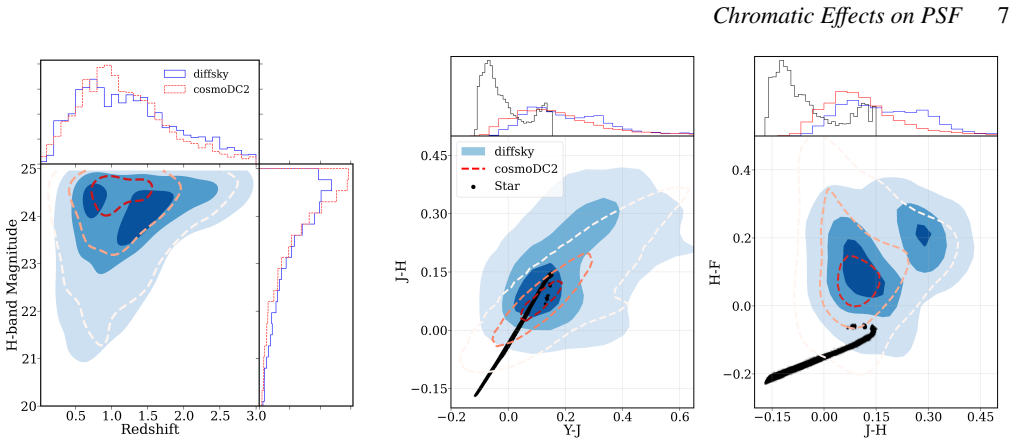
Summary. This paper quantifies, with Roman-like image simulations, the shear calibration biases induced by the wavelength dependence of the PSF when the PSF is modeled with stars but applied to galaxies. The authors use two extragalactic catalogs (Diffsky and cosmoDC2) with distinct SED libraries, a Kurucz-based stellar catalog, and the galsim.roman PSF model to generate noiseless oversampled postage stamps, measuring shapes with the FPFS/AnaCal estimator. They find uncorrected multiplicative biases of roughly 0.2% in the four Roman WL bands and roughly 2% in the wide filter W146, exceeding both the SRD requirement |m| < 3.2e-4 and the relaxed 1e-3 requirement; additive biases are acceptable in the WL bands but not in W146. The paper then develops a PSF-level correction based on a Taylor expansion of the flux-normalized SED difference into coefficients ΔS_n and precomputed basis images B_n, and shows that with perfect per-galaxy SED knowledge the first-order correction brings all WL bands within the stringent requirement, while W146 is not corrected to requirement. It also tests an analytical color-based estimator and a self-organizing-map estimator for realistic implementation, finding that both reduce biases but with catalog-dependent performance.
Significance. If the results hold, this is a timely and useful contribution for Roman weak lensing: it is the first systematic quantification of chromatic PSF biases from star-galaxy SED differences for the four Roman WL bands and W146, and it proposes a clean, SED-only correction framework that is independent of the shape-measurement method. The numerical work is careful: 10,000 galaxies per catalog, 45-degree rotations to suppress shape noise, three input shears, bootstrap error bars, a convergence check at 1,500 galaxies, and two independent SED libraries that give consistent uncorrected biases. The correction coefficients ΔS_n are derived from the SEDs, not fitted to the measured bias, so there is no parameter-fitted-to-target circularity. The public code and catalogs also make the analysis reproducible. The principal caveat is that the validation is performed entirely within the galsim.roman PSF model: the same model produces the simulated images and the B_n correction basis, so the Roman-specific amplitude of the biases and the demonstrated post-correction accuracy are conditional on that model's fidelity.
major comments (3)
- [Sec. 5.2.1 and Abstract] The central mitigation claim is validated in a closed loop: both the simulated galaxy images and the B1 basis functions used in Eq. (14) are generated from the same galsim.roman PSF model. A wavelength-dependent error in that model, for example from filter coating uncertainties, charge diffusion, or reshaping by coaddition (effects explicitly deferred in Sec. 3.5 and Sec. 7), would change both the uncorrected bias amplitude and the correction basis. The manuscript therefore does not yet demonstrate that the corrected bias remains below |m| < 3.2e-4 for the actual Roman PSF. Please add a sensitivity test that perturbs the PSF wavelength dependence (e.g., scaling B1 or using an independent PSF model such as WebbPSF) and shows the corrected m stays within budget, and state this closed-loop caveat explicitly in the abstract.
- [Sec. 5.2.1, Eq. (15)] The text states that the SCA-constant approximation for B_n is 'tested later on for B1 and confirmed to hold,' but I could not find this test anywhere in the manuscript: Secs. 5.3 through 6 contain no comparison of the center-of-SCA basis against the basis at the actual galaxy positions. Because Eq. (15) enters every corrected measurement in Fig. 5, please either present the missing test with quantitative residuals, or remove the claim and propagate the approximation uncertainty into the corrected m values.
- [Sec. 5.3 and Abstract] The abstract's statement that 'higher-order terms are necessary for the wide filter' is not backed by a working higher-order implementation in the paper: Sec. 5.3 reports that a second-order polynomial fit produced a higher multiplicative bias than the first-order correction and failed to meet the relaxed requirement in all redshift bins for both catalogs. Please either demonstrate a higher-order correction that actually reduces W146 biases to requirement, or rephrase the conclusion to say that the first-order correction is insufficient for W146 and a successful higher-order correction is not yet demonstrated.
minor comments (6)
- [Sec. 3.5] The choice of 0.0275 arcsec/pixel oversampled scale is described as 'somewhat arbitrary'; since the correction results and their comparison with coadded Roman images depend on pixel scale, please add a brief justification or a test of sensitivity to this choice.
- [Sec. 5.4, Table 2] What is called an 'upper limit' is actually the largest absolute bias across redshift bins, not a statistical upper limit; please rename it to something like 'largest |m| across redshift bins' to avoid over-interpretation.
- [Sec. 6.1, Eq. (23)] The statement that N_t/N_f 'resembles something like the color' is imprecise; the color is proportional to log10(N_t/N_f), not to the flux ratio itself, and this distinction affects how one expects the estimator to behave with noise.
- [Sec. 6.3, Table 3] The phrase 'fail to exceed the allowed relative error' should read 'exceed the allowed relative error' or 'fail to stay within the allowed relative error'; the current wording states the opposite of what Table 3 shows.
- [Sec. 2.2, Eq. (3)] Please define explicitly whether the SEDs in Eq. (3) are in photon units or energy units; the text mentions the necessary λ/hc conversion factor, but the equation as written is ambiguous, and the slope coefficients ΔS1 depend on this convention.
- [Fig. 4] The green curve representing the second-order approximation is not labeled in the legend of the right panel; please add a legend entry or a clear caption description so the reader can identify it.
Circularity Check
No circularity: the chromatic shear biases are simulation outputs, and the correction coefficients come from SEDs, not from the measured biases.
full rationale
The paper's central results are not circular. The multiplicative and additive biases in Fig. 3 are outputs of forward image simulations using GalSim and the AnaCal estimator (Eqs. 2 and 7), with galaxy and stellar SEDs from independent catalogs; no parameter is fitted to the measured m or c. The correction basis B_n is defined by Eq. (11) from the PSF model and filter throughput, and the coefficients ΔS_n are estimated from the SEDs in Sec. 5.2.2, not from the shear biases, so the corrected results in Fig. 5 are not a fit renamed as a prediction. The main caveat is model dependence: Sec. 5.2.1 states 'In this work we use the model provided by GalSim, as this is also the software used for image simulations,' so the demonstration that first-order correction meets requirements is closed-loop within galsim.roman. That is an external-validity limitation, not a circular reduction, and the paper explicitly flags related limits: Sec. 3.5 says 'No detector effects are included in these simulations,' and Sec. 7 says 'We emphasize that this work has produced results for oversampled images. Therefore, it will be extremely important to understand how the image coaddition of individual undersampled exposures will affect the chromaticity of the coadded PSF.' Self-citations to AnaCal (Li & Mandelbaum 2023) and to galsim.roman (Kannawadi et al. 2016) are code and estimator support with independent implementation, not load-bearing uniqueness claims or ansatz smuggling. Consequently no circular step is identified.
Assumptions & free parameters
free parameters (4)
- sigma_h (FPFS shapelet scale) =
1.15 x PSF scale radius
- C (FPFS weight) =
10
- Oversampled pixel scale =
0.0275 arcsec/pixel
- SOM grid and hyperparameters =
32x32 grid, std_coeff=12.0, learning rate=0.75
assumptions (5)
- domain assumption The SED of each object can be flux-normalized and Taylor-expanded around the filter effective wavelength, and the linear term dominates the chromatic PSF difference (Sec. 5.1, Eq. 9-13).
- domain assumption The galsim.roman and WebbPSF model reproduces the real Roman PSF wavelength dependence (Sec. 5.2.1).
- domain assumption Diffsky and cosmoDC2 SED libraries bracket the real galaxy SED population (Sec. 3.1).
- domain assumption The images are noiseless, oversampled, single-exposure, and free of detector effects and blending (Sec. 3.5).
- standard math Flux normalization implies that the zero-order SED difference Delta-S0 vanishes for linear SEDs (Appendix B).
Cite this review
Pith. "Pith review of Chromatic Effects on the PSF and Shear Measurement for the Roman Space Telescope High-Latitude Wide Area Survey." pith.science (2026). https://pith.science/paper/GRGOEAY5
@misc{pith2026250500093,
  author       = {Pith},
  title        = {Pith review of: Chromatic Effects on the PSF and Shear Measurement for the Roman Space Telescope High-Latitude Wide Area Survey},
  year         = {2026},
  howpublished = {\url{https://pith.science/paper/GRGOEAY5}},
  note         = {Machine review of arXiv:2505.00093}
}
abstract
Weak gravitational lensing (WL) is a key cosmological probe that requires precise measurement of galaxy images to infer shape distortions, or shear, and constrain cosmology. Accurate estimation of the Point Spread Function (PSF) is crucial for shear measurement, but the wavelength dependence of the PSF introduces chromatic biases that can systematically impact shear inference. We focus on biases arising from spectral energy distribution (SED) differences between stars, used for PSF modeling, and galaxies, used for shear measurement. We investigate these effects in $\textit{Roman's}$ four design reference mission WL bands (Y106, J129, H158, F184) and wide filter (W146). Using $\textit{Roman}$-like image simulations, we quantify the induced shear biases and compare them to requirements on those biases. Multiplicative biases over all galaxies hover around $\sim$0.2% in the WL bands and 2% in the wide filter, exceeding the mission requirement of $|m| < 0.032\%$ and relaxed requirement of $|m| < 0.1\%$. In individual redshift bins, biases can reach 0.4$\unicode{x2013}$0.9% for the WL bands and 3$\unicode{x2013}$6% for the wide filter. Additive biases remain acceptable in the WL bands but exceed systematic limits in the wide filter. We develop and test PSF-level corrections, showing that a first-order correction reduces biases within survey requirements for the WL bands; however, higher-order terms are necessary for the wide filter. Our results highlight the necessity of chromatic corrections for precision WL with $\textit{Roman}$ and provide a framework for mitigating these biases. Finally, we compare analytical color-based corrections to self-organizing maps (SOMs) and find that both methods effectively reduce biases.
Figures


Figures from the paper (6 more)


Forward citations
Cited by 1 Pith paper
-
D$_4$CNN$\times$AnaCal: Physics-Informed Machine Learning for Accurate and Precise Weak Lensing Shear Estimation
A D4-equivariant CNN calibrated with analytic gradients measures weak-lensing shear from isolated-galaxy simulations with sub-0.1% multiplicative bias and ~10% lower shape noise than FPFS.
Reference graph
Works this paper leans on
-
[1]
write newline
" write newline "" before.all 'output.state := FUNCTION fin.entry write newline FUNCTION new.block output.state before.all = 'skip after.block 'output.state := if FUNCTION new.sentence output.state after.block = 'skip output.state before.all = 'skip after.sentence 'output.state := if if FUNCTION not #0 #1 if FUNCTION and 'skip pop #0 if FUNCTION or pop #1...
-
[2]
Aihara H., et al., 2018, @doi [ ] 10.1093/pasj/psx066 , https://ui.adsabs.harvard.edu/abs/2018PASJ...70S...4A 70, S4
-
[3]
Albrecht A., et al., 2006, @doi [arXiv e-prints] 10.48550/arXiv.astro-ph/0609591 , https://ui.adsabs.harvard.edu/abs/2006astro.ph..9591A pp astro--ph/0609591
-
[4]
Amon A., et al., 2022, @doi [ ] 10.1103/PhysRevD.105.023514 , https://ui.adsabs.harvard.edu/abs/2022PhRvD.105b3514A 105, 023514
-
[5]
R., 2000, @doi [ ] 10.1086/316632 , https://ui.adsabs.harvard.edu/abs/2000PASP..112.1360A 112, 1360
Anderson J., King I. R., 2000, @doi [ ] 10.1086/316632 , https://ui.adsabs.harvard.edu/abs/2000PASP..112.1360A 112, 1360
doi:10.1086/316632 2000
-
[6]
Antilogus P., Astier P., Doherty P., Guyonnet A., Regnault N., 2014, @doi [Journal of Instrumentation] 10.1088/1748-0221/9/03/C03048 , https://ui.adsabs.harvard.edu/abs/2014JInst...9C3048A 9, C03048
-
[7]
Asgari M., et al., 2021, @doi [ ] 10.1051/0004-6361/202039070 , https://ui.adsabs.harvard.edu/abs/2021A&A...645A.104A 645, A104
-
[8]
Bartelmann M., Maturi M., 2017, @doi [Scholarpedia] 10.4249/scholarpedia.32440 , https://ui.adsabs.harvard.edu/abs/2017SchpJ..1232440B 12, 32440
Show all 87 references
-
[9]
J., 2012, @doi [New Astronomy] https://doi.org/10.1016/j.newast.2011.07.004 , 17, 175
Benson A. J., 2012, @doi [New Astronomy] https://doi.org/10.1016/j.newast.2011.07.004 , 17, 175
2012 doi
-
[10]
A., Liebert J., 1992, @doi [ ] 10.1086/171575 , https://ui.adsabs.harvard.edu/abs/1992ApJ...394..228B 394, 228
Bergeron P., Saffer R. A., Liebert J., 1992, @doi [ ] 10.1086/171575 , https://ui.adsabs.harvard.edu/abs/1992ApJ...394..228B 394, 228
1992 doi
- [11]
-
[12]
M., Laliotis K., Yamamoto M., Macbeth E., Troxel M
Cao K., Hirata C. M., Laliotis K., Yamamoto M., Macbeth E., Troxel M. A., 2024, @doi [arXiv e-prints] 10.48550/arXiv.2410.05442 , https://ui.adsabs.harvard.edu/abs/2024arXiv241005442C p. arXiv:2410.05442
2024 doi
-
[13]
G., Strauss M
Carlsten S. G., Strauss M. A., Lupton R. H., Meyers J. E., Miyazaki S., 2018, @doi [ ] 10.1093/mnras/sty1636 , https://ui.adsabs.harvard.edu/abs/2018MNRAS.479.1491C 479, 1491
2018 doi
-
[14]
Chang C., et al., 2012, @doi [ ] 10.1111/j.1365-2966.2012.22134.x , https://ui.adsabs.harvard.edu/abs/2012MNRAS.427.2572C 427, 2572
2012
-
[15]
F., Kalmbach J
Crenshaw J. F., Kalmbach J. B., Gagliano A., Yan Z., Connolly A. J., Malz A. I., Schmidt S. J., Collaboration T. L. D. E. S., 2024, Probabilistic Forward Modeling of Galaxy Catalogs with Normalizing Flows ( @eprint arXiv 2405.04740 )
2024 arXiv
-
[16]
S., Amara A., Voigt L
Cypriano E. S., Amara A., Voigt L. M., Bridle S. L., Abdalla F. B., R \'e fr \'e gier A., Seiffert M., Rhodes J., 2010, @doi [ ] 10.1111/j.1365-2966.2010.16461.x , https://ui.adsabs.harvard.edu/abs/2010MNRAS.405..494C 405, 494
2010
-
[17]
Dalal R., et al., 2023, @doi [ ] 10.1103/PhysRevD.108.123519 , https://ui.adsabs.harvard.edu/abs/2023PhRvD.108l3519D 108, 123519
2023 doi
-
[18]
Eifler T., et al., 2021, @doi [ ] 10.1093/mnras/stab533 , https://ui.adsabs.harvard.edu/abs/2021MNRAS.507.1514E 507, 1514
2021 doi
-
[19]
Eriksen M., Hoekstra H., 2018, @doi [ ] 10.1093/mnras/sty830 , https://ui.adsabs.harvard.edu/abs/2018MNRAS.477.3433E 477, 3433
2018 doi
-
[20]
Euclid Collaboration et al., 2019, @doi [ ] 10.1051/0004-6361/201935187 , https://ui.adsabs.harvard.edu/abs/2019A&A...627A..59E 627, A59
2019 doi
-
[21]
Euclid Collaboration et al., 2022, @doi [ ] 10.1051/0004-6361/202141938 , https://ui.adsabs.harvard.edu/abs/2022A&A...662A.112E 662, A112
2022 doi
-
[22]
J., Gorgas J., Peletier R
Falc \'o n-Barroso J., S \'a nchez-Bl \'a zquez P., Vazdekis A., Ricciardelli E., Cardiel N., Cenarro A. J., Gorgas J., Peletier R. F., 2011, @doi [ ] 10.1051/0004-6361/201116842 , https://ui.adsabs.harvard.edu/abs/2011A&A...532A..95F 532, A95
2011 doi
-
[23]
L., et al., 2020, @doi [ ] 10.3847/1538-3881/ab8a43 , https://ui.adsabs.harvard.edu/abs/2020AJ....159..258G 159, 258
Graham M. L., et al., 2020, @doi [ ] 10.3847/1538-3881/ab8a43 , https://ui.adsabs.harvard.edu/abs/2020AJ....159..258G 159, 258
2020 doi
-
[24]
R., Lin H., Gawiser E., Jha S
Gris P., Awan H., Becker M. R., Lin H., Gawiser E., Jha S. W., The LSST Dark Energy Science Collaboration 2024, @doi [ ] 10.3847/1538-4365/ad79f5 , https://ui.adsabs.harvard.edu/abs/2024ApJS..275...21G 275, 21
2024 doi
-
[25]
Hearin A., Korytov D., Kovacs E., Benson A., Aung H., Bradshaw C., Campbell D., LSST Dark Energy Science Collaboration 2020, @doi [ ] 10.1093/mnras/staa1495 , https://ui.adsabs.harvard.edu/abs/2020MNRAS.495.5040H 495, 5040
2020 doi
-
[26]
P., Chaves-Montero J., Alarcon A., Becker M
Hearin A. P., Chaves-Montero J., Alarcon A., Becker M. R., Benson A., 2023, @doi [ ] 10.1093/mnras/stad456 , https://ui.adsabs.harvard.edu/abs/2023MNRAS.521.1741H 521, 1741
2023 doi
-
[27]
Heitmann K., et al., 2019, @doi [ ] 10.3847/1538-4365/ab4da1 , https://ui.adsabs.harvard.edu/abs/2019ApJS..245...16H 245, 16
2019 doi
-
[28]
Heymans C., et al., 2006, @doi [ ] 10.1111/j.1365-2966.2006.10198.x , https://ui.adsabs.harvard.edu/abs/2006MNRAS.368.1323H 368, 1323
2006
-
[29]
M., et al., 2024, @doi [ ] 10.1093/mnras/stae182 , https://ui.adsabs.harvard.edu/abs/2024MNRAS.528.2533H 528, 2533
Hirata C. M., et al., 2024, @doi [ ] 10.1093/mnras/stae182 , https://ui.adsabs.harvard.edu/abs/2024MNRAS.528.2533H 528, 2533
2024 doi
-
[30]
Hoekstra H., Jain B., 2008, @doi [Annual Review of Nuclear and Particle Science] 10.1146/annurev.nucl.58.110707.171151 , https://ui.adsabs.harvard.edu/abs/2008ARNPS..58...99H 58, 99
2008
- [31]
-
[32]
Huterer D., Takada M., Bernstein G., Jain B., 2006, @doi [Monthly Notices of the Royal Astronomical Society] 10.1111/j.1365-2966.2005.09782.x , 366, 101
2006
-
[34]
Ivezi \'c Z ., et al., 2019b, @doi [ ] 10.3847/1538-4357/ab042c , https://ui.adsabs.harvard.edu/abs/2019ApJ...873..111I 873, 111
-
[35]
Jarvis M., et al., 2021, @doi [ ] 10.1093/mnras/staa3679 , https://ui.adsabs.harvard.edu/abs/2021MNRAS.501.1282J 501, 1282
2021 doi
-
[36]
Joachimi B., et al., 2015, @doi [ ] 10.1007/s11214-015-0177-4 , https://ui.adsabs.harvard.edu/abs/2015SSRv..193....1J 193, 1
2015 doi
-
[37]
Juri \'c M., et al., 2008, @doi [ ] 10.1086/523619 , https://ui.adsabs.harvard.edu/abs/2008ApJ...673..864J 673, 864
2008 doi
- [38]
-
[39]
A., Mandelbaum R., Hirata C
Kannawadi A., Shapiro C. A., Mandelbaum R., Hirata C. M., Kruk J. W., Rhodes J. D., 2016, @doi [ ] 10.1088/1538-3873/128/967/095001 , https://ui.adsabs.harvard.edu/abs/2016PASP..128i5001K 128, 095001
2016 doi
-
[40]
Kilbinger M., 2015, @doi [Rept. Prog. Phys.] 10.1088/0034-4885/78/8/086901 , 78, 086901
2015 doi
-
[41]
Kohonen T., 1982, @doi [Biological Cybernetics] 10.1007/BF00337288 , 43, 59
1982 doi
-
[42]
Korytov D., et al., 2019, @doi [ ] 10.3847/1538-4365/ab510c , https://ui.adsabs.harvard.edu/abs/2019ApJS..245...26K 245, 26
2019 doi
-
[43]
Kovacs E., et al., 2022, @doi [The Open Journal of Astrophysics] 10.21105/astro.2110.03769 , https://ui.adsabs.harvard.edu/abs/2022OJAp....5E...1K 5, 1
2022 arXiv
-
[44]
Kurucz R., 1993, Robert Kurucz CD-ROM, https://ui.adsabs.harvard.edu/abs/1993KurCD..13.....K 13
1993
-
[45]
M., Cao K., Yamamoto M., Troxel M., 2024, @doi [ ] 10.1088/1538-3873/ad9bec , https://ui.adsabs.harvard.edu/abs/2024PASP..136l4506L 136, 124506
Laliotis K., Macbeth E., Hirata C. M., Cao K., Yamamoto M., Troxel M., 2024, @doi [ ] 10.1088/1538-3873/ad9bec , https://ui.adsabs.harvard.edu/abs/2024PASP..136l4506L 136, 124506
2024 doi
-
[46]
Li X., Mandelbaum R., 2023, @doi [ ] 10.1093/mnras/stad890 , https://ui.adsabs.harvard.edu/abs/2023MNRAS.521.4904L 521, 4904
2023 doi
-
[47]
Li X., Katayama N., Oguri M., More S., 2018, @doi [ ] 10.1093/mnras/sty2548 , https://ui.adsabs.harvard.edu/abs/2018MNRAS.481.4445L 481, 4445
2018 doi
-
[48]
Li X., Li Y., Massey R., 2022, @doi [ ] 10.1093/mnras/stac342 , https://ui.adsabs.harvard.edu/abs/2022MNRAS.511.4850L 511, 4850
2022 doi
-
[49]
Li X., et al., 2023, @doi [ ] 10.1103/PhysRevD.108.123518 , https://ui.adsabs.harvard.edu/abs/2023PhRvD.108l3518L 108, 123518
2023 doi
-
[50]
Li X., Mandelbaum R., Jarvis M., Li Y., Park A., Zhang T., 2024, @doi [ ] 10.1093/mnras/stad3895 , https://ui.adsabs.harvard.edu/abs/2024MNRAS.52710388L 527, 10388
2024 doi
-
[51]
Li X., Mandelbaum R., The LSST Dark Energy Science Collaboration 2025, @doi [ ] 10.1093/mnras/stae2764 , https://ui.adsabs.harvard.edu/abs/2025MNRAS.536.3663L 536, 3663
2025 doi
-
[52]
Liaudat T., Starck J.-L., Kilbinger M., 2023, @doi [Front. Astron. Space Sci.] 10.3389/fspas.2023.1158213 , 10, 1158213
2023
-
[53]
Mandelbaum R., 2018, @doi [ ] 10.1146/annurev-astro-081817-051928 , https://ui.adsabs.harvard.edu/abs/2018ARA&A..56..393M 56, 393
2018 doi
-
[54]
Massey R., et al., 2012, @doi [Monthly Notices of the Royal Astronomical Society] 10.1093/mnras/sts371 , 429, 661
2012 doi
-
[55]
E., Burchat P
Meyers J. E., Burchat P. R., 2015a, @doi [JINST] 10.1088/1748-0221/10/06/C06004 , 10, C06004
-
[56]
E., Burchat P
Meyers J. E., Burchat P. R., 2015b, @doi [Astrophys. J.] 10.1088/0004-637X/807/2/182 , 807, 182
-
[57]
Mosby G., et al., 2020, @doi [Journal of Astronomical Telescopes, Instruments, and Systems] 10.1117/1.JATIS.6.4.046001 , https://ui.adsabs.harvard.edu/abs/2020JATIS...6d6001M 6, 046001
2020 doi
-
[58]
Munshi D., Valageas P., van Waerbeke L., Heavens A., 2008, @doi [ ] 10.1016/j.physrep.2008.02.003 , https://ui.adsabs.harvard.edu/abs/2008PhR...462...67M 462, 67
2008 doi
-
[59]
Myles J., et al., 2021, @doi [ ] 10.1093/mnras/stab1515 , https://ui.adsabs.harvard.edu/abs/2021MNRAS.505.4249M 505, 4249
2021 doi
-
[60]
Niemi S.-M., Cropper M., Szafraniec M., Kitching T., 2015, @doi [Experimental Astronomy] 10.1007/s10686-015-9440-7 , https://ui.adsabs.harvard.edu/abs/2015ExA....39..207N 39, 207
2015 doi
-
[61]
arXiv:2501.05632
OpenUniverse et al., 2025, @doi [arXiv e-prints] 10.48550/arXiv.2501.05632 , https://ui.adsabs.harvard.edu/abs/2025arXiv250105632O p. arXiv:2501.05632
2025 doi
-
[62]
L., 2008, @doi [ ] 10.1051/0004-6361:20079150 , https://ui.adsabs.harvard.edu/abs/2008A&A...484...67P 484, 67
Paulin-Henriksson S., Amara A., Voigt L., Refregier A., Bridle S. L., 2008, @doi [ ] 10.1051/0004-6361:20079150 , https://ui.adsabs.harvard.edu/abs/2008A&A...484...67P 484, 67
2008 doi
-
[63]
D., Sivaramakrishnan A., Lajoie C.-P., Elliott E., Pueyo L., Ravindranath S., Albert L., 2014, in Oschmann Jr
Perrin M. D., Sivaramakrishnan A., Lajoie C.-P., Elliott E., Pueyo L., Ravindranath S., Albert L., 2014, in Oschmann Jr. J. M., Clampin M., Fazio G. G., MacEwen H. A., eds, Society of Photo-Optical Instrumentation Engineers (SPIE) Conference Series Vol. 9143, Space Telescopes ...
2014 doi
-
[64]
W., et al., 2013, @doi [ ] 10.1051/0004-6361/201219230 , https://ui.adsabs.harvard.edu/abs/2013A&A...551A.119P 551, A119
Piotrowski L. W., et al., 2013, @doi [ ] 10.1051/0004-6361/201219230 , https://ui.adsabs.harvard.edu/abs/2013A&A...551A.119P 551, A119
2013 doi
-
[65]
A., Bernstein G., 2012, @doi [ ] 10.1086/668294 , https://ui.adsabs.harvard.edu/abs/2012PASP..124.1113P 124, 1113
Plazas A. A., Bernstein G., 2012, @doi [ ] 10.1086/668294 , https://ui.adsabs.harvard.edu/abs/2012PASP..124.1113P 124, 1113
2012 doi
-
[66]
Plazas A. A., Shapiro C., Kannawadi A., Mandelbaum R., Rhodes J., Smith R., 2016, @doi [ ] 10.1088/1538-3873/128/968/104001 , https://ui.adsabs.harvard.edu/abs/2016PASP..128j4001P 128, 104001
2016 doi
-
[67]
19, Progress in Optics
Roddier F., 1981, in Wolf E., ed., Progress in Optics, Vol. 19, Progress in Optics. Elsevier, pp 281--376, @doi https://doi.org/10.1016/S0079-6638(08)70204-X , https://www.sciencedirect.com/science/article/pii/S007966380870204X
1981 doi
-
[68]
Rowe B. T. P., et al., 2015, @doi [Astronomy and Computing] 10.1016/j.ascom.2015.02.002 , https://ui.adsabs.harvard.edu/abs/2015A&C....10..121R 10, 121
2015 doi
-
[69]
N., 2017, @doi [ ] 10.1103/PhysRevD.95.123512 , https://ui.adsabs.harvard.edu/abs/2017PhRvD..95l3512S 95, 123512
Schaan E., Krause E., Eifler T., Dor \'e O., Miyatake H., Rhodes J., Spergel D. N., 2017, @doi [ ] 10.1103/PhysRevD.95.123512 , https://ui.adsabs.harvard.edu/abs/2017PhRvD..95l3512S 95, 123512
2017 doi
- [70]
-
[71]
F., et al., 2022, @doi [ ] 10.1103/PhysRevD.105.023515 , https://ui.adsabs.harvard.edu/abs/2022PhRvD.105b3515S 105, 023515
Secco L. F., et al., 2022, @doi [ ] 10.1103/PhysRevD.105.023515 , https://ui.adsabs.harvard.edu/abs/2022PhRvD.105b3515S 105, 023515
2022 doi
-
[72]
Semboloni E., et al., 2013, @doi [Mon. Not. Roy. Astron. Soc.] 10.1093/mnras/stt602 , 432, 2385
2013 doi
-
[73]
S., Huff E
Sheldon E. S., Huff E. M., 2017, @doi [ ] 10.3847/1538-4357/aa704b , https://ui.adsabs.harvard.edu/abs/2017ApJ...841...24S 841, 24
2017 doi
-
[74]
S., Becker M
Sheldon E. S., Becker M. R., MacCrann N., Jarvis M., 2020, @doi [ ] 10.3847/1538-4357/abb595 , https://ui.adsabs.harvard.edu/abs/2020ApJ...902..138S 902, 138
2020 doi
- [75]
- [76]
- [77]
-
[78]
A., Ishak M., 2015, @doi [ ] 10.1016/j.physrep.2014.11.001 , https://ui.adsabs.harvard.edu/abs/2015PhR...558....1T 558, 1
Troxel M. A., Ishak M., 2015, @doi [ ] 10.1016/j.physrep.2014.11.001 , https://ui.adsabs.harvard.edu/abs/2015PhR...558....1T 558, 1
2015 doi
-
[79]
A., et al., 2023, @doi [ ] 10.1093/mnras/stad664 , https://ui.adsabs.harvard.edu/abs/2023MNRAS.522.2801T 522, 2801
Troxel M. A., et al., 2023, @doi [ ] 10.1093/mnras/stad664 , https://ui.adsabs.harvard.edu/abs/2023MNRAS.522.2801T 522, 2801
2023 doi
-
[80]
M., Bridle S
Voigt L. M., Bridle S. L., Amara A., Cropper M., Kitching T. D., Massey R., Rhodes J., Schrabback T., 2012, @doi [ ] 10.1111/j.1365-2966.2011.20395.x , https://ui.adsabs.harvard.edu/abs/2012MNRAS.421.1385V 421, 1385
2012
-
[81]
C., Creath K., 1992, in Shannon R
Wyant J. C., Creath K., 1992, in Shannon R. R., Wyant J. C., eds, 1 Vol. 11, Applied Optics and Optical Engineering, Volume XI. p. 2
1992
-
[82]
A., Jarvis M., Mandelbaum R., Hirata C., Long H., Choi A., Zhang T., 2023, @doi [ ] 10.1093/mnras/stac2644 , https://ui.adsabs.harvard.edu/abs/2023MNRAS.519.4241Y 519, 4241
Yamamoto M., Troxel M. A., Jarvis M., Mandelbaum R., Hirata C., Long H., Choi A., Zhang T., 2023, @doi [ ] 10.1093/mnras/stac2644 , https://ui.adsabs.harvard.edu/abs/2023MNRAS.519.4241Y 519, 4241
2023 doi
-
[83]
Zhang T., 2018, Measuring the Chromatic Effect of Atmospheric Point-Spread-Function in Optical Wavelength, @doi 10.5281/zenodo.14947939 , https://doi.org/10.5281/zenodo.14947939
2018 doi
-
[84]
Zonca A., Singer L., Lenz D., Reinecke M., Rosset C., Hivon E., Gorski K., 2019, @doi [Journal of Open Source Software] 10.21105/joss.01298 , 4, 1298
2019 doi
-
[85]
de Jong J. T. A., et al., 2013, The Messenger, https://ui.adsabs.harvard.edu/abs/2013Msngr.154...44D 154, 44
2013
-
[86]
H., Olivier S
de Vries W. H., Olivier S. S., Asztalos S. J., Rosenberg L. J., Baker K. L., 2007, @doi [ ] 10.1086/517873 , https://ui.adsabs.harvard.edu/abs/2007ApJ...662..744D 662, 744
2007 doi
-
[87]
L., et al., 2020, @doi [ ] 10.1051/0004-6361/202038835 , https://ui.adsabs.harvard.edu/abs/2020A&A...642A.200V 642, A200
van den Busch J. L., et al., 2020, @doi [ ] 10.1051/0004-6361/202038835 , https://ui.adsabs.harvard.edu/abs/2020A&A...642A.200V 642, A200
2020 doi
-
[88]
write newline
" write newline "" before.all 'output.state := FUNCTION fin.entry write newline FUNCTION new.block output.state before.all = 'skip after.block 'output.state := if FUNCTION new.sentence output.state after.block = 'skip output.state before.all = 'skip after.sentence 'output.stat...
Reviewed August 16, 2026 · model on record in the stance chip above.
Discussion (0). Continue with ORCID to comment.