REVIEW 4 major objections 5 minor 61 references
D-Tracker: Modeling Interest Diffusion in Social Activity Tensor Data Streams
T0 review · 4 major / 5 minor · reviewed 2026-08-16 · deepseek-v4-flash
Pith's one-line read D-Tracker embeds a reaction-diffusion system in tensor decomposition to forecast social activity streams and expose interest diffusion between locations.
desk verdict A genuinely new streaming tensor forecasting method with solid MAE results, but the diffusion interpretability claim is under-validated and the 'no hyperparameters' claim is overstated. read the letter →
The pith
A machine-rendered reading of the paper's core claim, the machinery that carries it, and where it could break.
The reading
What carries the argument
The load-bearing object is a reaction-diffusion system, a linear ordinary differential equation, embedded as the latent core of a nonnegative Tucker-style tensor decomposition. The system's parameters are the growth-rate matrix $\mathbf{A}$ and the diffusion tensor $\mathbf{D}$; the ODE generates the latent dynamics $\mathbf{W}^{(\mathrm{core})}$, which are multiplied by nonnegative keyword and location factors to reconstruct the trend tensor, while a separate PARAFAC-style component captures seasonality and a sparsified residual captures outliers. An MDL-based cost function decides how many latent keyword and location groups to keep and when to switch models, so that the model structure adapts automatically as the stream evolves. In one phrase: a reaction-diffusion-constrained nonnegative tensor decomposition with MDL-driven model switching.
What would settle it
Run D-Tracker on a synthetic tensor stream generated from a known reaction-diffusion process with a prescribed, time-varying diffusion matrix $\mathbf{D}$, then check whether the estimated diffusion arrows and the timing of MDL model switches recover the injected $\mathbf{D}$ and regime changes; systematic failure to recover them (e.g., arrows pointing from the group that actually receives interest to the group that seeds it) would settle that the interpretability claim is not supported. Alternatively, compare on a real event with known ground truth, such as a confirmed product launch date with documented regional adoption order.
Extended reading notes
Core claim
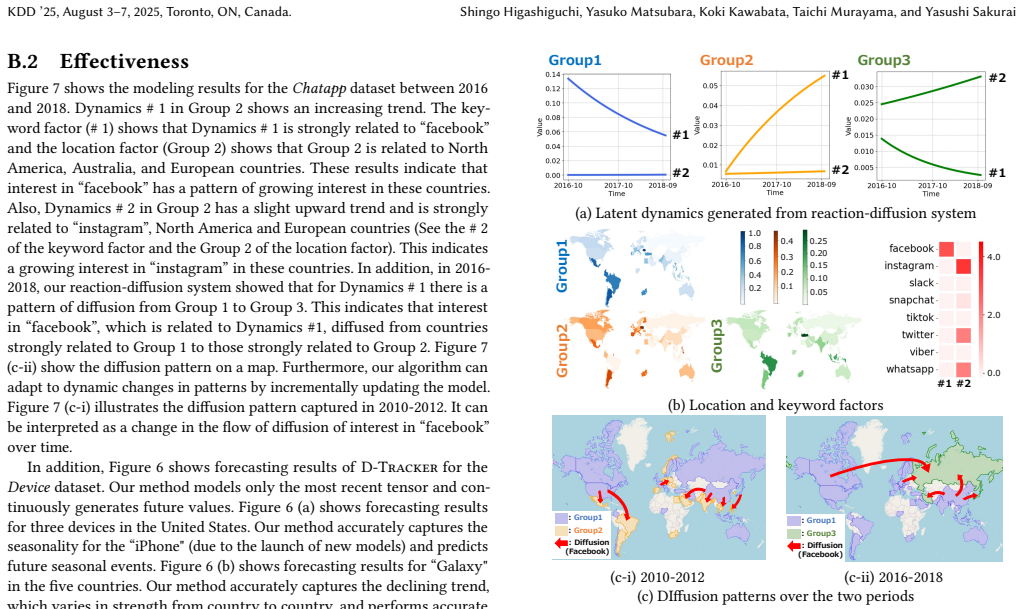
On its own terms, the paper's central claim is that the temporal structure of a keyword-location-time tensor can be summarized by a small number of latent dynamics $\mathbf{W}^{(\mathrm{core})}$ whose evolution is governed by the linear reaction-diffusion system $\frac{dw_{ij}}{dt} = a_{ij}w_{ij} + \sum_{j'} d_{ijj'}(w_{ij'} - w_{ij})$, with nonnegative factor matrices $\mathbf{W}^{(\mathrm{key})}$ and $\mathbf{W}^{(\mathrm{loc})}$ projecting these latent dynamics up to the keyword and location dimensions. Trends are the reaction terms $a_{ij}w_{ij}$; interest diffusion is the pairwise coupling $d_{ijj'}(w_{ij'} - w_{ij})$. Because the factors are nonnegative, the sign and direction of latent flows survive the projection, so the learned diffusion coefficients can be read as arrows between location groups (for example, iPhone interest moving from the US, Europe, and China to the rest of the world, or pandas interest moving from North America and Australia toward Asia). The paper further claims that these models can be maintained incrementally on data streams via MDL-based model switching and automatic rank updates, which yields forecasts that beat all seven comparison methods on MAE while taking computation time independent of stream length.
Load-bearing premise
The load-bearing premise is that the linear reaction-diffusion equation on a small number of latent dynamics describes how real interest actually spreads between locations; if the latent flows are merely an artifact of the factorization, the interpretable-diffusion component of the claim fails even if the forecasts stay accurate.
Editorial extensions
If this is right
- The method can update forecasts continuously as new observations arrive, with per-step computation cost $O(d_k d_l^2 + k d_k + l d_l)$ that does not grow with the length of the stream.
- The latent ranks (the number of keyword and location groups) and the timing of model switches are chosen by minimizing an MDL cost, so a user does not need to tune them manually after initialization.
- The recovered diffusion tensor gives an interpretable geography of interest spread, identifying which country groups seed a trend and which groups receive it, which could support advertising strategy and epidemic monitoring.
- On the reported benchmarks, D-Tracker achieves the best MAE on all six datasets at forecast horizons of 3, 6, or 9 months for search data and 1, 2, or 3 weeks for COVID-19 data, with improvements over the strongest baseline reaching roughly 57 percent.
Reading between the lines
- The interpretable-diffusion claim is plausible but is not validated against ground truth: the paper defines diffusion as whatever the fitted diffusion matrix says, and no external event timeline is used to confirm that the recovered arrows match real spread events. A dataset with tracked product launches or known epidemic introductions could test this directly.
- Because the reaction-diffusion system is linear, the model cannot represent accelerating waves, threshold effects, or other nonlinear regime behaviors. On series where diffusion is strongly nonlinear, forecasting accuracy may degrade exactly when the diffusion features matter most; comparing against a nonlinear variant on flash-crash or misinformation-spread data would reveal this.
- The 'no hyperparameters' claim is subtle: the reported experiments grid-search the initial latent ranks ($d_k \in [2,4]$, $d_s \in [0,4]$) for the first window, after which the rank-update algorithm adjusts them automatically, but the choice of that search range itself is a user decision.
- The same machinery could be applied to any nonnegative tensor stream with a spatial dimension, such as air-travel demand by route, mobile app installs by region, or disease incidence by hospital region, with location groups playing the role of countries.
Signed reviews
Editorial analysis
A structured set of objections, weighed in public.
Referee Report
Summary. This paper proposes D-Tracker, a streaming method for modeling and forecasting social activity tensor streams (e.g., keyword-by-location-by-time data). The model decomposes the current window into trend, seasonal, and outlier tensors; the trend tensor is represented by a nonnegative Tucker decomposition whose small core tensor is generated by a linear reaction-diffusion system with parameters A and D. The number of latent components and the timing of model switches are selected by an MDL criterion, and the model is updated incrementally as new data arrive. Experiments on six GoogleTrends datasets and one COVID-19 dataset compare D-Tracker with DISMO, FluxCube, PatchTST, Autoformer, DeepAR, LaST, and CoST. D-Tracker reports the best MAE in all settings and the fastest computation time in the scalability experiment; an ablation study shows that removing the diffusion, seasonal, outlier, or rank-update components degrades MAE. The paper also presents qualitative interpretations of the learned diffusion directions, e.g., iPhone interest spreading from North America/Europe/China to the rest of the world.
Significance. If the claims hold, D-Tracker would be a valuable addition to the streaming tensor-analysis toolbox: it unifies decomposition and forecasting in a single MDL-driven framework, provides interpretable latent dynamics, and offers a per-step cost that is independent of the total stream length. The paper is honest in reporting per-component ablations, and it ships code and datasets, which supports reproducibility. The MAE improvements over strong baselines are consistently in D-Tracker's favor across all datasets and horizons. However, the paper overstates its case in three respects that matter for the central claims: the 'no hyperparameters' property is not literally true; RMSE is not uniformly better; and the identification of the fitted diffusion coefficients with real-world interest diffusion is not yet validated.
major comments (4)
- [Abstract, §1, §4.2, Appendix B.1] The paper claims that D-Tracker is fully automatic and has no hyperparameters, but the method requires several user choices: the window length L_c (Section 3.1 and Q1), the float cost c_F=32 (Section 4.2), the small constant epsilon in Eq. (6), and the initial rank grid search over (d_k,d_l) in [2,4] and d_s in [0,4] described in Appendix B.1. These are hyperparameters in the usual sense. At minimum, the claim should be qualified to mean 'no per-dataset hyperparameter tuning beyond fixed defaults,' and the initialization grid search should be described as part of model selection rather than as an absence of parameters.
- [Section 5 Q1, Table 3] The central accuracy claim is metric-dependent. D-Tracker is best on MAE in every configuration, but it is not uniformly best on RMSE. For example, in the Covid-19 dataset with L_f=21, D-Tracker's RMSE is 3.65 versus Autoformer's 3.25; in VoD with L_f=13, D-Tracker's RMSE is 1.58 versus Autoformer's 1.33; and in Pythonlib with L_f=26, D-Tracker's RMSE is 1.54 versus Autoformer's 1.35. Since the paper reports both metrics and claims 'higher forecasting accuracy' without qualification, the text should either restrict the claim to MAE or provide a significance test and a substantive explanation for the RMSE differences.
- [Section 3.3, Eq. (3); Section 5 Q3] The interpretability claim that the fitted D coefficients represent real interest diffusion between locations is not supported by the evidence. The optimization in Eq. (5) is non-convex, and no identifiability or uniqueness result is given for the reaction-diffusion-constrained nonnegative Tucker model; the same reconstruction can potentially be obtained with different (A,D) pairs. The Q3 analysis is purely qualitative: the arrows in Figures 1, 5, and 7 are read from fitted maps without comparison to known diffusion events, without statistical significance, and without negative controls. The ablation 'w/o diffusion' (Figure 3) only shows that including the term reduces MAE in several datasets; it does not validate the direction or the existence of a spatial diffusion process. I would like to see a synthetic-data experiment with known diffusion coefficients, or an external ground-truth comparison (e.g., known product-launch or pandemic spread timing), before the diffusion interpretation is presented as a finding.
- [Lemma 1, Appendix A.3, Algorithm 2] The claimed time complexity of ModelEstimation, O(d_k d_l^2 + k d_k + l d_l), is not derived from the full algorithm. Algorithm 2 also updates the seasonal factors via Eq. (8), which involves multiplying an L_c by (k times l) unfolded tensor by a (k times l) by d_s matrix, and it sparsifies X_o by scanning the residual tensor of size k times l times L_c (Algorithm 2, steps 8-11). These operations have cost at least O(L_c k l d_s) and O(L_c k l), respectively, so the stated complexity omits a dependence on the window length L_c and on the tensor dimensions in the seasonal and outlier steps. This matters because the abstract and Q2 claim that computation time is independent of the data stream length; the per-step cost is independent of the total stream length n only because L_c is fixed, and the lemma as stated is inaccurate.
minor comments (5)
- [Algorithm 4, line 3] The tuple '(d_k,d_l+1,d_s)' appears twice and the case '(d_k+1,d_l,d_s)' is missing; this is presumably a typo that should be corrected.
- [Eq. (8)] The symbol circled-dot and the definition of U(mode) are not defined in the main text; please add a brief definition of the Khatri-Rao product used in the seasonal update.
- [Table 1] The checkmark under 'Parameter free' for D-Tracker conflicts with the hyperparameters identified above; consider renaming the row to 'Tuning-free after initialization' or otherwise qualifying the claim.
- [Section 4.3] The MDL comparison is between the cost of the current window under F' union Theta' and under F' alone; it would help to state whether the description cost of X_o in the old models is recomputed on the current window or only once at the time of creation, since this affects the switching decision.
- [Figure 3] The text calls (L_full - L_abl)/L_full the 'degradation rate,' but the formula yields a positive value when the ablation is worse; consider presenting it as an improvement rate or clarifying the sign convention.
Circularity Check
No significant circularity: D-Tracker's forecasts are genuinely out-of-sample extrapolations of its fitted dynamics, and the paper's self-citations are background and baseline references, not load-bearing evidence.
full rationale
The derivation chain is self-contained. The model is defined by explicit equations: the input tensor is decomposed as a sum of trend, seasonal, and outlier tensors (Eq. 1), the trend tensor is reconstructed through a Tucker-style multilinear projection (Eq. 2), and the latent dynamics are assumed to follow the reaction-diffusion system (Eq. 3). Parameters are estimated on the current window X_c via alternating least squares, Levenberg-Marquardt, and an MDL-based structural selection criterion (Eqs. 5-10). Forecasting is performed by continuing the fitted reaction-diffusion dynamics beyond the current time point, and the Q1 evaluation compares those forecasts against held-out future observations. No fitted parameter is renamed as a predicted value: the diffusion coefficients D in Eq. (3) are estimated latent couplings, and interpreting positive d_ijj' as interest diffusion is a model interpretation rather than a circular prediction. Self-citations such as [21], [22], and [35] describe prior methods and baselines; the paper does not invoke a uniqueness theorem or an unverified prior result from the same authors to force its modeling choice. The absence of ground-truth validation for the Q3 diffusion arrows is a correctness and identifiability concern, not evidence of circularity, and the forecasting evaluation remains independent of that interpretive claim.
Assumptions & free parameters
free parameters (5)
- Window length L_c =
104 (GoogleTrends), 56 (COVID-19)
- Initial rank search ranges =
d_k,d_l in [2,4], d_s in [0,4]
- Float cost c_F =
32 bits
- Epsilon in factor updates =
not specified
- Convergence and stopping criteria
assumptions (6)
- domain assumption Social activity data can be represented as the sum of trend, seasonal, and sparse outlier tensors, Eq. (1).
- domain assumption Interest diffuses between locations like chemicals in a reaction-diffusion process, with linear diffusion term D*(w_ij' - w_ij), Eq. (3).
- domain assumption Nonnegative keyword and location factors preserve interpretability of latent dynamics.
- domain assumption MDL cost with Gaussian negative log-likelihood and Huffman coding is a valid criterion for model selection and change-point detection.
- domain assumption Optimal latent ranks change gradually, so RankUpdate only needs to search rank changes of plus or minus one.
- standard math STL, PARAFAC, and nonnegative Tucker decomposition provide valid initializations.
invented entities (4)
-
Latent dynamics W(core) generated by a reaction-diffusion system
-
Latent keyword and location groups W(key), W(loc)
-
Diffusion coefficients D and growth rates A
-
Outlier tensor X_o
Cite this review
Pith. "Pith review of D-Tracker: Modeling Interest Diffusion in Social Activity Tensor Data Streams." pith.science (2026). https://pith.science/paper/V475QQ24
@misc{pith2026250500242,
  author       = {Pith},
  title        = {Pith review of: D-Tracker: Modeling Interest Diffusion in Social Activity Tensor Data Streams},
  year         = {2026},
  howpublished = {\url{https://pith.science/paper/V475QQ24}},
  note         = {Machine review of arXiv:2505.00242}
}
read the original abstract
Large quantities of social activity data, such as weekly web search volumes and the number of new infections with infectious diseases, reflect peoples' interests and activities. It is important to discover temporal patterns from such data and to forecast future activities accurately. However, modeling and forecasting social activity data streams is difficult because they are high-dimensional and composed of multiple time-varying dynamics such as trends, seasonality, and interest diffusion. In this paper, we propose D-Tracker, a method for continuously capturing time-varying temporal patterns within social activity tensor data streams and forecasting future activities. Our proposed method has the following properties: (a) Interpretable: it incorporates the partial differential equation into a tensor decomposition framework and captures time-varying temporal patterns such as trends, seasonality, and interest diffusion between locations in an interpretable manner; (b) Automatic: it has no hyperparameters and continuously models tensor data streams fully automatically; (c) Scalable: the computation time of D-Tracker is independent of the time series length. Experiments using web search volume data obtained from GoogleTrends, and COVID-19 infection data obtained from COVID-19 Open Data Repository show that our method can achieve higher forecasting accuracy in less computation time than existing methods while extracting the interest diffusion between locations. Our source code and datasets are available at {https://github.com/Higashiguchi-Shingo/D-Tracker.
Figures


Figures from the paper (4 more)


Reference graph
Works this paper leans on
-
[1]
Ardavan Afshar, Ioakeim Perros, Evangelos E Papalexakis, Elizabeth Searles, Joyce Ho, and Jimeng Sun. 2018. COPA: Constrained PARAFAC2 for sparse & large datasets. In Proceedings of the 27th ACM International Conference on Information and Knowledge Management . 793–802
work page 2018
-
[2]
Shaojie Bai, J Zico Kolter, and Vladlen Koltun. 2018. An empirical evaluation of generic convolutional and recurrent networks for sequence modeling. arXiv preprint arXiv:1803.01271 (2018)
arXiv 2018
-
[3]
Rasmus Bro. 1997. PARAFAC. Tutorial and applications. Chemometrics and intelligent laboratory systems 38, 2 (1997), 149–171
work page 1997
-
[4]
Xiaochun Cao, Xingxing Wei, Yahong Han, and Dongdai Lin. 2014. Robust face clustering via tensor decomposition. IEEE transactions on cybernetics 45, 11 (2014), 2546–2557
work page 2014
-
[5]
Jiawei Chen, Hande Dong, Xiang Wang, Fuli Feng, Meng Wang, and Xiangnan He. 2023. Bias and debias in recommender system: A survey and future directions. ACM Transactions on Information Systems 41, 3 (2023), 1–39
2023
-
[6]
Robert B Cleveland, William S Cleveland, Jean E McRae, and Irma Terpenning
-
[7]
James Durbin and Siem Jan Koopman. 2012. Time series analysis by state space methods. Vol. 38. OUP Oxford
work page 2012
-
[8]
Adolf Fick. 1855. Ueber Diffusion. Annalen der Physik 170, 1 (1855), 59–86
Show all 61 references
-
[9]
Jeremy Ginsberg, Matthew H Mohebbi, Rajan S Patel, Lynnette Brammer, Mark S Smolinski, and Larry Brilliant. 2009. Detecting influenza epidemics using search engine query data. Nature 457, 7232 (2009), 1012–1014
2009
-
[10]
GoogleTrends. [n. d.]. https://trends.google.com/trends/
-
[11]
Ekta Gujral, Georgios Theocharous, and Evangelos E Papalexakis. 2020. Spade: S treaming pa rafac2 de composition for large datasets. In Proceedings of the 2020 SIAM International Conference on Data Mining . SIAM, 577–585
2020
-
[12]
Elizabeth E Holmes, Mark A Lewis, JE Banks, and RR Veit. 1994. Partial differential equations in ecology: spatial interactions and population dynamics. Ecology 75, 1 (1994), 17–29
1994
-
[13]
Bryan Hooi, Kijung Shin, Shenghua Liu, and Christos Faloutsos. 2019. SMF: Drift-aware matrix factorization with seasonal patterns. In Proceedings of the 2019 SIAM International Conference on Data Mining . SIAM, 621–629
2019
-
[14]
Tianran Hu, Yinglong Xia, and Jiebo Luo. 2019. To return or to explore: Modelling human mobility and dynamics in cyberspace. In The World Wide Web Conference. 705–716
2019
-
[15]
Jun-Gi Jang and U Kang. 2021. Fast and memory-efficient tucker decomposition for answering diverse time range queries. InProceedings of the 27th ACM SIGKDD Conference on Knowledge Discovery & Data Mining . 725–735
2021
-
[16]
Jun-Gi Jang and U Kang. 2022. Dpar2: Fast and scalable parafac2 decomposition for irregular dense tensors. In 2022 IEEE 38th International Conference on Data Engineering (ICDE). IEEE, 2454–2467
2022
-
[17]
Jun-Gi Jang and U Kang. 2023. Static and streaming tucker decomposition for dense tensors. ACM Transactions on Knowledge Discovery from Data 17, 5 (2023), 1–34
2023
-
[18]
Jun-Gi Jang, Jeongyoung Lee, Yong-chan Park, and U Kang. 2023. Fast and Accurate Dual-Way Streaming PARAFAC2 for Irregular Tensors–Algorithm and Application. arXiv preprint arXiv:2305.18376 (2023)
2023 arXiv
-
[19]
Rudolf Emil Kalman. 1963. Mathematical description of linear dynamical systems. Journal of the Society for Industrial and Applied Mathematics, Series A: Control 1, 2 (1963), 152–192
1963
-
[20]
Koki Kawabata, Siddharth Bhatia, Rui Liu, Mohit Wadhwa, and Bryan Hooi. 2021. SSMF: Shifting Seasonal Matrix Factorization. In Advances in Neural Information Processing Systems, Vol. 34. 3863–3873
2021
-
[21]
Koki Kawabata, Yasuko Matsubara, Takato Honda, and Yasushi Sakurai. 2020. Non-Linear Mining of Social Activities in Tensor Streams. In Proceedings of the 26th ACM SIGKDD International Conference on Knowledge Discovery and Data Mining. 2093–2102
2020
-
[22]
Koki Kawabata, Yasuko Matsubara, and Yasushi Sakurai. 2023. Modeling Dynamic Interactions over Tensor Streams. InProceedings of the ACM Web Conference 2023. 1793–1803
2023
-
[23]
Henk AL Kiers, Jos MF Ten Berge, and Rasmus Bro. 1999. PARAFAC2—Part I. A direct fitting algorithm for the PARAFAC2 model. Journal of Chemometrics: A Journal of the Chemometrics Society 13, 3-4 (1999), 275–294
1999
-
[24]
Yong-Deok Kim and Seungjin Choi. 2007. Nonnegative Tucker Decomposition. In 2007 IEEE Conference on Computer Vision and Pattern Recognition . 1–8. doi:10. 1109/CVPR.2007.383405
2007
-
[25]
Tamara G Kolda and Brett W Bader. 2009. Tensor decompositions and applications. SIAM review 51, 3 (2009), 455–500
2009
-
[26]
Irena Koprinska, Dengsong Wu, and Zheng Wang. 2018. Convolutional neural networks for energy time series forecasting. In 2018 international joint conference on neural networks (IJCNN) . IEEE, 1–8
2018
-
[27]
Taehyung Kwon, Inkyu Park, Dongjin Lee, and Kijung Shin. 2021. Slicenstitch: Continuous cp decomposition of sparse tensor streams. In 2021 IEEE 37th Inter- national Conference on Data Engineering (ICDE) . IEEE, 816–827
2021
-
[28]
Jure Leskovec, Lars Backstrom, and Jon Kleinberg. 2009. Meme-tracking and the dynamics of the news cycle. InProceedings of the 15th ACM SIGKDD international conference on Knowledge discovery and data mining . 497–506
2009
-
[29]
Yixuan Li, Pingmei Xu, Dmitry Lagun, and Vidhya Navalpakkam. 2017. Towards Measuring and Inferring User Interest from Gaze. In Proceedings of the 26th International Conference on World Wide Web Companion (WWW ’17 Companion) . 525–533
2017
-
[30]
Bryan Lim and Stefan Zohren. 2021. Time-series forecasting with deep learning: a survey. Philosophical Transactions of the Royal Society A 379, 2194 (2021), 20200209
2021
-
[31]
Chenghao Liu, Steven CH Hoi, Peilin Zhao, and Jianling Sun. 2016. Online arima algorithms for time series prediction. In Proceedings of the AAAI conference on artificial intelligence, Vol. 30
2016
-
[32]
Yasuko Matsubara, Yasushi Sakurai, and Christos Faloutsos. 2015. The web as a jungle: Non-linear dynamical systems for co-evolving online activities. In Proceedings of the 24th international conference on world wide web . 721–731
2015
-
[33]
Yasuko Matsubara, Yasushi Sakurai, and Christos Faloutsos. 2016. Non-linear mining of competing local activities. In Proceedings of the 25th International Conference on World Wide Web. 737–747
2016
-
[34]
Jorge J Moré. 2006. The Levenberg-Marquardt algorithm: implementation and theory. In Numerical analysis: proceedings of the biennial Conference held at Dundee, June 28–July 1, 1977 . Springer, 105–116
2006
-
[35]
Taichi Murayama, Yasuko Matsubara, and Yasushi Sakurai. 2022. Mining Reaction and Diffusion Dynamics in Social Activities. In Proceedings of the 31st ACM KDD ’25, August 3–7, 2025, Toronto, ON, Canada. Shingo Higashiguchi, Yasuko Matsubara, Koki Kawabata, Taichi Murayama, and ...
2022
-
[36]
Kota Nakamura, Yasuko Matsubara, Koki Kawabata, Yuhei Umeda, Yuichiro Wada, and Yasushi Sakurai. 2023. Fast and Multi-aspect Mining of Complex Time-stamped Event Streams. In Proceedings of the ACM Web Conference 2023 . 1638–1649
2023
-
[37]
Yuqi Nie, Nam H Nguyen, Phanwadee Sinthong, and Jayant Kalagnanam. 2022. A time series is worth 64 words: Long-term forecasting with transformers. arXiv preprint arXiv:2211.14730 (2022)
2022 arXiv
-
[38]
Yilmazcan Ozyurt, Tobias Hatt, Ce Zhang, and Stefan Feuerriegel. 2022. A Deep Markov Model for Clickstream Analytics in Online Shopping. In Proceedings of the ACM Web Conference 2022 (WWW ’22). Association for Computing Machinery, New York, NY, USA, 3071–3081. https://doi.org/...
2022
-
[39]
Ioakeim Perros, Evangelos E Papalexakis, Fei Wang, Richard Vuduc, Elizabeth Searles, Michael Thompson, and Jimeng Sun. 2017. SPARTan: Scalable PARAFAC2 for large & sparse data. In Proceedings of the 23rd ACM SIGKDD International Conference on Knowledge Discovery and Data Minin...
2017
-
[40]
Pratt and Gleb Tschapek
Kevin B. Pratt and Gleb Tschapek. 2003. Visualizing Concept Drift. InProceedings of the Ninth ACM SIGKDD International Conference on Knowledge Discovery and Data Mining (KDD ’03) . Association for Computing Machinery, 735–740. https://doi.org/10.1145/956750.956849
2003
-
[41]
Maziar Raissi, Paris Perdikaris, and George E Karniadakis. 2019. Physics-informed neural networks: A deep learning framework for solving forward and inverse problems involving nonlinear partial differential equations. Journal of Computa- tional physics 378 (2019), 686–707
2019
-
[42]
Covid-19 Open Data Repository. [n. d.]. https://health.google.com/covid-19/open- data/
-
[43]
Manoel Horta Ribeiro, Kristina Gligorić, Maxime Peyrard, Florian Lemmerich, Markus Strohmaier, and Robert West. 2021. Sudden attention shifts on wikipedia during the covid-19 crisis. In Proceedings of the International AAAI Conference on Web and Social Media, Vol. 15. 208–219
2021
-
[44]
Jorma Rissanen. 1978. Modeling by shortest data description. Automatica 14, 5 (1978), 465–471
1978
-
[45]
Mark Rogers, Lei Li, and Stuart J Russell. 2013. Multilinear dynamical systems for tensor time series. Advances in Neural Information Processing Systems 26 (2013)
2013
-
[46]
David Salinas, Valentin Flunkert, Jan Gasthaus, and Tim Januschowski. 2020. DeepAR: Probabilistic forecasting with autoregressive recurrent networks. Inter- national Journal of Forecasting 36, 3 (2020), 1181–1191
2020
-
[47]
Ashish Vaswani, Noam Shazeer, Niki Parmar, Jakob Uszkoreit, Llion Jones, Aidan N Gomez, Łukasz Kaiser, and Illia Polosukhin. 2017. Attention is all you need. Advances in neural information processing systems 30 (2017)
2017
-
[48]
Zhuoyi Wang, Yuqiao Chen, Chen Zhao, Yu Lin, Xujiang Zhao, Hemeng Tao, Yigong Wang, and Latifur Khan. 2021. CLEAR: Contrastive-Prototype Learning with Drift Estimation for Resource Constrained Stream Mining. In Proceedings of the Web Conference 2021 (WWW ’21) . Association for...
2021
-
[49]
Zhiyuan Wang, Xovee Xu, Weifeng Zhang, Goce Trajcevski, Ting Zhong, and Fan Zhou. 2022. Learning latent seasonal-trend representations for time series forecasting. Advances in Neural Information Processing Systems 35 (2022), 38775– 38787
2022
-
[50]
Greg Welch, Gary Bishop, et al. 1995. An introduction to the Kalman filter. (1995)
1995
-
[51]
Gerald Woo, Chenghao Liu, Doyen Sahoo, Akshat Kumar, and Steven Hoi. 2022. Cost: Contrastive learning of disentangled seasonal-trend representations for time series forecasting. arXiv preprint arXiv:2202.01575 (2022)
2022 arXiv
-
[52]
Haixu Wu, Jiehui Xu, Jianmin Wang, and Mingsheng Long. 2021. Autoformer: De- composition transformers with auto-correlation for long-term series forecasting. Advances in Neural Information Processing Systems 34 (2021), 22419–22430
2021
-
[53]
An Zhang, Jingnan Zheng, Xiang Wang, Yancheng Yuan, and Tat-Seng Chua. 2023. Invariant Collaborative Filtering to Popularity Distribution Shift. In Proceedings of the ACM Web Conference 2023 . 1240–1251
2023
-
[54]
Le Zhang, Tong Xu, Hengshu Zhu, Chuan Qin, Qingxin Meng, Hui Xiong, and Enhong Chen. 2020. Large-scale talent flow embedding for company competitive analysis. In Proceedings of The Web Conference 2020 . 2354–2364
2020
-
[55]
Zi-Ke Zhang, Chuang Liu, Xiu-Xiu Zhan, Xin Lu, Chu-Xu Zhang, and Yi-Cheng Zhang. 2016. Dynamics of information diffusion and its applications on complex networks. Physics Reports 651 (2016), 1–34
2016
-
[56]
Guoxu Zhou, Andrzej Cichocki, Qibin Zhao, and Shengli Xie. 2015. Efficient non- negative tucker decompositions: Algorithms and uniqueness. IEEE Transactions on Image Processing 24, 12 (2015), 4990–5003
2015
-
[57]
Haoyi Zhou, Shanghang Zhang, Jieqi Peng, Shuai Zhang, Jianxin Li, Hui Xiong, and Wancai Zhang. 2021. Informer: Beyond efficient transformer for long se- quence time-series forecasting. In Proceedings of the AAAI conference on artificial intelligence, Vol. 35. 11106–11115
2021
-
[58]
Shuo Zhou, Nguyen Xuan Vinh, James Bailey, Yunzhe Jia, and Ian Davidson. 2016. Accelerating online cp decompositions for higher order tensors. In Proceedings of the 22nd ACM SIGKDD International Conference on Knowledge Discovery and Data Mining. 1375–1384
2016
-
[59]
Tian Zhou, Ziqing Ma, Qingsong Wen, Xue Wang, Liang Sun, and Rong Jin
-
[1990]
STL: A seasonal-trend decomposition. J. Off. Stat 6, 1 (1990), 3–73
1990
-
[2022]
facebook
Fedformer: Frequency enhanced decomposed transformer for long-term series forecasting. In International Conference on Machine Learning. PMLR, 27268– 27286. Appendix A Algorithm In this section, we describe our proposed algorithm in detail. A.1 Initialization Here, we detail th...
2025
Reviewed August 16, 2026 · model on record in the stance chip above.
Discussion (0). Continue with ORCID to comment.