REVIEW 4 major objections 7 minor 30 references
Gateformer: Advancing Multivariate Time Series Forecasting through Temporal and Variate-Wise Attention with Gated Representations
T0 review · 4 major / 7 minor · reviewed 2026-08-16 · deepseek-v4-flash
Pith's one-line read Gateformer claims that multivariate forecasting improves when a Transformer models time with gated patch-level attention and variate interactions with gated cross-variate attention, and reports top results on 13 datasets.
desk verdict Useful gated dual-attention architecture, but the SOTA claim rests on baseline numbers that appear lifted from prior papers rather than rerun under the same protocol. read the letter →
The pith
A machine-rendered reading of the paper's core claim, the machinery that carries it, and where it could break.
The reading
What carries the argument
The load-bearing object is the two-stage gated variate representation. In the temporal stage, each variate's series is normalized, split into non-overlapping patches, and fed through self-attention to produce a local temporal embedding $v^{(i)}_T$; in parallel, the same raw series passes through a shared MLP to produce a global temporal embedding $v^{(i)}_G$. A sigmoid gate $\text{Gate} = \sigma(v^{(i)}_T W_{g1} + v^{(i)}_G W_{g2})$ fuses the two into the variate embedding $s^{(i)}$. In the variate stage, self-attention runs over the matrix of these embeddings and a second gate blends the attended output with the unattended $S$, so the effective cross-variate coupling can be weak for datasets with few variates. This second gate is what lets the model behave like a channel-independent forecaster when that helps.
What would settle it
Re-run Gateformer and all nine baselines from a single codebase with identical chronological splits, look-back length $L=96$, the same prediction horizons, the same seeds, and an equal hyperparameter search budget per model, then compare the per-dataset averages. If Gateformer no longer ranks first in the stated 91 of 130 settings, the central state-of-the-art claim is falsified.
Extended reading notes
Core claim
The paper's central claim is that the best way to repurpose the Transformer for multivariate forecasting is to make it variate-wise in representation but gated in both stages: each series is first encoded independently by a patch-attention path and a global-MLP path, with a sigmoid gate choosing the mix; then attention runs across these variate embeddings, and a second gate blends the interacted and non-interacted forms. The authors claim this arrangement keeps PatchTST-level temporal resolution while adding iTransformer-style cross-variate capacity, and that the second gate prevents the cross-variate signal from hurting low-dimensional datasets. They assert this produces consistent gains on 13 benchmarks and that the design transfers to other architectures, reporting that the framework improves Autoformer, Flowformer, GPT4TS, and Moment errors on Electricity and Weather by 6.9–20.7%. In their framing, the model works because gating lets the network decide, per dataset, how much of the cross-variate information to let through.
Load-bearing premise
The state-of-the-art claim rests on the assumption that the baseline numbers it compares against were produced under the same protocol as Gateformer's experiments—identical chronological splits, look-back length $L=96$, and comparable hyperparameter tuning budgets—so if the baselines were not retuned with equal effort, the reported lead could shrink or disappear.
Editorial extensions
If this is right
- If Gateformer's results hold, a single architecture can serve datasets with as few as 7 and as many as 883 channels, with the gating layers deciding how much cross-variate interaction to use.
- The reported plug-in experiments imply that other forecasters can gain accuracy without changing their own attention machinery: Autoformer improves on Electricity by about 19.9%, Flowformer by 20.7%, GPT4TS by 10.8%, and Moment by 6.9% in the paper's Table 3.
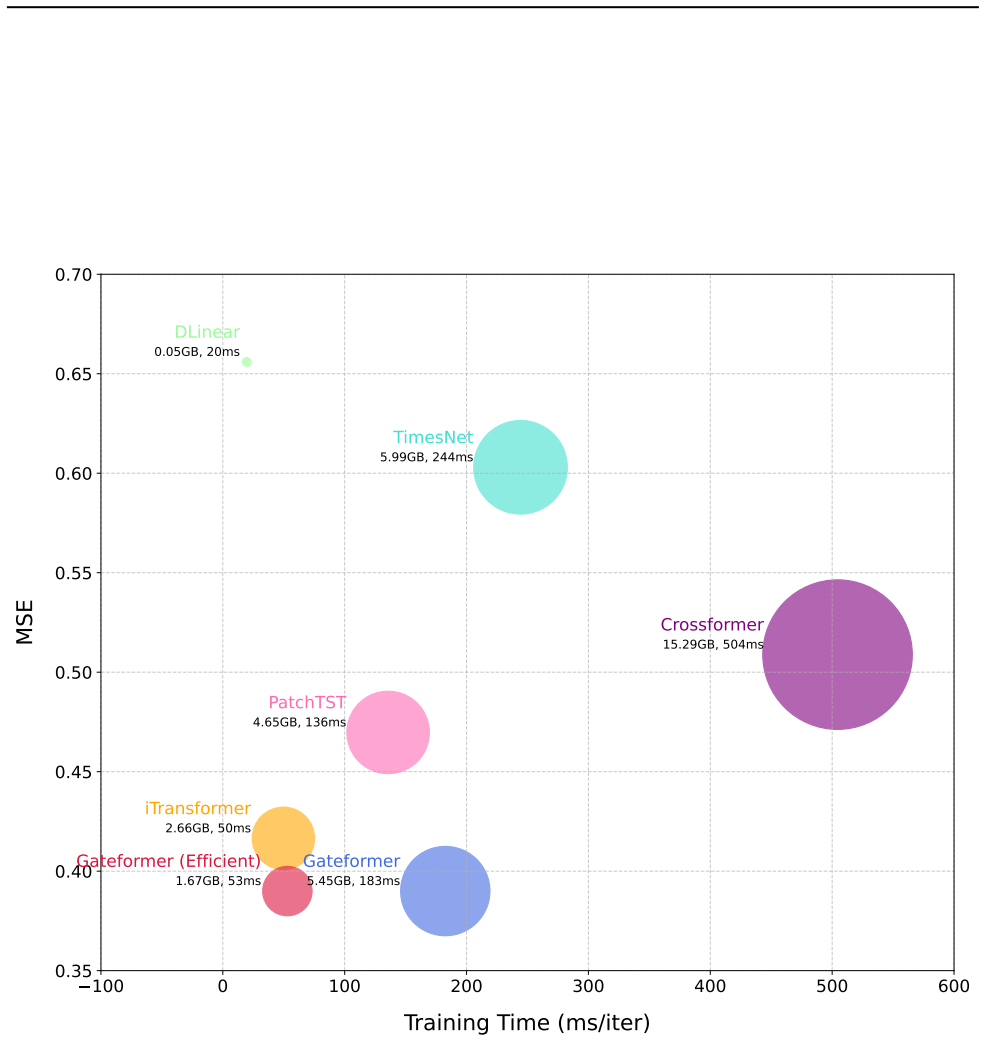
- The efficient variant, which swaps quadratic attention for Flowformer's linear attention and trains on 20% sampled variates, is claimed to keep performance while cutting memory (1.67GB vs 5.45GB on Traffic) and running as fast as iTransformer.
- Because variate-wise attention operates on the variate dimension rather than the time dimension, models built this way can be trained jointly on datasets with different numbers of variates; the PEMS scaling experiment reports consistent error reductions as the training pool grows.
Reading between the lines
- Beyond the paper: inspecting the learned gate values on a dataset-by-dataset basis would show whether the gates settle near zero for low-dimensional data and near one for high-dimensional data; the paper does not report such gate statistics.
- Beyond the paper: the reported gains when attaching the module to Autoformer, Flowformer, GPT4TS, and Moment suggest it could also be attached to newer decoder-only and foundation forecasters, but that reach is an extrapolation, since those models were not tested.
- Beyond the paper: an independent re-run that retrains all baselines under one codebase with an equal hyperparameter budget would settle how much of the 91-of-130 ranking comes from the architecture rather than from borrowed baseline numbers.
- Beyond the paper: forcing the second gate open and closed on the same datasets would quantify how much cross-variate information contributes at each dataset size, giving a practical diagnostic for when channel-independent modeling is preferable.
Signed reviews
Editorial analysis
A structured set of objections, weighed in public.
Referee Report
Summary. The paper introduces Gateformer, a Transformer-based architecture for multivariate time series forecasting that first models cross-time dependencies via patch-based temporal attention and a global MLP path, fuses these with a gating mechanism, then models cross-variate dependencies via attention over variate embeddings with a second gate. The authors claim state-of-the-art results on 13 public benchmarks (top-1 in 91 of 130 settings) and report that the framework can be integrated into Autoformer, Flowformer, GPT4TS, and Moment, improving performance by up to 20.7%. The manuscript includes ablations, sensitivity analyses, efficiency comparisons, transfer learning experiments, and a code link.
Significance. If the empirical claims are verified, the contribution is a reproducible, simple architecture that improves average performance over strong baselines and a general integration mechanism for existing forecasters. The code is publicly available. However, the absence of error bars, the unresolved inconsistency in baseline provenance, and the underspecified integration protocol currently prevent the 'state-of-the-art' claim from being endorsed at face value.
major comments (4)
- [Section 3.1 / Table 7 / Appendix B.2] The manuscript is internally inconsistent about the origin of baseline results. Section 3.1 states 'Baseline results follow Liu et al. (2024b)', Appendix B.2 states 'Baseline models were reproduced using the TimesNet repository', and Table 7's caption attributes baselines to Liu et al. (2024b). If the numbers are transcribed from published tables rather than produced under Gateformer's exact protocol (L=96, 10 epochs, early stopping, three-seed averaging, and the stated hyperparameter ranges), the comparison is not controlled, and the small margins (e.g., Electricity T=96 MSE 0.146 vs 0.148; Weather T=96 0.168 vs 0.174) could be within seed noise. Please report standard deviations for all results and either rerun the baselines under the same protocol or explicitly frame the comparison as against published numbers.
- [Section 3.3 / Table 3] The integration experiments are not sufficiently specified to support the 'seamless integration' claim. The text does not describe how the framework is grafted onto Autoformer, Flowformer, GPT4TS, and Moment, nor what 'our framework' adds in each case; no code or configuration is provided for the integrated models. The 'original' numbers in Table 3 are not stated to be reproduced locally, and the reported improvements (e.g., Flowformer Electricity average MSE from 0.267 to 0.187) are large enough that a protocol mismatch (different look-back, epochs, or tuning budget) could explain them. Please detail the integration mechanism, document how each baseline was obtained, and ensure equal training budgets and seeds.
- [All experimental tables / Appendix B.2] Results are said to be averaged over three seeds, but no standard deviations or confidence intervals are reported in any table. Given that several claimed gains are around 1–2% relative (e.g., Electricity average MSE 0.176 vs 0.178; Weather 0.253 vs 0.258), the state-of-the-art claim is statistically unsupported. Please include per-seed standard deviations or a paired significance test (e.g., across horizons) for the main comparisons.
- [Section 3.1 / Table 6 / Table 7] The phrase 'consistently outperforms all baselines across 13 datasets' is contradicted by individual settings: in Table 7, ETTh2 at T=96 has Gateformer MSE 0.306 vs iTransformer 0.297; ETTm2 at T=96 has 0.176 vs PatchTST 0.175; and in Table 6, PEMS04 at T=12 and T=24 are worse than SCINet (0.083 vs 0.073 and 0.114 vs 0.084). If the claim refers to per-dataset average MSE, say so explicitly and reword 'consistently'; otherwise the claim is false as written.
minor comments (7)
- [Contributions bullet list] The word 'propsed' should be 'proposed'.
- [Section 2.3 / Figure 1] The gating in the temporal modeling phase is described as fusing temporal and global embeddings; the caption of Figure 1 says 'Horizontal Blending: Intra-series Correlations', which is ambiguous. Consider annotating the gates explicitly as 'gate' to match the text.
- [Table 7] In the ETTm1 row for T=720, the Gateformer MSE is printed as '0459'; it should be '0.459'.
- [Appendix B.2] The patch size and stride for the patching operation are not listed among the hyperparameters; these are essential for reproducibility and should be included.
- [Section 3.3] The claimed improvement of 'up to 20.7%' is not directly traceable to a specific entry in Table 3; state which setting yields 20.7% and how the percentages are computed (e.g., relative to original MSE).
- [Appendix H.2] The efficiency comparison says all models use the same hidden dimension and batch size, but it does not state whether each baseline uses its official hyperparameters; note this in the caption.
- [Table 5 / Appendix G] The transfer learning results would be more informative with error bars, given the small differences between fine-tuning and from-scratch training.
Circularity Check
No circularity: Gateformer's forecast errors are measured on held-out chronological test splits, and no predicted quantity is defined in terms of its own target or a fitted parameter.
full rationale
The paper is an empirical architecture paper; it contains no analytic derivation whose conclusion is assumed in its premises. Gateformer's output is generated by a concrete pipeline (RevIN, patching, temporal self-attention, shared-MLP global embedding, gated fusion, variate-wise attention, gated skip, linear projection) trained to minimize MSE on the training split, and all headline numbers are test-set MSE/MAE on external benchmarks. The SOTA claim is a comparison against baselines taken either from Liu et al. (2024b) or the TimesNet repository. There is an internal inconsistency: Table 7's caption says "Baseline results are from Liu et al. (2024b)", while Appendix B.2 says "Baseline models were reproduced using the TimesNet repository"; if the copied baselines were not run under Gateformer's exact protocol, the comparison may be unfair. That is a correctness/protocol concern, not circularity, because Gateformer's numbers are not constructed from the baselines and the baselines are not fitted to Gateformer's predictions. The integration experiments (Table 3) measure "Original" versus "+ Our framework" on the same Electricity/Weather splits; the improvement is an empirical delta, not a quantity definitionally equal to the model's own output. No load-bearing step is justified by a self-citation: the authors do not invoke their own prior theorem, uniqueness result, or ansatz. The architecture choices (patching, gating, variate attention) are motivated by prior work such as PatchTST and iTransformer, but they are adopted as design choices and validated by ablations, not forced by a citation. The paper is therefore self-contained as an empirical study; no circular step is exhibited.
Assumptions & free parameters
free parameters (4)
- hidden_dim
- num_encoder_blocks
- learning_rate
- patch_size_and_stride
assumptions (3)
- standard math Softmax attention, layer normalization, MLP updates, and RevIN as described are correctly implemented and behave as assumed.
- domain assumption The chronological train/validation/test splits used (TimesNet protocol) are representative and free of data leakage.
- domain assumption Baseline results from Liu et al. (2024b) and the TimesNet repository are accurately transcribed and comparable to Gateformer's runs.
Cite this review
Pith. "Pith review of Gateformer: Advancing Multivariate Time Series Forecasting through Temporal and Variate-Wise Attention with Gated Representations." pith.science (2026). https://pith.science/paper/BWRREXEP
@misc{pith2026250500307,
  author       = {Pith},
  title        = {Pith review of: Gateformer: Advancing Multivariate Time Series Forecasting through Temporal and Variate-Wise Attention with Gated Representations},
  year         = {2026},
  howpublished = {\url{https://pith.science/paper/BWRREXEP}},
  note         = {Machine review of arXiv:2505.00307}
}
read the original abstract
There has been a recent surge of interest in time series modeling using the Transformer architecture. However, forecasting multivariate time series with Transformer presents a unique challenge as it requires modeling both temporal (cross-time) and variate (cross-variate) dependencies. While Transformer-based models have gained popularity for their flexibility in capturing both sequential and cross-variate relationships, it is unclear how to best integrate these two sources of information in the context of the Transformer architecture while optimizing for both performance and efficiency. We re-purpose the Transformer architecture to effectively model both cross-time and cross-variate dependencies. Our approach begins by embedding each variate independently into a variate-wise representation that captures its cross-time dynamics, and then models cross-variate dependencies through attention mechanisms on these learned embeddings. Gating operations in both cross-time and cross-variate modeling phases regulate information flow, allowing the model to focus on the most relevant features for accurate predictions. Our method achieves state-of-the-art performance across 13 real-world datasets and can be seamlessly integrated into other Transformer-based and LLM-based forecasters, delivering performance improvements up to 20.7\% over original models. Code is available at this repository: https://github.com/nyuolab/Gateformer.
Figures


Figures from the paper (7 more)




Reference graph
Works this paper leans on
-
[1]
Angryk, R. A., Martens, P. C., Aydin, B., Kempton, D., Mahajan, S. S., Basodi, S., Ahmadzadeh, A., Cai, X., Filali Boubrahimi, S., Hamdi, S. M., et al. Multivariate time series dataset for space weather data analytics. Scientific data, 7 0 (1): 0 227, 2020
work page 2020
-
[2]
Chen, C. W., Gerlach, R., Lin, E. M., and Lee, W. Bayesian forecasting for financial risk management, pre and post the global financial crisis. Journal of Forecasting, 31 0 (8): 0 661--687, 2012
work page 2012
-
[3]
A decoder-only foundation model for time-series forecasting
Das, A., Kong, W., Sen, R., and Zhou, Y. A decoder-only foundation model for time-series forecasting. In Forty-first International Conference on Machine Learning, 2024. URL https://openreview.net/forum?id=jn2iTJas6h
2024
-
[4]
Moment: A family of open time-series foundation models, 2024
Goswami, M., Szafer, K., Choudhry, A., Cai, Y., Li, S., and Dubrawski, A. Moment: A family of open time-series foundation models, 2024. URL https://arxiv.org/abs/2402.03885
arXiv 2024
-
[5]
Han, L., Ye, H.-J., and Zhan, D.-C. The capacity and robustness trade-off: Revisiting the channel independent strategy for multivariate time series forecasting. IEEE Transactions on Knowledge and Data Engineering, 2024
work page 2024
-
[6]
Y., Shi, X., Chen, P.-Y., Liang, Y., Li, Y.-F., Pan, S., and Wen, Q
Jin, M., Wang, S., Ma, L., Chu, Z., Zhang, J. Y., Shi, X., Chen, P.-Y., Liang, Y., Li, Y.-F., Pan, S., and Wen, Q. Time- LLM : Time series forecasting by reprogramming large language models. In The Twelfth International Conference on Learning Representations, 2024. URL https://openreview.net/forum?id=Unb5CVPtae
work page 2024
-
[7]
K., Dasgupta, N., Natarajan, S., Pickett, L
Kaushik, S., Choudhury, A., Sheron, P. K., Dasgupta, N., Natarajan, S., Pickett, L. A., and Dutt, V. Ai in healthcare: time-series forecasting using statistical, neural, and ensemble architectures. Frontiers in big data, 3: 0 4, 2020
work page 2020
-
[8]
Reversible instance normalization for accurate time-series forecasting against distribution shift
Kim, T., Kim, J., Tae, Y., Park, C., Choi, J.-H., and Choo, J. Reversible instance normalization for accurate time-series forecasting against distribution shift. In International Conference on Learning Representations, 2022. URL https://openreview.net/forum?id=cGDAkQo1C0p
2022
Show all 30 references
-
[9]
Reformer: The efficient transformer
Kitaev, N., Kaiser, L., and Levskaya, A. Reformer: The efficient transformer. In International Conference on Learning Representations, 2020. URL https://openreview.net/forum?id=rkgNKkHtvB
2020
-
[10]
Modeling long- and short-term temporal patterns with deep neural networks, 2018
Lai, G., Chang, W.-C., Yang, Y., and Liu, H. Modeling long- and short-term temporal patterns with deep neural networks, 2018. URL https://arxiv.org/abs/1703.07015
2018 arXiv
-
[11]
Informer: Beyond efficient transformer for long sequence time-series forecasting
Li, J., Hui, X., and Zhang, W. Informer: Beyond efficient transformer for long sequence time-series forecasting. arXiv: 2012.07436, 2021
2012 arXiv
-
[12]
SCIN et: Time series modeling and forecasting with sample convolution and interaction
Liu, M., Zeng, A., Chen, M., Xu, Z., LAI, Q., Ma, L., and Xu, Q. SCIN et: Time series modeling and forecasting with sample convolution and interaction. In Oh, A. H., Agarwal, A., Belgrave, D., and Cho, K. (eds.), Advances in Neural Information Processing Systems, 2022 a . URL ...
2022
-
[13]
X., and Dustdar, S
Liu, S., Yu, H., Liao, C., Li, J., Lin, W., Liu, A. X., and Dustdar, S. Pyraformer: Low-complexity pyramidal attention for long-range time series modeling and forecasting. In International Conference on Learning Representations, 2022 b . URL https://openreview.net/forum?id=0EXmFzUn5I
2022
-
[14]
Unitime: A language-empowered unified model for cross-domain time series forecasting
Liu, X., Hu, J., Li, Y., Diao, S., Liang, Y., Hooi, B., and Zimmermann, R. Unitime: A language-empowered unified model for cross-domain time series forecasting. In The Web Conference 2024, 2024 a . URL https://openreview.net/forum?id=P6sKyx2xAB
2024
-
[15]
Non-stationary transformers: Exploring the stationarity in time series forecasting
Liu, Y., Wu, H., Wang, J., and Long, M. Non-stationary transformers: Exploring the stationarity in time series forecasting. Advances in Neural Information Processing Systems, 35: 0 9881--9893, 2022 c
2022
-
[16]
itransformer: Inverted transformers are effective for time series forecasting
Liu, Y., Hu, T., Zhang, H., Wu, H., Wang, S., Ma, L., and Long, M. itransformer: Inverted transformers are effective for time series forecasting. In The Twelfth International Conference on Learning Representations, 2024 b . URL https://openreview.net/forum?id=JePfAI8fah
2024
-
[17]
Timer: Generative pre-trained transformers are large time series models
Liu, Y., Zhang, H., Li, C., Huang, X., Wang, J., and Long, M. Timer: Generative pre-trained transformers are large time series models. In Forty-first International Conference on Machine Learning, 2024 c . URL https://openreview.net/forum?id=bYRYb7DMNo
2024
-
[18]
Traffic flow prediction with big data: A deep learning approach
Lv, Y., Duan, Y., Kang, W., Li, Z., and Wang, F.-Y. Traffic flow prediction with big data: A deep learning approach. Ieee transactions on intelligent transportation systems, 16 0 (2): 0 865--873, 2014
2014
-
[19]
H., Sinthong, P., and Kalagnanam, J
Nie, Y., Nguyen, N. H., Sinthong, P., and Kalagnanam, J. A time series is worth 64 words: Long-term forecasting with transformers. In The Eleventh International Conference on Learning Representations, 2023. URL https://openreview.net/forum?id=Jbdc0vTOcol
2023
-
[20]
Pytorch: An imperative style, high-performance deep learning library
Paszke, A., Gross, S., Massa, F., Lerer, A., Bradbury, J., Chanan, G., Killeen, T., Lin, Z., Gimelshein, N., Antiga, L., et al. Pytorch: An imperative style, high-performance deep learning library. Advances in neural information processing systems, 32, 2019
2019
-
[21]
N., Kaiser, L
Vaswani, A., Shazeer, N., Parmar, N., Uszkoreit, J., Jones, L., Gomez, A. N., Kaiser, L. u., and Polosukhin, I. Attention is all you need. In Advances in Neural Information Processing Systems, 2017. URL https://proceedings.neurips.cc/paper_files/paper/2017/file/3f5ee243547dee9...
2017
-
[22]
Transformers in time series: A survey, 2023
Wen, Q., Zhou, T., Zhang, C., Chen, W., Ma, Z., Yan, J., and Sun, L. Transformers in time series: A survey, 2023. URL https://arxiv.org/abs/2202.07125
2023 arXiv
-
[23]
Autoformer: Decomposition transformers with auto-correlation for long-term series forecasting
Wu, H., Xu, J., Wang, J., and Long, M. Autoformer: Decomposition transformers with auto-correlation for long-term series forecasting. In Beygelzimer, A., Dauphin, Y., Liang, P., and Vaughan, J. W. (eds.), Advances in Neural Information Processing Systems, 2021. URL https://ope...
2021
-
[24]
Flowformer: Linearizing transformers with conservation flows
Wu, H., Wu, J., Xu, J., Wang, J., and Long, M. Flowformer: Linearizing transformers with conservation flows. arXiv preprint arXiv:2202.06258, 2022
2022 arXiv
-
[25]
Timesnet: Temporal 2d-variation modeling for general time series analysis
Wu, H., Hu, T., Liu, Y., Zhou, H., Wang, J., and Long, M. Timesnet: Temporal 2d-variation modeling for general time series analysis. In The Eleventh International Conference on Learning Representations, 2023. URL https://openreview.net/forum?id=ju_Uqw384Oq
2023
-
[26]
Are transformers effective for time series forecasting? In Proceedings of the AAAI conference on artificial intelligence, 2023
Zeng, A., Chen, M., Zhang, L., and Xu, Q. Are transformers effective for time series forecasting? In Proceedings of the AAAI conference on artificial intelligence, 2023. URL https://ojs.aaai.org/index.php/AAAI/article/view/26317/26089
2023
-
[27]
and Yan, J
Zhang, Y. and Yan, J. Crossformer: Transformer utilizing cross-dimension dependency for multivariate time series forecasting. In The Eleventh International Conference on Learning Representations, 2023. URL https://openreview.net/forum?id=vSVLM2j9eie
2023
-
[28]
Fedformer: Frequency enhanced decomposed transformer for long-term series forecasting, 2022
Zhou, T., Ma, Z., Wen, Q., Wang, X., Sun, L., and Jin, R. Fedformer: Frequency enhanced decomposed transformer for long-term series forecasting, 2022. URL https://arxiv.org/abs/2201.12740
2022 arXiv
-
[29]
One fits all: Power general time series analysis by pretrained LM
Zhou, T., Niu, P., Wang, X., Sun, L., and Jin, R. One fits all: Power general time series analysis by pretrained LM . In Thirty-seventh Conference on Neural Information Processing Systems, 2023. URL https://openreview.net/forum?id=gMS6FVZvmF
2023
-
[30]
Energy forecasting with robust, flexible, and explainable machine learning algorithms
Zhu, Z., Chen, W., Xia, R., Zhou, T., Niu, P., Peng, B., Wang, W., Liu, H., Ma, Z., Gu, X., et al. Energy forecasting with robust, flexible, and explainable machine learning algorithms. AI Magazine, 44 0 (4): 0 377--393, 2023
2023
Reviewed August 16, 2026 · model on record in the stance chip above.
Discussion (0). Continue with ORCID to comment.