Accelerating two-dimensional tensor network contractions using QR decompositions
Pith reviewed 2026-05-22 17:33 UTC · model grok-4.3
The pith
Replacing singular value decompositions with QR decompositions speeds up CTMRG contractions of C4v-symmetric iPEPS by up to two orders of magnitude.
A machine-rendered reading of the paper's core claim, the machinery that carries it, and where it could break.
Core claim
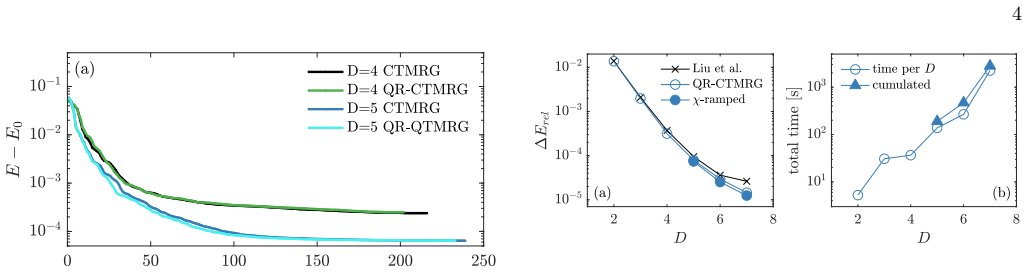
The authors introduce a contraction scheme for C4v-symmetric tensor networks that integrates QR decompositions into the CTMRG algorithm. This replaces the standard singular value or eigenvalue decompositions in the renormalization. The result is an up to 100-fold speedup with no loss of accuracy, allowing state-of-the-art computations for the Heisenberg and J1-J2 models to complete in less than one hour on an H100 GPU.
What carries the argument
The key mechanism is the use of QR decompositions to approximate the corner transfer matrices in the CTMRG renormalization step for symmetric tensors.
Load-bearing premise
That the QR decompositions maintain the fixed-point accuracy and convergence properties of the original CTMRG renormalization for these symmetric tensors.
What would settle it
Running the standard CTMRG and the QR version on the Heisenberg model at the same bond dimension and finding a significant difference in the computed ground state energy or order parameter.
Figures




read the original abstract
Infinite projected entangled-pair states (iPEPS) provide a powerful tool for studying strongly correlated systems directly in the thermodynamic limit. A core component of the algorithm is the approximate contraction of the iPEPS, where the computational bottleneck typically lies in the singular value or eigenvalue decompositions involved in the renormalization step. This is particularly true on GPUs, where tensor contractions are substantially faster than these decompositions. Here we propose a contraction scheme for $C_{4v}$-symmetric tensor networks based on combining the corner transfer matrix renormalization group (CTMRG) with QR-decompositions which are substantially faster, especially on GPUs. Our approach achieves up to two orders of magnitude speedup compared to standard CTMRG without loss of accuracy and yields state-of-the-art results for the Heisenberg and $J_1$-$J_2$ models in less than 1 h on an H100 GPU.
Editorial analysis
A structured set of objections, weighed in public.
Referee Report
Summary. The manuscript proposes replacing singular value or eigenvalue decompositions with QR decompositions in the renormalization step of CTMRG for C4v-symmetric iPEPS tensor networks. It claims this yields up to two orders of magnitude speedup on GPUs with no loss of accuracy, demonstrated by state-of-the-art energies for the Heisenberg and J1-J2 models obtained in under one hour on an H100 GPU.
Significance. If the accuracy claim holds, the approach would meaningfully accelerate 2D tensor-network simulations by alleviating the decomposition bottleneck on GPUs, enabling higher bond dimensions for strongly correlated systems. The concrete GPU timings and benchmarks on standard models are positive features.
major comments (2)
- [QR-based renormalization description] The central claim of preserved accuracy rests on the QR substitution in the CTMRG renormalization step for C4v tensors. A direct comparison of retained singular values, truncation errors, or corner-matrix spectra between the QR scheme and standard SVD (as in §3 or the renormalization subsection) is needed to confirm that deviations do not accumulate and alter the fixed-point environment.
- [Numerical results section] Table or figure reporting energies for the Heisenberg model: while state-of-the-art values are stated, the manuscript should include explicit truncation-error metrics or convergence plots comparing QR-CTMRG to SVD-CTMRG at the same bond dimension D and environment dimension χ to substantiate 'no loss of accuracy'.
minor comments (2)
- [Abstract and methods] Clarify in the methods whether the QR adaptation uses symmetry block structure or post-selection to mimic SVD truncation, and specify the exact bond dimensions D and environment sizes χ at which the reported speedups were measured.
- [Performance benchmarks] Ensure all timing benchmarks explicitly state hardware details, number of iterations, and whether the comparison uses identical convergence criteria.
Simulated Author's Rebuttal
We thank the referee for their positive assessment of our work and for the constructive suggestions that will improve the manuscript. We address each major comment below and have incorporated revisions to provide the requested comparisons.
read point-by-point responses
-
Referee: The central claim of preserved accuracy rests on the QR substitution in the CTMRG renormalization step for C4v tensors. A direct comparison of retained singular values, truncation errors, or corner-matrix spectra between the QR scheme and standard SVD (as in §3 or the renormalization subsection) is needed to confirm that deviations do not accumulate and alter the fixed-point environment.
Authors: We agree that explicit comparisons strengthen the accuracy claim. In the revised manuscript we have added a new subsection (Section 3.3) containing a direct comparison of the retained singular values and truncation errors for the QR and SVD renormalization steps at multiple bond dimensions. We also include a figure showing the corner-matrix spectra for both methods at the fixed point; the spectra agree to within 10^{-9} and the truncation errors differ by less than 10^{-8}, confirming that deviations do not accumulate over iterations. revision: yes
-
Referee: Table or figure reporting energies for the Heisenberg model: while state-of-the-art values are stated, the manuscript should include explicit truncation-error metrics or convergence plots comparing QR-CTMRG to SVD-CTMRG at the same bond dimension D and environment dimension χ to substantiate 'no loss of accuracy'.
Authors: We thank the referee for this suggestion. The revised manuscript now contains a new figure (Figure 4) that plots the energy per site versus environment dimension χ for both QR-CTMRG and SVD-CTMRG at fixed D = 8 for the Heisenberg model. An accompanying table reports the truncation errors and final energies at several χ values; the two methods agree to better than 10^{-7} in energy and exhibit comparable truncation errors, directly substantiating the claim of no accuracy loss. revision: yes
Circularity Check
No circularity: algorithmic substitution validated on external physical benchmarks
full rationale
The paper describes an explicit algorithmic change—replacing SVD/EVD with QR decompositions inside the CTMRG renormalization step for C4v-symmetric iPEPS tensors—and measures its effect via wall-clock speedup and agreement with known ground-state energies of the Heisenberg and J1-J2 models. No derivation step reduces to a fitted parameter that is then relabeled as a prediction, no self-citation supplies a uniqueness theorem that forces the result, and the accuracy claim is tested against independent external data rather than being true by construction. The method is therefore self-contained against external benchmarks.
Axiom & Free-Parameter Ledger
axioms (1)
- domain assumption The iPEPS ansatz and CTMRG renormalization produce accurate approximations to the thermodynamic limit for the models considered.
Lean theorems connected to this paper
-
IndisputableMonolith/Foundation/AlexanderDuality.leanalexander_duality_circle_linking unclear?
unclearRelation between the paper passage and the cited Recognition theorem.
We propose a contraction scheme for C4v-symmetric tensor networks based on combining the corner transfer matrix renormalization group (CTMRG) with QR-decompositions
-
IndisputableMonolith/Foundation/Cost/FunctionalEquation.leanwashburn_uniqueness_aczel unclear?
unclearRelation between the paper passage and the cited Recognition theorem.
the renormalization step in CTMRG is based on an isometry U, obtained by diagonalizing an enlarged corner C̃
What do these tags mean?
- matches
- The paper's claim is directly supported by a theorem in the formal canon.
- supports
- The theorem supports part of the paper's argument, but the paper may add assumptions or extra steps.
- extends
- The paper goes beyond the formal theorem; the theorem is a base layer rather than the whole result.
- uses
- The paper appears to rely on the theorem as machinery.
- contradicts
- The paper's claim conflicts with a theorem or certificate in the canon.
- unclear
- Pith found a possible connection, but the passage is too broad, indirect, or ambiguous to say the theorem truly supports the claim.
Forward citations
Cited by 1 Pith paper
-
Single-layer framework of variational tensor network states
A single-layer variational tensor network method reduces computational cost by three orders of magnitude in bond dimension for 2D quantum models and confirms an intermediate empty-plaquette valence bond solid phase in...
Reference graph
Works this paper leans on
-
[1]
S. R. White, Phys. Rev. Lett.69, 2863 (1992)
work page 1992
-
[2]
Schollwöck, Annals of Physics326, 96 (2011)
U. Schollwöck, Annals of Physics326, 96 (2011)
work page 2011
-
[3]
Renormalization algorithms for Quantum-Many Body Systems in two and higher dimensions
F. Verstraete and J. I. Cirac, arXiv:cond-mat/0407066 (2004)
work page internal anchor Pith review Pith/arXiv arXiv 2004
-
[4]
Tensor Product Variational Formulation for Quantum Systems
Y. Nishio, N. Maeshima, A. Gendiar, and T. Nishino, Preprint (2004), arXiv:cond-mat/0401115
work page internal anchor Pith review Pith/arXiv arXiv 2004
- [5]
- [6]
-
[7]
H. J. Liao, Z. Y. Xie, J. Chen, Z. Y. Liu, H. D. Xie, R. Z. Huang, B.Normand,andT.Xiang,Phys.Rev.Lett. 118, 137202 (2017)
work page 2017
- [8]
-
[9]
J.-Y. Chen, L. Vanderstraeten, S. Capponi, and D. Poil- blanc, Phys. Rev. B98, 184409 (2018)
work page 2018
-
[10]
S. S. Jahromi and R. Orús, Phys. Rev. B 98, 155108 (2018)
work page 2018
- [11]
-
[12]
H. Yamaguchi, Y. Sasaki, T. Okubo, M. Yoshida, T. Kida, M. Hagiwara, Y. Kono, S. Kittaka, T. Sakak- ibara, M. Takigawa, Y. Iwasaki, and Y. Hosokoshi, Phys. Rev. B 98, 094402 (2018)
work page 2018
-
[13]
A. Kshetrimayum, C. Balz, B. Lake, and J. Eisert, arXiv:1904.00028 [cond-mat, physics:quant-ph] (2019)
-
[14]
S. S. Chung and P. Corboz, Phys. Rev. B100, 035134 (2019)
work page 2019
-
[15]
H.-Y.Lee, R.Kaneko, L.E.Chern, T.Okubo, Y.Yamaji, N. Kawashima, and Y. B. Kim, Nat. Comm.11, 1639 (2020)
work page 2020
- [16]
-
[17]
J. L. Jiménez, S. P. G. Crone, E. Fogh, M. E. Za- yed, R. Lortz, E. Pomjakushina, K. Conder, A. M. Läuchli, L. Weber, S. Wessel, A. Honecker, B. Normand, C. Rüegg, P. Corboz, H. M. Rønnow, and F. Mila, Nature 592, 370 (2021)
work page 2021
-
[18]
P. Czarnik, M. M. Rams, P. Corboz, and J. Dziarmaga, Phys. Rev. B103, 075113 (2021)
work page 2021
- [19]
-
[20]
W.-Y. Liu, J. Hasik, S.-S. Gong, D. Poilblanc, W.-Q. Chen, and Z.-C. Gu, Phys. Rev. X12, 031039 (2022)
work page 2022
- [21]
- [22]
-
[23]
E. L. Weerda and M. Rizzi, Phys. Rev. B109, L241117 (2024)
work page 2024
- [24]
-
[25]
P. Schmoll, J. Naumann, J. Eisert, and Y. Iqbal, arXiv:2407.07145 [cond-mat] (2024)
-
[26]
P. Corboz, Y. Zhang, B. Ponsioen, and F. Mila, arXiv:2502.14091 [cond-mat] 10.48550/arXiv.2502.14091 (2025)
work page internal anchor Pith review Pith/arXiv arXiv doi:10.48550/arxiv.2502.14091 2025
- [27]
- [28]
- [29]
-
[30]
L. Vanderstraeten, M. Mariën, F. Verstraete, and J. Haegeman, Phys. Rev. B92, 201111 (2015)
work page 2015
-
[31]
V. Zauner-Stauber, L. Vanderstraeten, M. T. Fishman, F. Verstraete, and J. Haegeman, Phys. Rev. B97, 045145 (2018)
work page 2018
-
[32]
L. Vanderstraeten, L. Burgelman, B. Ponsioen, M. Van Damme, B. Vanhecke, P. Corboz, J. Haegeman, and F. Verstraete, Phys. Rev. B105, 195140 (2022)
work page 2022
- [33]
- [34]
-
[35]
H. H. Zhao, Z. Y. Xie, Q. N. Chen, Z. C. Wei, J. W. Cai, and T. Xiang, Phys. Rev. B81, 174411 (2010)
work page 2010
-
[36]
Z. Y. Xie, J. Chen, M. P. Qin, J. W. Zhu, L. P. Yang, and T. Xiang, Phys. Rev. B86, 045139 (2012)
work page 2012
- [37]
- [38]
- [39]
-
[40]
M. T. Fishman, L. Vanderstraeten, V. Zauner-Stauber, J. Haegeman, and F. Verstraete, Phys. Rev. B98, 235148 (2018)
work page 2018
-
[41]
Z. Y. Xie, H. J. Liao, R. Z. Huang, H. D. Xie, J. Chen, Z. Y. Liu, and T. Xiang, Phys. Rev. B96, 045128 (2017)
work page 2017
-
[42]
R. Haghshenas, S.-S. Gong, and D. N. Sheng, Phys. Rev. B 99, 174423 (2019)
work page 2019
- [43]
-
[44]
J. Naumann, E. L. Weerda, J. Eisert, M. Rizzi, and P. Schmoll, arXiv:2502.10298 [cond-mat] 10.48550/arXiv.2502.10298 (2025)
-
[45]
A. D. S. Richards and E. S. Sørensen, arXiv:2503.13900 6 [cond-mat] 10.48550/arXiv.2503.13900 (2025)
-
[46]
J. Unfried, J. Hauschild, and F. Pollmann, Phys. Rev. B 107, 155133 (2023)
work page 2023
-
[47]
In the C4v symmetric case, the number of variational parameters is n(D) = d/8(D4 + 2D3 + 3D2 + 2D)
-
[48]
Here we initialize the boundary from the bulk tensors by contracting the corresponding bra- and ket- legs on the open boundary
-
[49]
Another type of reduced-rank approximation was intro- duced in [43] to decrease the computational cost
-
[50]
H. C. Jiang, Z. Y. Weng, and T. Xiang, Phys. Rev. Lett. 101, 090603 (2008)
work page 2008
-
[51]
H. N. Phien, J. A. Bengua, H. D. Tuan, P. Corboz, and R. Orus, Phys. Rev. B92, 035142 (2015)
work page 2015
- [52]
-
[53]
L. Vanderstraeten, J. Haegeman, P. Corboz, and F. Ver- straete, Phys. Rev. B94, 155123 (2016)
work page 2016
-
[54]
H.-J. Liao, J.-G. Liu, L. Wang, and T. Xiang, Phys. Rev. X 9, 031041 (2019)
work page 2019
- [55]
-
[56]
A. W. Sandvik and H. G. Evertz, Phys. Rev. B 82, 024407 (2010)
work page 2010
-
[57]
Hasik, jurajHasik/j1j2_ipeps_states (2024), https://github.com/jurajHasik/j1j2_ipeps_states
J. Hasik, jurajHasik/j1j2_ipeps_states (2024), https://github.com/jurajHasik/j1j2_ipeps_states
work page 2024
-
[58]
W.-J. Hu, F. Becca, A. Parola, and S. Sorella, Phys. Rev. B 88, 060402 (2013)
work page 2013
- [59]
- [60]
- [61]
- [62]
- [63]
-
[64]
S. Dong, C. Wang, H. Zhang, M. Zhang, and L. He, arXiv:2407.15333 [cond-mat, physics:quant-ph] 10.48550/arXiv.2407.15333 (2024)
- [65]
-
[66]
X. Zhao, M. Li, Q. Xiao, J. Chen, F. Wang, L. Shen, M. Zhao, W. Wu, H. An, L. He, and X. Liang, inSC22: International Conference for High Performance Comput- ing, Networking, Storage and Analysis (IEEE Computer Society, Los Alamitos, CA, USA, 2022) pp. 1–15
work page 2022
- [67]
-
[68]
C. Roth, A. Szabó, and A. H. MacDonald, Phys. Rev. B 108, 054410 (2023)
work page 2023
- [69]
- [70]
- [71]
- [72]
-
[73]
O. van Alphen, S. V. Kleijweg, J. Hasik, and P. Corboz, Phys. Rev. B111, 045105 (2025)
work page 2025
- [74]
- [75]
- [76]
discussion (0)
Sign in with ORCID, Apple, or X to comment. Anyone can read and Pith papers without signing in.