REVIEW 4 major objections 7 minor 2 cited by
KeySync: A Robust Approach for Leakage-free Lip Synchronization in High Resolution
T0 review · 4 major / 7 minor · reviewed 2026-08-16 · deepseek-v4-flash
Pith's one-line read KeySync claims state-of-the-art lip synchronization at 512×512 resolution, surpassing the common 256×256 standard and reducing expression leakage from the input video.
desk verdict A solid engineering adaptation of KeyFace to lip-sync, with genuinely useful masking and occlusion-handling results, but the state-of-the-art claim is undercut by a resolution confound and train-test overlap. read the letter →
The pith
A machine-rendered reading of the paper's core claim, the machinery that carries it, and where it could break.
The reading
What carries the argument
The load-bearing mechanism is the two-stage keyframe-and-interpolation schema: a latent diffusion U-Net first generates keyframes spaced twelve frames apart that anchor the phonetic content of the audio, and a second pass reconstructs the frames between each keyframe pair, using a learnable embedding for the missing frames and fusing the HuBERT audio embedding through cross-attention and the diffusion timestep. Two design choices carry the leakage and occlusion claims. The first is a box-style mask, defined from facial landmarks, that covers the lower face and extends slightly above the nose to the bottom of the image, deliberately sized between a mouth-only mask, which leaks mouth cues, and a full lower-face mask, which removes too much context. The second is an inference-time refinement where the facial mask is intersected with the negation of an object segmentation, excluding occluders from the inpainted region. Training uses the EDM latent loss plus a masked L2 loss in RGB space, with only the masked region contributing to the loss.
What would settle it
Re-run the cross-sync evaluation of Table 1 computing LipLeak at a sweep of mouth-aspect-ratio thresholds (for example 0.15, 0.25, 0.35, 0.45) on the same 100 test videos, and check whether KeySync's rank and margin over LatentSync, Diff2Lip, and IP_LAP survive at every threshold; the paper's Supplement C, Figure 10 already shows LipLeak decreasing continuously with the threshold, so any crossing of the model curves would indicate the reported ordering is an artifact of the 0.25 cutoff. As a control, also compute LipLeak from fully silent input video: if the metric is not near zero in that case, it is measuring natural mouth posture rather than leakage.
Extended reading notes
Core claim
KeySync is a two-stage latent diffusion pipeline, built on Stable Video Diffusion and a keyframe-interpolation scheme, that outputs 512×512 lip-synced video. In the first stage a sparse set of keyframes is generated with lip shapes tied to the phonetic content of HuBERT audio embeddings; in the second, the frames between successive keyframes are interpolated, which is what yields temporally smooth motion without extra synchronization losses or past-frame conditioning. Expression leakage is blocked by a box-shaped mask, computed from facial landmarks, that covers the lower face from just above the nose down to the image edge, deliberately between the mouth-only masks that leak and the full lower-face masks that destroy context. An additional L2 loss in RGB space preserves fine mouth detail, and at inference time only, occluding objects are segmented with a video segmentation model and subtracted from the mask so a hand or microphone over the mouth is kept intact. The paper reports that this design beats five recent methods on image and video quality metrics (CMMD, TOPIQ, VL, FVD), lip-sync accuracy (LipScore), the new LipLeak metric, and pairwise human preferences, with the largest margins in the cross-sync setting that matters for dubbing.
Load-bearing premise
The whole leakage story rests on LipLeak's open-mouth threshold: a mouth aspect ratio of 0.25, chosen by visual inspection, is treated as the dividing line between a mouth that leaked from the input video and a mouth that did not, and the method rankings the paper reports are sensitive to that number since the supplement shows LipLeak falling continuously as the threshold rises.
Editorial extensions
If this is right
- Lip-synced output can be produced at 512×512, doubling the linear resolution of the field's de facto 256×256 standard, and human raters prefer it in both reconstruction and cross-sync settings.
- In cross-sync tests, where the driving audio comes from a different recording than the face, KeySync's lip-sync accuracy stays nearly constant while most baselines drop sharply, which is exactly the regime automated dubbing operates in.
- Expression leakage can be measured directly: feeding silent audio with non-silent video and counting open-mouth frames via the mouth aspect ratio yields a metric that ranks models and exposes leakage that lip-sync scores can misread.
- Occlusions such as hands, microphones, or motion blur over the mouth can be handled without retraining by segmenting the occluder and removing it from the model's mask, reducing reconstruction error around the occluder.
- Temporal consistency follows from the keyframe-then-interpolate decomposition itself, so the approach needs no sequence discriminator, temporal perceptual loss, or conditioning on past frames to stay smooth.
Reading between the lines
- Testable extension: because the supplement shows LipLeak decreasing continuously as the MAR threshold rises, a threshold sweep on the benchmark videos would settle whether KeySync's leakage advantage over LatentSync and Diff2Lip is a property of the models or an artifact of the hand-picked 0.25 cutoff.
- The mask-sizing principle stated in the paper, cover every region that signals mouth movement while keeping everything that preserves identity, generalizes beyond lip-sync to other masked-inpainting editing tasks, such as re-targeting expressions or removing speech-related motion from archival footage.
- Since the occlusion fix is a pure inference-time mask operation, it is a portable module: the paper demonstrates it on DiffDub and Diff2Lip out of the box, so it could plausibly become a standard pre-processing step for any free-form-mask lip-sync model.
- The silent-audio protocol assumes the ideal output for silent speech is a closed mouth; a stress test with speakers who naturally keep their mouths slightly open when quiet would reveal whether LipLeak partly confounds natural mouth posture with leakage.
Signed reviews
Editorial analysis
A structured set of objections, weighed in public.
Referee Report
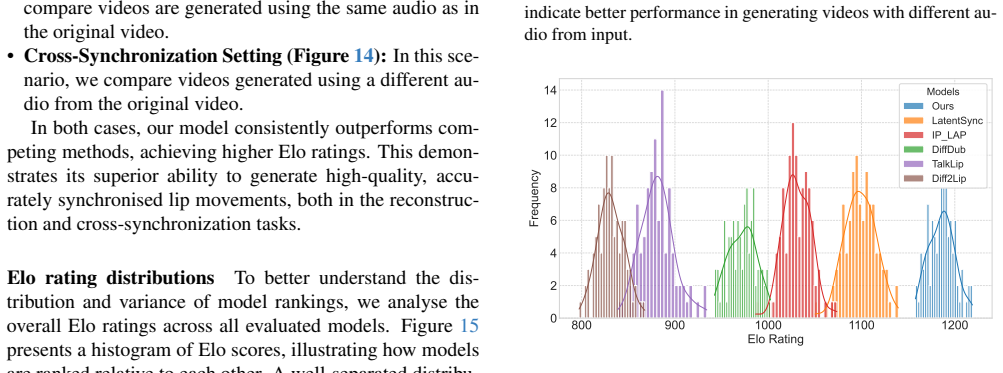
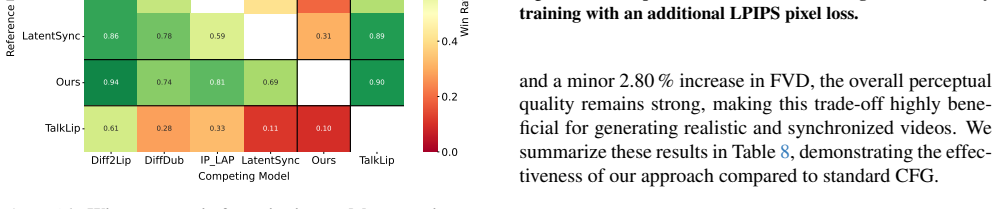
Summary. KeySync proposes a two-stage latent diffusion framework for lip synchronization at 512×512 resolution. The first stage generates sparse keyframes conditioned on HuBERT audio features and an identity frame; the second interpolates between keyframes. Leakage from the input video is addressed by a lower-face mask extending above the nose, and occlusions are handled at inference by excluding SAM2-segmented objects from the mask. The authors introduce LipLeak, a metric measuring the fraction of open-mouth frames when silent audio is fed with non-silent video. Experiments compare KeySync with DiffDub, IP_LAP, Diff2Lip, TalkLip, and LatentSync on reconstruction and cross-sync tasks using CMMD, TOPIQ, VL, FVD, LipScore, LipLeak, and a 1,000-pair user study with Elo ratings. The paper claims state-of-the-art results, particularly in cross-synchronization, and releases code and weights.
Significance. If the claimed results are reproducible at matched resolution, KeySync would be a useful step forward: it is, to my knowledge, one of the first lip-sync systems demonstrated at 512×512, it addresses the under-studied cross-sync setting, and its occlusion-handling trick is simple and applicable to other methods. The paper ships code and weights, performs systematic ablations (architecture, audio encoder, mask, guidance, losses), and grounds its subjective claims in a user study with bootstrap intervals. The LipLeak metric, despite the threshold-sensitivity issue discussed below, is a reasonable first attempt to quantify expression leakage, which is often only discussed qualitatively. However, the central SOTA claim rests on an evaluation protocol that currently does not control for output resolution, does not enforce a speaker-disjoint split, and relies partly on metrics proposed by the same authors; these gaps must be closed before the claim can be accepted.
major comments (4)
- [Section 5.1, Table 1] KeySync is evaluated at 512×512 (Supplement B, Table 7), while the competing methods are, in most cases, native 256×256 systems; Table 1 does not list the output resolution used for each baseline or state whether all outputs were resized to a common resolution before computing CMMD, FVD, VL, or running the user study. All of these metrics are resolution-sensitive (FVD and CMMD compare feature distributions of images of fixed size; the variance of Laplacian directly measures image sharpness). The paper's framing that KeySync 'surpasses the common 256×256 standard' is therefore confounded: the reported margins could reflect a resolution artifact rather than a lip-sync advantage. The authors should either evaluate all methods at a matched resolution (e.g., upscaling baselines to 512×512 or downsampling KeySync to 256×256) or otherwise demonstrate that the conclusions are invariant to resolution; the user-study stimulus resolution should also be reported.
- [Section 4.1, test set] The 100 test videos are 'randomly selected' from CelebV-Text, CelebV-HQ, and HDTF, the same datasets used for training, and no identity-level split is described. HDTF has only 264 speakers, and random selection at video level makes it very likely that test identities also appear in the training set; if so, identity memorization can inflate image-quality and LipScore numbers. The authors should report whether test identities are disjoint from training identities, and if not, provide results on a held-out identity split. In addition, Table 1 reports single point estimates with no error bars or significance tests; given the two settings and six models, bootstrap confidence intervals on CMMD/FVD/LipScore would be needed to support the claimed ordering.
- [Section 4.2 and Supplement C, LipLeak threshold] LipLeak is defined by a hand-set MAR threshold of 0.25, chosen 'based on visual inspection.' Figure 10 of the Supplement shows that LipLeak decreases continuously as the threshold increases, so the ranking of models on LipLeak depends on the chosen threshold; the current paper does not show whether the ordering in Table 1 (KeySync 0.16 vs. IP_LAP 0.28 vs. LatentSync 0.33) is stable over a plausible range, e.g., 0.2–0.3. Since LipLeak is used both as a headline contribution and as an ablation criterion (Table 4), the authors should report the metric as a function of threshold for all methods, or provide a principled criterion for the threshold.
- [Section 4.2, LipScore provenance] LipScore [2] is proposed in KeyFace, which is the same authors' system on which KeySync is built, and the paper uses it as the primary lip-sync quality measure; no independent lip-sync metric (e.g., SyncNet offset and confidence) is reported. Even if LipScore is more effective than SyncNet, its use here means the central claim is partly evaluated with a self-defined metric. The authors should report at least one external, widely used lip-sync measure in Table 1, or demonstrate that LipScore agrees with SyncNet-based scores on a subset of outputs.
minor comments (7)
- [Section 3.3, Eq. (3)] The notation 's ={zti,zm,...,z m| ...' is hard to parse; please define the number of learnable embeddings and clarify the order of frames in the sequence.
- [Section 4.2] The metric name 'variance of Laplacian (VL)' should be 'variance of the Laplacian' for correctness.
- [Supplement C] The sentence 'it's a a scale-invariant measure' contains a duplicated article and informal contraction; please revise.
- [Supplement G] There is a typo in 'would require extesnsive new data collection'; it should be 'extensive'.
- [Figure 2 caption] The labels 'Crepeat times' and 'repeat times' appear to be truncated expressions; the repetition count should be stated explicitly.
- [Section 5.2, Table 4] The rows 'Ours (nose-level)' and 'Ours' are not clearly defined in the main text; the difference between these two masks should be described explicitly and tied to Figure 7, especially since the text says extending the mask to the eye region is crucial.
- [References] Several references contain stray characters (e.g., 'V ougioukas' in [4]) and inconsistent formatting; the reference list should be cleaned, and the arXiv identifier for KeyFace [2] should be provided if available.
Circularity Check
No significant circularity: the method and its evaluation are self-contained, with external metrics and a user study corroborating the central claims.
full rationale
The paper's derivation chain is architectural and empirical rather than definitional. KeySync's training objective (Eqs. 4-6) is the standard EDM latent-diffusion loss plus a masked RGB L2 loss; none of these terms is defined in terms of the evaluation metrics. The masking strategy (Eq. 2) and occlusion handling (Eq. 7) are preprocessing choices, not fitted to the reported metrics. The headline SOTA claim is supported by a combination of external no-reference metrics (CMMD, FVD, TOPIQ, VL), a new LipLeak metric, and a 1,000-comparison user study with bootstrapped Elo ratings. The use of LipScore [2] is a self-citation to the authors' prior KeyFace work, and LipLeak is introduced in this paper, but both serve as evaluation instruments rather than as inputs to the model; the method would produce the same outputs regardless of these metrics. No equation equates a predicted quantity to a fitted parameter, no uniqueness theorem is imported from the authors' prior work, and no known result is renamed. The LipLeak threshold of 0.25 is empirically chosen, and Supplement C shows the metric varies monotonically with the threshold; this is a sensitivity or correctness consideration, not a circularity. Similarly, the potential resolution mismatch with baselines in Table 1 is a comparison-protocol concern, not a circularity. Therefore the paper contains no circular step that reduces its claims to its inputs.
Assumptions & free parameters
free parameters (4)
- MAR threshold for LipLeak =
0.25
- Mask extension above the nose =
nose-level
- Guidance scales waud and wid =
waud=5, wid=2
- Keyframe spacing S =
12
assumptions (5)
- domain assumption With silent audio input, any frame with an open mouth is caused by leakage from the input video.
- domain assumption LipScore from KeyFace [2] correlates with human-judged lip synchronization quality.
- ad hoc to paper A static mask computed once per video remains valid even when the head moves.
- ad hoc to paper The model trained on box-shaped masks generalizes to free-form masks with occlusions excluded at inference.
- domain assumption Test videos drawn from the same datasets used for training are a fair evaluation set.
Cite this review
Pith. "Pith review of KeySync: A Robust Approach for Leakage-free Lip Synchronization in High Resolution." pith.science (2026). https://pith.science/paper/EKFJJEGI
@misc{pith2026250500497,
  author       = {Pith},
  title        = {Pith review of: KeySync: A Robust Approach for Leakage-free Lip Synchronization in High Resolution},
  year         = {2026},
  howpublished = {\url{https://pith.science/paper/EKFJJEGI}},
  note         = {Machine review of arXiv:2505.00497}
}
read the original abstract
Lip synchronization, known as the task of aligning lip movements in an existing video with new input audio, is typically framed as a simpler variant of audio-driven facial animation. However, as well as suffering from the usual issues in talking head generation (e.g., temporal consistency), lip synchronization presents significant new challenges such as expression leakage from the input video and facial occlusions, which can severely impact real-world applications like automated dubbing, but are often neglected in existing works. To address these shortcomings, we present KeySync, a two-stage framework that succeeds in solving the issue of temporal consistency, while also incorporating solutions for leakage and occlusions using a carefully designed masking strategy. We show that KeySync achieves state-of-the-art results in lip reconstruction and cross-synchronization, improving visual quality and reducing expression leakage according to LipLeak, our novel leakage metric. Furthermore, we demonstrate the effectiveness of our new masking approach in handling occlusions and validate our architectural choices through several ablation studies. Code and model weights can be found at https://antonibigata.github.io/KeySync.
Figures


Figures from the paper (14 more)





Forward citations
Cited by 2 Pith papers
-
Avatar Forcing: Real-Time Interactive Head Avatar Generation for Natural Conversation
A causal diffusion-forcing model generates interactive head-avatar motion with 500ms motion-generation latency and learns expressive reactions via DPO with synthetic negative samples.
-
InfiniteTalk: Audio-driven Video Generation for Sparse-Frame Video Dubbing
Sparse-frame dubbing with adjacent-chunk keyframe sampling lets a streaming audio-video model produce full-body motion synchronized to new audio while preserving identity and camera motion.
Reference graph
Works this paper leans on
-
[2]
Antoni Bigata, Michał Stypułkowski, Rodrigo Mira, Stella Bounareli, Konstantinos V ougioukas, Zoe Landgraf, Nikita Drobyshev, Maciej Zieba, Stavros Petridis, and Maja Pantic. Keyface: Expressive audio-driven facial animation for long sequences via keyframe interpolation, 2025. 2, 3, 4, 5
work page 2025
-
[1]
wav2vec 2.0: A framework for self-supervised learning of speech representations
Alexei Baevski, Yuhao Zhou, Abdelrahman Mohamed, and Michael Auli. wav2vec 2.0: A framework for self-supervised learning of speech representations. In Advances in Neu- ral Information Processing Systems 33: Annual Conference on Neural Information Processing Systems 2020, NeurIPS 2020, December 6-12, 2020, virtual, 2020. 8
work page 2020
-
[3]
Speech driven video editing via an audio-conditioned diffusion model
Dan Bigioi, Shubhajit Basak, Michal Stypulkowski, Maciej Zieba, Hugh Jordan, Rachel McDonnell, and Peter Corco- ran. Speech driven video editing via an audio-conditioned diffusion model. Image Vis. Comput., 142:104911, 2024. 2, 3, 4
work page 2024
-
[4]
Stable video diffusion: Scaling latent video diffusion models to large datasets, 2023
Andreas Blattmann, Tim Dockhorn, Sumith Kulal, Daniel Mendelevitch, Maciej Kilian, Dominik Lorenz, Yam Levi, Zion English, Vikram V oleti, Adam Letts, Varun Jampani, and Robin Rombach. Stable video diffusion: Scaling latent video diffusion models to large datasets, 2023. 2, 4, 1
work page 2023
-
[5]
Adrian Bulat and Georgios Tzimiropoulos. How far are we from solving the 2d & 3d face alignment problem? (and a dataset of 230, 000 3d facial landmarks). In IEEE Interna- tional Conference on Computer Vision, ICCV 2017, Venice, Italy, October 22-29, 2017 , pages 1021–1030. IEEE Com- puter Society, 2017. 4
work page 2017
-
[6]
IQA-PyTorch: Pytorch toolbox for image quality assessment
Chaofeng Chen and Jiadi Mo. IQA-PyTorch: Pytorch toolbox for image quality assessment. [Online]. Avail- able: https : / / github . com / chaofengc / IQA - PyTorch, 2022. 5
work page 2022
-
[7]
TOPIQ: A top-down approach from semantics to distortions for image quality assessment
Chaofeng Chen, Jiadi Mo, Jingwen Hou, Haoning Wu, Liang Liao, Wenxiu Sun, Qiong Yan, and Weisi Lin. TOPIQ: A top-down approach from semantics to distortions for image quality assessment. IEEE Trans. Image Process., 33:2404– 2418, 2024. 5, 4
work page 2024
-
[8]
Talking-head generation with rhyth- mic head motion
Lele Chen, Guofeng Cui, Celong Liu, Zhong Li, Ziyi Kou, Yi Xu, and Chenliang Xu. Talking-head generation with rhyth- mic head motion. In European Conference on Computer Vi- sion, pages 35–51. Springer, 2020. 2
work page 2020
Show all 70 references
-
[9]
Wavlm: Large-scale self-supervised pre- training for full stack speech processing
Sanyuan Chen, Chengyi Wang, Zhengyang Chen, Yu Wu, Shujie Liu, Zhuo Chen, Jinyu Li, Naoyuki Kanda, Takuya Yoshioka, Xiong Xiao, Jian Wu, Long Zhou, Shuo Ren, Yan- min Qian, Yao Qian, Jian Wu, Michael Zeng, Xiangzhan Yu, and Furu Wei. Wavlm: Large-scale self-supervised pre- tra...
2022
-
[10]
Echomimic: Lifelike audio-driven portrait animations through editable landmark conditions, 2024
Zhiyuan Chen, Jiajiong Cao, Zhiquan Chen, Yuming Li, and Chenguang Ma. Echomimic: Lifelike audio-driven portrait animations through editable landmark conditions, 2024. 1, 2
2024
-
[11]
Videoretalking: Audio-based lip synchronization for talking head video editing in the wild
Kun Cheng, Xiaodong Cun, Yong Zhang, Menghan Xia, Fei Yin, Mingrui Zhu, Xuan Wang, Jue Wang, and Nannan Wang. Videoretalking: Audio-based lip synchronization for talking head video editing in the wild. In SIGGRAPH Asia 2022 Conference Papers, SA 2022, Daegu, Republic of Ko- re...
2022
-
[12]
Gonzalez, and Ion Stoica
Wei-Lin Chiang, Lianmin Zheng, Ying Sheng, Anasta- sios Nikolas Angelopoulos, Tianle Li, Dacheng Li, Hao Zhang, Banghua Zhu, Michael Jordan, Joseph E. Gonzalez, and Ion Stoica. Chatbot arena: An open platform for evalu- ating llms by human preference, 2024. 5
2024
-
[13]
You said that? arXiv preprint arXiv:1705.02966, 2017
Joon Son Chung, Amir Jamaludin, and Andrew Zisserman. You said that? arXiv preprint arXiv:1705.02966, 2017. 2
2017 arXiv
-
[14]
Diffu- sion models beat gans on image synthesis
Prafulla Dhariwal and Alexander Quinn Nichol. Diffu- sion models beat gans on image synthesis. In Advances in Neural Information Processing Systems 34: Annual Con- ference on Neural Information Processing Systems 2021, NeurIPS 2021, December 6-14, 2021, virtual , pages 8780– 8...
2021
-
[15]
Dae-talker: High fidelity speech-driven talking face generation with diffusion autoen- coder
Chenpeng Du, Qi Chen, Tianyu He, Xu Tan, Xie Chen, Kai Yu, Sheng Zhao, and Jiang Bian. Dae-talker: High fidelity speech-driven talking face generation with diffusion autoen- coder. In Proceedings of the 31st ACM International Con- ference on Multimedia, pages 4281–4289, 2023. 2
2023
-
[16]
Arpad E. Elo. The Rating of Chessplayers, Past and Present. Arco Pub., New York, 1978. 5, 3
1978
-
[17]
Goodfellow, Jean Pouget-Abadie, Mehdi Mirza, Bing Xu, David Warde-Farley, Sherjil Ozair, Aaron C
Ian J. Goodfellow, Jean Pouget-Abadie, Mehdi Mirza, Bing Xu, David Warde-Farley, Sherjil Ozair, Aaron C. Courville, and Yoshua Bengio. Generative adversarial networks. Com- mun. ACM, 63(11):139–144, 2020. 1
2020
-
[18]
Stylesync: High-fidelity generalized and personalized lip sync in style-based genera- tor
Jiazhi Guan, Zhanwang Zhang, Hang Zhou, Tianshu Hu, Kaisiyuan Wang, Dongliang He, Haocheng Feng, Jingtuo Liu, Errui Ding, Ziwei Liu, et al. Stylesync: High-fidelity generalized and personalized lip sync in style-based genera- tor. In Proceedings of the IEEE/CVF Conference on C...
-
[19]
Classifier-free diffusion guidance
Jonathan Ho. Classifier-free diffusion guidance. ArXiv, abs/2207.12598, 2022. 1, 4
2022 arXiv
-
[20]
Denoising dif- fusion probabilistic models
Jonathan Ho, Ajay Jain, and Pieter Abbeel. Denoising dif- fusion probabilistic models. In Advances in Neural Informa- tion Processing Systems 33: Annual Conference on Neural Information Processing Systems 2020, NeurIPS 2020, De- cember 6-12, 2020, virtual, 2020. 1, 2, 3, 4
2020
-
[21]
Video dif- fusion models
Jonathan Ho, Tim Salimans, Alexey Gritsenko, William Chan, Mohammad Norouzi, and David J Fleet. Video dif- fusion models. Advances in Neural Information Processing Systems, 35:8633–8646, 2022. 2
2022
-
[22]
Hubert: Self-supervised speech representation learning by masked prediction of hidden units
Wei-Ning Hsu, Benjamin Bolte, Yao-Hung Hubert Tsai, Kushal Lakhotia, Ruslan Salakhutdinov, and Abdelrahman Mohamed. Hubert: Self-supervised speech representation learning by masked prediction of hidden units. IEEE ACM Trans. Audio Speech Lang. Process. , 29:3451–3460, 2021. 3, 4, 8
2021
-
[23]
Animate anyone: Consistent and controllable image- to-video synthesis for character animation
Li Hu. Animate anyone: Consistent and controllable image- to-video synthesis for character animation. In IEEE/CVF Conference on Computer Vision and Pattern Recognition, CVPR 2024, Seattle, WA, USA, June 16-22, 2024 , pages 8153–8163. IEEE, 2024. 2
2024
-
[24]
Re- thinking FID: towards a better evaluation metric for image 9 generation
Sadeep Jayasumana, Srikumar Ramalingam, Andreas Veit, Daniel Glasner, Ayan Chakrabarti, and Sanjiv Kumar. Re- thinking FID: towards a better evaluation metric for image 9 generation. In IEEE/CVF Conference on Computer Vision and Pattern Recognition, CVPR 2024, Seattle, WA, USA...
2024
-
[25]
Driver drowsiness detection and alert system
R Kannan, Palamakula Jahnavi, and M Megha. Driver drowsiness detection and alert system. In 2023 IEEE In- ternational Conference on Integrated Circuits and Commu- nication Systems (ICICACS), pages 1–5, 2023. 5
2023
-
[26]
Analyzing and improv- ing the image quality of stylegan
Tero Karras, Samuli Laine, Miika Aittala, Janne Hellsten, Jaakko Lehtinen, and Timo Aila. Analyzing and improv- ing the image quality of stylegan. In Proceedings of the IEEE/CVF conference on computer vision and pattern recognition, pages 8110–8119, 2020. 3
2020
-
[27]
Elucidating the design space of diffusion-based generative models
Tero Karras, Miika Aittala, Timo Aila, and Samuli Laine. Elucidating the design space of diffusion-based generative models. In Advances in Neural Information Processing Sys- tems 35: Annual Conference on Neural Information Process- ing Systems 2022, NeurIPS 2022, New Orleans, ...
2022
-
[28]
Stylelipsync: Style-based personalized lip-sync video generation
Taekyung Ki and Dongchan Min. Stylelipsync: Style-based personalized lip-sync video generation. In IEEE/CVF Inter- national Conference on Computer Vision, ICCV 2023, Paris, France, October 1-6, 2023 , pages 22784–22793. IEEE,
2023
-
[29]
Latentsync: Au- dio conditioned latent diffusion models for lip sync
Chunyu Li, Chao Zhang, Weikai Xu, Jinghui Xie, Weiguo Feng, Bingyue Peng, and Weiwei Xing. Latentsync: Au- dio conditioned latent diffusion models for lip sync. CoRR, abs/2412.09262, 2024. 1, 3, 4, 6, 2
2024 arXiv
-
[30]
A light weight model for active speaker detection
Junhua Liao, Haihan Duan, Kanghui Feng, Wanbing Zhao, Yanbing Yang, and Liangyin Chen. A light weight model for active speaker detection. In Proceedings of the IEEE/CVF Conference on Computer Vision and Pattern Recognition (CVPR), pages 22932–22941, 2023. 1
2023
-
[31]
Diffdub: Person-generic visual dubbing using inpaint- ing renderer with diffusion auto-encoder
Tao Liu, Chenpeng Du, Shuai Fan, Feilong Chen, and Kai Yu. Diffdub: Person-generic visual dubbing using inpaint- ing renderer with diffusion auto-encoder. In IEEE Interna- tional Conference on Acoustics, Speech and Signal Process- ing, ICASSP 2024, Seoul, Republic of Korea, Ap...
2024
-
[32]
Repaint: Inpainting using denoising diffusion probabilistic models
Andreas Lugmayr, Martin Danelljan, Andr´es Romero, Fisher Yu, Radu Timofte, and Luc Van Gool. Repaint: Inpainting using denoising diffusion probabilistic models. InIEEE/CVF Conference on Computer Vision and Pattern Recognition, CVPR 2022, New Orleans, LA, USA, June 18-24, 2022...
2022
-
[33]
Diff2lip: Audio conditioned dif- fusion models for lip-synchronization
Soumik Mukhopadhyay, Saksham Suri, Ravi Teja Gadde, and Abhinav Shrivastava. Diff2lip: Audio conditioned dif- fusion models for lip-synchronization. In IEEE/CVF Win- ter Conference on Applications of Computer Vision, WACV 2024, Waikoloa, HI, USA, January 3-8, 2024 , pages 5280–
2024
-
[34]
Synctalkface: Talking face generation with precise lip-syncing via audio-lip memory
Se Jin Park, Minsu Kim, Joanna Hong, Jeongsoo Choi, and Yong Man Ro. Synctalkface: Talking face generation with precise lip-syncing via audio-lip memory. In Thirty- Sixth AAAI Conference on Artificial Intelligence, AAAI 2022, Thirty-Fourth Conference on Innovative Applications...
2022
-
[35]
Pech-Pacheco, G
J.L. Pech-Pacheco, G. Cristobal, J. Chamorro-Martinez, and J. Fernandez-Valdivia. Diatom autofocusing in brightfield microscopy: a comparative study. In Proceedings 15th In- ternational Conference on Pattern Recognition. ICPR-2000, pages 314–317 vol.3, 2000. 5
2000
-
[36]
A lip sync expert is all you need for speech to lip generation in the wild
KR Prajwal, Rudrabha Mukhopadhyay, Vinay P Nambood- iri, and CV Jawahar. A lip sync expert is all you need for speech to lip generation in the wild. In Proceedings of the 28th ACM International Conference on Multimedia , pages 484–492, 2020. 1, 3, 5
2020
-
[37]
Deep learning-based image and video inpainting: A survey
Weize Quan, Jiaxi Chen, Yanli Liu, Dong-Ming Yan, and Pe- ter Wonka. Deep learning-based image and video inpainting: A survey. Int. J. Comput. Vis., 132(7):2367–2400, 2024. 4
2024
-
[38]
Robust speech recognition via large-scale weak supervision
Alec Radford, Jong Wook Kim, Tao Xu, Greg Brockman, Christine McLeavey, and Ilya Sutskever. Robust speech recognition via large-scale weak supervision. In Interna- tional conference on machine learning, pages 28492–28518. PMLR, 2023. 8
2023
-
[39]
Girshick, Piotr Doll ´ar, and Christoph Feichtenhofer
Nikhila Ravi, Valentin Gabeur, Yuan-Ting Hu, Ronghang Hu, Chaitanya Ryali, Tengyu Ma, Haitham Khedr, Roman R¨adle, Chlo ´e Rolland, Laura Gustafson, Eric Mintun, Junt- ing Pan, Kalyan Vasudev Alwala, Nicolas Carion, Chao- Yuan Wu, Ross B. Girshick, Piotr Doll ´ar, and Christop...
2024 arXiv
-
[40]
High-resolution image syn- thesis with latent diffusion models
Robin Rombach, Andreas Blattmann, Dominik Lorenz, Patrick Esser, and Bj¨orn Ommer. High-resolution image syn- thesis with latent diffusion models. InIEEE/CVF Conference on Computer Vision and Pattern Recognition, CVPR 2022, New Orleans, LA, USA, June 18-24, 2022 , pages 10674–...
2022
-
[41]
Lee, Jonathan Ho, Tim Salimans, David J
Chitwan Saharia, William Chan, Huiwen Chang, Chris A. Lee, Jonathan Ho, Tim Salimans, David J. Fleet, and Mo- hammad Norouzi. Palette: Image-to-image diffusion mod- els. In SIGGRAPH ’22: Special Interest Group on Computer Graphics and Interactive Techniques Conference, Vancouv...
2022
-
[42]
Difftalk: Crafting diffu- sion models for generalized audio-driven portraits animation
Shuai Shen, Wenliang Zhao, Zibin Meng, Wanhua Li, Zheng Zhu, Jie Zhou, and Jiwen Lu. Difftalk: Crafting diffu- sion models for generalized audio-driven portraits animation. In IEEE/CVF Conference on Computer Vision and Pattern Recognition, CVPR 2023, Vancouver, BC, Canada, Jun...
2023
-
[43]
Diffused heads: Diffusion models beat gans on talking-face genera- tion
Michal Stypulkowski, Konstantinos V ougioukas, Sen He, Maciej Zieba, Stavros Petridis, and Maja Pantic. Diffused heads: Diffusion models beat gans on talking-face genera- tion. In IEEE/CVF Winter Conference on Applications of Computer Vision, WACV 2024, Waikoloa, HI, USA, Janu...
2024
-
[44]
Blindly assess image qual- ity in the wild guided by a self-adaptive hyper network
Shaolin Su, Qingsen Yan, Yu Zhu, Cheng Zhang, Xin Ge, Jinqiu Sun, and Yanning Zhang. Blindly assess image qual- ity in the wild guided by a self-adaptive hyper network. In IEEE/CVF Conference on Computer Vision and Pattern Recognition (CVPR), 2020. 1 10
2020
-
[45]
To- wards accurate generative models of video: A new metric and challenges, 2019
Thomas Unterthiner, Sjoerd van Steenkiste, Karol Kurach, Raphael Marinier, Marcin Michalski, and Sylvain Gelly. To- wards accurate generative models of video: A new metric and challenges, 2019. 5
2019
-
[46]
End-to-end speech-driven facial animation with tem- poral gans
Konstantinos V ougioukas, Stavros Petridis, and Maja Pan- tic. End-to-end speech-driven facial animation with tem- poral gans. In British Machine Vision Conference 2018, BMVC 2018, Newcastle, UK, September 3-6, 2018 , page
2018
-
[47]
Realistic speech-driven facial animation with gans
Konstantinos V ougioukas, Stavros Petridis, and Maja Pantic. Realistic speech-driven facial animation with gans. Interna- tional Journal of Computer Vision, pages 1–16, 2019. 1, 2
2019
-
[48]
V-express: Conditional dropout for progressive train- ing of portrait video generation
Cong Wang, Kuan Tian, Jun Zhang, Yonghang Guan, Feng Luo, Fei Shen, Zhiwei Jiang, Qing Gu, Xiao Han, and Wei Yang. V-express: Conditional dropout for progressive train- ing of portrait video generation. CoRR, abs/2406.02511,
-
[49]
Tan, and Haizhou Li
Jiadong Wang, Xinyuan Qian, Malu Zhang, Robby T. Tan, and Haizhou Li. Seeing what you said: Talking face genera- tion guided by a lip reading expert. InIEEE/CVF Conference on Computer Vision and Pattern Recognition, CVPR 2023, Vancouver, BC, Canada, June 17-24, 2023 , pages 14...
2023
-
[50]
Aniportrait: Audio-driven synthesis of photorealistic portrait animation,
Huawei Wei, Zejun Yang, and Zhisheng Wang. Aniportrait: Audio-driven synthesis of photorealistic portrait animation,
-
[51]
Hallo: Hierarchical audio-driven visual synthesis for portrait image animation, 2024
Mingwang Xu, Hui Li, Qingkun Su, Hanlin Shang, Liwei Zhang, Ce Liu, Jingdong Wang, Yao Yao, and Siyu Zhu. Hallo: Hierarchical audio-driven visual synthesis for portrait image animation, 2024. 1, 2
2024
-
[52]
Vasa-1: Lifelike audio-driven talking faces generated in real time
Sicheng Xu, Guojun Chen, Yu-Xiao Guo, Jiaolong Yang, Chong Li, Zhenyu Zang, Yizhong Zhang, Xin Tong, and Baining Guo. Vasa-1: Lifelike audio-driven talking faces generated in real time. arXiv preprint arXiv:2404.10667 ,
-
[53]
CelebV-Text: A large-scale facial text-video dataset
Jianhui Yu, Hao Zhu, Liming Jiang, Chen Change Loy, Wei- dong Cai, and Wayne Wu. CelebV-Text: A large-scale facial text-video dataset. In CVPR, 2023. 5, 1
2023
-
[54]
Make your actor talk: Generalizable and high-fidelity lip sync with motion and appearance disentanglement
Runyi Yu, Tianyu He, Ailing Zhang, Yuchi Wang, Jun- liang Guo, Xu Tan, Chang Liu, Jie Chen, and Jiang Bian. Make your actor talk: Generalizable and high-fidelity lip sync with motion and appearance disentanglement. CoRR, abs/2406.08096, 2024. 1, 3, 4
2024 arXiv
-
[55]
Multimodal image synthesis and editing: A survey and taxonomy
Fangneng Zhan, Yingchen Yu, Rongliang Wu, Jiahui Zhang, Shijian Lu, Lingjie Liu, Adam Kortylewski, Christian Theobalt, and Eric Xing. Multimodal image synthesis and editing: A survey and taxonomy. IEEE Transactions on Pat- tern Analysis and Machine Intelligence, 2023. 1
2023
-
[56]
Dream-talk: diffusion-based realistic emotional audio-driven method for single image talking face generation
Chenxu Zhang, Chao Wang, Jianfeng Zhang, Hongyi Xu, Guoxian Song, You Xie, Linjie Luo, Yapeng Tian, Xiaohu Guo, and Jiashi Feng. Dream-talk: diffusion-based realistic emotional audio-driven method for single image talking face generation. arXiv preprint arXiv:2312.13578, 2023. 2
2023 arXiv
-
[57]
Show-1: Marrying pixel and latent diffusion models for text-to-video generation
David Junhao Zhang, Jay Zhangjie Wu, Jia-Wei Liu, Rui Zhao, Lingmin Ran, Yuchao Gu, Difei Gao, and Mike Zheng Shou. Show-1: Marrying pixel and latent diffusion models for text-to-video generation. CoRR, abs/2309.15818, 2023. 4
2023 arXiv
-
[58]
Sadtalker: Learning realistic 3d motion coefficients for stylized audio- driven single image talking face animation
Wenxuan Zhang, Xiaodong Cun, Xuan Wang, Yong Zhang, Xi Shen, Yu Guo, Ying Shan, and Fei Wang. Sadtalker: Learning realistic 3d motion coefficients for stylized audio- driven single image talking face animation. In IEEE/CVF Conference on Computer Vision and Pattern Recognition,...
2023
-
[59]
MuseTalk: Real-Time High Quality Lip Synchroniza- tion with Latent Space Inpainting, 2024
Yue Zhang, Minhao Liu, Zhaokang Chen, Bin Wu, Yubin Zeng, Chao Zhan, Yingjie He, Junxin Huang, and Wenjiang Zhou. MuseTalk: Real-Time High Quality Lip Synchroniza- tion with Latent Space Inpainting, 2024. arXiv:2410.10122 [cs]. 2, 3
2024 arXiv
-
[60]
Flow-guided one-shot talking face generation with a high- resolution audio-visual dataset
Zhimeng Zhang, Lincheng Li, Yu Ding, and Changjie Fan. Flow-guided one-shot talking face generation with a high- resolution audio-visual dataset. In 2021 IEEE/CVF Confer- ence on Computer Vision and Pattern Recognition (CVPR) , pages 3660–3669, 2021. 5, 1
2021
-
[61]
Dinet: Deformation inpainting network for realistic face visually dubbing on high resolu- tion video
Zhimeng Zhang, Zhipeng Hu, Wenjin Deng, Changjie Fan, Tangjie Lv, and Yu Ding. Dinet: Deformation inpainting network for realistic face visually dubbing on high resolu- tion video. In Thirty-Seventh AAAI Conference on Artificial Intelligence, AAAI 2023, Thirty-Fifth Conference...
2023
-
[62]
Human-computer interaction system: A survey of talking-head generation
Rui Zhen, Wenchao Song, Qiang He, Juan Cao, Lei Shi, and Jia Luo. Human-computer interaction system: A survey of talking-head generation. Electronics, 12(1):218, 2023. 1
2023
-
[63]
Identity- preserving talking face generation with landmark and ap- pearance priors
Weizhi Zhong, Chaowei Fang, Yinqi Cai, Pengxu Wei, Gangming Zhao, Liang Lin, and Guanbin Li. Identity- preserving talking face generation with landmark and ap- pearance priors. In Proceedings of the IEEE/CVF Confer- ence on Computer Vision and Pattern Recognition (CVPR) , page...
2023
-
[64]
Style-preserving lip sync via audio-aware style refer- ence
Weizhi Zhong, Jichang Li, Yinqi Cai, Liang Lin, and Guan- bin Li. Style-preserving lip sync via audio-aware style refer- ence. CoRR, abs/2408.05412, 2024. 1, 3, 4
2024 arXiv
-
[65]
Talking face generation by adversarially disentangled audio-visual representation
Hang Zhou, Yu Liu, Ziwei Liu, Ping Luo, and Xiaogang Wang. Talking face generation by adversarially disentangled audio-visual representation. In Proceedings of the AAAI con- ference on artificial intelligence, pages 9299–9306, 2019. 1, 2
2019
-
[66]
Pose-controllable talking face generation by implicitly modularized audio-visual rep- resentation
Hang Zhou, Yasheng Sun, Wayne Wu, Chen Change Loy, Xiaogang Wang, and Ziwei Liu. Pose-controllable talking face generation by implicitly modularized audio-visual rep- resentation. In Proceedings of the IEEE/CVF conference on computer vision and pattern recognition, pages 4176–4186,
-
[67]
CelebV- HQ: A large-scale video facial attributes dataset
Hao Zhu, Wayne Wu, Wentao Zhu, Liming Jiang, Siwei Tang, Li Zhang, Ziwei Liu, and Chen Change Loy. CelebV- HQ: A large-scale video facial attributes dataset. In ECCV,
-
[133]
BMV A Press, 2018. 2
2018
-
[2022]
Examples of problematic videos in CelebV-HQ and CelebV-Text
5, 1 11 KeySync: A Robust Approach for Leakage-free Lip Synchronization in High Resolution Supplementary Material Figure 8. Examples of problematic videos in CelebV-HQ and CelebV-Text. A. Datasets A.1. Curation and preprocessing When working with in-the-wild datasets such as C...
-
[5290]
1, 3, 4, 6, 2
IEEE, 2024. 1, 3, 4, 6, 2
2024
Reviewed August 16, 2026 · model on record in the stance chip above.
Discussion (0). Continue with ORCID to comment.