REVIEW 4 major objections 6 minor 1 cited by
SpatialLLM: A Compound 3D-Informed Design towards Spatially-Intelligent Large Multimodal Models
T0 review · 4 major / 6 minor · reviewed 2026-08-16 · deepseek-v4-flash
Pith's one-line read SpatialLLM claims a staged 3D-data recipe lifts image-only spatial reasoning to 62.7%, beating GPT-4o by 8.7 points.
desk verdict A useful training recipe and a new orientation-heavy benchmark, but the benchmark's construct validity is not established, so the headline SOTA claim overreaches. read the letter →
The pith
A machine-rendered reading of the paper's core claim, the machinery that carries it, and where it could break.
The reading
What carries the argument
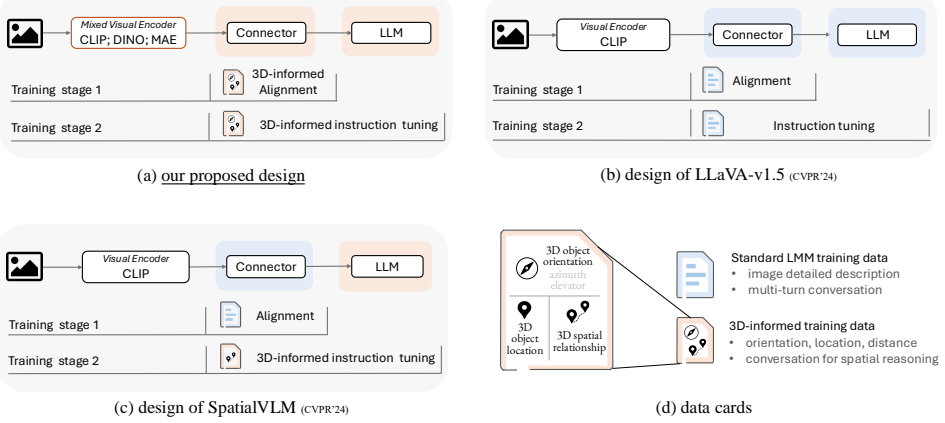
The load-bearing mechanism is the compound training recipe, not any single network module. Concretely: (1) 3DI-Pb-IN166K, a set of object-level 3D probing questions converted from human-annotated ImageNet3D poses, is inserted at the multimodal alignment stage; (2) 3DI-Ft1M, one million instruction-tuning conversations about distances, facing directions, and relative 3D positions, is inserted at instruction tuning; (3) the architecture is a LLaVA-style model with a CLIP+DINOv2 mixed vision encoder and Llama3-8B, with the encoder kept frozen; and (4) SpatialVQA, 1,323 rule-generated questions built from Omni3D 3D bounding boxes, supplies the yardstick for distance, orientation, and combined spatial reasoning. The design-space search shows that moving either dataset to the wrong stage, or replacing human pose annotations with pseudo-labels, lowers accuracy.
What would settle it
A pure 2D heuristic that answers SpatialVQA's distance and side questions from bounding-box area, pixel position, and occlusion would settle the claim: if it reaches or exceeds 62.7%, the benchmark does not isolate 3D reasoning.
Extended reading notes
Core claim
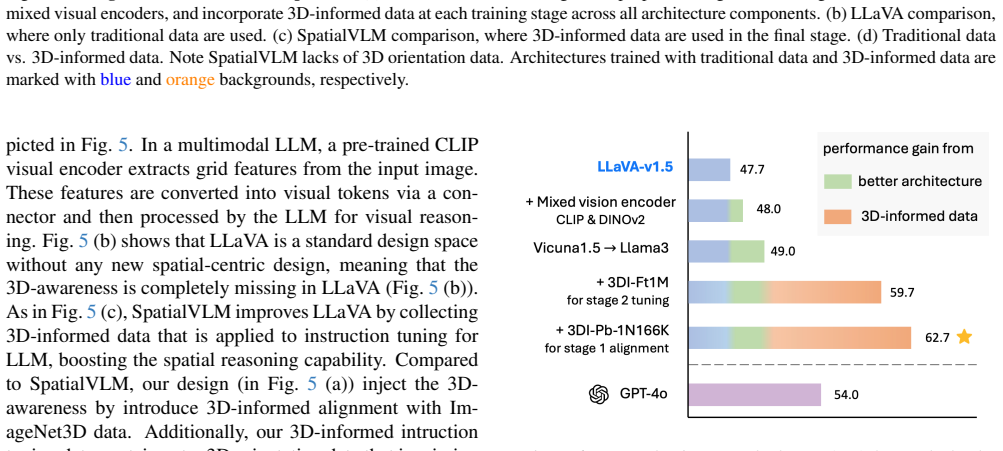
The paper's central claim is that 3D spatial reasoning in an LMM is primarily a data-placement problem. Starting from LLaVA-v1.5 at 47.7% on SpatialVQA, the paper moves through a roadmap: mixing a self-supervised DINOv2 encoder's features with CLIP and upgrading the LLM to Llama3-8B adds about 1.3 points; adding 3D-informed instruction conversations (3DI-Ft1M) at the tuning stage adds 10.7 points; and adding human-annotated 3D orientation probing data (3DI-Pb-IN166K) at multimodal alignment adds another 3 points, reaching 62.7%. The authors report that this is the first VQA data to include 3D orientation relationships on real images, and they show that pre-training the vision encoder on 3D probing data (stage 0) does not help, so the final design keeps visual features frozen.
Load-bearing premise
The headline numbers rest on SpatialVQA's rule-generated answers being correct and genuinely 3D; if those answers are noisy or reachable from 2D cues, the gap to GPT-4o measures something other than 3D reasoning.
Editorial extensions
If this is right
- Adding 3D-informed instruction tuning data alone yields a 10.7-point jump on SpatialVQA, making it the single strongest design decision.
- Adding human-annotated 3D pose probing data during multimodal alignment adds 3 more points and outperforms semi-automated pseudo-labels.
- Architecture upgrades contribute about 1.3 points total, so future gains are more likely to come from data composition than from new encoders or LLMs.
- Fine-tuning the vision encoder on 3D data before alignment is counterproductive; frozen pretrained encoders remain the better design.
- The final image-only model reaches 62.7% average accuracy and 86.3% on 3D distance questions, while orientation reasoning lags at 52.9%.
Reading between the lines
- Editorial inference: the 86.3% distance accuracy versus 52.9% orientation accuracy suggests the field's next bottleneck is orientation perception; datasets with higher-quality 6D pose labels, not more conversations, are likely to drive the next jump.
- Editorial inference: since stage-0 vision encoder tuning hurt performance, injecting 3D awareness through adapters or late fusion may be safer than fine-tuning the encoder, and the paper's negative result points there.
- Editorial inference: if the 13.7-point dominance of data over architecture reproduces on larger backbones, training-stage data placement should become a standard reporting axis for multimodal model papers, not just spatial ones.
Signed reviews
Editorial analysis
A structured set of objections, weighed in public.
Referee Report
Summary. The paper proposes SpatialLLM, a large multimodal model designed for 3D spatial reasoning, and introduces SpatialVQA, a 1,323-question benchmark generated from Omni3D 3D bounding boxes. The method combines a compound design: 3D-informed probing data for alignment, 3D-informed instruction-tuning data, a mixed vision encoder (CLIP+DINOv2), and an upgraded LLM (Llama3-8B). The paper reports 62.7% accuracy on SpatialVQA, surpassing GPT-4o by 8.7% and SpatialVLM by 10.5%, and attributes the gains to architecture improvements (1.3%) and 3D-informed data (13.7%). The systematic ablation over training stages and data types is the paper's main methodological contribution.
Significance. The paper's strengths are its systematic coverage of the design space (data type, training stage, vision encoder, LLM) and the construction of large 3D-informed training datasets (3DI-Pb-OI1M, 3DI-Pb-IN166K, 3DI-Ft1M). The idea of injecting 3D orientation probing data at the alignment stage and the 13.7% gain from data-side changes are, if confirmed, nontrivial and useful for practitioners. The new SpatialVQA benchmark, however, is the sole basis for all headline comparisons; because its construct validity is not demonstrated and the evaluation is on the same family of rule-generated data used for training, the central claim of state-of-the-art 3D spatial reasoning is not yet established. With external validation and better statistical controls, the contribution would be a valuable reference for the community.
major comments (4)
- [Sec. 3.2.2 / Appendix B] The central assertion that all SpatialVQA questions 'cannot be answered from 2D spatial reasoning only' is not supported by the question inventory. 'Closer to camera' is largely determined by apparent size and occlusion; 'Facing camera' reduces to which side is visible in the 2D image; 'Higher' and 'On which side' are mostly readable from image-plane coordinates; 'Same direction' can be approximated from projected 2D orientation. Only 'Closer to object' and possibly 'Facing object' seem to require true 3D relationships. The paper provides no 2D-cue oracle baseline, so the construct validity of the benchmark is unestablished. I request a control evaluation: implement a rule-based oracle using only 2D signals (2D box sizes, image-plane centers, occlusion/ordering, projected orientation) and report its accuracy per question type, along with the fraction of questions that are ambiguous or degenerate under 2D cues. This is necessary to interpret the headline 62.7% and the 8.7% margin over GPT-4o in Table 1.
- [Sec. 3.3.2 / Table 2 / Appendix A] The training data (3DI-Pb, 3DI-Ft1M) and the evaluation benchmark (SpatialVQA) are generated by the same group using the same rule-based conversion of 3D bounding box annotations (Omni3D for the benchmark; OpenImages/ImageNet3D for training) and the same question templates. The +10.7% from 3DI-Ft1M instruction tuning (Fig. 6) may therefore reflect learning benchmark-specific templates and label distributions rather than general 3D spatial reasoning. The manuscript does not report whether SpatialVQA images overlap with training images, nor does it evaluate on any independent benchmark. Please add (i) a check for image/annotation overlap between SpatialVQA and all training sets; (ii) evaluation on at least one external spatial reasoning benchmark or a human-annotated subset; and (iii) a discussion of how much of the gain persists when the evaluation template is varied.
- [Table 2 / Fig. 6] All conclusions are based on single-run accuracies on a 1,323-question set. For the overall accuracy, the approximate 95% binomial confidence interval is ±2.7 percentage points; for the per-type subsets (roughly 240 questions each) it is about ±6.3 points. Thus the reported differences of 0.3% (CLIP+DINOv2 vs CLIP+MAE) and 1.0% (LLaVA-v1.5 to Llama3) are within sampling noise, yet the roadmap in Fig. 6 treats them as design recommendations. Report multiple seeds or bootstrap confidence intervals, and correct for the multiple comparisons inherent in selecting a model on the same benchmark that produced the headline number.
- [Fig. 7 / Table 1] The comparison with GPT-4o is not quantified transparently. In Fig. 7, GPT-4o's response is a refusal ('without the ability to visually assess the image'), which is a limitation of the interaction protocol, not necessarily a spatial reasoning error. If refusals are scored as incorrect, the 8.7% margin over GPT-4o is inflated. The paper must report the exact prompt, the number of calls, retries, refusal detection, and the accuracy after excluding refusals or providing the image again. The same protocol should be documented for Claude 3.5 Sonnet.
minor comments (6)
- [Sec. 1] Typo: 'for for complex spatial relationships' should read 'for complex spatial relationships'.
- [Fig. 6] '3DI-Pb-1N166K' appears to be a typo for '3DI-Pb-IN166K'.
- [Fig. 5(d)] 'azimuth elevator' should be 'azimuth elevation'.
- [Related Work] SpatialRGPT is cited as [14,16]; reference [14] is SpatialVLM, which is a different method. Please correct the citation.
- [Appendix B] The angle threshold used to define 'same direction' and 'on which side' is not specified; please state the exact rule for completeness and reproducibility.
- [Supplementary Sec. A] The statement that 'We pretrain the visual connector only while freezing other modules' is inconsistent with the Stage 0 rows of Table 2, which update LoRA layers of the CLIP encoder; please clarify which modules are updated at each stage.
Circularity Check
No significant circularity: the reported gains are empirical ablations evaluated on a benchmark built from independent Omni3D annotations, not quantities forced by construction.
full rationale
The paper's central claim is an empirical result on SpatialVQA, a benchmark constructed from Omni3D's object-level 3D bounding boxes with rule-based question generation (Sec. 3.2.2, Appendix B). The model is trained on separate data, 3DI-Pb-OI1M, 3DI-Pb-IN166K, and 3DI-Ft1M, drawn from OpenImages and ImageNet3D; SpatialVQA images are not used in training, and the benchmark labels come from Omni3D annotations rather than from the authors' ImageNet3D pose estimator. The reported +10.7% and +3% gains are measured ablations, not fitted parameters renamed as predictions, and the final 62.7% is an evaluation result, not a quantity derived from the training labels by construction. The use of the authors' prior ImageNet3D work as a data and pose-estimation source is a normal tool citation; the paper does not invoke it as a uniqueness theorem, nor does it smuggle in an ansatz through that citation. The concern that some SpatialVQA question types may be answerable from 2D cues is a benchmark-validity and correctness issue, not a circular derivation: even if true, it would not make the reported accuracy equal to the training input by construction. No self-definitional, fitted-input, self-citation-chain, uniqueness-import, ansatz-smuggling, or renaming step can be exhibited from the paper's equations or data-generation rules.
Assumptions & free parameters
free parameters (1)
- Angle threshold for 'same direction' and 'on which side' classification
assumptions (5)
- domain assumption Metric depth and 3D pose estimates produced by foundation models (DepthAnything, the ImageNet3D pose estimator) are accurate enough to serve as training supervision.
- domain assumption Omni3D's 3D bounding box annotations are correct and can be converted into reliable orientation and spatial relationship labels for SpatialVQA.
- domain assumption SpatialVQA questions cannot be answered from 2D image cues alone.
- domain assumption Training images (OpenImages, ImageNet3D) are disjoint from evaluation images (Omni3D).
- domain assumption LLaVA-v1.5 hyperparameters and training recipe transfer to the new 3D-informed data without re-tuning.
Cite this review
Pith. "Pith review of SpatialLLM: A Compound 3D-Informed Design towards Spatially-Intelligent Large Multimodal Models." pith.science (2026). https://pith.science/paper/N3OZ5MRL
@misc{pith2026250500788,
  author       = {Pith},
  title        = {Pith review of: SpatialLLM: A Compound 3D-Informed Design towards Spatially-Intelligent Large Multimodal Models},
  year         = {2026},
  howpublished = {\url{https://pith.science/paper/N3OZ5MRL}},
  note         = {Machine review of arXiv:2505.00788}
}
read the original abstract
Humans naturally understand 3D spatial relationships, enabling complex reasoning like predicting collisions of vehicles from different directions. Current large multimodal models (LMMs), however, lack of this capability of 3D spatial reasoning. This limitation stems from the scarcity of 3D training data and the bias in current model designs toward 2D data. In this paper, we systematically study the impact of 3D-informed data, architecture, and training setups, introducing SpatialLLM, a large multi-modal model with advanced 3D spatial reasoning abilities. To address data limitations, we develop two types of 3D-informed training datasets: (1) 3D-informed probing data focused on object's 3D location and orientation, and (2) 3D-informed conversation data for complex spatial relationships. Notably, we are the first to curate VQA data that incorporate 3D orientation relationships on real images. Furthermore, we systematically integrate these two types of training data with the architectural and training designs of LMMs, providing a roadmap for optimal design aimed at achieving superior 3D reasoning capabilities. Our SpatialLLM advances machines toward highly capable 3D-informed reasoning, surpassing GPT-4o performance by 8.7%. Our systematic empirical design and the resulting findings offer valuable insights for future research in this direction. Our project page is available at: https://3d-spatial-reasoning.github.io/spatial-llm/
Figures


Figures from the paper (5 more)



Forward citations
Cited by 1 Pith paper
-
SpaceTools: Tool-Augmented Spatial Reasoning via Double Interactive RL
A two-phase interactive RL framework (DIRL) lets a 3B VLM learn to coordinate multiple vision and robot tools, reaching top benchmark scores and 86% real-robot pick-and-place success.
Reference graph
Works this paper leans on
-
[1]
Gpt-4 technical report.arXiv preprint arXiv:2303.08774,
Josh Achiam, Steven Adler, Sandhini Agarwal, Lama Ah- mad, Ilge Akkaya, Florencia Leoni Aleman, Diogo Almeida, Janko Altenschmidt, Sam Altman, Shyamal Anadkat, et al. Gpt-4 technical report.arXiv preprint arXiv:2303.08774,
-
[2]
SpaceLLaV A.https://huggingface
Remyx AI. SpaceLLaV A.https://huggingface. co/remyxai/SpaceLLaVA, 2024. 1, 7
work page 2024
-
[3]
Flamingo: a visual language model for few-shot learning.Advances in neural information processing systems, 35:23716–23736,
Jean-Baptiste Alayrac, Jeff Donahue, Pauline Luc, Antoine Miech, Iain Barr, Yana Hasson, Karel Lenc, Arthur Men- sch, Katherine Millican, Malcolm Reynolds, et al. Flamingo: a visual language model for few-shot learning.Advances in neural information processing systems, 35:23716–23736,
-
[4]
Claude 3.5 Sonnet.https : / / www
Anthropic. Claude 3.5 Sonnet.https : / / www . anthropic . com / news / claude - 3 - 5 - sonnet,
- [5]
-
[6]
Scanqa: 3d question answering for spatial scene understanding
Daichi Azuma, Taiki Miyanishi, Shuhei Kurita, and Motoaki Kawanabe. Scanqa: 3d question answering for spatial scene understanding. Inproceedings of the IEEE/CVF conference on computer vision and pattern recognition, pages 19129– 19139, 2022. 4, 1
work page 2022
-
[7]
Qwen technical report.arXiv preprint arXiv:2309.16609, 2023
Jinze Bai, Shuai Bai, Yunfei Chu, Zeyu Cui, Kai Dang, Xiaodong Deng, Yang Fan, Wenbin Ge, Yu Han, Fei Huang, et al. Qwen technical report.arXiv preprint arXiv:2309.16609, 2023. 2, 3
arXiv 2023
-
[8]
Jinze Bai, Shuai Bai, Shusheng Yang, Shijie Wang, Sinan Tan, Peng Wang, Junyang Lin, Chang Zhou, and Jingren Zhou. Qwen-vl: A frontier large vision-language model with versatile abilities.arXiv preprint arXiv:2308.12966, 2023. 2
arXiv 2023
Show all 70 references
-
[9]
Arkitscenes: A diverse real-world dataset for 3d indoor scene understanding using mobile rgb-d data.arXiv preprint arXiv:2111.08897, 2021
Gilad Baruch, Zhuoyuan Chen, Afshin Dehghan, Tal Dimry, Yuri Feigin, Peter Fu, Thomas Gebauer, Brandon Joffe, Daniel Kurz, Arik Schwartz, et al. Arkitscenes: A diverse real-world dataset for 3d indoor scene understanding using mobile rgb-d data.arXiv preprint arXiv:2111.08897,...
2021 arXiv
-
[10]
Zoedepth: Zero-shot trans- fer by combining relative and metric depth.arXiv preprint arXiv:2302.12288, 2023
Shariq Farooq Bhat, Reiner Birkl, Diana Wofk, Peter Wonka, and Matthias M ¨uller. Zoedepth: Zero-shot trans- fer by combining relative and metric depth.arXiv preprint arXiv:2302.12288, 2023. 1, 2
2023 arXiv
-
[11]
Omni3D: A large benchmark and model for 3D object detection in the wild
Garrick Brazil, Abhinav Kumar, Julian Straub, Nikhila Ravi, Justin Johnson, and Georgia Gkioxari. Omni3D: A large benchmark and model for 3D object detection in the wild. InCVPR, Vancouver, Canada, 2023. IEEE. 2, 4, 1
2023
-
[12]
nuscenes: A multi- modal dataset for autonomous driving
Holger Caesar, Varun Bankiti, Alex H Lang, Sourabh V ora, Venice Erin Liong, Qiang Xu, Anush Krishnan, Yu Pan, Gi- ancarlo Baldan, and Oscar Beijbom. nuscenes: A multi- modal dataset for autonomous driving. InProceedings of the IEEE/CVF conference on computer vision and patter...
2020
-
[13]
Honeybee: Locality-enhanced projector for multimodal llm
Junbum Cha, Wooyoung Kang, Jonghwan Mun, and Byungseok Roh. Honeybee: Locality-enhanced projector for multimodal llm. InProceedings of the IEEE/CVF Con- ference on Computer Vision and Pattern Recognition, pages 13817–13827, 2024. 2, 3
2024
-
[14]
Spatialvlm: Endow- ing vision-language models with spatial reasoning capabili- ties
Boyuan Chen, Zhuo Xu, Sean Kirmani, Brain Ichter, Dorsa Sadigh, Leonidas Guibas, and Fei Xia. Spatialvlm: Endow- ing vision-language models with spatial reasoning capabili- ties. InProceedings of the IEEE/CVF Conference on Com- puter Vision and Pattern Recognition, pages 14455–14465,
-
[15]
Vitamin: Designing scalable vision models in the vision-language era
Jieneng Chen, Qihang Yu, Xiaohui Shen, Alan Yuille, and Liang-Chieh Chen. Vitamin: Designing scalable vision models in the vision-language era. InProceedings of the IEEE/CVF Conference on Computer Vision and Pattern Recognition, 2024. 2
2024
-
[16]
Spatial- rgpt: Grounded spatial reasoning in vision language model
An-Chieh Cheng, Hongxu Yin, Yang Fu, Qiushan Guo, Rui- han Yang, Jan Kautz, Xiaolong Wang, and Sifei Liu. Spatial- rgpt: Grounded spatial reasoning in vision language model. arXiv preprint arXiv:2406.01584, 2024. 1, 2, 3, 4, 5
2024 arXiv
-
[17]
Imagenet: A large-scale hierarchical image database
Jia Deng, Wei Dong, Richard Socher, Li-Jia Li, Kai Li, and Li Fei-Fei. Imagenet: A large-scale hierarchical image database. In2009 IEEE conference on computer vision and pattern recognition, pages 248–255. Ieee, 2009. 2, 3
2009
-
[18]
The llama 3 herd of models.arXiv preprint arXiv:2407.21783,
Abhimanyu Dubey, Abhinav Jauhri, Abhinav Pandey, Ab- hishek Kadian, Ahmad Al-Dahle, Aiesha Letman, Akhil Mathur, Alan Schelten, Amy Yang, Angela Fan, et al. The llama 3 herd of models.arXiv preprint arXiv:2407.21783,
-
[19]
Prob- ing the 3d awareness of visual foundation models
Mohamed El Banani, Amit Raj, Kevis-Kokitsi Maninis, Ab- hishek Kar, Yuanzhen Li, Michael Rubinstein, Deqing Sun, Leonidas Guibas, Justin Johnson, and Varun Jampani. Prob- ing the 3d awareness of visual foundation models. InPro- ceedings of the IEEE/CVF Conference on Computer V...
2024
-
[20]
Dat- acomp: In search of the next generation of multimodal datasets.arXiv preprint arXiv:2304.14108, 2023
Samir Yitzhak Gadre, Gabriel Ilharco, Alex Fang, Jonathan Hayase, Georgios Smyrnis, Thao Nguyen, Ryan Marten, Mitchell Wortsman, Dhruba Ghosh, Jieyu Zhang, et al. Dat- acomp: In search of the next generation of multimodal datasets.arXiv preprint arXiv:2304.14108, 2023. 3
2023 arXiv
-
[21]
Are we ready for autonomous driving? the kitti vision benchmark suite
Andreas Geiger, Philip Lenz, and Raquel Urtasun. Are we ready for autonomous driving? the kitti vision benchmark suite. In2012 IEEE conference on computer vision and pat- tern recognition, pages 3354–3361. IEEE, 2012. 4, 1
2012
-
[22]
Making the v in vqa matter: Elevating the role of image understanding in visual question answer- ing
Yash Goyal, Tejas Khot, Douglas Summers-Stay, Dhruv Ba- tra, and Devi Parikh. Making the v in vqa matter: Elevating the role of image understanding in visual question answer- ing. InProceedings of the IEEE conference on computer vision and pattern recognition, pages 6904–6913, 2017. 3
2017
-
[23]
Masked autoencoders are scalable vision learners
Kaiming He, Xinlei Chen, Saining Xie, Yanghao Li, Piotr Doll´ar, and Ross Girshick. Masked autoencoders are scalable vision learners. InProceedings of the IEEE/CVF conference on computer vision and pattern recognition, pages 16000– 16009, 2022. 3, 5, 8
2022
-
[24]
Lora: Low-rank adaptation of large language models.arXiv preprint arXiv:2106.09685, 2021
Edward J Hu, Yelong Shen, Phillip Wallis, Zeyuan Allen- Zhu, Yuanzhi Li, Shean Wang, Lu Wang, and Weizhu Chen. Lora: Low-rank adaptation of large language models.arXiv preprint arXiv:2106.09685, 2021. 8
2021 arXiv
-
[25]
Open- clip, 2021
Gabriel Ilharco, Mitchell Wortsman, Ross Wightman, Cade Gordon, Nicholas Carlini, Rohan Taori, Achal Dave, Vaishaal Shankar, Hongseok Namkoong, John Miller, Han- naneh Hajishirzi, Ali Farhadi, and Ludwig Schmidt. Open- clip, 2021. If you use this software, please cite it as be...
2021
-
[26]
Novum: Neural object volumes for robust object classification
Artur Jesslen, Guofeng Zhang, Angtian Wang, Wufei Ma, Alan Yuille, and Adam Kortylewski. Novum: Neural object volumes for robust object classification. InEuropean Con- ference on Computer Vision, pages 264–281. Springer, 2024. 2
2024
-
[27]
Scaling up visual and vision-language representation learning with noisy text supervision
Chao Jia, Yinfei Yang, Ye Xia, Yi-Ting Chen, Zarana Parekh, Hieu Pham, Quoc Le, Yun-Hsuan Sung, Zhen Li, and Tom Duerig. Scaling up visual and vision-language representation learning with noisy text supervision. InICML, 2021. 2
2021
-
[28]
Mistral 7b.arXiv preprint arXiv:2310.06825, 2023
Albert Q Jiang, Alexandre Sablayrolles, Arthur Mensch, Chris Bamford, Devendra Singh Chaplot, Diego de las Casas, Florian Bressand, Gianna Lengyel, Guillaume Lam- ple, Lucile Saulnier, et al. Mistral 7b.arXiv preprint arXiv:2310.06825, 2023. 2
-
[29]
Perspective fields for single image cam- era calibration
Linyi Jin, Jianming Zhang, Yannick Hold-Geoffroy, Oliver Wang, Kevin Blackburn-Matzen, Matthew Sticha, and David F Fouhey. Perspective fields for single image cam- era calibration. InProceedings of the IEEE/CVF Conference on Computer Vision and Pattern Recognition, pages 17307...
2023
-
[30]
Berg, Wan-Yen Lo, Piotr Doll ´ar, and Ross Girshick
Alexander Kirillov, Eric Mintun, Nikhila Ravi, Hanzi Mao, Chloe Rolland, Laura Gustafson, Tete Xiao, Spencer White- head, Alexander C. Berg, Wan-Yen Lo, Piotr Doll ´ar, and Ross Girshick. Segment anything.arXiv:2304.02643, 2023. 1
2023 arXiv
-
[31]
Segment any- thing
Alexander Kirillov, Eric Mintun, Nikhila Ravi, Hanzi Mao, Chloe Rolland, Laura Gustafson, Tete Xiao, Spencer White- head, Alexander C Berg, Wan-Yen Lo, et al. Segment any- thing. InProceedings of the IEEE/CVF International Con- ference on Computer Vision, pages 4015–4026, 2023. 1, 2
2023
-
[32]
Visual genome: Connecting language and vision using crowdsourced dense image annotations.International journal of computer vision, 123:32–73, 2017
Ranjay Krishna, Yuke Zhu, Oliver Groth, Justin Johnson, Kenji Hata, Joshua Kravitz, Stephanie Chen, Yannis Kalan- tidis, Li-Jia Li, David A Shamma, et al. Visual genome: Connecting language and vision using crowdsourced dense image annotations.International journal of computer...
2017
-
[33]
Alina Kuznetsova, Hassan Rom, Neil Alldrin, Jasper Ui- jlings, Ivan Krasin, Jordi Pont-Tuset, Shahab Kamali, Stefan Popov, Matteo Malloci, Alexander Kolesnikov, et al. The open images dataset v4: Unified image classification, object detection, and visual relationship detection...
1956
-
[34]
Llava-onevision: Easy visual task transfer
Bo Li, Yuanhan Zhang, Dong Guo, Renrui Zhang, Feng Li, Hao Zhang, Kaichen Zhang, Yanwei Li, Ziwei Liu, and Chunyuan Li. Llava-onevision: Easy visual task transfer. arXiv preprint arXiv:2408.03326, 2024. 2, 8
2024 arXiv
-
[35]
Blip: Bootstrapping language-image pre-training for unified vision-language understanding and generation
Junnan Li, Dongxu Li, Caiming Xiong, and Steven Hoi. Blip: Bootstrapping language-image pre-training for unified vision-language understanding and generation. InICML,
-
[36]
Blip-2: Bootstrapping language-image pre-training with frozen image encoders and large language models
Junnan Li, Dongxu Li, Silvio Savarese, and Steven Hoi. Blip-2: Bootstrapping language-image pre-training with frozen image encoders and large language models. InIn- ternational conference on machine learning, pages 19730– 19742. PMLR, 2023. 8
2023
-
[37]
What if we recaption billions of web images with llama-3?arXiv preprint arXiv:2406.08478,
Xianhang Li, Haoqin Tu, Mude Hui, Zeyu Wang, Bingchen Zhao, Junfei Xiao, Sucheng Ren, Jieru Mei, Qing Liu, Huangjie Zheng, et al. What if we recaption billions of web images with llama-3?arXiv preprint arXiv:2406.08478,
-
[38]
Learning customized visual models with retrieval-augmented knowledge
Haotian Liu, Kilho Son, Jianwei Yang, Ce Liu, Jianfeng Gao, Yong Jae Lee, and Chunyuan Li. Learning customized visual models with retrieval-augmented knowledge. InProceedings of the IEEE/CVF Conference on Computer Vision and Pat- tern Recognition, pages 15148–15158, 2023. 8
2023
-
[39]
Improved baselines with visual instruction tuning
Haotian Liu, Chunyuan Li, Yuheng Li, and Yong Jae Lee. Improved baselines with visual instruction tuning. InPro- ceedings of the IEEE/CVF Conference on Computer Vision and Pattern Recognition, pages 26296–26306, 2024. 1, 2, 3, 7, 8
2024
-
[40]
Llava-next: Im- proved reasoning, ocr, and world knowledge, 2024
Haotian Liu, Chunyuan Li, Yuheng Li, Bo Li, Yuanhan Zhang, Sheng Shen, and Yong Jae Lee. Llava-next: Im- proved reasoning, ocr, and world knowledge, 2024. 7
2024
-
[41]
Visual instruction tuning.Advances in neural information processing systems, 36, 2024
Haotian Liu, Chunyuan Li, Qingyang Wu, and Yong Jae Lee. Visual instruction tuning.Advances in neural information processing systems, 36, 2024. 1, 2, 3, 4, 5, 8
2024
-
[42]
Grounding dino: Marrying dino with grounded pre-training for open-set object detection.arXiv preprint arXiv:2303.05499, 2023
Shilong Liu, Zhaoyang Zeng, Tianhe Ren, Feng Li, Hao Zhang, Jie Yang, Qing Jiang, Chunyuan Li, Jianwei Yang, Hang Su, et al. Grounding dino: Marrying dino with grounded pre-training for open-set object detection.arXiv preprint arXiv:2303.05499, 2023. 1
2023 arXiv
-
[43]
Deepseek-vl: towards real-world vision- language understanding.arXiv preprint arXiv:2403.05525,
Haoyu Lu, Wen Liu, Bo Zhang, Bingxuan Wang, Kai Dong, Bo Liu, Jingxiang Sun, Tongzheng Ren, Zhuoshu Li, Hao Yang, et al. Deepseek-vl: towards real-world vision- language understanding.arXiv preprint arXiv:2403.05525,
-
[44]
Robust category-level 6d pose estimation with coarse-to-fine rendering of neural features
Wufei Ma, Angtian Wang, Alan Yuille, and Adam Ko- rtylewski. Robust category-level 6d pose estimation with coarse-to-fine rendering of neural features. InEuropean Conference on Computer Vision, pages 492–508. Springer,
-
[45]
Imagenet3d: Towards general-purpose object-level 3d understanding
Wufei Ma, Guanning Zeng, Guofeng Zhang, Qihao Liu, Letian Zhang, Adam Kortylewski, Yaoyao Liu, and Alan Yuille. Imagenet3d: Towards general-purpose object-level 3d understanding. InNeurIPS, 2024. 2, 4, 5, 7, 1
2024
-
[46]
Mm1: Methods, analysis & insights from multimodal llm pre-training.arXiv preprint arXiv:2403.09611, 2024
Brandon McKinzie, Zhe Gan, Jean-Philippe Fauconnier, Sam Dodge, Bowen Zhang, Philipp Dufter, Dhruti Shah, Xi- anzhi Du, Futang Peng, Floris Weers, et al. Mm1: Methods, analysis & insights from multimodal llm pre-training.arXiv preprint arXiv:2403.09611, 2024. 3
2024 arXiv
-
[47]
Dinov2: Learning robust visual features without supervision
Maxime Oquab, Timoth ´ee Darcet, Th ´eo Moutakanni, Huy V o, Marc Szafraniec, Vasil Khalidov, Pierre Fernandez, Daniel Haziza, Francisco Massa, Alaaeldin El-Nouby, et al. Dinov2: Learning robust visual features without supervision. TMLR, 2024. 2, 3, 5, 6, 8
2024
-
[48]
Learn- ing transferable visual models from natural language super- vision
Alec Radford, Jong Wook Kim, Chris Hallacy, Aditya Ramesh, Gabriel Goh, Sandhini Agarwal, Girish Sastry, Amanda Askell, Pamela Mishkin, Jack Clark, et al. Learn- ing transferable visual models from natural language super- vision. InICML, 2021. 2, 3, 5, 6, 8
2021
-
[49]
Gsr-bench: A benchmark for grounded spatial reasoning evaluation via multimodal llms.arXiv preprint arXiv:2406.13246, 2024
Navid Rajabi and Jana Kosecka. Gsr-bench: A benchmark for grounded spatial reasoning evaluation via multimodal llms.arXiv preprint arXiv:2406.13246, 2024. 2
2024 arXiv
-
[50]
Susskind
Mike Roberts, Jason Ramapuram, Anurag Ranjan, Atulit Kumar, Miguel Angel Bautista, Nathan Paczan, Russ Webb, and Joshua M. Susskind. Hypersim: A photorealistic syn- thetic dataset for holistic indoor scene understanding. In International Conference on Computer Vision (ICCV) 2021,
2021
-
[51]
High-resolution image synthesis with latent diffusion models
Robin Rombach, Andreas Blattmann, Dominik Lorenz, Patrick Esser, and Bj ¨orn Ommer. High-resolution image synthesis with latent diffusion models. InProceedings of the IEEE/CVF conference on computer vision and pattern recognition, pages 10684–10695, 2022. 3
2022
-
[52]
Laion-5b: An open large-scale dataset for training next generation image-text models.Advances in Neural In- formation Processing Systems, 35:25278–25294, 2022
Christoph Schuhmann, Romain Beaumont, Richard Vencu, Cade Gordon, Ross Wightman, Mehdi Cherti, Theo Coombes, Aarush Katta, Clayton Mullis, Mitchell Worts- man, et al. Laion-5b: An open large-scale dataset for training next generation image-text models.Advances in Neural In- fo...
2022
-
[53]
Conceptual captions: A cleaned, hypernymed, im- age alt-text dataset for automatic image captioning
Piyush Sharma, Nan Ding, Sebastian Goodman, and Radu Soricut. Conceptual captions: A cleaned, hypernymed, im- age alt-text dataset for automatic image captioning. InACL,
-
[54]
Sun rgb-d: A rgb-d scene understanding benchmark suite
Shuran Song, Samuel P Lichtenberg, and Jianxiong Xiao. Sun rgb-d: A rgb-d scene understanding benchmark suite. In Proceedings of the IEEE conference on computer vision and pattern recognition, pages 567–576, 2015. 4, 1
2015
-
[55]
Core knowl- edge.Developmental science, 10(1):89–96, 2007
Elizabeth S Spelke and Katherine D Kinzler. Core knowl- edge.Developmental science, 10(1):89–96, 2007. 1
2007
-
[56]
Revisiting unreasonable effectiveness of data in deep learning era
Chen Sun, Abhinav Shrivastava, Saurabh Singh, and Abhi- nav Gupta. Revisiting unreasonable effectiveness of data in deep learning era. InProceedings of the IEEE international conference on computer vision, pages 843–852, 2017. 3
2017
-
[57]
Gemini: a family of highly capable multimodal models.arXiv preprint arXiv:2312.11805, 2023
Gemini Team, Rohan Anil, Sebastian Borgeaud, Yonghui Wu, Jean-Baptiste Alayrac, Jiahui Yu, Radu Soricut, Johan Schalkwyk, Andrew M Dai, Anja Hauth, et al. Gemini: a family of highly capable multimodal models.arXiv preprint arXiv:2312.11805, 2023. 1, 2
2023 arXiv
-
[58]
Cambrian- 1: A fully open, vision-centric exploration of multimodal llms.arXiv preprint arXiv:2406.16860, 2024
Shengbang Tong, Ellis Brown, Penghao Wu, Sanghyun Woo, Manoj Middepogu, Sai Charitha Akula, Jihan Yang, Shusheng Yang, Adithya Iyer, Xichen Pan, et al. Cambrian- 1: A fully open, vision-centric exploration of multimodal llms.arXiv preprint arXiv:2406.16860, 2024. 1, 3, 4, 7
2024 arXiv
-
[59]
Llama 2: Open foundation and fine- tuned chat models.arXiv preprint arXiv:2307.09288, 2023
Hugo Touvron, Louis Martin, Kevin Stone, Peter Al- bert, Amjad Almahairi, Yasmine Babaei, Nikolay Bash- lykov, Soumya Batra, Prajjwal Bhargava, Shruti Bhos- ale, Dan Bikel, Lukas Blecher, Cristian Canton Ferrer, Moya Chen, Guillem Cucurull, David Esiobu, Jude Fer- nandes, Jere...
2023 arXiv
-
[60]
3d-aware visual question answering about parts, poses and occlusions.Advances in Neural Information Processing Systems, 36, 2024
Xingrui Wang, Wufei Ma, Zhuowan Li, Adam Kortylewski, and Alan L Yuille. 3d-aware visual question answering about parts, poses and occlusions.Advances in Neural Information Processing Systems, 36, 2024. 2, 3
2024
-
[61]
Compositional 4d dynamic scenes understanding with physics priors for video question answering.arXiv preprint arXiv:2406.00622, 2024
Xingrui Wang, Wufei Ma, Angtian Wang, Shuo Chen, Adam Kortylewski, and Alan Yuille. Compositional 4d dynamic scenes understanding with physics priors for video question answering.arXiv preprint arXiv:2406.00622, 2024. 2
2024 arXiv
-
[62]
Depth anything: Unleashing the power of large-scale unlabeled data
Lihe Yang, Bingyi Kang, Zilong Huang, Xiaogang Xu, Jiashi Feng, and Hengshuang Zhao. Depth anything: Unleashing the power of large-scale unlabeled data. InCVPR, 2024. 1
2024
-
[63]
Depth anything: Unleashing the power of large-scale unlabeled data
Lihe Yang, Bingyi Kang, Zilong Huang, Xiaogang Xu, Jiashi Feng, and Hengshuang Zhao. Depth anything: Unleashing the power of large-scale unlabeled data. InProceedings of the IEEE/CVF Conference on Computer Vision and Pattern Recognition, pages 10371–10381, 2024. 1, 2
2024
-
[64]
3d question answering.arXiv preprint arXiv:2112.08359,
Shuquan Ye, Dongdong Chen, Songfang Han, and Jing Liao. 3d question answering.arXiv preprint arXiv:2112.08359,
-
[65]
Coca: Contrastive captioners are image-text foundation models.arXiv preprint arXiv:2205.01917, 2022
Jiahui Yu, Zirui Wang, Vijay Vasudevan, Legg Yeung, Mo- jtaba Seyedhosseini, and Yonghui Wu. Coca: Contrastive captioners are image-text foundation models.arXiv preprint arXiv:2205.01917, 2022. 3
2022 arXiv
-
[66]
Recognize anything: A strong image tagging model.arXiv preprint arXiv:2306.03514,
Youcai Zhang, Xinyu Huang, Jinyu Ma, Zhaoyang Li, Zhaochuan Luo, Yanchun Xie, Yuzhuo Qin, Tong Luo, Yaqian Li, Shilong Liu, et al. Recognize anything: A strong image tagging model.arXiv preprint arXiv:2306.03514,
-
[67]
Recognize anything: A strong image tagging model
Youcai Zhang, Xinyu Huang, Jinyu Ma, Zhaoyang Li, Zhaochuan Luo, Yanchun Xie, Yuzhuo Qin, Tong Luo, Yaqian Li, Shilong Liu, et al. Recognize anything: A strong image tagging model. InProceedings of the IEEE/CVF Con- ference on Computer Vision and Pattern Recognition, pages 172...
2024
-
[68]
Judging llm-as-a-judge with mt-bench and chatbot arena.Advances in Neural Information Processing Systems, 36:46595–46623, 2023
Lianmin Zheng, Wei-Lin Chiang, Ying Sheng, Siyuan Zhuang, Zhanghao Wu, Yonghao Zhuang, Zi Lin, Zhuohan Li, Dacheng Li, Eric Xing, et al. Judging llm-as-a-judge with mt-bench and chatbot arena.Advances in Neural Information Processing Systems, 36:46595–46623, 2023. 6, 8
2023
-
[69]
ibot: Image bert pre-training with online tokenizer.arXiv preprint arXiv:2111.07832,
Jinghao Zhou, Chen Wei, Huiyu Wang, Wei Shen, Cihang Xie, Alan Yuille, and Tao Kong. ibot: Image bert pre-training with online tokenizer.arXiv preprint arXiv:2111.07832,
-
[70]
yes” as the answer and 120 questions have “no
Shengjie Zhu, Abhinav Kumar, Masa Hu, and Xiaoming Liu. Tame a wild camera: In-the-wild monocular camera calibra- tion. InNeurIPS, 2023. 1 SpatialLLM: A Compound 3D-Informed Design towards Spatially-Intelligent Large Multimodal Models Supplementary Material A. 3D-Informed Data...
2023
Reviewed August 16, 2026 · model on record in the stance chip above.
Discussion (0). Continue with ORCID to comment.