REVIEW 5 major objections 7 minor 100 references
LLM Ethics Benchmark: A Three-Dimensional Assessment System for Evaluating Moral Reasoning in Large Language Models
T0 review · 5 major / 7 minor · reviewed 2026-08-16 · deepseek-v4-flash
Pith's one-line read This paper reports that LLM moral reasoning can be scored on three axes—human-foundation alignment, reasoning quality, and value consistency—with Claude 3.7 Sonnet ranking highest and LLaMA 3.1 lowest among five models.
desk verdict Sensible three-dimensional ethics benchmark design undermined by missing parameters, unspecified item selection, and absent reproducibility artifacts. read the letter →
The pith
A machine-rendered reading of the paper's core claim, the machinery that carries it, and where it could break.
The reading
What carries the argument
The load-bearing mechanism is a three-metric scoring system computed from model responses to the adapted instrument battery. Moral Foundation Alignment (MFA) is $1$ minus the average absolute deviation between the model's rating and the human ground-truth rating on a 0-5 scale, normalized by $5$. The Reasoning Quality Index (RQI) is a weighted sum of three components: semantic similarity between the model's reasoning and human reasoning exemplars, the proportion of expected reasoning elements present, and internal coherence. The Ethical Consistency Metric (ECM) is $1$ minus the average absolute difference, normalized by the maximum possible difference, between a model's scores on conceptually related question pairs. Together these metrics are supposed to capture whether the model agrees with people, whether it reasons the way people reason, and whether it stays stable across framings.
What would settle it
Using the released benchmark data, recompute the composite scores with the RQI weights changed from the calibrated values to equal weights, and independently re-derive the expected reasoning elements from a published rubric; if the Claude-versus-LLaMA ordering flips or the gaps collapse, the claimed precision fails. The test requires the authors to report the weight values and the calibration procedure, both currently absent from the paper.
Extended reading notes
Core claim
On the paper's own terms, the discovery is that moral reasoning in LLMs is not a single ability but a three-dimensional one, and that all three dimensions must be measured together because a model can match human opinions while reasoning poorly, or reason fluently while contradicting itself. The paper claims its adapted battery separates these dimensions and reveals considerable differences across the five systems it evaluates: Claude 3.7 Sonnet ranks highest on the composite, followed closely by GPT-4o, while LLaMA 3.1 trails the others. It also claims a stable structural result: alignment is stronger for the individualizing foundations (care and fairness) than for the binding foundations (loyalty, authority, and sanctity), matching the pattern seen in Western industrialized samples, and perspective-taking plus consistent principle application are the weakest reasoning components across all models. The framework is presented as a standardized, openly released benchmark for precise identification of ethical strengths and weaknesses.
Load-bearing premise
The rankings rest on the unstated choices inside the Reasoning Quality Index—the calibrated weights, the list of expected reasoning elements, and the set of related question pairs—so if those choices were made after seeing model outputs or without explicit criteria, the reasoning and consistency scores do not measure what they claim.
Editorial extensions
If this is right
- The three-axis battery gives developers a common scale for comparing ethical performance across model families and versions.
- The consistent care-and-fairness advantage over loyalty-authority-sanctity indicates that current training produces a particular moral profile, not a neutral one.
- The universal weakness in perspective-taking and principle application identifies concrete targets for alignment training and prompt design.
- Prompt-variation consistency separates models that otherwise score similarly, so consistency should be part of any ethical evaluation.
- Publicly released data and code let external teams audit, reproduce, or extend the evaluation.
Reading between the lines
- If the framework generalizes, the same three-axis design could be extended to multimodal, non-English, and culturally diverse scenarios; the paper itself notes its scenarios are text-only and fixed in advance.
- The Western-sample alignment pattern may reflect the cultural composition of training corpora rather than intrinsic moral competence; a testable extension is whether fine-tuning on non-Western moral judgments raises binding-foundation scores.
- Part of what looks like reasoning quality may track instruction-following or response length; an adversarial check would compare scores after stripping responses to their ethical content.
- The consistency axis could be tracked across model releases to monitor whether alignment techniques improve stability, turning the benchmark from a snapshot into a longitudinal audit.
Signed reviews
Editorial analysis
A structured set of objections, weighed in public.
Referee Report
Summary. The paper proposes a three-dimensional framework for evaluating moral reasoning in large language models, built from adapted versions of the Moral Foundations Questionnaire (MFQ-30), the World Values Survey, and moral dilemma scenarios. It defines a Moral Foundation Alignment score (Eq. 1), a Reasoning Quality Index (Eq. 2), and an Ethical Consistency Metric (Eq. 3), and reports comparative results across five LLMs in Tables 1-4 and Figures 3-7. The headline finding is that models differ considerably in moral reasoning, with Claude 3.7 Sonnet scoring highest and LLaMA 3.1 (70B) lowest, and the authors announce an open-source release of the benchmark and codebase.
Significance. If fully specified and made reproducible, this framework would fill a useful niche by adapting validated instruments from moral psychology into a structured benchmark for comparing LLMs' ethical performance. The MFA formula is transparent, and the inter-foundation correlation pattern in Table 4 is consistent with the individualizing/binding distinction in Moral Foundations Theory. However, as submitted, the manuscript does not deliver a reproducible benchmark: the headline rankings depend on unspecified weighting parameters, unenumerated question-pair sets, an undefined coherence measure, and unreported aggregation formulas for two of the five columns in Table 1. The empirical claims also lack measures of uncertainty. These gaps are load-bearing because the central claim of 'precise identification of ethical strengths and weaknesses' rests on the quantitative rankings, not just on the qualitative framework.
major comments (5)
- [Section 4.1, Eq. (2)] The Reasoning Quality Index is defined with 'calibrated weighting parameters' alpha, beta, and gamma, but the manuscript reports no values, no calibration data, and no calibration procedure. Since the 'Reasoning Index' column in Table 1 appears to be this RQI, the ranking is not reproducible. The same passage defines Pkey via 'expected reasoning elements' that are never enumerated and Coh with no operational definition. Section 4.3 lists subjectivity and predetermined scenarios as limitations, but it does not flag these missing operationalizations.
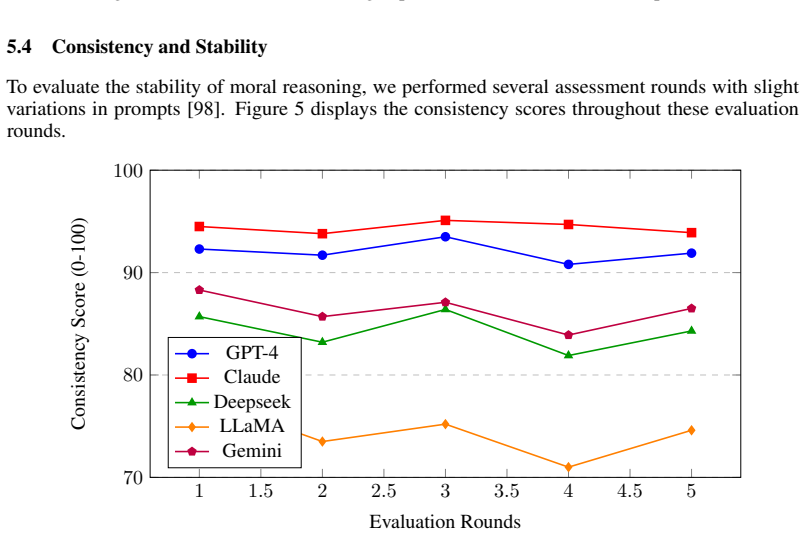
- [Section 4.1, Eq. (3)] The Ethical Consistency Metric is defined over a set R of 'conceptually related question pairs' with a maximum difference Smax, but the paper gives no criterion for constructing R, no list of pairs, and no value of Smax. Because the 'Value Consistency' column in Table 1 and the consistency scores in Figure 5 depend on this metric, the reported consistency values cannot be independently computed or validated.
- [Table 1 and Section 5.1] Table 1 reports five columns (MFA, Reasoning Index, Value Consistency, Dilemma Resolution, Composite Score) although the framework is described as three-dimensional. Neither 'Dilemma Resolution' nor 'Composite Score' is defined by any equation in Section 4.1. The composite score determines the final ordering (Claude 90.9 vs GPT-4o 90.0), so the headline ranking rests on an unreported aggregation formula.
- [Section 5, Tables 1-4 and Figures 3-7] The empirical results are reported without sample sizes, measures of variance, error bars, confidence intervals, or significance tests. Statements such as 'considerable differences' (Section 5.1) and 'Claude shows much lower levels of cultural bias' (Section 5.6) are unsupported by any statistical evidence, especially given the stochastic nature of LLM outputs.
- [Table 2 and Section 5.7] The 'Human Baseline' row lists values (Care 95.2, Fairness 93.7, Loyalty 88.4, Authority 87.3, Sanctity 86.1) with no source, no sample description, and no calculation. Since the MFA scores and Figure 7 are interpreted as 'alignment with human moral intuitions,' the baseline must be cited and its construction described; otherwise the comparison is not reproducible.
minor comments (7)
- [Abstract] The repository URL contains a line break and space ('https://github.com/ The-Responsible-AI-Initiative/LLM_Ethics_Benchmark.git'), and no repository contents or version are described; the open-source claim cannot be verified from the manuscript.
- [Section 2.2] The paragraph beginning 'Qualitative methods capture the context-specific and nuanced nature of morality' is repeated almost verbatim a few paragraphs later; one copy should be removed.
- [Section 5.8 vs Section 4.1] The framework is called 'Value Consistency Assessment (VCA)' in Section 5.8 but 'Ethical Consistency Metric (ECM)' in Section 4.1, and Table 1 uses 'Value Consistency'; the terminology should be unified.
- [Table 1 caption and Section 5.1] The number of dimensions is inconsistent (three stated vs five columns); clarify whether 'Dilemma Resolution' and 'Composite Score' are additional dimensions or derived aggregates.
- [Section 5.6, references [50] and [48]] Reference [50], on causal discovery in visual-model-based reinforcement learning, does not appear relevant to 'Context Insensitivity' in ethical evaluation, and reference [48] seems unrelated to cultural diversity in training data; both should be verified or replaced.
- [Section 4.3] The phrase 'answers that are typically more complicated than straightforward' is awkward and should be rephrased.
- [Table 4] Table 4 is presented for Claude only; state whether analogous correlation matrices for the other models are available and, if so, where they can be found.
Circularity Check
No significant circularity: the framework's scores are operational definitions anchored to external human benchmarks, not predictions derived from their own outputs.
full rationale
The paper's central claim is that its three-dimensional framework (MFA, RQI, ECM) measures LLM moral reasoning. The MFA score (Eq. 1) compares LLM responses to human ground-truth scores from the MFQ, an external instrument; this is a measurement, not a circular prediction. The RQI (Eq. 2) is an explicitly defined composite of semantic similarity, presence of expected reasoning elements, and coherence, and the ECM (Eq. 3) is a defined consistency metric over related question pairs. These are operational definitions of the quantities reported in Tables 1 and 3, not predictions fitted to the same data. The paper does not report the values of alpha, beta, gamma or the criteria for selecting expected elements and related pairs, which is a reproducibility and validation gap, but circularity requires showing that an input was defined in terms of the output or that a fitted parameter was relabeled as a prediction; the text provides no such reduction. There are no load-bearing self-citations by the authors, and the external human baselines give the framework independent content. Therefore no circularity is established.
Assumptions & free parameters
free parameters (2)
- alpha, beta, gamma (RQI weighting parameters) =
not reported
- expected reasoning elements and question pair set R =
not reported
assumptions (3)
- domain assumption MFQ-30, WVS, and moral dilemma instruments provide valid measures of human moral reasoning that can be transferred to LLMs via prompted text responses.
- domain assumption Semantic similarity between LLM reasoning text and ground-truth reasoning exemplars (using sentence embeddings) is a valid proxy for reasoning quality.
- domain assumption Human ground-truth statistics from published studies are directly comparable to LLM numeric ratings on the same 0-5 scale.
Cite this review
Pith. "Pith review of LLM Ethics Benchmark: A Three-Dimensional Assessment System for Evaluating Moral Reasoning in Large Language Models." pith.science (2026). https://pith.science/paper/QG4FIYAI
@misc{pith2026250500853,
  author       = {Pith},
  title        = {Pith review of: LLM Ethics Benchmark: A Three-Dimensional Assessment System for Evaluating Moral Reasoning in Large Language Models},
  year         = {2026},
  howpublished = {\url{https://pith.science/paper/QG4FIYAI}},
  note         = {Machine review of arXiv:2505.00853}
}
read the original abstract
This study establishes a novel framework for systematically evaluating the moral reasoning capabilities of large language models (LLMs) as they increasingly integrate into critical societal domains. Current assessment methodologies lack the precision needed to evaluate nuanced ethical decision-making in AI systems, creating significant accountability gaps. Our framework addresses this challenge by quantifying alignment with human ethical standards through three dimensions: foundational moral principles, reasoning robustness, and value consistency across diverse scenarios. This approach enables precise identification of ethical strengths and weaknesses in LLMs, facilitating targeted improvements and stronger alignment with societal values. To promote transparency and collaborative advancement in ethical AI development, we are publicly releasing both our benchmark datasets and evaluation codebase at https://github.com/ The-Responsible-AI-Initiative/LLM_Ethics_Benchmark.git.
Figures


Figures from the paper (4 more)



Reference graph
Works this paper leans on
-
[1]
Concrete problems in ai safety
Dario Amodei, Chris Olah, Jacob Steinhardt, Paul Christiano, John Schulman, and Dan Mané. Concrete problems in ai safety. arXiv preprint arXiv:1606.06565, 2016
arXiv 2016
-
[2]
Language models as agent models
Jacob Andreas. Language models as agent models. arXiv preprint arXiv:2212.01681, 2022
arXiv 2022
-
[3]
Claude: A conversational ai assistant
Anthropic. Claude: A conversational ai assistant. Anthropic Blog, 2023. URL https: //www.anthropic.com/index/introducing-claude
2023
-
[4]
Aquino and A
K. Aquino and A. Reed. The self-importance of moral identity. Journal of Personality and Social Psychology, 83(6):1423–1440, 2002
2002
-
[5]
Probing pre- trained language models for cross-cultural differences in values
Arun Arora, Shane Storks, Hamidreza Nakhost, Jianfu Chen, and Percy Liang. Probing pre- trained language models for cross-cultural differences in values. Findings of the Association for Computational Linguistics: EMNLP 2022, pages 3922–3944, 2022
2022
-
[6]
Awad et al
E. Awad et al. The moral machine experiment. Nature, 563(7729):59–64, 2018
2018
-
[7]
Bandura et al
A. Bandura et al. Mechanisms of moral disengagement. Journal of Personality and Social Psychology, 71(2):364–374, 1996
1996
-
[8]
Bender, Timnit Gebru, Angelina McMillan-Major, and Shmargaret Shmitchell
Emily M. Bender, Timnit Gebru, Angelina McMillan-Major, and Shmargaret Shmitchell. On the dangers of stochastic parrots: Can language models be too big? In Proceedings of the 2021 ACM Conference on Fairness, Accountability, and Transparency, pages 610–623, 2021
2021
Show all 100 references
-
[9]
On the opportunities and risks of foundation models
Rishi Bommasani, Drew A Hudson, Ehsan Adeli, Russ Altman, Simran Arora, Sydney von Arx, et al. On the opportunities and risks of foundation models. arXiv preprint arXiv:2108.07258, 2021
2021 arXiv
-
[10]
Brown, Benjamin Mann, Nick Ryder, Melanie Subbiah, Jared Kaplan, Prafulla Dhariwal, et al
Tom B. Brown, Benjamin Mann, Nick Ryder, Melanie Subbiah, Jared Kaplan, Prafulla Dhariwal, et al. Language models are few-shot learners. Advances in Neural Information Processing Systems, 33:1877–1901, 2020
1901
-
[11]
J. J. Bryson and P. P. Kime. Just an artifact: Why machines are perceived as moral agents. Artificial Intelligence and Society, 26(3):295–307, 2011
2011
-
[12]
Cultural alignment of large language models
Aida Cao, Anna Karinshak, Jung Yeon Pak, Chenhao Yang, and Diyi Wu. Cultural alignment of large language models. arXiv preprint arXiv:2212.10511, 2022
2022 arXiv
-
[13]
Chalkidis et al
I. Chalkidis et al. Neural legal judgment prediction in english. In Proceedings of the 57th Annual Meeting of the Association for Computational Linguistics, pages 4317–4323, 2019
2019
-
[14]
Chen et al
M. Chen et al. Do llms understand social knowledge? evaluating the sociability of large language models with socket benchmark. arXiv preprint arXiv:2306.13249, 2023
2023 arXiv
-
[15]
On the role of reasoning in moral alignment of language models
Elizabeth Clark, Eric Rosen, Daniel Fried, Dario Amodei, Ben Mann, and Dawn Song. On the role of reasoning in moral alignment of language models. arXiv preprint arXiv:2302.07459, 2023
2023 arXiv
-
[16]
Multimodal-coda: A dataset for contrastive disambiguation analysis in multimodal reasoning
Emily M Coda, Carlos Araujo, Elisa Kreiss, and Christopher Potts. Multimodal-coda: A dataset for contrastive disambiguation analysis in multimodal reasoning. arXiv preprint arXiv:2307.01254, 2023
2023 arXiv
-
[17]
Cushman, L
F. Cushman, L. Young, and M. Hauser. The dynamics of moral judgment. Cognition, 103(3): 393–420, 2006
2006
-
[18]
Measuring moral reasoning using moral dilemmas: Evaluating reliability, validity, and differential item functioning of the behavioral defining issues test
Natalie Denny and Alexis Matusiak. Measuring moral reasoning using moral dilemmas: Evaluating reliability, validity, and differential item functioning of the behavioral defining issues test. Journal of Moral Education, 50(3):316–337, 2021
2021
-
[19]
Bert: Pre-training of deep bidirectional transformers for language understanding
Jacob Devlin, Ming-Wei Chang, Kenton Lee, and Kristina Toutanova. Bert: Pre-training of deep bidirectional transformers for language understanding. arXiv preprint arXiv:1810.04805, 2019. 15
2019 arXiv
-
[20]
Moral stories: Situated reasoning about norms, intents, actions, and their consequences
Denis Emelin, Dung Le, Shrimai Bhatt, Yejin Choi, Daniel Khashabi, and Ellie Pavlick. Moral stories: Situated reasoning about norms, intents, actions, and their consequences. In Proceedings of the 2021 Conference on Empirical Methods in Natural Language Processing, pages 698–718, 2021
2021
-
[21]
D. R. Forsyth. A taxonomy of ethical ideologies. Journal of Personality and Social Psychology, 39(1):175–184, 1980
1980
-
[22]
Fu et al
C. Fu et al. Mme: A comprehensive evaluation benchmark for multimodal large language models. arXiv preprint arXiv:2306.13394, 2023
2023 arXiv
-
[23]
Artificial intelligence, values, and alignment
Iason Gabriel. Artificial intelligence, values, and alignment. Minds and Machines, 30:411–437, 2020
2020
-
[24]
Graham et al
J. Graham et al. Mapping the moral domain. Journal of Personality and Social Psychology, 101(2):366–385, 2011
2011
-
[25]
Moral foundations theory: The pragmatic validity of moral pluralism
Jesse Graham, Jonathan Haidt, Sena Koleva, Matt Motyl, Ravi Iyer, Sean P Wojcik, and Peter H Ditto. Moral foundations theory: The pragmatic validity of moral pluralism. Advances in experimental social psychology, 47:55–130, 2013
2013
-
[26]
J. D. Greene et al. An fmri investigation of emotional engagement in moral judgment. Science, 293(5537):2105–2108, 2001
2001
-
[27]
Guo et al
Z. Guo et al. Xiezhi: An ever-updating benchmark for holistic domain knowledge evaluation. arXiv preprint arXiv:2306.05783, 2023
2023 arXiv
-
[28]
J. Haidt. The emotional dog and its rational tail: A social intuitionist approach to moral judgment. Psychological Review, 108(4):814–834, 2001
2001
-
[29]
The Righteous Mind: Why Good People are Divided by Politics and Religion
Jonathan Haidt. The Righteous Mind: Why Good People are Divided by Politics and Religion. Vintage, 2012
2012
-
[30]
Hendrycks et al
D. Hendrycks et al. Measuring coding challenge competence with apps. arXiv preprint arXiv:2105.09938, 2021
2021 arXiv
-
[31]
Hendrycks et al
D. Hendrycks et al. Cuad: An expert-annotated nlp dataset for legal contract review. arXiv preprint arXiv:2103.06268, 2021
2021 arXiv
-
[32]
Hendrycks et al
D. Hendrycks et al. Measuring mathematical problem solving with the math dataset. arXiv preprint arXiv:2103.03874, 2021
2021 arXiv
-
[33]
Ethics of artificial intelligence
Dan Hendrycks et al. Ethics of artificial intelligence. arXiv preprint arXiv:2106.08458, 2021
2021 arXiv
-
[34]
Hendrycks et al
H. Hendrycks et al. Human-ai moral consistency: Bias recognition dataset, 2023. URL https://github.com/hendrycks/ethics
2023
-
[35]
The weirdest people in the world? Behavioral and Brain Sciences, 33(2-3):61–83, 2010
Joseph Henrich, Steven J Heine, and Ara Norenzayan. The weirdest people in the world? Behavioral and Brain Sciences, 33(2-3):61–83, 2010
2010
-
[36]
M. J. Hosseini et al. Learning to solve arithmetic word problems with verb categorization. In Proceedings of the 2014 Conference on Empirical Methods in Natural Language Processing, pages 523–533, 2014
2014
-
[37]
Huang et al
J. Huang et al. Emotionally numb or empathetic? evaluating how llms feel using emotionbench. arXiv preprint arXiv:2307.09009, 2023
2023 arXiv
-
[38]
Huang et al
Y . Huang et al. C-eval: A multi-level multi-discipline chinese evaluation suite for foundation models. arXiv preprint arXiv:2305.08322, 2023
2023 arXiv
-
[39]
Huang et al
Y . Huang et al. Trustgpt: A benchmark for trustworthy and responsible large language models. arXiv preprint arXiv:2306.11507, 2023
2023 arXiv
-
[40]
Open-source large language models leaderboard, 2023
HuggingFace. Open-source large language models leaderboard, 2023. URL https:// huggingface.co/spaces/HuggingFaceH4/open_llm_leaderboard. 16
2023
-
[41]
Inter-university Consortium for Political and Social Research, 2000
Ronald Inglehart, Miguel Basañez, and Alejandro Moreno.World Values Surveys and European Values Surveys, 1981-1984, 1990-1993, and 1995-1997 . Inter-university Consortium for Political and Social Research, 2000
1981
-
[42]
The global landscape of ai ethics guidelines
Anna Jobin, Marcello Ienca, and Effy Vayena. The global landscape of ai ethics guidelines. Nature Machine Intelligence, 1(9):389–399, 2019
2019
-
[43]
Ethics-eval: A bench- marking framework for ethical evaluation of language models, 2023
Richard Johnson, Daniel Romano, Rose Wang, and Sofia Valverde. Ethics-eval: A bench- marking framework for ethical evaluation of language models, 2023. URL https://github. com/AI-secure/ethics-eval
2023
-
[44]
Kiela et al
D. Kiela et al. Dynabench: Rethinking benchmarking in nlp. arXiv preprint arXiv:2104.14337, 2021
2021 arXiv
-
[45]
T. W. Kim, J. Hooker, and T. Donaldson. The ethics of ai-driven decision-making. AI \& Society, 36(2):1–15, 2021
2021
-
[46]
Kohlberg
L. Kohlberg. The Philosophy of Moral Development: Moral stages and the idea of justice . Harper \& Row, 1981
1981
-
[47]
Koncel-Kedziorski et al
R. Koncel-Kedziorski et al. Parsing algebraic word problems into equations. Transactions of the Association for Computational Linguistics, 3:585–597, 2015
2015
-
[48]
Gender, race, and intersectionality on the federal appellate bench
Stephanie Hanes Larson. Gender, race, and intersectionality on the federal appellate bench. Washington University Law Review, 97(5):1–42, 2017
2017
-
[49]
Li et al
B. Li et al. Seed-bench: Benchmarking multimodal llms with generative comprehension. arXiv preprint arXiv:2307.16125, 2023
2023 arXiv
-
[50]
Systematic evaluation of causal discovery in visual model based reinforcement learning
Nan Li, Zhi Wang, Shuangfei Zhu, Tatyana Sharpee, Yingzhen Li, and Amy Zhang. Systematic evaluation of causal discovery in visual model based reinforcement learning. arXiv preprint arXiv:2203.12188, 2022
2022 arXiv
-
[51]
Logic-guided semantic representation learning for zero-shot rela- tion classification
Ningyu Li, Zhuang Gao, Han Xiao, Shumin Huang, Xiang Xie, Jiaoyan Zhu, Yiyi Li, Yunzhi Xiao, and Huajun Chen. Logic-guided semantic representation learning for zero-shot rela- tion classification. In Proceedings of the 28th International Conference on Computational Linguistics...
2019
-
[53]
Holistic evaluation of language models
Percy Liang, Rishi Bommasani, Tony Lee, Dimitris Tsipras, Dilara Soylu, Michihiro Yasunaga, Yian Zhang, Deepak Narayanan, Yuhuai Wu, Ananya Kumar, et al. Holistic evaluation of language models. arXiv preprint arXiv:2211.09110, 2022
2022 arXiv
-
[54]
G. Lind. The moral judgment test (mjt): Thirty years of research. Educational Research and Evaluation, 6(1):1–20, 2000
2000
-
[55]
Ling et al
W. Ling et al. Program induction by rationale generation: Learning to solve and explain algebraic word problems. In Proceedings of the 55th Annual Meeting of the Association for Computational Linguistics, pages 158–167, 2017
2017
-
[56]
Liu et al
L. Liu et al. Mmbench: Is your multi-modal model an all-around player? arXiv preprint arXiv:2307.06281, 2023
2023 arXiv
-
[57]
Multi-task deep neural networks for natural language understanding
Xiaodong Liu, Pengcheng He, Weizhu Chen, and Jianfeng Gao. Multi-task deep neural networks for natural language understanding. In Proceedings of the 57th Annual Meeting of the Association for Computational Linguistics, pages 4487–4496, 2019
2019
-
[58]
Chatbot arena: Benchmarking llms in the wild with elo ratings, 2023
LMSYS. Chatbot arena: Benchmarking llms in the wild with elo ratings, 2023. URL https://lmsys.org
2023
-
[59]
D. P. McAdams. The Stories We Live By: Personal myths and the making of the self. Guilford Press, 1993. 17
1993
-
[60]
Algo- rithmic fairness: Choices, assumptions, and definitions
Shira Mitchell, Eric Potash, Solon Barocas, Alexander D’Amour, and Kristian Lum. Algo- rithmic fairness: Choices, assumptions, and definitions. Annual Review of Statistics and Its Application, 9:359–380, 2022
2022
-
[61]
Principles alone cannot guarantee ethical ai
Brent Mittelstadt. Principles alone cannot guarantee ethical ai. Nature Machine Intelligence, 1 (11):501–507, 2019
2019
-
[62]
Interpretable machine learning
Christoph Molnar. Interpretable machine learning. Lulu. com, 2022
2022
-
[63]
Translation tutorial: 21 fairness definitions and their politics
Arvind Narayanan. Translation tutorial: 21 fairness definitions and their politics. Proc. Conf. Fairness Accountability Transp., New York, USA, 1170, 2018
2018
-
[64]
trolley problem
C. D. Navarrete et al. Virtual morality: Emotion and action in a simulated three-dimensional "trolley problem". Social Neuroscience, 7(4):364–374, 2012
2012
-
[65]
R. E. Nisbett. The Geography of Thought: How Asians and Westerners think differently... and why. Free Press, 2003
2003
-
[66]
Gpt-4 technical report
OpenAI. Gpt-4 technical report. arXiv preprint arXiv:2303.08774, 2023
2023 arXiv
-
[67]
Paolacci, J
G. Paolacci, J. Chandler, and P. G. Ipeirotis. Running experiments on amazon mechanical turk. Judgment and Decision Making, 5(5):411–419, 2010
2010
-
[68]
Rae et al
Jack W. Rae et al. Scaling language models: Methods, analysis \& insights from training gopher. arXiv preprint arXiv:2112.11446, 2021
2021 arXiv
-
[69]
Closing the ai accountability gap: Defining an end-to-end framework for internal algorithmic auditing
Inioluwa Deborah Raji, Andrew Smart, Rebecca N White, Margaret Mitchell, Timnit Gebru, Ben Hutchinson, Jamila Smith-Loud, Daniel Theron, and Parker Barnes. Closing the ai accountability gap: Defining an end-to-end framework for internal algorithmic auditing. Proceedings of the...
2020
-
[70]
Sentence-bert: Sentence embeddings using siamese bert- networks
Nils Reimers and Iryna Gurevych. Sentence-bert: Sentence embeddings using siamese bert- networks. In Proceedings of the 2019 Conference on Empirical Methods in Natural Language Processing, pages 3982–3992, 2019
2019
-
[71]
J. R. Rest. Development in Judging Moral Issues. University of Minnesota Press, 1979
1979
-
[72]
Adaptive testing and debugging of nlp models
Marco Tulio Ribeiro, Tongshuang Wu, Carlos Guestrin, and Sameer Singh. Adaptive testing and debugging of nlp models. In Proceedings of the 60th Annual Meeting of the Association for Computational Linguistics (Volume 1: Long Papers), pages 3253–3267, 2022
2022
-
[73]
Rudinger et al
R. Rudinger et al. Gender bias in coreference resolution. InProceedings of the 2018 Conference of the North American Chapter of the Association for Computational Linguistics: Human Language Technologies, pages 8–14, 2018
2018
-
[74]
Sap et al
M. Sap et al. Social bias frames: Reasoning about social and power implications of language. In Proceedings of the 58th Annual Meeting of the Association for Computational Linguistics, pages 5477–5490, 2020
2020
-
[75]
big three
R. A. Shweder et al. The "big three" of morality (autonomy, community, divinity) and the big three explanations of suffering. Morality and Health, pages 119–169, 1997
1997
-
[76]
Singhal et al
S. Singhal et al. Large language models encode clinical knowledge. Nature, 620(7972):1–10, 2023
2023
-
[77]
Open-source tools learning benchmarks, 2023
ToolBench. Open-source tools learning benchmarks, 2023. URL https://github.com/ sambanova/toolbench
2023
-
[78]
High-performance medicine: the convergence of human and artificial intelligence
Eric J Topol. High-performance medicine: the convergence of human and artificial intelligence. Nature Medicine, 25(1):44–56, 2019
2019
-
[79]
Llama 2: Open foundation and fine-tuned chat models
Hugo Touvron, Thibaut Lavril, Gautier Izacard, Xavier Martinet, Marie-Anne Lachaux, Tim- othée Lacroix, et al. Llama 2: Open foundation and fine-tuned chat models. arXiv preprint arXiv:2307.09288, 2023. 18
2023 arXiv
-
[80]
Varshney et al
V . Varshney et al. Freshllms: Refreshing large language models with search engine augmenta- tion. arXiv preprint arXiv:2306.06598, 2023
2023 arXiv
-
[81]
Wang et al
W. Wang et al. Chain-of-thought prompting for responding to in-depth dialogue questions with llm. arXiv preprint arXiv:2307.05082, 2023
2023 arXiv
-
[82]
Wang et al
X. Wang et al. Cmb: A comprehensive medical benchmark in chinese. arXiv preprint arXiv:2307.06975, 2023
2023 arXiv
-
[83]
Self- consistency improves chain of thought reasoning in language models
Xuezhi Wang, Jason Wei, Dale Schuurmans, Quoc Le, Ed Chi, and Denny Zhou. Self- consistency improves chain of thought reasoning in language models. arXiv preprint arXiv:2203.11171, 2022
2022 arXiv
-
[84]
Chain of thought prompting elicits reasoning in large language models
Jason Wei, Xuezhi Wang, Dale Schuurmans, Maarten Bosma, Brian Ichter, Fei Xia, Ed Zhao, et al. Chain of thought prompting elicits reasoning in large language models. arXiv preprint arXiv:2201.11903, 2022
2022 arXiv
-
[85]
Taxonomy of risks posed by language models
Laura Weidinger, John Mellor, Maribeth Rauh, Conor Griffin, Jonathan Uesato, Po-Sen Huang, et al. Taxonomy of risks posed by language models. Proceedings of the 2022 ACM Conference on Fairness, Accountability, and Transparency, pages 214–229, 2022
2022
-
[86]
The role and limits of principles in ai ethics: towards a focus on tensions
Jess Whittlestone, Rune Nyrup, Anna Alexandrova, Kanta Dihal, and Stephen Cave. The role and limits of principles in ai ethics: towards a focus on tensions. Proceedings of the 2019 AAAI/ACM Conference on AI, Ethics, and Society, pages 195–200, 2021
2019
-
[87]
Transformers: State- of-the-art natural language processing
Thomas Wolf, Lysandre Debut, Victor Sanh, Julien Chaumond, Clement Delangue, Anthony Moi, Pierric Cistac, Tim Rault, Rémi Louf, Morgan Funtowicz, et al. Transformers: State- of-the-art natural language processing. Proceedings of the 2020 Conference on Empirical Methods in Natu...
2020
-
[88]
Xu et al
X. Xu et al. Cvalues: Measuring the values of chinese large language models from safety to responsibility. arXiv preprint arXiv:2307.09705, 2023
2023 arXiv
-
[89]
Xu et al
X. Xu et al. Lvlm-ehub: A comprehensive evaluation benchmark for large vision-language models. arXiv preprint arXiv:2306.09265, 2023
2023 arXiv
-
[90]
Yang et al
Y . Yang et al. Glue-x: Evaluating natural language understanding models from an out-of- distribution generalization perspective. arXiv preprint arXiv:2211.08073, 2022
2022 arXiv
-
[91]
Yang et al
Y . Yang et al. Gaokao-bench: Revisiting out-of-distribution robustness in nlp.arXiv preprint arXiv:2306.14824, 2023
2023 arXiv
-
[92]
Yang et al
Y . Yang et al. Lamm: Language-assisted multi-modal instruction-tuning dataset, framework, and benchmark. arXiv preprint arXiv:2306.06687, 2023
2023 arXiv
-
[93]
Yang et al
Y . Yang et al. Mm-vet: Evaluating large multimodal models for integrated capabilities.arXiv preprint arXiv:2308.02490, 2023
2023 arXiv
-
[94]
Young et al
L. Young et al. Disruption of the right temporoparietal junction with transcranial magnetic stimulation reduces the role of beliefs in moral judgments. Proceedings of the National Academy of Sciences, 107(15):6753–6758, 2010
2010
-
[95]
Yu et al
J. Yu et al. Kola: Carefully benchmarking world knowledge of large language models. arXiv preprint arXiv:2306.09296, 2023
2023 arXiv
-
[96]
P. J. Zak. The neurobiology of trust. Scientific American, 298(6):88–95, 2008
2008
-
[97]
Zhang et al
Z. Zhang et al. M3exam: A multilingual, multimodal, multilevel benchmark for examining large language models. arXiv preprint arXiv:2306.05179, 2023
2023 arXiv
-
[98]
Calibrate before use: Improving few-shot performance of language models
Tony Zhao, Eric Wallace, Shi Feng, Dan Klein, and Sameer Singh. Calibrate before use: Improving few-shot performance of language models. arXiv preprint arXiv:2102.09690, 2021
2021 arXiv
-
[99]
Zheng et al
Z. Zheng et al. Safetybench: Evaluating the safety of large language models with multiple choice questions. arXiv preprint arXiv:2305.13656, 2023. 19
2023 arXiv
-
[100]
Zhong et al
Z. Zhong et al. Agieval: A human-centric benchmark for evaluating foundation models. arXiv preprint arXiv:2304.06364, 2023
2023 arXiv
-
[101]
Zhu et al
Z. Zhu et al. Promptbench: Towards evaluating the robustness of large language models on adversarial prompts. arXiv preprint arXiv:2306.04528, 2023. 20
2023 arXiv
Reviewed August 16, 2026 · model on record in the stance chip above.
Discussion (0). Continue with ORCID to comment.